Showing posts with label Hercules. Show all posts

Friday, June 11, 2021

The Painters of Pompeii: Roman Frescoes from the National Archaeological Museum, Naples

The Painters of Pompeii: Roman Frescoes from the National Archaeological Museum, Naples will open June 26, 2021 at the Oklahoma City Museum of Art.  It will be on display until October 17, 2021. Tickets will be available on a timed entry basis with limited capacity to ensure adequate social distancing.  Although masks are encouraged, they are not required for fully vaccinated visitors.  Eighty artifacts and artworks from Pompeii and Herculaneum will be presented.

During the exhibition, the museum plans to host a series of lectures in the Noble Theater with several of the most renowned scholars in the field of Ancient Roman Art and History.  Topics include the rediscovery of Pompeii, Food & Wine in Pompeii, Roman Painting, and Powerful Elite Women in Imperial Rome.

The exhibit notice says its appearance at the Oklahoma City Museum of Art will be its only US presentation.


Image: Polyphemus hears of the arrival of Galatea (or Hercules and Omphale), ancient Roman fresco from a villa in Portici painted in the "Fourth Style" (45–79 CE) courtesy of the NAM Naples. 

If you enjoyed this post, never miss out on future posts by following me by email!


Wednesday, June 2, 2021

Heracles (Hercules) and the Lernaean Hydra

The Lernaean Hydra or Hydra of Lerna more often known simply as the Hydra, is a serpentine water monster in Greek and Roman mythology. Its lair was the lake of Lerna in the Argolid. Lerna was reputed to be an entrance to the Underworld, and archaeology has established it as a sacred site older than Mycenaean Argos. In the canonical Hydra myth, the monster is killed by Heracles (Hercules) as the second of his Twelve Labors.

The oldest extant Hydra narrative appears in Hesiod's Theogony, while the oldest images of the monster are found on a pair of bronze fibulae dating to c. 700 BCE. In both these sources, the main motifs of the Hydra myth are already present: a multi-headed serpent that is slain by Heracles and Iolaus. While these fibulae portray a six-headed Hydra, its number of heads was first fixed in writing by Alcaeus (c. 600 BCE), who gave it nine heads. Simonides, writing a century later, increased the number to fifty, while Euripides, Virgil, and others did not give an exact figure.

Like the initial number of heads, the monster's capacity to regenerate lost heads varies with time and author. The first mention of this ability of the Hydra occurs with Euripides, where the monster grew back a pair of heads for each one severed by Heracles. In the Euthydemus of Plato, Socrates likens Euthydemus and his brother Dionysidorus to a Hydra of a sophistical nature who grows two arguments for every one refuted. Palaephatus, Ovid, and Diodorus Siculus concur with Euripides, while Servius has the Hydra grow back three heads each time. Depictions of the monster dating to c. 500 BCE show it with a double tail as well as multiple heads, suggesting the same regenerative ability at work, but no literary accounts include this feature.  The Hydra had many parallels in ancient Near Eastern religions. In particular, Sumerian, Babylonian, and Assyrian mythology celebrated the deeds of the war and hunting god Ninurta that included slaying a a seven-headed serpent.

Several versions of Heracles struggle with the hydra existed.  In one, Heracles, seeing the creature merely grew more heads when he decapitated it, asked his nephew Iolaus for help. His nephew then came upon the idea (possibly inspired by Athena) of using a firebrand to scorch the neck stumps after each decapitation.  In an alternate version, Heracles dipped his sword in the Hydra's blood and used its own venom to burn subsequent stumps and prevent their regrowth.

The victorious Heracles then dipped his arrows in the Hydra's poisonous blood and used them to kill the Stymphalian Birds, the giant Geryon, and, unfortunately, the centaur Nessus. Nessus' tainted blood was applied to the Tunic of Nessus, by which the centaur had his posthumous revenge against Heracles. Both Strabo and Pausanias report that the stench of the river Anigrus in Elis, making all the fish of the river inedible, was reputed to be due to the Hydra's poison, washed from the arrows Heracles used on the centaur.

Hercules slaying the Hydra, Roman copy of 4th century BCE original by Lysippos, restored by Algardi, that I photographed at the Capitoline Museum in Rome.

Relief of Hercules slaying the Hydra, end of 3rd century CE, from the Roman Villa of Chiragan, Musée des Antiques de Toulouse, courtesy of Carole Raddato. (CC BY)

Detail of Relief of Hercules slaying the Hydra, end of 3rd century CE, from the Roman Villa of Chiragan, Musée des Antiques de Toulouse, courtesy of Wikimedia Commons contributor Caroline Léna Becker.

Relief depicting Heracles battling the Hydra at the base of the facade of Colleoni Chapel, by Giovanni Antonio Amadeo courtesy of Wikimedia Commons contributor Sailko.

Sarcophagus Relief Depicting Labors of Hercules (Heracles), 3rd-4th century C.E., marble, Roman, Honolulu Academy of Arts, courtesy of Wikimedia Commons contributor Haa900.

Etruscan black-figure hydria depicting Herakles and Iolaos fighting the Lernean Hydra (c. 346 BCE) from Caere now on display at the Getty Villa courtesy of Wikimedia Commons contributor Wolfgang Sauber

Fragment of a red-figure vase depicting Heracles battling the Hydra with Athena offering support, 375-340 BCE, on exhibit at the Fitchburg Art Museum, Fitchburg, Massachusetts, courtesy of Wikimedia Commons contributor Daderot.

Archaic-styled Heracles, Iolaus and the Lernaean Hydra. Side A of an Attic black-figured amphora, 560–555 BCE, now in the collections of The Louvre, Paris, courtesy of Wikimedia Commons contributor Bibi Saint-Pol.

Corinthian Aryballos, Greek, 6th century BCE, from Corinth, Terracotta, now on view at the Getty Villa, Gallery 104, courtesy of the museum. On this intricately detailed Corinthian black-figure aryballos (oil-flask), Herakles battles the Lernean Hydra, a many-headed, serpent-like monster. Required to destroy the fierce creature as the second of the Twelve Labors assigned to him by King Eurystheus, the hero grasps one of the snaky heads while stabbing the monster with his sword. One of the Hydra’s heads is about to bite Herakles’ shoulder, and a crab, sent to help the Hydra, approaches the hero’s ankle from behind. The goddess Athena stands behind him, offering her support. Both Herakles and Athena are identified by inscriptions written in retrograde, or right to left, in the distinctive Doric alphabet of Corinth. Likewise, inscriptions on the other side of the vase identify Iolaos, Herakles’ nephew and faithful companion, and Iphikles (written as Wiphikledas), Herakles’ twin brother. One figure holds the Hydra, while the other (under the handle of the vase) is shown as a charioteer, head turned back to face the action while keeping the four-horse chariot ready to carry off the victorious hero. An unidentified female head facing left decorates the handle itself

1843 reproduction of Heracles and Iolaus battling the Hydra from a red-figure vase by Eduard Gerhard courtesy of Wikimedia Commons contributor Angyalfia.

Renaissance-era plaque depicting Heracles battling the Hydra, 16th century CE, courtesy of Wikimedia Commons contributor Sailko

Athena supports Heracles who is attacked by the crab and the Lenaean Hydra. White-ground Attic lekythos, ca. 500–475 BCE now in the collections of The Louvre, Paris courtesy of Wikimedia Commons contributor Bibi Saint-Pol.

Mosaic from Roman Spain, 26 CE, depicting Heracles battling the Hydra courtesy of Wikimedia Commons contributor Luis Garcia.

Hercules and the Hydra, 1785 etching by Raphael West, in the collection of the Royal Academy of Arts, London, courtesy of the museum.

Fragmented vase with applique depicting Hercules battling the Hydra, discovered at Saint-Colombe, 2nd - 3rd century CE, now in the collections of the Gallo-Roman Museum of Fourvière in Lyon, France courtesy of Wikimedia Commons contributor Eunostos


If you enjoyed this post, never miss out on future posts by following me by email!


Friday, April 30, 2021

Bust of a Boy or Eros with the Attributes of Herakles, 150-100 BCE, Roman Period Greece

This thinly-cast bust depicts a youth wearing a lion-skin over his head and a quiver strap across the chest. The figure has delicate features and fine hair that is drawn up in a braid with tendrils falling onto his forehead. The figure may depict a young Herakles, or an unidentifiable youth in the guise of the great hero. A third possibility is that this young man is Eros, who was often depicted with attributes associated with Herakles. Two small holes at the bottom edge may have been used to attach this bust to a piece of furniture. 

While in wealthy households beds were used for sleeping in the bedrooms (lectus cubicularis), and couches for banqueting while reclining were used in the dining rooms (lectus tricliniaris), the less well off might use the same piece of furniture for both functions. The two types might be used interchangeably even in richer households, and it is not always easy to differentiate between sleeping and dining furniture. The most common type of Roman bed took the form of a three-sided, open rectangular box, with the fourth (long) side of the bed open for access. While some beds were framed with boards, others had slanted structures at the ends, called fulcra, to better accommodate pillows. The fulcra of elaborate dining couches often had sumptuous decorative attachments featuring ivory, bronze, copper, gold, or silver ornamentation.


Bust of a Boy with the Attributes of Herakles, 150-100 BCE, Greek, now part of the collections of the J. Paul Getty Museum on view at the Getty Villa in Pacific Palisades, California.  Image courtesy of Bruce White Photography.

If you enjoyed this post, never miss out on future posts by following me by email!


Monday, March 15, 2021

Hercules and the Cretan Bull

According to Jeremy McInerney, the iconography of the bull permeates Minoan culture. The cult of the bull was also prominent in southwestern Anatolia. Bernard Clive Dietrich notes that the most important animal in the Neolithic shrines at Çatalhöyük was the bull. The bull was a chthonic animal associated with fertility and vegetation. It figured in cave cults connected with rites for the dead.  

According to Greek myth, to confirm his right to rule, King Minos of Crete prayed to Poseidon to send him a snow-white bull as a sign. Poseidon sent Minos the bull, with the understanding that bull would be sacrificed to the god. Deciding that Poseidon's bull was too fine of a specimen to kill, Minos sent the bull to his herds and substituted another, inferior bull for sacrifice. Enraged, Poseidon had Aphrodite cause Pasiphaë, wife of Minos, to fall in love with the bull. She subsequently gave birth to the half-man, half-bull, Minotaur. Poseidon passed on his rage to the bull, causing him lay waste to the land.

As his seventh labor, Heracles was sent to capture the bull by Eurystheus.  Heracles sailed to Crete and King Minos gave Heracles permission to take the bull away as he had been wreaking havoc on Crete by uprooting crops and leveling orchard walls. Heracles captured the bull, and then shipped him to Eurystheus in Tiryns. The bull later broke loose and wandered into Marathon, becoming known as the "Marathonian Bull" who was later captured and sacrificed by Theseus.

McInerney observes that the story of Pasiphaë and the Cretan Bull was not written until after Crete had come under Greek control, however, and despite the fact that the palace at Knossos displays a number of murals depicting young men and women vaulting over a bull, scholars are divided as to whether or not this reflects an actual practice.  There is also no recorded evidence that has been recovered there of any Minoan legend of the famous Cretan Bull or the Minotaur either.


Hercules and the Cretan Bull at Schwerin Castle, Germany courtesy of Wikimedia Commons contributor Jens Burkhardt-Plückhahn


Heracles fighting the Cretan bull, while a siren perches on a branch. Laconian black-figure kylix in the manner of the Arkesilas Painter, ca. 550 BCE at the Metropolitan Museum of Art, New York, courtesy of Wikimedia Commons contributor ClaireH. (glare removed)


Ivory figure of Hercules capturing the Cretan bull, probably used to decorate a piece of furniture or a box, Roman 1st century CE, ivory, courtesy of the British Museum


Detail of the Mosaic with the Labors of Hercules (Seventh Labour: Cretan Bull), 3rd century AD, found in Llíria (Valencia), National Archaeological Museum of Spain, Madrid courtesy of Wikimedia Commons contributor Carole Raddatto


Heracles and the Cretan Bull - a metope from the Temple of Zeus at Olympia, in the Archaeological Museum of Olympia, Greece courtesy of Wikimedia Commons contributor Nicholas Hartmann


Detail of a Roman sarcophagus from Perge, Turkey depicting the capture of the Cretan Bull, 2nd century CE (?) courtesy of Wikimedia Commons contributor Mourad Ben Abdallah


Heracles binds the Cretan bull. Attic black-figure amphora in the manner of the Antimenes Painter, ca. 510 BCE From Vulci, Italy at the Staatliche Antikensammlungen in Munich, Germany courtesy of Wikimedia Commons contributor Bibi Saint-Pol.


Architectural terracotta plaque (so-called Campana plaque) representing Hercules capturing the Cretan bull, 1st half of the 1st century CE, discovered in 1828 in Quadraro (Roma Vecchia), Gregorian Etruscan Museum, Vatican City, courtesy of Wikimedia Commons contributor Jean-Pol Grandmont


If you enjoyed this post, never miss out on future posts by following me by email!


Thursday, February 18, 2021

Tales of Telephus

In Greek mythology, Telephus (also Telephos - meaning "far-shining") was the son of Auge, a priestess of Athena who was raped by Heracles.  When her father, King Aleus of Tegea learned of her violation, he attempted to dispose of mother and child. But they ended up in Asia Minor at the court of Teuthras, king of Mysia, where Telephus was adopted as the childless king's heir.

How mother and son ended up in Asia Minor is explained in a variety of versions. In the oldest extant account from a fragment of Hesiod's "Catalogue of Women, 6th century BCE, Auge goes to Mysia, is raised as a daughter by Teuthras, raped by Heracles when he arrives seeking the horses of Laomedon, and Telephus is born there. In some accounts Telephus arrives in Mysia as an infant with his mother, where Teuthras marries Auge, and adopts Telephus. In still another tale, while Auge (in various ways) is delivered to the Mysian court where she again becomes wife to the king, Telephus is instead left behind in Arcadia, having been abandoned on Mount Parthenion, either by Aleus, or by Auge when she gave birth while being taken to the sea by Nauplius to be drowned. However Telephus is suckled by a deer found and raised by King Corythus, or his herdsmen. Seeking knowledge of his mother, Telephus consulted the Delphic oracle which directed him to Mysia, where he was reunited with Auge and adopted by Teuthras.

It is this last version that found favor with Romans in Herculaneum where a fresco depicting Heracles finding Telephus suckled by a deer, with Arkadia, Pan and a winged Virgo looking on was recovered from the Augusteum and is now at the National Archaeological Museum in Naples.

Various plays were centered on the birth of Telephus including a tragedy by Sophocles entitled "Aleadae" (Sons of Aleus) and a play by Euripedes named "Auge," both of which only fragments survive. In Sophocles' play as recounted by 4th century BCE orator Alcidamas, Auge's father Aleus had been warned by the Delphic oracle that if Auge had a son, then this grandson would kill Aleus' sons, so Aleus made Auge a priestess of Athena, telling her she must remain a virgin, on pain of death. But Heracles passing through Tegea, being entertained by Aleus in the temple of Athena, became enamored of Auge and while drunk had sex with her. Aleus discovered that Auge was pregnant and gave her to Nauplius to be drowned. But, on the way to the sea, Auge gave birth to Telephus on Mount Parthenion, and according to Alcidamas, Nauplius, ignoring his orders, sold mother and child to the childless Mysian king Teuthras, who married Auge and adopted Telephus, and "later gave him to Priam to be educated at Troy".  Alcidamas' version of the story must have diverged from Sophocles in at least this last respect, though. For, rather than the infant Telephus being sold to Teuthras, as in Alcidamas, an Aleadae fragment seems to infer that in the Sophoclean play, the new-born Telephus was instead abandoned (on Mount Parthenion?), where he is suckled by a deer. 

It is Sophocles that includes the connection to Troy where, eventually, Telephus, was reportedly wounded by the Greek hero Achilles during the Greeks' first offensive against Troy. 

"The Delphic oracle told Telephos that he could be healed only by the offending weapon. In an attempt to secure Achilles' help, he sought out Orestes, the young son of Agamemnon, and threatened to kill him. Achilles finally heeded Telephos' entreaties and furnished scrapings of his spear that healed the festering wound. - Metropolitan Museum of Art

Representations of various events of the Telephus myth have been depicted on red-figure pottery from as early as 510 BCE and east-Ionian engraved gems from about 480 BCE. As at Herculaneum, scenes showing Telephus suckled by a deer or holding Orestes hostage were particularly popular. Roman depictions of Telephus suckled by a deer were popular through the 3rd century CE.

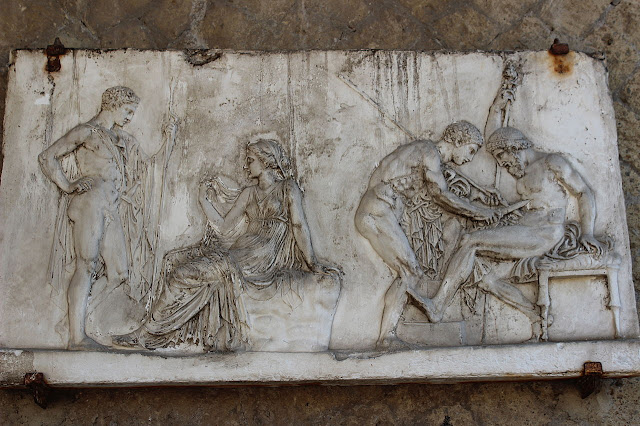
Other scenes include either his wounding or his healing by Achilles. In the House of the Relief of Telephus, also from Herculaneum, we see a seated Telephus being healed by Achilles who scrapes rust from his spear on the festered wound.

The most complete single account of the life of Telephus is depicted in the first-century BCE Telephus frieze, a decorative relief from the Pergamon Altar produced between 180 and 156 BCE now reconstructed in the Pergamon Museum in Berlin.  

Fresco from the Augusteum in Herculaneum depicting Heracles finding Telephus suckled by a deer, now in the National Archaeological Museum in Naples.

Marble statue of Hercules holding baby Telephus in his arms. Ancient Roman copy from a Greek original of 4th century BCE. Found in the 16th century in Campo de’ Fiori in Rome, courtesy of Wikimedia Commons contributor Jean-Pol Grandmont.

Heracles with the infant Telephus and deer, Roman, mid second century CE at The Louvre, courtesy of Wikimedia Commons contributor Marie-Lan Nguyen.


Roman relief from the House of the Relief of Telephus depicting Achilles (right) scraping rust from his spear on the wound of the seated Telephus, c. first century BCE, now in the National Archaeological Museum in Naples, courtesy of Wikimedia Commons contributor Miguel Hermoso Cuesta


Terracotta lekythos (oil flask), with raised relief depicting Clytemnestra pleading with Telephos for the life of her child Orestes, Greek, late 4th century BCE at the Metropolitan Museum of Art

Telephus threatens the infant Orestes, at Agamemnon's altar. Telephus frieze (panel 42), second century BCE from the Pergamon Altar now in Berlin at the Antikensammlung , courtesy of Wikimedia Commons contributor Marcus Cyron.


If you enjoyed this post, never miss out on future posts by following me by email!


Wednesday, September 23, 2020

The ancient city of Tiryns in history and myth

 Tiryns is the site of a Mycenaean palace and city where the hero Heracles is thought to have resided while he performed his twelve labors.  Although it originated before the Bronze Age, it reached its height between 1400 and 1200 BCE and was considered one of the most important centers of the Mycenaean world, especially in Argolis.  Tiryns is first referenced by Homer, who praised its massive walls. Ancient tradition held that the walls were built by the Cyclopes because only giants of superhuman strength could have lifted the enormous stones.  Tradition also associates the walls with Proetus, the sibling of Acrisius, king of Argos. According to the legend Proetus, pursued by his brother, fled to Lycia. With the help of the Lycians, he managed to return to Argolis. There, Proetus occupied Tiryns and fortified it with the assistance of the cyclopes.

The city's  acropolis was constructed in three phases, the first at the end of the Late Helladic II period (1500–1400 BCE), the second in Late Helladic III (1400–1300 BCE), and the third at the end of the Late Helladic III B (1300–1200 BCE).  The palace of the king inside the citadel was similar in construction to that of Mycenae. The walls were decorated with alabaster slabs along the lower zones with rosettes and flowers in relief with frescoes embellishing the upper zones. Mycenaean frescoes were similar in style to those of Minoan Crete and depicted religious ceremonies, processions, hunters, and warriors.

Tiryns was affected by the social collapse at the end of the Bronze Age but survived and was inhabited continuously until the middle of the 8th century BCE. Then in the 5th century BCE, when Cleomenes I of Sparta defeated the Argives, their slaves occupied Tiryns, according to Herodotus.  The Argives eventually avenged their defeat, though, in 468 BCE when they  completely destroyed both Mycenae and Tiryns, and, according to Pausanias, transferred the residents to Argos.

Tiryns was one of the sites excavated by Heinrich Schliemann in 1884-1885. Schliemann initially thought the ruins were medieval and almost destroyed them to excavate deeper seeking Mycenaean treasures.  Excavations continue today under the  direction of the German Archaeological Institute at Athens and the University of Heidelberg. 

Watercolor of a fresco depicting a Mycenaean hunt scene from the palace of Tiryns, Greece at the Royal Ontario Museum in Toronto, Canada courtesy of the museum (enlarged with AI software).

Fragment of a fresco depicting a female figure participating in a procession, carrying offerings to the goddess. Her elegant head is shown in profile, while her body is shown frontally. She is holding a lily in her hand as an offering to the goddess at the National Archaeological Museum in Athens courtesy of Wikimedia Commons contributor Marsyas

Tiryns wall-painting fragments with a representation of a procession of women bearing offerings, from the later Tiryns palace, 14-13th century BCE, National Archaeological Museum of Athens courtesy of Carole Raddato.

Tiryns wall-painting fragments with a representation of wild-boar hunt, from the later Tiryns palace, 14-13th century BCE, National Archaeological Museum of Athens courtesy of Carole Raddato.
If you enjoyed this post, never miss out on future posts by following me by email!


Wednesday, July 1, 2020

Herms of Herakles

This type of bronze pillar herm of Herakles wrapped in a lion skin  and wearing an ivy wreath, found in the sea off the coast of Halikarnassos, was often used as a boundary marker for gymnasia and palaestrae (exercise yards).  Marble examples have been found on the island of Delos.  Similar reliefs of Herakles have also been found  in east Greece on Hellenistic graves.

I photographed this herm on my last visit to the British Museum in 2016.  It is dated between 200-100 BCE.

Bronze herm of Herakles Greek 200-100 BCE Halikarnassos.  Photographed at
The British Museum in London.

If you enjoyed this post, never miss out on future posts by following me by email!


Saturday, June 13, 2020

Philoctetes and Compassion for Hercules on the Pyre

According to the most common legend of Hercules' death, no one but Hercules' friend Philoctetes,  son of King Poeas of the city of Meliboea in Thessaly, would light his funeral pyre. For his compassion, Philoctetes  received Hercules' bow and arrows.

Later, Philoctetes as one of the many eligible Greeks who competed for the hand of Helen, the Spartan princess, was required to participate in the Trojan War to reclaim Helen for Menelaus when she was stolen away by Paris.  On his way to the Trojan War, Philoctetes was bitten by a snake that Hera sent to molest him as punishment for his service to Hercules. The wound festered and began to smell so his Greek companions stranded Philoctetes on the island of Lemnos. 

When the Greeks reached Troy, Helenus, the prophetic son of King Priam, revealed under torture that one of the conditions for the Greeks to win the war was that they needed the bow and arrows of Hercules as some of the arrows were those dipped in the poison blood of the hydra. So Odysseus led a group back to Lemnos to retrieve Hercules' weapons and discovered Philoctetes was still alive. Odysseus tricked the weaponry away from Philoctetes, but Diomedes refused to take the weapons without the man. A deified Hercules came down from Olympus and told Philoctetes to go with them and he would be healed by the son of Asclepius and win great honor as a hero of the Achaean army. In some versions of the legend, Philoctetes is the archer, using Hercules bow and poisoned arrows, that ultimately killed Paris.


Image: Hercules on the Pyre by Guillaume Coustou the Elder, 1704, The Louvre, courtesy of Wikimedia Commons contributor Marie-Lan Nguyen (2006)

If you enjoyed this post, never miss out on future posts by following me by email!


Monday, June 1, 2020

Giambologna brings Heracles to Life

Yesterday, I featured the beautiful sculpture, "Kidnapping of the Sabine Women" by Giambologna displayed at the Loggia Dei Lanzi in Florence, Italy. Another spectacular work of Giambologna displayed there as well portrays the battle between Heracles and the centaur Nessus.

Nessus was a famous centaur who carried off Deianeira, the wife of Heracles, and tried to force himself on her.  Heracles saw him from across the river and shot a Hydra-poisoned arrow into Nessus's breast. As he lay dying, in a final act of malice, Nessus told Deianeira that his blood would ensure that Heracles would be true to her forever, knowing the blood to be infected with the hydra's poison. 

Sometime later, Deianeira's trust in Heracles began to wane because of his unrequited love for Iole, the daughter of King Eurytus of Oechalia. Heracles had been forbidden to marry Iole because her father, the king, feared she would meet the same fate as Heracles' first wife, Megara, who, along with their children, was murdered by Heracles when the jealous goddess Hera sent Heracles into a fit of madness.  So Heracles, denied Iole,  had married Deianeira instead and Deianeira was painfully aware of being second choice.

Heracles planned to attend a gathering of heroes, and Deianiera feared his passion would get the better of him. So, to bind Heracles to her, Deianeira, remembering what Nessus had said about his blood, spread the centaur's blood on a robe and gave it to her husband. After Heracles left for the gathering, Deianeira accidentally spilled a portion of the centaur's blood onto the floor. To her horror, it began to fume by the light of the rising sun. She instantly recognized it as poison and sent her messenger to warn Heracles but it was too late. Heracles lay dying slowly and painfully as the robe burned his skin.

Images: Hercules (Heracles) and Nessus, 1599, by Giambologna photographed at the Loggia dei Lanzi in Florence, Italy.

Hercules (Heracles) and Nessus, 1599, by Giambologna photographed at the Loggia dei Lanzi in Florence, Italy

Hercules (Heracles) and Nessus, 1599, by Giambologna photographed at the Loggia dei Lanzi in Florence, Italy

If you enjoyed this post, never miss out on future posts by following me by email!


Thursday, December 9, 2010

The Tunica Molesta: Roman Execution Ad Flammas

Nero's Torches (1876) by Henryk Siemiradzki

Warning: the following passage contains a very graphic description of the execution of four criminals condemned for arson by Commodus in the 2nd century CE.  Reader discretion is advised.

Bust of Commodus as Hercules, hence the lion s...Image via Wikipedia
The Roman Emperor Commodus dressed as Hercules
"Upon each platform had been erected a wooden cross, from which hung a condemned man.  All four were arsonists, whose crimes had been committed at Brundisium and Capua in the south, Aquileia in the north, and at Rome.  They each wore a tunic, but it was no ordinary tunic: it was black, and glistened in the sunlight.  Each of the condemned wore the tunica molesta: the garments had been soaked in pitch.  The arsonists were to be punished according to the nature of their crimes; they were condemned ad flammas...they were to be burned alive in the arena.

When they saw the four convestores entering the arena, the condemned started to scream and moan, begging the crowd for mercy.  The crowd screamed back at them.  They turned to the Emperor, their faces contorted in terror.  Commodus merely smiled, gave them a friendly wave, and sat back comfortably.

Each confector carried a burning torch, which would be touched to the tunica molesta of each criminal.  As they watched the approach of the confectores, two of the condemned lost control of their bowels.  When he saw the faeces running down their legs, Commodus turned to those nearest him with an indulgent smile, as if sharing in some witticism at a theatrical performance.

The time of their death was now upon them.  The torches of the confectores touched their pitch-soaked clothes, and the flames sprang to them, as if escaping imprisonment.  Wrapped in cloaks of fire, the condemned began to scream as the burning pitch closed upon their flesh.  Four columns of black smoke rose into the air above the arena.  In revolting agony the bodies of the condemned writhed; in excitement and hilarity writhed those of the spectators.  Skulls split with the heat, revealing the grey pulp within; stomachs burst, disgorging boiling entrails.  The awful stench of roasting flesh filled the arena.  Presently, the screams ceased, and the only sound that could be heard, other than the shouts of the crowd, was the crackle of the ravenous flames. - Alan Baker, .The Gladiator: The Secret History of Rome's Warrior Slaves

I came upon this horrific description of death by tunica molesta when I was researching the history of this form of execution after reading about it in Adrienne Mayor's text "Greek Fire, Poison Arrows, and Scorpion Bombs: Biological & Chemical Warfare in the Ancient World.  Although many of us have read about Nero executing Christians suspected of arson after the Great Fire in 64 C.E. by using them as human torches, I didn't realize that this method of execution, like crucifixion, had been used routinely for such crimes as arson and treason in the Roman world before that time.

I don't know why I had not considered this before because I knew that the Romans often used mythological reenactments with criminals to entertain the crowds at Roman games and certainly the death of Hercules, one of the most revered demigods of the Roman pantheon, by a burning poison garment would have figured prominently as a choice.

Heracles, Deianira and Nessus. Attic black-fig...Image via Wikipedia
Heracles, Deianira and Nessus. Attic black-figured
hydria, ca. 575–550 BC.
"Intending to offer sacrifice, [Hercules] sent the herald Lichas to Trachis to fetch fine raiment. From him Deianira learned about Iole, and fearing that Hercules might love that damsel more than herself, she supposed that the spilt blood of Nessus was in truth a love-charm, and with it she smeared the tunic. So Hercules put it on and proceeded to offer sacrifice. But no sooner was the tunic warmed than the poison of the hydra began to corrode his skin; and on that he lifted Lichas by the feet, hurled him down from the headland, and tore off the tunic, which clung to his body, so that his flesh was torn away with it. In such a sad plight he was carried on shipboard to Trachis: and Deianira, on learning what had happened, hanged herself. But Hercules, after charging Hyllus his elder son by Deianira, to marry Iole when he came of age, proceeded to Mount Oeta, in the Trachinian territory, and there constructed a pyre, mounted it, and gave orders to kindle it. When no one would do so, Poeas, passing by to look for his flocks, set a light to it. On him Hercules bestowed his bow. While the pyre was burning, it is said that a cloud passed under Hercules and with a peal of thunder wafted him up to heaven. - Apollodorus Lib. 2.7.7


Execution "ad flammas" was actually one of the specified methods of execution in ancient Rome's governing XII Tables.

"According to the XII Tables men might be bound, beaten, and burned alive (vivicomburium, damnatio ad flammas, vivus uri, crematio) as an ancient penalty for treachery and arson.  This was rare under the Republic, but the Roman masses knew the violent use of fire as a threat and as vengeance.  More common under the Empire, execution by fire was mostly for slaves and the lower orders (humiliores) for arson, desertion, magic, and treason, and it was an especially common punishment for Christians." - Donald G. Kyle, Spectacles of Death in Ancient Rome (Approaching the Ancient World).

Politically capitalizing on the spectacular nature of this mode of execution  probably did not occur, though,  until the "age of senatorial ascendancy" during the Punic Wars.

"Elite Romans had long used elaborate funerals to reinforce familial claims to status, and they would later use imposing monuments and tombs as more enduring symbols.  Just as the feasting and circus and theatrical games of triumphal ludi were vindications of awarded dignitas, the innovation of the gladiatorial munus on a limited almost experimental basis in 264 [BCE] allowed families, under the pretext of honoring a dead relative to display their claim to status.  With the wars against Carthage and with elite families vying for consulships and thus generalships, demonstrations of the destruction of foreign captives, rebel slaves or deserters, or exotic beasts from the expanding limits of Roman power seemed entirely appropriate fro the military leaders of a burgeoning empire.  Through the era of the Punic Wars, often called "the age of senatorial ascendancy", the nobles entrenched their control.  From the magnitude of the Punic Wars to the Roman atrocities in Spain, Romans fought "total' wars against non-Italians and became more tolerant and even expectant of public brutality.  In the same period munera [funeral games] and venationes [beast hunts] expanded in scope and frequency as the provision of spectacles of death was becoming more and more politically advantageous." - - Donald G. Kyle, Spectacles of Death in Ancient Rome (Approaching the Ancient World).

The adoption of many aspects of Greek culture that occurred after the conquest of Syracuse in 212 BCE might have also had an influence on the introduction of criminal execution in public spectacles.

Plato taught punishment in the form of pure retribution should be condemned as animalistic and pointless. As Roman nobility began to study the works of the Greek philosophers perhaps they rationalized these spectacles were a means to invoke humiliation in the miscreants thereby restoring social order, a loftier ideal than simple retribution.  This viewpoint was later expressed outright in the writings of the Middle Platonist L. Calvenus Taurus of the 2nd century CE but could have been shared earlier by Roman adopters of Greek philosophy, especially since it socially justified these activities and drew attention away from the political benefits reaped by these Roman magistrates.

In her paper, Fatal Charades: Roman Executions Staged as Mythological Enactments, K. M. Coleman also points out that the mockery of criminals at such public spectacles also served to dissociate and distance the onlookers from the individual whose behavior had been declared unacceptable by the state.


But, without properly equipped permanent facilities for these entertainments before the 1st century BCE, large scale reenactments of mythological narratives could not be properly presented.  Perhaps this explains why the use of the tunica molesta was relatively rare until then.


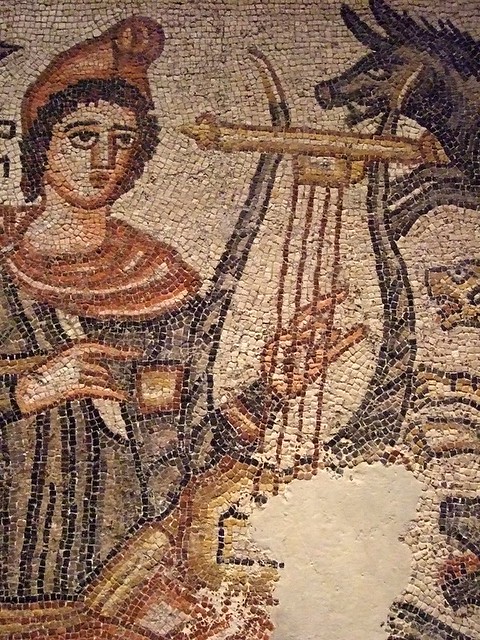
A reenactment of the Orpheus myth was a
popular "fatal charade" used to execute
people sentenced to death ad bestias
Roman mosaic of Orpheus circa 204 CE
Photographed at the Dallas Museum of Art
by Mary Harrsch © 2006.
"Underground passageways excavated below the Forum Romanum bear witness to an attempt to create adequate facilities, but it was the adoption during the first century of a Campanian architectural design, the amphitheater, which greatly increased the potential for sophisticated displays, made permanent accommodation available for seating a large audience and allowed easier control and handling of the animals, with a corresponding guarantee of safety of the audience." - K.M. Coleman, Fatal Charades: Roman Executions Staged as Mythological Enactments

When the Flavian amphitheater was finally completed under the reign of Titus, the son of Vespasian certainly took full advantage of the degree of spectacle that could be presented in the new facility.

 "...Titus celebrated his brother's birthday with great splendour, reserving in his honour for this festival much of the punishment of his Jewish captives.  For the number of those destroyed in contests with wild beasts or with one another or in the flames exceeded two thousand five hundred." - Josephus, VII.37-40
 
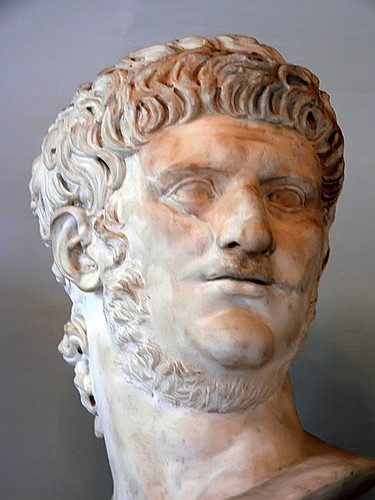
The Roman Emperor 1st century CE.
Photographed at the Capitoline Museum in
Rome, Italy by Mary Harrsch © 2005
Some writers claimed many of the Roman people had objected to the cruelty of Nero's executions ad flammas but the people must have had a short memory!

Coleman also pointed out that executions ad bestias were the real crowd pleasers but acquiring beasts was expensive and there was always a degree of uncertainty about the willingness of animals to "do the job".  Death by crucifixion, on the other hand, was usually too slow, taking hours or even days.  So the tunica molesta could have been an alternative means of execution that still provided a certain degree of entertainment while being relatively cheap with a guaranteed result.

Coleman mentions that evidence of ongoing  "fatal charades" disappears after the Severan dynasty but executions by fire certainly continued.  Ironically, it was a Christian emperor,  Justinian (r. 527-565 CE) who decreed that heretics would be put to death by fire as part of his Codex Iustiniani (CJ 1.5.), ratifying the decrees of his predecessors the Emperors Arcadius and Flavius Augustus Honorius.  Burning was also deemed the appropriate punishment for Zoroastrians in the Byzantine Empire for their worship of fire.


If you enjoyed this post, never miss out on future posts by following me by email!