Showing posts with label Getty Villa. Show all posts

Saturday, June 12, 2021

The ephebeia

Just as select Spartan youth endured the krypteia, a year long trial in the wilderness to prove their worthiness to become a Spartiate, Athenian young men also took part in a training regimen known as the ephebeia.  This "college" taught them the responsibilities of citizenship and trained them as soldiers.  After admission to the college, the ephebe took the oath of allegiance, recorded in histories by Pollux and Stobaeus, in the temple of Aglaurus, and was sent to Munichia or Acte to form one of the garrison there. 

At the end of the first year of training, the ephebi were reviewed, and, if their performance was satisfactory, were provided by the state with a spear and a shield, which, together with the chlamys (cloak) and petasos (broad-brimmed hat), made up their equipment. In their second year they were transferred to other garrisons in Attica, patrolled the frontiers, and on occasion took an active part in war. 

During these two years they were free from taxation, and were generally not allowed to appear in the law courts as plaintiffs or defendants. The ephebi took part in some of the most important Athenian festivals. Thus during the Eleusinian Mysteries they were sent to fetch the sacred objects from Eleusis and to escort the image of Iacchus on the sacred way. They also performed police duty at the meetings of the ecclesia.

After the end of the 4th century BCE, the institution underwent a radical change. Enrolment ceased to be obligatory, lasted only for a year, and the limit of age was dispensed with. Inscriptions attest a continually decreasing number of ephebi, and with the admission of foreigners the college lost its representative national character. Scholars have speculated this was mainly due to the weakening of the military spirit and the progress of intellectual culture. The military element was no longer all-important, and the ephebia became a sort of university for well-to-do young men of good family, whose social position has been compared with that of the Athenian "knights" of earlier times. The institution lasted till the end of the 3rd century CE.

Roman aristocratic families often sent their young men, between the ages of 16 - 20, to Greece to learn civic virtues. Several new officials were introduced, one of special importance being the director of the Diogeneion.  The Diogeneion was essentially a gymnasium originally built in honor of Diogenes, the last commander of the Macedonian garrison in Athens that departed the city in 229 BCE.  It is assumed he funded the construction of the building and scholars therefore conclude military training was conducted there.


Image: This Attic Red-Figure Stamnos at the Getty Villa (unfortunately not currently on view), produced between 470-460 BCE, appears to depict an ephebe (ephebus in Latin) who has completed at least his first year at the the ephebeia successfully as he is now equipped with two spears and wears the trademark petasos on his back.  He appears to be bidding farewell to an old white-haired man (his father or teacher) before leaving for his assigned garrison.


If you enjoyed this post, never miss out on future posts by following me by email!


Friday, April 30, 2021

Bust of a Boy or Eros with the Attributes of Herakles, 150-100 BCE, Roman Period Greece

This thinly-cast bust depicts a youth wearing a lion-skin over his head and a quiver strap across the chest. The figure has delicate features and fine hair that is drawn up in a braid with tendrils falling onto his forehead. The figure may depict a young Herakles, or an unidentifiable youth in the guise of the great hero. A third possibility is that this young man is Eros, who was often depicted with attributes associated with Herakles. Two small holes at the bottom edge may have been used to attach this bust to a piece of furniture. 

While in wealthy households beds were used for sleeping in the bedrooms (lectus cubicularis), and couches for banqueting while reclining were used in the dining rooms (lectus tricliniaris), the less well off might use the same piece of furniture for both functions. The two types might be used interchangeably even in richer households, and it is not always easy to differentiate between sleeping and dining furniture. The most common type of Roman bed took the form of a three-sided, open rectangular box, with the fourth (long) side of the bed open for access. While some beds were framed with boards, others had slanted structures at the ends, called fulcra, to better accommodate pillows. The fulcra of elaborate dining couches often had sumptuous decorative attachments featuring ivory, bronze, copper, gold, or silver ornamentation.


Bust of a Boy with the Attributes of Herakles, 150-100 BCE, Greek, now part of the collections of the J. Paul Getty Museum on view at the Getty Villa in Pacific Palisades, California.  Image courtesy of Bruce White Photography.

If you enjoyed this post, never miss out on future posts by following me by email!


Saturday, April 3, 2021

The tragic boy emperor, Philip II

Philip II (Latin: Marcus Julius Severus Philippus; 237 – 249CE), also known as Philip the Younger, was the son and heir of the Roman Emperor Philip the Arab by his wife Marcia Otacilia Severa. When his father became emperor in 244, young Philip was appointed caesar at the age of only seven-years-old. In 247, he became consul, and was later elevated by his father to the rank of augustus and co-ruler.  Although ancient historians claim both Philip the Arab and his son were killed in battle by Decius.  

Decius was a distinguished senator who had served as suffect consul in 232, had been governor of Moesia and Germania Inferior soon afterwards, served as governor of Hispania Tarraconensis between 235 and 238, and was urban prefect of Rome during the early reign of Emperor Philip the Arab. In 248 or 249 Decius was sent to quell the revolt of Pacatianus and his troops in Moesia and Pannonia, a rebellion seen by some modern historians as emerging Balkan separatism.  After the collapse of the revolt, Decius let the troops proclaim him emperor. Philip advanced against him and was killed at Verona, Italy, in September 249. The Senate then recognized Decius as emperor, giving him the attribute Traianus in reference to Emperor Trajan, an emperor considered the ultimate example of a ruler at the time. According to the Byzantine historian Zosimus, Decius was clothed in purple and forced to undertake the [burdens of] government, despite his reluctance and unwillingness.  

Modern scholars do not think Philip II was with his father in Verona and suggest that when news of his father's death and the proclamation of Decius as the new emperor reached Rome, the Praetorian Guard murdered the 12-years-old. 

Bust of Philip II at the archaeological museum in Venice, Italy, courtesy of Wikimedia Commons contributor Architas.

Previously crushed portrait of Philip the Younger from Asia Minor, 235 CE, bronze, at the J. Paul Getty Museum (Villa)

Portrait of Philip II, 247-249 CE, from the Chiragan Roman Villa, now in the Musée Saint-Raymond, image courtesy of Wikimedia Commons contributor Daniel Martin.


If you enjoyed this post, never miss out on future posts by following me by email!


Monday, January 18, 2021

Ancient theater in Greece and Rome

Nearly every Greek and Roman city of note had an open-air theater consisting of the orchestra, the flat dancing floor of the chorus, and the theatron, the actual structure of the theater building. Vase paintings indicate the stage stood about three feet high with a flight of steps in the center. The actors entered from either side and from a central door in the skene, which also housed the ekkyklema, a wheeled platform with sets of scenes. A mechane, or crane, located at the right end of the stage, was used to hoist gods and heroes through the air onto the stage.  

Theatrical performances were usually part of a seasonal festival and were accompanied by processions, sacrifices in the theater, parades, and competitions between playwrights. Almost all Greek tragedies were based on heroic myths although the dialogue between actor and chorus sometimes served an instructional purpose and reflected current debate in the public assembly.

"Unlike the Greek tragedy, the comic performances produced in Athens during the fifth century BCE, the so-called Old Comedy, ridiculed mythology and prominent members of Athenian society. There seems to have been no limit to speech or action in the comic exploitation of sex and other bodily functions. Terracotta figurines and vase paintings dated around and after the time of Aristophanes (450–ca. 387 BCE) show comic actors wearing grotesque masks and tights with padding on the rump and belly, as well as a leather phallus." - Art historian, Colette Hemingway

Comic characters and their masks eventually became standardized indicating the popularity not of a specific figure but of types—the old man, the slave, the courtesan, etc.—that appeared repeatedly in different plays. Terracotta or bronze figurines of these popular characters were often sold as souvenirs. Fourteen such figurines were found in one burial in Attica. Apparently the deceased was either an actor themselves or an avid theater-goer!

"In the second half of the fourth century BCE, the so-called New Comedy of Menander (343–291 BCE) and his contemporaries gave fresh interpretations to familiar material. In many ways comedy became simpler and tamer, with very little obscenity. The grotesque padding and phallus of Old Comedy were abandoned in favor of more naturalistic costumes that reflected the playwrights’ new style. Subtle differentiation of masks worn by the actors paralleled the finer delineation of character in the texts of New Comedy, which dealt with private and family life, social tensions, and the triumph of love in a variety of contexts." - Art historian, Colette Hemingway.

Read more about it:

Hemingway, Colette. “Theater in Ancient Greece.” In Heilbrunn Timeline of Art History. New York: The Metropolitan Museum of Art, 2000–. http://www.metmuseum.org/toah/hd/thtr/hd_thtr.htm (October 2004)

Terracotta Lamp with seated Comic Actor Greek made in Egypt 125-100 BCE that I photographed at The Getty Villa in Pacific Palisades, California.

Roman Terracotta Lamp with Reclining Comic Actor 100-200 CE that that I photographed at The Getty Villa in Pacific Palisades, California.

Statuette of a Comic Actor Wearing an Animal Mask Roman 100 BCE-100 CE  Bronze that I photographed at The Getty Villa in Pacific Palisades, California.

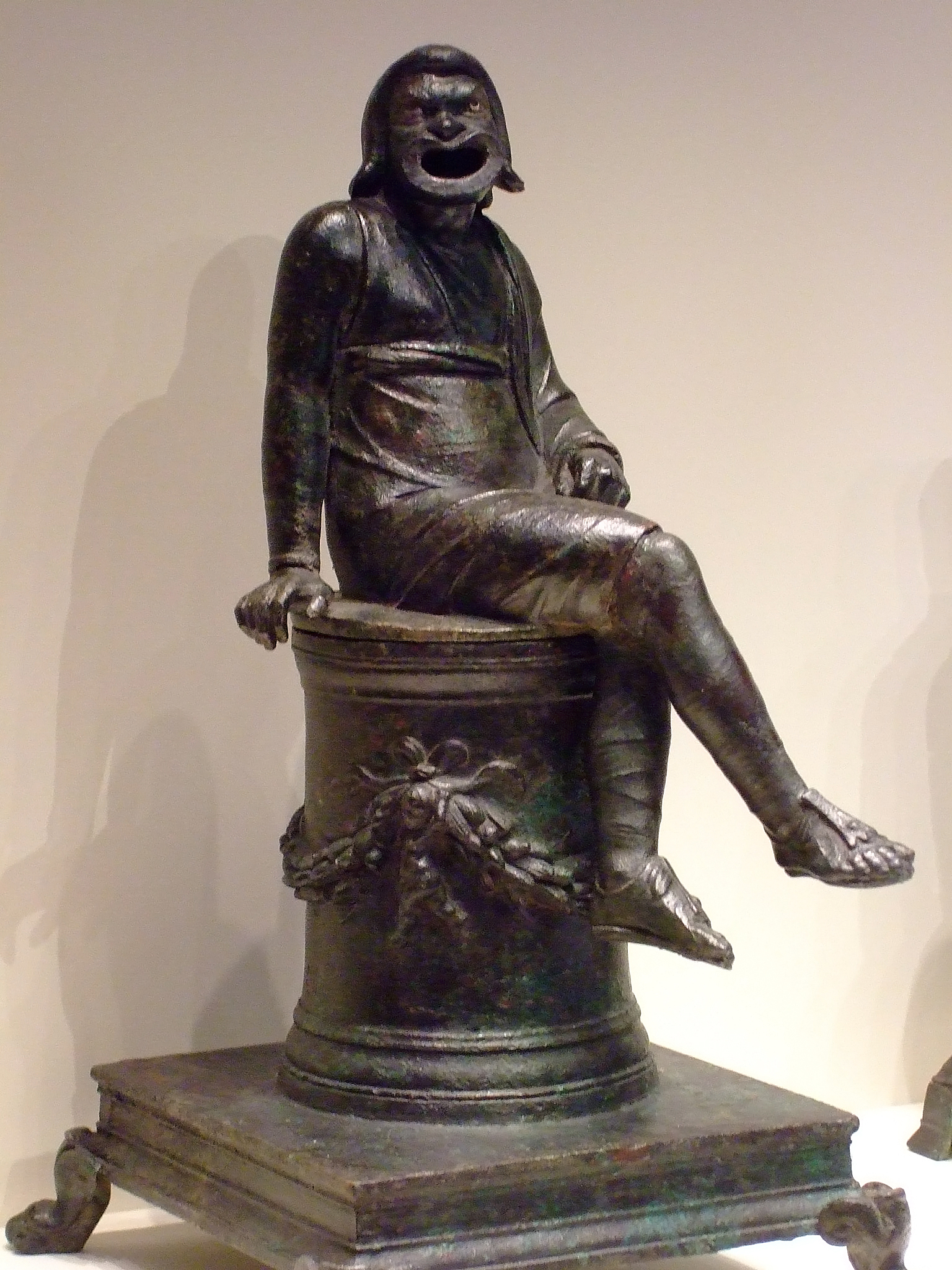
Incense Burner (Thymiaterion) shaped as a Comic Actor Seated on an Altar Roman 1-50 CE Bronze and Silver that I photographed at The Getty Villa in Pacific Palisades, California.

Detail from a red-figured Bell Krater with a scene of Phlyax actors Greek made in Apulia South Italy 370-360 BCE attributed to the Cotugno Painter Terracotta that I photographed at The Getty Villa in Pacific Palisades, California.

Bronze furniture decoration in the shape of theater masks Roman Imperial Period that I photographed at the Palazzo Massimo in Rome.


The Decumano Max leads to remains of the ancient Roman theater I photographed at Ostia built at the end of the 1st century BCE 

Architectural elements depicting theater masks that I photographed at the ancient Roman theater in Ostia Antica.

Male comic theater mask Roman 2nd century CE that I photographed at the Terme di Diocleziano in Rome.


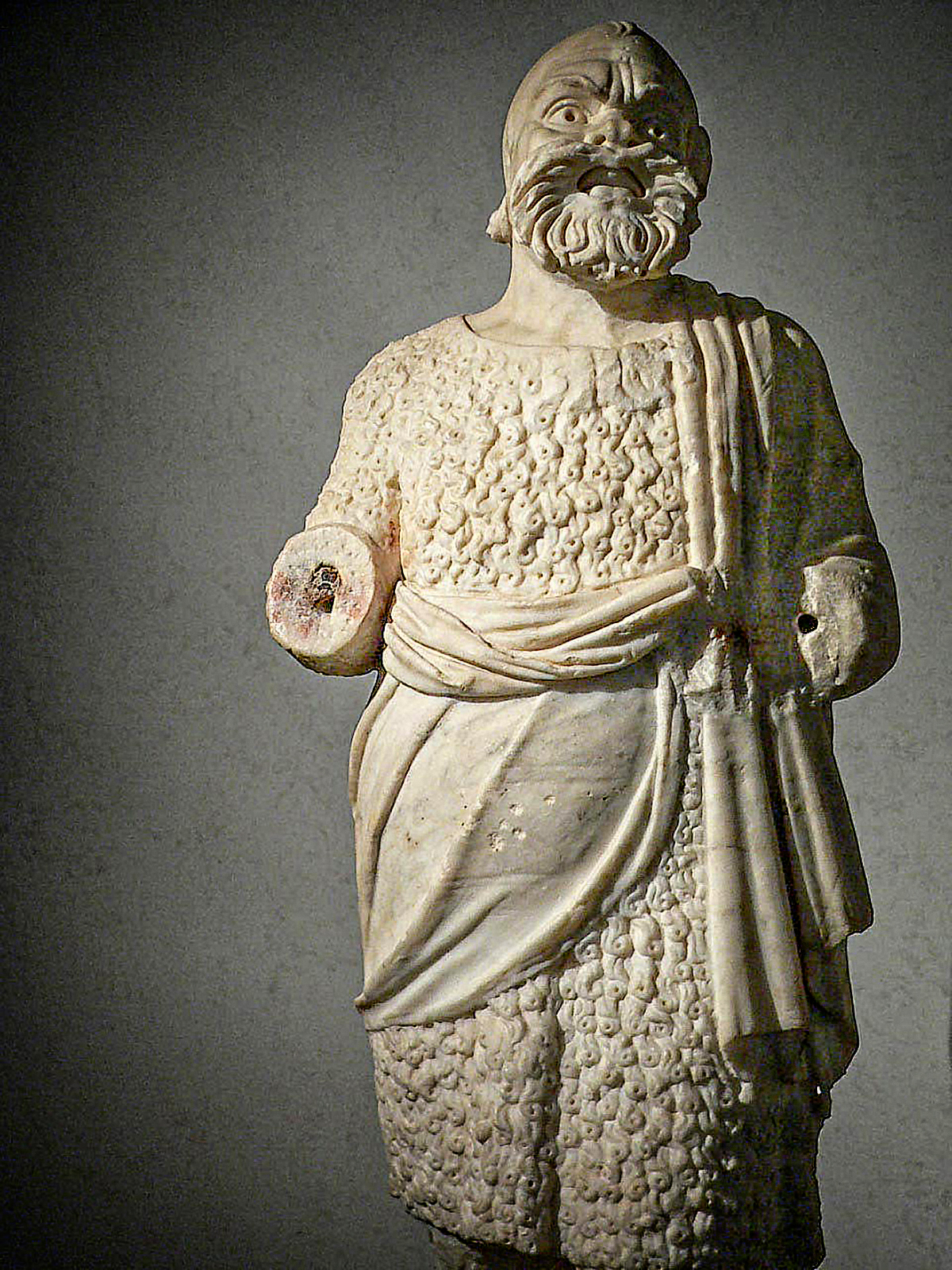
Roman Actor dressed as Papposilenus father of the satyrs from the Villa of Torre Astura 1st century BCE-1st century CE that I photographed at the Palazzo Massimo in Rome.

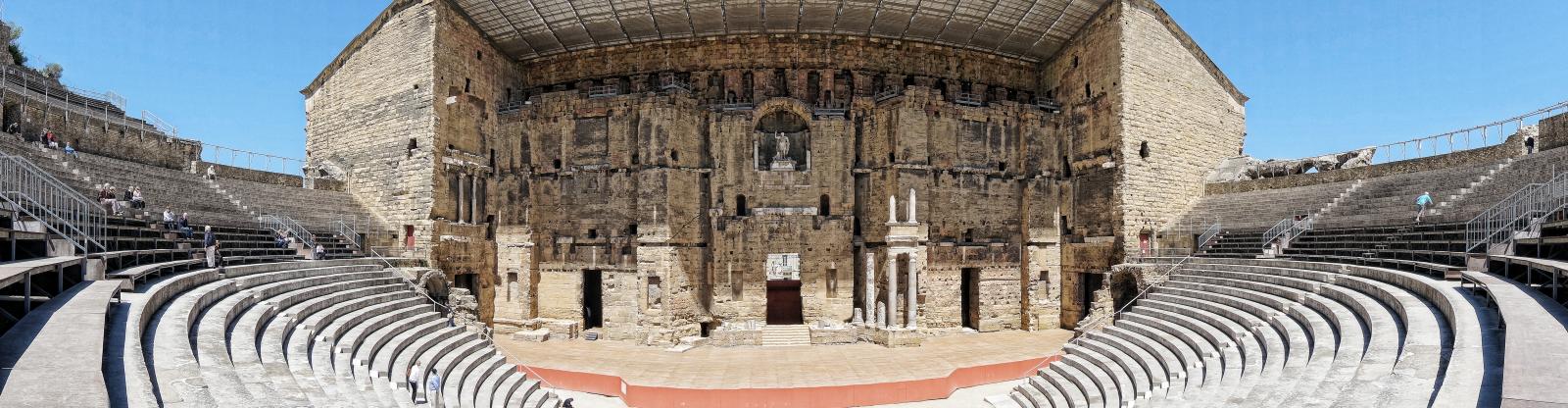
Panoramic view of the ancient Roman theater in Orange, France, a World Heritage Site, 1st century CE that I photographed.

A theater mask carved on the corner of a Roman funerary monument that I photographed at the Musèe de l'Arles Antique in Arles, France.


Terracotta scent bottle in the form of a squatting man, perhaps a comic actor  Corinthian from Camirus Rhodes 600-575 BCE that I photographed at The British Museum.


Masked actors perform Dyskolos "The Grouch" by Menander at ancient Alexandria's theater, a screenshot I took in Assassin's Creed Origins Discovery Tour.

Cleopatra leaves the Greek theater in ancient Alexandria, a screenshot I took in Assassin's Creed Origins Discovery Tour.

Terracotta statuette of an actor, late 5th–early 4th century BCE, Greek, at the Metropolitan Museum of Art.

Terracotta statuette of an actor, late 5th–early 4th century BCE, Greek, at the Metropolitan Museum of Art.

Terracotta statuette of an actor, late 5th–early 4th century BCE, Greek, at the Metropolitan Museum of Art.

Terracotta statuette of an actor, late 5th–early 4th century BCE, Greek, at the Metropolitan Museum of Art.

Terracotta statuette of an actor, late 5th–early 4th century BCE, Greek, at the Metropolitan Museum of Art.

Terracotta statuette of an actor, late 5th–early 4th century BCE, Greek, at the Metropolitan Museum of Art.


If you enjoyed this post, never miss out on future posts by following me by email!


Tuesday, July 7, 2020

Sirens in ancient mythology and beyond

In Greek mythology, the Sirens were dangerous creatures who lured nearby sailors to their deaths by enchanting them with music and singing voices which resulted in their shipwreck on the rocky coast of the sirens' island. Roman poets placed them on some small islands called Sirenum scopuli. Later, their "flowery" island of Anthemoessa, or Anthemusa, was considered to be  Cape Pelorum or the Sirenuse, near Paestum.  Plato said there were three kinds of Sirens: the celestial, creatures of Zeus,  the generative of Poseidon, and the cathartic of Hades. Originally, Sirens were shown to be male or female, but the male Siren disappeared from art around the fifth century BCE.

In addition to their role in menacing seamen, sirens were also thought to accompany souls on the journey to the afterlife, hence their portrayal on funerary art.  Sirens were first believed to look like a combination of women and birds in various  forms in ancient Greek, Etruscan, and Roman art. With their legendary male attraction, sirens were a popular motif for perfume vessels where they were often depicted as birds with large women's heads, wings, feathers and scaly feet. Later, they were represented as female figures with the legs of birds, with or without wings, playing a variety of musical instruments, especially harps and lyres. By the Middle Ages, however, they began to take on the attributes of mermaids.

Some of my favorite portrayals of sirens are on display at the Getty Villa in Pacific Palisades, California.  Dating to 350-300 BCE, these almost life-sized sculptures  were found in a funerary context in Tarentum in southern Italy along with a musician thought to be Orpheus. In another funerary context, sirens are portrayed on a relief that once adorned a Lycian sepulchral tower now in the collections of the British Museum.  Of course I find the smaller perfume vessels and other objects depicting sirens endearing as well.

Images: Some of the images I have taken of sirens at the Getty Villa, British Museum, and the Walters Art Museum as well as other images from the British Museum, National Archaeological Museum in Athens, and the Metropolitan Museum of Art.

Perfume bottle in the form of a siren Greek mid-4th century BCE photographed at the British Museum

Terracotta flask in the form of a siren, Greek, made in Kythera, Crete 600 BCE photographed at the British Museum

Funerary sculpture of a siren from Tarentum in southern Italy 350-300 BCE photographed at the Getty Villa

Funerary sculpture of a siren from Tarentum in southern Italy 350-300 BCE photographed at the Getty Villa

Funerary sculpture group of two sirens and a musician thought to be Orpheus from Tarentum in southern Italy 350-300 BCE courtesy of the Getty Villa

Funerary sculpture of a siren's feet from Tarentum in southern Italy 350-300 BCE photographed at the Getty Villa
Attic Black figure plate with Gorgon's head and bands of animals and sirens ceramic 600 BCE photographed at the Walters Art Museum

Ceramic Vase in the form of a siren Greek 540 BCE photographed at the Walters Art Museum in Baltimore, Maryland.

Etruscan bronze weight in the form of a siren with loop 475BC-425BCE courtesy of the British Museum

Marble Siren found in the Necropolis of Ceramics in Athens beside the stele of Athenian warrior Dexileo who fell in combat in 394 or 393 BCE courtesy of Wikimedia Commons and the National Archaeological Museum in Athens

Gold earring in the form of a siren, Greek, mid-4th century BCE courtesy of the Metropolitan Museum of Art

Harpy tomb originally part of a Lycian sepulchral tower 480-470 BCE courtesy of the British Museum

Oil Jar (Askos) in the shape of a Siren Greek from South Italy 480-450 BCE Bronze photographed at the Getty Villa

The Siren of Canosa, south Italy, Greek, 4th century BCE courtesy of Wikimedia Commons contributor Luis Garcia.

Water Jar Handle (Kalpis) with a Siren Greek 450-425 BCE Bronze photographed at the Getty Villa


If you enjoyed this post, never miss out on future posts by following me by email!


Friday, May 29, 2020

Figurines with articulated limbs: Children's toys or adult apotropaic objects?

Terracotta figurines with articulated limbs are often described as dolls or children’s toys, and are sometimes thought to have been dressed in clothes. While one cannot simply dismiss these assumptions, it must be pointed out that this hypothesis is based on an inaccurate reading of an ancient epigram, which was originally interpreted to say that a girl named Timareta dedicated to the goddess (at a sanctuary) her dolls and their dresses. However, more recently it has been convincingly argued that she in fact dedicated her hair and her own clothing. Another point to be made against the figurines being play things is that they are too fragile to be constantly handled by children. The fact that these “dolls” are often discovered in the graves of adults indicates their possible chthonic connection or apotropaic function. In addition, the movement these figurines were capable of when swinging, as well as the clanking noise they produced, might have made them attractive charms. - The Metropolitan Museum of Art.

Terracotta jointed doll thought to represent a ritual dancer Corinthian Greek 5th century BCE at the Metropolitan Museum of Art

Bone figurine with articulated limbs, Greek, Late 4th or 3rd century BCE at the Metropolitan Museum of Art

Ivory doll found in female burial along the Via Cassia near La Giustiniana Roman 2nd century CE photographed at the Palazzo Massimo in Rome, Italy

Ivory doll Ivory doll found in female burial Roman 2nd century CE at the Palazzo Massimo in Rome, Italy

Ivory jointed doll found in a female's sarcophagus in Tivoli, Italy Roman 2nd century CE photographed at the Palazzo Massimo in Rome, Italy

Segmented Roman bone dolls, 275-300 CE photographed at the Getty Villa in Pacific Palisades, California.

If you enjoyed this post, never miss out on future posts by following me by email!


Friday, May 22, 2020

Funerary symbolism: Relief of a hunter from Magna Graecia

Made in Taras, South Italy between 290-250 BCE, this Greek relief sculpture was probably once part of a grave monument.  A nude youth, with a horse rearing up behind him, lunges forward to attack an unseen foe.  The presence of the large snarling dog indicates this is a hunting scene and identifies the deceased as a member of the elite.  It also refers to an activity thought to be one of the pleasures of the afterlife.  Photographed at the Getty Villa in Pacific Palisades, California.

Funerary relief of a hunter with horse and hunting hound Greek, Taras, South Italy, 290-250 BCE photographed at the Getty Villa in Pacific Palisades, California by Mary Harrsch.

If you enjoyed this post, never miss out on future posts by following me by email!


Friday, May 15, 2020

Terracotta sarcophagi of the Ionian Greeks at Clazomenae

Clazomenae was an ancient Greek city on the coast of Ionia and a member of the Ionian League. It was one of the first cities to issue silver coinage. Its ruins are now located in the modern town Urla near Izmir in Izmir Province, Turkey. The city was originally located on the mainland at Limantepe, but probably during the early fifth-century BCE Ionian Revolt from the Persians, it was moved to Karantina Island just off the coast. Soon after that, the city of Chyton was founded on the mainland.

For some time it was subject to the Athenians, but during the middle of the Peloponnesian War (412 BCE) it revolted. After a brief resistance, though, it once more submitted to Athenian supremacy, and repelled a Lacedaemonian (Spartan) attack. In 387 BCE Clazomenae and other cities in Asia were once more taken over by Persia.  Then came Alexander the Great, who eventually connected Karantina island to the mainland with a causeway, the remains of which are still visible.

Later, under the Romans, Clazomenae was included in the province of Asia, and enjoyed immunity from taxation.  The city was famous for production and exports of olive oil and was also prized for its variety of garum. The philosopher Anaxagoras (c. 510 – 428 BCE) was born in Clazomenae, as was the earlier philosopher Hermotimus of Clazomenae. 

Nineteenth century archaeologists have recovered large painted terracotta sarcophagi from the site weighing up to two tons dating to the last quarter of the 6th century BCE to the mid 5th century BCE.  Examples can be seen at the Metropolitan Museum of Art in New York, the Getty Villa in Pacific Palisades, California,  the British Museum in London, the National Archaeological Museum in Athens, and the Izmir Archaeological Museum in Turkey.

Greek Terracotta Sarcophagus from Clazomenae in present-day Turkey attributed to the Albertinum Group 480-470 BCE photographed at the Getty Villa in Pacific Palisades, California.

Greek Terracotta Sarcophagus from Clazomenae in present-day Turkey attributed to the Albertinum Group 480-470 BCE photographed at the Getty Villa in Pacific Palisades, California.

Greek Terracotta Sarcophagus from Clazomenae in present-day Turkey attributed to the Albertinum Group 480-470 BCE photographed at the Getty Villa in Pacific Palisades, California.

Greek Terracotta Sarcophagus from Clazomenae in present-day Turkey attributed to the Albertinum Group 480-470 BCE photographed at the Getty Villa in Pacific Palisades, California.

Greek Terracotta Sarcophagus from Clazomenae in present-day Turkey attributed to the Albertinum Group 480-470 BCE photographed at the Getty Villa in Pacific Palisades, California.

Greek Terracotta Sarcophagus from Clazomenae in present-day Turkey attributed to the Albertinum Group 480-470 BCE photographed at the Getty Villa in Pacific Palisades, California.

Greek Terracotta Sarcophagus from Clazomenae in present-day Turkey attributed to the Albertinum Group 480-470 BCE photographed at the Getty Villa in Pacific Palisades, California.

Terracotta sarcophagus rim East Greek Clazomenian last quarter of the 6th century BCE photographed at the Metropolitan Museum of Art in New York.

Terracotta sarcophagus rim East Greek Clazomenian last quarter of the 6th century BCE photographed at the Metropolitan Museum of Art in New York.

Terracotta sarcophagus rim East Greek Clazomenian last quarter of the 6th century BCE photographed at the Metropolitan Museum of Art in New York.

Terracotta sarcophagus rim East Greek Clazomenian last quarter of the 6th century BCE photographed at the Metropolitan Museum of Art in New York.

Terracotta sarcophagus rim East Greek Clazomenian last quarter of the 6th century BCE photographed at the Metropolitan Museum of Art in New York.


If you enjoyed this post, never miss out on future posts by following me by email!