Showing posts with label Ravenna. Show all posts

Thursday, October 25, 2007

Mosaics in Ravenna Still Dazzle


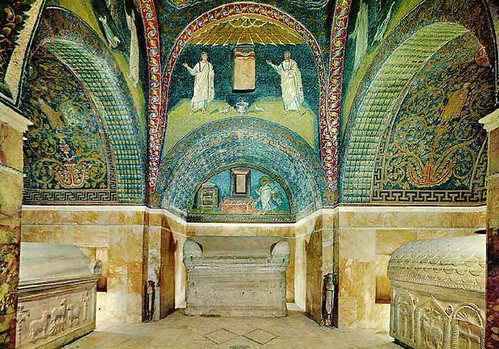
I was searching for a picture of the Amazon Warrior sculpture that was recently found in Herculaneum and stumbled across this blog about Mosaic Art and these wonderful pictures of the tomb of Galla Placidia, the powerful half-sister of Honorius and wife of Emperor Constantius III. I had heard that the mosaics in Ravenna are particularly spectacular and if these are any indication, they certainly are!

"Galla Placidia was the daughter of Roman Emperor Theodosius I (379-395) and his second wife, Galla, the daughter of Valentinian I. She was the half-sister of the young Roman emperors Honorius (393-423) and Arcadius (383-408), the aunt of Theodosius II, the wife of Athaulf, King of the Goths, and then of Flavius Constantius (421) (who was promoted to co-emperor with Honorius shortly before his death), and the mother of Valentinian III.

When, under the leadership of Alaric, the Goths sacked Rome in August 410, they took Galla Placidia with them to Gaul. After the death of Alaric, Athaulf became the king. Galla Placidia married him in Narbo in January 414 -- against the wishes of her half-brother Honorius, and had a son named Theodosius who died soon thereafter. Following the death of Athaulf in 414, the Goths returned Galla Placidia to the Romans who wanted her to marry Flavius Constantius, who had succeeded Stilicho to power. Reluctantly, Galla Placidia did so and produced two children, Justa Grata Honoria and Valentinian. When, on February 8, 421, Constantius was made co-emperor (Constantius III) in the west by Honorius, Galla Placidia was named Augusta. Constantius died on September 2, 421. Galla Placidia and her childless half-brother Honorius became very close for a while, but then they quarreled. Galla Placidia fled with her children to Constantinople in 423 to escape a charge of aiding her brother's enemies. Although earlier Theodosius hadn't recognized the imperial elevation of Constantius and therefore, the status of his aunt as Augusta, he welcomed her, and soon recognized both her status and the legitimacy of her son as heir. Honorius died soon after, on August 27 of the same year. A usurper John assumed the throne in Ravenna. Theodosius set out to win the throne back for his family. When the imperial party reached Thessalonica the young Valentinian was made Caesar. Placidia was regent for her young son for the next 12 years. She had legislation passed in her son's name (according to Oost), stating that the emperor was subject to the laws of the land, as opposed to the situation in the east where the emperor was above the law. Galla Placidia was also involved in the power play between Felix, Boniface, and Aetius, who has been called the last of the Romans. Earlier, Placidia is thought to have been involved in the conspiracy against the Vandal Stilicho and the subsequent execution of Serena, Stilicho's wife and Galla Placidia's cousin." - About Ancient History

Image by designucdavic
If you enjoyed this post, never miss out on future posts by following me by email!


Friday, August 17, 2007

Syrian mosaics restored in Ravenna featured in exhibit

A history resource article by  © 2007


A Syrian mosaic fragment from the late Roman
Period.
The following article was a press release from ANSI.

Ravenna, the capital of Roman and Byzantine mosaics, has turned its hand to a fresh clutch of works, restoring a number of priceless designs on loan from Syrian museums.

"The mosaics, which are currently on display, were created by artists during the late Roman period, when Syria was a province of the Roman Empire.
Ravenna was the centre of late Roman mosaic art in the fifth century CE but Syria was also considered a crucial production point."
 "Its capital Antioch was particularly renowned, and it was for a long time one of the most important areas of mosaic production in the entire Roman Empire."
“Mosaici d’Oriente. Tessere sulla via di Damasco” (“Mosaics of the East. Tiles on the Road to Damascus”) will showcase a selection of precious artworks from this era.
Most of the mosaics were designed for the floor and feature a variety of animals, symbolic designs whose meaning is still being studied by experts."
"One shows a series of animal pairs — a zebra and a lion, a cheetah and a unicorn — facing a fruit tree. Another depicts identical pairs of birds and quadrupeds standing next to a large urn."
"A third panel shows scenes from a hunt, including animals chasing one another, against a background of stylized rose-designs."
"The exhibition, the result of months of careful restoration work by Ravenna experts, is the second in a series of collaborations between the western Italian city and Syria." 
"A show last year focusing on the golden age of Ravenna, explored the town’s influence throughout the Mediterranean and included a number of Syrian mosaics among its 100 pieces on show."
"Ravenna developed rapidly after first replacing Rome as capital of the western Roman Empire in the fifth century CE and then becoming the capital of the Byzantine Empire."
"Its rulers built the finest Byzantine churches outside Constantinople and to this day, the city retains its name as the ‘Capital of Mosaics.’"
"Among the city’s most famous pieces is its Mausoleum of Galla Placidia, from 425-430, which shows a gold cross in the middle of a starry sky. Later pieces, completed after Ravenna was conquered by the Byzantine Empire, include mosaics in the Basilica of San Vitale, showing a series of scenes from the Old Testament, and small sequences in the Basilica of Sant’Apollinare Nuovo, depicting Christ’s miracles and parables on one side, and the Passion and Resurrection on the other.""

The Good Shepherd mosaic from the Mausoleum of Galla Placidia in Ravenna, Italy, a World Heritage Site.
Image courtesy of Wikimedia Commons.

Suggested Reading:

If you enjoyed this post, never miss out on future posts by following me by email!