Showing posts with label mausoleum. Show all posts

Monday, July 27, 2020

The emperor Hadrian and the Castel Sant'Angelo

The emperor Hadrian's tomb was erected on the right bank of the Tiber, between AD 134 and 139. Now known as the Castel Sant'Angelo, originally the mausoleum was a decorated cylinder, with a garden top and golden quadriga. Hadrian's ashes were placed here a year after his death in Baiae in 138, together with those of his wife Sabina, and his first adopted son, Lucius Aelius, who died in 138. Following this, the remains of succeeding emperors were also placed here, the last recorded deposition being Caracalla in 217 CE. But much of the tomb  contents and decorations were lost when the building was converted to a military fortress in 401 CE then subsequently included in the Aurelian Walls by Flavius Honorius Augustus. The urns and ashes were scattered by Visigoth looters during Alaric's sack of Rome in 410, and the original decorative bronze and stone statuary were thrown down upon the attacking Goths when they besieged Rome in 537, as recounted by Procopius.  In the 14th century the popes converted the tomb into a castle and connected it to St. Peter's Basilica by a covered fortified corridor called the Passetto di Borgo. It was also used as a prison and executions were performed in the inner courtyard.

I first visited the castle in 2005 when  a friend and I walked there after spending the morning at St. Peter's and the Vatican Museums.  At that time, however, photography was disappointingly not allowed inside the structure.  But yesterday when I was researching the origins of a Roman relief I thought might be in the Castel Sant'Angelo, I was searching the images of the castle on Wikimedia Commons and discovered quite a number of excellent interior images, including this one of a fresco of Hadrian. Rome must have changed their policy on photography at this site!  I encourage you to browse the images of this impressive monument on Wikimedia Commons.  


They certainly refreshed my memory of my experience there!  You can find the fresco of Hadrian in the room known as the Sala Paolina.  This image is courtesy of Wikimedia Commons contributor, Vassil. 

Fresco of the Emperor Hadrian in the Sala Paolina of Castel Sant'Angelo courtesy of
Wikimedia Commons contributor, Vassil.

If you enjoyed this post, never miss out on future posts by following me by email!


Thursday, October 25, 2007

Mosaics in Ravenna Still Dazzle


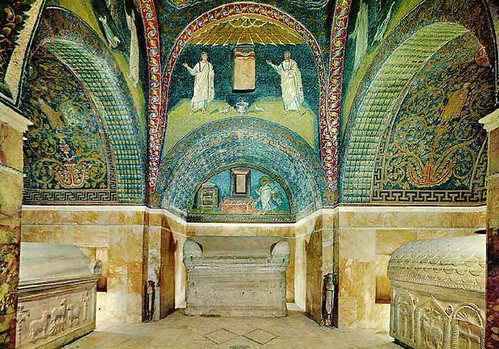
I was searching for a picture of the Amazon Warrior sculpture that was recently found in Herculaneum and stumbled across this blog about Mosaic Art and these wonderful pictures of the tomb of Galla Placidia, the powerful half-sister of Honorius and wife of Emperor Constantius III. I had heard that the mosaics in Ravenna are particularly spectacular and if these are any indication, they certainly are!

"Galla Placidia was the daughter of Roman Emperor Theodosius I (379-395) and his second wife, Galla, the daughter of Valentinian I. She was the half-sister of the young Roman emperors Honorius (393-423) and Arcadius (383-408), the aunt of Theodosius II, the wife of Athaulf, King of the Goths, and then of Flavius Constantius (421) (who was promoted to co-emperor with Honorius shortly before his death), and the mother of Valentinian III.

When, under the leadership of Alaric, the Goths sacked Rome in August 410, they took Galla Placidia with them to Gaul. After the death of Alaric, Athaulf became the king. Galla Placidia married him in Narbo in January 414 -- against the wishes of her half-brother Honorius, and had a son named Theodosius who died soon thereafter. Following the death of Athaulf in 414, the Goths returned Galla Placidia to the Romans who wanted her to marry Flavius Constantius, who had succeeded Stilicho to power. Reluctantly, Galla Placidia did so and produced two children, Justa Grata Honoria and Valentinian. When, on February 8, 421, Constantius was made co-emperor (Constantius III) in the west by Honorius, Galla Placidia was named Augusta. Constantius died on September 2, 421. Galla Placidia and her childless half-brother Honorius became very close for a while, but then they quarreled. Galla Placidia fled with her children to Constantinople in 423 to escape a charge of aiding her brother's enemies. Although earlier Theodosius hadn't recognized the imperial elevation of Constantius and therefore, the status of his aunt as Augusta, he welcomed her, and soon recognized both her status and the legitimacy of her son as heir. Honorius died soon after, on August 27 of the same year. A usurper John assumed the throne in Ravenna. Theodosius set out to win the throne back for his family. When the imperial party reached Thessalonica the young Valentinian was made Caesar. Placidia was regent for her young son for the next 12 years. She had legislation passed in her son's name (according to Oost), stating that the emperor was subject to the laws of the land, as opposed to the situation in the east where the emperor was above the law. Galla Placidia was also involved in the power play between Felix, Boniface, and Aetius, who has been called the last of the Romans. Earlier, Placidia is thought to have been involved in the conspiracy against the Vandal Stilicho and the subsequent execution of Serena, Stilicho's wife and Galla Placidia's cousin." - About Ancient History

Image by designucdavic
If you enjoyed this post, never miss out on future posts by following me by email!