|
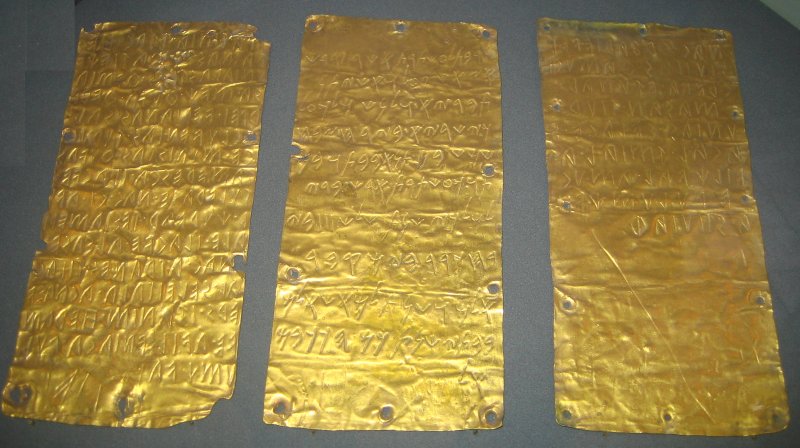
The Pyrgi tablets contain a treatise inscribed in both
Etruscan and Phoenician script. Image courtesy of
Wikimedia user Pufacz. |
|
Being a technology professional I couldn't help my excitement when I read that a new computer program developed at MIT had been used to decipher Ugarit, an ancient language used in Syria over three thousand years ago. Even more amazing is that the program was able to do so after only a few hours. Linguists have spent years trying to decipher it!
The program is designed to compare an unknown language with a language known to be related to it. In this case scientists set the known related language to Hebrew.
"The system looks for commonly used symbols in the two languages and gradually refines its mapping of the alphabet until it can go no further. The Ugaritic alphabet has 30 letters, and the system correctly mapped 29 of them to their Hebrew counterparts."
"Of the words that the two languages shared the program was able to correctly identify 60 per cent of them." - Read more
Critics point out that some as-yet undeciphered scripts have no known related languages so the program would not be of much use for them. But leading researcher Regina Barzilay thinks that by scanning multiple languages at once the program could draw logical conclusions from contextual references.
 |
Etruscan Architectural Antefix depicting a
Maenad and a Satyr 500-475 BCE. Photographed
at the Getty Villa by Mary Harrsch. |
Perhaps if they used epigraphic examples from similar types of excavation sites that would increase the likelihood that the inscriptions would be discussing similar topics. For example, if they used inscriptions from tablets all found near granaries or inscriptions all found on funerary objects in tombs it may help to increase the contextual similarities. If they further limited inscriptions to those found in similar sites from roughly equivalent time periods that would narrow the comparisons even further. This may also mean that comparisons could be made with languages existing at the same time period but not necessarily from a related language group.
In the Etruscan Museum in Rome housed in the Villa Giulia, there is a treatise inscribed on the Pyrgi tablets in both Etruscan and Phoenician. Although they are not related languages, they are both obviously talking about the same thing. Perhaps their inscriptions could be used as a test with the new software.
Other critics have pointed out that the program really does not have a way to determine the beginning or ending of words either. This can be a serious problem as Etruscan did not use spacing or punctuation until the sixth century BCE and then dots or colons may have also been used to separate syllables as well as words and sentences.
It's too bad all of the emperor Claudius' work on Etruscan have been lost over the centuries.
Only a few educated Romans with antiquarian interests, such as Varro, could read Etruscan. The last person known to have been able to read it was the Roman emperor Claudius (10 BC – AD 54), who — in the context of his work in twenty books about the Etruscans, Tyrrenikà (now lost) — compiled a dictionary (also lost) by interviewing the last few elderly rustics who still spoke the language. Urgulanilla, his first wife, was Etruscan.[3]
Livy and Cicero were both aware that highly specialized Etruscan religious rites were codified in several sets of books written in Etruscan under the generic Latin title Etrusca Disciplina. The Libri Haruspicini dealt with divination from the entrails of the sacrificed animal, the Libri Fulgurales expounded the art of divination by observing lightning. A third set, the Libri Rituales, would have provided us with the key to Etruscan civilization: its wider scope embraced Etruscan standards of social and political life as well as ritual practices. According to the 4th century Latin writer Servius, a fourth set of Etruscan books existed, dealing with animal gods, but it is probably unlikely that any contemporary scholar could have read Etruscan at such a late date. The single surviving Etruscan book, Liber Linteus, being written on linen, survived only by being used as mummy wrappings. - Wikipedia
Now that we have even better technology to analyze mummy wrappings and scrolls that were reused in the Middle Ages as well maybe some of Claudius' work will be found in the future.


 If you enjoyed this post, never miss out on future posts by following me by email!