Showing posts with label Etruscans. Show all posts

Thursday, July 22, 2010

Could New MIT program use Pyrgi Tablets to Decipher Etruscan?

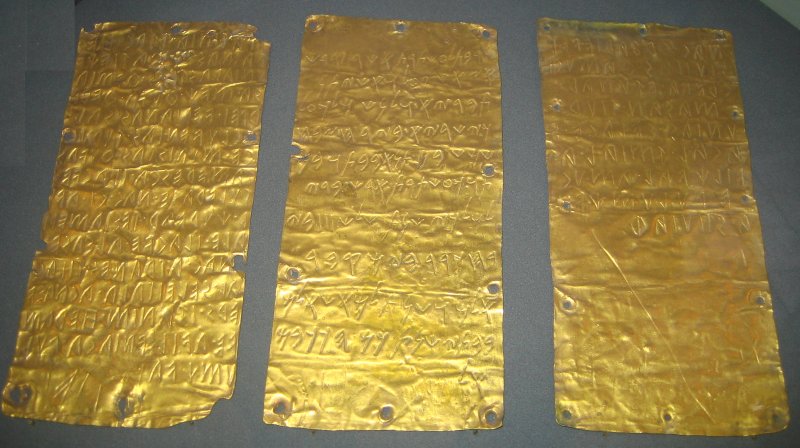
The Pyrgi tablets contain a treatise inscribed in both
Etruscan and Phoenician script.  Image courtesy of
Wikimedia user Pufacz.

Being a technology professional I couldn't help my excitement when I read that a new computer program developed at MIT had been used to decipher Ugarit, an ancient language used in Syria over three thousand years ago. Even more amazing is that the program was able to do so after only a few hours. Linguists have spent years trying to decipher it!


The program is designed to compare an unknown language with a language known to be related to it. In this case scientists set the known related language to Hebrew.


"The system looks for commonly used symbols in the two languages and gradually refines its mapping of the alphabet until it can go no further. The Ugaritic alphabet has 30 letters, and the system correctly mapped 29 of them to their Hebrew counterparts."

"Of the words that the two languages shared the program was able to correctly identify 60 per cent of them." - Read more


Critics point out that some as-yet undeciphered scripts have no known related languages so the program would not be of much use for them.  But leading researcher Regina Barzilay thinks that by scanning multiple languages at once the program could draw logical conclusions from contextual references.

Etruscan Architectural Antefix depicting a
Maenad and a Satyr 500-475 BCE. Photographed
at the Getty Villa by Mary Harrsch.

Perhaps if they used epigraphic examples from similar types of excavation sites that would increase the likelihood that the inscriptions would be discussing similar topics. For example, if they used inscriptions from tablets all found near granaries or inscriptions all found on funerary objects in tombs it may help to increase the contextual similarities. If they further limited inscriptions to those found in similar sites from roughly equivalent time periods that would narrow the comparisons even further. This may also mean that comparisons could be made with languages existing at the same time period but not necessarily from a related language group.

In the Etruscan Museum in Rome housed in the Villa Giulia, there is a treatise inscribed on the Pyrgi tablets in both Etruscan and Phoenician. Although they are not related languages, they are both obviously talking about the same thing. Perhaps their inscriptions could be used as a test with the new software.


Other critics have pointed out that the program really does not have a way to determine the beginning or ending of words either. This can be a serious problem as Etruscan did not use spacing or punctuation until the sixth century BCE and then dots or colons may have also been used to separate syllables as well as words and sentences.

It's too bad all of the emperor Claudius' work on Etruscan have been lost over the centuries.


Only a few educated Romans with antiquarian interests, such as Varro, could read Etruscan. The last person known to have been able to read it was the Roman emperor Claudius (10 BC – AD 54), who — in the context of his work in twenty books about the Etruscans, Tyrrenikà (now lost) — compiled a dictionary (also lost) by interviewing the last few elderly rustics who still spoke the language. Urgulanilla, his first wife, was Etruscan.[3]

Livy and Cicero were both aware that highly specialized Etruscan religious rites were codified in several sets of books written in Etruscan under the generic Latin title Etrusca Disciplina. The Libri Haruspicini dealt with divination from the entrails of the sacrificed animal, the Libri Fulgurales expounded the art of divination by observing lightning. A third set, the Libri Rituales, would have provided us with the key to Etruscan civilization: its wider scope embraced Etruscan standards of social and political life as well as ritual practices. According to the 4th century Latin writer Servius, a fourth set of Etruscan books existed, dealing with animal gods, but it is probably unlikely that any contemporary scholar could have read Etruscan at such a late date. The single surviving Etruscan book, Liber Linteus, being written on linen, survived only by being used as mummy wrappings. - Wikipedia
Now that we have even better technology to analyze mummy wrappings and scrolls that were reused in the Middle Ages as well maybe some of Claudius' work will be found in the future.

The Atlas of Languages: The Origin and Development of Languages Throughout the World (Facts on File Library of Language and Literature Series)   The Power of Babel: A Natural History of Language   Etruscan Civilization: A Cultural History   The Etruscan Language: An Introduction, Revised Editon   Claudius
If you enjoyed this post, never miss out on future posts by following me by email!


Saturday, January 31, 2009

Etruscan Treasures from Tuscany new exhibit at SMU museum in Dallas


Wonderful Etruscan grave goods loaned from the Florence Archaeological Museum in Italy are on display now at the Meadows Museum of Southern Methodist University in Dallas. The exhibit runs through May 17. Once again, because of a conflicting schedule, I won't be able to take the opportunity to view these exceptional objects!! Very frustrating!

[Image - Ritual Cart, second quarter of 7th c. B.C., Bronze. From Vetulonia, "Circolo dei Lebeti." Florence, National Archaeological Museum]

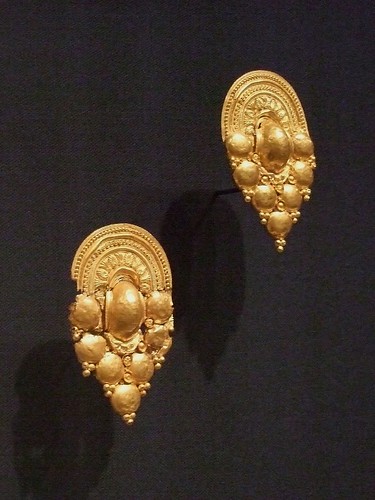
If any of you can make it to Dallas to see these treasures, be sure to stop by the Dallas Museum of Art as well as they have a very diverse Greco-Roman gallery including a large collection of gold Etruscan jewelry like these 5th-3rd century BCE gold grappolo earrings.

The Florence Archaeological Museum holds what is arguably the finest collection of Etruscan art in the world, and some of the choicest objects from its collection will come to the Meadows. These extraordinary objects illustrate every aspect of Etruscan life and afterlife over almost a thousand years. The Etruscans were ruled by a theocratic elite that controlled every aspect of Etruscan life; priest/magistrates were believed to be skilled at interpreting the will of the gods. The exhibition will include ritual objects, such as votive bronzes offered to the gods in sanctuaries, or objects used for interpreting the will of the gods, such as the still-mysterious Magliano lead disc. The exhibition also will include an entire temple pediment—the terracotta decoration for the front of an Etruscan temple—showing that the Etruscans were masters at working terracotta as well as bronze (the Etruscan skill at creating decorative objects in bronze was much admired by the Greeks, and adapted by the Romans). Additionally, a multitude of objects will be shown from Etruscan tombs: sarcophagi and ash urns, guardian animals and demons, as well as the splendid gold, silver, bronze, ivory, and ceramic objects that were deposited in the tombs of the wealthy. Especially impressive is the gold jewelry, so technically advanced that it is difficult to reproduce today.
Fifteen years of excavation at the Etruscan site of
Poggio Colla will also be displayed in an accompanying exhibit, New Light on the Etruscans. Overseen by Dr. P. Gregory Warden, a classical archaeologist and University Distinguished Professor of Art History at SMU, and Dr. Michael L. Thomas, archaeologist and Senior Research Associate at The University of Texas at Austin, the site, first excavated from 1968 to 1972 by Dr. Francesco Nicosia, the former Superintendent of Archaeology in Tuscany, was reopened in 1995.

"Archaeological evidence suggests that Poggio Colla was occupied from as early as 650 B.C.E. until at least 187 B.C.E. The site centers on the acropolis, a roughly rectangular plateau of one and a half acres at the summit of Poggio Colla. Excavations have found strong evidence that the acropolis was a sanctuary and have identified a building and an altar associated with the structure. The building’s form evolved from a modest hut-like structure in the seventh century B.C.E. to a monumental complex with stone foundations and tile roofs by the time of its destruction in the second century B.C.E. Since 1995, excavations have unearthed five stone column bases and other parts of a monumental building that are a testament to the scale and importance of this rural sanctuary at the frontier of the Etruscan world...

...Excavators discovered a large circular pit, at the center of which was placed a sandstone cylinder, possibly the top of a votive column or altar. Carefully situated near the cylinder were two sandstone statue bases, the larger of which is inscribed with the name of the aristocratic donor. Buried alongside these objects were a strand of gold wire, a purposely broken bronze implement, and two bronze bowls that had been used to pour ritual libations, as well as the bones of a sacrificial animal. This unique religious context allows us to reconstruct the actual rituals and actions of the priest/magistrate who presided over the ceremonies....

...a habitation and center of ceramic production [was] discovered in a field below the acropolis of Poggio Colla. The structure includes a room with a circular hearth surrounded by cooking vessels. A terraced outdoor work space preserved several carbonized post holes, perhaps the remnants of wooden drying racks surrounding a large fire pit. At the southern end of this terrace, set into a pit up against a terrace wall, excavation uncovered a deposit of unusual stands of a type usually used for banqueting. At the opposite side of the building were the remnants of three kilns. These teardrop-shaped kilns were used to produce simple fine-ware bowls of at least three different sizes."
If you enjoyed this post, never miss out on future posts by following me by email!


Friday, July 11, 2008

Capitoline Wolf Dated to 13th Century


It's rather ironic that just before I left for lunch today I lovingly touched the reproduction of the Capitoline wolf that I have on my bookcase before walking out the door. I returned and read the article below. Oh well, I'm sure the original wolf was just as enchanting. Sadly, it was probably the victim of the metal "meltdowns" that were widespread in the Roman Empire during the Dark Ages.


"A statue symbolising the mythical origins and power of Rome, long thought to have been made around 500BC, has been found to date from the 1200s.

The statue depicts a she-wolf suckling Remus and his twin brother Romulus - who is said to have founded Rome.

The statue of the wolf was carbon-dated last year, but the test results have only now been made public.

The figures of Romulus and Remus have already been shown to be 15th Century additions to the statue.

In a front page article in the Italian newspaper, La Repubblica, Rome's former top heritage official, Professor Adriano La Regina, said about 20 tests were carried out on the she-wolf at the University of Salerno.

He said the results of the tests gave a very precise indication that the statue was manufactured in the 13th Century.

Damaged paw

Academics have been arguing about the origins of the statue - known as the Lupa Capitolina - since the 18th Century.

Until recently it was widely acknowledged that the statue was an Etruscan work dating from the 5th Century BC.

The Roman statesman, Cicero, who lived in the 1st Century BC, describes a statue of a she-wolf that was damaged by a lightning strike - the Lupa Capitolina has a damaged paw.

However, in 2006, an Italian art historian and restorer, Anna Maria Carruba, argued that the statue had been cast in a single piece using a wax mould - a technique unknown in the ancient world.

She suggested the damage to the Lupa Capitolina's paw was the result of a mistake in the moulding process."

If you enjoyed this post, never miss out on future posts by following me by email!


Friday, May 9, 2008

Early Greek Influence In Etruria

I continue to listen to a lecture series on the intersection of Greek and Roman culture. In today’s lecture Professor Garland mentioned that the fifth king of Rome was really not Etruscan but the son of a Corinthian Greek named Demaratus who settled in Tarquinia to teach the Etruscans how to mold clay – especially into roof tiles. Apparently, roof tiles from Etruria have even been found in excavations of Corinth and scholars think the clay beds recently uncovered in Rome were probably the source of the raw material used in their construction. I found this information really interesting.

In his evaluation of classes of early Etruscan pottery, Alan Blakeway, in his article "Demaratus": A Study in Some Aspects of the Earliest Hellenisation of Latium and Etruria" in The Journal of Roman Studies, observes:

"This class, implying as it does the presence of Greek craftsmen in
Etruria at least as early as the ninth century B.c., is by far the most important as evidence of the character of this early Hellenisation. It is, of course, impossible to estimate exactly the contribution of these Greek [craftsmen] the development of Etruscan civilisation in this and in the following period, but it must be admitted that they provide a more satisfactory explanation of the Hellenisation of Etruscan Art in the ninth, eighth and seventh centuries than the theory of native genius working on imported models. In fact, it is probably they who are largely responsible for the great capacity for the imitation of Greek products shown by some of the ninth- and eighth-century potters of Etruria, as well as for the efflorescence of Graeco-Etruscan art in the seventh century. For Etruscan art (unlike that of most other Barbarian peoples) thus not only enjoyed the benefit of Greek influence both early in its own history and at a time when Greek art was not so far advanced beyond that of Etruria as to sterilise the native genius, but also learnt its lessons, in part at least, from Greek craftsmen working in Etruria, and not merely from the chance models imported by
Greek commerce."

He goes on to say:

"So far as our archaeological evidence goes, this earliest Greek influence seems to have been almost as strong as the Oriental in its effects on Etruscan art. If indeed there was any large-scale Oriental immigration in this and the preceding period, the art brought with it had no overwhelming or immediate effect on that of Etruria. With the major historical problem of the origin of the Etruscans I am not concerned; but it is necessary for me to point out that the theory of late Lydian immigration has done much to obscure (if not to conceal)the important early Greek contribution to Etruscan civilisation. Greek influence on Etruria is, in fact, not confined to the seventh century and later: it begins almost as soon as the civilisation of Etruria (on one theory) passed from the Villanovan to the Etruscan culture, that is to say, it almost coincides in time with the first appearance of non-Italian imports and influence."
If you enjoyed this post, never miss out on future posts by following me by email!


Wednesday, June 27, 2007

Brennus and the First Sack of Rome


I'm about two-thirds of the way through Steven Saylor's latest epic novel, "Roma", and am enjoying it very much. I just finished a section about the first sack of Rome by the Gauls under the command of Brennus. Most of my study has concentrated on the Late Republic so I didn't know much about this first sack other than when it occurred and it was the Gauls who did it.

However, Steven's characters are among the defenders that fortified themselves up on top of the Capitoline and held off the Gauls for seven months. I always assumed the sack was over in a few days like most sacks but it went on for quite a prolonged period. I also did not realize that the Veii question was so disruptive. I knew the Romans had conquered Veii but I assumed they simply added its people to the expanding Republic. I didn't realize the people were sold away into slavery and the city was left abandoned. Perhaps its people were treated so harshly because of the legendary massacre of the 300 Fabii at Cremora.

"Within a year of the victory at Cremora, the Etruscan navy, in conflict with Greece, was destroyed by Hieron of Syracuse, off of Cumae. The result was a military disaster for the Etruscans that they never really seemed to recover from. The various city states of the Etruscan league, including Veii, devolved more and more into separate unrelated entities, thereby losing the strength of mutual protection. Veii, despite its recent upper hand at Cremora, was forced to make a treaty with Rome.

Within this time frame a more consequential series of events were taking place, however. Celtic Gauls had been migrating into northern Italy from the 6th century BC and establishing themselves at or near Etruscan territory. Raids and warfare with these people would have a debilitating effect on the Etruscans and play directly into the growing strength of Rome. The Gauls so weakened the Etruscans that the Romans, between 406 and 396 BC, went on the offensive.

It's about this period in history that Livy tells us of the legendary Roman hero M. Furius Camillus. Under his command Fidemae was retaken from Veii, and then the city of Veii itself came under siege. According to the legend, the Siege of Veii lasted 10 years, but its description is so closely paralleled to the Homeric Siege of Troy, that we must take into account the propaganda used by ancient sources to inflate the glory of Rome. The actual siege probably lasted considerably less time, though the introduction of a paid professional legion during this course of events indicates that it was a protracted campaign. The siege was finally broken, in 396 BC, when the Romans supposedly drained Alban Lake. This not only would divert water supplies from the city but allowed access for Roman soldiers to sneak under the walls through empty stream beds. In the end, whatever the truth behind the legend may be, Camillus was credited with saving Rome and bestowed with the unending admiration of the Romans throughout its history.

Gaining Veii, the Romans, in stark contrast to their general conquest policies of incorporation, destroyed much of the city and drove out many of the Etruscan residents. The territory was allotted to Roman citizens, and four new tribes were created: the Stellatine, Tromentina, Sabatina and Aniensis." - Veii and the Etruscans, UNRV.com

Therefore, when the Gauls practically destroyed Rome, the hotly debated question became whether to rebuild Rome or to transfer her entire population to the empty city of Veii only twelve miles away. The hero Camillus was instrumental in persuading the people to rebuild Rome although those jealous of his success constantly complained that he was enriching himself through building contracts since he controlled most of the spoils and property from the Veii conquest.
If you enjoyed this post, never miss out on future posts by following me by email!