Showing posts with label Temple. Show all posts

Monday, March 29, 2021

The Temple of Jupiter Optimus Maximus

The Temple of Jupiter Optimus Maximus, also known as the Temple of Jupiter Capitolinus was the most important temple in Ancient Rome, located on the Capitoline Hill. It was surrounded by the Area Capitolina, a precinct where numerous shrines, altars, statues and victory trophies were displayed.

The first building was the oldest large temple in Rome, and, like many temples in central Italy, shared features with Etruscan architecture. It was traditionally dedicated in 509 BCE but in 83 BCE was destroyed by fire.  A replacement in Greek style was completed in 69 BCE (there were to be two more fires and new buildings). For the first temple sources report Etruscan specialists being brought in for various aspects of the building, including making and painting the extensive terracotta elements of the Temple of Zeus or upper parts, such as antefixes. But for the second building they were summoned from Greece, and the building was presumably essentially Greek in style, though like other Roman temples it retained many elements of Etruscan form. The two further buildings were evidently of contemporary Roman style, although of exceptional size.  The third temple only lasted five years, to 80 CE, but the fourth survived until the fall of the empire. Remains of the last temple survived to be pillaged for spolia in the Middle Ages and Renaissance, but now only elements of the foundations and podium or base survive.

I found this image of a reconstructed temple while searching Google Earth.  It appears to be a modern life-sized reconstruction but I've never seen it on either of my trips to Rome so I don't know if this is a model of one version of the temple simply added to Google Earth for historical reference or whether it is actually a reconstruction in situ. (Note: I've added the clouds to make the image more interesting).  I would welcome any further information anyone has about this structure.

Reconstruction of the Temple of Jupiter Optimus Maximus in Rome courtesy of Google Earth


If you enjoyed this post, never miss out on future posts by following me by email!


Saturday, August 8, 2020

Roman Mithraism

 Although scholars argue about whether Roman Mithraism arose in the 1st century BCE or the 1st century CE, Plutarch mentions the pirates of Cilicia were practicing secret rites of Mithras in 67 BCE. Plutarch says these pirates were especially active during the Mithridatic wars (between the Roman Republic and King Mithridates VI of Pontus) in which they supported the king. The association between Mithridates and the pirates is also mentioned by the ancient historian Appian. The 4th century commentary on Vergil by Servius says that Pompey settled some of these pirates in Calabria in southern Italy. However, the unique underground temples or mithraea appear suddenly in the archaeology in the last quarter of the 1st century CE.  

The earliest monument showing Mithras slaying the bull thought to have been found in Rome bears an inscription that tells us it was dedicated by a certain Alcimus, steward of T. Claudius Livianus, commander of the Praetorian guard in 101 CE. The first important expansion of the mysteries in the Empire seems to have happened quite quickly, but not until late in the reign of Antoninus Pius (b. 121 CE, d. 161 CE) and under Marcus Aurelius.  Mithraism reached the apogee of its popularity during the 2nd and 3rd centuries in parallel with the worship of Sol Invictus. It was a religion of redemption and taught Mithras guided souls from their earthly life back to the light from which they issued upon their death. Mithraism survived until the late 4th to early 5th century CE when Christianity became strong enough to exterminate it by force supported by the anti-pagan decrees of the emperor Theodosius.

Image: Fresco of Mithras and the bull from the Temple of Mithras in Marino, Italy dated to the 2nd century CE courtesy of Wikimedia Commons.

If you enjoyed this post, never miss out on future posts by following me by email!


Saturday, June 27, 2020

The use of the antefix on Greek, Etruscan and Roman architecture

Antefixes were mold-made, usually brightly painted, terracotta decorative covers to conceal the edges of joined roof tiles and protect the seams from the elements.  They often took the form of heads, either of humans or mythological creatures. The earliest examples in museum collections date back to the 6th century BCE in both Greece and Etruria.  They were also a frequent feature on Roman architecture as well. 

On temple roofs, maenads and satyrs were often alternated.  The frightening features of the Gorgon, with its petrifying eyes and sharp teeth was also a popular motif to ward off evil.  A Roman example from the Augustan period features the butting heads of two billy goats.  It may have had special significance in imperial Rome since the constellation Capricorn was adopted by the emperor Augustus as his own lucky star sign and appeared on coins and legionary standards.

In 2005, I visited the Villa Giulia in Rome that houses a large Etruscan collection.  In their courtyard is a reproduction of an Etruscan temple with antefixes. I've included my images of it here along with photographs of various antefixes I have photographed at the Getty Villa, the Walters Art Museum and images of those at the Metropolitan Museum of Art.

Replica of an Etruscan temple at the Villa Giulia in Rome, Italy

Replica of an Etruscan temple at the Villa Giulia in Rome, Italy

Replica of an Etruscan temple at the Villa Giulia in Rome, Italy

Etruscan antefix 1st century BCE courtesy of  Jean-Pol Grandmont 

Etruscan Antefix with Head of Silenus 4th century BCE Terracotta  photographed
at the Walters Art Museum

Etruscan antefix in the shape of a dancing Maenad and Satyr 500-475 BCE
photographed at the Getty Villa

Etruscan Terracotta antefix with head of a maenad 4th century BCE On this Etruscan antefix from Cerveteri, the maenad wears an elaborate diadem and very large grape-cluster earrings, a type of jewelry especially popular in the fifth and fourth centuries B.C.E.

Greek Terracotta gorgoneion antefix 580-570 BCE The frightening features of this Gorgon head, its petrifying eyes and sharp teeth, correspond to its Archaic date and were likely intended to ward off evil. Throughout the following century, the Gorgon tended to lose its more terrifying characteristics, and by the Late Classical period, its features were sweetened.Courtesy of the Metropolitan Museum of Art

Antefix head of a satyr Etruscan 250-175 BCE courtesy of the Getty Villa 

Antefix Roman 1st century BCE - 1st century CE courtesy of The Metropolitan Museum of Art.  This example, showing Venus (Aphrodite, the goddess of love) and her lover Mars (Ares, the god of war), retains a considerable amount of its painted surface.

The palmette-shaped antefix is decorated with the butting heads of two billy goats. Such representations were popular motifs in ancient art but they may have had special significance in imperial Rome since the constellation Capricorn was adopted by the emperor Augustus as his own lucky star sign and appeared on coins and legionary standards.  Courtesy of the Metropolitan Museum of Art.


If you enjoyed this post, never miss out on future posts by following me by email!


Saturday, July 11, 2015

Roman remains of ancient Gaul: Nimes (Nemausus)

An ancient history resource article by  © 2015
The Tour Magne is the remains of
one of the Roman tours built
during the reign of Augustus.
Image courtesy of Wikipedia.

In May, 2013, I had the opportunity to travel to southern France to explore and photograph Roman remains there. I originally wrote this article six months later and saved it to draft.  I only now noticed that I hadn't finished it.  So I thought I better wrap it up and get it posted. Thankfully, it wasn't a time-dependent piece.  As time permits I hope to write other articles about some of the sites I visited in Roman Gaul.

The first Roman site I visited in southern France was the city of Nimes known as Nemausus in Roman times, after a local sacred spring located there.

Nimes became part of the Roman Empire sometime before 28 BCE.  It was colonized by veterans of the Roman legions who had served Julius Caesar in his Nile campaigns. By the reign of Augustus in the 1st century CE Nimes had reached a population of 60,000.

Augustus ordered the construction of
a ring of ramparts six kilometres (3.7 miles) long, reinforced by fourteen towers.  Although two gates remain today, the Porta Augusta and the Porte de France, as well as the remains of one tower dubbed the Tour Magne, we, unfortunately, did not have time to inspect them. 


Our first stop was the Maison Carrée, a Roman temple originally constructed in 16 BCE. Originally the temple was designed after the temples of Apollo and Mars Ultor in the Forum of Augustus in Rome.  The structure was rebuilt by the famous Roman admiral, Marcus Agrippa (victor of Actium), in approximately 2 - 4 CE.  The temple was dedicated to his two ill-fated sons, Gaius and Lucius, who had been adopted by his best friend Augustus so they would rule Rome one day.  However, both died tragically young (poisoned by Augustus' vile wife Livia if we believe Robert Graves' interpretation of events in "I, Claudius!") 


The Maison Carree, an example of Vitruvian architecture built
in 16 BCE now houses an information center and theater
in Nimes, France.
Photo by . © 2013
The structure is an example of architecture popularized by the famous Roman architect, Vitruvius.  It is almost twice as long as it is wide with its entry fronted by six Corinthian columns topped with ornately carved acanthus leaves.


A pidgeon nestles into the protective acanthus
leaves sculpted on the capital of a Corinithian
column of the Maison Carrée
in Nimes, France.
Photo by  © 2013
The deep portico or proanos consumes 1/3 of the building's length and features a ceiling accented by a relief of ornamental rosettes.  The ceiling was restored in the early 19th century.  The big bronze doors were replaced in 1824.

Like the Pantheon in Rome, the temple survived the widespread destruction of pagan centers of worship after Rome adopted Christianity because it was converted to a church.  In the years that followed it was subsequently converted to a meeting hall for the city's consuls, a canon's house and even a stable for government-owned horses during the French Revolution.  It now houses an information center and theater.

Inside we bought a three day pass for all of the surrounding historical sites for only 11 Euros. It included admission to a short 3-D movie about the history of Nimes that was very well done even though Cecelia, a medieval reenactor, made fun of the less than authentic fencing in one of the segments.

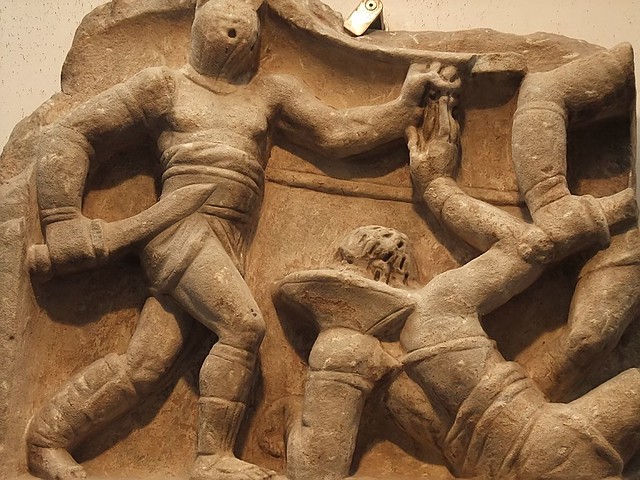
I thought the segment on gladiatorial fights was quite authentic with a properly attired Roman referee and a retiarius (net man with trident) and a Secutor battling it out with little blood spilled. Each time one of the gladiators was in danger of a mortal wound the referee would step in and separate the combatants. 

Finally one of the men went down and the referee looked to the crowd for a verdict and declared the victor without any further harm coming to his opponent. In historical times that type of encounter was far more common than the blood bath seen on the Starz' Spartacus: Blood and Sand series. The only thing that was not quite authentic was that the men were relatively svelt. In Roman times gladiators ate an almost vegetarian diet of barley gruel to put on a protective layer of fat and often appeared rather barrel-chested.


This Roman relief  found along the Via Appia near the tomb of Cecilia Metella
illustrates the well fed contours of arena combatants in the 1st century BCE
.
Photogaphed at the Baths of Diocletian venue of the National Museum, Rome, Italy by  © 2009
After the movie ended we climbed down the rather steep stairs and walked several blocks to the Roman amphitheater. The amphitheater was constructed in approximately 70 CE.  It measures 133 meters long and 101 meters wide and in ancient times could seat 24,000 people.  The stone for its construction was quarried at Roquemaillère and Baruthel located near Nîmes.

s er
A Roman amphitheater now serves
as a venue for bullfights
in Nimes, France.
Photo by  © 2013
Although several tiers of the structure are now missing, what remains is in very good condition. It is significantly smaller than the Colloseum in Rome, though. 


Once fortified by the Visigoths, the Nimes amphitheater was a target of destruction
by Charles Martel in 737 CE so only the lower tiers of the structure remain.
Photographed in Nimes, France by  © 2013
With the upper tiers of the structure missing I could not see any remnants of the supports for the sun shades that were usually extended to shade the spectators on a hot day. I also did not see any numbers carved in to the stone above the various entry doors that matched tokens given to attendees to tell them which door to use so ingress and egress could be accomplished in a relatively short time.  The official website for the site pointed out the fore-body parts of two bulls with their legs folded on either side on one of the arches.  I wish I would have noticed that. 

It also said there was a relief of a she-wolf giving milk to two children, Romulus and Remus, the mythical founders of Rome, on one of the pilasters opposite the Palais du Justice. Unlike the Roman version, the Nîmes she-wolf is looking towards the children. If you visit the amphitheater, don't overlook them like I did.

The archaeology museum in Nimes,one of the largest in France, is presently housed in the 17th century Jesuits College at 13 Boulevard Amiral Courbet, 30000. Iron age and Gallo-Roman artifacts comprise most of the collection with a host of everyday objects, including sigillated ceramics, bronze tableware, lamps, toilet and dress accessories. There is also an exhibit of Greek ceramics that have been recovered from the area.

In 2018, the collection will be moved to the new Museum of Romanity that is being built facing the Roman amphitheater.
An artist's rendering of the new Museum of Romanity slated for completion in 2018.  Image courtesy of  Nimes Tourism.


If you enjoyed this post, never miss out on future posts by following me by email!


Sunday, December 20, 2009

Exploring 1st - 4th century Roman villas in Brescia sounds fascinating!


I received a touristy little news item about the northern Italian town of Brescia that caught my interest.  The article mentioned that the area contained the largest Roman excavation in northern Italy so, of course, I had to read more about it.  I learned that Brescia, was once known as Brixia.

[Image: Mosaic floor of a 1st - 4th century Roman villa preserved at the Brescia Musei, Brescia, Italy.]

"Different mythological versions of the foundation of Brescia exist: one assigns it to Hercules, while another attributes its foundation to Altilia ("the other Ilium") by a fugitive from the siege of Troy. According to a further myth, the founder was the king of the Ligures Cidnus, who had invaded the Padan Plain in the late Bronze Age. Scholars attribute the foundation to the Etruscans." - Wikipedia

The Etruscans fell to the  Gallic Cenomani, allies of the Insubres, in the 4th century BCE.  The Celts succumbed to the Romans in 225 BCE.   But the Celts were not all satisfied with Roman rule and became part of a Celtic confederation allied with the Carthaginians in 202 BCE during the 2nd Punic War.

"...but, after a secret agreement, [Brixia] changed side and attacked the Insubres by surprise, destroying them. Subsequently the city and the tribe entered the Roman world peacefully as faithful allies, maintaining a certain administrative freedom. In 89 BC Brixia was recognized as civitas ("city") and in 41 BC its inhabitants received Roman citizenship. Augustus founded a civil (not military) colony there in 27 BC, and he and Tiberius constructed an aqueduct to supply it. The Roman Brixia had at least three temples, an aqueduct, an amphitheater, a forum with another temple built under Vespasianus, and some baths.

When Constantine advanced against Maxentius in 312, an engagement took place at Brixia in which the enemy was forced to retreat as far as Verona. In 402 the city was ravaged by the Visigoths of Alaric I. During the invasion of the Huns under Attila, the city was again besieged and sacked in 452 while, some forty years later, it was one of the first conquests of the Gothic general Theoderic the Great in his war against Odoacer." - Wikipedia

Republican-era buildings were discovered there in the 19th century under the remnants of the Capitolium, the temple built by the Emperor Vespasian.  Artifacts recovered from these excavations include Celtic arms, Roman portrait sculpture, frescoes and mosaics.  The Santa Giulia City Museum houses these discoveries as well as a collection of preserved Roman townhouses from the 1st to 4th century CE.

I'm also a big fan of armor collections and I see that the castle portion of the Museum houses an arms collection in the keep.  Over 580 swords, firearms and suits of armour, over half of the 1090 items bequeathed by industrialist Luigi Marzoli, are displayed in ten exhibit rooms.  The oldest item is a sword from the 13th century and one of the rarest is a large Venetian helmet and under-helmet with visor in the shape of a dog’s muzzle.

I had a wonderful time photographing the extensive armor collection at the Metropolitan Museum of Art in New York several years ago.  I would love to add images of  Brescia's marvelous collection to my Flickr set! I haven't yet visited Venice and I was really anxious to explore Ravenna someday too.  It looks like I need to plan a major expedition to northern Italy!


Houses, Villas, and Palaces in the Roman World     Roman Villas in Central Italy (Columbia Studies in the Classical Tradition)     Arms & Armor (DK Eyewitness Books)   Medieval Arms and Armor: A Pictorial Archive (Dover Pictorial Archive Series)   Vespasian   The Architecture of Roman Temples: The Republic to the Middle Empire
If you enjoyed this post, never miss out on future posts by following me by email!


Wednesday, July 25, 2007

Julian the Apostate's support of the Jews

A history resource article by  © 2007

Julian the Apostate presiding at a conference of sectarians by Edward Armitage, 1875.  Image courtesy of
Wikimedia Commons.
I found this article about Julian's support for the reconstruction of the Jewish Temple in Jerusalem quite interesting. I have read Michael Curtis Ford's "Gods and Legions", a novel about the life and reign of the emperor Julian and gained an admiration for this "soldier, inspired military commander and rhetorician" despite the centuries of vilification heaped upon him by subsequent Christian rulers.

"The Roman Emperor Julian, who ruled 361-363 CE, called on the Jews to return to the Land of Israel and rebuild their Temple in Jerusalem. Whatever his motives, he showed our ancestors unusual respect and understanding. 
Julian was hardly an ordinary emperor, though history has failed to pay sufficient attention to his policies. In Julian, the Romans had a just ruler and brave soldier. He was a modest man who labored to relieve the distress of his subjects while endeavoring to connect authority with merit and happiness with virtue. 

A bronze coin portrait of the Emperor Julianus II (the Apostate)

As a young soldier Julian subdued, against the odds, the German threat in Gaul with a small force. He ruled ancient Gaul with wisdom and authority, hardly ever seeking a personal gain. He slept on the ground with his legionnaires, earning their respect. Julian was an excellent organizer, an honest judge, a writer and a philosopher. 
Brought up as a Christian, Julian rejected the religion and turned back to the paganism of Greek and Roman days. He argued that Christianity would weaken and ultimately destroy the Roman Empire. As a result, he attempted to restore Hellenism, which earned him everlasting Christian disdain. 
Known to Christians as Julian the Apostate, the emperor restored pagan temples and the cult of the old Roman gods. These were to be served by a reform-minded pagan clergy with high moral character, who would compete with the Christian clergy in meeting the religious needs of the people. 
Julian remains famous for having declared absolute freedom for all religious beliefs - making him perhaps the first leader to extend toleration of religion to all Romans. 
ON THE July 19, 362 C.E., Julian left Constantinople and arrived in Antioch to prepare for the invasion of Persia. However busy he must have been, he met with "the chiefs of the Jews." 
The details of this fascinating meeting, preserved only in Christian sources, are cited in Michael Avi Yona's The Jews under Roman and Byzantine Rule - A Political History from the Bar Kochba War to the Arab Conquest. 
Julian, who wanted to form a common cause with the Jews against Christianity, asked: "Why do you not sacrifice to God, as required by the laws of Moses?" 
The Jews replied: "We are not allowed by our laws to sacrifice outside our Holy City. How can we do it now? Restore to us the City, rebuild the Temple and the altar, and we shall offer sacrifices, as in days of old." 
He promised: "I shall endeavor with the utmost zeal to set up the Temple of the Most High God." 
THE RESTORATION of the Jewish Temple in Jerusalem would, in Julian's opinion, defeat the Christian argument of replacement theology - that the Church was the true Israel, and that the Temple's destruction and the subsequent exile was the just punishment suffered by the Jewish people for the Crucifixion. The Temple's restoration, Julian figured, would persuade Christian converts that God still favored the Jewish people. 
As an army commander, embarking on a war against a formidable Persian enemy, Julian could also expect that the Jews of Mesopotamia would assist his legions. But there can also be no doubt that Julian's attitude of fairness and his respect for the stubborn stand of the Jewish remnant played a role in his desire to achieve a Jewish restoration. 
In his "Four Letters" addressed to the Jewish people, Julian recognized their dire situation and appealed to them to join him in his campaign. That's a vast difference from the Persian ruler Cyrus, who had only allowed the Jews to rebuild the Temple; Julian virtually ordered them to do so, and perhaps, upset by their initial hesitation, appointed Alypius, a pagan native of Antioch and his best friend, to supervise the work. 
In a letter to the Jewish Patriarch Hillel II, residing in Tiberias, Julian abrogated the entire gamut of anti-Jewish legislation and recognized Jewish authority in Israel, including the right to levy taxes. 
ACCORDING TO the Christian sources, there was considerable initial enthusiasm among the Jews of Diaspora. Many purses were opened. But other leading Jews were confused and apprehensive. The community had only recently suffered yet another painful defeat in the failed uprising against Gallus (351 C.E.), which erupted in protest against discriminatory anti-Jewish legislation. The Patriarchate had lost Lydda, the few remaining settlements in Judea and several vital Galilean villages. 
A 354 CE sketch of Constantius Gallus.  Image courtesy of Wikimedia Commons.

The people quoted a verse from Daniel (11:34): "Now when they shall stumble, they shall be helped with a little help; but many shall join themselves unto them with blandishments." 
The Jews were doubtless divided between those who believed that Julian was a savior and those who remembered Rabbi Simon Ben Eliezer's warning against the youthful enthusiasm of the second generation after the Bar Kochba disaster: "If children tell you: 'Go, build the Temple - do not listen to them.'" 
Above all, could Jewish hopes depend on the fortunes of one man? 
In the end, no attempt was made to set up a temporary altar and offer sacrifices on the former Temple grounds, as the Maccabeans had done. While the Jews could not oppose the will of the Roman emperor, they could drag their feet. Apparently the majority did. They remembered Rome as Amalek, not as a benefactor. 
THE WORK ordered on the Temple's foundation advanced slowly. It took time to provide silver spades and pickaxes, since no iron was allowed to be used. And then, according to the Roman writer Ammianus, "balls of fire" supposedly erupted from the foundations and rendered the place inaccessible. 
The Christian majority of Jerusalem described this fire in glowing terms, as a splendid miracle, a further proof of the rightness of Christianity. The Jews suspected Christian arson. Meanwhile Alypius, Julian's pagan friend, seemed hardly in a hurry to carry out the emperor's order."
A Kindle preview of "Gods and Legions" by Michael Curtis Ford:


More suggested reading:


If you enjoyed this post, never miss out on future posts by following me by email!