Hecate or Hekate is a goddess in ancient Greek religion and mythology, most often shown holding a pair of torches or a key. In later periods she is often depicted in triple form. She is variously associated with crossroads, entrance-ways, night, light, magic, witchcraft, knowledge of herbs and poisonous plants, ghosts, necromancy, and sorcery. Her earliest appearance in literature was in Hesiod's Theogony in the late 8th century BCE as a goddess of great honor with domains in sky, earth, and sea. Her place of origin is debated by scholars, but she had popular followings amongst the witches of Thessaly and an important sanctuary among the Carians of Asia Minor in Lagina.
Hecate was one of several deities worshiped in ancient Athens as a protector of the oikos (household), alongside Zeus, Hestia, Hermes, and Apollo. Some scholars have suggested Hecate was originally considered an aspect of Artemis prior to the latter's adoption into the Olympian pantheon. Artemis would have, at that point, become more strongly associated with purity and maidenhood, on the one hand, while her originally darker attributes like her association with magic, the souls of the dead, and the night would have continued to be worshiped separately under her title Hecate.
The general motif of a triple Hecate situated around a central pole or column, known as a hekataion, was used both at crossroads shrines as well as at the entrances to temples and private homes. These typically depict her holding a variety of items, including torches, keys, serpents, and daggers. Sometimes she is depicted with Charites dancing around her. Charites are sometimes called the Graces (Gratiae in Roman mythology) and refer to three or more goddesses of charm, beauty, nature, human creativity, goodwill, and fertility.
Hecate was closely associated with dogs and her approach was heralded by the howling of a dog. Although in later times Hecate's dog came to be thought of as a manifestation of restless souls or demons who accompanied her, its docile appearance and its accompaniment of a Hecate who looks completely friendly in many pieces of ancient art suggests that its original signification was positive and thus likelier to have arisen from the dog's connection with birth than the dog's underworld associations.
 |
| Triple-formed representation of Hecate, Marble, Roman copy after an original of the Hellenistic period courtesy of Wikimedia Commons contributor Marie-Lan Nguyen |
 |
| Gilt bronze Hekataion, 1st century CE Musei Capitolini, Rome courtesy of Wikimedia Commons contributor Daderot (digitally enhanced) |
 |
| Hekataion with the Charites, Attic, 3rd century BCE at the Glyptothek, Munich courtesy of Wikimedia Commons contributor Bibi Saint-Pol. |
 |
| Juniper wood Hekataion from Ptolemaic Egypt, 304–30 BCE, courtesy of the Metropolitan Museum of Art |
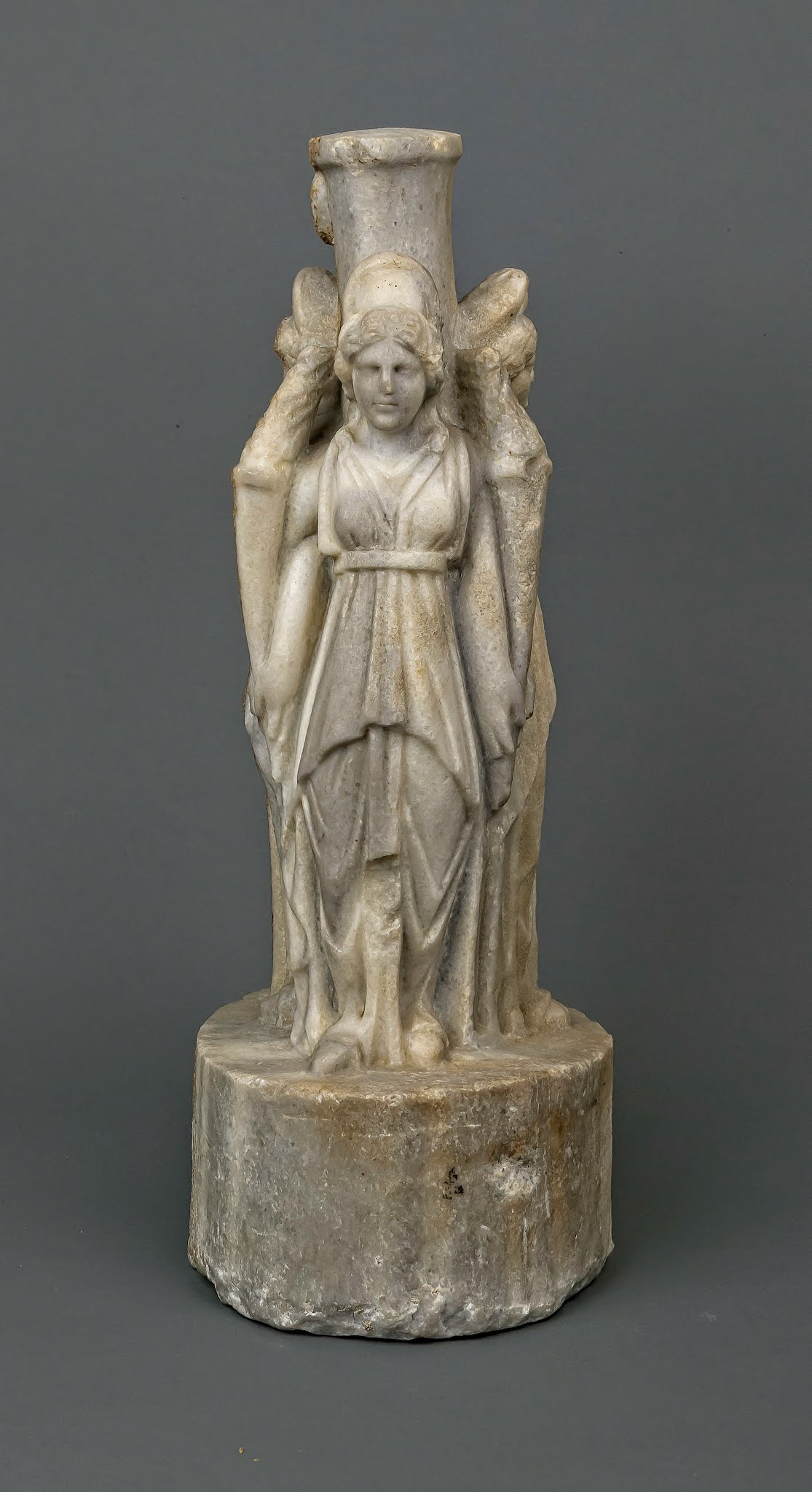 |
| Marble hekataion, Roman, 2nd century CE, courtesy of the Metropolitan Museum of Art |


