Showing posts with label worship. Show all posts

Friday, August 27, 2021

Pompeii Walk - 1st 30 minutes

The first 30 minutes of a 5 hour Pompeii walk video that I enjoyed immensely. Although I wasn't controlling the video camera, I was able to grab some screen shots that with a little editing with Topaz Sharpen AI, On1 Effects, and Photoshop's sky replacement feature (In summer Naples skies are usually empty and that makes for boring images!) I felt like I was revisiting the site and didn't even have to suffer any jet lag!


Enhanced screen captures:

House of the Mariner Tablinum screen capture from Pompeii Walk video courtesy of POMPEII ARCHAEOLOGICAL PARK

Mosaic fragments from the House of Trittolemo Pompeii Walk video courtesy of POMPEII ARCHAEOLOGICAL PARK

Mosaic fragments from the House of Trittolemo Pompeii Walk video courtesy of POMPEII ARCHAEOLOGICAL PARK

Apollo statue in Temple of Apollo Pompeii screen capture from Pompeii Walk video courtesy of POMPEII ARCHAEOLOGICAL PARK

Apollo statue in Temple of Apollo Pompeii screen capture from Pompeii Walk video courtesy of POMPEII ARCHAEOLOGICAL PARK

Diana in the Temple of Apollo Pompeii screen capture from Pompeii Walk video courtesy of POMPEII ARCHAEOLOGICAL PARK

Temple of Apollo Pompeii screen capture from Pompeii Walk video courtesy of POMPEII ARCHAEOLOGICAL PARK

Temple of Apollo Pompeii screen capture from Pompeii Walk video courtesy of POMPEII ARCHAEOLOGICAL PARK


The Eumachia, the largest building in the Forum of Pompeii screen capture from Pompeii Walk video courtesy of POMPEII ARCHAEOLOGICAL PARK

Statue of the priestess Eumachia in Pompeii screen capture from Pompeii Walk video courtesy of POMPEII ARCHAEOLOGICAL PARK

The Forum in Pompeii screen capture from Pompeii Walk video courtesy of POMPEII ARCHAEOLOGICAL PARK

Interior of the Sanctuary of the Genius of Augusts in Pompeii screen capture from Pompeii Walk video courtesy of POMPEII ARCHAEOLOGICAL PARK

Sanctuary of the Genius of Augustus in Pompeii screen capture from Pompeii Walk video courtesy of POMPEII ARCHAEOLOGICAL PARK

The circular area in the center of the Macellum was a fish market in Pompeii screen capture from Pompeii Walk video courtesy of POMPEII ARCHAEOLOGICAL PARK

Frescoes on the walls of the Macellum in Pompeii screen capture from Pompeii Walk video courtesy of POMPEII ARCHAEOLOGICAL PARK

Frescoes on the walls of the Macellum in Pompeii screen capture from Pompeii Walk video courtesy of POMPEII ARCHAEOLOGICAL PARK

Frescoes on the walls of the Macellum in Pompeii screen capture from Pompeii Walk video courtesy of POMPEII ARCHAEOLOGICAL PARK

Remains of victims of Pompeii stored in the Macellum screen capture from Pompeii Walk video courtesy of POMPEII ARCHAEOLOGICAL PARK

A worship center in the end of the Macellum in Pompeii screen capture from Pompeii Walk video courtesy of POMPEII ARCHAEOLOGICAL PARK

Another view of the Forum in Pompeii screen capture from Pompeii Walk video courtesy of POMPEII ARCHAEOLOGICAL PARK

If you enjoyed this post, never miss out on future posts by following me by email!


Friday, August 20, 2021

Disability and the politics of "Divine Disfavor" in the Greco-Roman world

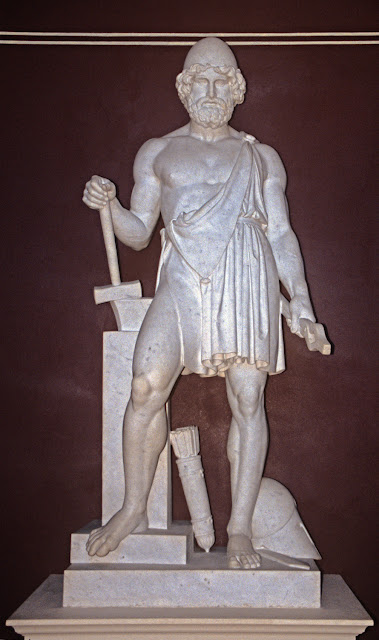
I was reading Classical Wisdom's newsletter in preparation for this weekend's virtual symposium and found their article "Hephaestus:The Humane God" particularly interesting. Although most of us think of Hephaestus as the divine metalworker that forged magical armor and weapons like the shield of Achilles, Sean Kelly pointed out that he was also the only god in the Greek pantheon (and Roman under the name Vulcan) who suffered from a physical impairment.  Hephaestus attempted to intervene in a quarrel between  Zeus and Hera, and an enraged Zeus  cast him from Mount Olympus, injuring his legs.  Thereafter he was the subject of derision because of his lameness although he was respected for his smithing skills. He forged Hermes' winged helmet and sandals, the Aegis breastplate, Aphrodite's famed girdle, Agamemnon's staff of office, Achilles' armour, Diomedes' cuirass, Heracles' bronze clappers, Helios' chariot, the shoulder of Pelops, and even Eros's bow and arrows. This did not prevent him from being referred to as "the lame one" or "the halting" though. However, an inscription found in Knossos, Crete indicates he was still worshipped.

So was this contradiction extended to those who suffered physical impairments in the human realm of the Greco-Roman world?

Classicist Martha L. Rose argues that modern models of "pity, charity, and categorization" were not imposed onto ancient persons with disabilities. Other scholars further observe that although modern categories of disability were not employed by ancient Greeks and Romans, there was the social stigma that individuals who were "unable" to perform some activities fell short of bodily or aesthetic ideals.  Garland adds that these individuals were also, at least to some extent, excluded from the religious life of the community, especially from service in priesthoods.

"In classical antiquity as in later times the social response to the handicapped was in part determined by religion, since beauty and wholeness were regarded as a mark of divine favor, whereas ugliness and deformity were interpreted as signs of the opposite. It made a difference, too, whether a disability was congenital or acquired later through disease, accident, warfare, or debauchery". - Robert Garland, The Eye of the Beholder: Deformity and Disability in the Graeco-Roman World.

References to "debilitas" in Rome encompassed both physical and other types of impairment, such as language difficulties, as evidenced in the writings of Cicero and Livy.  Aristotle even referred to baldness as a defect which may account for Gaius Julius Caesar's obsessive efforts to disguise his baldness as it could be perceived as him being among those with divine disfavor even though he claimed to be descended from Venus.

Blindness or partial blindness was highly regarded in the Roman psyche. Many individuals became famous after losing an eye. Notably, slaves would sometimes enter gladiatorial matches with a patch over a functioning eye, though historians disagree on whether this was in reference to the mythical cyclops or to make the gladiator appear more experienced. It is also known that many mythological figures, as well as known historical individuals, were thought by the Romans to have been blinded in return for favors from their gods. Such gifts varied from foresight to talent in singing.

Although Roman leaders typically had themselves depicted as physically perfect in statues and coinage, disabilities from injuries received while in the military were seen as marks of honor as opposed to simple disfigurements, with injuries to the eyes appearing most frequently in both common soldiers and famous personalities such as Hannibal.  In Commentarii de Bello Gallico, Julius Caesar mentions that the Gauls commonly maimed his centurions, usually by blinding them, mentioning that four centurions out of a cohort were blinded. Soldiers disabled in such circumstances were given a stipend by the state once they retired.

Walter D. Penrose Jr. points out that the ancient Athenians also provided maintenance payments to the "adynatoi" and exempted them from military service.  War orphans, disadvantaged by the lack of a father, also eventually received a mandated allowance.

"Diogenes Laertius writes that Solon reduced the allowances paid to victors in Panhellenic games on the grounds that it would be tasteless to increase the honors for these, while ignoring those who had died in battle, whose sons should be supported and educated at state expense," reports Dillon in his paper, "Payments to the Disabled at Athens: Social Justice or Fear of Aristocratic Patronage?"  

But, Dillon thinks the actual subsidy was probably introduced as a reform of Periklean democracy rather than any legislation of Solon or Peisistratus.  He also doubts the charitable nature of such payments.

"It could  perhaps be suggested that Athens was a 'welfare state' that made financial provision for those who could not support themselves, with the Athenians being motivated by considerations of 'social justice' to make provision for those less fortunate than the typical able-bodied citizen. But this does not seem to be the character of Athenian society, even in the age of democracy. Rather, it seems that the Athenians were motivated less by altruistic considerations than by a concern for the democracy itself," Dillon states.

"In providing the adynatoi with a means of subsistence, it avoided forcing citizens who could not support themselves to rely upon wealthy citizens for financial assistance, Dillon says, "Such assistance could have led to the establishment of patron-client links detrimental to the interests of the democracy."

He also notes that the tradition of Peisistratus providing financial assistance to farmers so they could make a decent living was also probably the result of a desire to keep them on the farms and away from the city where they might engage in political agitation.

Of course the Romans of the Republican Period embraced the patron-client relationship as a social model, despite reservations of Romulus as reported by the Greek historians Dionysius and Plutarch, because it was deemed "perculiarly congenial" to Roman politics and lent a sense of familia between citizens. However, as powerful generals began to extend their patronage over entire communities of the conquered or defended, the Republican form of government was doomed.  

Both Caesar and Augustus, established client-patron relationships in conquered regions. This can be seen in Caesar’s relations with the Aedui of Gaul wherein he was able to restore their influence over the other Gallic tribes whom where once their clients. Thereafter he was asked on several occasions to serve the duties of a patron by the Aedui and was thus regarded by many in Rome as the patron of the Aedui.  Augustus established colonies in all parts of the empire during his conquests which extended his influence to its very furthest reaches. He also made many acts of largess to the whole population of Rome, including food and monetary handouts, as well as settling soldiers in new colonies that he sponsored which indebted a great many people to him, serving his ambitions for power.

You can read more about The Discourse of Disability in Ancient Greece here:

https://www.academia.edu/27820223/The_Discourse_of_Disability_in_Ancient_Greece
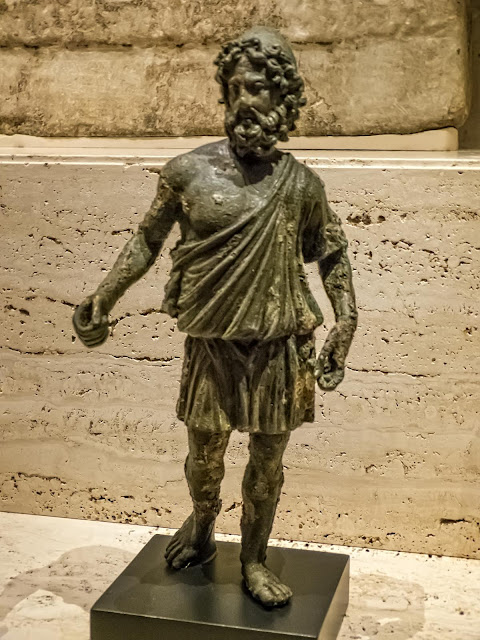
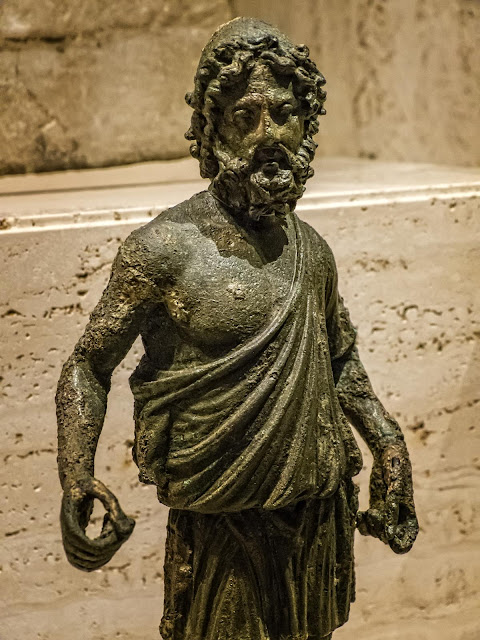
Statuette of Hephaestus the god of fire and patron of jewelers, armorers and blacksmiths Roman copy of a Greek original 1st - 2nd century CE Bronze that I photographed at the Nelson-Atkins Museum of Art in Kansas City, Missouri.

Statuette of Hephaestus the god of fire and patron of jewelers, armorers and blacksmiths Roman copy of a Greek original 1st - 2nd century CE Bronze that I photographed at the Nelson-Atkins Museum of Art in Kansas City, Missouri.

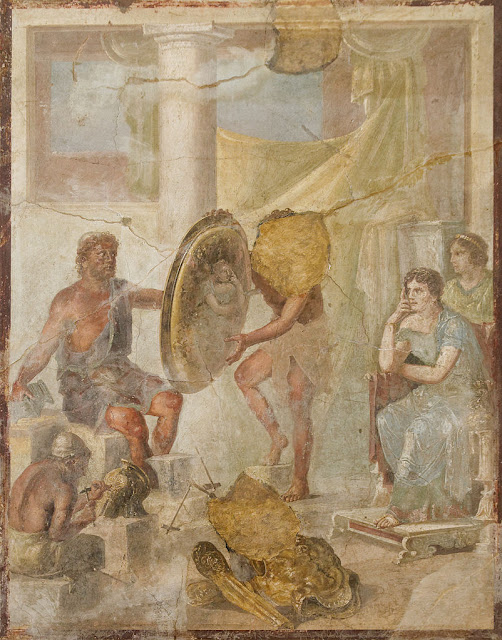
Roman fresco depicting Thetis at Hephaestos' forge waiting to receive Achilles' new weapons from Pompeii (IX I, 7, triclinium e), now in the collections of the National Archaeological Museum in Naples, courtesy of Wikimedia Commons contributor Marie-Lan Nguyen.

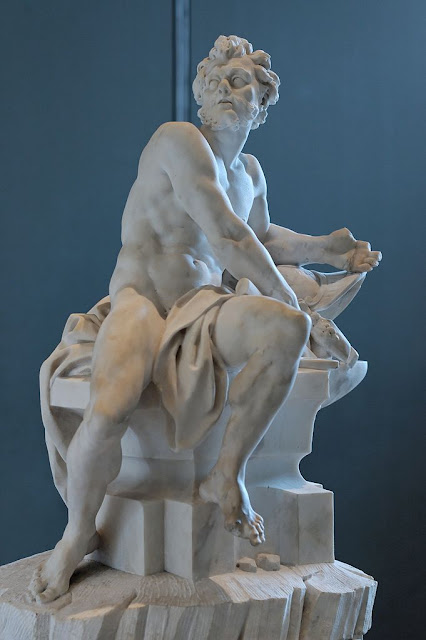
Vulcan by Guillaume Coustou the Younger, 1814, now in the Louvre Museum in Paris, courtesy of Wikimedia Commons contributor Marie-Lan Nguyen.

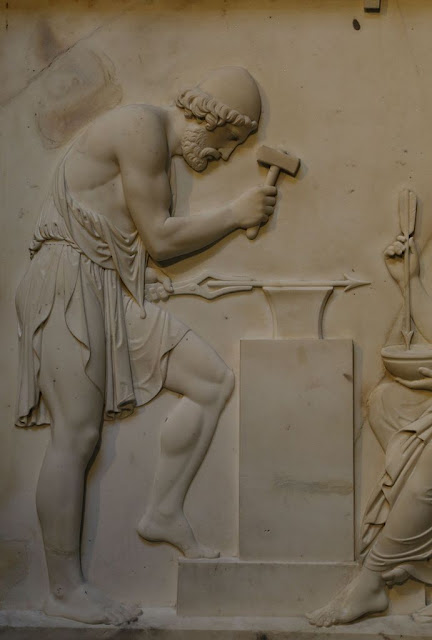
Closeup of Vulcan from a relief depicting Venus, Mars and Vulcan, about 1810, by Bertel Thorvaldsen courtesy of Wikimedia Commons contributor Rufus46.

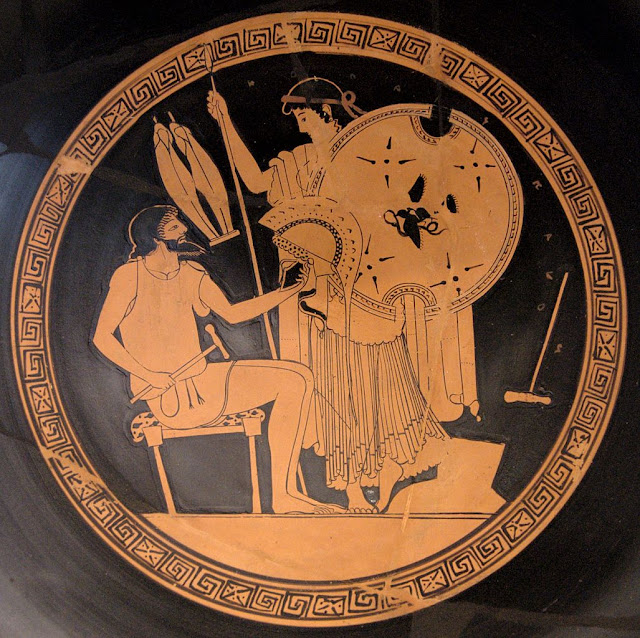
Hephaestus hands in the new Achilles' armor to Thetis (Iliad, XVIII, 617). Attic red-figure Kylix, 490–480 BCE, now in the collections of the Altes Museum in Berlin, courtesy of Wikimedia Commons contributor Bibi Saint-Pol.

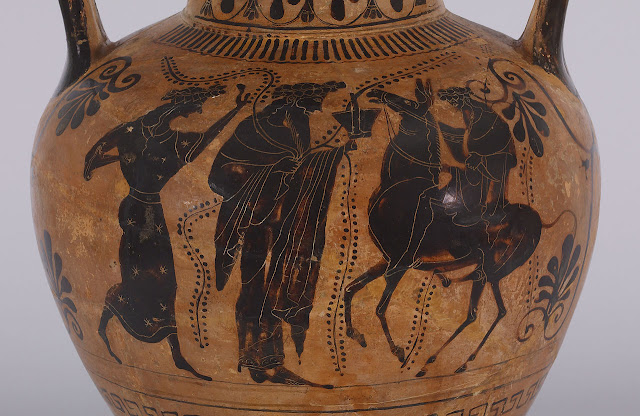
Black-figure Amphora depicting Dionysus who encounters the lame Hephaestus, god of fire and metalworking, riding on a donkey as a maenad looks on, 520 BCE, from Attica, now in the collections of the Walters Art Museum. Image courtesy of the museum.

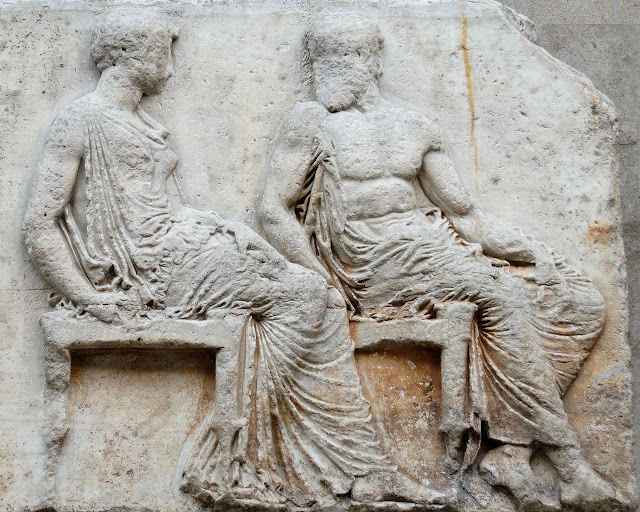
Athena holding a spear (now missing) watches the procession of the Great Panathenaia. Next to here, the lame god Hephaistos leans on a crutch. Block V (fig. 36-37) from the East frieze of the Parthenon, ca. 447–433 BCE, courtesy of Wikimedia Commons contributor Marie-Lan Nguyen.

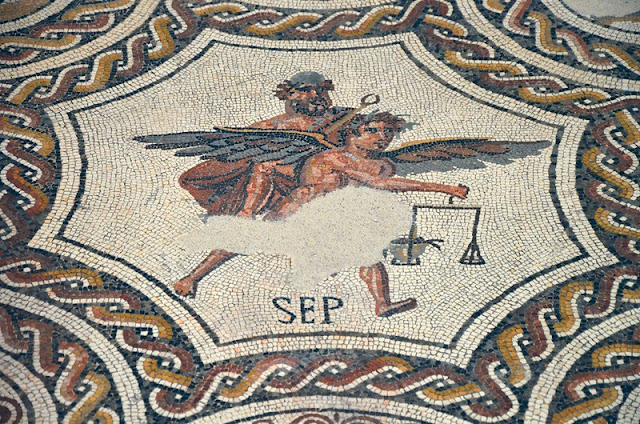
Detail of the mosaic of the seasons and the months, 3rd century AD, found in Hellin (Albacete), National Archaeological Museum of Spain, Madrid. September - Vulcan on winged genius carrying scales, Libra, courtesy of Carole Raddato (CC BY-SA 2.0)

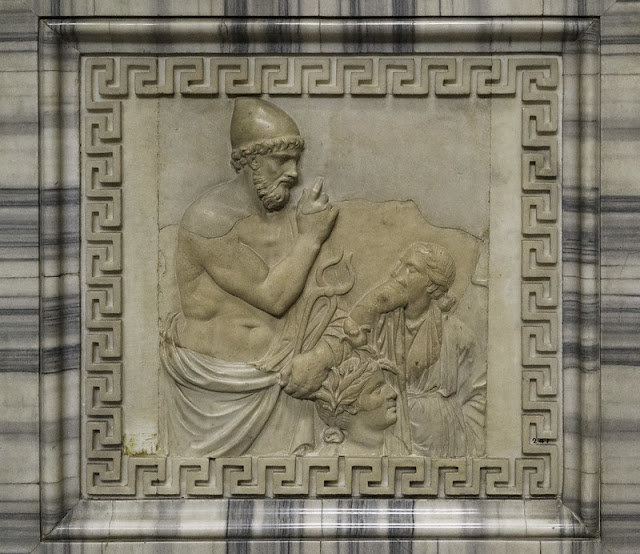
Fragment of a neo-Attic relief representing the birth of Erichthonios. The scene shows Hephaestus with “pileus” and holding tongs in his hands, Gaia, the earth goddess, wearing a crown of olive leaves and ears, and one of the daughters of Cecrops, standing with a hand to her mouth. Gaia is portrayed in the act of offering to Athena her newborn son Erichthonius. Both characters are now missing. This fragment, today inserted in the base of Galba’s statue, was found near Ostia where a famous Hephaisteion is documented. It dates from 50 BCE to the 50 CE. courtesy of Egisto Sani (CC BY-NC-SA 2.0)

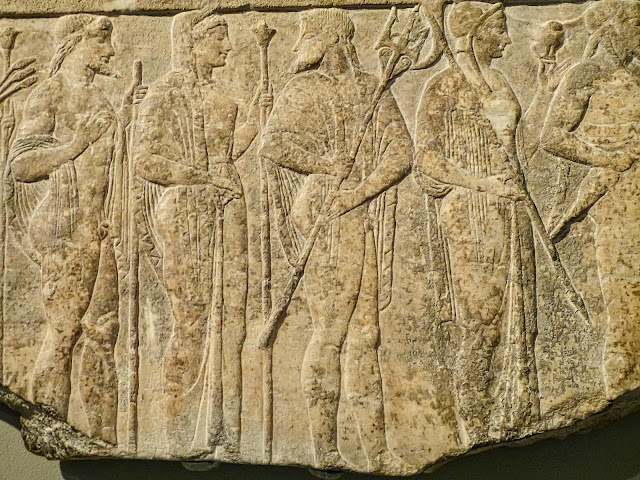
Closeup of Relief depicting twelve deities including Hephaestus (far left) Late Hellenistic or Roman possibly from Tarentum, Italy 1st century BCE that I photographed at the Walters Art Museum in Baltimore, Maryland

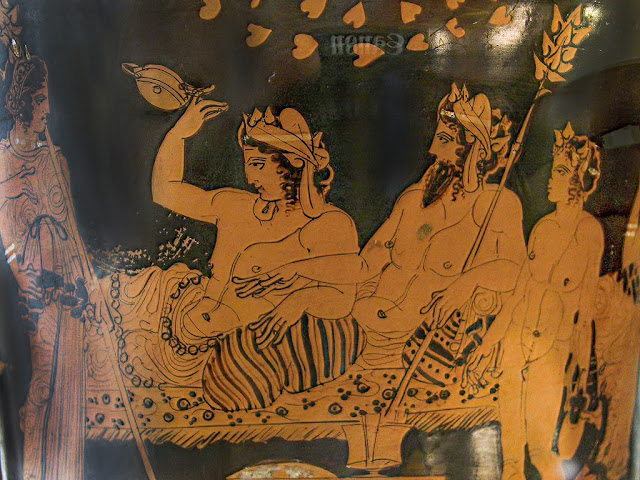
Calyx crater in red figure, 420-400 BCE, Lugano Painter. Side Aː Symposium scene. Bearded Dionysos and Hephaistos, a maenad and satyr. Archaeological Museum of Agrigento courtesy of Wikimedia Commons contributor Zde.

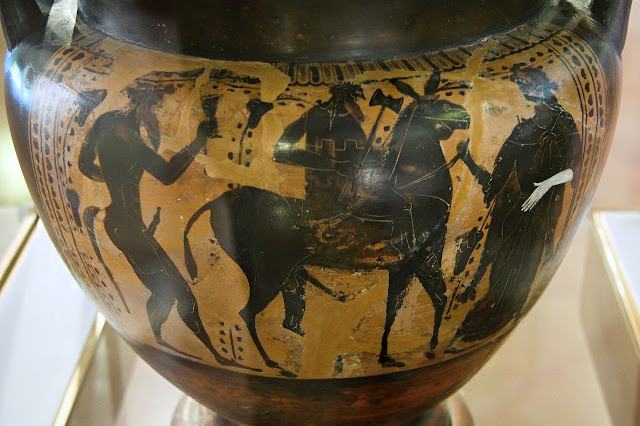
Attic colum crater, Leagros group, 550-500 BCE. Side A: The return of Hephaesos (Hefaistos) to Olympos. Archaeological Museum of Agrigento, courtesy of Wikimedia Commons contributor Zde.)

Vulcan (1838) by Herman Wilhelm Bissen (1798-1868). Sculpture in the Thorvaldsens Museum, Copenhagen, courtesy of Wikimedia Commons contributor James Steakley.


If you enjoyed this post, never miss out on future posts by following me by email!


Sunday, August 8, 2021

The Empire's Physician: Prosperity, Plague, and Healing in Ancient Rome

 The Institute for the Study of the Ancient World at New York University is sponsoring the virtual exhibit "The Empire's Physician: Prosperity, Plague, and Healing in Ancient Rome" (ancient medicine and health as seen through the eyes of Galen). Their exhibit can be explored here:  

https://galen.nyu.yourcultureconnect.com/e/home


Image: Votive relief depicting Asclepius healing a patient in her sleep, with Hygieia standing behind the god. Greek, ca. 400–350 BCE. Marble. Temple of Asclepius (Asclepieion), Piraeus, near Athens. H. 42 cm; W. 79 cm. Archaeological Museum of Piraeus: MP 405. Photo: Sites & Photos / Art Resource, NY.

If you enjoyed this post, never miss out on future posts by following me by email!


Thursday, August 5, 2021

The Transformation of Pharaonic deities to household gods in Roman Egypt

The iconography and style of depictions of Horus and other traditional Egyptian deities were influenced by Hellenistic and, later, Roman traditions of representation, often combining trappings of power in ways that are striking to modern observers.

"Roman period depictions of  the falcon-headed Horus have been  found  in  a  variety  of   materials  throughout  the  empire,  from  Egypt  to  Oxfordshire.  Usually  dressed  in  Roman  military costume, falcon-headed Horus is sometimes depicted on horseback, but more often standing, while seated figures are rare. Although smaller figures may have been dedicatory, larger stone and metal sculptures were probably objects of  public or private devotion." - Polychromy in Roman Egypt: A study of a limestone sculpture of the Egyptian god Horus by Joanne Dyer, Elisabeth R. O"Connell, and Antony Simpson.

Sir Harold Bell observes, "...a new religion, whether introduced by a conquering people or established as the result of a religious reform, never quite obliterates the beliefs and customs existing before its appearance.  Some of these beliefs and customs linger on underground, and so far from disappearing entirely with the passage of time they may even acquire new vitality as the first impulse of the new creed dies away." 

Opposing the traditional “decline of paganism/triumph of Christianity” model most often used to describe the Roman period in Egypt, David Frankfurter, in his text, "Religion in Roman Egypt: Assimilation and Resistance",  argues that the religion of Pharaonic Egypt did not die out as early as has been supposed but was instead relegated from political centers to village and home, where it continued a vigorous existence for centuries.

Even though the Roman emperor Augustus introduced restrictions on Egyptian temples that lead to their economic decline, the worship of traditional Egyptian deities continued in the domestic sphere including the consultation of oracles during the first three centuries of Roman occupation.

Frankfurter points to the continuing role of priests in Egyptian society despite the decline of religious institutions and the use of hieroglyphs for religious and administrative record keeping. Their charismatic leadership, their ritual expertise, and their knowledge of healing and guidance was still valued by the people since the day to day needs of the people - fertility, safety, and health of both individuals and their livestock - did not change.  Only their collective identity as it related to their religious systems evolved. This was accomplished with new divine names and the introduction of Roman iconography. Although divination under Roman administration could be accomplished by any literate individual who could read the sacred texts, no longer encoded in hieroglyphs but written in Coptic Egyptian or Greek, the fact remained that the most literate individuals were still the priests. Religious authority simply shifted from places and buildings to texts and persons in the form of independent "holy men." This resulted in the domestic worship of traditional deities up to the 5th century CE. 

Early Egyptian Christianity was eventually able to capitalize on this existing religious infrastructure. Frankfurter observed that Biblical texts and Christian lore were used not for their ideological content but for oracles and grimoires (magical texts) so what is described in the Coptic texts as the demonization and defeat of local spirits are not victories of one ideology over another but, rather, merely ritual innovations. 

Archaeologist point to the dozens of figurines found in Roman Period burials as evidence of this evolution in Egyptian worship. I find the figurines of Horus depicted in Roman armor to be among the most interesting. I think the ancient Egyptians would have identified the parallel between Horus, the son of Osiris, with Augustus and his descendants as sons of the deified Julius and hence the blending of iconography, especially with the introduction of the Roman emperor cult empire-wide during the reign of Augustus.  I also think it interesting that spectroscopy studies of the terracotta sculpture of Horus in Roman attire at the British Museum revealed the figure's chiton was painted green, the color of rebirth in the ancient Egyptian tradition.  However, the pigment was composed of celadonite, a common green pigment found in Roman art, but virtually unknown in dynastic Egypt. 

For those of you interested in examining this topic further, I would suggest exploring the posts and databases of "The Coptic Magical Papyri: Vernacular Religion in Late Roman and Early Islamic Egypt" project.  This ongoing scholarly effort is a five-year research project (2018-2023) under the direction of the Chair of Egyptology at  Julius Maximilian University Würzburg.  A team  consisting of Korshi Dosoo (research group leader), Edward O. D. Love, and Markéta Preininger are studying the corpus of Coptic  “magical texts” – manuscripts written on papyrus, as well as parchment, paper, ostraca and other materials, and attesting to private religious practices designed to cope with the crises of daily life in Egypt. There are about five hundred of these texts which survive, dating to between the third and twelfth centuries of the common era. Their website points out these documents address " the realities rather than the ideal of religious practices and beliefs as they were experienced and carried out in daily life. They provide rich information about the experiences of people from the periods they document – the transitions from traditional Egyptian religion to Christianity and Islam, the diffusion and interaction of different forms of Christianity (“gnostic” and orthodox, Miaphysiste and Dyophysite, cults of saints and angels), and conceptions of the human and divine worlds – how human experiences such as happiness and success, suffering and sickness, love and conflict were understood and negotiated."

Their English-version website is available here: https://www.coptic-magic.phil.uni-wuerzburg.de/

If you wish to read the full research paper Polychromy in Roman Egypt: A study of a limestone sculpture of the Egyptian god Horus, it is  available from: 

https://www.researchgate.net/publication/303482369_Polychromy_in_Roman_Egypt_A_study_of_a_limestone_sculpture_of_the_Egyptian_god_Horus 

Limestone seated figure of the Egyptian falcon god Horus wearing Roman military dress, from Egypt, Roman period, Roman Empire: Power & People, Leeds City Museum, UK courtesy of Carole Raddato

Limestone seated figure of the Egyptian falcon god Horus wearing Roman military dress, from Egypt, Roman period, courtesy of the British Museum.

Reconstruction of the pigments detected on the Limestone seated figure of the Egyptian falcon god Horus wearing Roman military dress, from Egypt, Roman period, now in the collections of the British Museum.

Roman period copper-alloy figure of the Egyptian god Horus, standing and wearing a nemes headdress and military costume now in the collections of the British Museum, courtesy of the museum.

Bronze figurine of Horus attired as Roman emperor with radiate crown suggestive of Sol Invictus, 2nd century CE, now in the collections of The Louvre in Paris. Image courtesy of the museum and Wikimedia Commons.

Shallow dish with high relief figures of Isis and falcon-headed Horus in Roman attire, possibly 2nd century CE, Egypt now in the collections of the Metropolitan Museum of Art. The curator there points out the feathered neck of the Horus figure suggests disintegration of pharaonic conventions for combining animal and human figures.

Egyptian relief of the God Horus in Roman style armor fighting the evil God Seth in crocodile form, 4th century CE, now in the collections of The Louvre in Paris, image courtesy of the museum.

Bronze figurine of Horus in Roman armor wearing the crowns of upper and lower Egypt at the Museum of Fine Arts Boston courtesy of the museum.


If you enjoyed this post, never miss out on future posts by following me by email!


Friday, July 9, 2021

The horse: A perfect gift to a Persian (or Parthian)

"For a nomadic people like the Persians, the horse had a significant practical and symbolic purpose and the importance of horses among the Iranian nobility is evidenced by the fact that many of them bore names compounded with the Old Persian word aspa – ‘horse’, observes Lloyd Llewellyn-Jones, Senior Lecturer in Ancient History at the University of Edinburgh.  "Several of Darius I’s inscriptions note that Persia was a land containing both good men and good horses (DZe §1; DPd §2) and Herodotus famously states that Persian fathers were intent on teaching their sons ‘to ride, to draw the bow, and to speak the truth’ (1. 136; see also Strabo 15. 3.18). The premium Persian horses were bred in the alfalfa-rich plains of Media, and it was here that the main royal stud farms were located (Polybius 10.70). Most prized of all were those steeds bred on the plains of Nisaea near Ecbatana and Bisitun, and Nisaean horses became celebrated for their magnificence, fine proportions, and swiftness (Herodotus 3. 106, 7. 40; Aristotle, History of Animals 9. 50.30). Nisaea is said to have sustained 160,000 horses (Diodorus 17.110), although stiff competition came from Media and Armenia which were also used for breeding good steeds (Strabo, Geography 11. 13.7; 11. 13.8, 14.9), as were the provinces of Babylonia (where one satrap possessed 800 stallions and 16,000 mares; Herodotus 1. 192), Cilicia (which provided an annual tribute of 360 white horses, Herodotus 3. 90), Chorasmia, Bactria, Sogdiana, and lands of the Saka which provided the Empire with its cavalry."

The Persepolis texts tell us that individuals who safeguarded the royal horses and officials serving as Masters of the Horse were paid well and enjoyed a diet of regular meat. Horses symbolized wealth and status and appeared in courtly ideology to model the ideal warrior image. They were also the center of aristocratic pastimes including hunting and racing.

According to Xenophon, the finest present to give a Persian was a horse and horses served as exceptional religious sacrifices.  

"As founder of the Empire, Cyrus II was honored with a horse sacrificed to his soul every month (Arrian, Anabasis 6. 29.7.)," states Llewellyn-Jones. "Moreover, the infamous tale recounted by Herodotus (3.85) of how Darius I acquired his kingdom through a trick involving the neighing of his horse is, in all probability, a Greek misunderstanding of the Iranian practice of hippomancy, or divination through the behavior of horses (see also Ctesias F13 §17), demonstrating the deep-set importance of the horse as a hallowed species in the Iranian consciousness."


Image: Procession of nobles, possibly from Palmyra, Syria, 100-150 CE, limestone, now in the collections of the Cleveland Museum of Art, image courtesy of the museum.

Palmyra was a key center for trade between the Roman and Parthian Empires. This unique relief at the Cleveland Museum of Art has been associated with Palmyra only through stylistic comparisons because its find spot is unknown. 

"It depicts men in Parthian dress riding Arabian horses with bejeweled harness trappings ahead of riders on camels—a possible reference to the caravans that made Palmyra so wealthy. Although all of the riders are dressed and equipped as Parthians, the proportions and perspective of the scene seem to be informed by Greco-Roman conventions. It may depict a ceremonial procession." - Cleveland Museum of Art

The museum defines the horses as Arabians but their body structure is quite stocky, not at all like the Arabian horses of our time. Yet, a 2017 study by evolutionary biologist Barbara Wallner at the University of Veterinary Medicine in Vienna concluded that nearly all modern horse breeds can be traced to two distinct, ancient Middle Eastern lines, the Arabian and the now extinct Turkoman horses from the Eurasian Steppe. Wallner and her colleagues studied variations in a segment of DNA along the Y chromosomes of 52 modern male horses that represented 21 modern breeds then expanded their analysis to include 363 males representing 57 modern breeds.  


If you enjoyed this post, never miss out on future posts by following me by email!


The transformative shrew in Greco-Roman-Egyptian mythology

When I saw this carefully detailed bronze sculpture of a common shrew from Egypt's Greco-Roman Period, I wondered why the ancients thought this creature worthy of such expense. Although this sculpture is part of the collections of the Cleveland Museum of Art, the Metropolitan Museum of Art also has a similar, though less detailed example from the same period as does the Museum of Fine Arts in Budapest.  

According to The Met, the ancient Egyptians named the shrew, "the voracious", because of its feeding habits. In ancient Egyptian mythology, the shrew represented the blind aspect of the solar deity, “the one with no eyes in his face” (Mechenti-n-irti in old Egyptian) that was complemented by the ichneumon, “the one whose eyes (the Sun and the Moon) are in his face” (Mechenti-irti in old Egyptian), a creature with very keen eyesight. This god with the dual nature was revered in Letopolis as one of the aspects of Horus, who, as myth has it, was blind at birth. 

According to Egyptians, this Horus of Letopolis assists the Sun god during his nocturnal journey on the solar bark which lasted until the sixth hour of the night.

"The shrew assumed the form of the god Horus to enter the afterlife and descended into the darkness of the afterlife to revive the deceased/Osiris. In this phase of the journey, he helped to navigate the solar bark through the dark, while his reforming power accelerated the regeneration of the deceased. The more combative functions in the ascending phase of the Sun god’s journey, after the sixth hour of the night, were given to the companion animal: the ichneumon (mongoose)." - The Museum of Fine Arts, Budapest, Hungary.

The process of transformation from the blind shrew into a seeing being  and from a being of the afterlife/inactive being into a perfectly reborn being able to act dynamically in the light of daytime was therefore viewed as having the ability to grant life in the afterlife. In fact, the hieroglyphic inscription on the front and right side of the plinth on which the shrew sculpture in Budapest stands, asks this temporarily blind aspect of Horus of Letopolis to grant such life to an individual named Imhotep.

As for the shrew's complementary creature, although I am familiar with a mongoose I had never heard it called an ichneumon so did a little research and discovered it was a name used not only for a mongoose but a creature called the pharaoh's rat. Sometimes the name was also used for an otter. It's name in Greek means "tracker" and it was said to be the enemy of the dragon.

According to Pliny the Elder (Natural History, Book 8, 88), "The ichneumon is known for its willingness to fight to the death with the snake. To do this, it first covers itself with several coats of mud, drying each coat in the sun to form a kind of armor. When ready it attacks, turning away from the blows it receives until it sees an opportunity, then with its head held sideways it goes for its enemy's throat. The ichneumon also attacks the crocodile in a similar manner."  

I was aware of the snake-killing reputation of the mongoose but wondered how such a relatively small creature could kill a Nile crocodile.  However, the 1st century CE geographer, Strabo backs up the claim by Pliny saying "The ichneumon [is] most destructive both to crocodiles and asps. The ichneumons destroy not only the eggs of the latter, but the animals themselves. The ichneumons are protected by a covering of mud, in which they roll, and then dry themselves in the sun. They then seize the asps by the head or tail, and dragging them into the river, so kill them. They lie in wait for the crocodiles, when the latter are basking in the sun with their mouths open. They then drop into their jaws, and eating through their intestines and belly, issue out of the dead body."

As late as the 3rd century CE, Marcus Aurelius Olympius Nemesianus, a poet at the court of the Roman emperor Carus, refers to hunting the Ichneumon on river banks among the rushes in his poem Cynegetica. Sadly, the poem is fragmentary and any longer passage describing such a hunt has been lost. If the creature could take on a crocodile, it would seem to me that hunting the beast would be a very dangerous endeavor!

Read more about the cult of the shrew: https://www.mfab.hu/shrew-a-sacred-glutton/


Image: Solid cast bronze sculpture of a shrew, Egypt, Greco-Roman Period, 305-30 BCE, now in the collections of the Cleveland Museum of Art, image courtesy of the museum. 

If you enjoyed this post, never miss out on future posts by following me by email!


Tuesday, June 29, 2021

From Etruscan Lasa to Roman Lare

Although art historians are not certain whether a Lasa was a major or minor Etruscan deity, it is thought the domain and purpose of the lasa morphed into a being known as a Lar to the Romans. Lares are thought to have been hero-ancestors, guardians of the hearth, fields, boundaries, or fruitfulness, or an amalgamation of these.

Roman writers sometimes conflated the Lares with domestic Penates but the Lares had much broader domains. Roadways, seaways, agriculture, livestock, towns, cities, the state, and its military were all under the protection of their particular Lar or Lares. Those who protected local neighborhoods (vici) were housed in the crossroad shrines (Compitalia), which served as a focus for the religious, social, and political lives of their local, overwhelmingly plebeian communities. Their cult officials included freedmen and slaves, otherwise excluded by status or property qualifications from most administrative and religious offices. Despite official bans on non-Christian cults from the late fourth century CE onwards, unofficial cults to Lares persisted until at least the early fifth century CE. 

Although the Etruscan Lasa could be female, Roman Lares were described by Plutarch as  two small, youthful, lively male figures clad in short, rustic, girdled tunics – made of dogskin. They take a dancer's attitude, tiptoed or lightly balanced on one leg. One arm raises a drinking horn (rhyton) aloft as if to offer a toast or libation, the other bears a shallow libation dish (patera). 

Traditional Roman households owned at least one protective Lares figure, housed in a shrine along with the images of the household's penates, genius image and any other favored deities. Their statues were placed at table during family meals and banquets. They were divine witnesses at important family occasions, such as marriages, births, and adoptions, and their shrines provided a religious hub for social and family life. Care and cult attendance to domestic Lares could include offerings of spelt wheat and grain-garlands, honey cakes and honeycombs, grapes and first fruits, wine, and incense. They could be served at any time and not always by intention - in addition to the formal offerings that seem to have been their due, any food that fell to the floor during house banquets was considered theirs.

By the early Imperial period, household shrines of any kind became known generically as lararia (s. lararium) because they typically contained a Lares figure or two. In households of modest means, small Lar statuettes were set in wall-niches, sometimes merely a tile-support projecting from a painted background. In wealthier households, they tend to be found in servant's quarters and working areas. The sumptuous House of the Vettii in Pompeii had two lararia.  One was positioned out of public view, and was probably used in private household rites. The other was placed boldly front-of-house, among a riot of Greek-inspired mythological wall-paintings and the assorted statuary of patron divinities.

Domestic Lararia were also used as a sacred, protective depository for commonplace symbols of family change and continuity. In his coming-of-age, a boy gave his personal amulet (bulla) to his Lares before he put on his manly toga (toga virilis). Once his first beard had been ritually cut off, it was placed in their keeping. On the night before her wedding, a Roman girl surrendered her dolls, soft balls, and breastbands to her family Lares, as a sign she had come of age. On the day of her marriage, she transferred her allegiance to her husband's neighborhood Lares (Lares Compitalici) by paying them a copper coin en route to her new home. She paid another to her new domestic Lares, and one to her husband.

The city of Rome itself was protected by a Lar, or Lares, housed in a shrine (sacellum) on the city's ancient, sacred boundary (pomerium). Each Roman vicus (pl. vici – administrative districts or wards) had its own communal Lares, housed in a permanent shrine at a central crossroads of the district. These Lares Compitalicii were celebrated at the Compitalia festival (from the Latin compitum, a crossroad) just after the Saturnalia that closed the old year. In the "solemn and sumptuous" rites of Compitalia, a pig was led taken in celebratory procession through the streets of the vicus, then sacrificed to the Lares at their Compitalia shrine. According to Plutarch, Servius Tullius, the sixth king of Rome who was assassinated in 579 BCE, is credited with the founding of the Lares' public festival. 

Etruscan Lasa, once the support for a patera, bronze with silver inlays, 3rd - early 2nd century BCE, now in the collections of the Cleveland Museum of Art, image courtesy of the museum.

Dancing Roman Lare holding a rhyton and a patera. Bronze statuette, First century CE, in the collections of the Capitoline Museum, Rome. Image courtesy of Wikimedia Commons contributor Marie-Lan Nguyen.

Figurine of a Lar, 0-200 CE, at the Gallo-Roman museum, Tongeren, Belgium, courtesy of Wikimedia Commons contributor Sam Donvil.


Frescoed and columned lararium in the house of Marco Epidio Sabino in Pompeii watercolor by Luigi Bazzani. Currently housed in the Victoria and Albert Museum in London, England that I uploaded to Wikimedia Commons.

Watercolor of a red Pompeii interior with lararium by Luigi Bazzani that I uploaded to Wikimedia Commons

Lararium of the House of Dioscuri at Pompeii, 1902 watercolor by Luigi Bazzani that I uploaded to Wikimedia Commons.

Lararium in the Casa degli Amorini Dorati (House of the Golden Cupids) in Pompeii courtesy of Wikimedia Commons contributor Miguel Hermoso Cuesta

Lararium from the Casa del Efebo in Pompeii courtesy of Wikimedia Commons contributor Miguel Hermoso Cuesta

Pompeii lararium courtesy of Wikimedia Commons contributor ho visto nina volare.

An elaborate Lararium with niche from Pompeii, Roman, 1st century CE, courtesy of Wikimedia Commons contributor Claus Ableiter.

Lararium in the peristyle of the Villa Romana del Casale courtesy of Wikimedia Commons contributor José Luiz Bernardes Ribeiro.

Lararium in the Casa del Criptoportico (1.6.2), Pompeii courtesy of Wikimedia Commons contributor Maltaper

Kitchen lararium in Pompeii courtesy of Pompeii in Pictures (https://pompeiiinpictures.com/pompeiiinpictures/index.htm)

Another niche lararium from the south wall of a garden area in Pompeii courtesy of Wikimedia Commons contributor Stanley A. Jashemski.

Niche lararium from the west wall of a garden area in Pompeii courtesy of Wikimedia Commons contributor Stanley A. Jashemski and Pompeii in Pictures.

Lararium niche on west wall of peristyle garden in Pompeii courtesy of Pompeii in Pictures

If you enjoyed this post, never miss out on future posts by following me by email!