Showing posts with label engraved. Show all posts

Wednesday, June 23, 2021

Protesilaus: The first Greek to die in the Trojan War

Protesilaus (also spelled Protesilaos) was one of the suitors of Helen of Troy sworn to defend the honor of Menelaus. He brought forty black ships with him to Troy, drawing his men from "flowering" Pyrasus, coastal Antron, and Pteleus, "deep in grass", in addition to his native Phylace in ancient Thessaly. Protesilaus was "the first man who dared to leap ashore when the Greek fleet touched the Troad", Pausanias recalled, quoting the author of the epic called The Cypria.  An oracle had prophesied that the first Greek to walk on the land after stepping off a ship in the Trojan War would be the first to die, and so, after killing four men, he was himself slain by Hector. (Alternate sources have him slain by either Aeneas, Euphorbus, Achates, or Cycnus.) 

The gods had pity on his widow, Laodamia, daughter of Acastus, and brought him up from Hades to see her. She was at first overjoyed, thinking he had returned from Troy, but after the gods returned him to the underworld, she found the loss unbearable. She had a bronze statue of her late husband constructed, and devoted herself to it. After her worried father had witnessed her behavior, he had a great fire built to burn the statue, but Laodamia jumped into the fire and was consumed along with her husband's likeness.

According to legend, the Nymphs planted elms on the tomb of "great-hearted Protesilaus" in the Thracian Chersonese that grew to be the tallest in the known world.  But when their topmost branches grew high enough to see the far off  ruins of Troy, they immediately withered, so great still was the bitterness of the hero buried below. The story is the subject of a poem by Antiphilus of Byzantium (1st century CE) in the Palatine Anthology:

"Thessalian Protesilaos, a long age shall sing your praises,

Of the destined dead at Troy the first,

Your tomb with thick-foliaged elms they covered,

The nymphs, across the water from hated Ilion.

Trees full of anger, and whenever that wall they see,

Of Troy, the leaves in their upper crown wither and fall.

So great in the heroes was the bitterness then, some of which still

Remembers, hostile, in the soulless upper branches."

The tomb of Protesilaus at Elaeus in the Thracian Chersonese is documented in the 5th century BCE, when, during the Persian War, votive treasure deposited at his tomb was plundered by the satrap Artayctes, under permission from Xerxes. The Greeks later captured and executed Artayctes, returning the treasure. When Alexander the Great arrived at Elaeus on his campaign against the Persian Empire, he offered a sacrifice at the tomb, hoping to avoid the fate of Protesilaus when he arrived in Asia. Like Protesilaus before him, Alexander was the first to set foot on Asian soil during his campaign but successfully avoided the Greek hero's fate.

The Augustan-era mythographer, Conon, claimed Protesilaus survived the Trojan War and was returning with Priam's sister Aethilla as his captive. When the ships put ashore for water on the coast of Pallene, between Scione and Mende, Aethilla persuaded the other Trojan women to burn the ships, forcing Protesilaus to remain and found the city of Scione where a founder-cult of Protesilaus was later established.

In Philostratus' Heroicus, a Roman imperial period literary work representing an alternative Greek hero-cult tradition to the original epic, Protesilaus, speaking from beyond the grave, is the oracular source of the corrected eye-witness account of the actions of heroes at Troy, related by a "vine-dresser" to a Phoenician merchant. 


Image: Engraved Cornelian scaraboid with Protesilaos on the Prow of a Ship, Greek, 400-350 BCE, now in the collections of the Getty Villa and on view in Gallery 101D.  Image courtesy of the museum.


If you enjoyed this post, never miss out on future posts by following me by email!


Monday, May 24, 2021

Roman athletics (as opposed to spectator sports)

Depictions of athletes were popular on gems of the late 500s BCE and thereafter.  Not only Greek but Etruscan artisans produced these miniature works of art and the collection of these gems became popular among the Roman elite. As I've mentioned previously, both Julius Caesar and Pompey the Great collected them.

One such artist, Epimenes, from the Cyclades, produced scenes of nude youths with meticulously defined musculature in complex twisted poses. His youths sported locks of hair radiating from the crown of the head with clusters of curls on the forehead. He adopted these features from innovations in sculpture and vase-painting at the time.

"It is clear that some form of amateur athletics must have taken place simulta­neously with the real business at hand, which was, naturally enough from the bias of Republican Rome, training for war," observes classicist Donald White, University of Pennsylvania Museum of Archaeology and Anthropology. "Special ludi in­cluding sports that may be assumed to have stressed physical endur­ance, team work, and courage were part of the routine conduct of the Juventus, an ancient Italic institu­tion for the training of young males eventually revived by Augustus."

White points out that even Marcus Cato the Censor (234-149 BCE), who constantly reminded Rome's senate that Carthage must be destroyed, took pains to instruct how own son in “his grammer, law, and his gymnastic exercises. Nor did he only show him, too, how to throw a dart, to fight in armor, and to ride, but to box also and to endure both heat and cold, and to swim over the most rapid and rough rivers” (Plut. Vit. Cat. Mai., Clough trans., p. 251).  The Campus Martius served Roman youth as an exercize ground. Cato also scorned overweight men saying  ‘What use can the state turn a man’s body to, when all between the throat and groin is taken up by the belly?” 

Boxing (pugilatio) was imported from Greece and Livy (i, 35) records that  Tarquinius Priscus imported boxers from outlying areas for his inaugural celebration as early as the 6th century BCE including Etruria where pugilism flourished. One famous Roman-era boxer, Melankomas, from Caria and victor in the 207th Olympiad in 49 CE  supposedly gained fame because he avoided the punches of other boxers and never threw any punches himself. Dio says he never lost a match, hit an opponent, or was struck by an opponent.  (I wonder how he managed that while maintaining the goodwill of the crowd?)

Foot races and even races on mule-back were also conducted and scholars suggest there were at least some amateur participation. The festival of the Ro­bigalia on April 25, featured foot races in honor of Robigus, the god who averted mildew, and the Consualia on August 21, with its races on foot and on mule-back were conducted in honor of the ancient Italic deity Consus, who presided over secret plans and counsels.

"A number of prominent Republican figures attempted to introduce Greek style athletic games to Rome, says White.  "The earliest of these were staged in 186 BCE by Marcus Fulvius Nobilior, who imported large numbers of Greeks to per­form in Rome. A century later the dictator Lucius Cornelius Sulla managed to clean out nearly all of Greece to provide athletes to help celebrate in Horne his victory over Mithridates, which meant that in 81 BCE the best that Olympia could put on for its games was the foot race. Similar efforts were re­peated by Pompey, Julius Caesar and Augustus."

Both Caligula and Claudius staged gymnastic competitions for the Roman people but participation was limited to foreign athletes. Nero, however, encouraged Roman aristocrats to compete with the lower classes in a variety of athletic events at his "Youth Games" in 59 CE. He constructed a Greek style gym­nasium complex in 62 CE in the vicinity of the Pantheon to facilitate athletic training, that was the first such structure to he erected in Rome.

White points out, though, that the more conservative element in Roman society disapproved of the resulting activity.  Tacitus remarks “Birth age, official career did not prevent people from acting in Greek or Latin style—or from accompanying their perfor­mances with effeminate gestures and songs. Eminent women, too re­hearsed indecent parts. . . Places of assignation and taverns were built, and every stimulus to vice was displayed for sale. . . Promiscuity and degradation throve. Roman morals had long become impure, hut never was there so favorable an environment for debauchery as among this filthy crowd” (Ann. pp. 310-11, M. Grant trans.).

"Perhaps the insinuations of sexual miscon­duct arose in large measure from merely the sight of athletes competing naked in front of both sexes, but we do hear of one Palfitrius Sura, son of a consul, wrestling naked with a girl from Sparta," White says.

Donald White's article goes on to discuss wrestling (both male and female) and the often bloody pankration (A 3rd century CE Roman army recruit named Lucius Septimius Flavianus Favillianus gained fame as a champion wrestler and pankrationist) as well as palestra games using balls such as harpastum (a game featured in Anthony Riches, "Betrayal", Book 1 of his Centurions trilogy), pila pagancia, and trigon. His article includes images of mosaics depicting various athletic competitors that I found really interesting as well.

You can read it here: 

https://www.penn.museum/sites/expedition/roman-athletics/

Engraved Obsidian Scaraboid with Athlete attributed to Epimenes, Greek, Cyclades, about 500 BCE now in the collections of the J. Paul Getty Museum. Standing in left profile with one leg raised, a nude athlete bends forward to scrape his shin with a curved blade called a strigil. His upper body is shown in three-quarter view, and his hair is detailed with a row of pellets representing curls. After training, Greek athletes coated themselves in oil and used a strigil to scrape off the sweat and dirt. Depictions of athletes were popular on gems of the late 500s B.C., reflecting the interests of the men who owned them. The pose of this figure, shown standing but leaning forward while engaged in some activity, was also a favorite for gems in this period, in part because it fills the oval space well. The difficult three-quarter view of the youth, the rendering of the musculature, and details such as the duck's head decorating the end of the strigil, however, display this artist's unique skills. Another four gems have been attributed to the same engraver, Epimenes (including 81.AN.76.22), all of which show nude youths engaged in similar activities with the same careful depiction of the body. Only one of these gems is signed: the letter forms of the signature suggest that the artist was from one of the Cycladic Islands, where there was a long tradition of gem engraving. - J. Paul Getty Museum

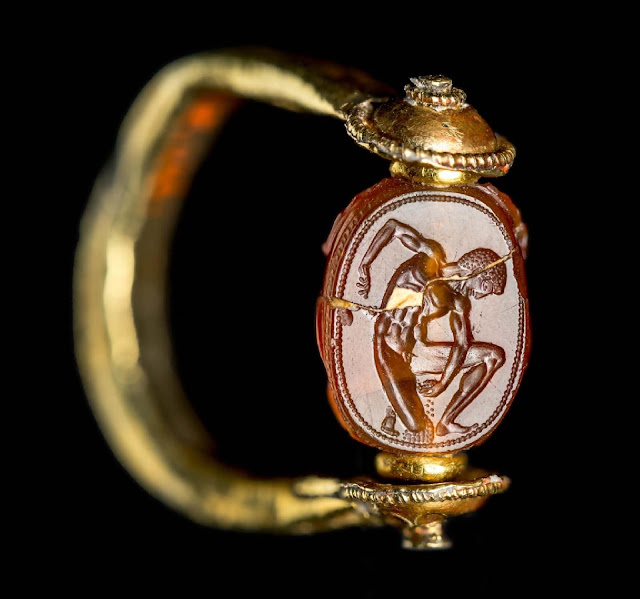
Swivel ring with a scarab showing an athlete pouring sand on his thigh, Italic, Etruscan, Late Archaeic Period about 500–475 B.C.E. now in the collections of the Museum of Fine Arts, Boston. Image courtesy of the museum. Brownish orange carnelian. Scarab with a flat, oval base engraved in intaglio; pierced lengthwise; set in a swivel ring made of gold sheet and decorated with faux twisted wire on either ends of the swiveling part. Athlete with right knee on the ground, frontal with head in profile to right. He pours sand on his right knee with his left hand. Pellet border. Back carved as a beetle with a hatched border around the thorax, two raised lines dividing the elytra, winglets in relief and dotted head. Detailed legs with spined front legs. Plinth with tongues. - Museum of Fine Arts, Boston


If you enjoyed this post, never miss out on future posts by following me by email!


Thursday, May 20, 2021

Forgeries of ancient engraved gems

The J. Paul Getty Museum has some spectacular ancient engraved gems in their collections and I have featured a number of them in my posts.  But, during the pandemic one of their curators, Kenneth Lapatin, researched one gem in their collection with a portrait of Marc Antony engraved upon it, and discovered, unfortunately, it was not ancient at all but a 19th century forgery produced by Giovanni Calandrelli for Prince Stanislas Poniatowski, nephew and heir to the King of Poland and Lithuania, and one of the richest men in Europe.

Alerted by a friend, the late Gertrud Platz from the Berlin Antikensammlung, who had  just published a study of Giovanni Calandrelli, Lapatin learned she had recently examined a plaster impression that was made of one of Calandrelli's forgeries featuring a portrait of Marc Antony.  Platz suspected the Getty gem was the same work.  So Lapatin sent an impression of the Getty gem to her and they were found to be virtually identical.

"There are three smoking guns," explains Lapatin. "There is the plaster impression in Berlin, and another sent to St. Petersburg, Russia, that show that the gem had been in the Poniatowski collection, which was full of forgeries. That doesn’t prove anything, because Poniatowski’s collection also contained some genuine antiquities, but puts the gem in very bad company. Then, there’s Calandrelli’s notebook, which says he made a Mark Antony with the signature of Gnaios. And then, the third is when we put our gem next to ones that we know are genuine ancient engravings by Gnaios, we can see stylistic discrepancies, especially in the way the skin and hair is rendered."

Mistakes such as this are certainly understandable since it is widely known Pompey the Great, Julius Caesar, and the nephew of the Emperor Augustus, as well as other ancient aristocrats, all collected gems and donated their collections to the gods in temples.  This particular gem came to be widely known in 1968 when John Boardman (now Sir John), one of the foremost authorities on ancient gems, published and praised this gem very highly as one of the masterpieces of late Roman Republican, early Augustan gem carving. It is just unfortunate that some wealthy 19th century collectors sought to boost their prestige by clandestinely hiring talented gem engravers to simulate ancient works.

Read more about it:  https://blogs.getty.edu/iris/a-gem-of-a-mystery/  

Amethyst gem with engraved portrait of Marc Antony originally thought to be late Roman Republican to early Augustan work.  Actually, it is a forgery produced by 19th century gem carver, Giovanni Calandrelli.  It remains in the collections of the J. Paul Getty Museum due to its quality but has been moved from the Getty Villa to the Getty Center where it is now displayed with the works of other 19th century engravers.


If you enjoyed this post, never miss out on future posts by following me by email!


Saturday, April 17, 2021

Centaur battling a Giant?

Centaurs are popular on Archaic and Classical Greek gems and are often shown fighting, armed with branches or stones as signs of their wild nature. Battles with Herakles or the Lapiths (a people of Thessaly, famous in Greek mythology for their defeat of the centaurs) appear often, but the exact scene on this gem is unclear. The two snakes seen below the centaur’s forelegs recall the standard depiction of giants in Greek art, which are typically shown with human bodies and snake-legs: although a battle between a centaur and giant would be extremely unusual and is not a specific feature of Greek myth, the subject is attested on a Roman glass paste intaglio, suggesting it might also be depicted here. Such motifs probably reflect the Late Classical and Hellenistic interest in fanciful scenes involving mythical creatures popular in painting and sculpture.

A scaraboid is a simplified scarab, with a plain curved back and an intaglio design decorating the flat underside. The form gradually replaced the scarab in Greece in the 400s B.C.E. Like scarabs, they were typically pierced and worn either as a ring or pendant. When attached to a metal hoop and worn as a ring, the curved side faced out and the intaglio surface rested against the finger. When needed as a seal, the ring was removed, the gem swiveled, and the intaglio design was pressed into soft clay or wax to identify and secure property. - J. Paul Getty Museum 


Image: Engraved scaraboid with a bearded centaur wearing an animal skin cloak battling a snake-legged Giant, brown chalcedony, 1st quarter of the 4th century BCE, Greek in the J. Paul Getty collection of engraved gems. The centaur is shown advancing to the left to battle an unknown adversary – suggested only by the presence of two coiled snakes below the centaur’s legs. 

If you enjoyed this post, never miss out on future posts by following me by email!