Showing posts with label jewelry. Show all posts

Saturday, June 26, 2021

Ancient Amber

 Despite fanciful descriptions by some ancient sources like Nicias (470-415 BCE) that amber "is a liquid produced by the rays of the sun, and that these rays, at the moment of the sun's setting, striking with the greatest force upon the surface of the soil, leave upon it an unctuous sweat, which is carried off by the tides of the Ocean, and thrown up upon the shores of Germany", Roman naturalist Pliny the Elder cited sources who were well aware of amber's actual origin from tree resin.

In Book 37, section XI of Natural History, Pliny wrote:

"Amber is produced from a marrow discharged by trees belonging to the pine genus, like gum from the cherry, and resin from the ordinary pine. It is a liquid at first, which issues forth in considerable quantities, and is gradually hardened [...] Our forefathers, too, were of opinion that it is the juice of a tree, and for this reason gave it the name of "succinum" and one great proof that it is the produce of a tree of the pine genus, is the fact that it emits a pine-like smell when rubbed, and that it burns, when ignited, with the odour and appearance of torch-pine wood."

Pliny says that the German name of amber was glæsum, "for which reason the Romans, when Germanicus Caesar commanded the fleet in those parts, gave to one of these islands the name of Glæsaria, which by the barbarians was known as Austeravia". 

As an important commodity, sometimes dubbed "the gold of the north", amber was transported from the North Sea and Baltic Sea coasts overland by way of the Vistula and Dnieper rivers to Italy, Greece, the Black Sea, Syria and Egypt over a period of thousands of years. The oldest trade in amber in antiquity originated from Sicily. The Sicilian amber trade was directed to Greece, North Africa and Spain. Sicilian amber was also discovered in Mycenae by the archaeologist Heinrich Schliemann. This amber also appeared in sites in southern Spain and Portugal and its distribution is similar to that of ivory, so it is possible that amber from Sicily reached the Iberian Peninsula through contacts with North Africa. After a decline in the consumption and trade of amber at the beginning of the Bronze Age, around 2,000 BCE, the influence of Baltic amber gradually took the place of the Sicilian one throughout the Iberian peninsula starting around 1000 BCE. 

From at least the 16th century BC, amber was moved from Northern Europe to the Mediterranean area. The breast ornament of the Egyptian pharaoh Tutankhamen (c. 1333–1324 BCE) contains large Baltic amber beads. Amber was also sent from the North Sea to the temple of Apollo at Delphi as an offering.

In Roman times, a main route ran south from the Baltic coast (modern Lithuania), the entire north–south length of modern-day Poland (likely through the Iron Age settlement of Biskupin), through the land of the Boii (modern Czech Republic and Slovakia) to the head of the Adriatic Sea (Aquileia by the modern Gulf of Venice). Along with amber, other commodities such as animal fur and skin, honey and wax were exported to Rome in exchange for Roman glass, brass, gold, and non-ferrous metals such as tin and copper. As this road was a lucrative trade route connecting the Baltic Sea to the Mediterranean Sea, Roman military fortifications were constructed along the route to protect merchants and traders from Germanic raids.

Amber occurs in a range of different colors. As well as the usual yellow-orange-brown that is associated with the color "amber", amber itself can range from a whitish color through a pale lemon yellow, to brown and almost black. Other uncommon colors include red amber (sometimes known as "cherry amber"), green amber, and even blue amber, which is rare and highly sought after. As amber ages, however, it often becomes opaque and crackled. 

Amber has been crafted into jewelry and pendants since the Stone Age, from 13,000 years ago. Amber ornaments have been found in Mycenaean tombs.  However, it has also been used in folk medicine for its purported healing properties. Hippocrates and other ancient physicians used amber extracts for a wide variety of treatments. In ancient China amber was heated under specific conditions to produce oil of amber that, when combined with nitric acid, was used to produce artificial musk.


Amber head of a woman or goddess, Roman, 1st - 2nd century CE, now in the collections of the National Archaeological Museum of Aquileia, courtesy of Wikimedia Commons contributor Sailko.


Amber figurine of a dog, Roman, from a tomb in Aquileia, 90-110 CE, now in the collections of the National Archaeological Museum of Aquileia, courtesy of Wikimedia Commons contributor Sailko.


Amber ring with the form of a female bust, 1st century CE, in the collections of the National Archaeological Museum of Aquileia, courtesy of Wikimedia Commons contributor Sailko.


Amber figural sculpture from a tomb in Aquileia, 90 CE, now in the collections of the National Archaeological Museum of Aquileia, courtesy of Wikimedia Commons contributor Sailko.

Amber figural sculpture of a woman with a melon hairstyle from a tomb in Aquileia, 90 CE, now in the collections of the National Archaeological Museum of Aquileia, courtesy of Wikimedia Commons contributor Sailko.

Amber head of a satyr, Roman, 1st - 2nd century CE, now in the collections of the National Archaeological Museum of Aquileia, courtesy of Wikimedia Commons contributor Sailko.

Amber sculpture of winged figures, Roman, 1st - 2nd century CE, now in the collections of the National Archaeological Museum of Aquileia, courtesy of Wikimedia Commons contributor Sailko.

Carved amber bow of a fibula depicting a couple reclining on a couch, with attendant and bird at the Metropolitan Museum of Art in New York. While numerous details are Etruscan, it is impossible to identify where the artist came from and whether the figures are mortal or divine.

Amber pendant in the form of a sphinx, from south Italy, Taranto, late 6th century BCE now in the collections of the Cleveland Museum of Art.

Weight with Ram and Tiger, Early Western Han Dynasty, 3rd-2nd century BCE, Bronze inlaid with gold silver and amber that I photographed at the Portland (Oregon) Art Museum.

Amber amulet depicting a boar between two lion heads, Italic, 500-400 BCE, that I photographed at the Getty Villa.

Amber Amulet depicting a Boar's Head, Italic about 500 BCE that I photographed at the Getty Villa.

Amber amulet depicting a woman holding a child (Kourotrophos), Italic or Etruscan, 500-400 BCE, that I photographed at the Getty Villa.

Amber pendant in the form of a Satyr Head in profile, Etruscan, 525-480 BCE now in the collections of the J. Paul Getty Museum, image courtesy of the museum.

Amber bead and pendant necklace, Italic, 700-475 BCE, BCE now in the collections of the J. Paul Getty Museum, image courtesy of the museum.

Amber Gorgoneion (Medusa Head), Roman, 1st - 2nd century CE now in the collections of the J. Paul Getty Museum, image courtesy of the museum.
If you enjoyed this post, never miss out on future posts by following me by email!


Thursday, May 20, 2021

Forgeries of ancient engraved gems

The J. Paul Getty Museum has some spectacular ancient engraved gems in their collections and I have featured a number of them in my posts.  But, during the pandemic one of their curators, Kenneth Lapatin, researched one gem in their collection with a portrait of Marc Antony engraved upon it, and discovered, unfortunately, it was not ancient at all but a 19th century forgery produced by Giovanni Calandrelli for Prince Stanislas Poniatowski, nephew and heir to the King of Poland and Lithuania, and one of the richest men in Europe.

Alerted by a friend, the late Gertrud Platz from the Berlin Antikensammlung, who had  just published a study of Giovanni Calandrelli, Lapatin learned she had recently examined a plaster impression that was made of one of Calandrelli's forgeries featuring a portrait of Marc Antony.  Platz suspected the Getty gem was the same work.  So Lapatin sent an impression of the Getty gem to her and they were found to be virtually identical.

"There are three smoking guns," explains Lapatin. "There is the plaster impression in Berlin, and another sent to St. Petersburg, Russia, that show that the gem had been in the Poniatowski collection, which was full of forgeries. That doesn’t prove anything, because Poniatowski’s collection also contained some genuine antiquities, but puts the gem in very bad company. Then, there’s Calandrelli’s notebook, which says he made a Mark Antony with the signature of Gnaios. And then, the third is when we put our gem next to ones that we know are genuine ancient engravings by Gnaios, we can see stylistic discrepancies, especially in the way the skin and hair is rendered."

Mistakes such as this are certainly understandable since it is widely known Pompey the Great, Julius Caesar, and the nephew of the Emperor Augustus, as well as other ancient aristocrats, all collected gems and donated their collections to the gods in temples.  This particular gem came to be widely known in 1968 when John Boardman (now Sir John), one of the foremost authorities on ancient gems, published and praised this gem very highly as one of the masterpieces of late Roman Republican, early Augustan gem carving. It is just unfortunate that some wealthy 19th century collectors sought to boost their prestige by clandestinely hiring talented gem engravers to simulate ancient works.

Read more about it:  https://blogs.getty.edu/iris/a-gem-of-a-mystery/  

Amethyst gem with engraved portrait of Marc Antony originally thought to be late Roman Republican to early Augustan work.  Actually, it is a forgery produced by 19th century gem carver, Giovanni Calandrelli.  It remains in the collections of the J. Paul Getty Museum due to its quality but has been moved from the Getty Villa to the Getty Center where it is now displayed with the works of other 19th century engravers.


If you enjoyed this post, never miss out on future posts by following me by email!


Friday, February 12, 2021

Cypriot gold spiral earrings: Local fashion or the result of Achaemenid influence?

 According to the Metropolitan Museum of Art, spirals with ornate animal-head terminals are frequently found in Cypriot tombs of the Classical period. Terracotta and limestone votive statues illustrate that from the Archaic through the Classical period it was customary for Cypriot men and women to wear such ornaments in large holes pierced through their earlobes.

When I saw these earrings, I wondered if this Cypriot practice of making large holes in their earlobes to accommodate these ornaments was a local fashion or adopted as a result of Persian rule beginning in 545 BCE, especially since most examples I have seen  are dated between the late 6th century to the 5th century BCE. I managed to find images of Achaemenid bracelets similarly made of gold tubing but each example of similar earrings I found in my research were all labeled Cypriot. Since the Cypriots were ruled by the Assyrians and even the Egyptians for a short time, I researched the jewelry of those cultures as well but found nothing similar. 


Cypriot Earrings or spiral with lion-griffin terminals, Gold and Silver, 400-350 BCE and Lion headed spirals from mid-5th century BCE, at the Metropolitan Museum of Art


Cypriot Gold and copper alloy spiral with lion-head terminal, 2nd half of the 5th century B.C.E. at the Metropolitan Museum of Art. The lion-head is made in two halves (left and right) from sheet gold.


Cypriot Earrings or spiral with lion-griffin terminals, Gold and Silver, 400-350 BCE, at the Metropolitan Museum of Art.


Cypriot Earrings or spiral with lion-griffin terminals, Gold and Silver, 400-350 BCE, at the Metropolitan Museum of Art.

Pair of gold spiral earrings with terminals in the form of a crested griffins head. Cypriot, 475-400 B.C.E. British Museum

Gilt bronze spiral with griffin terminal. Period: Classical. Date: ca. 400–350 B.C.E. Culture: Cypriot. Medium: Gold, bronze. British Museum

Cypriot Gold allow spiral earings with Griffin terminals 5th century BCE at the British Museum courtesy of Wikimedia Commons contributor Paul Hudson. (digitally enhanced and recomposed)

Cypriot Gold alloy spiral earring with horned mythological creature terminal and floret, 5th century BCE, at the Antikensammlung Museum in Berlin courtesy of Wikimedia Commons contributor Marsupium

Achaemenid Gold Bracelet with Inlaid Termini in the Form of Duck's Heads, Gold with lapis lazuli, agate, and carnelian inlay, mid-6th-4th century B.C.E. at the Miho Museum in Kyoto, Japan. The ducks are reduced to protomes with their heads turned back in a typical Achaemenid fashion. The bracelet is constructed of hollow gold tubing, and the duck protomes were formerly elaborately inlayed with colored stones. One duck bill is made of agate, the other of carnelian. The ducks were both made separately and were in all likelihood originally joined together at their breasts. In order to put on the bracelet, the birds could be separated from the circlet by removing the rivets.

The bracelet type is preserved in much simpler versions of bronze or golden wire, and details like the turned heads resting on the animals' backs seem truly Achaemenid, but a certain naturalistic tendency along with the concept of a removable part may point to a later period and attribute this piece to the circle of Achaemenizing art fashioned in the Hellenistic period. It must be stressed, however, that at the moment, this is nothing but a hypothesis. - Miho Museum, Kyoto, Japan

Achaemenid Gold Bracelet with Inlaid Termini in the Form of Seated Ducks, Gold with lapis lazuli, turquoise, onyx, and rock crystal inlay, mid-6th-4th century B.C.E. at the Miho Museum in Kyoto, Japan. The jeweler of this bracelet chose ducks as terminal figures and combined them with a rather heavy looking circlet that can be opened. The ducks were fashioned separately, and all the feathers and the eyes were originally characterized by inlays. The ducks' bills are not preserved. The birds are fixed to a single massive tubular circlet, which originally had colored inlays at the junction between the ducks. The use of colored inlays for the details of the feathering is a feature of Egyptianizing tendencies in Achaemenid craftsmanship. Though the "Great Kings" are known to have employed Egyptian craftsmen, the use of this technique does not necessarily imply that the jeweler was an Egyptian, because the technique was widely used on objects of truly Achaemenid style. 
If you enjoyed this post, never miss out on future posts by following me by email!


Tuesday, January 12, 2021

Etruscan jewelry

The tomb group represents one of the richest and most impressive sets of Etruscan jewelry ever found. It comprises a splendid gold and glass pendant necklace, a pair of gold and rock-crystal disk earrings, a gold dress fastener (fibula) decorated with a sphinx, a pair of plain gold fibulae, a gold dress pin, and five finger rings. Two of the rings have engraved scarabs that revolve on a swivel bezel. One is decorated with embossed satyr heads, and the other two have decorated gold bezels.

Very little jewelry from the Villanovan Era, an Early Iron Age culture dating c. 900 BCE – 700 BCE, has been discovered in modern times. The Villanovan Etruscans seem to have left few items of luxury, and thus appear modest. Yet extant Villanovan jewelry confirms that in Etruria great effort was placed in the production of decorative arts.

Trade networks with the Greeks and the ancient Near East, particularly the Assyrians,  Phoenicians, and Egyptians, brought techniques such as granulation and filigree to the Etruscans during the Orientalizing period beginning in the late 8th century BCE. The period is characterized by a shift from the prevailing geometric style to a style with Eastern-inspired motifs filled with animals and mythological monsters.  These themes were thought to have been emphasized by migrating seers and healers who transmitted their skills in divination and purification ritual along with elements of their mythological wisdom.

The Etruscans love of color led them to decorate their work with faience, colored gemstones and glass beads as well as enameling after the 7th century BCE.

Gold was scarce to the Etruscans and this is expressed by the lightness and precision workmanship on an incredible minute scale. Much of the sheet gold used is less than 0,1 mm thick. Where thicker rods were needed, sheet gold would be rolled up to form hollow tubes. Gold wire was used in filigree, the most typical being the spiral beaded wire that was made by rolling a knife-edge over a smooth wire causing a screw-thread like decorative wire to be produced. The most famous technique of the Etruscans is their perfect granulation that was applied without any solder. - Antique Jewelry University https://www.langantiques.com/university/etruscan-jewelry/

Etruscan jewelry can be roughly divided into two periods: Early Etruscan and Late Etruscan. As Etruscan civilization declined because of attacks from the Celts in the north and the Romans in the south, their jewelry declined in workmanship.   Flimsy sheet gold pieces with simple embossing replaced the meticulously crafted jewelry from the early period. Granulation and filigree were used only rarely in the late period.  


Image: Set of jewelry, early 5th century BCE, Etruscan, at the Metropolitan Museum of Art


If you enjoyed this post, never miss out on future posts by following me by email!


Wednesday, December 23, 2020

Securing valuables in the ancient world

Security of possessions has been a primary concern since humans began accumulating anything of value. Locks were invented to address this issue about 6,000 years ago as evidenced by examples discovered in the ruins of Nineveh, the capital of ancient Assyria.  Locks evolved in ancient Egypt to a wooden pin lock consisting of a  bolt, door fixture or attachment, and key. When the key was inserted, pins within the fixture were lifted out of drilled holes within the bolt, allowing it to move. When the key was removed, the pins fell part-way into the bolt, preventing movement. 

This design evolved further into a warded lock, a type of lock that uses a set of obstructions, or wards, to prevent the lock from opening unless the correct key is inserted. The correct key has notches or slots corresponding to the obstructions in the lock, allowing it to rotate freely inside the lock. Warded locks were used in both Rome and ancient China.

The Romans were the first to introduce steel ward springs in the locking mechanism between 100-200 CE. An example found in Sweden and now on display in the Museum of National Antiquities in Stockholm uses dual ward springs. When locked, the springs rest against a wall of the lock body with two notches that match a key with corresponding dual bits. The two curved bits of the key fit into the notches and depress the springs to free the shackle.  

Keys to Roman locks varied in complexity and ornamentation.  Some were small and light with easy-to-grasp bows while others were shaped like humans or animals.  Still others included the shapes of the architecture containing the related lock.  Tiny keys that unlocked jewelry boxes were sometimes fashioned into finger rings that were worn as status symbols indicating the wearer had property valuable enough to protect.

Key with a horse-head handle Roman 100-200 CE Bronze and iron that I photographed at the Getty Villa

Roman key with bronze boar and Pan portrait 1st century CE at the Cleveland Museum of Art

Keys from the grounds of a villa rustica in Bondorf, near Böblingen, 2nd-3rd century, at the Landesmuseum Württemberg, Stuttgart, Germany courtesy of Wikimedia Commons contributor Anagoria.

Iron key with a bronze lion handle probably from a Roman temple 100-150 CE courtesy of Wikimedia Commons contributor Gryffindor.

Roman key finger ring, 2nd -3rd century CE at the Staatliche Antikensammlungen courtesy of Wikimedia Commons contributor Mattes

Key with a Dog-Shaped Handle Roman 1-100 CE Bronze and Iron that I photographed at the Getty Villa

A variety of Roman keys at the Landesmuseum Württemberg - Stuttgart, Germany, courtesy of Wikimedia Commons contributor Daderot.

Diagram of Roman padlock with chain 500 BCE - 300 CE courtesy of historicallocks.com

Diagram of a Roman padlock with shackle and ward springs courtesy of historicallocks.com

Key with Bow, 2nd - 3rd century courtesy of the Metropolitan Museum of Art.


If you enjoyed this post, never miss out on future posts by following me by email!


Sunday, November 22, 2020

Byzantine Temple Pendants

 Temple pendants are thought to have hung near the temple or cheek, suspended from the wearer’s hair or headdress. The pendant’s hollow interior probably held a piece of perfumed cloth. A small stick would have been used to guide the cloth in and out of the pendant.

When Kievan Rus, a powerful new state to the north of the Byzantine Empire, accepted Christianity as its official religion in 988, the aristocracy also adopted the manners and dress of the Byzantine court. Local artists soon produced their own versions of Constatinopolitan fashions. Temple pendants of precious metals worked in cloisonné enamel or niello are local variants of the more intricately detailed works made for the Byzantine court. As in Byzantium, temple pendants may have been worn next to the face by both the men and the women of Rus. The works in the Metropolitan Museum of Art were perhaps buried by their owners when the Mongol armies under Batu Khan sacked Kiev in 1240.

In her paper "Temple Pendants' in Medieval Rus': How Were They Worn?", Ntalija Ristovska points out that  excavated burials with the precise location of ornaments on the body revealed by oxide staining on the skeleton, have shown that up to 12 rings were worn entangled in the hair at each side of the head, either in a cluster at the level of the temples or ears or arranged in a single row in the area between the forehead and the shoulders.  In some cases ornaments were secured by plaits or twisted sections of hair which ran from the temples to the back of the head.  Other examples revealed that one of more rings were threaded through leather and textile straps hanging from a headband or hat.  She also observes that combinations of different ornament types on each side of the head was common.

To read more about these ornaments and see drawings of excavated examples being worn check out her paper:

https://www.academia.edu/4539478/Temple_Pendants_in_Medieval_Rus_How_Were_They_Worn_in_Ch_Entwistle_and_N_Adams_ed_Intelligible_Beauty_Recent_Research_on_Byzantine_Jewellery_London_The_British_Museum_Press_2010_

Temple Pendant and Stick ca. 1080–1150 CE Byzantine courtesy of the Metropolitan Museum of Art

Temple Pendant and Stick ca. 1080–1150 CE Byzantine courtesy of the Metropolitan Museum of Art


 Temple Pendant with Two Birds Flanking a Tree of Life courtesy of the Metropolitan Museum of Art

An historical reenactor wearing temple pendants courtesy of Pinterest.


Two Sirens flanking a Tree of Life ca. 1000–1200 CE from Kievan Rus courtesy of the 
Metropolitan Museum of Art

If you enjoyed this post, never miss out on future posts by following me by email!


Sunday, October 11, 2020

The revolutionary Orientalizing Period in Mediterranean art

These gold plaques depicting a winged goddess flanked by lions were created on the island of Rhodes during the so-called "orientalizing period."  This reference in art history is used to describe a development in western art beginning in the latter part of the 8th century BCE when there was a heavy influence from the art of the eastern Mediterranean including Assyria, Phoenicia, and Egypt.  During this time Greek motifs began to shift from geometric designs to the depiction of deities, animals, and mythological creatures. 

Two schools of thought exist regarding the question of whether or not Geometric art itself was indebted to eastern models. In Attic pottery, the distinctive Orientalizing style known as "proto-Attic" was marked by floral and animal motifs. It was the first time discernibly Greek religious and mythological themes were represented in vase painting. The bodies of men and animals were depicted in silhouette, though their heads were drawn in outline. Women were drawn completely in outline. In Corinth, the orientalizing influence started earlier, though the tendency there was to produce smaller, highly detailed vases in the "proto-Corinthian" style that prefigured the black-figure technique.

These changes were triggered by population shifts brought about by both conquest and colonization.  During this period, the Assyrians advanced along the Mediterranean coast, accompanied by Greek and Carian mercenaries, who were also active in the armies of Psamtik I in Egypt.  Phoenicians settled in Cyprus and in western regions of Greece, Greeks established trading colonies at Al Mina, Syria, and in Ischia (Pithecusae) off the Tyrrhenian coast of Campania in southern Italy. The new groups started to compete with established Mediterranean merchants.

The period from roughly 750 to 580 BCE also saw a comparable Orientalizing phase of Etruscan art, as a rising economy encouraged Etruscan families to acquire foreign luxury products incorporating Eastern-derived motifs. Similarly, areas of Italy—such as Magna Grecia, Sicily, the Picenum, Latium vetus, Ager Faliscus, the Venetic region, the Nuragic civilization of Sardinia, and the Iberian peninsula, in particular in the city-state of Tartessos, also experienced an Orientalizing phase at this time. 

Classicist Walter Burkert described the new movement in Greek art as a revolution: "With bronze reliefs, textiles, seals, and other products, a whole world of eastern images was opened up which the Greeks were only too eager to adopt and adapt in the course of an 'orientalizing revolution."


Image: Gold plaques with winged goddesses flanked by lions and dangling pomegranates, a fruit originating within a region from Iran to northern India, Greek from Kamiros, Rhodes, Orientalizing Period 700-600 BCE probably worn as a collar around the neck of clothing, that I photographed at the British Museum in 2016.


If you enjoyed this post, never miss out on future posts by following me by email!


Sunday, May 3, 2020

Cyprus and Rome: A kingdom falls to a Roman Tribune of the Plebs

The island of Cyprus has been inhabited by humans since at least 10,000 BCE.  During the late Bronze Age the island experienced two waves of Greek settlement, around 1400 BCE, and,  following the Bronze Age collapse of Mycenaean Greece, from 1100 to 1050 BCE. 

Literary evidence also suggests an early Phoenician presence at Kition which was under Tyrian rule at the beginning of the 10th century BCE. It is thought Phoenician merchants colonized the area and expanded the political influence of Kition.

Then, Cyprus was conquered by Assyria, first during the reign of Tiglath-Pileser III (744-7242 BCE), then by Sargon II (722-705 BCE). Assyrian hegemony ended with the fall of the Neo Assyrian Empire in 609 BCE. 

The city-kingdoms of Cyprus gained their independence for a short time before domination by Egypt in the sixth century BCE, followed by Persia in 545 BCE.  In 499 BCE, the Cypriots, led by Onesilus, king of Salamis, joined the Greeks in the unsuccessful Ionian Revolt. These gold ear ornaments with lion-griffin terminals reflect Persian motifs and were produced just before the island was conquered by Alexander the Great in 333 BCE. 

After Alexander's death and the subsequent wars of the Diadochi (Alexander's successor generals), Cyprus was fully Hellenized under the rule of Ptolemaic Egypt. In 58 BCE, Cyprus was annexed as a Roman province.  According to Strabo, Ptolemy, the King of Cyprus and younger brother of  Ptolemy XII Auletes, king of Egypt, offended  Publius Clodius Pulcher, by failing to ransom him when he had fallen into the hands of Cilician pirates.  In retaliation, when Clodius became tribune  in 58 BCE, he enacted a law to deprive Ptolemy of his kingdom, and reduce Cyprus to a Roman province. Cato the Younger, who was entrusted with carrying out this decree, advised Ptolemy to submit, offering him his personal safety, with the office of high-priest at Paphos and a generous pension. Ptolemy refused, and, wholly unprepared to resist Roman power and deciding to die a king, put an end to his own life.


Image: Cypriot gold ear ornaments with Lion-Griffin terminals, beginning of the 4th century BCE, at the Metropolitan Museum of Art

If you enjoyed this post, never miss out on future posts by following me by email!


Saturday, January 31, 2009

Etruscan Treasures from Tuscany new exhibit at SMU museum in Dallas


Wonderful Etruscan grave goods loaned from the Florence Archaeological Museum in Italy are on display now at the Meadows Museum of Southern Methodist University in Dallas. The exhibit runs through May 17. Once again, because of a conflicting schedule, I won't be able to take the opportunity to view these exceptional objects!! Very frustrating!

[Image - Ritual Cart, second quarter of 7th c. B.C., Bronze. From Vetulonia, "Circolo dei Lebeti." Florence, National Archaeological Museum]

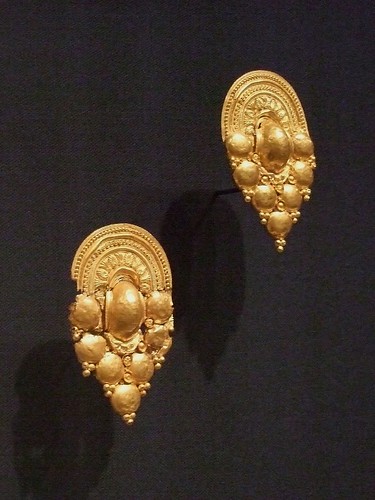
If any of you can make it to Dallas to see these treasures, be sure to stop by the Dallas Museum of Art as well as they have a very diverse Greco-Roman gallery including a large collection of gold Etruscan jewelry like these 5th-3rd century BCE gold grappolo earrings.

The Florence Archaeological Museum holds what is arguably the finest collection of Etruscan art in the world, and some of the choicest objects from its collection will come to the Meadows. These extraordinary objects illustrate every aspect of Etruscan life and afterlife over almost a thousand years. The Etruscans were ruled by a theocratic elite that controlled every aspect of Etruscan life; priest/magistrates were believed to be skilled at interpreting the will of the gods. The exhibition will include ritual objects, such as votive bronzes offered to the gods in sanctuaries, or objects used for interpreting the will of the gods, such as the still-mysterious Magliano lead disc. The exhibition also will include an entire temple pediment—the terracotta decoration for the front of an Etruscan temple—showing that the Etruscans were masters at working terracotta as well as bronze (the Etruscan skill at creating decorative objects in bronze was much admired by the Greeks, and adapted by the Romans). Additionally, a multitude of objects will be shown from Etruscan tombs: sarcophagi and ash urns, guardian animals and demons, as well as the splendid gold, silver, bronze, ivory, and ceramic objects that were deposited in the tombs of the wealthy. Especially impressive is the gold jewelry, so technically advanced that it is difficult to reproduce today.
Fifteen years of excavation at the Etruscan site of
Poggio Colla will also be displayed in an accompanying exhibit, New Light on the Etruscans. Overseen by Dr. P. Gregory Warden, a classical archaeologist and University Distinguished Professor of Art History at SMU, and Dr. Michael L. Thomas, archaeologist and Senior Research Associate at The University of Texas at Austin, the site, first excavated from 1968 to 1972 by Dr. Francesco Nicosia, the former Superintendent of Archaeology in Tuscany, was reopened in 1995.

"Archaeological evidence suggests that Poggio Colla was occupied from as early as 650 B.C.E. until at least 187 B.C.E. The site centers on the acropolis, a roughly rectangular plateau of one and a half acres at the summit of Poggio Colla. Excavations have found strong evidence that the acropolis was a sanctuary and have identified a building and an altar associated with the structure. The building’s form evolved from a modest hut-like structure in the seventh century B.C.E. to a monumental complex with stone foundations and tile roofs by the time of its destruction in the second century B.C.E. Since 1995, excavations have unearthed five stone column bases and other parts of a monumental building that are a testament to the scale and importance of this rural sanctuary at the frontier of the Etruscan world...

...Excavators discovered a large circular pit, at the center of which was placed a sandstone cylinder, possibly the top of a votive column or altar. Carefully situated near the cylinder were two sandstone statue bases, the larger of which is inscribed with the name of the aristocratic donor. Buried alongside these objects were a strand of gold wire, a purposely broken bronze implement, and two bronze bowls that had been used to pour ritual libations, as well as the bones of a sacrificial animal. This unique religious context allows us to reconstruct the actual rituals and actions of the priest/magistrate who presided over the ceremonies....

...a habitation and center of ceramic production [was] discovered in a field below the acropolis of Poggio Colla. The structure includes a room with a circular hearth surrounded by cooking vessels. A terraced outdoor work space preserved several carbonized post holes, perhaps the remnants of wooden drying racks surrounding a large fire pit. At the southern end of this terrace, set into a pit up against a terrace wall, excavation uncovered a deposit of unusual stands of a type usually used for banqueting. At the opposite side of the building were the remnants of three kilns. These teardrop-shaped kilns were used to produce simple fine-ware bowls of at least three different sizes."
If you enjoyed this post, never miss out on future posts by following me by email!