Showing posts with label prophecy. Show all posts

Wednesday, June 23, 2021

Protesilaus: The first Greek to die in the Trojan War

Protesilaus (also spelled Protesilaos) was one of the suitors of Helen of Troy sworn to defend the honor of Menelaus. He brought forty black ships with him to Troy, drawing his men from "flowering" Pyrasus, coastal Antron, and Pteleus, "deep in grass", in addition to his native Phylace in ancient Thessaly. Protesilaus was "the first man who dared to leap ashore when the Greek fleet touched the Troad", Pausanias recalled, quoting the author of the epic called The Cypria.  An oracle had prophesied that the first Greek to walk on the land after stepping off a ship in the Trojan War would be the first to die, and so, after killing four men, he was himself slain by Hector. (Alternate sources have him slain by either Aeneas, Euphorbus, Achates, or Cycnus.) 

The gods had pity on his widow, Laodamia, daughter of Acastus, and brought him up from Hades to see her. She was at first overjoyed, thinking he had returned from Troy, but after the gods returned him to the underworld, she found the loss unbearable. She had a bronze statue of her late husband constructed, and devoted herself to it. After her worried father had witnessed her behavior, he had a great fire built to burn the statue, but Laodamia jumped into the fire and was consumed along with her husband's likeness.

According to legend, the Nymphs planted elms on the tomb of "great-hearted Protesilaus" in the Thracian Chersonese that grew to be the tallest in the known world.  But when their topmost branches grew high enough to see the far off  ruins of Troy, they immediately withered, so great still was the bitterness of the hero buried below. The story is the subject of a poem by Antiphilus of Byzantium (1st century CE) in the Palatine Anthology:

"Thessalian Protesilaos, a long age shall sing your praises,

Of the destined dead at Troy the first,

Your tomb with thick-foliaged elms they covered,

The nymphs, across the water from hated Ilion.

Trees full of anger, and whenever that wall they see,

Of Troy, the leaves in their upper crown wither and fall.

So great in the heroes was the bitterness then, some of which still

Remembers, hostile, in the soulless upper branches."

The tomb of Protesilaus at Elaeus in the Thracian Chersonese is documented in the 5th century BCE, when, during the Persian War, votive treasure deposited at his tomb was plundered by the satrap Artayctes, under permission from Xerxes. The Greeks later captured and executed Artayctes, returning the treasure. When Alexander the Great arrived at Elaeus on his campaign against the Persian Empire, he offered a sacrifice at the tomb, hoping to avoid the fate of Protesilaus when he arrived in Asia. Like Protesilaus before him, Alexander was the first to set foot on Asian soil during his campaign but successfully avoided the Greek hero's fate.

The Augustan-era mythographer, Conon, claimed Protesilaus survived the Trojan War and was returning with Priam's sister Aethilla as his captive. When the ships put ashore for water on the coast of Pallene, between Scione and Mende, Aethilla persuaded the other Trojan women to burn the ships, forcing Protesilaus to remain and found the city of Scione where a founder-cult of Protesilaus was later established.

In Philostratus' Heroicus, a Roman imperial period literary work representing an alternative Greek hero-cult tradition to the original epic, Protesilaus, speaking from beyond the grave, is the oracular source of the corrected eye-witness account of the actions of heroes at Troy, related by a "vine-dresser" to a Phoenician merchant. 


Image: Engraved Cornelian scaraboid with Protesilaos on the Prow of a Ship, Greek, 400-350 BCE, now in the collections of the Getty Villa and on view in Gallery 101D.  Image courtesy of the museum.


If you enjoyed this post, never miss out on future posts by following me by email!


Saturday, April 10, 2021

Julia Domna and the Severan Prophecy

Julia Domna was born in Emesa (present-day Homs) in Roman Syria, the youngest daughter of the high priest of Baal, Julius Bassianus. The family had enormous wealth and was promoted to Roman senatorial aristocracy. Before her marriage, Domna also inherited the estate of her paternal great-uncle, Julius Agrippa, a former leading centurion. 

In 187 CE, she married Severus, who at the time was governor of the Roman province of Gallia Lugdunensis. The Augustan History relates that, after losing his first wife around 186 CE, Septimius Severus heard a prophesy of a woman in Syria who would marry a king. So Severus sought out Domna from one of Syria's most prominent families as his wife.

As empress, Domna was famous for her political, social, and philosophical influence. She received titles such as "Mother of the Invincible Camps" because, unlike most imperial wives, Domna remarkably accompanied her husband on his military campaigns and stayed in camp with the army. After the elder of her sons, Caracalla, started ruling with his father, she was briefly co-empress with Caracalla's wife, Fulvia Plautilla, until the latter fell into disgrace. Following the death of Severus in 211, Domna became the first empress dowager to receive the title combination "Pia Felix Augusta", which may have implied greater powers being vested in her than what was usual for a Roman empress mother. 

Domna is said to have committed suicide in 217 CE upon hearing of her son Caracalla's assassination in the course of his campaign against Parthia, on which she had accompanied him as far as Antioch (present-day Antakya, Turkey).


Image: A Severan Period mold-made lamp, 2nd century CE, terracotta, at the J. Paul Getty Museum (Villa).  This unusual moldmade lamp depicts  a woman dressed in a long-sleeved garment standing next to a truncated column, playing a harp, which leans on her shoulder. Her hairdo is similar to a style worn by Empress Julia Domna, wife of Septimius Severus . The Filling-hole is on top of the instrument and the wick-hole pierces its base. 


If you enjoyed this post, never miss out on future posts by following me by email!


Wednesday, June 24, 2020

Sibyls as female authors of prophecy and myth

The Libyan Sibyl by Michelangelo on the ceiling of the Sistine Chapel (after restoration)
courtesy of Wikimedia Commons.
A friend asked me if I could point him in the right direction to study female writers of mythology in the ancient world.  I suggested he research the origins of the worship of the Great Mother (associated with Cybele) with a possible forerunner in the earliest Neolithic at Çatalhöyük. The Roman state adopted and developed a particular form of her cult after the Sibylline oracle in 205 BCE recommended her conscription as a key religious ally in Rome's second war against Carthage (218 to 201 BCE). Roman mythographers (that often included historians like Livy) reinvented her as a Trojan goddess, and thus an ancestral goddess of the Roman people by way of the Trojan prince Aeneas.

Although Roman religion did not have a basis in scriptures and exegesis, priestly literature was one of the earliest written forms of Latin prose. The books (libri) and commentaries (commentarii) of the College of Pontiffs and of the augurs contained religious procedures, prayers, and rulings and opinions on points of religious law. Although at least some of this archived material was available for consultation by the Roman senate, it was often occultum genus litterarum, an arcane form of literature to which by definition only priests (only males) had access. Prophecies pertaining to world history and to Rome's destiny turn up fortuitously at critical junctures in history, discovered suddenly in the nebulous Sibylline books, which Tarquin the Proud (according to legend) purchased in the late 6th century BCE from the Cumaean Sibyl.

Although there were many sibyls throughout the ancient world, three sibyls were deemed of particular importance in the Greco-Roman world, the Apollonian Sibyl at Cumae, the most famous among the Romans, the Erythraean Sibyl from Turkey, and the oldest Hellenic oracle, the Sibyl of Dodona whose prophecies may have reached back as far as the 2nd millenium BCE, at least according to Herodotus. The Cumaean Sibyl is supposedly the author of the famous Sibylline books.  If you consider prophecy directly related to myth, I would encourage the study of these sybils as ancient female authors. 

There are 14 books and eight fragments of so-called Sibylline Oracles that survive today although these are not the original Sibylline Books of the Romans which were burned on the orders of the Roman general Flavius Stilicho in the 4th century CE.  Although they are deemed an "odd pastiche" of Hellenistic and Roman mythology interspersed with Jewish, Gnostic and early Christian legend they are still considered a valuable source of information about classical mythology.
If you enjoyed this post, never miss out on future posts by following me by email!


Monday, June 30, 2014

Anthropomancy and other slanders against Julian the Apostate

A history resource article by  © 2014 updated 2017

In Terry Deary's book "Dangerous Days in the Roman Empire" Deary apparently promotes claims that the ancient Romans and the emperor known as Julian "The Apostate" in particular regularly engaged in anthropomancy, the foretelling of the future by the examination of the entrails of human sacrifices.  Deary gained notoriety for his "Horrible Histories" series for children. The books were later the basis for a BBC television series.
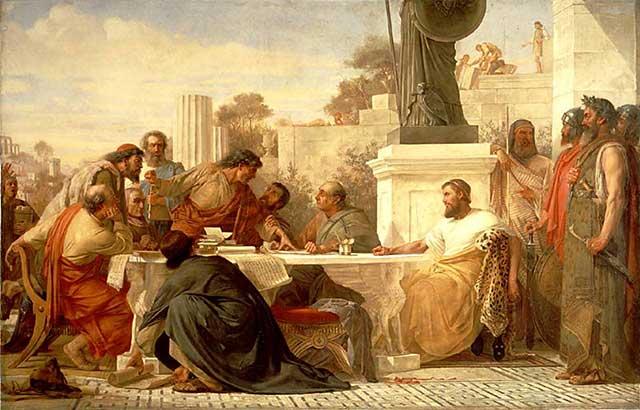
Julian the Apostate presiding at a conference of sectarians, by Edward Armitage, 1875


19th century agnostic and orator
Robert Green Ingersoll.
 
It's fairly common knowledge among Roman scholars, though, that the Romans abhorred human sacrifice.

"... the killing of humans offerings to the gods as a regular, required part of worship was sacrifice and it was generally unacceptable. It was foreign to Roman practice or, if we accept what the Roman themselves claimed, foreign to Roman practice in the historical period. The Romans did not tolerate human sacrifice among the peoples they conquered, forbidding the Bletonesii [a Celtic tribe living in the central part of the Iberian peninsula] from performing it and seriously curtailing (if not actually eliminating it) among the Carthaginians and among the Celts. Even so, the Romans were willing on at least three occasions to offer human victims to the gods. This type of ritual was permissible but only just barely, within the Roman religious tradition because it was enacted only as an extraordinary, or ad hoc, response to an exceptional circumstance. It was not part of regular worship, but was ordered, as Plutarch points out, by the Sibylline books." - Celia E. Schultz, The Romans and Ritual Murder

So where did these charges originate?  The 19th-century agnostic Robert Green Ingresoll references such reports and attributes them to two of the Roman emperor Julian's Christian enemies, Gregory of Nazianzus and Theodoret of Cyrrhus.

How did the cousin of Constantius II, the emperor who actively promoted Christianity at the expense of paganism and decreed the closing of pagan temples, the banning of animal sacrifices, and introduced the death penalty for those who performed such sacrifices, end up the target of such Christian invectives?

"Constantius' cousin Julian, who was overseeing the Western Empire as Caesar, saw such actions as undermining the Empire, " explains Dr. Eugenia Russell, Lecturer in History at St Mary's University, Twickenham, UK. "He was already a successful general who had been proclaimed Augustus (in 360 CE) by his troops in Paris, and a decisive conflict between the two was only averted by the death-bed recognition by Constantius of Julian as his successor, leaving the latter in sole control in AD 361...With an empire riven by internal conflict and beset by external forces, he attempted to promote peace and tolerance through the reaffirmation of what he saw as Roman virtues, becoming the last emperor to worship the pagan deities and uphold the customs of the ancient world." — Eugenia Russell, "The Last Non-Christian Roman Emperor, Julian the Apostate"


19th century depiction of Julian being proclaimed Emperor in Paris at the Thermes de Cluny, standing on a shield in the Frankish manner, in February 360. Image courtesy of Wikimedia Commons.
Julian was actually raised in a Christian household, even serving as a Church reader (Anagnostes) at one point. But, after studying philosophy and the classics at the Academy at Athens, he became an admirer of the academy's founder, Plato, and of the Homeric deities in traditional Graeco-Roman religion.

However, Julian remained a monotheist who sought to unite Neoplatonism with Homeric myth.

"Julian insisted there is one supreme god called by many names," observes Vasiliki Limberis in his paper 'Religion' as the Cipher for Identity: The Cases of Emperor Julian, Libanius, and Gregory Nazianzus. 

So was Julian really a pagan or not?

"In some aspects, Julian's religion is consistent with Greco-Roman tradition. It is noteworthy, for example, that for Julian, religion is a public duty, whose obligations are designated by the civic calendar and local custom. This includes pleasing a host of gods by ritual sacrifice, proper fulfillment of ritual obligations, and festive celebrations in feasts, theatre events, games, or contests, all arranged in an annual cycle. Nor was Julian much of an innovator when he emphasized the ritual, even the magical, aspects of religion; he was simply tapping into current trends of the days a combination of philosophy and cultic ritual. However despite the elements of Julian's religious program that appear traditional, it was his attempt to democratize religion that represented his most startling innovation." - Vasiliki Limberis
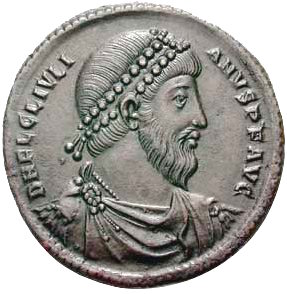
An official coin depicting the Emperor Julian minted in Antioch in 360 CE
Image courtesy of Wikimedia Commons.

Limberis points out that at that time there was a surge of interest in theurgy, the practice of rituals for the purpose of encouraging divine intervention in the perfection of oneself. Many of the popular mystery religions incorporated theurgy into their practice and even some Christian teachers including Clement of Alexandria, Cyrillus and Synesius embraced the concept.

 But, Christians were also engaged in fighting between themselves over the "nature" of Christ. Those referred to as Arians considered Christ to be begotten of God but distinctly separate from him and subordinate. The Monophysites believed Christ was of a single essence with God the Father. The single essence concept was officially adopted at the First Council of Nicaea in 325 CE and Arians were declared heretical and, for all intents and purposes, considered no longer doctrinal Christians, splitting a very small minority, less than 10% of the total Roman population at the time, even further.

"Julian adhered to the syncretic form of Graeco-Roman religion popular in the Late Empire that absorbed a wide variety of beliefs and practices. Although an initiate in at least three of the 'mystery religions' (including Mithraism), he abhorred the exclusivity that made Christianity incompatible with his view of toleration, referring to it as a disease." —  Eugenia Russell, "The Last Non-Christian Roman Emperor, Julian the Apostate"

Unlike previous emperors like Diocletian, however, Julian still protected Christianity's followers, making it unlawful to force a Christian to offer a sacrifice, even if this was expected of someone in a public office. Julian did, however, give preference to pagan citizens for public duty, revoke exemptions previously granted to Christian clergy, return public property that had been confiscated for the building of Christian churches, and ban the teaching of classical texts by Christians, apparently fearing the Homeric myths would be presented with a negative spin.

But if Julian only attempted to return the Empire to a religious status quo, why did his actions inflame such influential Christian leaders as Gregory of Nazianzus?
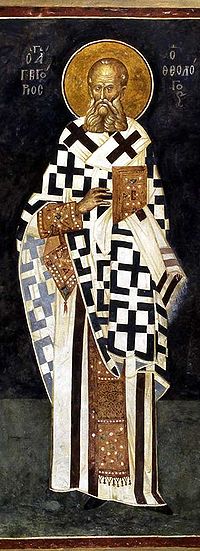
St. Gregory Nazianzen.
Image courtesy of
Wikipedia.
"Gregory of Nazianzus was born into an elite family around 329 or 330 CE near the provincial city of Nazianzus in southwest Cappadocia. At the time of his birth, his father and the rest of his family had only recently converted to Christianity, according to Raymond van Dam, due to Constantine’s patronage." - Benjamin James Rogaczewski, Killing Julian: the Death of an Emperor and the Religious History of the Later Roman Empire

Gregory's father was eventually named Bishop of Nazianzus and, like many Roman fathers, wanted his son to become a cleric, too. But Gregory, educated in the classics at Athens, chose to teach rhetoric instead until his father ordained him a priest against his wishes in 361 CE. Gregory rebelled and fled with his friend Basil of Caesarea to a monastery.

"Around early 361, soon after Gregory left Nazianzus, emperor Constantius compelled many eastern bishops to sign a creed meant to unify the eastern churches under an “Arian” doctrine of faith. Although many of these bishops, one of whom was Gregory’s father, opposed Constantius, they feared possible persecution and subscribed to the creed. When Constantius died, the Nicene accused Gregory the Elder of heresy and “betraying” orthodox doctrine..."

"In 361, while Gregory was in monastic retreat, Julian became emperor and declared not only his rejection of Christianity, but also economical and religious reforms that directly affected the church. He allowed all previously exiled bishops and clerics to return, which only fueled the Arian controversy, creating more dissension within Christian communities, such as Nazianzus. He also removed state funding for the church and seized the municipal lands Constantine and Constantius had given to the church and returned them to the cities. These measures were intended to restore the finances of many cities, which had fallen into neglect, but they also had the effect of removing an important source of income from the control of the church." Benjamin James Rogaczewski

Julian penned a satirical work entitled The Caesars in which he attacked what he viewed as Constantine's hypocritical advocacy of Christianity. Julian was particularly critical of the Christian doctrine of forgiveness of sins:

"He that is a seducer, he that is a murderer, he that is sacrilegious and infamous, let him approach without fear! For with this water will I wash him and will straightway make him clean. And though he should be guilty of those same sins a second time, let him but smite his breast and beat his head and I will make him clean again." - Flavius Claudius Iulianus Augustus, The Caesars 

Julian also despised  his predecessors' luxuriant lifestyle. He forbid the use of the reference Dominus (Lord) when addressed and dispensed with court formalities and elaborate dress, preferring to live simply. He even espoused chastity outside of marriage.

You would have thought Julian's character that closely resembled the qualities, once so admired by early Christian believers would have found favor among the pious. But the wealthy Christians that had once populated the imperial court and dominated Antioch were enraged by his behavior and his scraggly philosopher's beard, considering it inappropriate for a ruling monarch.

Already seething with anger, Gregory also appears to have had to defend his abandonment of his priestly duties to his father's Christian constituents when he penned the Apology for his Flight to Pontus. Then Gregory went on the attack penning two long rambling invectives against the emperor himself.. Gregory needed a worthy adversary to oppose in his prodigious literary outpourings and Julian, the "apostate" who had been raised a Christian then rejected its teachings, was just the target he needed.

"Gregory’s acutely hostile language in this oration foreshadows the vicious attacks against the emperor in his Invectives against Julian. The emperor of course opposed the use of violence against Christians and carefully avoided persecuting them. Instead, he removed the privileges previously granted to the church to encourage Christians to turn away from Christianity as he had done. However, Gregory wished to convey the impression that Julian actually was persecuting Christians and hurting the church—and, indeed, he may have perceived it that way; for Gregory surely understood the importance of imperial patronage to the church. Hence, it is perhaps not surprising that he portrays Julian as a persecutor of Christians, recalling images of the Christian persecutions of old. This “wild beast” that now ruled the empire had discovered “fresh tortures of greater severity” namely tortures that affected the coffers of the church." - Benjamin James Rogaczewski

Rogaczewski also points out that Gregory also had personal reasons to despise Julian

"Around the time he wrote the Apology, Julian had passed Nazianzus on his way to Antioch to prepare for war against the Persians. Julian was displeased with the Christian zeal of the Cappadocians and his correspondence during this time suggests that he dismissed many, if not all, Christian Cappadocians from court, including Gregory’s brother, Caesarius [a court physician]. Not only had Julian prohibited Gregory from teaching rhetoric, which he loved, but he also slighted Gregory’s family."  - Benjamin James Rogaczewski

Gregory actually knew Julian personally, having become acquainted when both young men studied the classics in Athens. I also wonder if Gregory had attempted a relationship with Julian that was rejected or if Gregory had become deeply jealous of Julian because, as the emperor's cousin, he probably received more of the teachers' attention.

In any case, Gregory's apparent hatred of Julian was so complete, Gregory, who would be later referred to with the reverential epithet of "the Theologian," is suspected of fictionalizing his account of Julian's death and to make it appear that, in the end, Julian surrendered to the Christ on his deathbed.

Gregory actually relays more than one account of Julian's death.

"In one of Gregory’s versions, Julian’s death was similar to the death of Cyrus the Younger who fought alongside Xenophon and his “Ten-Thousand” in the battle of Cunaxa. The story goes that Cyrus recklessly attacked the enemy king, his brother Artaxerxes, and was killed by enemies because of his rashness. This version of Julian’s death, comparing Julian’s death to that of the reckless Cyrus, finds an echo in the versions of Libanius and Ammianus in which a reckless Julian is mortally wounded because he is not wearing a breastplate." - Benjamin James Rogaczewski

Closeup of the fallen Julian inscribed on the Sassanian relief of the investiture of Ardashir II showing MithraShapur II and Ahura Mazda above a defeated Julian, lying prostrate. Image courtesy of Wikimedia Commons
Then Gregory goes on to claim Julian was actually assassinated by one of his own soldiers.
"[Julian] had gone up upon a lofty hill to take a view of his army and ascertain how much was left him for carrying on the war; and then when he saw the number considerable and superior to his expectation, he exclaimed, “What a dreadful thing if we shall bring back all these fellows to the land of the Romans!” as though he begrudged them a safe return. Whereupon one of his officers, being indignant and not able to repress his rage, ran him through the bowels, without caring for his own life." - Gregory of Nazianzus, Second Invective Against Julian The Emperor
Then Gregory continues, as if spinning a tale, blaming an itinerant barbarian jester. This is thought to be a reference to the death of the emperor Alexander Severus as described in the Historia Augusta which had been recently published at the time.

"Gregory likely has included this story, a fool killing an even greater fool, to incite laughter amongst his audience at the expense of Julian," observes Rogaczewski.

David Woods disagrees saying Gregory may have misinterpreted the reference and that it may have pointed to the member of a barbarian light infantry unit known as the Petulantes.

"As an auxilium  palatinum, the Petulantes were an elite mobile unit attached to the palace, and it would have not have been surprising had they been fighting in relatively close proximity to the emperor himself at the time of his fatal wounding. More importantly, the auxilia palatina were light-infantry units, and Ammianus seems to describe the main group involved in the repulse of the Persians during the skirmish in which Julian was wounded as a light-infantry force. Given the confused circumstances of the skirmish, the fact that there seems to have been no co-ordination between this light-infantry force on the one hand and the small group gathered about Julian on the other, it is not impossible that a  weapon thrown by a member of the light-infantry force may have hit Julian as he was engaged in hot pursuit of the retreating Persians. In this way, although relatively little is known about the skirmish which resulted in the death of  Julian, such details as are preserved by Ammianus at least are consistent with the belief that it was a member of the  Petulantes, or an associated light-infantry unit, who threw the weapon that fatally wounded him." - David Woods, Gregory of Nazianzus on the Death of Julian the Apostate 

Finally, Gregory claims Julian, an obvious madman, tried to throw himself into a river to attain godhood. Rogaczewski thinks Gregory wanted to not only mock Julian's attempt to attain divinity but  to criticize the pagan ritual of deification.

"The story is particularly interesting in that it is not completely Gregory’s, but rather a twisted borrowing, taken from Arrian’s narrative of Alexander the Great’s death in the Anabasis," Rogaczewski points out.

Unfortunately, Gregory's grossly biased narratives would be embraced by three other revered Christian historians, Theodoret of Cyrrhus, Socrates Scholasticus of Constantinople, and Sozomen of Gaza and  whose histories of the church became enormously influential in the Byzantine East and the medieval West.
"It is related that when Julian had received the wound, he filled his hand with blood, flung it into the air and cried, "Thou hast won, O Galilean." Theodoret, Ecclesiastical History, Book III, Ch. 20 (c. 429)
"...The story that the dying emperor acknowledged that he was conquered by the Galilean was originated by some of the so-called Fathers of the Church, probably by Gregory or Theodoret. They are the same wretches who said that Julian sacrificed a woman to the moon, tearing out her entrails with his own hands."  — Robert Green Ingersoll, Julian the Apostate

Theodoret of Cyrus, the fifth-century Eusebian scholar, was probably merely repeating stories promulgated by Gregory and, perhaps, Theodoret's knowledge that Julian was an initiate of the Eleusinian Mysteries (associated with mysterious nighttime rituals).

Theodoret may have been further motivated by Gregory's possible association of Julian with the Assyrian Church of the East since Gregory derogatorily refers to Julian as "the Assyrian" in his invectives. This could have been merely an ethnic slur, though, as Julian was born in Constantinople - ancient Assyria, known for its martial brutality.

The Assyrian Church of the East originally developed during the 1st century CE in the Mesopotamian Eastern Aramaic speaking regions of Assyria, Babylonia, and northwestern Persia (today's Iraq, southeast Turkey, northeast Syria and northwestern Iran.  It is considered an apostolic church founded by the apostles St. Thomas (Mar Toma), St. Thaddeus (Mar Addai), and St. Bartholomew (Mar Bar Tulmay). Scholars of the church advanced the doctrine that Christ embodied two natures, one human and the other divine.  But this viewpoint (later referred to as Nestorianism) was later declared heretical and was one of many rejected by Theodoret and other followers of Eusebius of Caesarea who promoted Arian-like interpretations of the nature of Christ.  I find this villification ironic, though, since Julian actually spent his early childhood with Eusebius of Nicomedia.

Julian spent quite a bit of time in Mesopotamia and another scenario could have been that he at one point actively studied cultural beliefs of the region in anticipation of its conquest and this apparent interest was misinterpreted. Sadly, our contemporary source material for the 4th century is woefully fragmented, so all we can do is speculate.

Socrates Scholasticus embroiders the death of Julian still further in his Ecclesiastical History of 439.

"Socrates discusses the reign of Julian in book three, where he also describes Julian’s death, drawing on Libanius and Gregory Nazianzus. However, Socrates provides his own commentary on the events. For instance, he quotes verbatim a passage from Libanius’s Funeral Oration, but then proceeds to a discussion on whether or not a Christian soldier killed Julian. After considering the charge, he replaces the Christian murderer with an evil supernatural being, whom Christians often associated with the pagan gods." - Benjamin James Rogaczewski

Sozomen of Gaza, in his work composed between 440 and 443 with much of it based on the works of Socrates Scholasticus, admits Julian was killed by a Christian soldier but claims the murder was not a crime because "God Willed It!," an excuse that would be used liberally later during the Crusades.

Some early Christians attribute Julian's death to Saint
Mercurius, a converted Roman soldier executed by the
Roman emperor Decius during one of his religious persecutions.

Image courtesy of Wikipedia.
"All these stories rest upon the same foundation, the mendacity of [Christian] priests. Julian changed the religion of the Empire, and diverted the revenues of the church. Whoever steps between a priest and his salary, will find that he has committed every crime. No matter how often the slanders may be refuted, they will be repeated until the last priest has lost his body and found his wings. These falsehoods about Julian were invented some fifteen hundred years ago, and they are repeated to-day by just as honest and just as respectable people as these who told them at first. Whenever the church cannot answer the arguments of an opponent, she attacks his character. She resorts to falsehood, and in the domain of calumny she has stood for fifteen hundred years without a rival." — Robert Green Ingersoll, Julian the Apostate

Ingersoll claims the description provided by pagan contemporaries of the emperor, the philosopher Libanius and soldier/historian Ammianus Marcellinus, appeared to provide an ending more consistent with Julian's character and philosophical education.

'Brought back to his tent, and feeling that he had but a short time to live, he [Julian] spent his last hours in discoursing with his friends on the immortality of the soul. He reviewed his reign and declared that he was satisfied with his conduct, and had neither penitence nor remorse to express for anything that he had done.' His last words were: 'I submit willingly to the eternal decrees of heaven, convinced that he who is captivated with life, when his last hour has arrived is more weak and pusillanimous than he who would rush to voluntary death when it is his duty still to live.'"  — Robert Green Ingersoll, Julian the Apostate

Some scholars think Libanius may have been trying to give the philosopher-emperor a more Socratic end, though.

However, I thought it was particularly interesting that Ammianus Marcellinus, a historian who was serving as a soldier on Julian's Persian campaign, claiming not to have been present at the emperor's death, mentions a rumor among the Persians that the emperor Julian was killed by his own men.

The period immediately following Julian's death was especially dangerous with the wealthy Christians seizing power once more. Even Libanius, a respected sophist, teacher of rhetoric, and comrade of Julian did not publish his Funeral Oration in which he defended Julian as a just ruler, a devout Hellene, and most importantly, a monarch treacherously murdered, until a year after Julian's death. This was followed by an entreaty for justice entitled Avenging Julian. Even Marcellinus waited until the 390s to pen his thirty-one volume Res Gestae and notably published it in Latin in Rome not his native Greek in his hometown of Antioch, a city that had been so adamantly opposed to Julian.

"Libanius hints that Julian was not only killed by a Roman soldier, but by a Christian soldier. This shift in blame from a foreign enemy to a domestic, internal one is highly significant, since with that Libanius clearly sought more explicitly to implicate Christians in the death of an emperor—an act of high treason. The charge would prove to be both controversial and influential. Libanius’s imperial connections, his familiarity with Julian, his renown as an effective orator, and wide readership (which included none other than John Chrysostom, one of his Christian students) may have fueled the controversy around the allegation long into the fifth century when the ecclesiastical historians Socrates and Sozomen picked it up and responded to it in their church histories..." - Benjamin James Rogaczewski

Anyway, I hope I have made my point about the folly of quoting sources (even ancient ones) without investigating the social and political context in which they were made and the relationship of the source with the target, especially if the information is defamatory in nature. Blindly repeating such allegations as a sensational "fact" as Deary does in a book touted as "nonfiction" may sell books but is not the kind of  "shallow" scholarship I would want foisted on children.

References:

Schultz, C. (2010). The Romans and Ritual Murder. Journal of the American Academy of Religion, 78(2), 516-541. Retrieved from http://www.jstor.org/stable/40666530

Ingersoll, R. G. (1881). The Great Infidels: A Lecture

Russell, E. (2017, August). The Last Non-Christian Roman Emperor, Julian the Apostate". Ancient History Magazine, (11), 15-17.

Rogaczewski, Benjamin James, "Killing Julian: the Death of an Emperor and the Religious History of the Later Roman Empire"(2014). Theses and Dissertations Paper 423.

Gregory of Nazianzus, Second Invective Against Julian

Limberis, V. (2000). "Religion" as the Cipher for Identity: The Cases of Emperor Julian, Libanius, and Gregory Nazianzus. The Harvard Theological Review, 93(4), 373-400. Retrieved from http://www.jstor.org.libproxy.uoregon.edu/stable/1510164

Woods, D. (2015). Gregory of Nazianzus on the Death of Julian the Apostate (Or. 5.13). Mnemosyne, 68, 297–303. https://doi.org/10.1163/1568525X-12301532
If you enjoyed this post, never miss out on future posts by following me by email!


Saturday, July 7, 2012

Review: The Pillars of Rome by Jack Ludlow


"One shall tame a might foe, the other strike to save Rome's fame, neither will achieve their aim.  Look aloft if you dare, though what you fear cannot fly, both will face it before you die." - Jack Ludlow, The Pillars of Rome

This prophesy by the Alban Sybil, accompanied by a crude drawing of an eagle in flight that bursts into flame of its own accord, set the stage for Jack Ludlow's first novel set in ancient Rome.

"The Pillars of Rome" is the first book in a trilogy by Jack Ludlow set in the late 2nd century BCE.  Ludlow is an experienced writer and has published a number of books set in other time periods but this is his first with a Roman theme.  Ludlow does an excellent job of developing vibrant characters and deftly recreates Republican Rome with its strict social hierarchy, scheming and corrupt senators and provincial governors, politically motivated marriages, military reliance on landowners (this is before Marius approved career soldiers without land ownership requirements) and strict military "disciplina" in the conduct of its troops who, in turn, extended little mercy to the conquered.

However, Ludlow chooses to populate his book with purely fictional characters, making it more of a challenge for me to identify the time period and discuss the differences between events described in the novel compared to actual historical events like I usually do in most of my reviews.

Ludlow did give me some clues, though, as to the historical personages used as models for his main characters thus pinpointing the period of Roman history as well.

Ludlow's two main protagonists, Aulus Cornelius Macedonicus and Lucius Falerius Nerva, are lifelong companions and the prologue opens with a scene of the two as boys creeping into a dark cavern to clandestinely meet with the Sybil to gain insight into their respective futures.  It is soon apparent that Aulus is far more pious and god-fearing than Lucius  who is willing to risk eternal damnation to learn if he will realize his dreams of fame and fortune.  Aulus' piety will eventually become revered by Roman society and serve him well in his ascension to the peak of military success.  Likewise, Lucius' ambition will be the driving force in his future where risk-taking becomes second nature in his struggle to become politically the first man in Rome.

From his cognomen, Macedonicus, we know that Aulus apparently was instrumental in the Roman conquest of Macedon.  There were a number of Macedonian Wars but as we read the novel, we learn that he defeated King Perseus, son of King Philip V of Macedon, who ascended the throne in 179 BCE giving us a historical period of the early to mid 2nd century BCE.

Perseus was defeated by the legions led by Lucius Aemilius Paullus at the Battle of Pydna in 168 BCE at the climax of the Third Macedonian War.  Thereafter, he became known as  Lucius Aemilius Paullus Macedonicus.  So, we can assume Aulus is a surrogate for Paullus and examine the life of Paullus  to gain historical insight into this personage and the events surrounding this period of history.

In Plutarch's Lives, Paullus is held up as an examplery nobleman with "traditional Roman firmness and courage in adversity" ( an introduction by Philip A. Stadter and Robin Vaterfield to Roman Lives: A Selection of Eight Lives by Plutarch).  He carefully prepared for each engagement unlike his nemesis Perseus who is characterized as miserly, cowardly and unfaithful to his mercenaries who he failed to pay.
Perseus surrenders to Paullus. Painting by Jea...
Perseus surrenders to Paullus. Painting by Jean-François Pierre Peyron from 1802. Museum of Fine Arts, Budapest. (Photo credit: Wikipedia)
Paullus was also painfully aware of the fickleness of fortune.  One of his young sons, a boy of only 14, died just five days before Paullus was set to celebrate his victory.  While preparing for his triumph, Aemilius chided the cowering Perseus for failing to bear his reversal of fortune but follows this with reproaching his sons and officers for taking too much pride in their victory:

"What occasion can there possibly be for men to take heart, when victory over others is precisely the time when we are most compelled to be afraid of fortune, and when a happy man can be plunged into the depths of depression by the realization that fate follows a cyclical course and attaches itself to different people at different times?"

This reminds me of the fatalism expressed by Scipio Aemilianus, son of Paullus, upon witnessing the destruction of Carthage in 146 BCE.  Polybius reports:

"Scipio, when he looked upon the city as it was utterly perishing and in the last throes of its complete destruction, is said to have shed tears and wept openly for his enemies. After being wrapped in thought for long, and realizing that all cities, nations, and authorities must, like men, meet their doom; that this happened to Ilium, once a prosperous city, to the empires of Assyria, Media, and Persia, the greatest of their time, and to Macedonia itself, the brilliance of which was so recent, either deliberately or the verses escaping him, he said:

A day will come when sacred Troy shall perish,
And Priam and his people shall be slain.

And when Polybius speaking with freedom to him, for he was his teacher, asked him what he meant by the words, they say that without any attempt at concealment he named his own country, for which he feared when he reflected on the fate of all things human."

The son obviously learned this sad truth from his father.


Detail of The Triumph of Aemilius Paulus
Detail of The Triumph of Aemilius Paulus (Photo credit: Wikipedia)


Aulus' [Paullus'] triumph is mentioned several times in the novel and was obviously the crowning achievement of his career.  Fortunately, a wonderful description of the  three day spectacle comes down to us from Plutarch in his biography of Paullus:

"The first day - and it was only just enough - was given over to the spectacle of all the statuettes, paintings, and statues taken during the war, which were transported on 250 wagons.  On the next day the most beautiful and valuable of the Macedonian arms and armour were carried through the streets on large numbers of carts.  The bronze and iron parts of the weapons had been polished until they shone, and all the objects had been artfully and aesthetically positioned, so as to look as much as possible as though they had fallen into random heaps of their own accord: there were helmets lying next to shields, breastplates on top of greaves, Cretan targes and Thracian wicker shields and quivers all jumbled up with horses' bridles; the piles bristled with unsheathed swords, and pikes had been planted among them.  The arms and armour were somewhat loosely arranged, so that as they were carried along they struck against one another and gave out a harsh and fearsome sound, and even though they had belonged to the losers in the war their appearance was not without its terrors.  After the wagons with the arms and armour came three thousand men carrying coined silver money in 750 boxes; each box held three talents' worth of money and was carried by four men.  Then came more men carrying silver mixing-bowls, drinking-horns, drinking bowls, and cups, each shown off to its best advantage and each remarkable for its size and for the depth of the chased work on it."

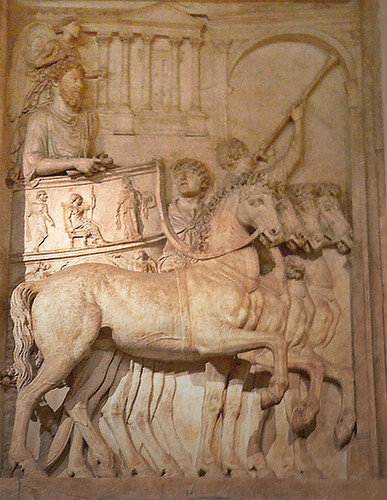
Marcus Aurelius driving a quadriga in a 
triumphal procession.  Photographed at the
Capitoline Museum by Mary Harrsch.


"Early in the morning of the third day trumpeters made their way through the streets, but the music they played was unusual for a procession or an exhibition; it was the kind with which the Romans used to rouse themselves in battle.  Behind the trumpeters 120 stall-fed oxen, with their horns gilded, and arrayed with headbands and chaplets were being led to sacrifice by young men dressed in ceremonial aprons with purple borders, and boys went with them, carrying silver and gold libation cups.  Next came the men carrying the gold coinage, which had been divided up, like the silver money, into vessels with a capacity of three talents, and there were seventy-seven such vessels altogether.  They were followed by men carrying the sacred bowl, which had been made, on Aemilius' instructions, out of ten talents of gold and studded with gems.  Next came men displaying the Antigonid, Seleucid, and Thericlean goblets, and all the golden tableware Perseus used.  They were followed by Perseus' chariot, which carried his arms and armour with his diadem lying on top of them.  Not far behind the chariot Perseus' children were led along as slaves, accompanied by a throng of weeping nurses, teachers, and tutors, who stretched out their hands in supplication to the spectators and taught the children to beg and plead.  There were two boys and one girl, too young to comprehend the magnitude of the disaster - and this made people feel so much more sad for them, considering the fact that one day this incomprehension would end, that Perseus walked by almost unnoticed by the Romans, who were just staring at the children in pity.  Many people started crying, and in all of them the spectacle aroused a mixture of pleasure and pain, until the children had passed by."

"Behind the children and their retinue came Perseus.  He wore a grey cloak and Macedonian boots, and looked as though he was utterly astounded and bewildered by the magnitude of the disaster that had happened to him.  He too was accompanied by a crowd of associates and friends; their faces were heavy with grief, but because they were constantly glancing at Perseus and weeping they gave the spectators to understand that they were mourning his fate and did not care in the slightest for their own.  Perseus had written to Aemilius, asking not to be paraded through the streets and included in the triumph, but Aemilius, apparently in mockery of Perseus' cowardice and fear of death, remarked: 'The situation is no different now from what it was before: he could grant his own request, if he wanted.' He [Aemilius] meant that he [Perseus] could always choose death instead of dishonour, but the coward could not bring himself to do that.  Instead, unmanned by hope, he became a part of his own spoils."

"After Perseus and his retinue, four hundred golden garlands were carried along, which had been brought and presented to Aemilius by representatives from the various cities in recognition of his valour.  Then came the man himself, mounted on a magnificiently decorated chariot.  He would have made a remarkable sight even without all these trappings of power; he wore a cloak dyed with purple and shot through with gold, and held in his right hand a spray of laurel.  Every single soldier likewise carried laurel.  The army marched behind their commander's chariot in their units and divisions, with the men singing partly traditional songs with an element of humour in them , and partly hymns of victory and praise for Aemilius' achievements."
In the novel, Aulus is said to have ritually strangled Perseus at the conclusion of the triumph but historically this did not occur.  Paullus actually arranged for Perseus to be moved from the "carcer" (prison) to a place that was clean "where he could life more like a human being."  But Perseus died anyway.  Plutarch says some writers say he starved himself to death while others report he angered his guards who, in retaliation, decided to not allow him to sleep, "until, eventually, worn out by this treatment he died."-  Plutarch, Aemilius Paullus, Roman Lives: A Selection of Eight Lives, edited by Philip A. Stadter and Robin Vaterfield.

As for his children that were so pitied by the Roman spectators, two of the children also died.  But Perseus' son Alexander survived and became an expert engraver and an accomplished secretary.

I sometimes wonder if ritual strangulation was as common as we are led to believe when I read about kings and rulers, like Perseus, that escaped the executioner's rope.  Maybe this ritual only occurred occasionally much like fights to the death between gladiators in the arena.

Returning to the novel, I think  Ludlow did a superb job of capturing this essence of nobility in his characterization of Aulus Cornelius.

Ludlow's novel makes a giant leap in time from the boyhood of the prologue to the mature years of his two main characters that comprise most of the novel.  When we pick up the tale in Chapter 1, Lucius has, indeed, become a powerful senator and leader of the Optimates while Aulus, the consummate warrior, has just returned from Spain where he has been battling the Celt-Iberians who have been stirred up by an outcast Gallic Druid by the name of Brennos.  The rebel activity must have been a prelude to the Celtiberian War.

"The Celtiberians, famous for their martial ability, fought a long and bitter war against Rome known as the Celtiberian war (Bellum Celtibericum, 153-133 BCE) and were involved in other conflicts with Rome throughout the 2nd century BC." -John T. Koch,  Celtic Culture: A Historical Encyclopedia

Aulus, like Paullus, had fought the Celt-Iberians in Spain earlier in his military career before his victories in Macedonia.

"Rome's most competent commanders were busy with the war against Antiochus the Great when another war broke out in the west, in Spain, where there had been serious disturbances.  Aemilius was dispatched there with the rank of praetor, but he had six extra lictors over and above the usual six praetorian lictors, with the reulst that his office was equivalent in dignity to that of a consul.  He won two pitched battles against the local tribesmen, who lost about thirty thousand men, and apparently it was plain to see that his success was due to his tactical skill, since he made victory easy for his troops by ensuring that they fought on favourable ground, on the far side of a certain river.  He also subdued 250 towns, which were happy to open their gates to him." Plutarch, Aemilius Paullus, Roman Lives: A Selection of Eight Lives, edited by Philip A. Stadter and Robin Vaterfield.

Although Plutarch never mentions Paullus' return to Spain, this is certainly a plausible plot development considering the ongoing conflicts  referred to by Koch.

Aulus finds Lucius, who has built his career around his ability to manipulate people with clever words rather than military prowess, mired in a dispute with a tribune of the plebs pushing land reform.  This can be no other than Tiberius Gracchus and Ludlow has kept the praenomen Tiberius but given his character a different gens name, Lavonius.   Tiberius Gracchus was elected tribune of the people in 133 BCE.  Historically, the problem is Paullus was already dead, having died in 160 BCE.  So Ludlow has compressed the historical timeframe at this point.  The only other reference I could find to earlier land reform efforts was a bill introduced during the consulship of Laelius in 140 BCE that was supported by Scipio Aemilianus but rejected by the senate (Paullus' younger son was adopted by the son of Scipio Africanus because Paullus, having four sons, could not afford to fund that many sons in their efforts to climb the Coursus Honorum).

Ludlow also portrays Lucius as the senator most violently opposed to the Gracchus figure which would make Lucius equivalent to Scipio Nasica Serapio.  Lucius,  like Nasica, unable to sway Tiberius Lavonius [Gracchus] from his determination to alleviate the inequality between the priviledged wealthy and thousands of Rome's destitute, hires thugs armed with clubs to seek out the tribune and club him to death - the actual fate that befell Tiberius Gracchus.

For those of you unfamiliar with Gracchus' land reform bill, here is a very good summary:

"There already existed a law at Rome - the so-called Licinian law - which limited the number of acres to be possessed by any one citizen to five hundred.  But this Licinian law had been a dead letter for many years, and there were many rich citizens in Rome who counted the number of their acres by the thousand or even ten thousand.  It was this violation of the Licinian law, and the open injustice done to the poor by this violation, which Teiberius Gracchus wanted to correct.  He therefore introduced a new agrarian law which aimed to revive the Licinian law, but at the same time greatly modified and attenuated its provision.  The change in the law which Tiberius Gracchus proposed was in one respect an act of injustice, because it put a premium on the violation of the law as it had existed, instead of punishing that biolation by imposing an adequate fine.  Under the new law a citizen might hold 500 acres of the public lands in his own name, and in addition, 250 acres for each son still under the paternal roof and authority.  Moreover, the new law provided that, whenever a citizen should be compelled to give up land which he held in excess of the share which the law allowed him, he should be reimbursed for this loss, at the appraised value, from the public treasury.  Tiberius Gracchus also favored the immediate distribution of the conviscated lands among the poor as their absolute property, and proposed that, whenever a Roman colony was founded on conquered territory, a similar distribution of the newly acquired land should be made." - Francis Johnson, Famous Assassinations of History From Philip of Macedon to Alexander of Servia

There is no mention of any violence surrounding the earlier debate over land reform in 140 BCE.  So, I feel I have teased out the historical figure represented by Lucius with a caveat.  In Ludlow's novel, Lucius and Aulus have been friends since boyhood.  However, if Lucius is really a surrogate for Scipio Nasica Serapio who orchestrated the death of Tiberius Gracchus, Ludlow must have decided to consolidate historical personages with Scipio Nasica Corculum (his father) since it is that Nasica that was more of a contemporary with Aemilius Paullus.  It is also that Nasica that served under Paullus in the Third Macedonian War, according to Plutarch in his description of the key battle of Pydna. 

Lucius is also portrayed as having no real military gifts except logistics (supply) but both Nasica Corculum and Nasica Serapio served as military commanders with Corculum leading a night action that was instrumental in the victory at Pydna. Serapio, however, is thought to be the praetor who suffered a great Roman defeat at the hands of the Pannonians in 141 BCE.  So Ludlow must have decided to soften this disparity with a middle path.

Now, let us return to Ludlow's narrative.

Aulus, suspects Lucius of having a part in the death of Tiberius Lavonius [Gracchus]and withdraws his political support, leaving Lucius angry and resentful.  Historically we know Paullus was considered a member of the aristocracy but he was recognized as being of such noble stature that he was considered "above" the day-to-day political mudslinging of the period.  We also know that his younger son did openly support the first efforts at land reform under Laelius.

Lucius is also put out about a social snub inadvertently committed by Aulus  when he failed to appear when summoned to attend the birth of Lucius' first son because Aulus was dealing with a secret birth within his own household - the subject of a subplot in the novel that will further manifest itself in successive books.

This subplot involving Paullus' second wife is, of course, totally fictitious because of the timeline if nothing else.  However, we know nothing about Paullus' second wife from the ancient sources so it isn't really historically misleading.  The ancient sources record the name of Paullus' first wife and state that Paullus actually divorced her - some say without adequate cause - even though  Aulus is portrayed as a widower in the novel.  Ludlow portrays the lady Claudia as barely 16 when she is offered to Aulus, even though he is quite mature, a common practice for the period.

(Spoiler alert) The baby is the result of Paullus' wife being captured by the Celt-Iberians and Aulus and his faithful Greek body servant Cholon take the child far away and expose it where they think no one would possibly find it.  Of course, someone does just like in the ancient Greek epics.  It's at this point that land ownership requirements for serving in the legions plays an important part in succeeding events.

One of the minor characters, a well meaning but unsuccessful former legionary who has gambled away the plot of land he received upon discharge from the army, is seduced into rejoining the legions as a surrogate for a neighbor who has been far more successful with his own plot.  The neighbor agrees to take care of the man's wife and adopted son (the child exposed by Aulus) while the hapless man is on campaign in the neighbor's stead.  In the meantime, the neighbor further fattens his pockets by avoiding taxes on his properties because he has had his surrogate enlist under the prosperous neighbor's name, making him exempt from taxation.

I never really thought about this much before since most of my study has focused on the post-Marius reform period where just about anyone could join the legions, but I'm sure these types of deceptions probably occurred during the second century BCE when military service was restricted to landowners.  The wealthy have always had carefully orchestrated loopholes to avoid mandatory military service in my lifetime so it would be logical to assume this practice has come down to us from antiquity.

But back to Aulus and Lucius!

To get Aulus out of his way politically, Lucius arranges for Aulus to head an investigation of the corrupt activities of the new governor of Illyricum since Aulus had initially pacified the area earlier in his career.

This background information about Aulus (Paullus) is also based on history.

"After being elected consul, Aemilius led an army against the Ligurians, whose territory ran alongside the Alps.  The Ligurians were a warlike and courageous people who were having their military skills honed by the Romans, whose neighbours they were...Aemilius' advance was met by a force of forty thousand, five times the number of his eight thousand men, but he engaged them in battle, forced them back, and pinned them inside their strongholds...The Ligurians trusted Aemilius and surrendered both their ships and their settlements to him.  He restored their settlements to them unharmed..." - Plutarch, Aemilius Paullus, Roman Lives: A Selection of Eight Lives, edited by Philip A. Stadter and Robin Vaterfield.

But after his conquest of Macedon, we have no evidence Paullus returned to Illyricum so this coupled with the timeline issue points to the rest of story as purely fictional.

In Illyricum, Aulus finds that the people who he had left pacified were on the verge of open revolt because the greedy governor was gouging them with taxes while at the same time delaying payment to his own legions so he could loan out money in the pay chests and reap the interest for himself.  The men of the legions have lost their discipline and are no longer in fighting trim.  So Aulus has his work cut out for him and takes command offending the corrupt governor Vegetius.  Meanwhile the rebels of Epirus rise up against the Roman administration there. Aulus marches a relief force towards the gathering rebel army near a narrow defile named Thralaxas where he faces the dire fate forecast those many years ago in the Sybil's cavern.

I'm sure Paullus would have welcomed such a heroic end but in fact, he died of natural causes.  Apparently not long after being named censor (although Plutarch points out he had time to complete all of the most important things) he fell critically ill.  His doctors advised him to rest in the country by the sea so he sailed to Velia.  But the Romans missed him.

"...in the theaters they often gave voice to what seemed to be prayers and appeals to see him.  And so, when a sacrifice was to take place which required his presence, and his health seemed up to it, he returned to Rome.  He performed the sacrifice along with his fellow priests, surrounded by a crowd of visibly happy Romans, and then the next day made another sacrifice, in private, asking the gods to keep him in good health.  When the sacrifice had been performed in the prescribed manner, he returned home and lay down, but suddenly, before he had time to notice and comprehend the change, he became delirious and deranged, and two days later he died." - Plutarch, Aemilius Paullus, Roman Lives: A Selection of Eight Lives, edited by Philip A. Stadter and Robin Vaterfield.

I found Ludlow's novel to be culturally immersive and with enough complexity to be intellectually satisfying.  His battle sequences were exhilarating and his characters empathetic.  I have already begun book two in the trilogy "The Sword of Revenge" and look forward to Aulus' son Titus exacting retribution for his father's betrayal.


Enhanced by Zemanta
If you enjoyed this post, never miss out on future posts by following me by email!


Wednesday, July 6, 2011

On Scipio's Villa


Scipio Africanus the ElderImage courtesy of  Wikipedia
Scipio Africanus the Elder
Today I was listening to one of Professor Steven Tuck's lectures in his series "Pompeii: Daily Life in an Ancient Roman City" and  I was intrigued to learn that Dr. Tuck ascribes the introduction of Roman villa architecture to none other than Scipio Africanus.  Not only did Scipio come back from conquering Carthage with a boatload
of money, but he subsequently ran afoul of other members of the senate, particularly Cato the Elder, so eventually chose self exile to free himself of the political bickering.

According to Seneca he cried “It is my wish,” said he, “not to infringe in the least upon our laws, or upon our customs, let all Roman citizens have equal rights. O my country, make the most of the good that I have done, but without me. I have been the cause of your freedom, and I shall also be its proof; I go into exile, if it is true that I have grown beyond what is to your advantage!”

So, Scipio took his hard earned wealth and moved to the seaside town of  Liternum.  There, he constructed a personal residence of significant proportions that would be emulated and embellished by Rome's later elite.


Two hundred years after Scipio's death, Seneca visited the villa and we are fortunate to have an extant copy of his observations.
Lucius Annaeus Seneca, sculpture by Puerta de ...Lucius Annaeus Seneca in Cordoba Spain.  Image courtesy of  Wikipedia


"I have inspected the house, which is constructed of hewn stone; the wall which encloses a forest; the towers also, buttressed out on both sides for the purpose of defending the house; the well, concealed among buildings and shrubbery, large enough to keep a whole army supplied; and the small bath, buried in darkness according to the old style, for our ancestors did not think that one could have a hot bath except in darkness. It was therefore a great pleasure to me to contrast Scipio’s ways with our own. Think, in this tiny recess the “terror of Carthage,” to whom Rome should offer thanks because she was not captured more than once, used to bathe a body wearied with work in the fields! For he was accustomed to keep himself busy and to cultivate the soil with his own hands, as the good old Romans were wont to do. Beneath this dingy roof he stood; and this floor, mean as it is, bore his weight." - Lucius Annaeus Seneca, On Scipio's Villa


I assume the forest (sometimes translated as "park") enclosed by the villa's walls represents the first vestiges of what would later become the peristyle garden.  Although the structure was probably palatial for the time period, Seneca, tutor to the emperor Nero in the 1st century CE and well acquainted with the lavish accommodations of the imperial court, is obviously appalled by the modest nature of Scipio's bathing facility.


"But who in these days could bear to bathe in such a fashion? We think ourselves poor and mean if our walls are not resplendent with large and costly mirrors; if our marbles from Alexandria are not set off by mosaics of Numidian stone, if their borders are not faced over on all sides with difficult patterns, arranged in many colors like paintings; if our vaulted ceilings are not buried in glass; if our swimming-pools are not lined with Thasian marble, once a rare and wonderful sight in any temple-pools into which we let down our bodies after they have been drained weak by abundant perspiration; and finally, if the water has not poured from silver spigots." Lucius Annaeus Seneca, On Scipio's Villa


Seneca goes on to point out that Scipio probably only washed his soiled limbs on a daily basis and did not fully bathe but once a week since he toiled at honest work and had no need to rid himself of perfumed oils like later members of elite Roman society.  I found this interesting because I often think about how our own society has been influenced by the Romans and wonder if my parents view of weekly bathing back in the 1950s and 60s was ultimately a European adoption of a ritual handed down from conservative merchant-class Romans who also did not use perfumed oils excessively.


Seneca also makes much of the fact that Scipio bathed almost in the dark as his bathing chamber featured only "tiny chinks-you cannot call them windows-cut out of the stone wall in such a way as to admit light without weakening the fortifications..."  I think Seneca should have, instead, marveled at how much safer the Italian countryside was in his time as opposed to the early 2nd century CE.  After all, Scipio had just defeated Hannibal a few years before Scipio retired to Liternum and Hannibal had ravaged much of the surrounding Campanian countryside during the Second Punic War.  It's hardly surprising, then, that Scipio would have been careful to preserve the strength of his walls rather than carelessly focus on aesthetics.


Old fisherman or Dying Seneca 2nd century
CE Roman copy of Hellenistic original.
Photographed at The Louvre by Mary Harrsch
Seneca also should have pondered Scipio's reputed mystic nature.  Perhaps Scipio found that bathing in a relatively dark chamber encouraged the visitations of prophetic dreams.  Most of what I had read about Scipio up until now described his military strategies and his political activities so I was not aware that some ancient sources, including Livy, reported that Scipio was prescient.  Polybius, on the other hand, attributed Scipio's successes to good planning, rational thinking and intelligence, which he perceived as a better indication of divine favor than prophetic dreams.

"His [Livy's] account is more literary than historical, more dramatic and careless. He was not very critical of sources. In his effort to promote Roman patriotism he reduces Roman strength and increases that of the enemy. As for his attitude toward Scipio, he did not assume the mystical religion bit was purely 'a cloak and tool'..."
"The closest we can come to Scipio is the writing of Polybius, the eminent Greek general and historian, who composed his history of Rome some 60 years after Scipio's active career...He was, however, a Stoic. This philosophy insisted on the rationality of the universe and the existence of natural causes for historical events. This philosophy certainly helped him in comparison with the more mystic ideas held by others, but in Scipio's case it caused Polybius trouble."
"Polybius' sources besides the Scipio family and Laelius, were Greeks, on both the Roman and Carthaginian side. These Greeks followed the school of thought of Alexander the Great - that of a mystic leader. They were perhaps the original "image makers". They liked to surround the idea of the leader with a divine glow. If they could not explain something, they said it was due to divine intervention. Hence they developed the Legend of Scipio. Polybius was anxious to refute this legend. [However,] He admired Scipio as his Stoic HERO, so made him a supremely rational genius. The result was a kind of caricature, a cunning individual who purposely plays on the superstition of his followers and uses religion for his own ends. Polybius makes it seem Scipio spread these ideas of his divinity himself, while disbelieving them." - John Sloan, Scipio Africanus, Publius Cornelius, (The Elder) (237 - 183 BC), son of Publius Cornelius Scipio


So called Patrizio Torlonia. Escultura de Marc...Image courtesy of Wikipedia
A rather sour-faced Cato the Elder
Sloan also mentions that some scholars point to Scipio's Etruscan origins and the widespread acknowledgment of Etruscan mystical gifts as the source of belief in his prophecy.  Whatever the reason behind this legendary aspect of his nature, I find it quite intriguing.


I noticed another interesting tidbit about Scipio in my research, too.  He supposedly wore his toga in the Greek fashion, resembling the dress of Greek poets and artists.  He was well known to be an avid Graekophile but this overt demonstration of his embrace of Greek culture did not endear him to many of the staunch Roman traditionalists, particularly Cato the Elder.  Yet, Scipio also introduced the practice of being clean shaven, perhaps emulating images of Alexander the Great, but not typical of Greek philosophers and poets of the time.  Definitely, a man of unusual contradictions.  Perhaps what frustrated Cato the Elder so much was that he couldn't pigeon-hole Scipio into any particular category making it difficult for Cato to mount an all out political attack on the man.


Cato did ultimately succeed in driving him away, though.  Apparently, Scipio took his resulting bitterness to his grave, reportedly ordering a tomb inscription that read:  "Ingrata patria, ne ossa quidem habebis"—ungrateful fatherland, you will not even have my bones!" (although we don't really know where Scipio was ultimately buried and have never recovered any funerary monument with these words.)  


I was curious whether any effort had been made to find Scipio's villa and learned that an initial excavation of Liternum was begun in 1923 and continued until 1937 but apparently no evidence of the villa was unearthed.  A UNESCO volunteer excavation was launched in the 1970s but it, too, did not reveal the site of Scipio's last days. Then in 1988 a more extensive excavation was launched.


"The remains as they stand today date mostly from the the early imperial period. The standing monuments consist of a temple, a basilica and a small theatre, positioned on the west side of the forum with a large open area in front. These are contained within a surrounding wall onto which are abutted a number of small rectangular buildings that are thought to be shops.
"The temple is in a typical Roman style set on a high podium of locally quarried tufa, with the emphasis of approach from the front of the building, the facade of which would have dominated the space in front of the temple. One complete and one partial column are all that remain of the temple facade.." 
"To the left of the temple lie the scant remains of the basilica. The brickwork in opus reticulatum suggests a date for the building between the second half of the first century BC and the first century AD, although the existing structure would almost certainly have been built to replace an earlier building on the site. The remains of the basilica today are unimpressive, but the vestiges of the marble that originally decorated the building, visible in one or two places where modern 'quarriers' haven't yet found it, give some indication of a rather grander past for the building."
"The other main structure on the site, to the right of the temple, is a small theatre of the imperial period. The remains show that the theatre follows a typical Roman plan. After removal of dense vegetation the scaena or stage building, and the cavea or seating area where clearly visible. The upper part of the cavea had collapsed, creating the impression that the theatre was much smaller than it actually had been. Although very small, the theatre would have been quite adequate for a town of this size. It might be surmised that the population had grown from the three hundred families of the original foundation, but probably not by much." - Jim Devine, University of Glasgow, Liternum: A Campanian Coastal Town


So, it seems that Scipio remains as elusive as ever.  As for Scipio being credited with the development of one of the first villas, though, it seems the jury is still out on that one too.  Helsinki scholar Eeva Maria Viitanen points out that the "Auditorium Villa", excavated in the 1990s, indicates there was a luxurious residential complex constructed as early as the 6th century BCE.


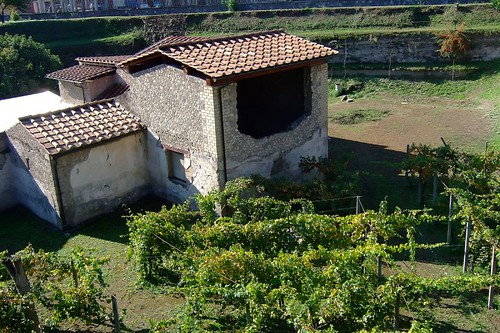
The Villae Regina, a villae rusticae unearthed at Boscoreale near Naples, Italy
was one of 30 small holdings situated  on the lower slopes of Vesuvius and
 on the adjacent plain of Sarno.  These 
small- and medium-sized 
properties
 were family-run or employed
 a few slaves.  Photographed 
by Mary Harrsch.
"The building has a very long history, starting from the Archaic period, and its earlier phases are also fairly well perserved.  What is special about this site is the rebuilding of the early small farm as a large and luxurious complex with what are probably separate living quarter and productive parts towards the end of the 6th century BCE.  In comparison with other sites of the period, the built area is enormous and it remains very large among its peers until the 1st century BCE, when the villa becomes quite normal in size among the many other large country houses.  It has been suggested that the Auditorium Villa was in fact a country residence for the head of a Roman elite family, who thus asserted his right over the landscape inhabited by members of his clan.  Such residences would have been relatively rare which is why they probably have not been found before.  The other farms were small in size and there would not have been intermediary forms between the very large and the small.  The possible model for these large residences might have been the slightly earlier Etruscan elite palaces, such as Murlo.  It is also claimed that there were no Catonian small or medium-sized villae rusticae in the 3rd-2nd centuries BCE.  The development into the 1st century BCE villa would have been faster and the changes would have happened closer to this boom period than suggested before.  The economic explanation echoes the common model of war booty invested in land, as external funds were needed to establish the new large villas and that the owners would have represented a much more heterogeneous group of persons than before." - Eeva Maria Viitanen, Locus Bonus: The Relationship of the Roman Villa to its Environment in the Vicinity of Rome


But whether Scipio inspired the widespread development of Roman villa architecture or not, he certainly was a passionate and gifted individual that I plan to study further.  I hope that by giving up those "triumphs with their withering laurels" he found those "lasting rewards that keep forever fresh and green" Cicero described so eloquently in Scipio's Dream.


Enhanced by Zemanta
If you enjoyed this post, never miss out on future posts by following me by email!