Showing posts with label janiform. Show all posts

Sunday, July 25, 2021

Eudaimonia and the corruption of excess

"Excess generally causes reaction, and produces a change in the opposite direction, whether it be in the seasons, or in individuals, or in governments." - Plato

In the case of drinking to excess, this change could result in the loss of virtue and well-being or, as the Greek philosophers termed it, Eudaimonia. Plato believed that individuals naturally feel unhappiness when they do something they know and acknowledge to be wrong.

Plato's student, Aristotle, agreed that although the pursuit of virtue, excellence, and the best within us was necessary to achieve eudaimonia, virtue in itself was not sufficient alone.  

"Aristotle believes that happiness and well-being come from how we live our lives,"   explains psychologist Catherine Moore, "And that's not in pursuit of material wealth, power, or honor."

Aristotle expounds upon ways to achieve the happy life in his work "Nichomacean Ethics."

"To be honest, a lot of Nichomacean Ethics is about what happiness isn’t," Moore points out, "Satisfying appetites is akin to a “life suitable to beasts." The pursuit of political power, material wealth, even fun and leisure, he (Aristotle) saw as “laughable things”, inferior to “serious things."

"Instead, happiness is an ‘intermediate’, or a ‘golden mean’ between deficiency and excess. One example of virtue as a mean between two extremes is courage – as a virtue, it’s halfway between recklessness and cowardice."

“He is happy who lives in accordance with complete virtue and is sufficiently equipped with external goods, not for some chance period but throughout a complete life.” – Aristotle, Nichomacean Ethics, Book I, Chapter 10

So, although Aristotle acknowledged  fate or luck does play a role in happiness, he believed an individual's disposition and talent could still be used to achieve it.

Which virtues does Plato value?  In his work "Republic" Plato describes a discussion among friends as to what a just republic would look like and four virtues are revealed:

Temperance (moderation) – or self-regulation, to avoid the vices and corruption caused by excess.

Courage (or fortitude) – to stand up for what we believe is right and good.

Justice – a social consciousness that plays a key part in maintaining societal order, and

Wisdom (practical wisdom, or prudence) – the pursuit of knowledge.

Again we see a reference to excess. These ideas were being exchanged at symposia of the 4th century BCE both in Greece and in the Greek colony of Magna Graecia in southern Italy. Plato, in his work "Gorgias", written about 380 BCE describes Magna Graecia as a place where discussion of the human soul abounded amid religious and philosophic speculation. Its proximity to and trade relations with Etruria would have also been a strong influence on Etruscan potters and may have served to inspire moralistic themes in art of the period. One possible example is a red-figured terracotta rhyton found in a tomb at Tarquinia.

"This unusual 4th century BCE vessel is composed of two mold-made faces set back to back: the upper one a bearded Greek warrior with curly hair and wearing a Corinthian helmet pushed up on top of his head, the lower one a caricature of a bearded man, perhaps a Syrian or Phoenician, with a broad nose, almond eyes, and thick, smiling lips." - Museum of Fine Arts, Boston.

As is characteristic of many Janiform representations, it may portray two contrasting aspects of a single individual - the friendly face of the Greek warrior rendered realistically that is transformed into a caricature of a belligerent barbarian once the guest overindulges - a subtle caution about the corruption of excess. I think the fact that the barbarian visage is rendered as a caricature points to the artist's metaphorical intent.

Read more about Eudaimonic Well-Being here: 

https://positivepsychology.com/eudaimonia/

Images:  Etruscan rhyton attributed to the Bruschi Group, Late 4th century BCE - Late Classical or Early Hellenistic Period, now in the collections of the Museum of Fine Arts Boston, images courtesy of the museum.


Images:  Etruscan rhyton attributed to the Bruschi Group, Late 4th century BCE - Late Classical or Early Hellenistic Period, now in the collections of the Museum of Fine Arts Boston, images courtesy of the museum.


If you enjoyed this post, never miss out on future posts by following me by email!


Saturday, January 16, 2021

Janiform art in Greece and Rome

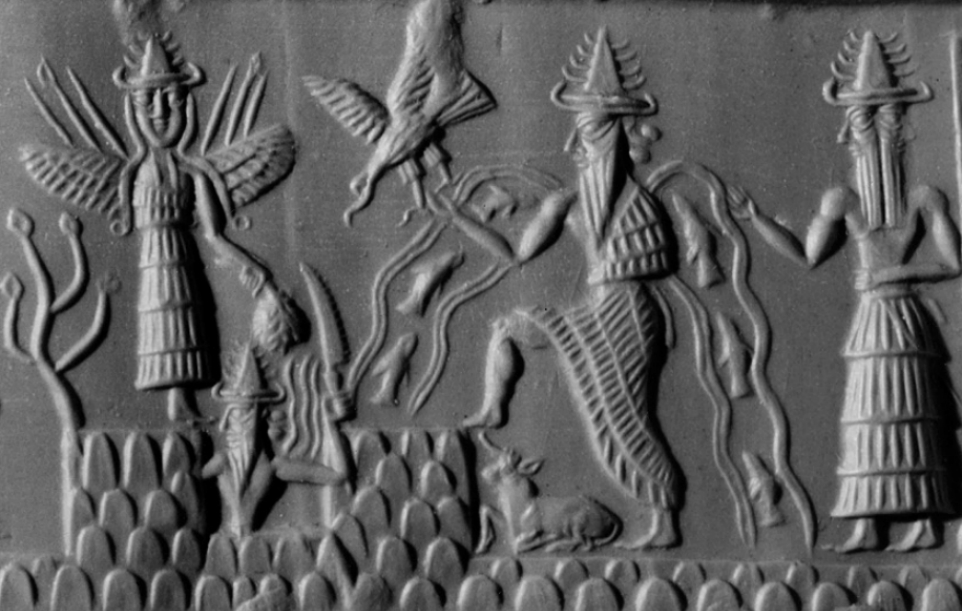
 Called Janiform after Janus, the two-faced Roman god associated with doorways and beginnings, two-faced head herms, flasks, or vases were produced as early as the 8th century BCE in Athens, though, and a god with two faces appears repeatedly in Sumerian and Babylonian art dating back to the third millenium. The ancient Sumerian deity Isimud was commonly portrayed with two faces facing in opposite directions. Unlike Janus, however, Isimud is not a god of doorways. Instead, he is the messenger of Enki, the ancient Sumerian god of water and civilization. In Hinduism the image of double or four faced gods is quite common, as it is a symbolic depiction of the divine power of seeing through space and time. The supreme god Brahma is represented with four faces. Likewise the Scandinavian god Heimdallr looks similar to Janus and his abode is said to define the limits of the earth and the extremity of heaven.

To the Romans, Janus frequently symbolized change and transitions such as the progress of past to future, from one condition to another, from one vision to another, and young people's growth to adulthood. He represented time, because he could see into the past with one face and into the future with the other. Hence, Janus was worshipped at the beginnings of the harvest and planting times, as well as at marriages, deaths and other beginnings. He represented the middle ground between barbarism and civilization, rural and urban space, youth and adulthood. Having jurisdiction over beginnings, Janus had an intrinsic association with omens and auspices, particularly important to the Romans. 

This artform was particularly favored for herms which were used to mark crossroads or directions, such as in the agora or forum, in sanctuaries, at the entrance to the Acropolis in Athens, and in the doorways of private homes. Widespread during the Hellenistic period, janiform objects with Dionysiac subjects were particularly popular because of Alexander the Great's visit to the Siwa oasis which gave rise to the myth that Alexander was declared the son of Zeus Ammon and thereafter portrayed in juxtapositon to emphasize his divine nature.  Artwork expressing a dual nature, often with divine subjects, continued to inspire classical art through the Roman Period including a satyr paired with a maenad, Herakles with Omphale, a young and old Aristotle. etc.

"Many combinations of heads for janiform herms are well attested and numerous deities were represented in that form. Herms similar to this example were found at Pompeii in the House of the Golden Cupid, the House of Marcus Lecretius, and the House of the Vettii, where they were mounted on slender columns and decorated the gardens of these villas. Such specialized works of art were even more popular at Herculaneum, where herms surmounted by double heads lined garden paths and were placed in the center of gardens or near fountains or pools. The reflection of these sculptures in garden waters increased the visual enjoyment of them and created a spacial effect similar to the illusion of space seen in Roman paintings that decorated the walls of these villas. Within a natural garden environment provided by plantings of boxwood, laurel, ivy, rosemary and evergreens, as cited by ancient literary sources, such herms added an element of man-made beauty and contributed to the fine sense of aesthetics for which the horticultural designs of Hellenistic and Roman gardens are known." - Phoneix Ancient Art.

Double herm of Homer (Apollonius of Tyana type) and Menander. Pentelic marble, Roman copy from the Neronian or Flavian period after a Hellenistic originals. From the Barbuta area in Rome courtesy of Wikimedia Commons contributor Marie-Lan Nguyen.

Double bust of Dionysos as a youth and an adult at the Palatine Museum courtesy of Wikimedia Commons contributor Carole Raddato.

Herm of Metrodorus of Lampsacus (the younger) leaned with his back against Roman, Imperial Era, (2nd-half of the 2nd century CE?). Found in Rome, Italy. Courtesy of Wikimedia Commons contributor Erc Gaba. Profile photo part of the Françoise Foliot collection.

Cast of Portrait double (twin) herma of Herodotus and Thucydides, archetype from 400-350 BCE at NAMA Naples (inv. 6239) courtesy of Wikimedia Commons contributor Zde.

Head of Janus, Vatican Museum, Rome, courtesy of Wikimedia Commons contributor Loudon dodd.

Double Headed Janus Flask (right) and Head Flask Roman 100-200 CE that I photographed at the Getty Villa in Pacific Palisades, California.

Double Headed Janus Flask (right) and Head Flask Roman 100-200 CE that I photographed at the Getty Villa in Pacific Palisades, California.

Double Herm depicting Dionysus and a Satyr Roman 100-199 CE Marble that I photographed at the Portland Art Museum in Portland, Oregon.

Double herm at the Panathenaic Stadium. Athens, Attica, Greece courtesy of Wikimedia Commons contributor LBM1948.

Double portrait of Aristotle with view as old man Roman copy of 4th century BCE Greek original NAMA 3772 that I photographed at "The Greeks" exhibit at The Field Museum in Chicago, Illinois.

The Socrates side of a double portrait of the philosopher Socrates and Seneca with ancient name inscriptions, 3rd century CE, Roman copy of a 1st century CE original, Neues Museum, Berlin courtesy of Wikimedia Commons contributor Carole Raddato.

The Seneca side of a double portrait of the philosopher Socrates and Seneca with ancient name inscriptions, 3rd century CE, Roman copy of a 1st century CE original, Neues Museum, Berlin courtesy of Wikimedia Commons contributor Carole Raddato.

Terracotta vase with janiform heads, 4th century B.C.E., Etruscan, at the Metropolitan Museum of Art in New York. This Etruscan vase is unique because both heads are made from the same mold but are painted to appear different, one representing a satyr with pointed ears and a beard, the other a black man.

Terracotta vase with janiform heads, 4th century B.C.E., Etruscan, at the Metropolitan Museum of Art in New York. This Etruscan vase is unique because both heads are made from the same mold but are painted to appear different, one representing a satyr with pointed ears and a beard, the other a black man.

Double portrait of the philosopher Socrates and Seneca with ancient name inscriptions, 3rd century CE, Roman copy of a 1st century CE original, Neues Museum, Berlin courtesy of Wikimedia Commons contributor Marcus Cyron (digitall enhanced).

A cylinder seal depicting the gods Ishtar, Shamash, Enki, and Isimud, who is shown with two faces (circa 2300 BCE) courtesy of the British Museum Collections and Wikimedia Commons.
If you enjoyed this post, never miss out on future posts by following me by email!