Showing posts with label Sumerian. Show all posts

Friday, June 4, 2021

The Orphic hymns and incense use in the ancient Mediterranean World

The word incense comes from Latin incendere meaning 'to burn'.  In ancient times incense was burnt to counteract or obscure malodorous products of human habitation, but was widely perceived to also deter malevolent demons and appease the gods with its pleasant aroma. Resin balls were found in many prehistoric Egyptian tombs in El Mahasna, giving evidence for the prominence of incense and related compounds in Egyptian antiquity. One of the oldest extant incense burners originates from the 5th dynasty of Egypt dating back to the 25th century BCE.  The Babylonians also used incense while offering prayers to divining oracles and it is thought Incense spread from there to Greece and Rome. 

Incense burners, commonly known in ancient Greece as thymiateria, could take a wide variety of forms, ranging from simple earthenware pots to elaborate carved, moulded or cast items made from clay or bronze.  They were used in sacred rituals in sanctuaries and temples, during religious processions, funerals, symposiums and weddings.

The ritual use of thymiateria has been attested to in many archaeological sites including Olbia where a rich deposit of thymiateria has been found in the sanctuary of Aphrodite. These thymiateria were molded into a bust of the goddess but she is depicted as a modest matron and not nude as was typical for the goddess of love.  The inclusion of Erotes is thought to provide an emphasis on her motherhood.  They also distinguish the worshipped deity as Aphrodite and not Demeter, Hera or the Mother of the Gods as has been the case at other temple sites.

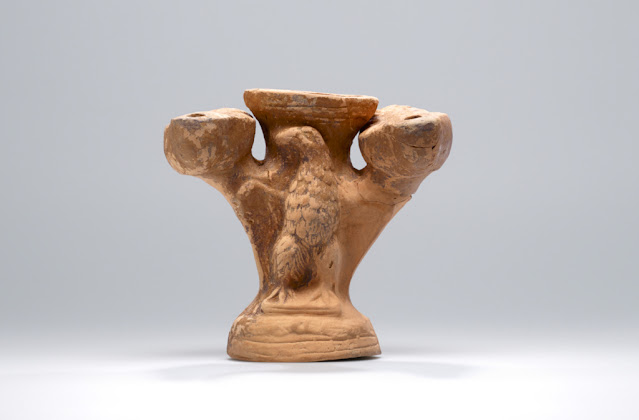
A Roman bronze thymiaterion in the form of a comic actor from the 1st century CE I have seen at the Getty Villa must have been used at dinner parties as I'm not familiar with any religious significance it may have.  They also have a terracotta lamp/incense burner  with an eagle with spread wings on it. I wonder if it was used for some military ritual? 

"Although aroma was an essential part of thymiateria culture, only the Orphic Hymns cast light on the use of particular incenses (in pure form or in compound) for each god or hero," observes Maryna Rusiaieva in her paper "On Ancient Greek Thymiateria and Their Purpose." 

For example, according to the Orphic Hymns, mánna is the recommended incense used to worship Artemis and Asclepius.  It is obtained by evaporating the sap of the manna ash, extracted by making small cuts in the bark. Athena, on the other hand, prefers incense crafted from aromatic herbs.  Dionysus, however, expects storax (sometimes marketed as styrax), a rare fragrant gum resin obtained from the Asian liquidambar tree.  If you're planning a sea voyage, an offering of myrhh should be used to appeal to Poseidon.

The Orphic Hymns are a collection of eighty-seven hymns to the Olympian gods attributed to Orpheus, but the actual authorship is unclear. The date of composition of the hymns is also disputed.  Scholars have dated the hymns to a period ranging from the 6th century BCE to the 4th century CE, although there is no evidence of any Christian influence in the poems.

You can learn much more about the Orphic Hymns here:

https://www.hellenicgods.org/projectstatement

The site provides the original Greek text and an English translation.

Silver Censer shaped like a bird, Byzantine, that I photographed at the Metropolitan Museum of Art in New York City

Stand in the Shape of an Ibex that probably held an incense burner, Iran 1000-800 BCE, Bronze, that I photographed at the Walters Art Museum in Baltimore, Maryland.

Frieze depicting two female temple attendants kneeling before an incense burner Roman 1st century CE Terracotta and slip that I photographed at the Art Institute of Chicago

Feline-Handled Bronze Incense Burner, Parthian, 100 CE, at the Cleveland Museum of Art in Cleveland, Ohio, image courtesy of the museum and Wikimedia Commons.

Incense Burner in the Form of a Female Head, probably representing Demeter, Greek, 3rd century BCE, found in Canosa, Italy, courtesy of the Walters Art Museum.

Moldmade lampstand/incense-burner consisting of a hollow body fixed on a circular spreading base and surmounted by a bowl. Upper part with two applied lamps, one on each side. On front center is an eagle in high relief with spreading wings, clawed feet resting on a platform, head turned to left; feathers carefully rendered, Roman, late 2nd century CE, now in the collections of the Getty Villa. Image courtesy of the museum.

Incense Burner (Thymiaterion) shaped as a Comic Actor Seated on an Altar Roman 1-50 CE Bronze and Silver at the Getty Villa in Pacific Palisades, California

Moldmade terracotta lampstand/incense-burner from Central Anatolia, Roman, 1st century CE at the Getty Villa in Pacific Palisades, California.  Image courtesy of the museum. 

Bronze southern Etruscan thymiaterion, 500 BCE, courtesy of Wikimedia Commons contributor Sailko.


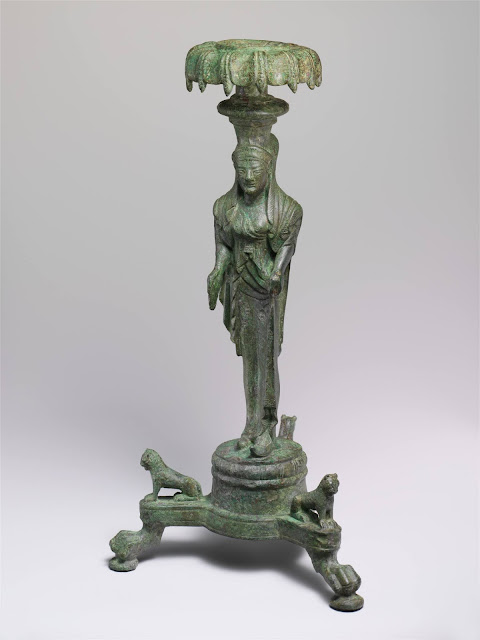
Bronze thymiaterion (incense burner) in the form of a woman, late 6th–early 5th century BCE, Etruscan, at the Metropolitan Museum of Art in New York.  The calyx-shaped receptacle on the woman's head was probably originally surmounted by a shaft. Utensils incorporating human figures as supports or handles were as popular in Etruria as in Greece. This incense burner is exceptional, not only for the rendering of the woman, who is both statuesque and decorative, but also for the manner in which every part emphasizes her three-dimensionality.


Terracotta group of women seated around a well head, 2nd half of 4th century BCE, Greek, Tarentine, at the Metropolitan Museum of Art in New York City.  Incense burners (Greek thymiateria) were important cult implements throughout the ancient Mediterranean world. This South Italian terracotta example of the second half of the 4th century B.C.E. is exceptionally complex and rare: five women crowned with flowers are shown around a wellhead. The iconography reflects a local cult, probably that of Demeter and Kore who were widely worshipped in Southern Italy and Sicily at the time.

Vessel stand for offerings including incense with ibex support, ca. 2600–2350 BCE, Sumerian, at the Metropolitan Museum of Art.  Temple rituals during the Early Dynastic period included making offerings of food, drink, and probably incense to the gods. This stand, made using the lost-wax technique, with four rings supported by a magnificent ibex, would have supported lamps or bowls holding offerings or incense and may have been used in temple or in banquet rituals.

Incense burner, southwest Arabia, ca. mid-1st millennium BCE, at the Metropolitan Museum of Art in New York City, image courtesy of the museum.  The importance of incense in the religion of southwestern Arabia is reflected in this object; the ibex and snakes are powerful apotropaic symbols representing virility and fertility, and were frequently associated with local gods. The disk-and-crescent symbol, likewise, probably represents the moon god, the chief god of their pantheon.

Bronze censer (thymiaterion), made in Paros, 460-450 BCE. Archaeological Museum of Delphi, courtesy of Wikimedia Commons contributor Dennis Jarvis.


If you enjoyed this post, never miss out on future posts by following me by email!


Saturday, January 16, 2021

Janiform art in Greece and Rome

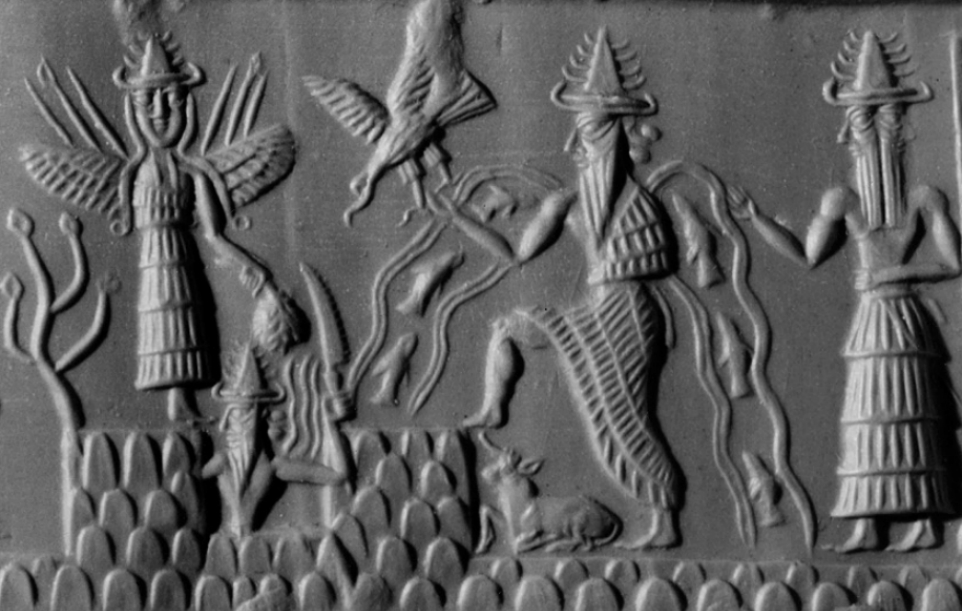
 Called Janiform after Janus, the two-faced Roman god associated with doorways and beginnings, two-faced head herms, flasks, or vases were produced as early as the 8th century BCE in Athens, though, and a god with two faces appears repeatedly in Sumerian and Babylonian art dating back to the third millenium. The ancient Sumerian deity Isimud was commonly portrayed with two faces facing in opposite directions. Unlike Janus, however, Isimud is not a god of doorways. Instead, he is the messenger of Enki, the ancient Sumerian god of water and civilization. In Hinduism the image of double or four faced gods is quite common, as it is a symbolic depiction of the divine power of seeing through space and time. The supreme god Brahma is represented with four faces. Likewise the Scandinavian god Heimdallr looks similar to Janus and his abode is said to define the limits of the earth and the extremity of heaven.

To the Romans, Janus frequently symbolized change and transitions such as the progress of past to future, from one condition to another, from one vision to another, and young people's growth to adulthood. He represented time, because he could see into the past with one face and into the future with the other. Hence, Janus was worshipped at the beginnings of the harvest and planting times, as well as at marriages, deaths and other beginnings. He represented the middle ground between barbarism and civilization, rural and urban space, youth and adulthood. Having jurisdiction over beginnings, Janus had an intrinsic association with omens and auspices, particularly important to the Romans. 

This artform was particularly favored for herms which were used to mark crossroads or directions, such as in the agora or forum, in sanctuaries, at the entrance to the Acropolis in Athens, and in the doorways of private homes. Widespread during the Hellenistic period, janiform objects with Dionysiac subjects were particularly popular because of Alexander the Great's visit to the Siwa oasis which gave rise to the myth that Alexander was declared the son of Zeus Ammon and thereafter portrayed in juxtapositon to emphasize his divine nature.  Artwork expressing a dual nature, often with divine subjects, continued to inspire classical art through the Roman Period including a satyr paired with a maenad, Herakles with Omphale, a young and old Aristotle. etc.

"Many combinations of heads for janiform herms are well attested and numerous deities were represented in that form. Herms similar to this example were found at Pompeii in the House of the Golden Cupid, the House of Marcus Lecretius, and the House of the Vettii, where they were mounted on slender columns and decorated the gardens of these villas. Such specialized works of art were even more popular at Herculaneum, where herms surmounted by double heads lined garden paths and were placed in the center of gardens or near fountains or pools. The reflection of these sculptures in garden waters increased the visual enjoyment of them and created a spacial effect similar to the illusion of space seen in Roman paintings that decorated the walls of these villas. Within a natural garden environment provided by plantings of boxwood, laurel, ivy, rosemary and evergreens, as cited by ancient literary sources, such herms added an element of man-made beauty and contributed to the fine sense of aesthetics for which the horticultural designs of Hellenistic and Roman gardens are known." - Phoneix Ancient Art.

Double herm of Homer (Apollonius of Tyana type) and Menander. Pentelic marble, Roman copy from the Neronian or Flavian period after a Hellenistic originals. From the Barbuta area in Rome courtesy of Wikimedia Commons contributor Marie-Lan Nguyen.

Double bust of Dionysos as a youth and an adult at the Palatine Museum courtesy of Wikimedia Commons contributor Carole Raddato.

Herm of Metrodorus of Lampsacus (the younger) leaned with his back against Roman, Imperial Era, (2nd-half of the 2nd century CE?). Found in Rome, Italy. Courtesy of Wikimedia Commons contributor Erc Gaba. Profile photo part of the Françoise Foliot collection.

Cast of Portrait double (twin) herma of Herodotus and Thucydides, archetype from 400-350 BCE at NAMA Naples (inv. 6239) courtesy of Wikimedia Commons contributor Zde.

Head of Janus, Vatican Museum, Rome, courtesy of Wikimedia Commons contributor Loudon dodd.

Double Headed Janus Flask (right) and Head Flask Roman 100-200 CE that I photographed at the Getty Villa in Pacific Palisades, California.

Double Headed Janus Flask (right) and Head Flask Roman 100-200 CE that I photographed at the Getty Villa in Pacific Palisades, California.

Double Herm depicting Dionysus and a Satyr Roman 100-199 CE Marble that I photographed at the Portland Art Museum in Portland, Oregon.

Double herm at the Panathenaic Stadium. Athens, Attica, Greece courtesy of Wikimedia Commons contributor LBM1948.

Double portrait of Aristotle with view as old man Roman copy of 4th century BCE Greek original NAMA 3772 that I photographed at "The Greeks" exhibit at The Field Museum in Chicago, Illinois.

The Socrates side of a double portrait of the philosopher Socrates and Seneca with ancient name inscriptions, 3rd century CE, Roman copy of a 1st century CE original, Neues Museum, Berlin courtesy of Wikimedia Commons contributor Carole Raddato.

The Seneca side of a double portrait of the philosopher Socrates and Seneca with ancient name inscriptions, 3rd century CE, Roman copy of a 1st century CE original, Neues Museum, Berlin courtesy of Wikimedia Commons contributor Carole Raddato.

Terracotta vase with janiform heads, 4th century B.C.E., Etruscan, at the Metropolitan Museum of Art in New York. This Etruscan vase is unique because both heads are made from the same mold but are painted to appear different, one representing a satyr with pointed ears and a beard, the other a black man.

Terracotta vase with janiform heads, 4th century B.C.E., Etruscan, at the Metropolitan Museum of Art in New York. This Etruscan vase is unique because both heads are made from the same mold but are painted to appear different, one representing a satyr with pointed ears and a beard, the other a black man.

Double portrait of the philosopher Socrates and Seneca with ancient name inscriptions, 3rd century CE, Roman copy of a 1st century CE original, Neues Museum, Berlin courtesy of Wikimedia Commons contributor Marcus Cyron (digitall enhanced).

A cylinder seal depicting the gods Ishtar, Shamash, Enki, and Isimud, who is shown with two faces (circa 2300 BCE) courtesy of the British Museum Collections and Wikimedia Commons.
If you enjoyed this post, never miss out on future posts by following me by email!


Sunday, September 20, 2020

Chariots in ancient warfare

 The origin of the chariot is not definitively documented but it is thought to have been a technology developed in the Eurasian steppe by cultures such as the Sintashta, a Middle Bronze Age civilization dating to the period 2200-1800 BCE.  The earliest remains of chariots have been found in Sintashta burials.

Russian archaeological analysis indicates the preceding Abashevo culture was already marked by endemic intertribal warfare. Intensified by ecological stress and competition for resources in the Sintashta period, this drove the construction of fortifications on an unprecedented scale and innovations in military technique such as the invention of the war chariot.   Many Sintashta graves are furnished with weapons, although the composite bow associated later with chariotry does not appear.

The Sintashta economy included the production of copper from ore in nearby mines  and arsenical bronze, that uses arsenic rather than tin, which was smelted on an industrial scale.  The metal was exported to the cities of Bactria-Margiana in Central Asia, for the first time connecting the steppe region to the ancient urban civilizations of the Near East.  It was through these trade routes that domesticated horses and chariots were introduced to the Near East and ultimately the rest of the Mediterranean basin.

The oldest testimony of chariot warfare in the ancient Near East is the Old Hittite Anitta text (18th century BCE), which mentions 40 teams of horses at the siege of Salatiwara.  The Hittites became renowned charioteers. They developed a new chariot design that had lighter wheels, with four spokes rather than eight, and that held three rather than two warriors. It could hold three warriors because the wheel was placed in the middle of the chariot and not at the back as in Egyptian chariots. Typically one Hittite warrior steered the chariot while the second man was usually the main archer; the third warrior would either wield a spear or sword when charging at enemies or hold up a large shield to protect himself and the others from enemy arrows.  The Battle of Kadesh in 1274 BCE is likely to have been the largest chariot battle ever fought, involving over 5,000 chariots.

The Persians may have been the first to yoke four horses to their chariots. They also used scythed chariots. Cyrus the Younger employed these chariots in large numbers at the Battle of Cunaxa. Herodotus mentions that the ancient Libyan and the ancient Indian (Sattagydia, Gandhara and Hindush) satrapies supplied cavalry and chariots to Xerxes the Great's army. However, by this time, cavalry was far more effective and agile than the chariot, and the defeat of Darius III at the Battle of Gaugamela (331 BCE), where the army of Alexander simply opened their lines and let the chariots pass and attacked them from behind, effectively marked the end of the era of dependence on chariot warfare in Mediterranean battlefield tactics.

The Romans encountered the use of chariots in warfare by the Britons but never used chariots for warfare themselves.  Julius Caesar reported that, unlike earlier Near Eastern tactics where warriors or archers fought from chariots, the Britons would drive their chariots "in between the troops of horse, leap from their chariots and engage on foot. The charioteers in the meantime withdraw some little distance from the battle, and so place themselves with the chariots that, if their masters are overpowered by the number of the enemy, they may have a ready retreat to their own troops."  

The last mention of chariot use in battle in Brittania was reported to be at the Battle of Mons Graupius in modern Scotland in 84 CE (Agricola 1.35-36).  "The plain between resounded with the noise and with the rapid movements of chariots and cavalry." But the chariots did not win even their initial engagement with the Roman auxiliaries.

Fragmentary terracotta model of a four horse chariot from Cyprus, 700-500 BCE, Cypro-Archaic I-II Period, at the Royal Ontario Museum in Toronto, Canada courtesy of the museum.

Nike mounted on a quadriga that I photographed in the King Victor Emmanuel II Monument in Rome, Italy.

Bronze Etruscan chariot inlaid with ivory, 2nd quarter of 6th century BCE found near Monteleone di Spoleto with scenes of the battles of Achilles that I photographed at the Metropolitan Museum of Art in New York.

A reconstructed four-wheeled Gallic "chariot" at the Musée archéologique de Strasbourg courtesy of Wikimedia contributor Chatsam

A four-horse Qin Dynasty chariot of the tomb of Chinese emperor Qin Shi Huang, 210 BCE, that I photographed at the Terracotta Warriors exhibit at The Field Museum in Chicago, Illinois.

A Lucanian tomb fresco from Paestum depicting a biga, two-horse chariot, courtesy of Carole Raddato.

A Roman mosaic depicting a quadriga, four-horse racing chariot courtesy of the Rheinisches Landesmuseum in Trier, Germany.

A reconstructed four-wheeled Gallic "chariot" at the Musée archéologique de Strasbourg courtesy of Wikimedia contributor Chatsam


If you enjoyed this post, never miss out on future posts by following me by email!