Showing posts with label muse. Show all posts

Wednesday, March 31, 2021

The Muses

 According to Pausanias, who wrote in the later second century CE, there were originally three Muses, worshipped on Mount Helicon in Boeotia: Aoide ("song" or "tune"), Melete ("practice" or "occasion"), and Mneme ("memory").  The earliest known records of the Muses come from Boeotia and some ancient authorities point to Thrace as the origin of this myth.  

Writing in the first century BCE, Diodorus Siculus claims Homer and Hesiod state there are actually nine Muses, though.  According to Hesiod's account (c. 600 BCE), generally followed by most writers of antiquity, the Nine Muses were the nine daughters of Zeus and Mnemosyne (i.e., "Memory" personified), which represented personifications of knowledge and the arts, especially poetry, literature, dance and music.  Ironically, Hesiod says the Muses brought to people forgetfulness, that is, the forgetfulness of pain and the cessation of obligations, though.

For poet and "law-giver" Solon, the Muses were "the key to the good life", since they brought both prosperity and friendship. Solon sought to perpetuate his political reforms by establishing recitations of his poetry—complete with invocations to his practical-minded Muses—by Athenian boys at festivals each year. He believed that the Muses would help inspire people to do their best.

Distinguished ancient authors would invoke the Muses when writing poetry, hymns or epic history to comply with established poetic tradition.  Such invocations can be found in the works of Homer, Virgil, Catullus, and Ovid.

An example from Virgil's Aeneid:

O Muse! the causes and the crimes relate

What goddess was provok'd, and whence her hate

For what offense the Queen of Heav'n began

To persecute so brave, so just a man

—Virgil (c. 29 - 19 BCE), in Book I of the Aeneid 

Muse Roman from Cremna in present-day Turkey about 200 CE Marble gold that I photographed at the Getty Villa in Pacific Palisades, California. These statues of the muses are among my favorites because of their softer features.

Muse Roman from Cremna in present-day Turkey about 200 CE Marble gold that I photographed at the Getty Villa in Pacific Palisades, California. These statues of the muses are among my favorites because of their softer features.

Muse Euterpe Roman from Cremna in present-day Turkey about 200 CE Marble pigment and gold that I photographed at the Getty Villa in Pacific Palisades, California.

Muse Euterpe Roman from Cremna in present-day Turkey about 200 CE Marble pigment and gold that I photographed at the Getty Villa in Pacific Palisades, California.

Muse of love poetry or dance, Roman, from Cremna in present day Turkey 200 CE Marble pigment and gold that I photographed at the Getty Villa in Pacific Palisades, California. These statues of the muses are among my favorites because of their softer features.

Muse of love poetry or dance, Roman, from Cremna in present day Turkey 200 CE Marble pigment and gold that I photographed at the Getty Villa in Pacific Palisades, California. These statues of the muses are among my favorites because of their softer features.

Terpsichore, Muse of the dance. Marble, Roman artwork from the 2nd century CE. The head is ancient but does not belong to the body. From the Villa of Cassius near Tivoli, now in the collections of the Vatican Museums, courtesy of Wikimedia Commons contributor Marie-Lan Nguyen 

Part of a pavement mosaic with the bust of a muse. Roman artwork of the second half of 2nd - early 3rd century CE from the Villa dei Severi now at the Palazzo Massimo alle Terme in Rome, Italy courtesy of Wikimedia Commons contributor Jean Pol Grandmont. 

Roman mosaic depicting the Muses dating between 2nd and 4th centuries CE, excavated at Antioch, Turkey, now in the collections of the Worcester Art Museum in Worcester, Massachusetts, courtesy of Wikimedia Commons contributor Daderot 

The fragmentary front of a large sarcophagus with a seated woman surrounded by Muses. The muse to the left is Terpsichore. She wears a chiton completely enveloped by a himation, and holds a lyre in her left hand. She turns toward a seated woman (probably the deceased) who wears a himation and whose foot rests on a foot-stool. She reaches to touch the strings of Terpsichore's lyre. Beside her is Thalia, wearing a close-fitting netlike garment with a mantle wrapped around her lower body. A bulla is around her neck and she wears open-toed shoes. In her left hand, she holds a lagobolon concealed by her cloak, and in her right, a comic mask. At the end, Euterpe holds the tibiae (pipes) with both hands. She wears a sleeved chiton trimmed with tassels at the hem. A short mantle is wrapped around her shoulders and tucked under her belt. To the right of Euterpe are the remains of a pillar. Courtesy of the Getty Villa

Clio the Roman Muse of History from Cremna in present-day Turkey about 200 CE Marble pigment and gold that I photographed at the Getty Villa in Pacific Palisades, California.

Clio the Roman Muse of History from Cremna in present-day Turkey about 200 CE Marble pigment and gold that I photographed at the Getty Villa in Pacific Palisades, California.

Clio the Roman Muse of History from Cremna in present-day Turkey about 200 CE Marble pigment and gold that I photographed at the Getty Villa in Pacific Palisades, California.

Urania (astronomy) 1, Euterpe (flutes and lyric poetry) 2, Polyhymnia (sacred poetry) 3, Erato (love poetry) 4 but name to other side of Kleio (Kleio In Greek mythology, Clio (traditionally /ˈklaɪoʊ/, but now more frequently /ˈkliːoʊ/; Greek: Κλειώ, Kleiṓ; "made famous" or "to make famous"), also spelled Kleio, is the muse of history, or in a few mythological accounts, the muse of lyre playing, 5, Terpsichore (dance) 6, Melpomene (tragedy) 7, Thalia (comedy and pastoral poetry) 8. The ninth is not in this group, as she is Calliope who is shown in a frame of her own, handing a paper (“inspiration”?) to Hesiod. 2nd century CE Roman mosaic courtesy of Wikimedia Commons contributor Dick Osseman. 

The Muse Terpsichore, Roman statue based on an Attic model from 150–100 BCE found in the Villa Adriana in Tivoli, Italy, now in the collections of the Prado Museum, courtesy of Wikimedia Commons contributor na Belén Cantero Paz. 


If you enjoyed this post, never miss out on future posts by following me by email!


Wednesday, March 10, 2021

The Esquiline Treasure

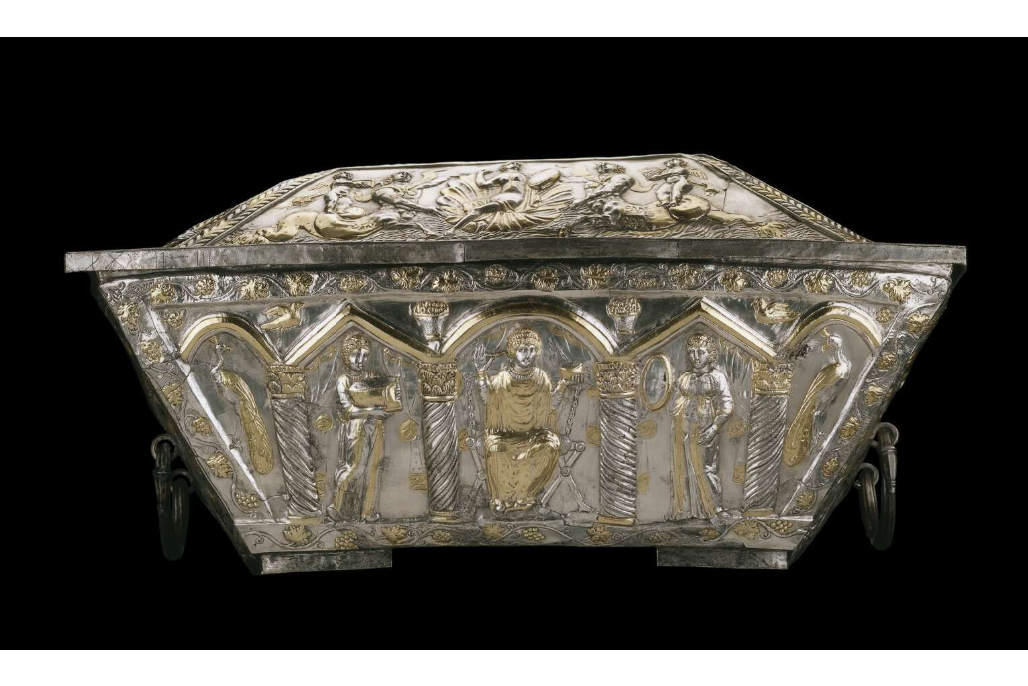
The Esquiline Treasure is an ancient Roman silver treasure that was found in 1793 on the Esquiline Hill in Rome. The hoard is considered an important example of late antique silver work from the 4th century CE, probably about 380 for the major pieces. Since 1866, 57 objects, representing the great majority of the treasure, have been in the British Museum. Two of the most important objects in the treasure are the ornate silver-gilt engraved boxes known as the Projecta Casket and the Muse Casket. The treasure was part of the belongings of a wealthy Roman household of high social status. The collection includes 8 plates (4 circular and 4 rectangular), a fluted dish, a ewer inscribed for "Pelegrina", a flask with embossed scenes, an amphora, 6 sets of horse trappings, with furniture fittings including 4 Tyche figures representing the 4 main cities of the Roman Empire: Rome, Constantinople, Antioch and Alexandria, two hands clenching bannisters, and an assortment of jewelry. The four silver Tyches are represented with different attributes: military attire for the Tyche of Rome, a cornucopia for the one of Constantinople, sheaves of corns and the bow of a ship for the Tyche of Alexandria, and a male swimmer personifying the Orontes River at the feet of the Tyche of Antioch. The five panels on the lid of the Projecta Casket represent three mythological scenes, a double portrait and a bathing scene. On the top panel of the lid are half-length figures of a man and woman within a wreath held by standing erotes (or putti in modern terms) and an inscription which reads: "SECVNDE ET PROIECTA VIVATIS IN CHRI[STO] ('Secundus and Projecta, may you live in Christ'). The attire of the two figures is clearly that of an affluent couple from late antiquity. The woman is wearing a long-sleeved tunic with a large necklace. In her hands she holds a papyrus roll alluding to her education. The man is in a long-sleeved tunic that he wears under a chlamys. The four panels of the box itself represent the preparations for a grand Roman wedding. These are placed between columns joined by alternating arches and bottomless pediments, all under a frieze with scrolling vines. In one scene, Projecta is shown sitting on an ornate chair holding a decorated box similar in shape to the Muse Casket. She wears a long-sleeved tunic under a colobium or short-sleeved tunic. A smaller inscription on the front rim of the lid gives the weight as "XXII-III", meaning "[Pondo] XXII,III [Unciae],S[emuncia]" or "Twenty-two pounds, three and one-half ounces" in Roman units. The Muse Casket is divided into sixteen panels, with flat and concave faces. The 'flat' panel decoration includes: vases, vines and birds. The fluted panels are undecorated and those on body contain standing female figures under arches (eight of the nine muses). They are, to the right of the hasp, reading counter-clockwise: Urania, with a globe, Melpomene, with a Heraclean club and a mask, Clio, with a book and a caspa with scrolls, Polyhymnia, with a small mask, Terpsichore, with a lyre, Euterpe, with a double flute, Thalia, with a Dionysiac pedum and comic mask, and Calliope, with a scroll. The top of dome has a medallion containing female figures seated in landscape setting. The interior is fitted for five vessels - four identical silver canisters and one silver flask. Current research suggests that the Projecta Casket and some other items in the treasure (but probably not all of them) were a wedding gift to the newly married couple Projecta and Secundus. Sadly, Projecta is thought to be associated with an epitaph dated to 383 CE stating she died shortly before her 17th birthday.

Silver furniture fittings depicting two hands clenching bannisters part of the Esquiline Treasure, Roman 330-380 CE, now in the British Museum. Image courtesy of Wikimedia Commons contributor Recruos

Silver repousse vase, part of the Esquiline Treasure, Roman 330-380 CE, now in the British Museum courtesy of Wikimedia Commons contributor Sailko

The Pelegrina Ewer. The bride's name can be seen at the widest point, across the three "dimples" to the right. Part of the Esquiline Treasure, Roman 330-380 CE, now in the British Museum. Image courtesy of Wikimedia Commons contributor Sailko

The Muse Casket, part of the Esquiline Treasure, Roman 330-380 CE, now in the British Museum. Image courtesy of the museum.

The Muse Casket, part of the Esquiline Treasure, Roman 330-380 CE, now in the British Museum. Image courtesy of the museum.

The Muse Casket, part of the Esquiline Treasure, Roman 330-380 CE, now in the British Museum. Image courtesy of the museum.

The Muse Casket, part of the Esquiline Treasure, Roman 330-380 CE, now in the British Museum. Image courtesy of the museum.

The Projecta Casket, part of the Esquiline Treasure, Roman 330-380 CE, now in the British Museum. Image courtesy of the museum.

The Projecta Casket, part of the Esquiline Treasure, Roman 330-380 CE, now in the British Museum. Image courtesy of the museum.

The Projecta Casket, part of the Esquiline Treasure, Roman 330-380 CE, now in the British Museum. Image courtesy of the museum.

The Projecta Casket, part of the Esquiline Treasure, Roman 330-380 CE, now in the British Museum. Image courtesy of the museum.

Silver charm depicting a crouching mouse, part of the Esquiline Treasure, Roman 330-380 CE, now in the British Museum. Image courtesy of the museum.

Silver horse trappings found in the Esquiline Treasure, Roman, 330-380 CE now in the British Museum. Image courtesy of the museum.

Silver ring depicting Nike, part of the Esquiline Treasure, Roman 330-380 CE, now in the British Museum. Image courtesy of the museum.

Roman pin, part of the Esquiline Treasure, Roman 330-380 CE, now in the British Museum. Image courtesy of the museum.

Gilded silver furniture ornament depicting Tyche of Alexandria, part of the Esquiline Treasure, Roman 330-380 CE, now in the British Museum. Image courtesy of the museum.

Gilded silver furniture ornament depicting Tyche of Antioch, part of the Esquiline Treasure, Roman 330-380 CE, now in the British Museum. Image courtesy of the museum.

Gilded silver furniture ornament depicting Tyche of Constantinople, part of the Esquiline Treasure, Roman 330-380 CE, now in the British Museum. Image courtesy of the museum.

Gilded silver furniture ornament depicting Tyche of Rome, part of the Esquiline Treasure, Roman 330-380 CE, now in the British Museum. Image courtesy of the museum.

Silver fluted bowl, part of the Esquiline Treasure, Roman 330-380 CE, now in the British Museum courtesy of Wikimedia Commons contributor Jononmac46

Silver decorated trulla or saucepan, part of the Esquiline Treasure, Roman 330-380 CE, now in the Petit Palais Museum in Paris courtesy of Wikimedia Commons contributor Sailko.


If you enjoyed this post, never miss out on future posts by following me by email!


Friday, February 26, 2021

For the love of Sappho

In antiquity Sappho's poetry was highly admired, and several ancient sources refer to her as the "tenth Muse". The earliest surviving poem to do so is a third-century BCE epigram by Dioscorides. She was sometimes also referred to as "The Poetess", just as Homer was "The Poet". 

The scholars of Alexandria included Sappho in the canon of nine lyric poets. According to Aelian, the Athenian lawmaker and poet Solon asked to be taught a song by Sappho "so that I may learn it and then die". This story may well be apocryphal, especially as Ammianus Marcellinus tells a similar story about Socrates and a song of Stesichorus, but it is indicative of how highly Sappho's poetry was considered in the ancient world.

Sappho's poetry also influenced other ancient authors. In Greek, the Hellenistic poet Nossis was described by Marilyn B. Skinner as an imitator of Sappho, and Kathryn Gutzwiller argues that Nossis explicitly positioned herself as an inheritor of Sappho's position as a woman poet.  Beyond poetry, Plato cites Sappho in his Phaedrus, and Socrates' second speech on love in that dialogue appears to echo Sappho's descriptions of the physical effects of desire in fragment 31. 

Some Romans inherited the Greeks appreciation for Sappho. In the first century BCE, Catullus established the themes and metres of Sappho's poetry as a part of Latin literature, adopting the Sapphic stanza, believed in antiquity to have been invented by Sappho, giving his lover in his poetry the name "Lesbia" in reference to Sappho (and, perhaps, Clodia Metelli), and adapting and translating Sappho's 31st fragment in his poem 51.

But Roman critics found her lustful and perhaps even homosexual. Horace called her "mascula Sappho" in his Epistles, which the later Porphyrio commented was "either because she is famous for her poetry, in which men more often excel, or because she is maligned for having been a tribad" - a term used to refer to eroticism between women although not used until Late Antiquity. By the third century CE, the difference between Sappho's literary reputation as a poet and her moral reputation as a woman had become so pronounced that the suggestion that there were in fact two Sapphos began to develop. In his Historical Miscellanies, Aelian wrote that there was "another Sappho, a courtesan, not a poetess."

Earlier Greek red-figured vessels would tend to contradict this later assessment, though, depicting Sappho with her contemporary male poet Alcaeus of Mytilene,  referencing a rumored love affair between the two poets. Alcaeus is credited with inventing the Alcaic stanza and, like Sappho, is listed as one of the nine lyric poets by the scholars of Hellenistic Alexandria.  Since both poets composed for the entertainment of Mytilenean friends, they had many opportunities to associate with each other on a quite regular basis, such as at the Kallisteia, an annual festival celebrating the island's federation under Mytilene, where Sappho performed publicly with female choirs. Alcaeus' reference to Sappho in terms more typical of a divinity, such as "holy/pure, honey-smiling Sappho" may owe its inspiration to her performances at the festival, though, rather than to a personal relationship.

But, sexual innuendo has often been used in efforts to discredit powerful or exceptional individuals in the ancient world. I wrote an article about it entitled "Sexual innuendo and character assassination in the ancient world back in 2012:

https://ancientimes.blogspot.com/2012/02/sexual-innuendo-and-character.html

Terracotta bell-krater (bowl for mixing wine and water), ca. 460 B.C.E., Attributed to the Danaë Painter at the Metropolitan Museum of Art. The scene here has an intimacy that is exceptional in Greek vase-painting. In an indoor setting, a seated woman plays the lyre. Before her stand two women, one of whom rests her chin and hands on the shoulder of the other. The listeners are enraptured by what they hear. All of the elements in the representation reflect daily life in mid-fifth century B.C. Athens. It is nonetheless tempting to see the subject in more specific terms. One scholar has suggested that the women might be muses. Another possibility is that the performer is the poetess Sappho, who appears on several black-figured and red-figured vases.

Sappho and Alkaios (Alcaeus) by the Brygos painter, 480 BCE Staatliche Antikensammlungen, Munich, Germany. The bubbles in front of Alkaio's mouth show that he is singing but Sappho rejects his courtship. Image courtesy of Wikimedia Commons contributor Matthias Kabel - I reduced the saturation then brightened to make the red-figure color tone more consistent with other red-figure ceramics and dehazed then burned in the black ceramic background to remove blue overtone.

Drawing of Alkaios und Sappho by Johann Jakob Horner, 1831, courtesy of Wikimedia Commons.

Red-figure vase (hydria, or kalpis) by the Group of Polygnotos, ca. 440–430 BC. Seated, Sappho is reading one of her poems to a group of three student-friends. National Archaeological Museum in Athens, courtesy of Wikimedia Commons contributor Μαρσύας

Hellenistic Period Head of poetess Sapho, Roman, from ancient Smyrna, Istanbul Archaeology Museums courtesy of Wikimedia Commons contributor Bjørn Erik Pedersen.

Hermaic pillar with a female portrait, inscribed Sappho Eresia Roman copy of 5th century BCE original that I photographed at the Capitoline Museum

Marble statue of a girl Roman 1st or 2nd century CE copy of a 3rd or 2nd century BCE Greek work (Sappho?) that I photographed at the Metropolitan Museum of Art.

Detail of a mosaic depicting a bust of Sappho from the tombstone of Aurelius Aurelianus, 3rd Century CE, Split Archaeological Museum courtesy of Carole Raddato (CC BY-SA 2.0)

A constructed portrait bust of a woman known as the "Oxford Bust" or "Sappho" Head Roman version of a Classical Aphrodite 50 - 200 CE that I photographed at the Ashmolean Museum. Body was probably sculpted between 1540 and 1600 CE if not a reworked ancient piece.

Double portrait of the poetess Sappho (?) and Alkios of Mytilene, 2nd century CE from Italy, Roman copy of a 4th century BCE original, Neues Museum, Berlin courtesy of Carole Raddato, (CC BY-SA 2.0).

Beautiful modern sculpture of Sappho by Mauritian-born artist, Comte Prosper D'Epinay, Rome, 1895, that I photographed at the Metropolitan Museum of Art in New York.

Closeup of Beautiful modern sculpture of Sappho by Mauritian-born artist, Comte Prosper D'Epinay, Rome, 1895, that I photographed at the Metropolitan Museum of Art in New York.


If you enjoyed this post, never miss out on future posts by following me by email!