Showing posts with label Aeneid. Show all posts

Wednesday, March 31, 2021

The Muses

 According to Pausanias, who wrote in the later second century CE, there were originally three Muses, worshipped on Mount Helicon in Boeotia: Aoide ("song" or "tune"), Melete ("practice" or "occasion"), and Mneme ("memory").  The earliest known records of the Muses come from Boeotia and some ancient authorities point to Thrace as the origin of this myth.  

Writing in the first century BCE, Diodorus Siculus claims Homer and Hesiod state there are actually nine Muses, though.  According to Hesiod's account (c. 600 BCE), generally followed by most writers of antiquity, the Nine Muses were the nine daughters of Zeus and Mnemosyne (i.e., "Memory" personified), which represented personifications of knowledge and the arts, especially poetry, literature, dance and music.  Ironically, Hesiod says the Muses brought to people forgetfulness, that is, the forgetfulness of pain and the cessation of obligations, though.

For poet and "law-giver" Solon, the Muses were "the key to the good life", since they brought both prosperity and friendship. Solon sought to perpetuate his political reforms by establishing recitations of his poetry—complete with invocations to his practical-minded Muses—by Athenian boys at festivals each year. He believed that the Muses would help inspire people to do their best.

Distinguished ancient authors would invoke the Muses when writing poetry, hymns or epic history to comply with established poetic tradition.  Such invocations can be found in the works of Homer, Virgil, Catullus, and Ovid.

An example from Virgil's Aeneid:

O Muse! the causes and the crimes relate

What goddess was provok'd, and whence her hate

For what offense the Queen of Heav'n began

To persecute so brave, so just a man

—Virgil (c. 29 - 19 BCE), in Book I of the Aeneid 

Muse Roman from Cremna in present-day Turkey about 200 CE Marble gold that I photographed at the Getty Villa in Pacific Palisades, California. These statues of the muses are among my favorites because of their softer features.

Muse Roman from Cremna in present-day Turkey about 200 CE Marble gold that I photographed at the Getty Villa in Pacific Palisades, California. These statues of the muses are among my favorites because of their softer features.

Muse Euterpe Roman from Cremna in present-day Turkey about 200 CE Marble pigment and gold that I photographed at the Getty Villa in Pacific Palisades, California.

Muse Euterpe Roman from Cremna in present-day Turkey about 200 CE Marble pigment and gold that I photographed at the Getty Villa in Pacific Palisades, California.

Muse of love poetry or dance, Roman, from Cremna in present day Turkey 200 CE Marble pigment and gold that I photographed at the Getty Villa in Pacific Palisades, California. These statues of the muses are among my favorites because of their softer features.

Muse of love poetry or dance, Roman, from Cremna in present day Turkey 200 CE Marble pigment and gold that I photographed at the Getty Villa in Pacific Palisades, California. These statues of the muses are among my favorites because of their softer features.

Terpsichore, Muse of the dance. Marble, Roman artwork from the 2nd century CE. The head is ancient but does not belong to the body. From the Villa of Cassius near Tivoli, now in the collections of the Vatican Museums, courtesy of Wikimedia Commons contributor Marie-Lan Nguyen 

Part of a pavement mosaic with the bust of a muse. Roman artwork of the second half of 2nd - early 3rd century CE from the Villa dei Severi now at the Palazzo Massimo alle Terme in Rome, Italy courtesy of Wikimedia Commons contributor Jean Pol Grandmont. 

Roman mosaic depicting the Muses dating between 2nd and 4th centuries CE, excavated at Antioch, Turkey, now in the collections of the Worcester Art Museum in Worcester, Massachusetts, courtesy of Wikimedia Commons contributor Daderot 

The fragmentary front of a large sarcophagus with a seated woman surrounded by Muses. The muse to the left is Terpsichore. She wears a chiton completely enveloped by a himation, and holds a lyre in her left hand. She turns toward a seated woman (probably the deceased) who wears a himation and whose foot rests on a foot-stool. She reaches to touch the strings of Terpsichore's lyre. Beside her is Thalia, wearing a close-fitting netlike garment with a mantle wrapped around her lower body. A bulla is around her neck and she wears open-toed shoes. In her left hand, she holds a lagobolon concealed by her cloak, and in her right, a comic mask. At the end, Euterpe holds the tibiae (pipes) with both hands. She wears a sleeved chiton trimmed with tassels at the hem. A short mantle is wrapped around her shoulders and tucked under her belt. To the right of Euterpe are the remains of a pillar. Courtesy of the Getty Villa

Clio the Roman Muse of History from Cremna in present-day Turkey about 200 CE Marble pigment and gold that I photographed at the Getty Villa in Pacific Palisades, California.

Clio the Roman Muse of History from Cremna in present-day Turkey about 200 CE Marble pigment and gold that I photographed at the Getty Villa in Pacific Palisades, California.

Clio the Roman Muse of History from Cremna in present-day Turkey about 200 CE Marble pigment and gold that I photographed at the Getty Villa in Pacific Palisades, California.

Urania (astronomy) 1, Euterpe (flutes and lyric poetry) 2, Polyhymnia (sacred poetry) 3, Erato (love poetry) 4 but name to other side of Kleio (Kleio In Greek mythology, Clio (traditionally /ˈklaɪoʊ/, but now more frequently /ˈkliːoʊ/; Greek: Κλειώ, Kleiṓ; "made famous" or "to make famous"), also spelled Kleio, is the muse of history, or in a few mythological accounts, the muse of lyre playing, 5, Terpsichore (dance) 6, Melpomene (tragedy) 7, Thalia (comedy and pastoral poetry) 8. The ninth is not in this group, as she is Calliope who is shown in a frame of her own, handing a paper (“inspiration”?) to Hesiod. 2nd century CE Roman mosaic courtesy of Wikimedia Commons contributor Dick Osseman. 

The Muse Terpsichore, Roman statue based on an Attic model from 150–100 BCE found in the Villa Adriana in Tivoli, Italy, now in the collections of the Prado Museum, courtesy of Wikimedia Commons contributor na Belén Cantero Paz. 


If you enjoyed this post, never miss out on future posts by following me by email!


Tuesday, March 2, 2021

Earth Shaker

 In pre-Olympian Bronze Age Greece, Poseidon was venerated as a chief deity at Pylos and Thebes. He had also the cult title "earth shaker". In the myths of isolated Arcadia he is related with Demeter and Persephone and he was venerated as a horse, however it seems that he was originally a god of the waters. He is often regarded as the tamer or father of horses, and he could create springs with a strike of his trident.

 Homer and Hesiod suggest that Poseidon became lord of the sea following the defeat of his father Cronus, when the world was divided by lot among his three sons: Zeus was given the sky, Hades the underworld, and Poseidon the sea, with the Earth and Mount Olympus belonging to all three. In Homer's Iliad, Poseidon supports the Greeks against the Trojans during the Trojan War and in the Odyssey, during the sea-voyage from Troy back home to Ithaca, the Greek hero Odysseus provokes Poseidon's fury by blinding his son, the Cyclops Polyphemus, resulting in Poseidon punishing him with storms, the complete loss of his ship and companions, and a ten-year delay. In Plato's "Timaeus and Critias", the legendary island of Atlantis was Poseidon's domain.

Poseidon was named Neptune by the Romans and held a special place in their pantheon of deities because in Book XX of the Iliad, even though Poseidon (Neptune) favored the Greeks, he rescues Aeneas from Achilles.  In Virgil's Aeneid, Neptune is still resentful of the wandering Trojans, but is not as vindictive as Juno, and in Book I he rescues the Trojan fleet from the goddess's attempts to wreck it, although his primary motivation for doing this is his annoyance at Juno's having intruded into his domain.

Poseidon. National Archaeological Museum of Athens courtesy of Wikimedia Commons contributor Ricardo André Frantz

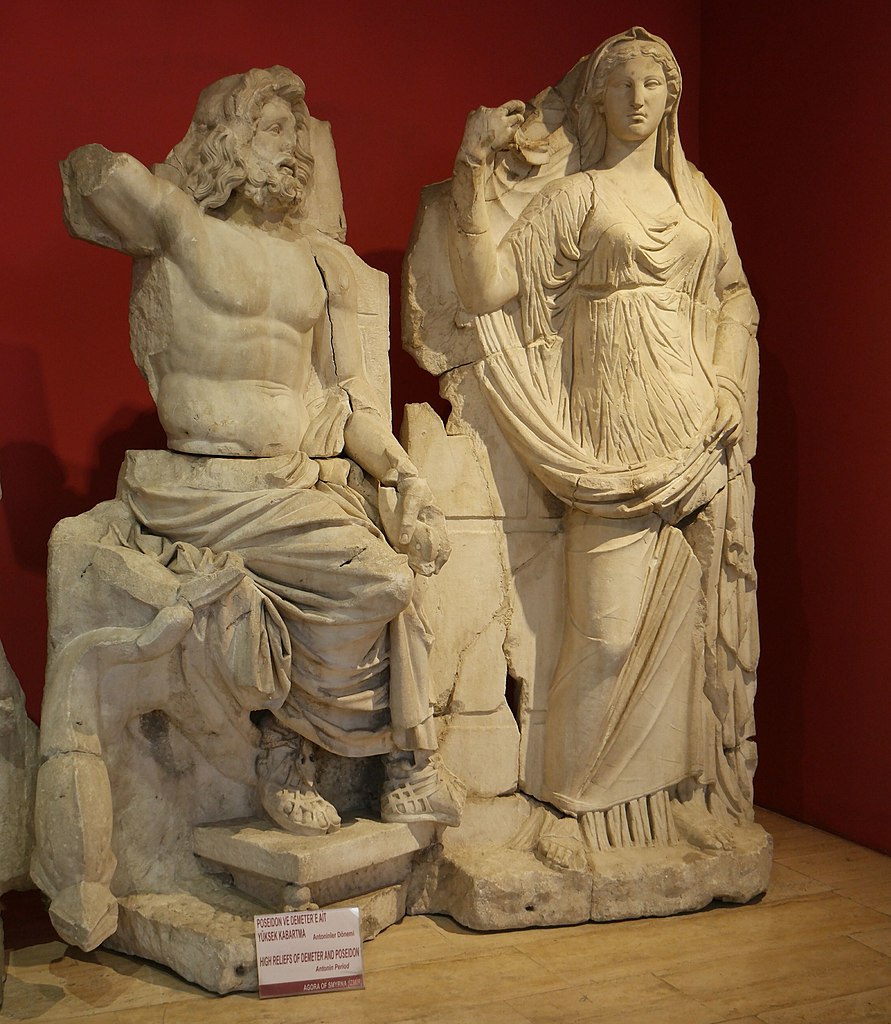
High reliefs of Poseidon and Demeter, from the Nerva–Antonine dynasty period, found in the Agora of Smyrna, now on display in the Izmir's History and Culture Museum Athens courtesy of Wikimedia Commons contributor Isabeau

Closeup of Neptune by Adam Lambert-Sigisbert 1725-1727 CE that I photographed at the Los Angeles County Museum of Art.

Bronze statuette of Poseidon, found in the Gulf of Livadostra, c. 480 BCE, courtesy of Wikimedia Commons contributor Sailko.

Roman mosaic depicting the Triumph of Neptune, 2nd century CE, at the Bardo National Museum in Tunisia courtesy of Wikimedia Commons contributor Tony Hisgett.

Mosaic depicting Neptune and Amphitrite, 1st century CE, that I photographed in the House of Neptune and Amphitrite in Herculaneum in 2007.

Reproduction of a frieze depicting an archaic style Neptune decorating the sacred area in Herculaneum that I photographed in 2007.

Sculpture of Neptune that I photographed at Huntington Gardens in Pasadena, California.

Neptune with a Hippocamp by Michel Anguier French 1652 CE Bronze that I photographed at the National Gallery of Art in Washington D.C. in 2015.

Triumph of Neptune and Amphitrite", a Roman mosaic from Cirta, now in the Louvre courtesy of Wikimedia Commons.

Neptune (with Cosimo I's head) on his chariot by Bartolomeo Ammannati II that I photographed in the Piazza della Signoria in Florence in 2005.

The Lateran Poseidon is a 2nd century CE colossal statue which derived from the lost bronze sculpture made by Lysippos (IV century BCE) for the Temple of Isthmia, on the Isthmus of Corinth, dedicated to the god Poseidon. The statue was originally in the Lateran Museum in Rome (then suppressed) and is probably the most significant evidence of the lost masterpiece of Lysippos.

Roman mosaic of Neptune from Monastir, Tunisia courtesy of Wikimedia Commons contributor Touzrimounir

Terracotta lekythos (oil flask), ca. 440 B.C.E. attributed to the Phiale Painter at the Metropolitan Museum of Art. Poseidon, the god of the sea and the brother of Zeus and Hades is said to have created fresh water springs including the great springs at Lerna in the southern Peloponnesos which gushed forth as a result of his pursuit of Amymone, the daughter of the king of Argos.

Detail of Neptune from the Roman "Mosaic of the Seasons" from Palermo in the Regional Archaeological Museum of Palermo courtesy of Wikimedia Commons contributor Giovanni Dall'Orto.


If you enjoyed this post, never miss out on future posts by following me by email!


Tuesday, February 23, 2021

Mythical origins of the game of knucklebones in the Mediterranean World

Beginning in 5000 BCE, the talus bones of hooved animals (also known as astragali) have been found in higher numbers than other bones and in contexts unrelated to food preparation in archaeological excavations.  Although the astragalus is not entirely symmetric, it is thought these bones were used like dice in games of chance.

Sophocles, in a written fragment of one of his works, ascribed the invention of knucklebones to the mythical figure Palamedes, who taught it to his Greek countrymen during the Trojan War. Both the Iliad and the Odyssey contain allusions to games similar in character to knucklebones. 

Palamedes was the warrior Agamemnon sent to Ithaca to retrieve Odysseus, who had promised to defend the marriage of Helen and Menelaus. Odysseus did not want to honor his oath, so he plowed his fields with an ass and an ox both hitched to the same plow, so the beasts of different sizes caused the plow to pull chaotically. Palamedes guessed what was happening and put Odysseus' son, Telemachus, in front of the plow. Odysseus stopped working and revealed his sanity.

Odysseus never forgave Palamedes for ruining his attempt to stay out of the Trojan War. When Palamedes advised the Greeks to return home, Odysseus hid gold in his tent and wrote a fake letter purportedly from Priam. The letter was found and the Greeks accused him of being a traitor. Palamedes was stoned to death by Odysseus and Diomedes. According to other accounts, the two warriors drowned him during a fishing expedition. Still, another version relates that he was lured into a well in search of treasure, and then was crushed by stones. 

Although he is a major character in some accounts of the Trojan War, Palamedes is not mentioned in Homer's Iliad but Euripedes and other dramatists wrote plays about his fate. The Greek sophist, Gorgias, penned the "Defense of Palamedes", an oration dealing with issues of morality and political commitment in which he demonstrates how plausible arguments can cause doubt in the acceptance of conventional truths.  Later, the Roman poet Ovid discusses Palamedes' role in the Trojan War in his Metamorphoses and Palamedes' fate is also described in Virgil's Aeneid. 

However, both  Herodotus and Plato ascribe a foreign origin to the game. Plato, in Phaedrus, names the Egyptian god Thoth as its inventor, while Herodotus relates that the Lydians, during a period of famine in the days of King Atys, originated this game.

Two young women playing knucklebones Greek 330-300 BCE said to be from Capua, Italy that I photographed at "The Body Beautiful in Ancient Greece" at the Portland (Oregon) Art Museum.

Closeup of one of Two young women playing knucklebones Greek 330-300 BCE said to be from Capua, Italy that I photographed at "The Body Beautiful in Ancient Greece" at the Portland (Oregon) Art Museum.

Maidens Playing "Knucklebones" Greek Late 4th or early 3rd century BCE Terracotta that I photographed at the Walters Art Museum in Baltimore, Maryland. The maidens are playing an ancient form of jacks, known as astragalus (knucklebones), a game in which five small animal bones were tossed into the air and caught on the back of the hand. The grouping of separate statuettes is almost unknown before Hellenistic times, when artists became fascinated both by the interaction of figures and by the challenge of representing complex poses, such as this crouching stance.

One of Two Boys Fighting Over a Game of Knucklebones 1st century CE Roman copy of 2nd century BCE original from Rome that I photographed photographed at "The Body Beautiful in Ancient Greece" at the Portland (Oregon) Art Museum.

Game piece of bone in the shape of a baboon, 332–30 B.C.E., Ptolemaic Period, at the Metropolitan Museum of Art. Animal ankle joints, anatomically termed astragals, were used as gaming pieces. The knucklebone itself might be carved, or astragal-shaped gaming pieces might be carved from other sources or materials. All were termed astragals, which were used like dice or jacks. 

Terracotta vase in the form of an astragal (knucklebone), ca. 460 B.C.E., Attributed to an artist recalling the Painter of London D 12, at the Metropolitan Museum of Art. Astragals were popular toys in antiquity. As each side of an astragal is distinctive, what mattered in a game was how the pieces fell. Such games of chance also acquired prophetic or erotic aspects. The poet Anacreon wrote about the astragals of Eros—the dice of Love. It is entirely appropriate that this large example is decorated with a lyre-playing Eros.

Carchemish orthostat at the Gaziantep Archaeology Museum courtesy of Wikimedia Commons contributor Dick Osseman. This is one of a set of orthostats, that adorned the Royal Buttress in Carchemish in Gaziantep province. They are from the 8th century BC. The hieropglyphs at this scene bear the names of children of the Country-lord: Malitispa, Astitarhunza, Tarnitispa, Issikaritispa, Sikara, Halpawaki, Yahilatispa. These are two of three people holding knucklebones.


If you enjoyed this post, never miss out on future posts by following me by email!


Friday, February 19, 2021

Adrastus and the Seven against Thebes

Adrastus was a king of Argos, and leader of the Seven against Thebes. He was said to be the founder of the Nemean Games, had hero cults at Sicyon, Megara, and Colonus, and was depicted in works of art from as early as the 6th century BCE.  Adrastus is mentioned as early as Homer's Iliad,  figures prominently in the poetry of Pindar, and is a main character in Euripides' The Suppliants.

From the lyric poets Bacchylides and Pindar we first hear that Adrastus was the son of Talaus, who according to Apollonius of Rhodes was an Argonaut.  Adrastus was the owner of the fabulously fast horse Arion, who was the offspring of Poseidon and Demeter when they mated in horse form. Adrastus was given Arion by Heracles, and the horse saved Adrastus' life during the war of the Seven against Thebes, when all the other champions of the expedition were killed.

The war of the Seven against Thebes resulted from a quarrel between Oedipus' sons Polynices and Eteocles over the kingship of Thebes, which left Eteocles on the throne, and Polynices in exile. One night, Polynices arrived at Adrastus' palace seeking shelter. He found a place to sleep, but soon after Tydeus, the exiled son of the Calydonian king Oeneus, also arrived seeking shelter, and the two began to fight over the same space. When Adrastus discovered Polynices and Tydeus fighting like wild beasts (or in later accounts when he saw that Polynices wore the hide of a lion and that Tydeus wore the hide of a boar, or that they had those animals on their shields), he remembered an oracle of Apollo that said he should marry his daughters to a lion and a boar. So Adrastus gave his daughters, Argia to Polynices, and Deipyle to Tydeus, and promised to restore them to their kingdoms, beginning with Polynices.

Adrastus proceeded to assemble a large Argive army to attack Thebes, appointing seven champions to be its leaders. These became known as the Seven against Thebes. As foretold by a seer, the expedition ended in disaster at Thebes. All of the champions perished, except for Adrastus who was saved by the speed of his divine horse Arion. Creon, who with the death of Eteocles became the new ruler of Thebes, forbade the burial of the expeditions' dead. Athenian tradition held that Theseus, the king and founder-hero of Athens, assisted Adrastus in recovering the bodies of his fallen comrades.

Ten years after the failed expedition against Thebes, to avenge their father's deaths, the sons of the fallen Seven, who were called the Epigoni ("Afterborn"), marched again on Thebes. Adrastus accompanied them on this second Theban expedition, called the war of the Epigoni. This time (according to Pindar) the omens foretold success for the expedition, but death for Adrastus' son Aegialeus. According to Hyginus, as Adrastus was the only one of the Seven to survive the first expedition, his son Aegialeus was the only one of the Epigoni to die in the second. According to Pausanias, the Megarians said that Adrastus, leading the Argive army home after taking Thebes, died at Megara of old age and grief for the death of his son.

Of Adrastus, Pindar writes "I shall exalt the hero with fame-bringing honors."  He goes on to describe the ill-fated expedition:

"...they led an army of men to seven-gated Thebes, on a journey with no favorable omens, and Cronus’ son brandished his lightning and urged them not to set out, recklessly from home, but to forgo the expedition. But after all, the host was eager to march, with bronze weapons and cavalry gear, into obvious disaster, and on the banks of the Ismenus, they laid down their sweet homecoming and fed the white-flowering smoke with their bodies, for seven pyres feasted on the men’s young limbs."

Adrastus appears in vase paintings as early as the late 6th century BCE. Pausanias reports seeing Adrastus depicted on the Amyclae Throne of Apollo (6th century BCE) and a monument at Delphi dating to the 450s BCE.  Adrastus was found in a scene on a shield strap from Olympia as well.  The hero makes the leap to Etruria and, along with four of the seven champions, appears on an Etruscan gem dated to the 5th century BCE.  Centuries later, Adrastus is described by Virgil in the Aeneid where Aeneas encounters the pale shade of Adrastus in the underworld. Late 4th or early 5th century CE Roman grammarian, Maurus Servius Honoratus, in his commentaries on the works of Virgil, explains the pallor of Adrastus as a result of seeing the deaths of the seven at Thebes.  Thereafter, the phrase "pallor of Adrastus" became a proverbial reference. 

Terracotta pediment from the temple of Talamone (Grosseto), the first closed pediment in Etruria, showing the fate of the Seven against Thebes, 2nd century BCE, at the National Archaeological Museum in Florence, Italy courtesy of Wikimedia Commons contributor Nicolò Musmeci

Terracotta pediment from the temple of Talamone (Grosseto), the first closed pediment in Etruria, showing the fate of the Seven against Thebes, 2nd century BCE, at the National Archaeological Museum in Florence, Italy courtesy of Wikimedia Commons contributor Sailko

High terracotta Etruscan relief depicting scenes from the myth of the Seven Against Thebes. It decorated the back of the temple of the sanctuary at Pyrgi, 470-460 BCE, National Etruscan Museum of Villa Giulia, Rome, courtesy of Wikimedia Commons contributor Carole Raddato.

Antigone with Polynices' Body by Sebastien Norblin, 1825 CE, Paris, Ecole Nationale Supérieure des Beaux-Art courtesy of Wikimedia Commons.

This image of a young warrior cutting his hair before battle may reflect a scene in Seven against Thebes, a tragedy by Aeschylus. The seven heroes knew that only one of them would survive battle. Each cut a lock of his hair and tied it to the chariot that would carry home the survivor. This terracotta lekythos (oil flask) was probably made as a tomb gift c. 470-460 BCE. Now in the collections of the Metropolitan Museum of Art in New York.

The Oath of the Seven Chiefs against Thebes, 1800, by Anne-Louis Girodet de Roucy-Trioson, chalk on paper, at the Cleveland Art Museum.

Terracotta amphoriskos (flask) depicting Adrastos in his chariot, Attic, ca. 420 B.C.E. at the Metropolitan Museum of Art in New York.

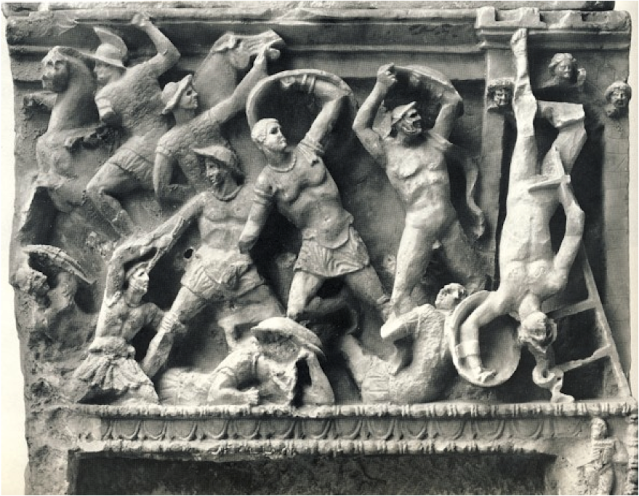
Etruscan Seven Against Thebes-themed Ash Urn from Volterra, early 1st century BCE. (PD)


If you enjoyed this post, never miss out on future posts by following me by email!