An online magazine about current archaeology and classical research into the lives of inhabitants of the Roman Empire and Byzantium and the civilizations around them.
A Phlyax play, also known as a hilarotragedy, was a burlesque dramatic form that developed in the Greek colonies of Magna Graecia (southern Italy) in the 4th century BCE. Its name derives from the Phlyakes, “Gossip Players,” in Doric Greek. From the surviving titles of the plays they appear to have been a form of mythological burlesque, which mixed figures from the Greek pantheon with the stock characters and situations of Attic New Comedy. The absence of any surviving script has led to conjecture that they were largely improvised.
Although only a few script fragments have been found, fortunately, such plays were a popular subject of vase paintings from the region. The vases first appeared at the end of the 5th century BCE, but most are 4th century BCE. They depict grotesque characters, the masks of comedy, and the props of comic performance such as ladders, baskets, and open windows. These vase paintings indicate that they were performed on a raised wooden stage with an upper gallery, and that the actors wore grotesque costumes and masks similar to those of Attic Old Comedy. The term phlyax, which is used for both the play and the costumed actors, probably derives from the Greek verb "to swell" and finds its meaning in the actors' costumes. They wore a mask, tights, a padded tunic, and a large artificial phallus. Any other garments necessary for the role were worn over this. They parodied heroes and themes of mythology or the comic elements of everyday life and incorporated acrobatics into the performances.
The Greek version of phlyakes seems to have died out by the late 3rd century BCE, but the Oscan inhabitants of Campania subsequently developed a tradition of farces, parodies, and satires influenced by late Greek models, which became popular in Rome during the 3rd century BCE. This genre was known as Atellan farce, Atella being the name of a Campanian town. Atellan farce introduced a set of stock characters such as Maccus and Bucco to Latin comedy. Even in antiquity, these were thought to be the ancestors of the characters found in Plautus, and perhaps distantly of those of commedia dell'arte, an improvised kind of popular comedy in Italian theaters in the 16th–18th centuries. Although an older view held that Attic comedy was the only source of Roman comedy, it has been argued that the phlyax playwright Rhinthon, in particular, influenced Plautus’s Amphitruo.
Image: Phlyax scene: three men (Gynmilos, Kosios and Karion) robbing a miser (Kharinos) inside his house. Side A of red-figure calyx-krater made in Paestum, 350–340 BCE, now in the Altes Museum in Berlin courtesy of Wikimedia Commons contributor Bibi Saint-Pol.
If you enjoyed this post, never miss out on future posts by following me by email!
According to Pausanias, who wrote in the later second century CE, there were originally three Muses, worshipped on Mount Helicon in Boeotia: Aoide ("song" or "tune"), Melete ("practice" or "occasion"), and Mneme ("memory"). The earliest known records of the Muses come from Boeotia and some ancient authorities point to Thrace as the origin of this myth.
Writing in the first century BCE, Diodorus Siculus claims Homer and Hesiod state there are actually nine Muses, though. According to Hesiod's account (c. 600 BCE), generally followed by most writers of antiquity, the Nine Muses were the nine daughters of Zeus and Mnemosyne (i.e., "Memory" personified), which represented personifications of knowledge and the arts, especially poetry, literature, dance and music. Ironically, Hesiod says the Muses brought to people forgetfulness, that is, the forgetfulness of pain and the cessation of obligations, though.
For poet and "law-giver" Solon, the Muses were "the key to the good life", since they brought both prosperity and friendship. Solon sought to perpetuate his political reforms by establishing recitations of his poetry—complete with invocations to his practical-minded Muses—by Athenian boys at festivals each year. He believed that the Muses would help inspire people to do their best.
Distinguished ancient authors would invoke the Muses when writing poetry, hymns or epic history to comply with established poetic tradition. Such invocations can be found in the works of Homer, Virgil, Catullus, and Ovid.
An example from Virgil's Aeneid:
O Muse! the causes and the crimes relate
What goddess was provok'd, and whence her hate
For what offense the Queen of Heav'n began
To persecute so brave, so just a man
—Virgil (c. 29 - 19 BCE), in Book I of the Aeneid
Muse Roman from Cremna in present-day Turkey about 200 CE Marble gold that I photographed at the Getty Villa in Pacific Palisades, California. These statues of the muses are among my favorites because of their softer features.
Muse Roman from Cremna in present-day Turkey about 200 CE Marble gold that I photographed at the Getty Villa in Pacific Palisades, California. These statues of the muses are among my favorites because of their softer features.
Muse Euterpe Roman from Cremna in present-day Turkey about 200 CE Marble pigment and gold that I photographed at the Getty Villa in Pacific Palisades, California.
Muse Euterpe Roman from Cremna in present-day Turkey about 200 CE Marble pigment and gold that I photographed at the Getty Villa in Pacific Palisades, California.
Muse of love poetry or dance, Roman, from Cremna in present day Turkey 200 CE Marble pigment and gold that I photographed at the Getty Villa in Pacific Palisades, California. These statues of the muses are among my favorites because of their softer features.
Muse of love poetry or dance, Roman, from Cremna in present day Turkey 200 CE Marble pigment and gold that I photographed at the Getty Villa in Pacific Palisades, California. These statues of the muses are among my favorites because of their softer features.
Terpsichore, Muse of the dance. Marble, Roman artwork from the 2nd century CE. The head is ancient but does not belong to the body. From the Villa of Cassius near Tivoli, now in the collections of the Vatican Museums, courtesy of Wikimedia Commons contributor Marie-Lan Nguyen
Part of a pavement mosaic with the bust of a muse. Roman artwork of the second half of 2nd - early 3rd century CE from the Villa dei Severi now at the Palazzo Massimo alle Terme in Rome, Italy courtesy of Wikimedia Commons contributor Jean Pol Grandmont.
Roman mosaic depicting the Muses dating between 2nd and 4th centuries CE, excavated at Antioch, Turkey, now in the collections of the Worcester Art Museum in Worcester, Massachusetts, courtesy of Wikimedia Commons contributor Daderot
The fragmentary front of a large sarcophagus with a seated woman surrounded by Muses. The muse to the left is Terpsichore. She wears a chiton completely enveloped by a himation, and holds a lyre in her left hand. She turns toward a seated woman (probably the deceased) who wears a himation and whose foot rests on a foot-stool. She reaches to touch the strings of Terpsichore's lyre. Beside her is Thalia, wearing a close-fitting netlike garment with a mantle wrapped around her lower body. A bulla is around her neck and she wears open-toed shoes. In her left hand, she holds a lagobolon concealed by her cloak, and in her right, a comic mask. At the end, Euterpe holds the tibiae (pipes) with both hands. She wears a sleeved chiton trimmed with tassels at the hem. A short mantle is wrapped around her shoulders and tucked under her belt. To the right of Euterpe are the remains of a pillar. Courtesy of the Getty Villa
Clio the Roman Muse of History from Cremna in present-day Turkey about 200 CE Marble pigment and gold that I photographed at the Getty Villa in Pacific Palisades, California.
Clio the Roman Muse of History from Cremna in present-day Turkey about 200 CE Marble pigment and gold that I photographed at the Getty Villa in Pacific Palisades, California.
Clio the Roman Muse of History from Cremna in present-day Turkey about 200 CE Marble pigment and gold that I photographed at the Getty Villa in Pacific Palisades, California.
Urania (astronomy) 1, Euterpe (flutes and lyric poetry) 2, Polyhymnia (sacred poetry) 3, Erato (love poetry) 4 but name to other side of Kleio (Kleio In Greek mythology, Clio (traditionally /ˈklaɪoʊ/, but now more frequently /ˈkliːoʊ/; Greek: Κλειώ, Kleiṓ; "made famous" or "to make famous"), also spelled Kleio, is the muse of history, or in a few mythological accounts, the muse of lyre playing, 5, Terpsichore (dance) 6, Melpomene (tragedy) 7, Thalia (comedy and pastoral poetry) 8. The ninth is not in this group, as she is Calliope who is shown in a frame of her own, handing a paper (“inspiration”?) to Hesiod. 2nd century CE Roman mosaic courtesy of Wikimedia Commons contributor Dick Osseman.
The Muse Terpsichore, Roman statue based on an Attic model from 150–100 BCE found in the Villa Adriana in Tivoli, Italy, now in the collections of the Prado Museum, courtesy of Wikimedia Commons contributor na Belén Cantero Paz.
If you enjoyed this post, never miss out on future posts by following me by email!
Roman theater began to develop following the devastation of a widespread plague in 364 BCE. Roman citizens began including theatrical presentations as a supplement to the Lectisternium ceremonies, religious propitiatory meals, in a stronger effort to pacify the gods. In the years following the establishment of these practices, actors began adapting these dances and games into performances by acting out texts set to music and simultaneous movement.
As the era of the Roman Republic progressed, citizens began including professionally performed drama in the eclectic offerings of the ludi (celebrations of public holidays) held throughout each year—the largest of these festivals being the Ludi Romani, held each September in honor of the Roman god Jupiter. It was as a part of the Ludi Romani in 240 BCE that author and playwright Livius Adronicus became the first to produce translations of Greek plays to be performed on the Roman stage.
In the 1st century CE, Seneca, the famous Stoic philosopher and tutor to the emperor Nero, wrote tragedies that used a declamatory style emphasizing rhetoric. These works sought to reflect the soul of a tragic character by using rhetoric to reveal something about the state of the character's mind. One of the most notable ways that Seneca developed a tragedy, was through the use of an aside, a common theatre device in Hellenistic drama, but, at the time, foreign to the world of Attic tragedy. Seneca used 'self-representational soliloquies or monologues,' which focused on one's inner thoughts, the central causes of their emotional conflicts, their self-deception, as well as other varieties of psychological turmoil to dramatize emotion in a way that became central to Roman tragedy, distinguishing it from prior forms of Greek tragedy. Perhaps this figure represented a rhetorician in one of Seneca's dramas.
Of course one of the most eye-catching aspects of this figure is the very short tunic and cloak he wears. The length of a Roman tunic indicated the wearer's social status. Soldiers, manual workers, and even slaves usually wore tunics that reached to just a little above the knee. Actors, however, were considered "infamia," an official exclusion from the legal protections enjoyed by a Roman citizen that included corporal punishment, usually reserved for slaves. This lowly status is reflected in the length of this figure's garments.
Image: Bronze statuette of a draped man thought to be an actor, 1st century BCE - 1st century CE, Greek or Roman, courtesy of the Metropolitan Museum of Art. This impressive statuette shows a mature, bearded man who stands purposefully and looks upward. The cloak that covers his torso also conceals his arms, bent forward over his chest. Proposed identifications have linked him with the theater, specifically as an actor declaiming a text rather than playing a role. - Metropolitan Museum of Art
If you enjoyed this post, never miss out on future posts by following me by email!
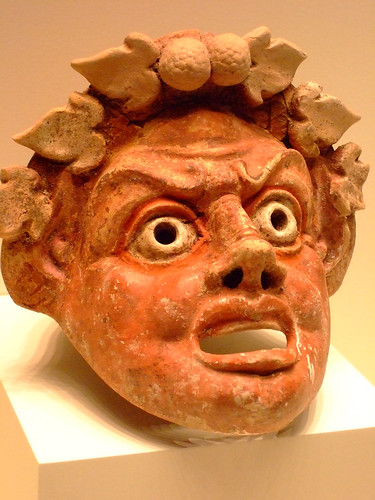
Votive mask of a Satyr Greek made in
the eastern Mediterranean 300-100 BCE
Terracotta. Photographed at the Getty
Villa by Mary Harrsch.
Elaborate costumes, complex choreography, scenic architecture, and the iconic masks of tragedy and comedy depicted in the visual arts of ancient Greece from the 5th to 1st century BCE are the focus of the new exhibit at the Getty Villa, "The Art of Ancient Greek Theater" on display now through January 3, 2011.
The exhibition is being presented in conjunction with the Getty Villa’s annual outdoor theater performance. This year's production will be Sophocles’ Elektra, directed by Carey Perloff, artistic director of the American Conservatory Theater in San Francisco, with a new translation commissioned from Timberlake Wertenbaker. Performances are scheduled Thursday, Friday, and Saturday evenings, September 9 through October 2, 2010. A two-day international scholarly conference that will further explore the themes of the exhibition will be held September 24-25, 2010. In addition, the Villa Theater Lab will present Understanding a Satyr Play: The Trackers on November 19 and 20, 2010.
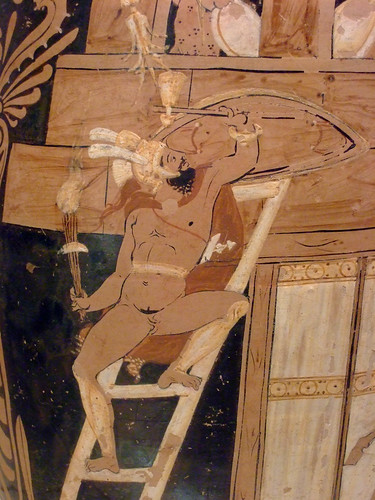
Scene from "Seven Against Thebes" by Aeschylus
depicted on a red-figure storage jar produced
in Campania, Italy about 340 BCE. Photographed
at the Getty Villa by Mary Harrsch.
“Ancient art and theater share a strong and enduring connection–one that is inspired
by mythology and the social, cultural, and political realities of life in ancient Greece and Rome,” says David Bomford, acting director of the J. Paul Getty Museum. “With this exhibition and our annual production in the outdoor theater, we are delighted to bring ancient theater alive at the Getty Villa and invite our visitors to join us and discover how those themes found in ancient times persist today.”
In addition to the Getty's own collection of Athenian and South Italian vases, marble reliefs, figurines and masks, the exhibit will draw from major collections in Denmark, Australia, New Zealand, France, Germany, Italy, Spain, The Netherlands, Switzerland, the United Kingdom and elsewhere in the United States.
I found a humorous description of the history of Greek comedy by Brander Matthews in "The Development of Drama" published in 1912:
"Comedy seems to have sprung into being at the vintage-festival of the Greek villagers, when all was jovial gaiety and jesting license in honor of Dionysus. "On public occasions," so a recent historian of the origin of art has reminded us, "the common mood, whether joy or sorrow, is often communicated even to those who were originally possessed by the opposite feeling; and so powerful is infection of excitement that a sober man will join in the antics of his drunken comrades--yeilding to a drunkenness by induction." And these seasons of contagious revelry were exactly suited to a development of the double desire of mankind for personation--one man seeking to get outside of his own individuality and to assume a character not his own, while another finds his satisfaction rather in the observation of this simulation, in being a sympathetic spectator when actions are represented not proper to the actor's own character.
So it came to pass that there were companies of young fellows, often disguised grossly as beasts or birds, who broke out into riotous phallic dances, enjoyed equally by those who looked on and by those who took part. In time the dancers grouped themselves in rival bands, the leaders of which indulged in a give-and-take of banter and repartee, certainly vulgar and personal, and probably as direct and artless as the chop-logic dialogues of the medieval quack-doctor and his jack-pudding, or of the modern ring-master and circus clown. The happy improvisation of this carnival spirit which happened to delight the crowd one year would surely be repeated the next year deliberately, perhaps only to evoke an unexpected retort with which it would thereafter be conjoined in what might prove to be the nucleus of a comic scene of some length. Thus a species would tend to appear, as the tradition was handed down from season to season, enriching itself constantly with the accretions of every venturesome jester. However frail this framework might be, it would be likely to contain a rough realization of the more obvious types of rural character; and almost from the beginning there would be abundant and irreverent parody of heroic legend and of religious myth." - Brander Matthews, The Development of Drama
Perhaps because of its riotous origins, Greek theater, like other aspects of Greek culture, was only tentatively embraced by the Romans. Until the Theater of Pompey was built in 55 BCE, theaters were temporary structures of wood that were erected before scheduled performances and torn down afterwards. The construction of two stone temples had been attempted in 179 and 174 BCE but never completed. Then a third temple was begun in 154 BCE but the consul P. Scipio Nasica, declared the structure to be "undesirable" and "harmful to public morals" (Livy, Periochae 48.68) and had the construction torn down. Even in the late Republic, Pompey was forced to disguise his theater as a temple to Venus. Until 145 BCE audiences were not even allowed to sit while attending a theatrical performance.
A decree of the Roman Senate forbade sitting at theatrical performances "so that the manly behavior of standing might be known as proper to the Roman people for the relaxation of their spirits (Valerius Maximus, Memorable Words and Deeds 2.4.2)." - Introduction to Greek and Roman Comedy
There were several key differences in both the construction of theaters and in the structure of the performances presented to Roman audiences.
The Roman theater, although similar in form to the Greek theater, developed a magnificence and splendor in keeping with Rome's imperial status. This grandeur is most evident in the stage building, which was raised to the height of the seating area. Thus the stage building was normally three stories high in comparison with the two stories of the skene in later Greek theaters. The orchestra in the Roman theater for the most part became a seating areabecause of the virtual disappearance of the chorus from Roman drama." - Introduction to Greek and Roman Comedy
I found a rather anti-Roman comparison of Greek and Roman theater written by Wilhelm Schlegel in 1904. Like many Victorian-era classicists of the period, he appears to idolize the cultural contributions of the Greeks and consider the Roman poets and playwrights little more than copyists!
Other deviations from the Grecian mode of representation were also sanctioned, which can hardly be considered as improvements. At the very first introduction of the regular drama, Livius Andronicus, a Greek by birth, and the first tragic poet and actor of Rome, in his monodies (lyrical pieces which were sung by a single person, and not by the whole chorus), separated the song from the mimetic dancing, the latter only remaining to the actor, in whose stead a boy, standing beside the flute-player, accompanied him with his voice. Among the Greeks, in better times, the tragic singing, and the accompanying rhythmical gestures, were so simple, that a single person was able to do at the same time ample justice to both. The Romans, however, it would seem, preferred separate excellence to harmonious unity. Hence arose, at an after period, their fondness for pantomime, of which the art was carried to the greatest perfection in the time of Augustus. From the names of the most celebrated of the performers, Pylades, Bathyllus, &c., it would appear that it was the Greeks that practiced this mute eloquence in Rome; and the lyric pieces which were expressed by their dances were also delivered in Greek. Lastly, Roscius frequently played without a mask, and in this respect probably he did not stand alone; but, as far as we know, there never was any instance of it among the Greeks. The alteration in question might be favourable to the more brilliant display of his own skill, and the Romans, who were pleased with it, showed here also that they had a higher relish for the disproportionate and prominant talents of a virtuoso, than for the harmonious impression of a work of art considered as a whole. -Lectures on Dramatic Art and Literature by Wilhelm Schlegel
To see a variety of both Greek and Roman art objects embellished with theatrical masks or scenes from theatrical performances, I encourage you to view the following slideshow of artifacts I have photographed at the Getty as well as the British Museum, The Louvre, and various museums in Italy:
For those of you who can visit the Getty Villa in November, I highly recommend that you attend one of the performances of "Elektra" in the Villa's reproduction of a Greek theater.
The story of Elektra carries forward the tragic history of the House of Atreus. Years after the bloody murder of King Agamemnon, his widow, Clytemnestra, and her lover Aegisthus, rule the city with an iron hand, while their daughter Elektra prays to the gods that her exiled brother Orestes might return to avenge their father's death. Believed to have been written near the end of Sophocles' life, Elektra embodies the playwright's most profound portrait of the endurance of the human spirit, brilliantly ablaze with the warring, inner flames of hope and despair. - Elektra Director, Carey Purloff
Actually, both Sophocles and Euripedes wrote plays about Elektra (sometimes spelled Electra) the very same year. A modern reviewer compares the two versions, pointing out that in his opinion Sophocles' characters adhere to societal values regardless of the personal consequences where Euripedes appears to advocate the assessment of alternative solutions and a degree of thought independent of societal dictates.
I see next year the Getty will present "The Trojan Women". I had the privilege of attending a performance of a modern adaptation of "The Trojan Women" presented by the drama department at the University of Oregon at their Robinson Theater a couple of years ago and enjoyed it immensely.
I learned even more fascinating information about Greek theater when I listened to The Teaching Company's excellent lecture series on Greek tragedy presented by Professor Elizabeth Vandiver of Whitman College. I found it absolutely riveting!
If you enjoyed this post, never miss out on future posts by following me by email!