Showing posts with label Homer. Show all posts

Sunday, April 18, 2021

Achilles' Ambush of Troilus

All Greek and Etruscan metal rings with engraved bezels ultimately derive from Egyptian and Phoenician cartouche-shaped rings. The cartouche-shaped ring was especially popular in Etruria in the later 500s B.C., where immigrant Greek goldsmiths from Ionia introduced it.

This example features an intricate scene of two men approaching a fountain where water gushes into a vessel from a lion's head spout. Behind the fountain, a man squats as if hiding, holding a sword. These details identify the scene as a standard depiction of the ambush of Troilos (Troilus), prince of Troy, by the Greek hero Achilles during the Trojan War. On this ring, however, a strange dog-headed creature, who is not part of the Troilos myth, sits atop the fountain. The creature may actually be jackal-headed and thus meant to recall the Egyptian god Anubis harking back to the origin of such rings from Egypt.

Prophecies retold in the Iliad link the fate of Troilos, one of the sons of King Priam (or Apollo in some versions of Greek myth), with the fate of Troy itself. Ancient writers including Sophocles treated Troilos, a paragon of youthful male beauty, as the epitome of a dead child mourned by his parents. 

 Only 54 words have been identified as coming from Sophocles' play, Troilos.  Fragment 619 refers to Troilos as an andropais, a man-boy. (A fragment from the 6th century tragic poet Phyrnichus refers to Troilus as possessing the light of love glowing on his reddening cheeks) Fragment 621 indicates that Troilos was going to a spring with a companion to fetch water or to water his horses but a scholion (explanatory comment) to the Iliad states that Sophocles relates how Troilos was ambushed by Achilles while exercising his horses in the Thymbra. Fragment 623 indicates that Achilles mutilated Troilos' corpse by a gruesome method known as maschalismos. This involved preventing the ghost of a murder victim from returning to haunt their killer by cutting off the corpse's extremities and stringing them under its armpits. 

Considering Troilos, according to many versions and interpretations, was still a child, Achilles' behavior was beyond the pale. Greek heroes were not always heroic!

Gold finger ring depicting Achilles' Ambush of Troilos, Etruscan, 550-500 BCE, at the J. Paul Getty Museum, image courtesy of the museum.

Red-figured bell-krater depicting Achilles in wait for Troilos. Troilos leads up a mule to drink, with right arm over its back. He is represented as a child, with curls in front of his ears, chlamys over left shoulder, petasos hanging from neck, in left hand two spears. Mid-fifth to third centuries BCE, British Museum.

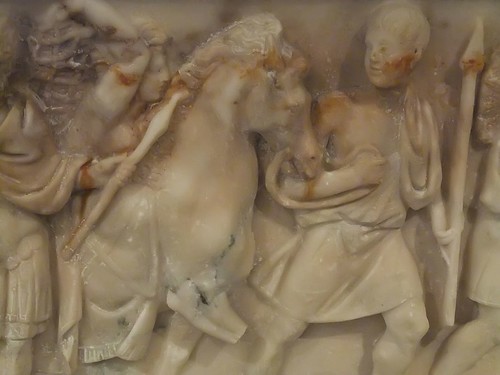
Roman relief from a statue of Germanicus, 2nd c. CE, depicting the ambush of Troilos, Archeological Museum of Perugia courtesy of Wikimedia Commons contributor Haiduc.

Achilles ambushing Troilos and Polyxena, shoulder of an Attic black-figure hydria, 560-550 BCE at the Metropolitan Museum of Art courtesy of Wikimedia Commons contributor Marie-Lan Nguyen.

Image: Achilles (left) ambushing Troilus (on horseback, right). Etruscan fresco, Tomb of the Bulls, Tarquinia, 530–520 BCE courtesy of Wikimedia Commons.
If you enjoyed this post, never miss out on future posts by following me by email!


Wednesday, April 14, 2021

Gigantes

In Greek and Roman Mythology, the Giants, also called Gigantes, were a race of great strength and aggression, though not necessarily of great size. They were known for the Gigantomachy (Gigantomachia), their battle with the Olympian gods for supremacy of the cosmos. Historically, the myth of the Gigantomachy (not to be confused with the Titanomachy) may reflect the "triumph" of the new imported gods of the invading Greek speaking peoples from the north (c. 2000 BCE) over the old gods of the existing peoples of the Greek peninsula. For the Greeks, the Gigantomachy represented a victory for order over chaos—the victory of the divine order and rationalism of the Olympian gods over the discord and excessive violence of the earth-born chthonic Giants. More specifically, for sixth and fifth century BCE Greeks, it represented a victory for civilization over barbarism. 

Archaic and Classical representations show Gigantes as man-sized hoplites (heavily armed ancient Greek foot soldiers) fully human in form. According to Hesiod in his Theogony, the Giants were the offspring of Gaia (Earth), born from the blood that fell when Uranus (Sky) was castrated by his Titan son Cronus. Later representations (after c. 380 BCE) show Gigantes with snakes for legs. In later traditions, the Giants were often confused with other opponents of the Olympians, particularly the Titans, an earlier generation of large and powerful children of Gaia and Uranus. 

In the Odyssey, Homer has Giants among the ancestors of the Phaiakians, a race of men encountered by Odysseus,  Their ruler, Alcinous, compares the Giants to the Cyclopes, saying they are "near kin" to the gods. Homer compares them to the Laestrygonians, who "hurled...rocks huge as a man could lift." Surprisingly, however, Homer does not mention anything about the famous Gigantomachy.

Bacchylides portrays the giants as arrogant and victims of their own hubris.  Pindar describes the Giants as excessively violent and provides some of the earliest details of the Gigantomachy. He says it took place on the plain of Phlegra (the ancient name for Pallene -modern Kassandra) and has the legendary seer Teiresias prophesying that the Giants would be killed by Heracles "beneath his rushing arrows." He tells us that Porphyrion, the king of the Giants is overcome by the bow of Apollo. These events are recalled in Euripedes play "Heracles." In the play, Heracles' son Ion has the chorus describe seeing a depiction of the Gigantomachy on the late sixth century BCE Temple of Apollo at Delphi, with Athena fighting the Giant Enceladus with her "gorgon shield", Zeus burning the Giant Mimas with his "mighty thunderbolt, blazing at both ends", and Dionysus killing an unnamed Giant with his "ivy staff". Apollonius of Rhodes describes how  the sun god Helios takes up Hephaestus, exhausted from the fight in Phlegra, on his chariot.

Apollodorus provides the reason for the war between the giants and the Olympians. Although he mentions the theft of Helios' cattle, he suggests a mother's revenge as the actual motive for the war, saying that Gaia bore the Giants because of her anger over the Titans defeat and imprisonment. 

The vanquished Giants were said to be buried under volcanoes and to be the cause of volcanic eruptions and earthquakes. In his Metamorphoses, Ovid says from the blood of the Giants came a new race of beings in human form. According to Ovid, Earth [Gaia] did not want the Giants to perish without a trace, so "reeking with the copious blood of her gigantic sons", she gave life to the "steaming gore" of the blood soaked battleground. These new offspring, like their fathers the Giants, also hated the gods and possessed a bloodthirsty desire for "savage slaughter".

From the sixth century BCE onwards, the Gigantomachy was a popular and important theme in Greek art, with over six hundred representations cataloged.

Detail of Gigantomachy (the battle between the Greek gods and the Giants portrayed here as Tritons), Hellenistic art of the Roman period, 2nd century CE. From Aphrodisias in the Istanbul Archaeological Museum courtesy of Wikimedia Commons contributor Giovanni Dall'Orto.

Poseidon attacks Polybotes in the presence of Gaia, red-figure cup late fifth century BCE at the Antikensammlung  in Berlin courtesy of Wikimedia Commons contributor Sailko.

Detail of the Sala dei Giganti in the Palazzo del Te, Mantua, c. 1530, Giulio Romano courtesy of Wikimedia Commons.

Poseidon (left) holding a trident, with the island Nisyros on his shoulder, battling a Giant (probably Polybotes), red-figure cup c. 500–450 BCE in the Cabinet des Medailles in Paris courtesy of Wikimedia Commons contributor Bibi Saint-Pol.

Scene from the Gigantomachy on the frieze of the Pergamon Altar depicting Athena and Nike fighting Alkyoneus, as Gaia rises up from the ground, courtesy of Wikimedia Commons contributor Mila Ranta.

Metope from the Temple of Hera in Paestum depicting Hercules killing the giant Alcyoneus, now in the National Archaeological Museum courtesy of Wikimedia Commons contributor Miguel Hermoso Cuesta.

Second century CE Roman sarcophagus depicting the Gigantomachy at the Vatican Pius Clementine Museum courtesy of Wikimedia Commons contributor xiquinhosilva.

Statuette of a Giant Hurling a Rock, 200–175 BCE, Bronze, in the J. Paul Getty Museum, Villa Collection, Malibu, California.

Gigantomachy (the battle between the Greek gods and the Giants portrayed here as Tritons), Hellenistic art of the Roman period, 2nd century CE. From Aphrodisias in the Istanbul Archaeological Museum courtesy of Wikimedia Commons contributor Giovanni Dall'Orto.

Gigantomachy on the north frieze of the Siphnian Treasury at Delphi, 525 BCE, with the gods facing right and the Giants facing left, courtesy of Wikimedia Commons contributor Bgabel.


A serpent-legged giant from a mosaic depicting the Gigantomachy at the Villa Romana del Casale courtesy of Wikimedia Commons contributor Lasterketak.


If you enjoyed this post, never miss out on future posts by following me by email!


Wednesday, March 31, 2021

The Muses

 According to Pausanias, who wrote in the later second century CE, there were originally three Muses, worshipped on Mount Helicon in Boeotia: Aoide ("song" or "tune"), Melete ("practice" or "occasion"), and Mneme ("memory").  The earliest known records of the Muses come from Boeotia and some ancient authorities point to Thrace as the origin of this myth.  

Writing in the first century BCE, Diodorus Siculus claims Homer and Hesiod state there are actually nine Muses, though.  According to Hesiod's account (c. 600 BCE), generally followed by most writers of antiquity, the Nine Muses were the nine daughters of Zeus and Mnemosyne (i.e., "Memory" personified), which represented personifications of knowledge and the arts, especially poetry, literature, dance and music.  Ironically, Hesiod says the Muses brought to people forgetfulness, that is, the forgetfulness of pain and the cessation of obligations, though.

For poet and "law-giver" Solon, the Muses were "the key to the good life", since they brought both prosperity and friendship. Solon sought to perpetuate his political reforms by establishing recitations of his poetry—complete with invocations to his practical-minded Muses—by Athenian boys at festivals each year. He believed that the Muses would help inspire people to do their best.

Distinguished ancient authors would invoke the Muses when writing poetry, hymns or epic history to comply with established poetic tradition.  Such invocations can be found in the works of Homer, Virgil, Catullus, and Ovid.

An example from Virgil's Aeneid:

O Muse! the causes and the crimes relate

What goddess was provok'd, and whence her hate

For what offense the Queen of Heav'n began

To persecute so brave, so just a man

—Virgil (c. 29 - 19 BCE), in Book I of the Aeneid 

Muse Roman from Cremna in present-day Turkey about 200 CE Marble gold that I photographed at the Getty Villa in Pacific Palisades, California. These statues of the muses are among my favorites because of their softer features.

Muse Roman from Cremna in present-day Turkey about 200 CE Marble gold that I photographed at the Getty Villa in Pacific Palisades, California. These statues of the muses are among my favorites because of their softer features.

Muse Euterpe Roman from Cremna in present-day Turkey about 200 CE Marble pigment and gold that I photographed at the Getty Villa in Pacific Palisades, California.

Muse Euterpe Roman from Cremna in present-day Turkey about 200 CE Marble pigment and gold that I photographed at the Getty Villa in Pacific Palisades, California.

Muse of love poetry or dance, Roman, from Cremna in present day Turkey 200 CE Marble pigment and gold that I photographed at the Getty Villa in Pacific Palisades, California. These statues of the muses are among my favorites because of their softer features.

Muse of love poetry or dance, Roman, from Cremna in present day Turkey 200 CE Marble pigment and gold that I photographed at the Getty Villa in Pacific Palisades, California. These statues of the muses are among my favorites because of their softer features.

Terpsichore, Muse of the dance. Marble, Roman artwork from the 2nd century CE. The head is ancient but does not belong to the body. From the Villa of Cassius near Tivoli, now in the collections of the Vatican Museums, courtesy of Wikimedia Commons contributor Marie-Lan Nguyen 

Part of a pavement mosaic with the bust of a muse. Roman artwork of the second half of 2nd - early 3rd century CE from the Villa dei Severi now at the Palazzo Massimo alle Terme in Rome, Italy courtesy of Wikimedia Commons contributor Jean Pol Grandmont. 

Roman mosaic depicting the Muses dating between 2nd and 4th centuries CE, excavated at Antioch, Turkey, now in the collections of the Worcester Art Museum in Worcester, Massachusetts, courtesy of Wikimedia Commons contributor Daderot 

The fragmentary front of a large sarcophagus with a seated woman surrounded by Muses. The muse to the left is Terpsichore. She wears a chiton completely enveloped by a himation, and holds a lyre in her left hand. She turns toward a seated woman (probably the deceased) who wears a himation and whose foot rests on a foot-stool. She reaches to touch the strings of Terpsichore's lyre. Beside her is Thalia, wearing a close-fitting netlike garment with a mantle wrapped around her lower body. A bulla is around her neck and she wears open-toed shoes. In her left hand, she holds a lagobolon concealed by her cloak, and in her right, a comic mask. At the end, Euterpe holds the tibiae (pipes) with both hands. She wears a sleeved chiton trimmed with tassels at the hem. A short mantle is wrapped around her shoulders and tucked under her belt. To the right of Euterpe are the remains of a pillar. Courtesy of the Getty Villa

Clio the Roman Muse of History from Cremna in present-day Turkey about 200 CE Marble pigment and gold that I photographed at the Getty Villa in Pacific Palisades, California.

Clio the Roman Muse of History from Cremna in present-day Turkey about 200 CE Marble pigment and gold that I photographed at the Getty Villa in Pacific Palisades, California.

Clio the Roman Muse of History from Cremna in present-day Turkey about 200 CE Marble pigment and gold that I photographed at the Getty Villa in Pacific Palisades, California.

Urania (astronomy) 1, Euterpe (flutes and lyric poetry) 2, Polyhymnia (sacred poetry) 3, Erato (love poetry) 4 but name to other side of Kleio (Kleio In Greek mythology, Clio (traditionally /ˈklaɪoʊ/, but now more frequently /ˈkliːoʊ/; Greek: Κλειώ, Kleiṓ; "made famous" or "to make famous"), also spelled Kleio, is the muse of history, or in a few mythological accounts, the muse of lyre playing, 5, Terpsichore (dance) 6, Melpomene (tragedy) 7, Thalia (comedy and pastoral poetry) 8. The ninth is not in this group, as she is Calliope who is shown in a frame of her own, handing a paper (“inspiration”?) to Hesiod. 2nd century CE Roman mosaic courtesy of Wikimedia Commons contributor Dick Osseman. 

The Muse Terpsichore, Roman statue based on an Attic model from 150–100 BCE found in the Villa Adriana in Tivoli, Italy, now in the collections of the Prado Museum, courtesy of Wikimedia Commons contributor na Belén Cantero Paz. 


If you enjoyed this post, never miss out on future posts by following me by email!


Saturday, November 14, 2020

One-eyed warriors and gold-guarding griffins

 The relief on this elegantly worked roundel depicts a nude youth being attacked by a griffin. It relates to legends, first mentioned by the ancient Greek writer Herodotus, of the people called Arimasps who lived east of the Black Sea.Their land was rich in gold, but the gold was guarded by fierce griffins. The subject became popular during the Hellenistic period, especially for terracottas produced in Tarentum. It is likely that these South Italian models inspired the Central Italian adaptation on this bronze. - Metropolitan Museum of Art

The Arimaspi were a legendary tribe of one-eyed people of northern Scythia who lived in the foothills of the Riphean Mountains, variously identified with the Ural or Carpathian mountains.  The tales of their struggles with gold-guarding griffins in the Hyperborean lands beyond Thrace, reported by Herodotus, were originally told in a lost archaeic poem, Arimaspea, by Aristeas,  a native of Proconnesus in Asia Minor, active during the 7th century BCE.   Strabo and Pliny's Natural History perpetuated the fables about the northern people who had a single eye in the center of their foreheads and engaged in stealing gold from the griffins.

Scholars point out that the struggle between the Arimaspi and the griffins has remarkable similarities to Homer's account of the Pygmaioi warring with cranes:

"...when the cranes escape the winter time and the rains unceasing and clamorously wing their way to the streaming Ocean, bringing to the Pygmaian men bloodshed and destruction..." - Homer, The Iliad

In his History of Animals, Aristotle claims the story is true, "these birds [the cranes] migrate from the steppes of Scythia to the marshlands south of Egypt where the Nile has its source. And it is here, by the way, that they are said to fight with the pygmies. The story is not fabulous, as there is in reality a race of dwarfish men, and the horses are little in proportion, and the men live in caves underground."

The Roman poet Ovid also describes such an age-old battle in one of his stories when a Pygmy Queen named Gerana who offended the goddess Hera with her boasts of superior beauty, was transformed into a crane.

Modern historians speculate Herodotus or his source may have understood the Scythian word as a combination of the roots arima ("one") and spou ("eye") and to have created a mythic image to account for it. This similarity of name and location, however, could point to the ancestors of the local Uralic people, the Mari.


Bronze lid and upper part of an oil flask depicting a youth being attacked by a griffin, 4th century BCE, Praenestine, courtesy of the Metropolitan Museum of Art.


If you enjoyed this post, never miss out on future posts by following me by email!


Sunday, June 7, 2020

The Metamorphosis of Polyphemus


The Cyclops Polyphemus from the Antonine period 2nd - 3rd century CE photographed at the Capitoline Museum in Rome, Italy.
Depictions of the Cyclops Polyphemus have differed radically, depending on the literary genres in which he has appeared, and have given him an individual existence independent of the Homeric herdsman encountered by Odysseus. In the epic he was a man-eating monster dwelling in an unspecified land.

Some centuries later, a dithyramb by Philoxenus of Cythera, followed by several episodes by the Greek pastoral poets, created of him a comedic and generally unsuccessful lover of the water nymph Galatea. In the course of these he woos his love to the accompaniment of either a cithara or the pan-pipes. Such episodes take place on the island of Sicily, and it was here that the Latin poet Ovid also set the tragic love story of Polyphemus and Galatea recounted in the Metamorphoses.

Still later tradition made him the eventually successful husband of Galatea. According to some accounts, the Celts (Galati in Latin) were descended from their son Galatos, while Appian credited them with three children, Celtus, Illyrius and Galas, from whom descended the Celts, the Illyrians and the Gauls.  That their conjunction was fruitful is also implied in a later Greek epic from the turn of the 5th century CE. In the course of his Dionysiaca, Nonnus gives an account of the wedding of Poseidon and Beroe, at which the Nereid "Galatea twangled a marriage dance and restlessly twirled in capering step, and she sang the marriage verses, for she had learnt well how to sing, being taught by Polyphemos with a shepherd’s syrinx."

If you enjoyed this post, never miss out on future posts by following me by email!


Wednesday, May 27, 2020

Symbols of Faithfulness: Dogs in Ancient Art

Domesticated dogs appeared in prehistoric paintings at sites like Bhimbetka in central India that date back more than 100,000 years. During the Bronze Age statues, children's toys, and ceramics depicted dogs. Hunting dogs were most commonly portrayed but pet dogs, valued for their faithfulness and courage were also subjects of ancient art.

Dogs were often seen on Greek and Roman reliefs and ceramics as symbols of fidelity and given as gifts among lovers.  Homer's Odyssey reinforced this concept of a dog's faithfulness by telling the story of Odysseus' dog who was the only one that recognized him when he returned home after years of wanderings, even though he was disguised to conceal his appearance. Sadly, because dogs were revered for their loyalty, they were also sometimes sacrificed in special religious rituals.  During Xanthika, a spring purification of the Macedonian army, a dog was sacrificed.  The Spartans sacrificed a dog to Enyalius, the son of Ares, in one of their military festivals as well. At the Robigalia, a festival in ancient Roman religion held on April 25, a dog was sacrificed to protect grain fields from disease.

The ancient Romans kept three types of dogs: hunting dogs, especially sighthounds, a dog like a whippet that hunts primarily by sight and speed rather than by scent and endurance like a beagle, Molossus dogs like the Neapolitan Mastiff for protection, often depicted in reliefs and mosaics with the words "Cave Canem", and small companion dogs like the Maltese, used as women's lap dogs.  Like the ancient Egyptians, Greeks, Persians, Sarmatians, Baganda, Alans, Slavs, and Britons, the Romans used large dogs as military sentries and on patrol and sometimes they were taken into battle.  The earliest use of war dogs in a battle recorded in classical sources was by Alyattes of Lydia against the Cimmerians around 600 BCE where the Lydian dogs killed some invaders and routed others.  During Late Antiquity, Attila the Hun used Molossus dogs in his campaigns.

Fresco of Endymion and Selene with a dog from the House of the Dioscuri in Pompeii

Roman funerary monument to a dog with footprint from the Vidy Roman Museum in Lausanne, Switzerland courtesy of Wikimedia Commons contributor Rama

2nd century BCE sculptural group of Roman sight hounds found near Lanuvio, Italy in 1774 now in the Museo Pio-Clementino at the Vatican courtesy of Wikimedia Commons contributor Henry Townsend

Roman Terracotta figurine of a dog 1st century BCE-1st century CE at the British Museum courtesy of Wikimedia Commons contributor AgTigress

Terracotta askos in the form of a dog 2nd-1st century BCE Greek at the Metropolitan Museum of Art in New York, courtesy of the museum.
If you enjoyed this post, never miss out on future posts by following me by email!


Thursday, August 19, 2010

Turkish documentary to retrace sea voyage of Aeneas

Roman Sarcophagus Depicting Scenes from the Aeneid
2nd century CE from the Giustiniana area along the
Via Cassia Rome.  Photographed at the National Museum
in Rome, Italy by Mary Harrsch.
In an effort to promote the parallel study of the post- Trojan period in Turkey and Italy, Turkish archaeologists are planning to produce a documentary film about the sea journey of Aeneas  from Antandrus in Turkey to the Latium region of Italy.

“A ship, which we’ll name ‘Tempest,’ will set off from Altınoluk and follow the route that was taken by Aeneas’ band in 700 B.C. using sails and oars only,” said Excavation Chairman Gürcan Polat in detailing the plans for the journey from the northwestern Turkish province to Italy.

The ship to be used in re-creating Aeneas’ journey will be built in the style of the post-Trojan period, the excavation coordinator said.

“Aeneas’ experiences in every place he passed will be dramatically re-created and documented. In this way, we will have a very significant historical documentary,” said Polat, detailing plans for a documentary film to accompany the seafarers. “I hope it will also contribute to the promotion of both Antandrus and Turkey abroad.” - Turkey Daily News & Economic Review
Homer tells us that Antandrus was among the 11 cities and 12 islands conquered by Achilles during the Trojan War.


Aristotle states that Antandrus was occupied by the Cimmerians about 700 BCE and was referred to as Kimmeris for a hundred years during their occupation.


Antandrus was later colonized by the Greeks on the north side of the Adramyttian Gulf in the Troad region of Anatolia, near the modern village of Avcilar in Turkey in the 5th century BCE but scholars disagree on the founders.

"Strabo, quoting the poet Alcaeus, mentions the Leleges (Geography, 13.1.51), Herodotus believed the first settlers were Pelasgians (Histories, 7.42), and Thucydides mentions the Aeolians (History of the Peloponnesian War, 8.108)." - Livius.org

After participating in the Ionian Revolt, Antandrus later joined the Delian League.

During the Peloponnesian War, exiles from Lesbos captured the city, used it as base to recapture Mytilene, but were expelled by the Athenians, who garrisoned the place (Diodorus, World History, 12.72.2). - Livius.org

During the Corinthian War, it was used as a strategic naval base. 

The economy of Antandrus was based on the sale of timber from Ida Mountains.

In Search of a Homeland: The Story of the Aeneid   Vergil's Aeneid: Hero War Humanity   Art of the Aeneid (Bristol Classical Paperbacks.)   In Search of the Trojan War, Updated edition   Troy and its Remains: A Narrative of Researches and Discoveries Made on the Site of Ilium, and in the Trojan Plain (Cambridge Library Collection - Archaeology)   The Modern Scholar Archaeology and the Iliad: The Trojan War in Homer and History   The Trojan War: Literature and Legends from the Bronze Age to the Present
If you enjoyed this post, never miss out on future posts by following me by email!