Showing posts with label myth. Show all posts

Friday, August 20, 2021

Disability and the politics of "Divine Disfavor" in the Greco-Roman world

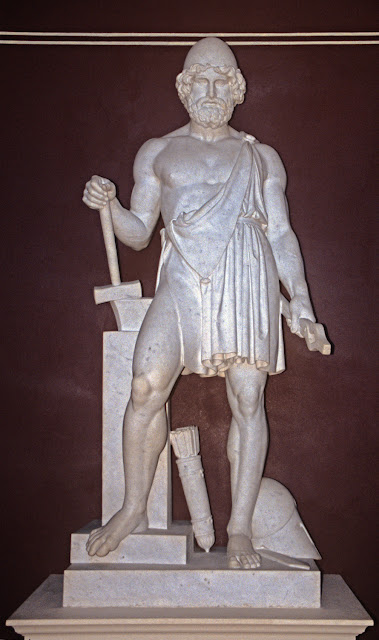
I was reading Classical Wisdom's newsletter in preparation for this weekend's virtual symposium and found their article "Hephaestus:The Humane God" particularly interesting. Although most of us think of Hephaestus as the divine metalworker that forged magical armor and weapons like the shield of Achilles, Sean Kelly pointed out that he was also the only god in the Greek pantheon (and Roman under the name Vulcan) who suffered from a physical impairment.  Hephaestus attempted to intervene in a quarrel between  Zeus and Hera, and an enraged Zeus  cast him from Mount Olympus, injuring his legs.  Thereafter he was the subject of derision because of his lameness although he was respected for his smithing skills. He forged Hermes' winged helmet and sandals, the Aegis breastplate, Aphrodite's famed girdle, Agamemnon's staff of office, Achilles' armour, Diomedes' cuirass, Heracles' bronze clappers, Helios' chariot, the shoulder of Pelops, and even Eros's bow and arrows. This did not prevent him from being referred to as "the lame one" or "the halting" though. However, an inscription found in Knossos, Crete indicates he was still worshipped.

So was this contradiction extended to those who suffered physical impairments in the human realm of the Greco-Roman world?

Classicist Martha L. Rose argues that modern models of "pity, charity, and categorization" were not imposed onto ancient persons with disabilities. Other scholars further observe that although modern categories of disability were not employed by ancient Greeks and Romans, there was the social stigma that individuals who were "unable" to perform some activities fell short of bodily or aesthetic ideals.  Garland adds that these individuals were also, at least to some extent, excluded from the religious life of the community, especially from service in priesthoods.

"In classical antiquity as in later times the social response to the handicapped was in part determined by religion, since beauty and wholeness were regarded as a mark of divine favor, whereas ugliness and deformity were interpreted as signs of the opposite. It made a difference, too, whether a disability was congenital or acquired later through disease, accident, warfare, or debauchery". - Robert Garland, The Eye of the Beholder: Deformity and Disability in the Graeco-Roman World.

References to "debilitas" in Rome encompassed both physical and other types of impairment, such as language difficulties, as evidenced in the writings of Cicero and Livy.  Aristotle even referred to baldness as a defect which may account for Gaius Julius Caesar's obsessive efforts to disguise his baldness as it could be perceived as him being among those with divine disfavor even though he claimed to be descended from Venus.

Blindness or partial blindness was highly regarded in the Roman psyche. Many individuals became famous after losing an eye. Notably, slaves would sometimes enter gladiatorial matches with a patch over a functioning eye, though historians disagree on whether this was in reference to the mythical cyclops or to make the gladiator appear more experienced. It is also known that many mythological figures, as well as known historical individuals, were thought by the Romans to have been blinded in return for favors from their gods. Such gifts varied from foresight to talent in singing.

Although Roman leaders typically had themselves depicted as physically perfect in statues and coinage, disabilities from injuries received while in the military were seen as marks of honor as opposed to simple disfigurements, with injuries to the eyes appearing most frequently in both common soldiers and famous personalities such as Hannibal.  In Commentarii de Bello Gallico, Julius Caesar mentions that the Gauls commonly maimed his centurions, usually by blinding them, mentioning that four centurions out of a cohort were blinded. Soldiers disabled in such circumstances were given a stipend by the state once they retired.

Walter D. Penrose Jr. points out that the ancient Athenians also provided maintenance payments to the "adynatoi" and exempted them from military service.  War orphans, disadvantaged by the lack of a father, also eventually received a mandated allowance.

"Diogenes Laertius writes that Solon reduced the allowances paid to victors in Panhellenic games on the grounds that it would be tasteless to increase the honors for these, while ignoring those who had died in battle, whose sons should be supported and educated at state expense," reports Dillon in his paper, "Payments to the Disabled at Athens: Social Justice or Fear of Aristocratic Patronage?"  

But, Dillon thinks the actual subsidy was probably introduced as a reform of Periklean democracy rather than any legislation of Solon or Peisistratus.  He also doubts the charitable nature of such payments.

"It could  perhaps be suggested that Athens was a 'welfare state' that made financial provision for those who could not support themselves, with the Athenians being motivated by considerations of 'social justice' to make provision for those less fortunate than the typical able-bodied citizen. But this does not seem to be the character of Athenian society, even in the age of democracy. Rather, it seems that the Athenians were motivated less by altruistic considerations than by a concern for the democracy itself," Dillon states.

"In providing the adynatoi with a means of subsistence, it avoided forcing citizens who could not support themselves to rely upon wealthy citizens for financial assistance, Dillon says, "Such assistance could have led to the establishment of patron-client links detrimental to the interests of the democracy."

He also notes that the tradition of Peisistratus providing financial assistance to farmers so they could make a decent living was also probably the result of a desire to keep them on the farms and away from the city where they might engage in political agitation.

Of course the Romans of the Republican Period embraced the patron-client relationship as a social model, despite reservations of Romulus as reported by the Greek historians Dionysius and Plutarch, because it was deemed "perculiarly congenial" to Roman politics and lent a sense of familia between citizens. However, as powerful generals began to extend their patronage over entire communities of the conquered or defended, the Republican form of government was doomed.  

Both Caesar and Augustus, established client-patron relationships in conquered regions. This can be seen in Caesar’s relations with the Aedui of Gaul wherein he was able to restore their influence over the other Gallic tribes whom where once their clients. Thereafter he was asked on several occasions to serve the duties of a patron by the Aedui and was thus regarded by many in Rome as the patron of the Aedui.  Augustus established colonies in all parts of the empire during his conquests which extended his influence to its very furthest reaches. He also made many acts of largess to the whole population of Rome, including food and monetary handouts, as well as settling soldiers in new colonies that he sponsored which indebted a great many people to him, serving his ambitions for power.

You can read more about The Discourse of Disability in Ancient Greece here:

https://www.academia.edu/27820223/The_Discourse_of_Disability_in_Ancient_Greece
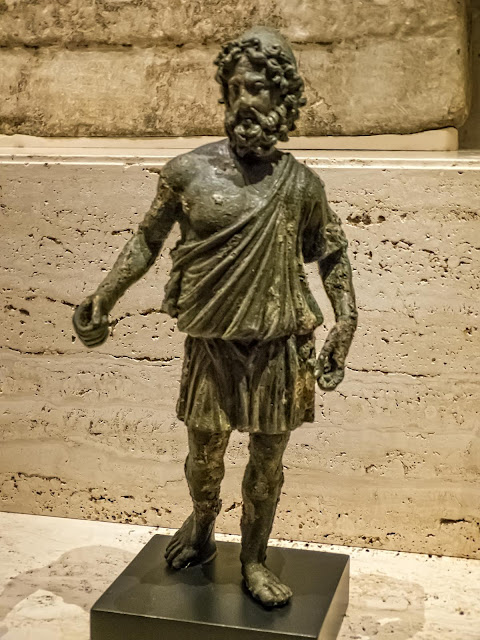
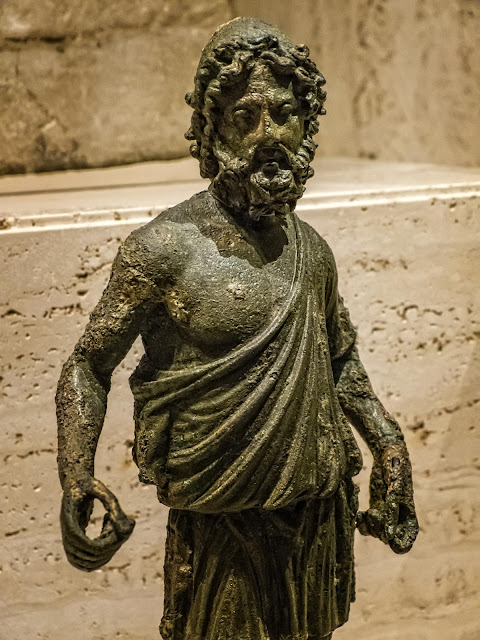
Statuette of Hephaestus the god of fire and patron of jewelers, armorers and blacksmiths Roman copy of a Greek original 1st - 2nd century CE Bronze that I photographed at the Nelson-Atkins Museum of Art in Kansas City, Missouri.

Statuette of Hephaestus the god of fire and patron of jewelers, armorers and blacksmiths Roman copy of a Greek original 1st - 2nd century CE Bronze that I photographed at the Nelson-Atkins Museum of Art in Kansas City, Missouri.

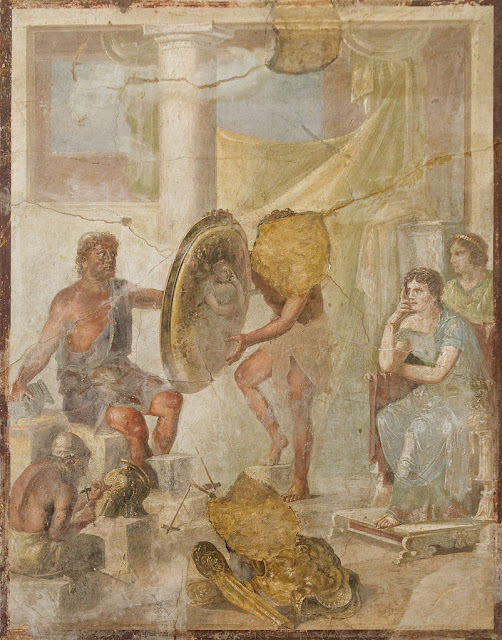
Roman fresco depicting Thetis at Hephaestos' forge waiting to receive Achilles' new weapons from Pompeii (IX I, 7, triclinium e), now in the collections of the National Archaeological Museum in Naples, courtesy of Wikimedia Commons contributor Marie-Lan Nguyen.

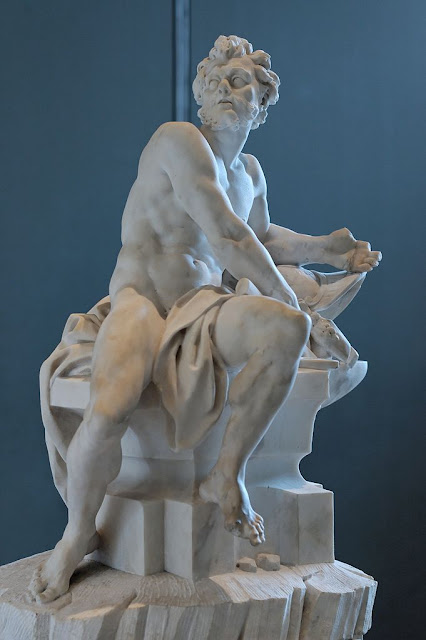
Vulcan by Guillaume Coustou the Younger, 1814, now in the Louvre Museum in Paris, courtesy of Wikimedia Commons contributor Marie-Lan Nguyen.

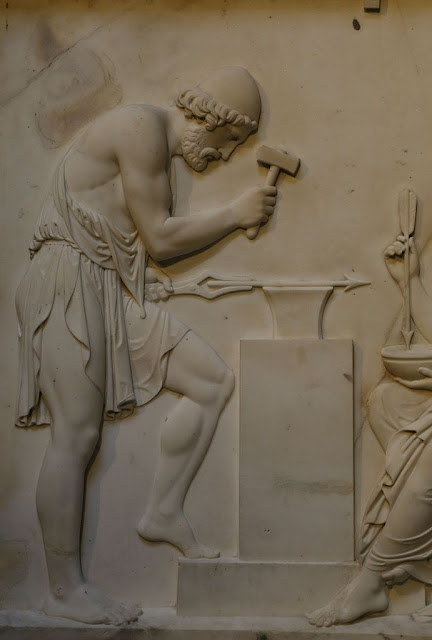
Closeup of Vulcan from a relief depicting Venus, Mars and Vulcan, about 1810, by Bertel Thorvaldsen courtesy of Wikimedia Commons contributor Rufus46.

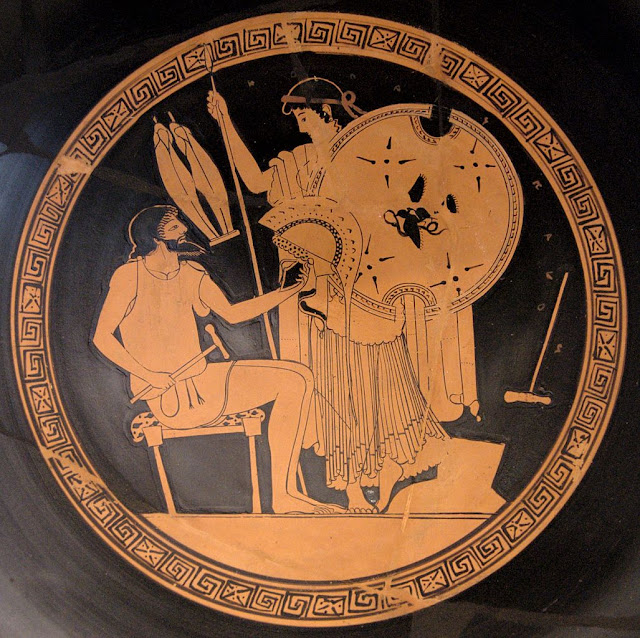
Hephaestus hands in the new Achilles' armor to Thetis (Iliad, XVIII, 617). Attic red-figure Kylix, 490–480 BCE, now in the collections of the Altes Museum in Berlin, courtesy of Wikimedia Commons contributor Bibi Saint-Pol.

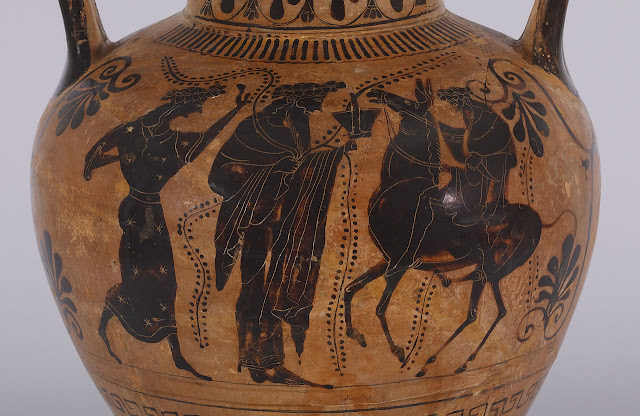
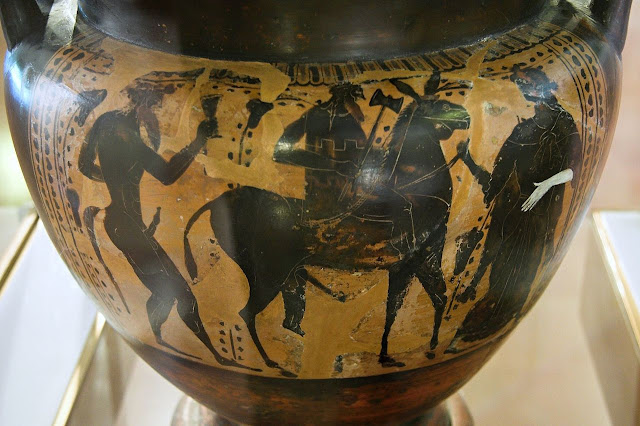
Black-figure Amphora depicting Dionysus who encounters the lame Hephaestus, god of fire and metalworking, riding on a donkey as a maenad looks on, 520 BCE, from Attica, now in the collections of the Walters Art Museum. Image courtesy of the museum.

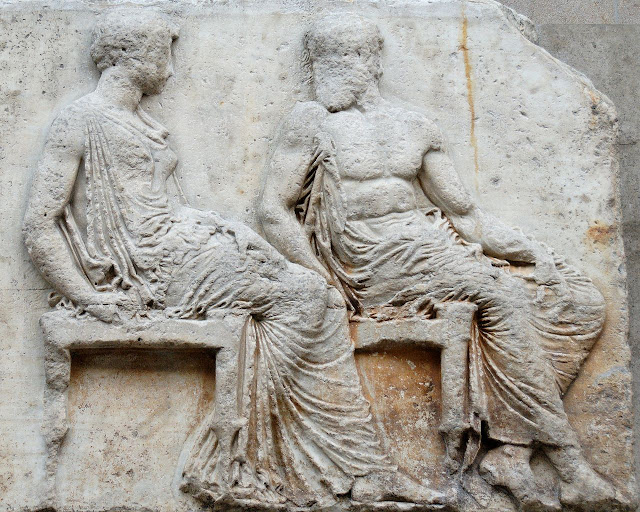
Athena holding a spear (now missing) watches the procession of the Great Panathenaia. Next to here, the lame god Hephaistos leans on a crutch. Block V (fig. 36-37) from the East frieze of the Parthenon, ca. 447–433 BCE, courtesy of Wikimedia Commons contributor Marie-Lan Nguyen.

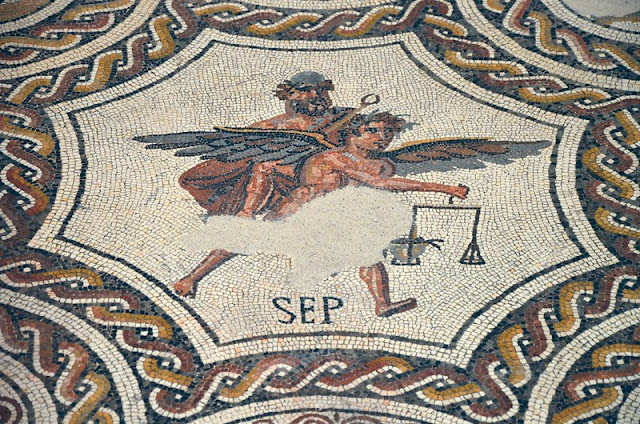
Detail of the mosaic of the seasons and the months, 3rd century AD, found in Hellin (Albacete), National Archaeological Museum of Spain, Madrid. September - Vulcan on winged genius carrying scales, Libra, courtesy of Carole Raddato (CC BY-SA 2.0)

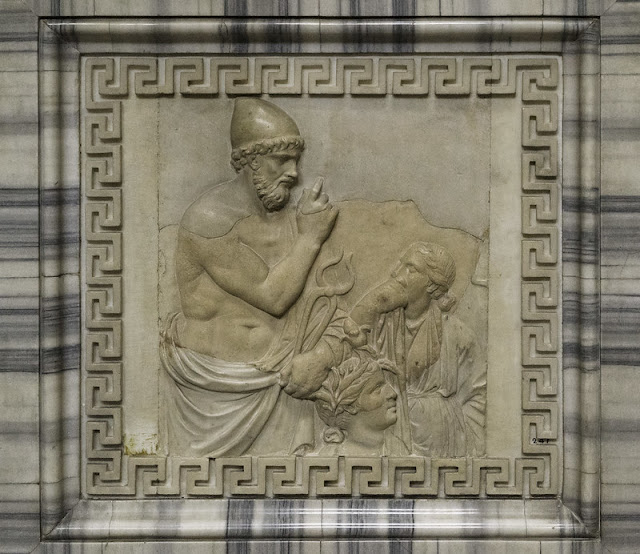
Fragment of a neo-Attic relief representing the birth of Erichthonios. The scene shows Hephaestus with “pileus” and holding tongs in his hands, Gaia, the earth goddess, wearing a crown of olive leaves and ears, and one of the daughters of Cecrops, standing with a hand to her mouth. Gaia is portrayed in the act of offering to Athena her newborn son Erichthonius. Both characters are now missing. This fragment, today inserted in the base of Galba’s statue, was found near Ostia where a famous Hephaisteion is documented. It dates from 50 BCE to the 50 CE. courtesy of Egisto Sani (CC BY-NC-SA 2.0)

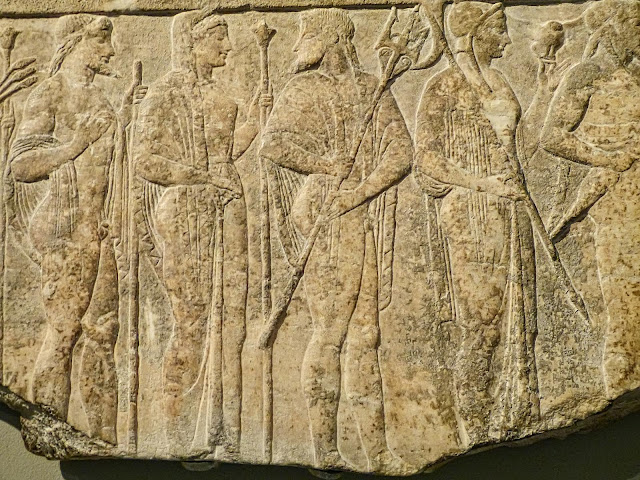
Closeup of Relief depicting twelve deities including Hephaestus (far left) Late Hellenistic or Roman possibly from Tarentum, Italy 1st century BCE that I photographed at the Walters Art Museum in Baltimore, Maryland

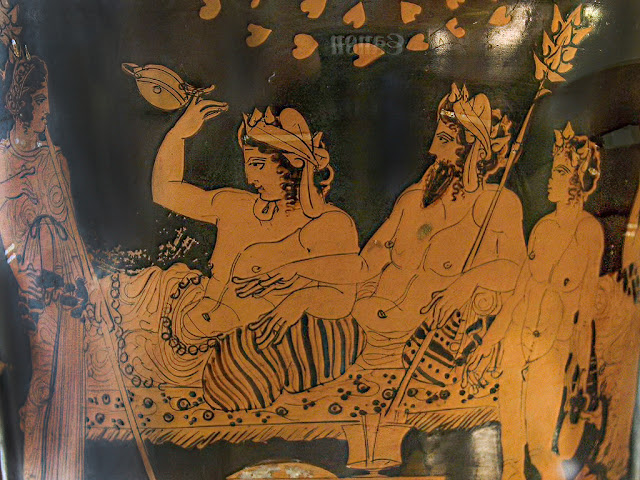
Calyx crater in red figure, 420-400 BCE, Lugano Painter. Side Aː Symposium scene. Bearded Dionysos and Hephaistos, a maenad and satyr. Archaeological Museum of Agrigento courtesy of Wikimedia Commons contributor Zde.

Attic colum crater, Leagros group, 550-500 BCE. Side A: The return of Hephaesos (Hefaistos) to Olympos. Archaeological Museum of Agrigento, courtesy of Wikimedia Commons contributor Zde.)

Vulcan (1838) by Herman Wilhelm Bissen (1798-1868). Sculpture in the Thorvaldsens Museum, Copenhagen, courtesy of Wikimedia Commons contributor James Steakley.


If you enjoyed this post, never miss out on future posts by following me by email!


Wednesday, July 21, 2021

Deciphering Iconography of a late Classical Period Etruscan sarcophagus

The sarcophagus of Etruscan priest Laris Partunus found in the Tarquinian necropolis was produced in the late Classical Period.  This exquisite sarcophagus crafted of Parian marble is painted with scenes of the Amazonomachy.  The Greeks are shown in hoplite armor while the Amazons are wearing chitons. Surprisingly, the Amazons are depicted winning most of the paired battles instead of an equal number of victories as depicted on the Amazon sarcophagus also from Tarquinia.

The Partunus sarcophagus also depicts blue-skinned demons, but unlike the fearsome blue demons seen in the Tomb of the Blue Demons, also in Tarquinia, these figures appear to be gently guiding an aristocratic lady to her family like Greek psychopomps,  creatures, spirits, angels, or deities in many religions whose responsibility is to escort newly deceased souls from Earth to the afterlife. 

The painting on the long side of the sarcophagus depicts the execution of Trojan prisoners. They too are accompanied by winged blue-skinned demons who symbolize their impending deaths and journey to the underworld.  Such inclusion of mythical beings may have also served a heraldic or apotropaic function.

"This scene has inappropriately been seen as influenced by the sacrifice of Roman captives by the Tarquinians in 358 BCE (Livy 7.15.10-11), and the subsequent slaughter of Tarquinian prisoners by the Romans in 353 BCE (Livy 7.19.2-3), points out Allison Weir in her PhD thesis "Footsteps of the Dead: Iconography of Beliefs about the Afterlife and Evidence for Funerary Practices in Etruscan Tarquinia", "There are, though, many significant problems with the attempt to connect a mythological scene in a tomb with an alleged historical event. It goes without saying that the historical accuracy of Livy’s account cannot be taken for granted, especially for an episode alleged to have occurred in the 4th century. The uncertain dating of the sarcophagus aside, there is nothing in the scene to suggest a human sacrifice, rather, the scene depicts the execution of prisoners of war. Therefore, the decoration on the sarcophagus should be seen for what it is: a mythological scene fused with local Etruscan chthonic demons. "

Weir also discounts the implausible suggestion that the presence of victorious female fighters on the sarcophagus indicate the women of Tarquinia in the 4th century were emancipated.

The image of Laris Partunus lying fully flat on the lid of the sarcophagus reflects the style of the  mid 4th century BCE where sarcophagi had either a fully reclined image or no image of the dead at all. It reminded me of tomb effigies I have photographed from the medieval period - no dogs or lions at their feet, though!

"As the Hellenistic period progressed, the pose of the figure on the lids of sarcophagi and cinerary urns became progressively more upright," Weir observes.

This is illustrated by the sarcophagus of Laris' son, Velthur Partunus, also found in the same family tomb. He is depicted in a position halfway between that of his father and the upright pose of sculptures on later sarcophagi.

To read more about Funerary Practices in Etruscan Tarquinia, check out Allison Weir's full thesis at:

  https://dt01-s1.123dok.com/pdf/123dok_us/pdf/2020/01_22/xz7brd1579688774.pdf?X-Amz-Content-Sha256=UNSIGNED-PAYLOAD&X-Amz-Algorithm=AWS4-HMAC-SHA256&X-Amz-Credential=94NFDWF3B17T3R35S85K%2F20210721%2F%2Fs3%2Faws4_request&X-Amz-Date=20210721T142719Z&X-Amz-SignedHeaders=host&X-Amz-Expires=600&X-Amz-Signature=f74d1bc7e60980fd614ff8d6657d6575700ba08a66b213b762843827335c0d8d

Images: Sarcophagus of Laris Portunus, priest, depicting scenes from the Amazonomachy and the Trojan War, Parian Marble, 350 BCE, now in the collections of the National Archaeological Museum at Tarquinia, Italy, courtesy of Wikimedia Commons contributor Sailko

Sarcophagus of Laris Portunus, priest, depicting scenes from the Amazonomachy and the Trojan War, Parian Marble, 350 BCE, now in the collections of the National Archaeological Museum at Tarquinia, Italy, courtesy of Wikimedia Commons contributor Sailko

Fully recumbent effigy of Etruscan pries Laris Portunus on the lid of his sarcophagus found in the necropolis at Tarquinia, Italy, 350 BCE, now in the collections of the National Archaeological Museum at Tarquinia, Italy, courtesy of Wikimedia Commons contributor Sailko

Scenes of the Amazonomachy including prisoners and blue demon-like beings acting as guides to the underworld on the Sarcophagus of Laris Portunus, priest, Parian Marble, 350 BCE, now in the collections of the National Archaeological Museum at Tarquinia, Italy, courtesy of Wikimedia Commons contributor Sailko

Sarcophagus of Laris Portunus, priest, depicting scenes from the Amazonomachy and the Trojan War, Parian Marble, 350 BCE, now in the collections of the National Archaeological Museum at Tarquinia, Italy, courtesy of Wikimedia Commons contributor Sailko

Sarcophagus of Laris Portunus, priest, depicting scenes from the Amazonomachy and the Trojan War, Parian Marble, 350 BCE, now in the collections of the National Archaeological Museum at Tarquinia, Italy, courtesy of Wikimedia Commons contributor Sailko

A bound prisoner on the Sarcophagus of Laris Portunus, priest, depicting scenes from the Amazonomachy and the Trojan War, Parian Marble, 350 BCE, now in the collections of the National Archaeological Museum at Tarquinia, Italy, courtesy of Wikimedia Commons contributor Sailko

Sarcophagus of Laris Portunus, priest, depicting scenes from the Amazonomachy and the Trojan War, Parian Marble, 350 BCE, now in the collections of the National Archaeological Museum at Tarquinia, Italy, courtesy of Wikimedia Commons contributor Sailko

Sarcophagus of Laris Portunus, priest, depicting scenes from the Amazonomachy and the Trojan War, Parian Marble, 350 BCE, now in the collections of the National Archaeological Museum at Tarquinia, Italy, courtesy of Wikimedia Commons contributor Sailko

Closeup of one of the blue-skinned demons acting as a psychopomp on the Sarcophagus of Laris Portunus, priest, depicting scenes from the Amazonomachy and the Trojan War, Parian Marble, 350 BCE, now in the collections of the National Archaeological Museum at Tarquinia, Italy, courtesy of Wikimedia Commons contributor Sailko

A winged blue-skinned demon preparing to take a dying warrior to the underworld on the Sarcophagus of Laris Portunus, priest, depicting scenes from the Amazonomachy and the Trojan War, Parian Marble, 350 BCE, now in the collections of the National Archaeological Museum at Tarquinia, Italy, courtesy of Wikimedia Commons contributor Sailko

Sarcophagus of Laris Portunus, priest, depicting scenes from the Amazonomachy and the Trojan War, Parian Marble, 350 BCE, now in the collections of the National Archaeological Museum at Tarquinia, Italy, courtesy of Wikimedia Commons contributor Sailko


A blue-skinned demon preparing to guide a soldier to the underworld on the Sarcophagus of Laris Portunus, priest, depicting scenes from the Amazonomachy and the Trojan War, Parian Marble, 350 BCE, now in the collections of the National Archaeological Museum at Tarquinia, Italy, courtesy of Wikimedia Commons contributor Sailko
If you enjoyed this post, never miss out on future posts by following me by email!


Monday, June 14, 2021

Spurned Women: The violent death of Orpheus

Orpheus is best known as a musician that could play so beautifully he charmed even the most violent animals.  As such he is portrayed in numerous mosaics, paintings, and on ceramics.  So I was surprised to see a red-figure calyx krater attributed to the Villa Giulia Painter and dated to 460-450 BCE depicting Orpheus being violently attacked by Thracian women, one with a spear and one with an axe. I realize taste in music is quite personal but this extreme response is so antithetical to all of those peaceful images I have seen of Orpheus surrounded by mesmerized animals that I had to research this event further.

According to a Late Antique summary of Aeschylus' lost play Bassarids, Orpheus, towards the end of his life, disdained the worship of all gods except the sun, whom he called Apollo. One early morning he went to the oracle of Dionysus at Mount Pangaion to salute his god at dawn, but, like Pentheus, was ripped to shreds by Thracian maenads for not honoring his previous patron (Dionysus). It has been speculated that the Orphic mystery cult regarded Orpheus as a parallel figure to or even an incarnation of Dionysus so his abandonment of Dionysus would have been viewed as the ultimate sacrilege. Pausanias writes that the river Helicon sank underground when the women that killed Orpheus tried to wash off their blood-stained hands in its waters. 

Other legends claim that Orpheus became a follower of Dionysus and spread his cult across the land and abstained from the love of women. In this version of the legend, it is said that Orpheus was torn to shreds by the women of Thrace for his inattention.

Ovid's account of the death of Orpheus in Metamorphoses Book X is quite similar:

"[Orpheus] had abstained from the love of women, either because things ended badly for him, or because he had sworn to do so. Yet, many felt a desire to be joined with the poet, and many grieved at rejection. Indeed, he was the first of the Thracian people to transfer his affection to young boys and enjoy their brief springtime, and early flowering this side of manhood."

Feeling spurned by Orpheus for taking only male lovers (eromenoi), the Ciconian women, followers of Dionysus, first threw sticks and stones at him as he played, but his music was so beautiful even the rocks and branches refused to hit him. Enraged, the women tore him to pieces during the frenzy of their Bacchic orgies.

His head and lyre, still singing mournful songs, floated down the River Hebrus into the sea, after which the winds and waves carried them to the island of Lesbos, at the city of Methymna. There, the inhabitants buried his head and a shrine was built in his honor near Antissa where his oracle prophesied, until it was silenced by Apollo. Orpheus' soul is said to have returned to the underworld, to the fields of the Blessed, where he was reunited at last with his beloved Eurydice.

As with many myths, scholars believe Orpheus may have actually existed. Only Aristotle, alone, thought he did not.  Most believed he lived several generations before Homer.  He is thought to have been a poet, augur, and astrologer who also earned a living as a musician and some say, a wizard.  Aristophanes, in his play "Frogs" refers to Orpheus as one of the oldest poets and characterizes him as a religious teacher.

When I read the part about Orpheus' eventual rejection of all gods except the sun which he called Apollo, I couldn't help but think about that old Star Trek episode "Bread and Circuses" where the Enterprise crew intercepts radio transmissions from a planet they are orbiting that refer to worship of the "sun".  As the episode progresses, the crew realizes some of the planet inhabitants are not worshipping the sun up in the sky but the Son. Perhaps this was the case with Orpheus - why else would he give the entity the name of an anthropomorphic deity? 

Attic Red-figure calyx krater attributed to the Villa Giulia Painter and dated to 460-450 BCE depicting Orpheus being violently attacked by Thracian women now in the collections of the Getty Villa, image courtesy of the museum.

Detail of Attic Red-figure calyx krater attributed to the Villa Giulia Painter and dated to 460-450 BCE depicting Orpheus being violently attacked by Thracian women now in the collections of the Getty Villa, image courtesy of Wikimedia Commons contributors Dave and Margie Hill/Kleerup.

Attic Red-figure calyx krater attributed to the Villa Giulia Painter and dated to 460-450 BCE depicting Orpheus being violently attacked by Thracian women now in the collections of the Getty Villa, image courtesy of Wikimedia Commons contributors Dave and Margie Hill/Kleerup.

The Death of Orpheus, detail from a silver kantharos, 420-410 BCE, part of the Vassil Bojkov collection, Sofia, Bulgaria, courtesy of Wikimedia Commons contributor Gorgonchica.

Attic red figure stamnos with lid depicting Thracian women killing Orpheus by the Dokimasia Painter, 480-470 BCE, at the Antikenmuseum Basel und Sammlung Ludwig in Basel, Switzerlandm courtesy of Wikimedia Commons contributor ArchaiOptix.

Hydria fragment with the death of Orpheus, c. 460 BCE at the Martin von Wagner Museum in Würzburg, Germany courtesy of Wikimedia Commons contributor Daderot.

Thracian Girl Carrying the Head of Orpheus on His Lyre (1865) by Gustave Moreau, now in the Musée d'Orsay, Paris, France, courtesy of Wikimedia Commons.

Nymphs Finding the Head of Orpheus (1900) by John William Waterhouse (PD), now in a private collection, courtesy of Wikimedia Commons.


If you enjoyed this post, never miss out on future posts by following me by email!


Friday, June 11, 2021

The Painters of Pompeii: Roman Frescoes from the National Archaeological Museum, Naples

The Painters of Pompeii: Roman Frescoes from the National Archaeological Museum, Naples will open June 26, 2021 at the Oklahoma City Museum of Art.  It will be on display until October 17, 2021. Tickets will be available on a timed entry basis with limited capacity to ensure adequate social distancing.  Although masks are encouraged, they are not required for fully vaccinated visitors.  Eighty artifacts and artworks from Pompeii and Herculaneum will be presented.

During the exhibition, the museum plans to host a series of lectures in the Noble Theater with several of the most renowned scholars in the field of Ancient Roman Art and History.  Topics include the rediscovery of Pompeii, Food & Wine in Pompeii, Roman Painting, and Powerful Elite Women in Imperial Rome.

The exhibit notice says its appearance at the Oklahoma City Museum of Art will be its only US presentation.


Image: Polyphemus hears of the arrival of Galatea (or Hercules and Omphale), ancient Roman fresco from a villa in Portici painted in the "Fourth Style" (45–79 CE) courtesy of the NAM Naples. 

If you enjoyed this post, never miss out on future posts by following me by email!


Tuesday, June 8, 2021

Triton and the fate of Misenus

This morning while browsing artifacts in the collections of the Getty Villa, I came across this exquisite gilded silver sculpture of a Triton forming the handle of an oinochoe.  As I described in a post a couple of years ago, the original sea god, Triton, was the son of Poseidon and Amphitrite according to Hesiod's Theogony. Triton is usually represented as a merman, with the upper body of a human and the tailed lower body of a fish. At some time during the Greek and Roman era, Tritons became a generic term for mermen in art and literature. A female version (tritoness) was eventually introduced as well.

Triton was said to dwell with his parents in  a golden palace claimed to be located at Aegae on the island of Euboea in a passage from book 5 of Homer's Iliad. It describes how  Poseidon "lashed his long-maned horses and drove to Aegae, where he had his famous palace" after having destroyed Odysseus' raft with a storm. Later in Book 13 of the Iliad, Poseidon "took three strides, and with the fourth he reached his goal—Aegae, where is his glittering golden palace, imperishable, in the depths of the sea."

Only in later times was Triton associated with possessing a conch shell, which he blew like a trumpet to calm or raise the waves. He was "trumpeter and bugler" to Oceanus and Poseidon. Its sound was so cacophonous that when loudly blown, it was said to put the giants to flight, who imagined it to be the roar of a dark wild beast.

in Virgil's epic poem the Aeneid, Misenus, a brother-in-arms of Hector and, after Hector's death, Aeneas' trumpeter, challenged the gods to a musical contest on a conch shell. He, like Marsyas, was punished for his hubris when he was drowned by Triton.  Aeneas was told by the Cumaean Sibyl at that time that Misenus's body had to be buried before he could enter the Underworld and detailed the necessary funeral rites required that were later adopted by the Romans. Cape Misenum, the headland that marks the northwestern limit of the Gulf of Naples as well as the Bay of Pozzuoli in southern Italy and supposedly named for Misenus,  was important to the Romans since it was a natural shelter for passage into the inner harbor of Portus Julius, the home port for the Roman western imperial fleet.


Image: Gilded silver oinochoe handle depicting Triton from Macedonia or Illyria, 100-1 BCE, at the Getty Villa in Gallery 111, Pacific Palisades, California. Now detached from the vessel of which it was once part, Triton’s scaly lower body serves as the functional part of the handle, and the acanthus leaves from which the torso rises would have hidden the join at the rim. Triton's torso would have projected as a decorative element above the mouth, and gilding elaborates much of its surface. The figure probably held a trident in its left hand, a frequent attribute of sea beings. Such an elaborate pouring vessel would have been part of an ornate set of serving and drinking vessels used at banquets or symposia.

If you enjoyed this post, never miss out on future posts by following me by email!


Wednesday, June 2, 2021

Heracles (Hercules) and the Lernaean Hydra

The Lernaean Hydra or Hydra of Lerna more often known simply as the Hydra, is a serpentine water monster in Greek and Roman mythology. Its lair was the lake of Lerna in the Argolid. Lerna was reputed to be an entrance to the Underworld, and archaeology has established it as a sacred site older than Mycenaean Argos. In the canonical Hydra myth, the monster is killed by Heracles (Hercules) as the second of his Twelve Labors.

The oldest extant Hydra narrative appears in Hesiod's Theogony, while the oldest images of the monster are found on a pair of bronze fibulae dating to c. 700 BCE. In both these sources, the main motifs of the Hydra myth are already present: a multi-headed serpent that is slain by Heracles and Iolaus. While these fibulae portray a six-headed Hydra, its number of heads was first fixed in writing by Alcaeus (c. 600 BCE), who gave it nine heads. Simonides, writing a century later, increased the number to fifty, while Euripides, Virgil, and others did not give an exact figure.

Like the initial number of heads, the monster's capacity to regenerate lost heads varies with time and author. The first mention of this ability of the Hydra occurs with Euripides, where the monster grew back a pair of heads for each one severed by Heracles. In the Euthydemus of Plato, Socrates likens Euthydemus and his brother Dionysidorus to a Hydra of a sophistical nature who grows two arguments for every one refuted. Palaephatus, Ovid, and Diodorus Siculus concur with Euripides, while Servius has the Hydra grow back three heads each time. Depictions of the monster dating to c. 500 BCE show it with a double tail as well as multiple heads, suggesting the same regenerative ability at work, but no literary accounts include this feature.  The Hydra had many parallels in ancient Near Eastern religions. In particular, Sumerian, Babylonian, and Assyrian mythology celebrated the deeds of the war and hunting god Ninurta that included slaying a a seven-headed serpent.

Several versions of Heracles struggle with the hydra existed.  In one, Heracles, seeing the creature merely grew more heads when he decapitated it, asked his nephew Iolaus for help. His nephew then came upon the idea (possibly inspired by Athena) of using a firebrand to scorch the neck stumps after each decapitation.  In an alternate version, Heracles dipped his sword in the Hydra's blood and used its own venom to burn subsequent stumps and prevent their regrowth.

The victorious Heracles then dipped his arrows in the Hydra's poisonous blood and used them to kill the Stymphalian Birds, the giant Geryon, and, unfortunately, the centaur Nessus. Nessus' tainted blood was applied to the Tunic of Nessus, by which the centaur had his posthumous revenge against Heracles. Both Strabo and Pausanias report that the stench of the river Anigrus in Elis, making all the fish of the river inedible, was reputed to be due to the Hydra's poison, washed from the arrows Heracles used on the centaur.

Hercules slaying the Hydra, Roman copy of 4th century BCE original by Lysippos, restored by Algardi, that I photographed at the Capitoline Museum in Rome.

Relief of Hercules slaying the Hydra, end of 3rd century CE, from the Roman Villa of Chiragan, Musée des Antiques de Toulouse, courtesy of Carole Raddato. (CC BY)

Detail of Relief of Hercules slaying the Hydra, end of 3rd century CE, from the Roman Villa of Chiragan, Musée des Antiques de Toulouse, courtesy of Wikimedia Commons contributor Caroline Léna Becker.

Relief depicting Heracles battling the Hydra at the base of the facade of Colleoni Chapel, by Giovanni Antonio Amadeo courtesy of Wikimedia Commons contributor Sailko.

Sarcophagus Relief Depicting Labors of Hercules (Heracles), 3rd-4th century C.E., marble, Roman, Honolulu Academy of Arts, courtesy of Wikimedia Commons contributor Haa900.

Etruscan black-figure hydria depicting Herakles and Iolaos fighting the Lernean Hydra (c. 346 BCE) from Caere now on display at the Getty Villa courtesy of Wikimedia Commons contributor Wolfgang Sauber

Fragment of a red-figure vase depicting Heracles battling the Hydra with Athena offering support, 375-340 BCE, on exhibit at the Fitchburg Art Museum, Fitchburg, Massachusetts, courtesy of Wikimedia Commons contributor Daderot.

Archaic-styled Heracles, Iolaus and the Lernaean Hydra. Side A of an Attic black-figured amphora, 560–555 BCE, now in the collections of The Louvre, Paris, courtesy of Wikimedia Commons contributor Bibi Saint-Pol.

Corinthian Aryballos, Greek, 6th century BCE, from Corinth, Terracotta, now on view at the Getty Villa, Gallery 104, courtesy of the museum. On this intricately detailed Corinthian black-figure aryballos (oil-flask), Herakles battles the Lernean Hydra, a many-headed, serpent-like monster. Required to destroy the fierce creature as the second of the Twelve Labors assigned to him by King Eurystheus, the hero grasps one of the snaky heads while stabbing the monster with his sword. One of the Hydra’s heads is about to bite Herakles’ shoulder, and a crab, sent to help the Hydra, approaches the hero’s ankle from behind. The goddess Athena stands behind him, offering her support. Both Herakles and Athena are identified by inscriptions written in retrograde, or right to left, in the distinctive Doric alphabet of Corinth. Likewise, inscriptions on the other side of the vase identify Iolaos, Herakles’ nephew and faithful companion, and Iphikles (written as Wiphikledas), Herakles’ twin brother. One figure holds the Hydra, while the other (under the handle of the vase) is shown as a charioteer, head turned back to face the action while keeping the four-horse chariot ready to carry off the victorious hero. An unidentified female head facing left decorates the handle itself

1843 reproduction of Heracles and Iolaus battling the Hydra from a red-figure vase by Eduard Gerhard courtesy of Wikimedia Commons contributor Angyalfia.

Renaissance-era plaque depicting Heracles battling the Hydra, 16th century CE, courtesy of Wikimedia Commons contributor Sailko

Athena supports Heracles who is attacked by the crab and the Lenaean Hydra. White-ground Attic lekythos, ca. 500–475 BCE now in the collections of The Louvre, Paris courtesy of Wikimedia Commons contributor Bibi Saint-Pol.

Mosaic from Roman Spain, 26 CE, depicting Heracles battling the Hydra courtesy of Wikimedia Commons contributor Luis Garcia.

Hercules and the Hydra, 1785 etching by Raphael West, in the collection of the Royal Academy of Arts, London, courtesy of the museum.

Fragmented vase with applique depicting Hercules battling the Hydra, discovered at Saint-Colombe, 2nd - 3rd century CE, now in the collections of the Gallo-Roman Museum of Fourvière in Lyon, France courtesy of Wikimedia Commons contributor Eunostos


If you enjoyed this post, never miss out on future posts by following me by email!