Showing posts with label Greek. Show all posts

Friday, August 20, 2021

Disability and the politics of "Divine Disfavor" in the Greco-Roman world

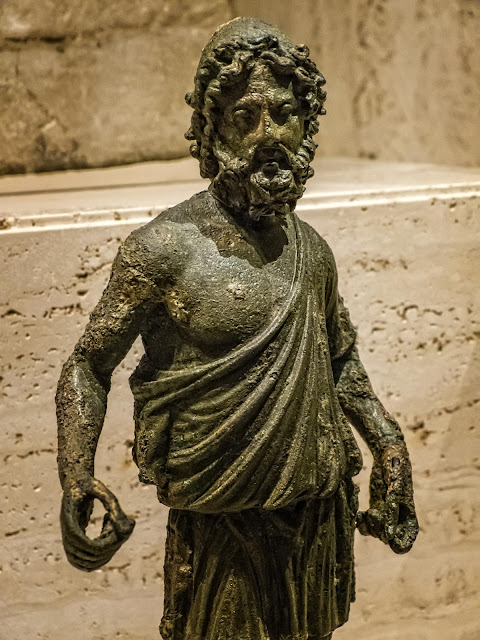
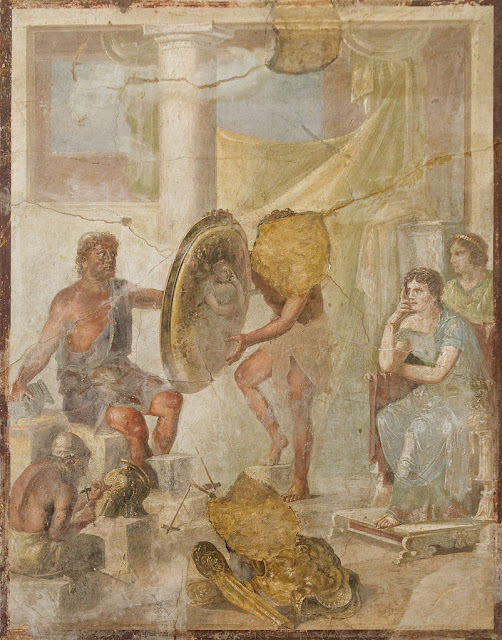
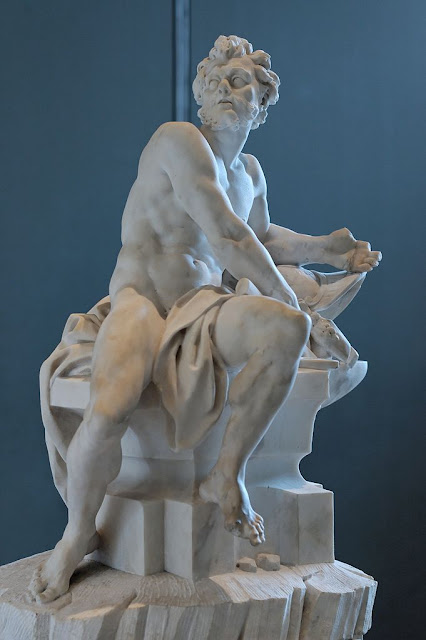
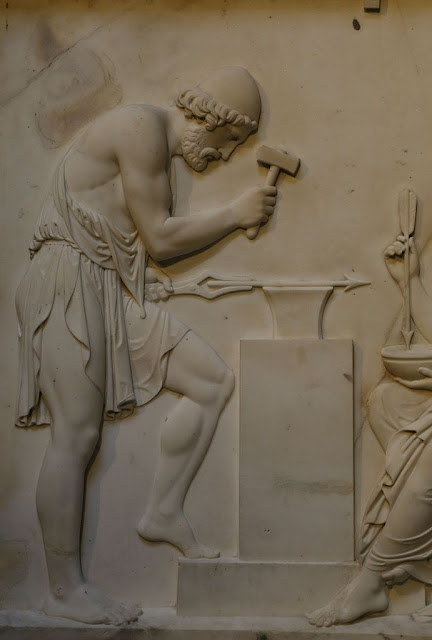
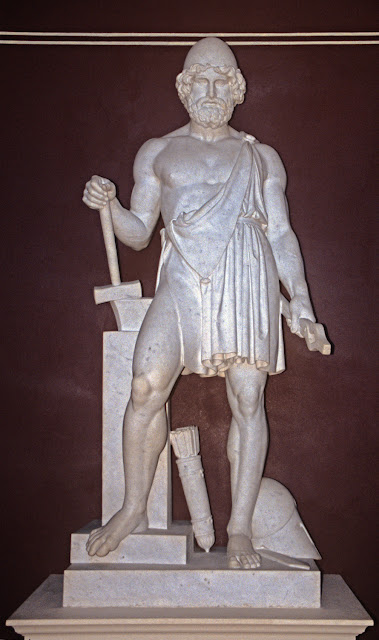
I was reading Classical Wisdom's newsletter in preparation for this weekend's virtual symposium and found their article "Hephaestus:The Humane God" particularly interesting. Although most of us think of Hephaestus as the divine metalworker that forged magical armor and weapons like the shield of Achilles, Sean Kelly pointed out that he was also the only god in the Greek pantheon (and Roman under the name Vulcan) who suffered from a physical impairment.  Hephaestus attempted to intervene in a quarrel between  Zeus and Hera, and an enraged Zeus  cast him from Mount Olympus, injuring his legs.  Thereafter he was the subject of derision because of his lameness although he was respected for his smithing skills. He forged Hermes' winged helmet and sandals, the Aegis breastplate, Aphrodite's famed girdle, Agamemnon's staff of office, Achilles' armour, Diomedes' cuirass, Heracles' bronze clappers, Helios' chariot, the shoulder of Pelops, and even Eros's bow and arrows. This did not prevent him from being referred to as "the lame one" or "the halting" though. However, an inscription found in Knossos, Crete indicates he was still worshipped.

So was this contradiction extended to those who suffered physical impairments in the human realm of the Greco-Roman world?

Classicist Martha L. Rose argues that modern models of "pity, charity, and categorization" were not imposed onto ancient persons with disabilities. Other scholars further observe that although modern categories of disability were not employed by ancient Greeks and Romans, there was the social stigma that individuals who were "unable" to perform some activities fell short of bodily or aesthetic ideals.  Garland adds that these individuals were also, at least to some extent, excluded from the religious life of the community, especially from service in priesthoods.

"In classical antiquity as in later times the social response to the handicapped was in part determined by religion, since beauty and wholeness were regarded as a mark of divine favor, whereas ugliness and deformity were interpreted as signs of the opposite. It made a difference, too, whether a disability was congenital or acquired later through disease, accident, warfare, or debauchery". - Robert Garland, The Eye of the Beholder: Deformity and Disability in the Graeco-Roman World.

References to "debilitas" in Rome encompassed both physical and other types of impairment, such as language difficulties, as evidenced in the writings of Cicero and Livy.  Aristotle even referred to baldness as a defect which may account for Gaius Julius Caesar's obsessive efforts to disguise his baldness as it could be perceived as him being among those with divine disfavor even though he claimed to be descended from Venus.

Blindness or partial blindness was highly regarded in the Roman psyche. Many individuals became famous after losing an eye. Notably, slaves would sometimes enter gladiatorial matches with a patch over a functioning eye, though historians disagree on whether this was in reference to the mythical cyclops or to make the gladiator appear more experienced. It is also known that many mythological figures, as well as known historical individuals, were thought by the Romans to have been blinded in return for favors from their gods. Such gifts varied from foresight to talent in singing.

Although Roman leaders typically had themselves depicted as physically perfect in statues and coinage, disabilities from injuries received while in the military were seen as marks of honor as opposed to simple disfigurements, with injuries to the eyes appearing most frequently in both common soldiers and famous personalities such as Hannibal.  In Commentarii de Bello Gallico, Julius Caesar mentions that the Gauls commonly maimed his centurions, usually by blinding them, mentioning that four centurions out of a cohort were blinded. Soldiers disabled in such circumstances were given a stipend by the state once they retired.

Walter D. Penrose Jr. points out that the ancient Athenians also provided maintenance payments to the "adynatoi" and exempted them from military service.  War orphans, disadvantaged by the lack of a father, also eventually received a mandated allowance.

"Diogenes Laertius writes that Solon reduced the allowances paid to victors in Panhellenic games on the grounds that it would be tasteless to increase the honors for these, while ignoring those who had died in battle, whose sons should be supported and educated at state expense," reports Dillon in his paper, "Payments to the Disabled at Athens: Social Justice or Fear of Aristocratic Patronage?"  

But, Dillon thinks the actual subsidy was probably introduced as a reform of Periklean democracy rather than any legislation of Solon or Peisistratus.  He also doubts the charitable nature of such payments.

"It could  perhaps be suggested that Athens was a 'welfare state' that made financial provision for those who could not support themselves, with the Athenians being motivated by considerations of 'social justice' to make provision for those less fortunate than the typical able-bodied citizen. But this does not seem to be the character of Athenian society, even in the age of democracy. Rather, it seems that the Athenians were motivated less by altruistic considerations than by a concern for the democracy itself," Dillon states.

"In providing the adynatoi with a means of subsistence, it avoided forcing citizens who could not support themselves to rely upon wealthy citizens for financial assistance, Dillon says, "Such assistance could have led to the establishment of patron-client links detrimental to the interests of the democracy."

He also notes that the tradition of Peisistratus providing financial assistance to farmers so they could make a decent living was also probably the result of a desire to keep them on the farms and away from the city where they might engage in political agitation.

Of course the Romans of the Republican Period embraced the patron-client relationship as a social model, despite reservations of Romulus as reported by the Greek historians Dionysius and Plutarch, because it was deemed "perculiarly congenial" to Roman politics and lent a sense of familia between citizens. However, as powerful generals began to extend their patronage over entire communities of the conquered or defended, the Republican form of government was doomed.  

Both Caesar and Augustus, established client-patron relationships in conquered regions. This can be seen in Caesar’s relations with the Aedui of Gaul wherein he was able to restore their influence over the other Gallic tribes whom where once their clients. Thereafter he was asked on several occasions to serve the duties of a patron by the Aedui and was thus regarded by many in Rome as the patron of the Aedui.  Augustus established colonies in all parts of the empire during his conquests which extended his influence to its very furthest reaches. He also made many acts of largess to the whole population of Rome, including food and monetary handouts, as well as settling soldiers in new colonies that he sponsored which indebted a great many people to him, serving his ambitions for power.

You can read more about The Discourse of Disability in Ancient Greece here:

https://www.academia.edu/27820223/The_Discourse_of_Disability_in_Ancient_Greece
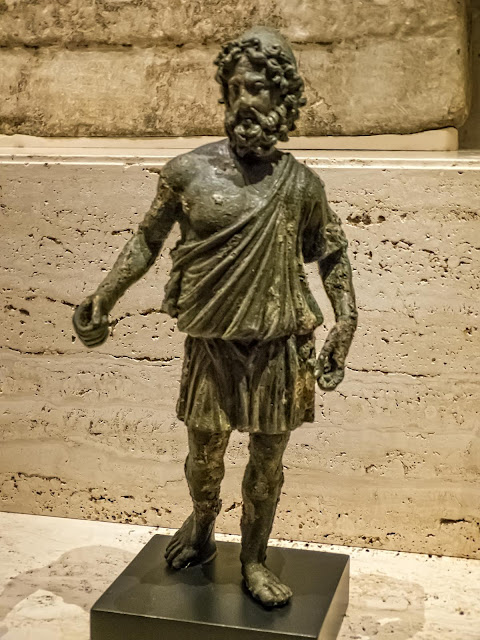
Statuette of Hephaestus the god of fire and patron of jewelers, armorers and blacksmiths Roman copy of a Greek original 1st - 2nd century CE Bronze that I photographed at the Nelson-Atkins Museum of Art in Kansas City, Missouri.

Statuette of Hephaestus the god of fire and patron of jewelers, armorers and blacksmiths Roman copy of a Greek original 1st - 2nd century CE Bronze that I photographed at the Nelson-Atkins Museum of Art in Kansas City, Missouri.

Roman fresco depicting Thetis at Hephaestos' forge waiting to receive Achilles' new weapons from Pompeii (IX I, 7, triclinium e), now in the collections of the National Archaeological Museum in Naples, courtesy of Wikimedia Commons contributor Marie-Lan Nguyen.

Vulcan by Guillaume Coustou the Younger, 1814, now in the Louvre Museum in Paris, courtesy of Wikimedia Commons contributor Marie-Lan Nguyen.

Closeup of Vulcan from a relief depicting Venus, Mars and Vulcan, about 1810, by Bertel Thorvaldsen courtesy of Wikimedia Commons contributor Rufus46.

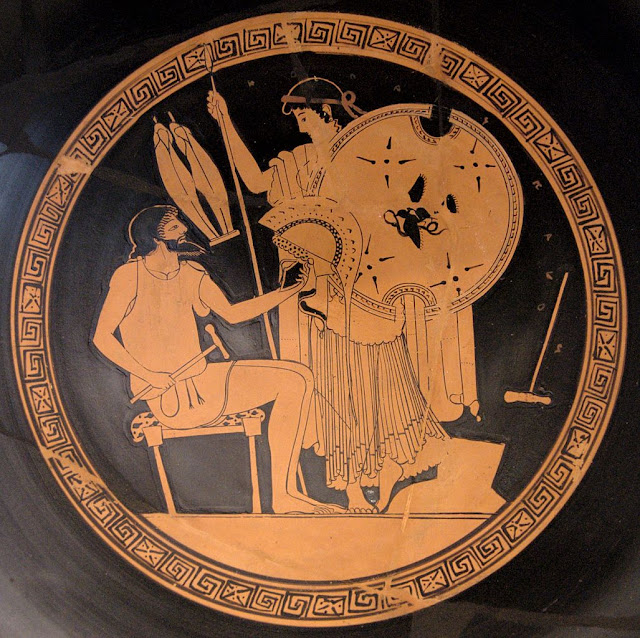
Hephaestus hands in the new Achilles' armor to Thetis (Iliad, XVIII, 617). Attic red-figure Kylix, 490–480 BCE, now in the collections of the Altes Museum in Berlin, courtesy of Wikimedia Commons contributor Bibi Saint-Pol.

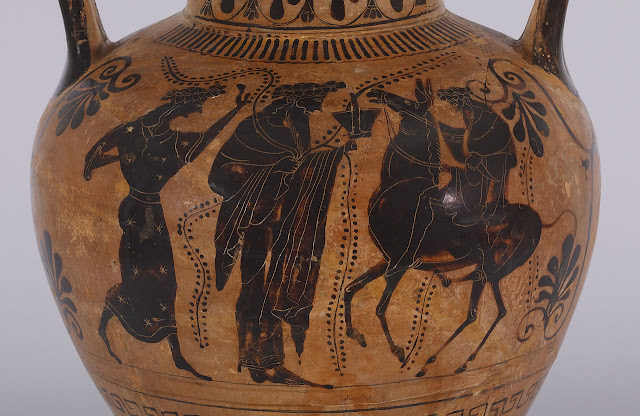
Black-figure Amphora depicting Dionysus who encounters the lame Hephaestus, god of fire and metalworking, riding on a donkey as a maenad looks on, 520 BCE, from Attica, now in the collections of the Walters Art Museum. Image courtesy of the museum.

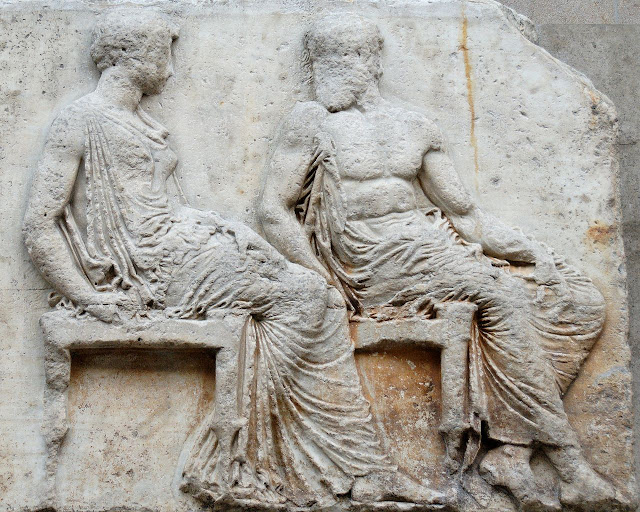
Athena holding a spear (now missing) watches the procession of the Great Panathenaia. Next to here, the lame god Hephaistos leans on a crutch. Block V (fig. 36-37) from the East frieze of the Parthenon, ca. 447–433 BCE, courtesy of Wikimedia Commons contributor Marie-Lan Nguyen.

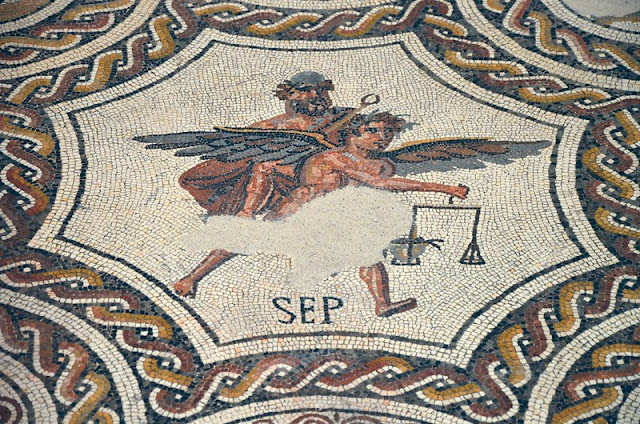
Detail of the mosaic of the seasons and the months, 3rd century AD, found in Hellin (Albacete), National Archaeological Museum of Spain, Madrid. September - Vulcan on winged genius carrying scales, Libra, courtesy of Carole Raddato (CC BY-SA 2.0)

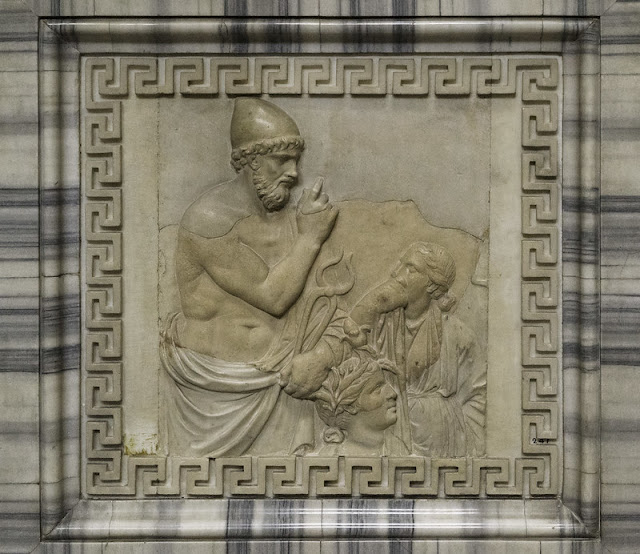
Fragment of a neo-Attic relief representing the birth of Erichthonios. The scene shows Hephaestus with “pileus” and holding tongs in his hands, Gaia, the earth goddess, wearing a crown of olive leaves and ears, and one of the daughters of Cecrops, standing with a hand to her mouth. Gaia is portrayed in the act of offering to Athena her newborn son Erichthonius. Both characters are now missing. This fragment, today inserted in the base of Galba’s statue, was found near Ostia where a famous Hephaisteion is documented. It dates from 50 BCE to the 50 CE. courtesy of Egisto Sani (CC BY-NC-SA 2.0)

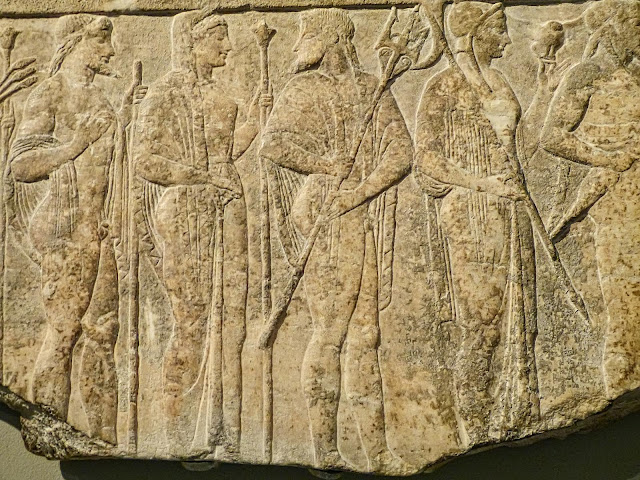
Closeup of Relief depicting twelve deities including Hephaestus (far left) Late Hellenistic or Roman possibly from Tarentum, Italy 1st century BCE that I photographed at the Walters Art Museum in Baltimore, Maryland

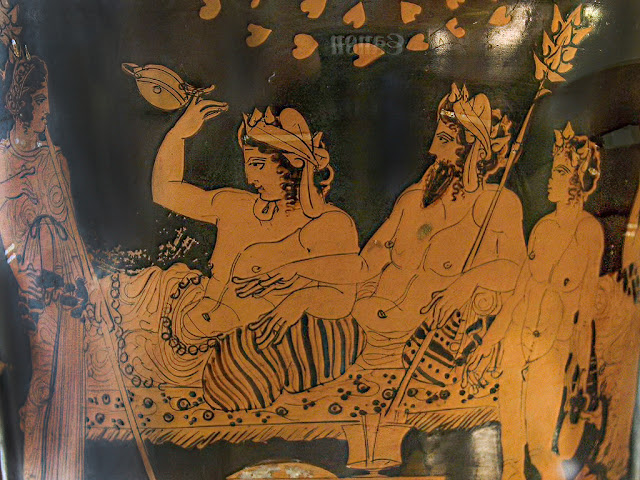
Calyx crater in red figure, 420-400 BCE, Lugano Painter. Side Aː Symposium scene. Bearded Dionysos and Hephaistos, a maenad and satyr. Archaeological Museum of Agrigento courtesy of Wikimedia Commons contributor Zde.

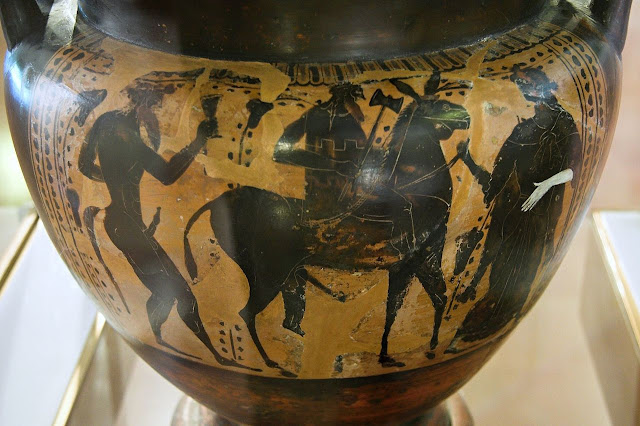
Attic colum crater, Leagros group, 550-500 BCE. Side A: The return of Hephaesos (Hefaistos) to Olympos. Archaeological Museum of Agrigento, courtesy of Wikimedia Commons contributor Zde.)

Vulcan (1838) by Herman Wilhelm Bissen (1798-1868). Sculpture in the Thorvaldsens Museum, Copenhagen, courtesy of Wikimedia Commons contributor James Steakley.


If you enjoyed this post, never miss out on future posts by following me by email!


Saturday, August 14, 2021

The Syncretization of Zeus Ammon and the Oracle of Siwa

Zeus was identified with the Roman god Jupiter and associated in the syncretic classical imagination with various other deities, such as the Etruscan Tinia and the Egyptian Amun (Ammon). He, along with Dionysus, absorbed the role of the chief Phrygian god Sabazios as well in the syncretic deity known in Rome as Sabazius.

Ammon was origiinally a Libyan deity.  His oracle, situated in the Siwa oasis, 500 kilometers west of Memphis became known by the Egyptians as "Amun of Siwa, lord of good counsel." Siwa is believed to have been occupied as early as Paleolithic and Neolithic times, and some believe at one time it was the capital of an ancient kingdom that may have included Qara, Arashieh and Bahrein. 

According to one myth the temple at Siwa was founded by the Greek god Dionysus. While lost in the Western Desert, Dionysus was perishing of thirst when a man appeared and guided him to the spring at Aghurmi. In gratitude, Dionysus erected the temple. In other myths, the Oracle of Siwa is reputed to have cursed Andromeda who was then tied to a rock to be devoured by a sea-serpent. Perseus is said to have stopped off to visit the Oracle prior to beheading Medusa, and Hercules is though to have visited it before he fought Bursiris.

"Siwa was too far away and too isolated to be a real part of the Egyptian kingdom, but there may have been indirect control. We are certain that during the Nineteenth Dynasty, there was a fort north of Siwa, at Umm el-Rakham on the coast. This proves that the pharaohs were interested in the far west. After the fall of the New Kingdom, Siwa was certainly independent, and it is no strange idea that the Libyan kings of the Twenty-Second and Twenty-Third Dynasties were somehow related to the rulers of Siwa."

"Siwa finally became a fully integrated part of Egypt after the domestication of the dromedary had made desert travel easier, for example to Egypt in the east, the Cyrenaica in the northwest and the Nasamones in the west. Among the oasis' exports was salt." - Livius.org

When the Libyan tribes assisted in the ascension of the pharaoh Amasis (r. 570-526 BCE), the pharoah built a shrine at site.  The Lydian king Croesus, an ally of Amasis, is said to have offered sacrifices to the god Ammon. Documented by Herodotus, it is assumed that the cult had spread beyond Egypt by then (560-546 BCE). A second temple at the oasis was built by Nectanebo II ( (r. 359/358-342/341 BCE). 

The first Greeks to visit the shrine were people from Cyrenaica, who knew the site through caravan trade. They called the god Zeus Ammon and the poet Pindar (522-445 BCE) was the first Greek to dedicate an ode to the god and one of the first Greeks to erect a statue to the god at Thebes and at Sparta. 

“and one day Apollo, in his gold-filled house,
will admonish him by oracle,
when at length he enters the Pythian shrine,
to lead a host of men in ships
to the rich precinct of Zeus Ammon by the Nile.”

Pindar, Pythian 4

Later visitors included the Persian king Cambyses, the Athenian commander Cimon, the athlete Eubotas, the Spartan general Lysander, the Macedonian king Alexander the Great, and the Carthaginian commander Hannibal.

Cambyses was said to have wanted to destroy the Oracle but lost his army in a raging sandstorm in the Western Desert instead. Pliny tells us that this was because the sacred stone at the temple was touched by a sacrilegious hand.

In 449 BCE Cimon, the Athenian general, waiting at Cyprus, sent emissaries to the Oracle to ask if he should attack Egypt.  Upon reaching the temple, his emissaries were told "Cimon is already with me!". When they returned to Cyprus they learned that Cimon had died at the same moment as they were speaking with the Oracle.

About 409 BCE, Eubotas, the famous Cyrene athlete sought advice from the Oracle and Lysander, the Spartan general, made two treks to consult with the Oracle. 

In his "History of Alexander," Quintus Curtius writes:

What is worshipped as the god does not have the same form that artificers have commonly given to the deities; its appearance is very like that of a navel fastened in a mass of emeralds and other gems. When an oracle is sought, the priests carry this in a golden boat with many silver cups hanging from both sides of the boat; matrons and maidens follow, singing in the native manner a kind of rude song, by which they believe Jupiter is propitiated and led to give a trustworthy response. (4. 23-25)

Then, after sacrifice had been offered, gifts were given both to the priests and to the god, and the king’s friends also were allowed to consult Jupiter. They asked nothing more than whether the god authorized them to pay divine honours to their king. The prophets replied that this also would be acceptable to Jupiter. (4. 28-29)

Such was the oracle's reputation among the Classical Greeks that Alexander the Great, declared "the son of Amun" by the oracle at Siwa, thereafter considered himself divine.

As for Hannibal, I only found a reference that he visited the Oracle. I wish we knew what he asked and what response he received.

Under Roman administration, the Oracle began to decline in importance.  Not before Cato (the Younger?), though, attempted to consult the Oracle about the freedom of Rome. One source claims the Oracle refused to answer.  Another source claims it was Cato who refused to speak in his effort to challenge and disparage the Oracle. Inscriptions dating to as late as the reign of Trajan have been found there, though.


Fragment of a clay slab depicting Jupiter Ammon, 1st century CE, polychrome terracotta at the Museo Barracco in Rome, courtesy of Wikimedia Commons contributor Archeologo


Bronze bust of god Sabazios, 2nd-century CE, in the collections of the Musei Vaticani courtesy of Wikimedia Commons contributor Jebulon.

Tinia, highest god in Etruscan mythology, equivalent to the Roman Jupiter and the Greek Zeus. Terracotta, 300-250 B.C.E. now in the collections of the Staatliche Antikensammlungen in Munich, Germany, courtesy of Wikimedia Commons contributor Dan Mihai Pitea.

Head of a colossal statue of ram-horned Zeus Ammon, Roman Tunisia (?), 150-180 CE, courtesy of Wikimedia Commons contributor Carole Raddato.

Zeus Ammon. Roman copy of a Greek original from the late 5th century BCE. The Greeks of the lower Nile Delta and Cyrenaica combined features of supreme god Zeus with features of the Egyptian god Amun-Ra, now in the collections of the Staatliche Antikensammlungen in Munich, courtesy of Wikimedia Commons contributor Dan Mihai Pitea.

Ancient Roman statue of Zeus Ammon found in Pergamon, now in the collections of the Istanbul Archaeological Museum, courtesy of Wikimedia Commons contributor Giovanni Dall'Orto

Aequipondium (steelyard counterweight) in the shape of a Jupiter Ammon, 190-210 CE, courtesy of Wikimedia Commons contributor Sailko

Head of Zeus Ammon, 1st-2nd centuries CE, Roman copy of a Greek original now in the collections of the Hermitage Museum in St. Petersburg, Russia.

Diorite head of a Ptolemaic king (Ptolemy I?) as Zeus Ammon, from Egypt, now in the collections of the Istanbul Archaeological Museum

A Marble Head of Zeus Ammon, Roman Imperial, 120-160 CE recently sold for $3,554,500. by Sotheby's.

Coin from Cyrene, showing Zeus-Ammon now in the collections of the Kunsthistorisches Museum, Vienna (Austria)

Entrance to the oracle courtesy of (https://www.livius.org/pictures/egypt/siwa/siwa-oracle/)

View of the sanctuary courtesy of (https://www.livius.org/pictures/egypt/siwa/siwa-oracle-1/) Note: with sky replacement - hey, plain blue sky is boring!!
If you enjoyed this post, never miss out on future posts by following me by email!


Monday, July 19, 2021

Red-figured fish plates of the 5th century BCE

Throughout my travels to various museums around the world I have often encountered red-figured fish plates. First developed in Athens, these beautifully detailed serving pieces became especially popular in South Italy and Sicily in the 400s BCE. I stumbled across this excellent video about them and learned that fish plates produced in Magna Graecia were usually more colorful with white accents and the fish are portrayed with their bellies facing inwards towards the small central depression that is thought to have contained dipping sauce like garum. Fish on plates produced in Athens are painted with their bellies facing outwards. I thought this is quite a peculiar style difference. 

There also seems to be disagreement among scholars as to whether these plates were actually used in everyday life or produced for funerary purposes only, as almost all of the 1,000 examples that have been recovered came from ancient burials. Art historian Lucas Livingston points out that many of the recovered examples have a crack in the bottom of the dipping well produced during firing. This would indicate many of the plates were never actually used in the way they are designed.

You can see dozens of examples here:

https://www.bing.com/images/search?q=ancient+Greek+fish+plates+in+art&qs=n&form=QBIR&sp=-1&pq=ancient+greek+fish+plates+in+art&sc=0-32&cvid=B677B9B0A24547C0B59A1F1E97C1E345&first=1&tsc=ImageHoverTitle

As producer of the Ancient Art Podcast, Livingston, who has worked at the Art Institute of Chicago since 2002, has a number of other ancient video lessons available on YouTube including a discussion of Hadrian and Antinous, Medusa, the Roman Lycurgus Cup, Cleopatra's ethnic origins, and ancient astronomy.


If you enjoyed this post, never miss out on future posts by following me by email!


Friday, July 9, 2021

The transformative shrew in Greco-Roman-Egyptian mythology

When I saw this carefully detailed bronze sculpture of a common shrew from Egypt's Greco-Roman Period, I wondered why the ancients thought this creature worthy of such expense. Although this sculpture is part of the collections of the Cleveland Museum of Art, the Metropolitan Museum of Art also has a similar, though less detailed example from the same period as does the Museum of Fine Arts in Budapest.  

According to The Met, the ancient Egyptians named the shrew, "the voracious", because of its feeding habits. In ancient Egyptian mythology, the shrew represented the blind aspect of the solar deity, “the one with no eyes in his face” (Mechenti-n-irti in old Egyptian) that was complemented by the ichneumon, “the one whose eyes (the Sun and the Moon) are in his face” (Mechenti-irti in old Egyptian), a creature with very keen eyesight. This god with the dual nature was revered in Letopolis as one of the aspects of Horus, who, as myth has it, was blind at birth. 

According to Egyptians, this Horus of Letopolis assists the Sun god during his nocturnal journey on the solar bark which lasted until the sixth hour of the night.

"The shrew assumed the form of the god Horus to enter the afterlife and descended into the darkness of the afterlife to revive the deceased/Osiris. In this phase of the journey, he helped to navigate the solar bark through the dark, while his reforming power accelerated the regeneration of the deceased. The more combative functions in the ascending phase of the Sun god’s journey, after the sixth hour of the night, were given to the companion animal: the ichneumon (mongoose)." - The Museum of Fine Arts, Budapest, Hungary.

The process of transformation from the blind shrew into a seeing being  and from a being of the afterlife/inactive being into a perfectly reborn being able to act dynamically in the light of daytime was therefore viewed as having the ability to grant life in the afterlife. In fact, the hieroglyphic inscription on the front and right side of the plinth on which the shrew sculpture in Budapest stands, asks this temporarily blind aspect of Horus of Letopolis to grant such life to an individual named Imhotep.

As for the shrew's complementary creature, although I am familiar with a mongoose I had never heard it called an ichneumon so did a little research and discovered it was a name used not only for a mongoose but a creature called the pharaoh's rat. Sometimes the name was also used for an otter. It's name in Greek means "tracker" and it was said to be the enemy of the dragon.

According to Pliny the Elder (Natural History, Book 8, 88), "The ichneumon is known for its willingness to fight to the death with the snake. To do this, it first covers itself with several coats of mud, drying each coat in the sun to form a kind of armor. When ready it attacks, turning away from the blows it receives until it sees an opportunity, then with its head held sideways it goes for its enemy's throat. The ichneumon also attacks the crocodile in a similar manner."  

I was aware of the snake-killing reputation of the mongoose but wondered how such a relatively small creature could kill a Nile crocodile.  However, the 1st century CE geographer, Strabo backs up the claim by Pliny saying "The ichneumon [is] most destructive both to crocodiles and asps. The ichneumons destroy not only the eggs of the latter, but the animals themselves. The ichneumons are protected by a covering of mud, in which they roll, and then dry themselves in the sun. They then seize the asps by the head or tail, and dragging them into the river, so kill them. They lie in wait for the crocodiles, when the latter are basking in the sun with their mouths open. They then drop into their jaws, and eating through their intestines and belly, issue out of the dead body."

As late as the 3rd century CE, Marcus Aurelius Olympius Nemesianus, a poet at the court of the Roman emperor Carus, refers to hunting the Ichneumon on river banks among the rushes in his poem Cynegetica. Sadly, the poem is fragmentary and any longer passage describing such a hunt has been lost. If the creature could take on a crocodile, it would seem to me that hunting the beast would be a very dangerous endeavor!

Read more about the cult of the shrew: https://www.mfab.hu/shrew-a-sacred-glutton/


Image: Solid cast bronze sculpture of a shrew, Egypt, Greco-Roman Period, 305-30 BCE, now in the collections of the Cleveland Museum of Art, image courtesy of the museum. 

If you enjoyed this post, never miss out on future posts by following me by email!


Sunday, June 27, 2021

The Meidias Painter: Art amidst the Peloponnesian War

The Meidias Painter was an Athenian red-figure vase painter active in the last quarter of the 5th century BCE (fl. c. 420 to c. 400 BCE). He is named after the potter whose signature was found on a large hydria, depicting the rape of the daughters of Leucippus (Leukippos), prince of Messenia, by the Dioscuri, excavated from an Etruscan tomb.  John D. Beazley, renowned connoisseur of Greek vases, said of Meidias' work, "Here there is beauty: The gleam of gold, loves and ladies with soft limbs, in soft raiment, and all that is shining, easeful and luxurious: perfume, honey and roses." 

The Meidias Painter was known for combining his theatrical “florid” style with his “flying drapery.”  He worked during the period of the Peloponnesian War and his depiction of many Attic legends, particularly those involving Erichtonios, son of Hephaistos, points to "a clear assertion of local pride prompted by the Athenians' decisive role in the fight against the barbarian" according to Jenifer Neils, Assistant Curator of Ancient Art at Case Western Reserve University.

He ranged his scenes across the entire background of most vessels, especially kraters.  This reflects the influence of monumental wall painting during this period. The Meidias Painter is thought to be one of the best pupils of the Eretria Painter, who initially popularized non-mythical scenes of Aphrodite with four to five of her richly dressed attendants, Eudaimonia (Happiness or Prosperity), Eukleia (Good Repute), Eunomia (Good Order), Eutychia (Good Luck), Harmonia (Harmony) , Hygieia (Health), Paidia (Play), and Peitho (Persuasion).   Sadly, the personification of Eirene (Peace) did not make an appearance in Greek art until the early fourth century BCE.  Instead, the Meidias Painter focused on themes of love and music instead of heroes and the battlefield, possibly as an escape from the brutality of the war engulfing his world at the time.

Read more about it: https://www.academia.edu/12707446/A_Greek_Nativity_by_the_Meidias_Painter

Attic red-figure hydria of the Leucippides depicting the Dioskuroi, Kastor and Polydeukes, in their chariots raping the Leukippides Elera and Eriphyle by the Meidias Painter, 420-400 BCE, now in the British Museum courtesy of Wikimedia contributor ArchaiOptix.

Another scene on the Attic red-figure hydria of the Leucippides by the Meidias Painter, 420-400 BCE, now in the British Museum courtesy of Wikimedia contributor ArchaiOptix.

Red-Figure Squat Lekythos (Oil Vessel) depicting the Birth of Erichthonios attributed to the Meidias Painter, 420-410 BCE, now in the collections of the Cleveland Museum of Art, image courtesy of the museum.

Attic red figure loutrophoros depicting a draped woman standing beside a groom in a wedding scene with Eros between the bride and groom painted in the "manner" of the Meidias Painter.

Attic red figure squat lekythos depicting Oedipus killing a sphinx with his spear while a seated Apollo looks on painted in the "manner of the Meidias Painter, now at the British Museum, courtesy of Wikimedia contributor ArchaiOptix.

Agamemnon seated on a rock and holding his sceptre, identified from an inscription. Fragment of the lid of an Attic red-figure lekanis by the circle of the Meidias Painter, 410–400 BCE. From the contrada Santa Lucia in Taranto. Stored in the Museo Nazionale Archeologico in Taranto (Italy), courtesy of Wikimedia Commons contributor Marie-Lan Nguyen.

Phaon and Aphrodite on an Attic red-figure clayx-krater dated from 420-400 BCE now in the collections of the Regional Archaeological Museum of Antonino Salinas courtesy of Wikimedia Commons contributor Marie-Lan Nguyen.

Attic Red-figured kylix depicting Peitho, the goddess of Persuasion, who stands addressing a woman named Demonassa, sitting in a rocky landscape looking rather dejected , 410 BCE attributed to the Meidias Painter, now in the collections of the J. Paul Getty Museum, image courtesy of the museum. 

Red-figured squat lekythos depicting female allegories with Eros in a garden, Hygieia, Pandasia with wreath and phiale, flying Eros, Eudaimonia seated, standing youth (Polyeidos or Polykles) in chlamys with 2 spears, plants. Said to be a "poor" attempt (I still thought it was beautiful) to copy the Meidias Painter by Greek ceramic expert John D. Beazley, now at the British Museum, courtesy of Wikimedia contributor ArchaiOptix.

Closeup of red-figured hydria painting depicting Phaon and women from Lesbos, 410 BCE, now in the collections of the Archaeological Museum in Florence, courtesy of Wikimedia Commons contributor Shakko.

Small hydria with Eros, carrying a tambourine, flying towards a woman, in a flowered chiton and long mantle, whose right foot is on a foot stool. Behind her a girl in a Doric chiton, seated, playing with a panther. Before the Eros an acanthus ornament. Painted in the "manner" of the Meidias Painter, end of the 5th century BCE now in the collections of the Museum of Fine Arts Boston, image courtesy of the museum.


If you enjoyed this post, never miss out on future posts by following me by email!


Saturday, June 26, 2021

Ancient Amber

 Despite fanciful descriptions by some ancient sources like Nicias (470-415 BCE) that amber "is a liquid produced by the rays of the sun, and that these rays, at the moment of the sun's setting, striking with the greatest force upon the surface of the soil, leave upon it an unctuous sweat, which is carried off by the tides of the Ocean, and thrown up upon the shores of Germany", Roman naturalist Pliny the Elder cited sources who were well aware of amber's actual origin from tree resin.

In Book 37, section XI of Natural History, Pliny wrote:

"Amber is produced from a marrow discharged by trees belonging to the pine genus, like gum from the cherry, and resin from the ordinary pine. It is a liquid at first, which issues forth in considerable quantities, and is gradually hardened [...] Our forefathers, too, were of opinion that it is the juice of a tree, and for this reason gave it the name of "succinum" and one great proof that it is the produce of a tree of the pine genus, is the fact that it emits a pine-like smell when rubbed, and that it burns, when ignited, with the odour and appearance of torch-pine wood."

Pliny says that the German name of amber was glæsum, "for which reason the Romans, when Germanicus Caesar commanded the fleet in those parts, gave to one of these islands the name of Glæsaria, which by the barbarians was known as Austeravia". 

As an important commodity, sometimes dubbed "the gold of the north", amber was transported from the North Sea and Baltic Sea coasts overland by way of the Vistula and Dnieper rivers to Italy, Greece, the Black Sea, Syria and Egypt over a period of thousands of years. The oldest trade in amber in antiquity originated from Sicily. The Sicilian amber trade was directed to Greece, North Africa and Spain. Sicilian amber was also discovered in Mycenae by the archaeologist Heinrich Schliemann. This amber also appeared in sites in southern Spain and Portugal and its distribution is similar to that of ivory, so it is possible that amber from Sicily reached the Iberian Peninsula through contacts with North Africa. After a decline in the consumption and trade of amber at the beginning of the Bronze Age, around 2,000 BCE, the influence of Baltic amber gradually took the place of the Sicilian one throughout the Iberian peninsula starting around 1000 BCE. 

From at least the 16th century BC, amber was moved from Northern Europe to the Mediterranean area. The breast ornament of the Egyptian pharaoh Tutankhamen (c. 1333–1324 BCE) contains large Baltic amber beads. Amber was also sent from the North Sea to the temple of Apollo at Delphi as an offering.

In Roman times, a main route ran south from the Baltic coast (modern Lithuania), the entire north–south length of modern-day Poland (likely through the Iron Age settlement of Biskupin), through the land of the Boii (modern Czech Republic and Slovakia) to the head of the Adriatic Sea (Aquileia by the modern Gulf of Venice). Along with amber, other commodities such as animal fur and skin, honey and wax were exported to Rome in exchange for Roman glass, brass, gold, and non-ferrous metals such as tin and copper. As this road was a lucrative trade route connecting the Baltic Sea to the Mediterranean Sea, Roman military fortifications were constructed along the route to protect merchants and traders from Germanic raids.

Amber occurs in a range of different colors. As well as the usual yellow-orange-brown that is associated with the color "amber", amber itself can range from a whitish color through a pale lemon yellow, to brown and almost black. Other uncommon colors include red amber (sometimes known as "cherry amber"), green amber, and even blue amber, which is rare and highly sought after. As amber ages, however, it often becomes opaque and crackled. 

Amber has been crafted into jewelry and pendants since the Stone Age, from 13,000 years ago. Amber ornaments have been found in Mycenaean tombs.  However, it has also been used in folk medicine for its purported healing properties. Hippocrates and other ancient physicians used amber extracts for a wide variety of treatments. In ancient China amber was heated under specific conditions to produce oil of amber that, when combined with nitric acid, was used to produce artificial musk.


Amber head of a woman or goddess, Roman, 1st - 2nd century CE, now in the collections of the National Archaeological Museum of Aquileia, courtesy of Wikimedia Commons contributor Sailko.


Amber figurine of a dog, Roman, from a tomb in Aquileia, 90-110 CE, now in the collections of the National Archaeological Museum of Aquileia, courtesy of Wikimedia Commons contributor Sailko.


Amber ring with the form of a female bust, 1st century CE, in the collections of the National Archaeological Museum of Aquileia, courtesy of Wikimedia Commons contributor Sailko.


Amber figural sculpture from a tomb in Aquileia, 90 CE, now in the collections of the National Archaeological Museum of Aquileia, courtesy of Wikimedia Commons contributor Sailko.

Amber figural sculpture of a woman with a melon hairstyle from a tomb in Aquileia, 90 CE, now in the collections of the National Archaeological Museum of Aquileia, courtesy of Wikimedia Commons contributor Sailko.

Amber head of a satyr, Roman, 1st - 2nd century CE, now in the collections of the National Archaeological Museum of Aquileia, courtesy of Wikimedia Commons contributor Sailko.

Amber sculpture of winged figures, Roman, 1st - 2nd century CE, now in the collections of the National Archaeological Museum of Aquileia, courtesy of Wikimedia Commons contributor Sailko.

Carved amber bow of a fibula depicting a couple reclining on a couch, with attendant and bird at the Metropolitan Museum of Art in New York. While numerous details are Etruscan, it is impossible to identify where the artist came from and whether the figures are mortal or divine.

Amber pendant in the form of a sphinx, from south Italy, Taranto, late 6th century BCE now in the collections of the Cleveland Museum of Art.

Weight with Ram and Tiger, Early Western Han Dynasty, 3rd-2nd century BCE, Bronze inlaid with gold silver and amber that I photographed at the Portland (Oregon) Art Museum.

Amber amulet depicting a boar between two lion heads, Italic, 500-400 BCE, that I photographed at the Getty Villa.

Amber Amulet depicting a Boar's Head, Italic about 500 BCE that I photographed at the Getty Villa.

Amber amulet depicting a woman holding a child (Kourotrophos), Italic or Etruscan, 500-400 BCE, that I photographed at the Getty Villa.

Amber pendant in the form of a Satyr Head in profile, Etruscan, 525-480 BCE now in the collections of the J. Paul Getty Museum, image courtesy of the museum.

Amber bead and pendant necklace, Italic, 700-475 BCE, BCE now in the collections of the J. Paul Getty Museum, image courtesy of the museum.

Amber Gorgoneion (Medusa Head), Roman, 1st - 2nd century CE now in the collections of the J. Paul Getty Museum, image courtesy of the museum.
If you enjoyed this post, never miss out on future posts by following me by email!