Showing posts with label novel. Show all posts

Wednesday, November 11, 2015

Review: Vespasian: Rome's Executioner by Robert Fabbri

A history resource article by  © 2015

I didn't realize it but I guess I started this series about one of Rome's "good" emperors with book 2 of the series.  However, the story, woven around the downfall of the infamous Praetorian Prefect Sejanus, stood on its own quite nicely.

There is no indication in history that Vespasian and his brother Sabinus conspired with the Lady Antonia, Tiberius' sister-in-law, to overthrow Sejanus to protect the reign of Tiberius.  However, a successful conspiracy is one in which the participants remain anonymous so Fabbri takes advantage of the lack of documentation to creatively spin this tale.

Sejanus was born into the equestrian class in 20 BCE at Volsinii in Etruria.  Sejanus' grandfather had improved the family's social standing by marrying a sister of the wife of Gaius Maecenas, one of the Emperor Augustus' closest political allies.  Sejanus' father, Lucius Seius Strabo, also married well and his uncle Quintus Junius Blaesus distinguished himself as a military commander and became proconsul of Africa in 21 CE.  Junius subsequently earned triumphal honors by crushing the rebellion of Tacfarinas, a Numidian deserter from the Roman Army who led a coalition of rebels against the forces of Rome in north Africa for 10 years.

It is thought Strabo eventually came to the notice of Augustus through his connection to Maecenas. Anyway, sometime after 2 BCE, Strabo, Sejanus' father, was appointed prefect of the Praetorian Guard.

We know little of Sejanus' early career until, according to Tacitus, Sejanus accompanies Gaius Caesar, adopted grandson of Augustus, to Armenia in 1 BCE.  Gaius Caesar dies from wounds supposedly received in a campaign in Artagira, Armenia in 4 CE.  Tacitus suggests there may have been foul play involved in the death of Gaius, orchestrated by Augustus' wife Livia to facilitate the accession of her own son Tiberius to the throne of the Roman principate.  However, Tacitus does not point an accusing finger at Sejanus.  But when Tiberius is crowned emperor in 14 CE, Sejanus is immediately appointed prefect of the Praetorian Guard as a colleague of his father.

A young Patrick Stewart as Sejanus in the 1976 production of
"I, Claudius".  Image courtesy of the British Broadcasting Company.
© 1976
Then when Sejanus' father is appointed to the governorship of Egypt in 15 CE, Sejanus assumes sole command of the Praetorians.  He centralizes the guards into a single garrison on the outskirts of Rome, personally appoints the centurions and tribunes and increases the number of cohorts from nine to twelve, resulting in a force of 12,000 soldiers now loyal to him.

Sejanus then conspires with the wife of Drusus, Tiberius' son, to have Drusus poisoned.  But when Sejanus asks permission to marry Drusus' widow, Tiberius ominously warns Sejanus not to overstep his bounds.  So Sejanus sets about sowing unrest between Tiberius and the senate.  Tiberius, already deeply depressed over the loss of his son, finally retreats to Campania in 26 CE then the island of Capri, leaving Sejanus to essentially rule Rome in Tiberius' absence.  Sejanus then sets about eliminating anyone he deems a threat that includes many of the elite.

A bronze statue of the Roman emperor Tiberius (not Augustus)
with head veiled (capite velato) preparing to perform a
religious rite found in Herculaneum 37 CE.  Photographed at
the Getty Villa by Mary Harrsch © 2014.
While matters were going thus with Sejanus, many of the other prominent men perished, among them Gaius Fufius Geminus. This man, having been accused of maiestas against Tiberius, took his will into the senate-chamber and read it, showing that he had left his inheritance in equal portions to his children and to the emperor. Upon being charged with cowardice, he went home before a vote was taken; then, when he learned that the quaestor had arrived to look after his execution, he wounded himself, and showing the wound to the official, exclaimed: “Report to the senate that it is thus one dies who is a man.” Likewise his wife, Mutilia Prisca, against whom some complaint had been lodged, entered the senate chamber and there stabbed herself with a dagger, which she had brought in secretly. - Cassius Dio, History of Rome, 58.4
Sejanus was so great a person by reason both of his excessive haughtiness and of his vast power, that, to put it briefly, he himself seemed to be emperor and Tiberius a kind of island potentate, inasmuch as the latter spent his time on the island of Capreae. - Cassius Dio, History of Rome, 58.5

Sejanus is wielding this immense power when Fabbri's story begins in Thrace where Vespasian is completing his appointment as tribune.  The plot involves Sejanus' funding of a rebellion in Thrace as a strategy to weaken the empire and redirect the attention of the legions from politics in Rome to the provinces. The groundwork for these clandestine activities may have been laid in Book 1 but I had to simply accept them as described as I had not read book 1 and have not found any references to them in the ancient sources.

A portrait bust of the Roman emperor Vespasian.
Photographed near the Forum Romanun
in Rome, Italy by Mary Harrsch © 2005
Fabbri's pacing of the story is good and the characters thoughtfully fleshed out.  The only thing I found a bit distracting was Vespasian's use of colloquial language such as referring to "me mates".  I realize Vespasian was born into a rather undistinguished family of tax farmers and debt collectors in a little village northeast of Rome but I think he would have tried to speak in a more educated manner in the presence of military legates and a Thracian queen.

The constant bickering between Vespasian and his brother Sabinus also grew tiresome, especially since I know the two Flavian brothers were actually quite close and during the tumultuous Year of the Four Emperors, Vespasian entrusted the care of his youngest son Domitian to Sabinus during a very dangerous period.  But, soon the action kicked into high gear and there wasn't much time for the siblings to snipe at each other any more.

Vespasian's relationship to Antonia's slave Caenis was also more out in the open than it was portrayed in Lindsey Davis' book, "The Course of Honor".  Their little trysts did provide the opening for the development of another strong female character, however, so I can understand why Fabbri plotted the story in this way.

Vespasian is portrayed as being a childhood friend of Caligula's and, although there is no evidence of this in the ancient sources, the plot device worked well to provide an inside source in Tiberius' household on Capri to enable the band of rescuers access to the emperor.

Fabbri developed Tiberius' character as described by his detractors, Suetonius and Tacitus - a sinister demented pervert.  I personally think Suetonius and Tacitus' accounts of Tiberius' behavior in his last years are full of discrepancies and represent more character assassination than fact (See my article "Sexual innuendo and character assassination in the ancient world".)

But, from a dramatic standpoint, such a character definitely adds a heightened level of suspense to the narrative.

Fabbri appears to have intentionally changed one aspect of history.  Early in his career Vespasian obtained a post as a minor magistrate in the vigintivirate.  In the book, Vespasian becomes a tresviri capitales, one of three magistrates charged with managing prisons and the execution of criminals. This places him in a key position to be informed of the Senate proceedings surrounding the treason of Sejanus (since he is not a senator himself) and to witness both the execution of Sejanus and his eldest son as well as the tragic execution of Sejanus' young children (and provide the title for the book). Scholars, however, think Vespasian served as a quattuorviri viis in urbe purgandis - one of four magistrates charged with road maintenance within the city of Rome.  He was so unsuccessful in this position it is said the emperor Caligula publicly stuffed fistfuls of muck down Vespasian's toga because the streets were so filthy.

All in all, though, the novel followed the history of the fall of Sejanus quite closely including the dramatic climax and the fates of key characters.  I will definitely add the first book of the series and the sequel to this novel to my "to read" stack!

Kindle preview:


More Suggested Reading:

If you enjoyed this post, never miss out on future posts by following me by email!


Thursday, September 3, 2015

Review: Master and God by Lindsey Davis

A history resource article by  © 2015

The very first book written by Lindsey Davis I ever read  was The Course of Honour about the relationship between the Roman emperor Vespasian and his mistress, the freedwoman Antonia Caenis, set against the backdrop of Vespasian's rise to power in the years leading up to the Year of the Four Emperors.  It has remained one of my favorites.  I recently finished "Master and God" and found it too a very compelling tale of the relationship between a wounded and psychologically damaged Praetorian Guard  and a freedwoman serving as a hairdresser in the imperial palace of Vespasian's son, Domitian.  The characters were placed so the reader could gain insight into the life of this controversial Roman emperor across the fifteen years of his reign and observe his effect on members of his court, his legions and other members of the aristocracy.

We first meet the male hero of the novel when he is serving as an officer of the vigiles, Rome's combination force of firemen and night watchmen.  We learn that Gaius Vinnius Claudianus was raised by a gaggle of loving aunts and two older brothers after the death of his mother.  He grew up strong and handsome and joined the military, like his late father, who served as a Praetorian Guard at the end of his military career.  We learn that Vinnius (he goes by this name until he joins the guard) has received the Civic Crown for valor defending a tribune in a ferocious battle with spear wielding barbarians.  His personal sacrifice, however, includes the loss of his left eye and disfigurement of the left side of his handsome face.

Fragmentary Marble head of a Helmeted Soldier Roman
Early Imperial Flavian period 69-79 CE.  Photographed
at the Metropolitan Museum of Art by Mary Harrsch
© 2007 
Vinnius is self conscious about his appearance and has his desk turned so his undamaged right profile is seen by visitors entering his office.  We also learn he is intelligent and observant and enjoys the procedural tasks involved in crime investigations.

We then meet the female protagonist, Flavia Lucilla.   A pretty fifteen-year-old, Lucilla has come to the vigiles to report a theft of her mother's jewelry.  She explains that the jewelry was given to her mother, an imperial hairdresser, by her boy friend.  As Vinnius gently questions the girl, he begins to suspect her mother simply hid the items so she could play upon her boyfriend's sympathy and get more.  As his questions become more probing the reality that Lucilla may have been misled by her mother begins to dawn on the young girl as well.  But she refuses to retract her complaint, indignantly referring to Vinnius as "pretty boy".  He simply smiles and turns toward her saying that condition has long passed.  Although she is startled for a brief moment by his appearance, she is not repulsed by him.

Bust of a Roman man found in Ostia between the
theatre and Vigiles barracks 110-120 CE.
Photographed at the Terme di Diocleziano venue of
the National Museum of Rome in Rome, Italy by
Mary Harrsch © 2009
Vinnius promises to investigate the case just as his adjutant rushes in to report a massive conflagration.  The fire of 80 CE, the second major fire to gut the heart of Rome in less than 20 years, has begun and would rage for the next three days.

Most people are generally aware of the so-called "Great Fire" of 64 CE during the emperor Nero's reign and that some of the ancient sources notoriously claim Nero played the lyre and sang while Rome burned.  The conflagration has also been immortalized through subsequent religious teachings as the reason for the first major persecution of the early Christians.

Nero Watching Rome Burning by Alphonse Mucha (1887)
However, widespread destructive fires have been recorded throughout Rome's history.  In the Republican period the rapid and haphazard construction needed to house Rome's burgeoning population resulted in a number of catastrophic blazes (and I doubt a particular individual or even a group was blamed for them).

In his journal article "Conflagrations in Ancient Rome" published in 1932, H.V. Carter points out that dating back to to the Gallic invasion of 390 BCE, there had been no fewer than 15 documented fires, of which seven were widespread conflagrations and seven others involved the loss of at least one important public building.

"Remembering that our sources are limited, particularly for the early part of the period, and that ancient writers almost invariably confine their accounts of fire to those involving only the more important structures, we may safely conclude that the figures given fall well below the actual occurence of fires which were considerable in extent and of serious consequences." - H.V. Carter, "Conflagrations in Ancient Rome"

Brennus and his share of the spoils by Paul Jamin (1893).
Fires became an even more common occurence in the Imperial Period.

"...we can say that in the imperial period destructive fires in Rome were far more numerous than in that of the Republic.  This was due to the fact that a greatly increased population, larger supplies of food and clothing necessary for its maintenance, and an inevitable increase in homes, tenements, shops and warehouses necessary for domestic and business life, produced still greater congestion in certain already overpopulated quarters, a condition which, as affecting fire risk, was not adequately offset by improved building, either in plans or materials used, or by facilities sufficient for checking and extinguishing fires." - H.V. Carter, "Conflagrations in Ancient Rome"

Carter says there were at least nine fires recorded during the reign of Augustus, the most destructive being the fire of 6 CE that destroyed so much of the city Augustus immediately reorganized the vigiles to make the unit more effective.

The Roman emperor Augustus as Pontifex Maximus
photographed at the Palazzo Massimo in Rome, Italy by
Mary Harrsch © 2009

Five major fires were recorded during the reign of Tiberius.  The fire of 36 CE burned the long side of the Circus Maximus facing the Aventine then spread to the Aventine itself.  It caused so much destruction that Tiberius, sometimes criticized as "stingy" by contemporaries and possibly even some scholars, donated over 100 million sesterces to its victims to rebuild their homes.

A bronze statue of the Roman emperor Tiberius (not Augustus) with head veiled (capite velato)
preparing to perform a religious rite found in Herculaneum 37 CE.  Photographed at the
Getty Villa in Pacific Palisades, California by Mary Harrsch © 2014
The emperor Claudius was not spared either.

"In 54 [CE] the Aemiliana district (in the southern part of the Campus Martius) was leveled by a stubborn fire which lasted for at least a day and two nights.  The emperor, when the regular firemen augmented by a body of his own slaves were unable to cope with the flames, summoned the common people from all parts of the city to assist the fire fighters, and paid on the spot each helper so enlisted a suitable remuneration for his service.  In this same conflagration was burned (and apparently never rebuilt) the temple of Felicitas, in or near the Forum Boarium.  It was in front of this temple, embellished with statues of the Muses by Praxiteles and by other works of art, that Julius Caesar had the misfortune to break the axle of his chariot when celebrating his triumph in 46 BCE. -  H.V. Carter, "Conflagrations in Ancient Rome"
Posthumous portrait head of the Roman Emperor Claudius
from the reign of Nero 54-68 CE .  Photographed at the
Seattle Art Museum in Seattle, Washington by
Mary Harrsch  © 2015
Nero's "Great Fire" lasting six days and seven nights was probably the largest conflagration to ever strike the Eternal City but the fire of 80 CE was second only to it.

"In the year 80 [CE] flames raged for three days and nights, burned a large section of the Campus Martius, and, moving thence in a southeasterly direction, devastated the Capitoline hill.  Dio Cassius (LXVI, 24), after naming eleven structures that were consumed (including the temple of Jupiter Capitolinus with its surrounding temples), adds: "Anyone can estimate from the list of buildings that I have given how many others must have been destroyed."  it is probably that at least five additional important public buildings were in whole or part destroyed by this same fire.  Naturally, too, a large number of public and private buildings of secondary importance wedged in among the principal ones were swept away at this time." -  H.V. Carter, "Conflagrations in Ancient Rome"

Carter points out that fire was responsible for the destruction, wholly or partially, of the Temple of Vesta five times, the Regia and Theater of Pompey at least four times, the Temple of Jupiter Capitolinus, the Basilica Julia and the Basilica Aemilia three times and the Theater of Marcellus, the Pantheon and the Colosseum twice.

Remains of the Temple of Vesta in the Forum Romanum
in Rome, Italy.  Over the course of Rome's history the
Temple of Vesta was destroyed five times by fire.
Photographed by Mary Harrsch © 2005
In the novel Davis mentions the destruction of the Pantheon and I was startled by this.  Although I knew Hadrian had "refashioned" the Pantheon, I assumed at least part of it was the original structure built by Marcus Agrippa, like a lot of other people, because of the inscription on its front facade.  I guess I should have read up on it before I visited the structure for the first time in 2005.  In fact, the Augustan Pantheon was totally destroyed by the fire in 80 CE. Domitian subsequently rebuilt the Pantheon which was destroyed again in 110 CE.

A spectacular vertirama of the interior of the Pantheon by Christopher Chan © 2010. Reproduced with permission via
CC by-nc-nd 2.0
But, it is the destruction of the Temple of Jupiter Capitolinus that is the site of our hero's next courageous act and the deed that will bring him to the personal attention of the young Flavian princeling, Domitian.  This time his bravery will win him an appointment to the Praetorian Guard and give him the opportunity to personally serve the man that will become emperor in less than a year.

Meanwhile, Flavia Lucilla learns to craft the huge crescents of curls that will become a hallmark of feminine style during the Flavian period and increasingly spends more and more time at the palace herself.

Portrait of a woman of the Flavian period, marble possibly
a  portrait bust of Julia, daughter of Titus Marble, 80-90 CE
Photographed at the Capitoline Museum by Mary Harrsch
© 2005
As in the relationship between Vespasian and Caenus in "Course of Honour", the on-again off-again nature of Vinnius and Lucilla's relationship creates an underlying thread of sexual tension that helps to drive the story forward.  Just when you think they are finally going to get together, Vinnius' brothers saddle him with a newly widowed mate and Lucilla eventually ends up married to some stodgy poet who wears socks!!

The couple finally recognize their feelings for each other but Domitian has named himself censor for life and reinstituted the old Augustan morality laws so an affair could be literally fatal.  Then Decebalus, the king of Dacia, begins raiding Roman outposts along the Danube and Domitian announces he will handle the problem himself, taking the Praetorian guard and our hero along with him.

Bronze portrait of an ancient Dacian photographed at the
National Military Museum, Buchareșt, Romania by
Cristian Peter Marinescu-Ivan © 2009
Reproduced with permission via CC by-sa 2.0

I knew Decebalus had been defeated two decades later by Trajan, hence the carving of Trajan's Column to commemorate the event.  But I didn't realize as a young leader, Decebalus (then called Diurpaneus) had given Domitian trouble in Moesia back in 85 - 86 CE, surprising the Roman governor, Oppius Sabinus and annihilating a legion, probably the V Alaudae, which disappears from the military records at this time.  Domitian and his Praetorian Prefect Cornelius Fuscus arrive and the ever-micromanaging Domitian reorganizes the province into two separate provinces, Moesia Inferior and Moesia Superior.  Then Domitian orders the IIII Flavia from Dalmatia, and the I and II Adiutrix to the region to replace the lost legion and prepare for an attack on Dacia.

Scholars are divided by what happened next.  Some say Domitian handed the command over to Fuscus and returned to Rome.  Other scholars think Domitian personally led a successful operation against the Dacians and returned to Rome where, it is recorded, he celebrated a double triumph.  In any event, a contingent of the Praetorian Guard remain with Fuscus and in 87 CE Fuscus crosses the Danube where his army (that includes our hero Vinnius) like that of Oppius Sabinus, is ambushed and destroyed at a mountain pass the Romans called Tapae (widely known as the Iron Gates along what is now the modern Romania-Serbia border).  The battle becomes known as the First Battle of Tapae.

Scene of the Second Battle of Tapae with Jupiter Optimus Maximus overlooking Roman troops depicted on Trajan's Column in Rome, Italy.  Photographed by Mary Harrsch © 2009.
Although Davis does not describe the battle in as much visceral detail as Harry Sidebottom or Douglas Jackson would, she provides enough context and suspense to leave the reader breathless.

So how will our female protagonist carry on with the worst years of Domitian's tyranny still ahead? You'll need to read the novel to find out but I assure you Davis will keep you guessing about the ultimate fate of her protagonists until the last paragraph!

Because Domitian is not one of the main characters of the narrative, Davis has to get very inventive to provide background information about this controversial emperor.  In one chapter she does so by introducing a non-human character named Mosca - a house fly.  Suetonius tells us that at the beginning of his reign Domitian would spend hours alone every day catching flies and stabbing them with his needle-sharp stylus.

"Once, on being asked whether anyone was closeted with the Emperor, "Vivius Crispus answered wittily: 'No, not even a fly!'." - Suetonius, Domitian, The Twelve Caesars

Mosca makes all kinds of observations about the solitary human inhabitant of her environment as she prepares to annoy him, oblivious to the corpses of her relatives splayed beneath Domitian's stylus.

I thoroughly enjoyed "Master and God" and have elevated it to one of my favorite Lindsey Davis novels.

To learn more about Domitian and the other Roman emperors mentioned in this post I recommend The Great Courses series Emperors of Rome by Professor Garrett G. Fagan of Pennsylvania State University.

References: 

Carter, H. (1932). Conflagrations in Ancient Rome. The Classical Journal, 27(4), 270-288.

Kindle preview:


More suggested reading:

If you enjoyed this post, never miss out on future posts by following me by email!


Thursday, June 27, 2013

Total War Rome: Destroy Carthage 1st of novels based on the new game

I received an e-mail about a new series of novels scheduled for release in September that will serve as companion novels to the new "Rome Total War II" game by Creative Assembly:

"Carthage, 146 BC. This is the story of Fabius Petronius Secundus – Roman legionary and centurion – and his rise to power: from his first battle against the Macedonians, that seals the fate of Alexander the Great's Empire, to total war in North Africa and the Siege of Carthage.
 Fabius's success brings him admiration and respect, but also attracts greed and jealousy – the closest allies can become the bitterest of enemies. And then there is Julia, of the Caesar family – a dark horse in love with both Fabius and his rival Paullus – who causes a vicious feud.
 Ultimately for Fabius, it will come down to one question: how much is he prepared to sacrifice for his vision of Rome?
 Inspired by Total War: Rome II, the bestselling game, Destroy Carthage is the first in an epic series of novels. Not only the tale of one man’s fate, but is also a journey to the core of Roman times, through the world of extraordinary military tactics and political intrigue that Rome’s warriors and citizens used to cheat death." - Pan Macmillan, publisher

The publisher also points out that author David Gibbins has penned seven previous historical adventure novels that have sold over two million copies and are published in twenty-nine languages. Gibbins taught archaeology, ancient history and art history as a university lecturer, before turning to writing fiction full-time.  Hopefully, Gibbins will be as successful at creating vibrant characters and settings as Harry Sidebottom, another academician turned best-selling novelist.  Pan Macmillan has graciously offered to send me a review copy so I'll give you my take on it when I get some time to read it.


Related articles
Enhanced by Zemanta
If you enjoyed this post, never miss out on future posts by following me by email!


Monday, August 27, 2012

Review: The Sword of Revenge by Jack Ludlow


The Sword of Revenge is the second book in Jack Ludlow's "Republic " trilogy.  One of the main protagonists in this novel is the young outcast, Aquila, the son of the wife of the famous Aulus Cornelius Macedonicus and a Celtic warlord named Brennos who captured her in a Celtic raid in Iberia (ancient Spain).  Aquila has grown up on the small farm of an old ex-legionary who discovered the infant abandoned in the woods with no indication of his parentage except a gold talisman depicting an eagle in flight wound around his foot.

Clodius raises the child as his own but Clodius is a better soldier than a farmer so the struggling family must rely on hunting and fishing just to put food on the table.  One day, Clodius, having drunk a little too much wine, is tricked into accepting the offer of a wealthy neighbor, Piscius Dabo, who says he will provide for Clodius' family if Clodius would serve in the legions as  the wealthy neighbor's surrogate.  In truth, Dabo has previously served in the legions but has found it much more profitable to stay home and buy up all the surrounding farms from other neighbors who have gone off to serve the Republic.

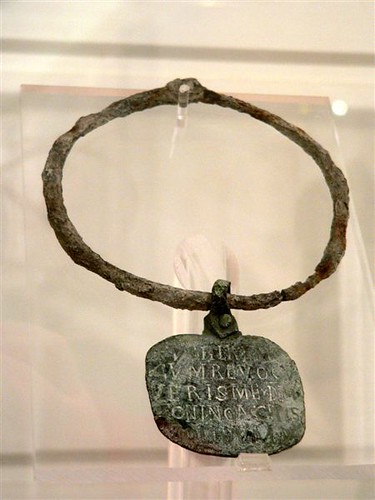
Roman Slave Medallion photographed at the
Terme di Dioclezione in Rome, Italy by
Mary Harrsch


With his adoptive father gone, Aquila spends his days in the surrounding hills hunting until one day he comes upon what appears to be an old shepherd.  However, Aquila discovers the man is really a one-eyed Celtic warrior named Gadoric who was captured by the Romans and masquerades as a feeble cripple to avoid being sent to Sicily to work on the large latifundias (farms owned by wealthy Roman senators) there.  The Celt is mystified by Aquila's tall, blonde appearance and feeling a kinship with the boy, teaches him to use a spear and a bow despite the fact that if the warrior, now a slave, should be found with weapons he could be crucified.

The Celt becomes a surrogate father to the youth and the two become inseparable.  But one day Aquila finds the Celt has been discovered and watches tearfully as his friend is led away in shackels towards Sicily.  More misfortune follows when his adoptive mother dies and he must go to live with the despised Piscius Dabo.

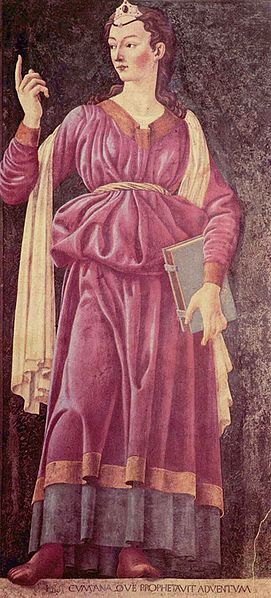
The other protagonist whose story runs parallel to Aquila's is Marcellus Falerius, son of Lucius Falerius, one of the two main characters from Book 1 who has, as yet, escaped the fate prophesied by the Sybil when Lucius and his boyhood friend Aulus clandestinely sought out the Sybil as children.

Cumaen Sybil by 
Andrea del Castagno 


One will tame a mighty foe, the other strike to save Rome's fame.
Neither will achieve their aim.
Look aloft if you dare, though what you fear cannot fly.
Both will see it before you die.

The old crone had scratched a drawing of an eagle in flight on a scrap of papyrus and tossed it to the two boys but as Lucius caught it, the image burst into flame, but not before searing the image into each boy's mind.

Before the climactic battle of Thralaxas at the conclusion of Book 1, Clodius, serving as a legionary under the great Macedonicus, had scratched his adopted son's eagle talisman in the dirt where Aulus stumbled across it before his bloody death at the Thermopylae-like defeat.  But Lucius is unaware that the first half of the prophecy has come to pass as he visits the tomb of his old friend at the beginning of Book 2.

Lucius Falerius grew up to become an ambitious politican and was the man who had ordered the murder of the tribune of the plebs (a character based on Tiberius Gracchus) because the man supported legislation to redistribute land to the poor.

A monument to the Gracchi by Eugene Guillame, French, 1853.
Photographed at the Musee d'Orsay by Mary Harrsch.


Falerius viewed this legislation as a move that would destroy the Rome he knew, directed by the wealthy elite known as the Optimates.  Although his ruthless act had caused quite a stir at the time, Falerius, claiming innocence, expertly manipulated the strings of power to overcome the opposition and become the first man in Rome.  Now aging, he works desperately to pass on his knowledge of the political machine to his son, Marcellus.  But Marcellus, actually the son of one of Falerius' barbarian slaves and Falerius' wife, unlike his "father", harbors an innate athletic ability that makes the martial arts come naturally to him.  Although he learns the political lessons his father drills into him, he, as yet, is not the ruthless singleminded individual his father has become.  And, he is beginning to chafe under his father's constant surveillance although he remains obedient to his father's commands.

This information is provided in the lengthy prologue as well as artfully woven throughout the fabric of the narrative as needed to make the novel stand on its own for readers who have not yet read Book 1, "The Pillars of Rome".

Then, "The Sword of Revenge" formally begins.

Flaccus, an old centurion who served with Aquila's adoptive father, shows up at the Nabo farm with a band of ex-gladiators on their way to take over the management of one of the large farms on Sicily.  Flaccus tells the boy of his adoptive father's death.  So, Aquila, without any further reason to stay, decides to throw in with Flaccus and his toughs and heads for Sicily hoping to find his old friend Gadoric.

Flaccus has made a bargain with the wealthy Cassius Barbinus, Aquila's vicious neighbor who owned Gadoric, to go to Barbinus' other farm on Sicily and "crack the whip" so to speak to improve the land's yield in return for a large percentage of the excess profit.

On the way to Sicily, some of Flaccus' ruffians sneak out at night to murder and pillage the surrounding countryside to enable them to buy wine and women.  I thought this was an excellent way Ludlow has chosen to introduce his readers to the dangerous environment of this period in Rome's history.  Such activities during this time were clearly described by Roman historian, Diodorus Siculus in his narrative about The First Servile War.

"With such licence given to men who had the physical strength to accomplish their every resolve, who had scope and leisure to seize the opportunity, and who for want of food were constrained to embark on perilous enterprises, there was soon an increase in lawlessness. They began by murdering men who were travelling singly or in pairs, in the most conspicuous areas. Then they took to assaulting in a body, by night, the homesteads of the less well protected, which they destroyed, seizing the property and killing all who resisted." - Diodorus Siculus

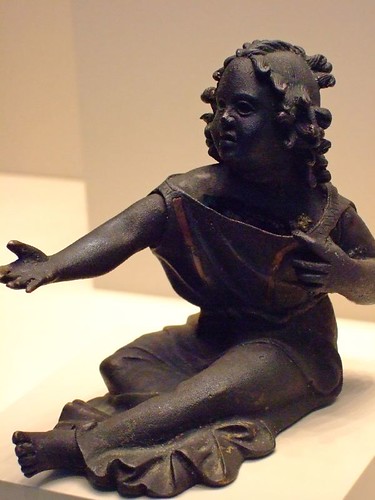
A bronze Roman coin bank depicting a beggar girl 25-50 CE.
Photographed at the Getty Villa by Mary Harrsch.


Once on Sicily, Flaccus,  implements a harsh regime, working not only the men but the women and children as he pushes hard to improve the farm's output.

"...they treated them with a heavy hand in their service, and granted them the most meagre care, the bare minimum for food and clothing. As a result most of them made their livelihood by brigandage, and there was bloodshed everywhere, since the brigands were like scattered bands of soldiers." - Diodorus Siculus

Soon a problem develops with runaway slaves who are banding together in the foothills and raiding the Roman estates.  This led to the revolt referred to as The First Servile War that lasted from 136 - 132 BCE.

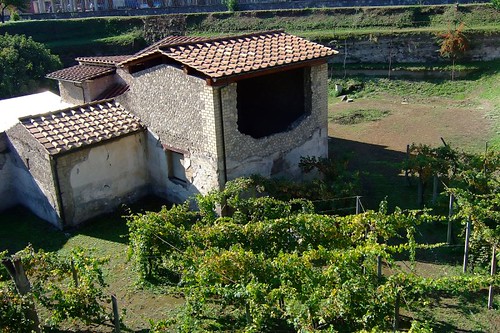
A Roman villa rustica excavated at Boscoreale near Naples, Italy.  Photo by
Mary Harrsch
The governor of Sicily calls for a meeting of the farming overseers to try to come up with a plan to avert the looming slave revolt.  Now a trusted bodyguard for Flaccus, Aquila goes with Flaccus to the meeting.  But on the way there he discovers his old Celtic friend, Gadoric, bound to a stake along the roadside in preparation for his impending crucifixion.

Aquila slips away from the meeting and when night falls, he overpowers the guards near the crucifixion site and frees his friend and a Palmyran Greek slave staked nearby named Hippolytas.

The rest of the novel focuses on the slave revolt eventually led by Aquila's friend and the mysterious Hippolytas who convinces the slaves on the island that he has oracular powers and demonstrates his ability to commune with the gods by spewing flames from his mouth.  This character is obviously based on the slave leader Eunus who led the slave revolt on Sicily in 136 BCE.

"There was a certain Syrian slave, belonging to Antigenes of Enna; he was an Apamean by birth and had an aptitude for magic and the working of wonders. He claimed to foretell the future, by divine command, through dreams, and because of his talent along these lines deceived many. Going on from there he not only gave oracles by means of dreams, but even made a pretence of having waking visions of the gods and of hearing the future from their own lips. 
Of his many improvisations some by chance turned out true, and since those which failed to do so were left unchallenged, while those that were fulfilled attracted attention, his reputation advanced apace. Finally, through some device, while in a state of divine possession, he would produce fire and flame from his mouth, and thus rave oracularly about things to come. 
For he would place fire, and fuel to maintain it, in a nut -- or something similar -- that was pierced on both sides; then, placing it in his mouth and blowing on it, he kindled now sparks, and now a flame. Prior to the revolt he used to say that the Syrian goddess appeared to him, saying that he should be king, and he repeated this, not only to others, but even to his own master." - Diodorus Siculus

Ludlow even has one of his characters confront Hippolytas about the use of the fuel-containing nut in his mouth to produce the illusion he throws flames from his mouth during his mystical prophesies.

Like Eunus, Hippolytas grows increasingly pompous as his superstitious followers become more insistent he assume the role of king of the slave army.  But Aquila, appalled by the brutality of the rebels and Hippolytas' growing greed, withdraws to the hills.

Meanwhile, back in Rome, an attempt is made on the life of Lucius Falerius.  To recover from his wounds, the old fox decides to seek solace in the south of Italy where he can direct the activities of Titus Cornelius, son of his late friend Aulus and now a military legate, and his own son, Marcellus, who are preparing a Roman military response to the slave revolt on Sicily.

Historically, the slaves take over the south central town of Enna and are eventually defeated there through siege and betrayal.

"Cities were captured with all their inhabitants, and many armies were cut to pieces by the rebels, until Rupilius, the Roman commander, recovered Tauromenium for the Romans by placing it under strict siege and confining the rebels under conditions of unspeakable duress and famine: conditions such that, beginning by eating the children, they progressed to the women, and did not altogether abstain even from eating one another. It was on this occasion that Rupilius captured Comanus, the brother of Cleon, as he was attempting to escape from the beleaguered city. 
Finally, after Sarapion, a Syrian, had betrayed the citadel, the general laid hands on all the runaway slaves in the city, whom, after torture, he threw over a cliff. From there he advanced to Enna, which he put under siege in much the same manner, bringing the rebels into extreme straits and frustrating their hopes. Cleon came forth from the city with a few men, but after an heroic struggle, covered with wounds, he was displayed dead, and Rupilius captured this city also by betrayal, since its strength was impregnable to force of arms." - Diodorus Siculus
Eunus is captured alive and thrown into prison where he sucuumbs to disease and dies at Morgantina.

"Eunus, taking with him his bodyguards, a thousand strong, fled in unmanly fashion to a certain precipitous region. The men with him, however, aware that their dreaded fate was inevitable, inasmuch as the general, Rupilius, was already marching against them, killed one another with the sword, by beheading. Eunus, the wonder-worker and king, who through cowardice had sought refuge in certain caves, was dragged out with four others, a cook, a baker, the man who massaged him at his bath, and a fourth, whose duty it had been to amuse him at drinking parties. 
Remanded to prison, where his flesh disintegrated into a mass of lice, he met such an end as befitted his knavery, and died at Morgantina." - Diodorus Siculus

Ludow, however, moves the action to the southern coastal city of Agrigentum where he treats us to an exciting naval battle between a rebel-converted merchant galley and a Roman trireme.

The revolt also ends quite a bit differently than in the history books as Aquila takes his revenge upon the Greek charlatan leaving blood-spattered images of his eagle talisman in his wake.  The sketches are dutifully copied and transmitted to none other than Lucius Falerius, thereby fulfilling the fateful prophecy.

Meanwhile, Marcellus visits the nearby cave of the Sybil and receives a prophecy of his own that sounds relatively benign.  The prophetess tells the young man he will inherit his father's fortune.  But, although Marcellus is unconcerned, it sent a shiver down my spine remembering that his real barbarian father was betrayed by Lucius Falerius and set upon by assassins who wounded him so severely that when he sought escape by jumping into the Tiber he could not withstand the strong current and drowned.

So, I'm looking forward to Book 3 of Ludlow's Republic trilogy, "The Gods of War" to learn how Aquila fulfills his destiny and if Marcellus escapes his fate.

Enhanced by Zemanta
If you enjoyed this post, never miss out on future posts by following me by email!