Showing posts with label Jack Ludlow. Show all posts

Saturday, May 21, 2016

Review: The Last Roman: Triumph

A history resource article by Mary Harrsch © 2016

The final chapters of Flavius Belisarius' life are the focus of Jack Ludlow's third and final installment in his series "The Last Roman" subtitled "Triumph".  In the second book, "The Last Roman: Honour", Flavius fights a vicious battle on two fronts as he struggles to retake the Italian peninsula for his emperor, Justinian I, while the empress Theodora, consumed with jealousy and paranoia, tries to thwart his success, both clandestinely and overtly.  Flavius, undermanned, poorly supplied and saddled with ambitious disloyal subordinates,  ends up having to resort to subterfuge to capture the Goth capital of Ravenna.  He receives an offer of the crown of the Western Roman Empire and allows the Goths to believe he is willing to accept it to obtain their surrender.  But this ruse does not go unnoticed by the treacherous Theodora and, although Flavius publicly refuses the crown that would have made him equal in rank to Justinian,  he is abruptly recalled to the imperial court in Constantinople to explain himself.

As book three opens, Flavius returns to Constantinople with the Goth treasure for the imperial coffers.  But, the imperial sycophants, fearful of the ruthless Theodora, whisper of his imminent downfall as his requests for an audience are ignored day after day.


"Not even the government officials could approach the Empress without expending much time and effort. They were treated like servants and kept waiting in a small, stuffy room for an endless time. After many days, some of them might at last be summoned, but going into her presence in great fear, they very quickly departed. They simply showed their respect by laying face down and touching the instep of each of her feet with their lips; there was no opportunity to speak or to make any request unless she told them to do so. The government officials had sunk into a slavish condition, and she was their slave-instructor." - Procopius, Anecdota

Proskynesis depicted on a Byzantine-era ivory plaque.  Image courtesy of Wikimedia Commons.

In the streets of Constantinople, however, Flavius is openly revered and can walk among the people without a single bodyguard.  This infuriates the empress Theodora even more, since she remembers how she and Justinian nearly met a grisly fate at the hands of the mob during the Nika riots early in Justinian's reign.

Finally, Flavius is confronted by a publicly hostile Justinian. But after what appears to be a great show of imperial displeasure, Flavius is asked to attend Justinian in his private chambers.  There, Justinian's royal posturing dissolves into nervous pacing as Flavius is briefed on serious Sassanid incursions that are eating away at the eastern frontier.  Flavius realizes Justinian, who refuses to publicly cross his vicious empress, was putting on a show for her benefit, but actually needs Flavius' help and has not forgotten their friendship.

As we saw in book two, Justinian, like many of his predecessors, maintained the empire's long standing policy of averting outright war with the Sassanids by the payment of subsidies.

The Sassanian Empire was founded by Ardashir I in 224 CE, after the fall of the Parthian Empire and the defeat of the last Arsacid king, Artabanus V.   Just six years later, Ardashir's son, Shapur I begins a centuries-long cycle of Persian incursions and Roman retaliation when he raids deep into Roman territory in 230 CE.  Territory ebbs and flows between the two superpowers until Shapur finally engineers a highly advantageous peace treaty with the Roman emperor Philip the Arab in 244 CE, securing the immediate payment of 500,000 silver denarii and further annual payments.

Ghal'eh Dokhtar (or "The Maiden's Castle") in present-day Fars, Firuzabad, Iran, built by Ardashir in 209, before he was finally able to defeat the Parthian empire.  Photo courtesy of Wikimedia Commons.
The Sassanid king comes to rely upon these subsidies to pay Persian nobles to ensure their loyalty and keep him in power.  This arrangement does not last, however, when Shapur's forces, attempting to exploit past successes, advance into Asia Minor in 260 CE and suffer a catastrophic defeat at the hands of the Romans led by Marcus Claudius Ballista and their Palmyrene ally Odaenathus.  (For an exciting series about this period, check out Harry Sidebottom's "Warrior of Rome" series of novels beginning with "Fire In the East".)

But maintaining troops is expensive and eventually Rome again resorts to paying subsidies sporadically to avoid the monumental cost of engaging in a full scale war with the Sassanids.  This continues for the next 270 years.  During that time, frontier skirmishes are used as a way for Sassanid kings to periodically extort more Roman gold whenever Persian nobles once more become contentious.

During one of these restless periods, a very young Flavius Belisarius faces the armies of Kavadh I, defeating them at the famous battle of Dara in 530 CE (detailed in book two).  But ten years have passed now, and as they say, glory is fleeting.   Justinian now expects Flavius to face the forces of Kavadh's son Khosrow I, but without adequate supplies, money or Flavius' fiercely loyal bucellarii, his personally trained armored cavalry.

Gilt-Silver plate depicting King Khosrow I hunting.  Sassanid 6th century CE.  Image courtesy of Wikimedia Commons.
Meanwhile, Theodora, not to be outwitted, sends Flavius' duplicitous wife, Antonina, Theodora's creature, east as well to keep tabs on Flavius.  Then the so-called Justinian's plague sweeps the empire.  Among the victims is the emperor himself so the troops turn to Rome's most respected general for leadership.

Ludlow's taut narrative keeps the reader immersed in the unending court intrigues and the military challenges Flavius faces as he doggedly attempts to remain loyal to an emperor that has allowed court politics to blind his once formidable administrative acumen.  Knowing that Theodora died of breast cancer at the relatively young age of 48, twenty years before Flavius and Justinian, I hoped that Flavius could at last put aside his loveless marriage originally engineered by Theodora, and enjoy at least some modicum of peace.  But, like toxic waste, Theodora's legacy of suspicion and paranoia lingers between Justinian and Flavius, a fate I felt Flavius did not deserve.  At least Justinian did not blind Flavius, as a popular medieval legend maintains, although the emperor periodically seizes Flavius' estates and allows him to be prosecuted on trumped up charges of corruption.

I realized as I finished this novel that the title did not refer to a military triumph, as I had originally assumed, but to Flavius Belisarius' triumph of maintaining his honor despite numerous imperial and personal betrayals throughout his tumultuous life. For this seemingly impossible achievement alone, I felt the Belisarius of Ludlow's novel truly earned his moniker as "The Last Roman."

A free Kindle preview:


Other suggested readings:


If you enjoyed this post, never miss out on future posts by following me by email!


Sunday, March 13, 2016

Review: The Last Roman: Honour by Jack Ludlow

A history resource article by Mary Harrsch © 2015

When we left a young Flavius Belasarius in  the first book of Ludlow's "The Last Roman" series "Vengeance", Flavius had successfully avenged the death of his father and brothers at the hands of a treacherous Roman senator and had been accepted into the household of his father's old comrade Justinus, commander of the excubitors, the emperor's imperial guard in Constantinople.  Book 2, "Honour", picks up three years later in which Flavius, now a young excubitor officer, has been sent to the eastern Persian frontier by Justinus to hone his military skills.

There, Flavius discovers Persian raiders frequently cross into Byzantine territory to plunder Roman settlements then flee back across the border, usually without consequence because Emperor Anastasius has standing orders for the Roman army not to cross the Sassanid border.

Anastasius, flush with gold, has traditionally paid tribute to the Persian King Kavadh to prevent clashes along the Byzantine frontier.  But Kavadh's nobles are a fractious bunch and when they start getting restless and threaten rebellion, Kavadh must initiate raids into Byzantine territory to extort more Roman gold and resupply the Persian coffers from which Kavadh will essentially buy his continued rule.  This cycle of extortion has apparently gone on for some years.

 One day in 518 CE he receives a message from Justinus' nephew recalling him to Constantinople where the Emperor Anastasius lies dying.  Upon arrival, the nephew, Petrus Sabbatius (the future Emperor Justinian), quickly entangles Flavius in a conspiracy to spirit away a cache of gold from a powerful courtier planning to use it to support a new candidate for the imperial throne.  Petrus subsequently uses the gold to buy support for his uncle and when Anastasius finally expires, the excubitors, like the praetorians of old Rome, proclaim Justinus Emperor Justin I.

Flavius convinces Justin and Petrus to let him raise and train a special unit of armored cavalry that are mounted on faster horses, wear lighter armor than the Persian cataphracts and are proficient with a Hunnic compound bow.  This unit will become known as his bucellarii and will be an important component in Belisarius' future victories.

Relief Taq-e Bostan (Kermanshah Province in Iran) from the era of Sassanid Empire: One of the oldest depictions of a Persian cataphract.
Image courtesy of Wikimedia Commons
Flavius is given his own command at the tender age of only 25 and ordered back to the Persian frontier and assigned a secretary/legal advisor named Procopius.  The rest of the novel closely follows the events described in Procopius' "Wars of Justinian".

Procopius of Caesarea turns out to be the most eminent of sixth century historians although many modern scholars have a tendency to doubt much of what he wrote in his most famous work "Wars of Justinian" because he is also attributed as the author of what has become known as "The Secret History" also known as the Anekdota, a virtual diatribe against Justinian and Theodora with even unflattering criticism of Belisarius, mostly surrounding his relationship with his wife, Antonina, a close friend of Theodora.

Mosaic depicting the Empress Theodora flanked by a chaplain on her right and a court lady believed to be Belisarius' wife Antonina on her left.  Image courtesy of Wikimedia Commons.
Scholar Charles F. Pazdernik thinks Procopius, though, was a classically trained historian who may have  attended the school of Thucydidean studies in sixth-century Gaza.

"...Procopius is our key witness to a period of great transition and upheaval, for which he supplies a continuous historical narrative conditioned by his own distinctive point of view.  Consideration of his allusions to Thucydides leads one to examine Procopius' broader political and cultural allegiances and the lively engagement he demostrates in all of his works with questions about the legitimate uses of power and their role in influencing historical change.  By calling attention to the position of lesser parties implicated in conflict and drawing striking parallels between their plight and comparable situation in Thucydides, Procopius presents himself as a powerful and nuanced critic of Justinian's expansionist policies." - Charles F. Pazdernik, Procopius and Thucydides on the Labors of War: Belisarius and Brasidas in the Field

A bust of Thucydides at the Pushkin Museum.
Image courtesy of Wikimedia Commons.
He points out how Procopius astutely compared the campaigns of Belisarius with those of Brasidas, a classical Spartan general of the 5th century BCE Peloponnesian War.

"Both Brasidas and Belisarius proclaim a campaign of liberation, undertaken on behalf of the populations whose cooperation they hope to secure, against their opponents, whose rule they characterize as illegitimate and despotic."

He goes on to draw comparisons between the tactics of Belisarius in North Africa against the Vandals and at the siege of Naples during the Ostrogothic War with those employed by Brasida to sway Greek city-states away from Athenian influence.

"In depicting these battles for hearts and minds, however, both Thucydides and Procopius expose the cold calculations of Machtpolitik that lie at the heart of such appeals.  The inhabitants of the invaded territories are persuaded to be liberated, yet their welfare is not the foremost concern of the invader.  The respective fates of the Thracian cities of Mende and Skione at the close of the first phase of the Peloponnesian War (Thuc. 4.120-24, 129-33, 5.18,32) and Naples at the outset of the Ostrogothic War (Wars 5.8-10) demonstrate the ambivalence of both figures.  Nor are the would-be liberators themselves free from entanglements with their respective governments.  In the end the priorities of the rulers at home, and not those of the crusading generals themselves, determine the objectives of the conflict."

We follow Flavius, with Procopius at his side, from his famous victory against the Persians at Dara to North Africa and the conquest of the Vandals then on to Italy.  But with Flavius' victories comes heightened suspicions back in Constantinople. Ludlow does appear to base much of the characters of Justinian, Theodora and Belisarius' wife Antonina on the information included in Procopius' Secret History.

Fragment of a North African mosaic depicting a vandal.  Public domain image.

Although I personally don't doubt the degree of corruption in Justinian's court, I have a problem with the thinly veiled propaganda in The Secret History.  It just sounds too much like the defamatory pieces I have read about Tiberius, Gaius (Caligula), Nero and Domitian.  The Roman Empire has a long history of patronized historians issuing "biographies" of unpopular emperors rife with sexual innuendos and vile behaviors.  Added to this the fact that this work attributed to Procopius was "discovered" in the Vatican Library almost a thousand years after it was written but not published.  Added to that, this discovery occured some time after the "Great Schism" between the Catholic Church and the Eastern Orthodox Church.  Although The Secret History was not officially published by Niccolò Alamanni until 1623, those who support its authenticity point to its reference in the Suda, a massive 10th century Byzantine encyclopedia.  But I think we cannot dismiss the fact that the Great Schism of 1054 also falls within this time frame.  Both Justinian and Theodora were sainted by the Eastern Orthodox Church.  It just seems too coincidental to me that a document villifying them is documented at this critical time in church history.

Anyway, at least for fictional purposes, the antics described in The Secret History certainly liven up a narrative.  It also made Belisarius even more admirable reading how honorable he tried to be in his dealings with the enemy and even his emperor only to be rewarded with suspicion and betrayal.

Again, Ludlow has produced a fascinating narrative filled with vibrant characters drawn from meticulous research and real historical events.  I was appalled by a review posted on Amazon by another reviewer accusing Ludlow of sloppy research.  In fact the incidents claimed to be erroneous in the review were incorrect on the part of the reviewer.  The John Vitalian referred to as a subordinate general to Belisarius during the effort to capture Ravenna was the nephew of the Vitalian the reviewer was thinking about who was murdered on the orders of Justinian near the beginning of his reign.  In the Audible version I listened to the Empress Euphemia was clearly the wife of Justin not Justinian.  Who knows, maybe that reviewer based his review on an unpublished rough draft or something.  Also, to criticize Ludlow for similarities to Robert Graves novel, Count Belisarius does not take into account that both authors used Procopius as their definitive ancient source.

I think you will find this series really brings the sixth century and the famous general Belisarius to life and I recommend it highly! 

References:

Procopius and Thucydides on the Labors of War: Belisarius and Brasidas in the Field by
Charles F. Pazdernik, Transactions of the American Philological Association (1974-), Vol. 130 (2000), pp. 149-187

A Kindle Preview:


More suggested reading:


If you enjoyed this post, never miss out on future posts by following me by email!


Sunday, January 24, 2016

Review: The Last Roman: Vengeance by Jack Ludlow

A history resource article by  © 2015

Before Belisarius became the famous general that recaptured much of the western Roman Empire for the emperor Justinian, he was a youth on the cusp of manhood in Durostorum (now called Silistra in Bulgaria), an outpost of the Eastern Roman Empire on the southern shore of the Danube River.  There, according to the novel, he was trained in the arts of war and honor under the watchful eye of his father, Decimus, a senior centurion commanding the local imperial cohort, and his three older brothers.

Historical note - Although Belisarius was born and raised in this area, little is known of his parentage or family.  Some scholars claim Belisarius was born of peasant stock.  But in his 1829 biography, "The Life of Belisarius", Earl Philip Henry Stanhope disagrees:

"Some modern historians deny Belisarius the advantage of liberal studies, and place his birth amongst the peasants of his province.  Yet from two passages in Procopius, which have not hitherto been observed, it may be concluded that he was of noble blood, and inherited a patrimonial fortune.  He is mentioned as possessing an estate near Constantinople in the year before the African expedition, when, having but very lately been appointed to any high or lucrative station, he could hardly have derived from it the means of purchase.  Nor could he have acquired this property by marriage, since his wife's first husband had died poor.  Besides the Greek word used by Procopius is almost always applied exclusively to that property which descends by hereditary right." - Earl Philip Henry Stanhope, The Life of Belisarius

Stanhope further points out that Procopius quotes a letter between Pharas, a Herulian prince to King Gelimer of the Vandals and Alans saying "should you consider it disgraceful to be a subject of Justinian with Belisarius and myself?  Though we also, like you, are of noble birth, we glory in obeying so magnanimous a sovereign." - Procopius, Vandal. lib.ii.c.6

Late Roman helmet, called the Deurne helmet,
covered in expensive silver-gilt sheathing
and inscribed to a cavalryman of the equites
stablesiani.  Image courtesy of  Rob Koopman,
Wikimedia Commons.  cc by-sa 2.0
Although Belisarius was taught the importance of honor in his noble household, it was no longer an attribute deemed essential by a corrupt senator, Senuthius Vicinus, who controls most of the land around Durostorum and commands the local militia. When Decimus discovers the extent of the senator's crimes and requests a formal imperial investigation, the senator connives with the Huns to put an end to Belisarius' meddlings.  The resulting treachery wipes out all of the Belisarius men except for 15-year-old Flavius who must flee to escape a horrific death on the cross planned by the senator and his henchman, the local Monophysite bishop.

Followers of Monophysitism held that Jesus Christ had only a single nature which was either purely divine or a synthesis of divine and human. Chalcedonian followers, including the Belisarius family and many others in Thrace and Illyricum, believed that Christ had two distinct natures, one divine and one human.  Unfortunately for the Chalcedonians, the reigning emperor Anastasius I (who reigned from 491 - 518 CE), decreed formal support for the Monophysite position after riots of the populace in Constantinople in 512 CE.  Although this may seem like a minor issue of interpretation to us, it caused a major schism in the developing Christianity of the early 6th century and resulted in a rebellion led by Flavius Vitalianus, a native of Moesia of possibly mixed Roman and barbarian descent, who had become a senior commander in Thrace, probably comes foederatorum.

Flavius' father had kept his family's religious position to himself, under the circumstances, like many other senior officials of the empire, including his old comrade-in-arms, Justinus, who now served as the commander of the emperor's bodyguard at the palace in the capital city.  It is Justinus who had been communicating with Decimus about the criminal activities of Senuthius, so Flavius decides he must somehow make his way to Constantinople and convince Justinus to help him avenge his family.

After a hair-raising escape across the Danube and capture by the barbarian Sklaveni tribe, Flavius finally meets up with Vitalian's army marching on Constantinople.  Despite his age, Flavius' military skills bring him to the attention of his superior officers and he soon finds himself a decanus - the leader of a contubernium, a squad of eight legionaries living in the same tent.

A figure thought to be Belisarius from the mosaic in the
Church of  San Vitale in Ravenna, Italy.
Vitalian's army, numbering some 50,000-60,000 men, was composed of both untrained peasants and disaffected imperial troops from the provinces of Thrace, Moesia II and Scythia Minor who were outraged that Anastatius and his very unpopular magister militum per Thracias, Hypatius (Anastasius' nephew) had refused to supply the foederati with "annonae" - rations and provisions.

How 5th-6th century CE emperors got away with not provisioning their troops is a mystery to me but it happened frequently in the collapsing Western Empire and must have not been considered disastrous in the Eastern Empire at this time either.  I recently took an online course through FutureLearn entitled "Hadrian's Wall: Life on the Roman Frontier" and learned that often troops in Britain towards the end of the occupation there were not paid for months at a time.  (Augustus must have been churning in his grave!) Although troops were fed, I wondered what happened to their "unofficial" families that lived outside the fort if no money for support was forthcoming.  Anway, back to our story.

The formidable walls of Constantinople depicted in a 14th century CE mural in the Istanbul Archaeological Museum.
Image courtesy of Wikimedia Commons CC by-sa 3.0.
When the army arrives at Constantinople, the soldiers are dismayed by the city's formidable walls as Vitalian has no siege equipment.  But, Anastasius, fearful of a restive populace within the city, offers to negotiate.  Vitalian demands the restoration of the Chalcedonian orthodoxy and settlement of the Thracian army's grievances.  Anastasius offers to restore Chalcedonian bishops to their parishes and to settle the army's grievances. As proof of his sincerity the emperor provides lavish gifts to Vitalian's officers.

But all is not as it seems and young Belisarius soon becomes entangled in an imperial web of intrigue orchestrated by Justinus' shrewd and calculating nephew, Flavius Petrus Sabbatius, who would become known to history as Justinianus Augustus - Justinian I.

Ludlow has once more done a masterful job of bringing this tumultuous period of Roman history to life.  He crafts an honorable but conflicted hero in Belisarius, a respectable though illiterate commander in Justinus and a suitably conniving and ambitious future emperor in Petrus.  Although Vitalian is mostly in the background, Ludlow carefully structures his story around the real events of Vitalian's rebellion and provides enough background on the religious controversy to make the causes of the rebellion understandable without allowing theology to dominate the storyline, no mean accomplishment during this period of Byzantine politics.

I'm very much looking forward to continuing this trilogy with "The Last Roman: Honour".

A Kindle Preview:


 More suggested readings:
If you enjoyed this post, never miss out on future posts by following me by email!


Wednesday, November 14, 2012

Review: "Gods of War" by Jack Ludlow


Note:  Contains historical references that may be considered spoilers if the reader is unfamiliar with this period of Roman history

In the third book of Jack Ludlow's "Republic" trilogy, the protagonist, Aquila Terentius, having gained battle experience in the Servile War on Sicily, returns to Italy and makes his way to Rome where he hopes his adoptive brother may help him in his quest to achieve the destiny foretold by his adopted mother and the ancient soothsayer, Drisia.

Background and story up to now

Aquila is the bastard son of a Druid chieftain named Brennos and the wife of Aulus Cornelius Macedonicus, the Roman proconsul charged with putting down a revolt of Celts in Iberia led by Brennos.  The Lady Claudia is captured by the Celts in an ambush and when she is rescued two years later, Claudia is found pregnant.  Her husband, Aulus, assuming the child to be a product of rape, exposes the child soon after it is born.  But Claudia has wrapped a golden amulet shaped like an eagle in flight around the child's foot in hopes that the child will be found and reared by some other loving Roman family.

That family turns out to be an old legionary named Clodius Terentius and his wife who name the boy Aquila after the gold charm they found wrapped around his foot.  Clodius, a poor excuse for a farmer, barely scrapes by  as an occasional day laborer  but loves the little tot with red gold hair and bright blue eyes.
One day Clodius is duped into another stint in the legions by a wealthy neighbor who promises to care for Clodius' family if Clodius would serve in the legions in his stead.  So little Aquila is left to wander the fields around the tiny Terentius hut alone until one day he meets a Celtic slave named Gadoric.   Gadoric pretends to be crippled so he will be left alone to watch over a wealthy neighbor's flock rather than sent off to hard labor on the Roman's large latifundia on Sicily.  Gadoric suspects Aquila may be at least part Celt because of his tall stature and coloring.  So, Gadoric teaches Aquila his language and how to use a spear.  He also teaches him all the secrets of hunting and reading the signs of life in the forest and hills which ultimately proves quite useful when Gadoric's deception is discovered and he is shipped off to Sicily and Aquila is left alone once more.  (End of Book 1: "Pillars of Rome" - see full review here)

After his adoptive mother dies, Aquila falls in with a motley cadre of ex-gladiators led by a former Centurion in his father's legion named Flaccus.  Flaccus has stopped by the wealthy neighbor's farm to bring the news of Clodius' death at the battle of Thralaxas in Illyria.  The group sails to Sicily where they are contracted to serve as overseers of a large farm there.  But Aquila becomes entangled in the Servile War when he finds Gadoric and helps him and a Greek slave named Hippolytas to escape.  But Hippolytas, a charismatic fellow who claims to have visions, is convinced all the slaves can unite and drive the Romans back to Italy and sets about organizing a slave army to pillage the surrounding countryside.  Aquila, given command of a number of the men, tries to limit the brutality of the slave army.  But, he becomes increasingly uncomfortable with the slaves' hatred for Romans since Aquila considers himself Roman.   So Aquila eventually retreats to the mountains to avoid any further conflict with them.

The treacherous Greek, Hippolytas, secretly sends an envoy to the Romans to negotiate a peace that includes betrayal of Gadoric and the slave army in exchange for wealth and a large villa on the Italian mainland.  When Gadoric is ambushed and meets a warrior's death, Aquila follows the Greek and the co-conspirators back to Italy where he wreaks his bloody revenge upon them for the death of his friend.  (End of Book 2: "Sword of Revenge" - see my full review here)

Now a seasoned warrior, Aquila heads towards Rome, wearing the eagle amulet proudly around his neck.  Aquila is unaware that the amulet is the original talisman worn by the rebel Celt Brennos with a mystical destiny attached to it.  The Celts in Iberia believe the man who wears the amulet will one day bring down Rome.

In Rome, Aquila is not given any encouragement by his step brother Demetrius but befriends his "nephew" Fabius.  After some dubious adventures, Aquila talks Fabius into joining the legions with him.  Unknown to Aquila, his legion is on its way to Iberia to fight the rebellious tribes being led by Brennos, Aquila's real father, who has taken over a hill fort named Numantia.

The events of what became known as the Numantine War are the focus of this third (and last) novel of the series.

Aquila's 18th legion first serves under Quintus Cornelius Macedonicus, the oldest son of Aquila's stepfather, Aulus Cornelius Macedonicus, although neither man knows of the relationship.

Historically there really was a Quintus Caecilius Metellus Macedonicus who fought in Spain.  But I think the character of Quintus Cornelius Macedonicus represents Quintus Fabius Maximus Aemilianus, the adopted son of Lucius Aemilius Paullus Macedonicus, the model for Aquila's step father, Aulus Cornelius Macedonicus (see my original analysis of character models in my review of the first book in the trilogy, "Pillars of Rome").

The Roman senate sent Quintus Maximus to quell an uprising of the Lusitani, a Celtic tribe inhabiting what is now modern day Portugal, led by a chieftain named Viriathus.  In the novel, paralleling actual history, Quintus brought two legions that had never engaged in warfare before, as well as inexperienced staff officers that were brought along for political reasons.  Despite repeated provocation of the surrounding Celtic tribes, Quintus just dig in and concentrates on exercising and training his men.

"But Maximus declined an engagement with the whole army and continued to exercise his men, frequently sending out skirmishing parties, making trial of the enemy's strength, and inspiring his own men with courage. When he sent out foragers he always placed a cordon of legionaries around the unarmed men and himself rode about the region with his cavalry. He had seen his father Paullus do this in the Macedonian war." - Appian, Roman History, The Spanish Wars

In the novel, one of the skirmishing parties, led by one of Quintus' inexperienced greedy and ambitious junior officers, marches into the territory of a tribe allied to the Romans.  He has been told by an informer from a non-allied tribe that the friendly Celts were planning to lure the Romans into a trap and kill them.  Why the officer would believe a non-friendly Celt over his allies is a mystery but he figures he can turn the tables and plunder the properous friendly village that sprawls out before him like a plum ready to be picked.

The village elders come out and greet the Romans warmly and offer hospitality.  The Roman officer appears to accept their welcome but under his breath issues orders to kill all the males as soon as they enter the village.

This incident sounds very much like an actual event recounted by Appian:

"... the elders of the city came out wearing crowns on their heads and bearing olive-branches, and asked Lucullus what they should do to establish friendly relations. He replied that they must give hostages and 100 talents of silver, and furnish a contingent of horse to the Roman army. When all these demands had been complied with, he asked that a Roman garrison should be admitted to the city. When the Caucaei assented to this he brought in 2,000 soldiers carefully chosen, to whom he gave orders that when they were admitted they should occupy the walls. When this was done, Lucullus introduced the rest of his army and ordered them at the sound of the trumpet to kill all the adult males of the Caucaei. The latter, invoking the gods who preside over promises and oaths, and upbraiding the perfidy of the Romans, were cruelly slain, only a few out of 20,000 escaping by leaping down the sheer walls at the gates. Lucullus sacked the city and brought infamy upon the Roman name. The rest of the barbarians collecting together from the fields took refuge among inaccessible rocks or in the most strongly fortified towns, carrying away what they could, and burning what they were obliged to leave, so that Lucullus should not find any plunder."  - Appian, Roman History, The Spanish Wars

Aquila attempts to dissuade the officer but the officer angrily dismisses him and orders Aquila and his men to return to base camp.  But as Aquila travels back through the narrow defile leading to the little valley where the friendly village is located, he notices large number of horse tracks that were not there when the skirmishing party passed through earlier.

He finds the non-friendly Celts preparing to ambush the Romans after they have plundered the friendly village.  It takes all of Aquila's skill to avert the ambush and rescue the foolish  officer and rest of the Roman force.  Aquila uses tactics that sounded similar to those described by Appian in another engagement.

"When he discovered the ambush he divided his horse into two bodies and ordered them to charge the enemy on either side alternately, hurling their javelins all together and then retiring, not to the same spot from which they had advanced, but a little further back each time. In this way the horsemen were brought in safety to the plain." - Appian, Roman History, The Spanish Wars

Quintus is furious when the skirmishing force finally returns to base camp but goes ahead and claims the body count so he may enjoy a triumph when he returns to Rome at the end of the year.  But Quintus does not return to Rome with his troops.  Aquila's 18th legion must remain behind to continue the struggle to pacify the Celts.  However, Aquila receives a silver Spear for his bravery and courage, the first of many honors, and a promotion to Centurion.

A reconstruction of an early Celt-Iberian House courtesy
of About.com


As the years pass, Aquila becomes increasingly more frustrated as each year a new consul from Rome appears to plunder the territory and gain enough of a body count to claim a triumph in Rome.  Aquila finds their greediness and foolishness totally inexcusable but rescues them from certain defeat time after time, garnering even more honors and a promotion to Primus Pilus in the process.

Finally, a real commander with military experience and integrity arrives on the scene.  In the novel, he is named Titus Cornelius Macedonicus, the younger son of Aulus Cornelius Macedonicus.  Historically, the commander was Scipio Aemilianus, the actual son of Aemilius Paullus Macedonicus.

Titus decides to lay siege to Numantia, the most powerful hill fort in central Iberia, to finally bring an end to the Celt-Iberian Wars.  But first he must restore strict discipline to the troops that had been left in Spain and had grown demoralized and out of shape over the years .   With Aquila's help, Titus orders the expulsion of all of the legions' camp followers and sets about retraining the legions to bring them back into fighting condition.  This coincides exactly with the preparations of Scipio Aemilianus.

"When he arrived he expelled all traders and harlots; also the soothsayers and diviners, whom the soldiers were continually consulting because they were demoralized by defeat. For the future he forbade the bringing in of anything not necessary, or any victims for purposes of divination. He ordered all wagons and their superfluous contents to be sold, and all pack animals, except such as he designated, to remain. For cooking utensils it was permitted to have only a spit, a brass kettle, and one cup. Their food was limited to plain boiled and roasted meats. They were forbidden to have beds, and Scipio was the first one to sleep on straw. He forbade them to ride on mules when on the march; "for what can you expect in a war," said he, "from a man who is not able to walk?" Those who had servants to bathe and anoint them were ridiculed by Scipio, who said that only mules, having no hands, needed others to rub them." - Appian, Roman History, The Spanish Wars

Under Aquila's guiding hand, the Romans once more become a formidable force and Aquila is promoted to second in command.  Titus' legate, Marcellus Falerius, son of the ruthless politician that was the childhood friend of Titus' father, resents Aquila, claiming such a low born plebian has no social right to such an elevated position.  But Titus stands firm on his decision.

I found it ironic that Marcellus was so haughty to Aquila.  In the first book we discover that Marcellus is really the bastard child of a barbarian slave and the wife of Lucius Falerius Nerva, a ruthless politician who paid the slave to have relations with Falerius' wife because the politician was apparently sterile but wanted an heir.  Of course Marcellus does not know and never learns of the deception.

Titus does respect Marcellus, though, and finds him to be a promising officer.  So Titus grants Marcellus the command of an attack force against the Lusitani  to keep that formidable tribe busy so they cannot come to Numantia's aid.

Marcellus accomplishes this by building a fleet of ships and launching his attacks by sea. The sea battle passages in the novel are thrilling and extremely well written.  However, I could not find any historical references to indicate the Lusitani were defeated in this way.  But, after all, this is a novel, right?

I was really tense reading the sea battle passages, though, because I remembered that in the end of book 2, Marcellus visits the Sybil and receives what he thinks is a mundane prophecy saying he will inherit his father's fortune.  As the sole heir to Lucius Falerius Nerva, Marcellus does inherit his "father's" financial fortune but Sybilline prophecies are never what they seem.  Marcellus' real father was betrayed by Falerius who hired assassins to kill him.  The ex-gladiators succeed in wounding the slave but he escapes by leaping into the Tiber River.  However, the river's current is too swift and the barbarian is eventually pulled under and drowned.  So, every time Marcellus gets into a sea battle I was always afraid he would end up wounded and drowned.  I really liked the character of Marcellus so I didn't want him to suffer that fate.

Anyway, back to the story!

Titus lays siege to Numantia.  To prevent the inhabitants from escape or from bringing in provisions, Titus has the men build a boom of logs across the Durius River that courses through the hill fort.

This, too, parallels history quite closely.

"... the river Durius, which took its course through the fortifications, was very useful to the Numantines for bringing provisions and sending men back and forth, some diving and others concealing themselves in small boats, some making their way with sail-boats when a strong wind was blowing, or with oars aided by the current." 
"As he was not able to span it on account of its breadth and swiftness, Scipio built two towers in place of a bridge. To each of these towers he moored large timbers with ropes and set them floating across the river. The timbers were stuck full of knives and spear-heads, which were kept constantly in motion by the force of the stream dashing against them, so that the enemy were prevented from passing covertly, either by swimming, or diving, or sailing in boats." - Appian, Roman History, The Spanish Wars

To prevent the nearby Arevaci tribe from coming to the aid of the Numantines, Titus sends Aquila as his envoy to dissuade them.   During his years in Iberia, Aquila, who already knew some of the Celtic language from his years with Gadoric, taught himself to speak the local dialect so was the perfect candidate for an envoy.  When Aquila meets Masagori, the chieftain of the Arevaci, the leader spots the golden eagle amulet around the neck of this Roman with the red-gold hair who resembles a younger version of Brennos, the old Druid leading the Numantines.  Recognizing Aquila as the manifestation of the ancient prophecy, the Arevaci agree to withdraw.

But, as the Numantine plight becomes desperate, one night Brennos orders a group of his men to assault the Roman log boom as a distraction so he and a handful of horseman can ride to the Arevaci for help.

"...a man of the greatest valor, induced five of his friends to take an equal number of servants and horses, and cross the space between the two armies secretly, on a cloudy night, carrying a bridge made in sections. Arriving at the wall he and his friends sprang upon it, slew the guards on either side, sent back the servants, drew the horses up the bridge, and rode off to the towns of the Arevaci, bearing olive-branches and entreating them, as blood relations, to help the Numantines. - Appian, Roman History, The Spanish Wars

But Masagori refuses Brennos and tells him of the tall red-haired Roman with an eagle amulet.  He says Brennos has brought on his own destruction by planting his seed in the belly of his enemy.

However, some of the younger warriors of the Arevaci, hoping to gain personal glory in this monumental struggle, voice their support of Brennos even though their chieftain will not relent.

"The chiefs of the Arevaci, fearing the Romans, would not even listen to them, but sent them away immediately. There was a rich town named Lutia, distant 55 kilometers from Numantia, whose young men sympathized with the Numantines and urged their city to send them aid. The older citizens secretly communicated this fact to Scipio." 
"Receiving this intelligence about the eighth hour , he marched thither at once with a numerous and well-equipped force. Surrounding the place about daylight, he demanded that the leaders of the young men should be delivered up to him. When the citizens replied that they had fled from the place, he sent a herald to tell them that if these men were not surrendered to him he would sack the city. Being terrified by this threat, they delivered them up, to the number of about 400. Scipio cut off their hands, withdrew his force, rode away, and was back in his own camp the next morning." - Appian, Roman History, The Spanish Wars

Brennos then seeks help from the Lusitani but Marcellus has done his work well and the Lusitani fear they no longer have the favor of their gods.  So Brennos returns to Numantia where he meets a grisly fate and the mighty hill fort of Numantia falls.

The present day archaeological site of Numantia
courtesy of About.com

"Many, directly after the surrender, killed themselves in whatever way they chose, some in one way and some in another." 
"The remainder congregated on the third day at the appointed place, a strange and shocking spectacle. Their bodies were foul, their hair and nails long, and they were smeared with dirt. They smelt most horribly, and the clothes they wore were likewise squalid and emitted an equally foul odor. For these reasons they appeared pitiable even to their enemies. At the same time there was something fearful to the beholders in the expression of their eyes - an expression of anger, grief, toil, and the consciousness of having eaten human flesh." 
"Having reserved fifty of them for his triumph, Scipio sold the rest and razed the city to the ground." - Appian, Roman History, The Spanish Wars

So, do the visions described by the old crone, Drisia those many years ago come to pass at last?  You'll have to read the book yourself to find out.  But, Ludlow leaves several loose ends at the end of the novel.  Will Aquila use his newly acquired status to enter the political arena and support reforms that will eventually lead to the destruction of the Roman Republic?  Will Marcellus oppose Aquila and lead the opposition into a civil war?   Will the prophecy of the amulet totally come true and Aquila or his descendants eventually bring down the Roman Empire? I'm afraid we'll never know since Ludlow has moved on to other historical time periods and settings.

I still found this final installment of Ludlow's Republic Series offers enough resolution along with excitement and vibrant characters to be a very gratifying read, though.


Enhanced by Zemanta
If you enjoyed this post, never miss out on future posts by following me by email!


Monday, August 27, 2012

Review: The Sword of Revenge by Jack Ludlow


The Sword of Revenge is the second book in Jack Ludlow's "Republic " trilogy.  One of the main protagonists in this novel is the young outcast, Aquila, the son of the wife of the famous Aulus Cornelius Macedonicus and a Celtic warlord named Brennos who captured her in a Celtic raid in Iberia (ancient Spain).  Aquila has grown up on the small farm of an old ex-legionary who discovered the infant abandoned in the woods with no indication of his parentage except a gold talisman depicting an eagle in flight wound around his foot.

Clodius raises the child as his own but Clodius is a better soldier than a farmer so the struggling family must rely on hunting and fishing just to put food on the table.  One day, Clodius, having drunk a little too much wine, is tricked into accepting the offer of a wealthy neighbor, Piscius Dabo, who says he will provide for Clodius' family if Clodius would serve in the legions as  the wealthy neighbor's surrogate.  In truth, Dabo has previously served in the legions but has found it much more profitable to stay home and buy up all the surrounding farms from other neighbors who have gone off to serve the Republic.

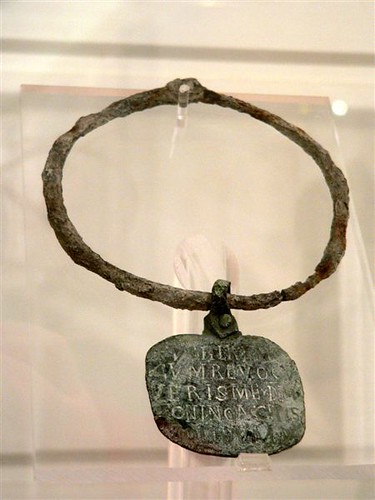
Roman Slave Medallion photographed at the
Terme di Dioclezione in Rome, Italy by
Mary Harrsch


With his adoptive father gone, Aquila spends his days in the surrounding hills hunting until one day he comes upon what appears to be an old shepherd.  However, Aquila discovers the man is really a one-eyed Celtic warrior named Gadoric who was captured by the Romans and masquerades as a feeble cripple to avoid being sent to Sicily to work on the large latifundias (farms owned by wealthy Roman senators) there.  The Celt is mystified by Aquila's tall, blonde appearance and feeling a kinship with the boy, teaches him to use a spear and a bow despite the fact that if the warrior, now a slave, should be found with weapons he could be crucified.

The Celt becomes a surrogate father to the youth and the two become inseparable.  But one day Aquila finds the Celt has been discovered and watches tearfully as his friend is led away in shackels towards Sicily.  More misfortune follows when his adoptive mother dies and he must go to live with the despised Piscius Dabo.

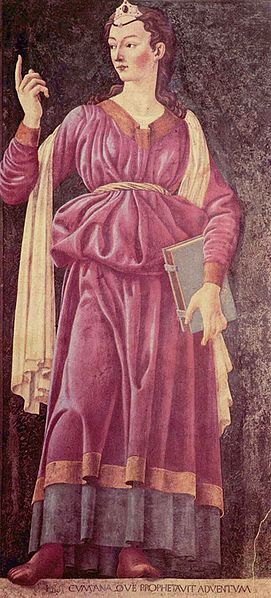
The other protagonist whose story runs parallel to Aquila's is Marcellus Falerius, son of Lucius Falerius, one of the two main characters from Book 1 who has, as yet, escaped the fate prophesied by the Sybil when Lucius and his boyhood friend Aulus clandestinely sought out the Sybil as children.

Cumaen Sybil by 
Andrea del Castagno 


One will tame a mighty foe, the other strike to save Rome's fame.
Neither will achieve their aim.
Look aloft if you dare, though what you fear cannot fly.
Both will see it before you die.

The old crone had scratched a drawing of an eagle in flight on a scrap of papyrus and tossed it to the two boys but as Lucius caught it, the image burst into flame, but not before searing the image into each boy's mind.

Before the climactic battle of Thralaxas at the conclusion of Book 1, Clodius, serving as a legionary under the great Macedonicus, had scratched his adopted son's eagle talisman in the dirt where Aulus stumbled across it before his bloody death at the Thermopylae-like defeat.  But Lucius is unaware that the first half of the prophecy has come to pass as he visits the tomb of his old friend at the beginning of Book 2.

Lucius Falerius grew up to become an ambitious politican and was the man who had ordered the murder of the tribune of the plebs (a character based on Tiberius Gracchus) because the man supported legislation to redistribute land to the poor.

A monument to the Gracchi by Eugene Guillame, French, 1853.
Photographed at the Musee d'Orsay by Mary Harrsch.


Falerius viewed this legislation as a move that would destroy the Rome he knew, directed by the wealthy elite known as the Optimates.  Although his ruthless act had caused quite a stir at the time, Falerius, claiming innocence, expertly manipulated the strings of power to overcome the opposition and become the first man in Rome.  Now aging, he works desperately to pass on his knowledge of the political machine to his son, Marcellus.  But Marcellus, actually the son of one of Falerius' barbarian slaves and Falerius' wife, unlike his "father", harbors an innate athletic ability that makes the martial arts come naturally to him.  Although he learns the political lessons his father drills into him, he, as yet, is not the ruthless singleminded individual his father has become.  And, he is beginning to chafe under his father's constant surveillance although he remains obedient to his father's commands.

This information is provided in the lengthy prologue as well as artfully woven throughout the fabric of the narrative as needed to make the novel stand on its own for readers who have not yet read Book 1, "The Pillars of Rome".

Then, "The Sword of Revenge" formally begins.

Flaccus, an old centurion who served with Aquila's adoptive father, shows up at the Nabo farm with a band of ex-gladiators on their way to take over the management of one of the large farms on Sicily.  Flaccus tells the boy of his adoptive father's death.  So, Aquila, without any further reason to stay, decides to throw in with Flaccus and his toughs and heads for Sicily hoping to find his old friend Gadoric.

Flaccus has made a bargain with the wealthy Cassius Barbinus, Aquila's vicious neighbor who owned Gadoric, to go to Barbinus' other farm on Sicily and "crack the whip" so to speak to improve the land's yield in return for a large percentage of the excess profit.

On the way to Sicily, some of Flaccus' ruffians sneak out at night to murder and pillage the surrounding countryside to enable them to buy wine and women.  I thought this was an excellent way Ludlow has chosen to introduce his readers to the dangerous environment of this period in Rome's history.  Such activities during this time were clearly described by Roman historian, Diodorus Siculus in his narrative about The First Servile War.

"With such licence given to men who had the physical strength to accomplish their every resolve, who had scope and leisure to seize the opportunity, and who for want of food were constrained to embark on perilous enterprises, there was soon an increase in lawlessness. They began by murdering men who were travelling singly or in pairs, in the most conspicuous areas. Then they took to assaulting in a body, by night, the homesteads of the less well protected, which they destroyed, seizing the property and killing all who resisted." - Diodorus Siculus

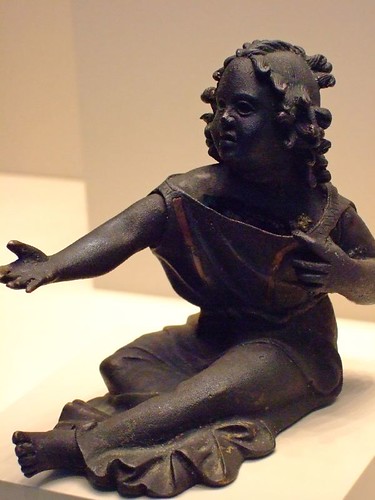
A bronze Roman coin bank depicting a beggar girl 25-50 CE.
Photographed at the Getty Villa by Mary Harrsch.


Once on Sicily, Flaccus,  implements a harsh regime, working not only the men but the women and children as he pushes hard to improve the farm's output.

"...they treated them with a heavy hand in their service, and granted them the most meagre care, the bare minimum for food and clothing. As a result most of them made their livelihood by brigandage, and there was bloodshed everywhere, since the brigands were like scattered bands of soldiers." - Diodorus Siculus

Soon a problem develops with runaway slaves who are banding together in the foothills and raiding the Roman estates.  This led to the revolt referred to as The First Servile War that lasted from 136 - 132 BCE.

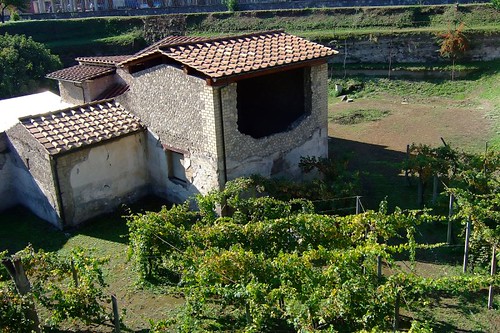
A Roman villa rustica excavated at Boscoreale near Naples, Italy.  Photo by
Mary Harrsch
The governor of Sicily calls for a meeting of the farming overseers to try to come up with a plan to avert the looming slave revolt.  Now a trusted bodyguard for Flaccus, Aquila goes with Flaccus to the meeting.  But on the way there he discovers his old Celtic friend, Gadoric, bound to a stake along the roadside in preparation for his impending crucifixion.

Aquila slips away from the meeting and when night falls, he overpowers the guards near the crucifixion site and frees his friend and a Palmyran Greek slave staked nearby named Hippolytas.

The rest of the novel focuses on the slave revolt eventually led by Aquila's friend and the mysterious Hippolytas who convinces the slaves on the island that he has oracular powers and demonstrates his ability to commune with the gods by spewing flames from his mouth.  This character is obviously based on the slave leader Eunus who led the slave revolt on Sicily in 136 BCE.

"There was a certain Syrian slave, belonging to Antigenes of Enna; he was an Apamean by birth and had an aptitude for magic and the working of wonders. He claimed to foretell the future, by divine command, through dreams, and because of his talent along these lines deceived many. Going on from there he not only gave oracles by means of dreams, but even made a pretence of having waking visions of the gods and of hearing the future from their own lips. 
Of his many improvisations some by chance turned out true, and since those which failed to do so were left unchallenged, while those that were fulfilled attracted attention, his reputation advanced apace. Finally, through some device, while in a state of divine possession, he would produce fire and flame from his mouth, and thus rave oracularly about things to come. 
For he would place fire, and fuel to maintain it, in a nut -- or something similar -- that was pierced on both sides; then, placing it in his mouth and blowing on it, he kindled now sparks, and now a flame. Prior to the revolt he used to say that the Syrian goddess appeared to him, saying that he should be king, and he repeated this, not only to others, but even to his own master." - Diodorus Siculus

Ludlow even has one of his characters confront Hippolytas about the use of the fuel-containing nut in his mouth to produce the illusion he throws flames from his mouth during his mystical prophesies.

Like Eunus, Hippolytas grows increasingly pompous as his superstitious followers become more insistent he assume the role of king of the slave army.  But Aquila, appalled by the brutality of the rebels and Hippolytas' growing greed, withdraws to the hills.

Meanwhile, back in Rome, an attempt is made on the life of Lucius Falerius.  To recover from his wounds, the old fox decides to seek solace in the south of Italy where he can direct the activities of Titus Cornelius, son of his late friend Aulus and now a military legate, and his own son, Marcellus, who are preparing a Roman military response to the slave revolt on Sicily.

Historically, the slaves take over the south central town of Enna and are eventually defeated there through siege and betrayal.

"Cities were captured with all their inhabitants, and many armies were cut to pieces by the rebels, until Rupilius, the Roman commander, recovered Tauromenium for the Romans by placing it under strict siege and confining the rebels under conditions of unspeakable duress and famine: conditions such that, beginning by eating the children, they progressed to the women, and did not altogether abstain even from eating one another. It was on this occasion that Rupilius captured Comanus, the brother of Cleon, as he was attempting to escape from the beleaguered city. 
Finally, after Sarapion, a Syrian, had betrayed the citadel, the general laid hands on all the runaway slaves in the city, whom, after torture, he threw over a cliff. From there he advanced to Enna, which he put under siege in much the same manner, bringing the rebels into extreme straits and frustrating their hopes. Cleon came forth from the city with a few men, but after an heroic struggle, covered with wounds, he was displayed dead, and Rupilius captured this city also by betrayal, since its strength was impregnable to force of arms." - Diodorus Siculus
Eunus is captured alive and thrown into prison where he sucuumbs to disease and dies at Morgantina.

"Eunus, taking with him his bodyguards, a thousand strong, fled in unmanly fashion to a certain precipitous region. The men with him, however, aware that their dreaded fate was inevitable, inasmuch as the general, Rupilius, was already marching against them, killed one another with the sword, by beheading. Eunus, the wonder-worker and king, who through cowardice had sought refuge in certain caves, was dragged out with four others, a cook, a baker, the man who massaged him at his bath, and a fourth, whose duty it had been to amuse him at drinking parties. 
Remanded to prison, where his flesh disintegrated into a mass of lice, he met such an end as befitted his knavery, and died at Morgantina." - Diodorus Siculus

Ludow, however, moves the action to the southern coastal city of Agrigentum where he treats us to an exciting naval battle between a rebel-converted merchant galley and a Roman trireme.

The revolt also ends quite a bit differently than in the history books as Aquila takes his revenge upon the Greek charlatan leaving blood-spattered images of his eagle talisman in his wake.  The sketches are dutifully copied and transmitted to none other than Lucius Falerius, thereby fulfilling the fateful prophecy.

Meanwhile, Marcellus visits the nearby cave of the Sybil and receives a prophecy of his own that sounds relatively benign.  The prophetess tells the young man he will inherit his father's fortune.  But, although Marcellus is unconcerned, it sent a shiver down my spine remembering that his real barbarian father was betrayed by Lucius Falerius and set upon by assassins who wounded him so severely that when he sought escape by jumping into the Tiber he could not withstand the strong current and drowned.

So, I'm looking forward to Book 3 of Ludlow's Republic trilogy, "The Gods of War" to learn how Aquila fulfills his destiny and if Marcellus escapes his fate.

Enhanced by Zemanta
If you enjoyed this post, never miss out on future posts by following me by email!