In attempts to lure more tourists to the archaeological sites of Rome, the Italian government has managed to divert money normally spent on staff bonuses and special projects to security details to monitor public access to sites that have been closed to the public for decades. I just hope they allow people to take time to fully appreciate the remnants of ancient art on display.
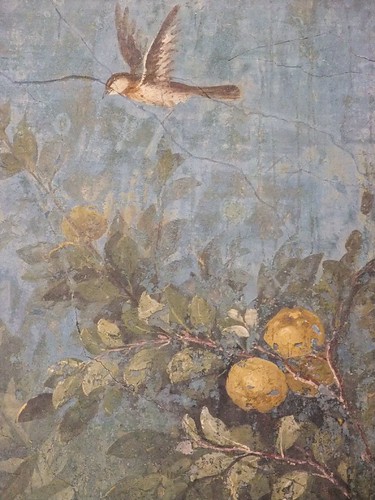
[Image - Mural from the triclinium of the Villa of Livia at Prima Porta, Roman, 1st century CE, exhibited at the Palazzo Massimo, Museo Nazionale Romano, Rome, Italy. Photograph by Mary Harrsch]When I visited the newly excavated rooms of the Villa of Augustus on the Palatine Hill this spring, I had to stand in a long queue only to be hustled through the viewing area for the rooms, which were sealed off with glass, and denied the opportunity to photograph anything even without a flash. I could not fully appreciate the detail of the frescoes or anything else with such a quick glance. I had intentionally looked for the Egyptian motifs that I had seen discussed on a History Channel presentation but could not readily identify them without more time to examine the frescoes more carefully. I imagine the visitors who came in the height of tourist season would have been given even less time to make the tightly controlled circuit through the remains with queues probably four times as long.
At least I was able to take all the time I wanted to examine and photograph the beautiful garden frescoes that once adorned the subterranean triclinium of the Villa of Livia now displayed in the Palazzo Massimo venue of the Museo Nazionale Romano (see image above left). I had a special low-light camera with me this time so was able to take a number of detail images of the lush foliage, flowers, fruit trees and birds that comprise that stunning work. The totally encompassing painting must have truly soothed the empress' guests with its pastoral calm. I would have loved to have toured the villa itself.
Among the attractions that await visitors is the House of Livia, once the home of the wife of the emperor Augustus. The two-story structure has been closed for more than two decades, but until October it will be open every Tuesday.
Buried under the ruins of the Domus Flavia, built by Nero and Domitian, are the remains of the so-called House of Gryphons, one of the most important residences of Republican Rome. Excavated in 1912, it is virtually unknown outside academic circles. It too is now open on Tuesdays.
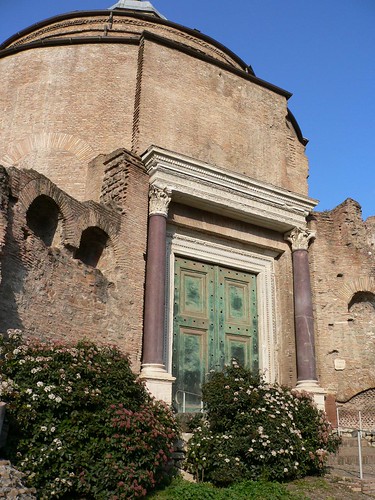
Behind its massive original bronze doors, the misnamed Temple of Romulus in the Roman Forum (it was probably the Temple of Jupiter Stator) shows evidence of the gradual merging of pagan religions with the Christian usurper. Like the so-called Oratory of the 40 Martyrs, decorated with eighth-century frescoes of soldiers who perished in frozen waters in Armenia, the temple is now open on Fridays.
[Image - Temple of Romulus in the Forum Romanum. Photo by Mary Harrsch]
One relatively modern attraction is the Loggia Mattei, which dates from the Renaissance, when some aristocratic families colonized the Palatine with landscaped gardens and small villas, often absorbing Roman ruins. Frescoes from a hall dedicated to the cult of Isis, the Egyptian goddess, have been brought here from another site on the Palatine. The loggia, built in the 16th century, was briefly open in 1997, Ms. Tomei said, “but even then we didn’t have enough custodians. Since then it’s fallen into oblivion.”
The ancient frescoes abut the newer loggia, which was painted by the workshop of Baldassare Peruzzi with mythological scenes. The decoration includes 12 roundels with signs of the Zodiac, panels that belong to the Metropolitan Museum of Art in New York. - More: New York Times
If you enjoyed this post, never miss out on future posts by following me by email!

 I always enjoy his insight that he has shared in numerous History Channel programs. Even after all of the years he has spent studying ancient Rome, he still talks about it with such marvelous enthusiasm. I had hoped to catch a glimpse of him when I visited Herculaneum in October 2007, but no such luck. I did watch some of his researchers working on this beautiful mosaic in a bath complex: