Showing posts with label Persia. Show all posts

Friday, July 9, 2021

The horse: A perfect gift to a Persian (or Parthian)

"For a nomadic people like the Persians, the horse had a significant practical and symbolic purpose and the importance of horses among the Iranian nobility is evidenced by the fact that many of them bore names compounded with the Old Persian word aspa – ‘horse’, observes Lloyd Llewellyn-Jones, Senior Lecturer in Ancient History at the University of Edinburgh.  "Several of Darius I’s inscriptions note that Persia was a land containing both good men and good horses (DZe §1; DPd §2) and Herodotus famously states that Persian fathers were intent on teaching their sons ‘to ride, to draw the bow, and to speak the truth’ (1. 136; see also Strabo 15. 3.18). The premium Persian horses were bred in the alfalfa-rich plains of Media, and it was here that the main royal stud farms were located (Polybius 10.70). Most prized of all were those steeds bred on the plains of Nisaea near Ecbatana and Bisitun, and Nisaean horses became celebrated for their magnificence, fine proportions, and swiftness (Herodotus 3. 106, 7. 40; Aristotle, History of Animals 9. 50.30). Nisaea is said to have sustained 160,000 horses (Diodorus 17.110), although stiff competition came from Media and Armenia which were also used for breeding good steeds (Strabo, Geography 11. 13.7; 11. 13.8, 14.9), as were the provinces of Babylonia (where one satrap possessed 800 stallions and 16,000 mares; Herodotus 1. 192), Cilicia (which provided an annual tribute of 360 white horses, Herodotus 3. 90), Chorasmia, Bactria, Sogdiana, and lands of the Saka which provided the Empire with its cavalry."

The Persepolis texts tell us that individuals who safeguarded the royal horses and officials serving as Masters of the Horse were paid well and enjoyed a diet of regular meat. Horses symbolized wealth and status and appeared in courtly ideology to model the ideal warrior image. They were also the center of aristocratic pastimes including hunting and racing.

According to Xenophon, the finest present to give a Persian was a horse and horses served as exceptional religious sacrifices.  

"As founder of the Empire, Cyrus II was honored with a horse sacrificed to his soul every month (Arrian, Anabasis 6. 29.7.)," states Llewellyn-Jones. "Moreover, the infamous tale recounted by Herodotus (3.85) of how Darius I acquired his kingdom through a trick involving the neighing of his horse is, in all probability, a Greek misunderstanding of the Iranian practice of hippomancy, or divination through the behavior of horses (see also Ctesias F13 §17), demonstrating the deep-set importance of the horse as a hallowed species in the Iranian consciousness."


Image: Procession of nobles, possibly from Palmyra, Syria, 100-150 CE, limestone, now in the collections of the Cleveland Museum of Art, image courtesy of the museum.

Palmyra was a key center for trade between the Roman and Parthian Empires. This unique relief at the Cleveland Museum of Art has been associated with Palmyra only through stylistic comparisons because its find spot is unknown. 

"It depicts men in Parthian dress riding Arabian horses with bejeweled harness trappings ahead of riders on camels—a possible reference to the caravans that made Palmyra so wealthy. Although all of the riders are dressed and equipped as Parthians, the proportions and perspective of the scene seem to be informed by Greco-Roman conventions. It may depict a ceremonial procession." - Cleveland Museum of Art

The museum defines the horses as Arabians but their body structure is quite stocky, not at all like the Arabian horses of our time. Yet, a 2017 study by evolutionary biologist Barbara Wallner at the University of Veterinary Medicine in Vienna concluded that nearly all modern horse breeds can be traced to two distinct, ancient Middle Eastern lines, the Arabian and the now extinct Turkoman horses from the Eurasian Steppe. Wallner and her colleagues studied variations in a segment of DNA along the Y chromosomes of 52 modern male horses that represented 21 modern breeds then expanded their analysis to include 363 males representing 57 modern breeds.  


If you enjoyed this post, never miss out on future posts by following me by email!


Saturday, February 13, 2021

Bust of a Priest with Silver Inlaid Eyes, Roman or Sasanian?

While I was researching the Cypriot ear spirals yesterday, I noticed this bronze bust of a priest with silver inlaid eyes dated from the 3rd - 4th century CE at the Miho Museum.  The museum identified it as late Roman but the museum's image had been shared on Flickr and I noticed that someone with the username eternal persia commented on the piece and insisted it was Sasanian.  He/she pointed to the monogram on the hat, clothes, hair design and leaves that decorate the bust and insisted these are Sasanian elements.

Intrigued, I researched the item a little further.  At first, most Sasanian portrait sculptures I reviewed were all bearded.  Then I saw an image of a relief depicting Kartir, a high priest and vizier serving during the reigns of Shapur I, Hormizd I, Bahram I, and Bahram II. Not only is Kartir clean shaven, he sports the corkscrew curls and crested hat worn by the priest of the bust at the Miho Museum.

Some scholars think Kartir may have been a eunuch, due to being depicted without a beard in the Sasanian reliefs. He first appears in historical records in Shapur I's inscription at the Ka'ba-ye Zartosht, which was most likely created between 260–262 CE. Kartir is the only religious bureaucrat mentioned in the inscription. Shapur I, termed a "lukewarm Zoroastrian", was known for his tolerance towards other religions. Although admiring the teachings of his own religion and encouraging the Zoroastrian clergy, Shapur I allowed the Jews, Christians, Buddhists, and Hindus to freely practice their religion. He was also friendly towards the founder of Manichaeism, Mani, whom he allowed to preach freely and even to be an escort in his military expeditions.

Shapur I's religious practices seems to have been somewhat unusual, though, with animal sacrifice being made for the soul of the kings and queens of the Sasanian family. Kartir, who "abhorred animal sacrifice" was unable to stop Shapur I from performing them. Shapur I died in 270 CE, and was succeeded by Hormizd I, who gave Kartir clothes that were worn by the upper class including the cap and belt (kulāf ud kamarband) and appointed him as the chief priest (mowbed).

Hormizd I died the following year and Bahram I, who was never considered a candidate for succession of the throne by his father, ascended the throne with the aid of Kartir, whose authority and influence had greatly increased. Bahram I then made a settlement with his brother Narseh who he asked to give up his entitlement to the throne in return for the governorship of the important frontier province of Armenia, which was constantly the subject of war between the Roman and Sasanian Empires.  Although Narseh held the title of Vazurg Šāh Arminān ("Great King of Armenia"), scholars think he probably still viewed Bahram I as a usurper.

Although previous Sasanian shahs had pursued a policy of religious tolerance towards the non-Zoroastrian minorities in the empire, with Bahram I's accession to the throne, and the rise of the authority of the Zoroastrian priesthood under the leadership of Kartir, this changed. When Mani, still the leader of the Manichaeists, arrived in the city of Gundishapur, Kartir and his cadre of Zoroastrian priest protested, viewing Mani as a threatening heterogeneous philosopher who presented an obscure perception of Zoroastrianism tainted by Jewish, Buddhist, and Christian ideas. Kartir pressured Bahram I to have Mani imprisoned and sentenced to death in 274 CE. Mani's death was followed by the persecution of his followers by Kartir and the Zoroastrian clergy, who used the persecution of religious minorities as a method to increase and spread their vast influence.  With the backing of Bahram I, Kartir laid foundations for Zoroastrianism's adoption as the state religion.

When Bahram I died, his son viewed Kartir as a mentor and granted him the rank of grandee (wuzurgan), and appointed him as the supreme judge (dadwar) of the whole empire.  Thereafter, Zorastrian priests were given the office of judge. Kartir's intolerance continued and his inscription at  Ka'ba-ye Zartosht boasts that he "struck down" non-Zoroastrian minorities, although modern scholars point out that Jewish and Christian sources makes no mention of persecutions during this period.

When Bahram III succeeded his father, Bahram II, something changed, however, in Kartir's relationship with the royal family.  Kartir inexplicably threw in his lot with Narseh and, along with a group of Sasanian nobles, supported Narseh's overthrow of Bahram III. But Narseh's reign  marked the return to the policy of religious tolerance which had been practiced by his father, Shapur I, all those years ago, and Kartir finally fades from history. 

Bust of a Priest with Silver Inlaid Eyes, Bronze and sliver, 3rd-4th century C.E., courtesy of the Miho Museum in Kyoto, Japan.


Relief of Kartir, the Zoroastrian high priest at Naqsh-e Rajab courtesy of Wikimedia Commons contributor درفش کاویانی.


If you enjoyed this post, never miss out on future posts by following me by email!


Sunday, February 7, 2021

Sasanian royal gifts of silver

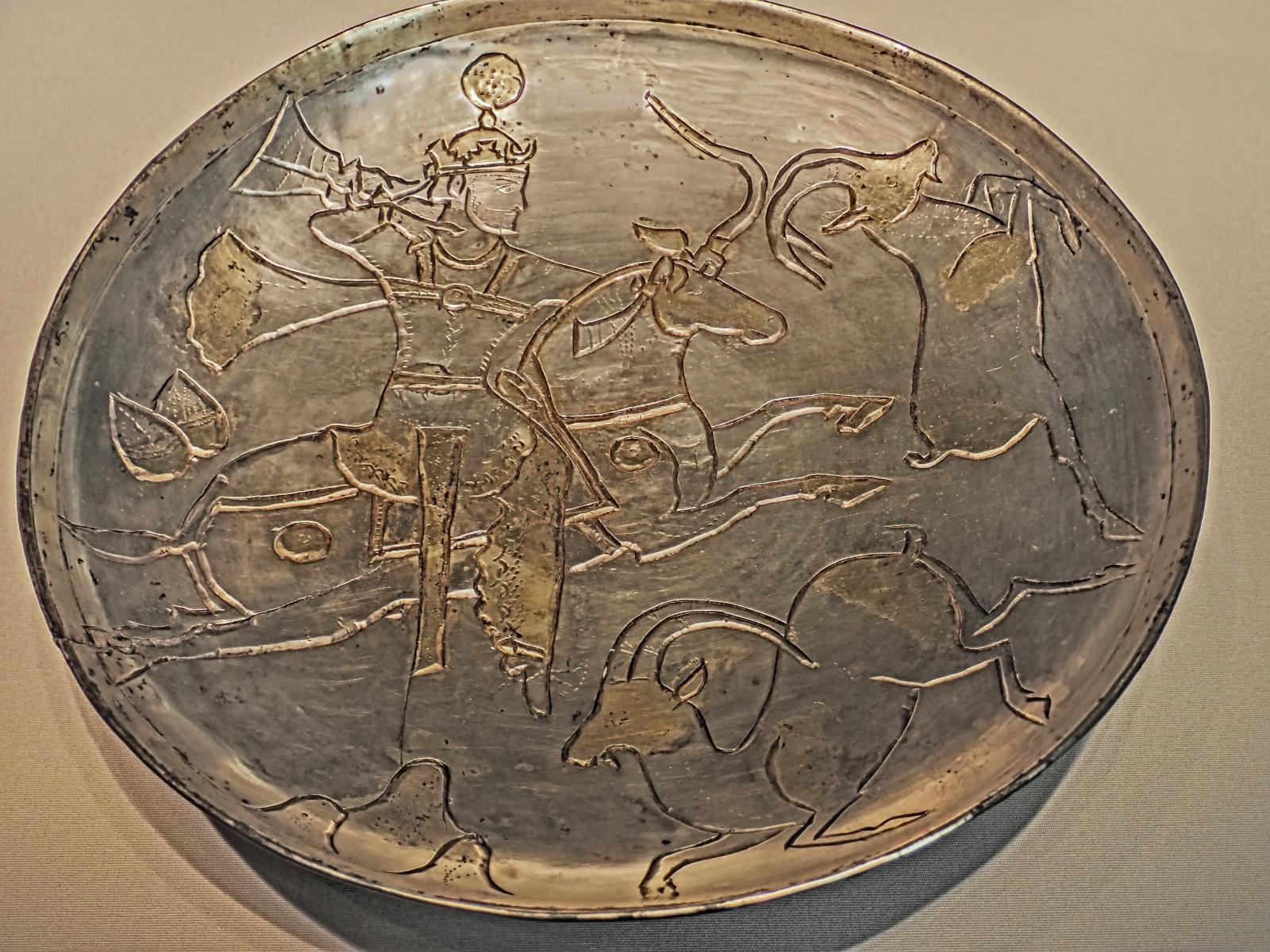
Sasanian silver plates were usually hammered into shape and then decorated using a variety of complex techniques.  Gilding was often used to highlight the hunter, usually the king, and sometimes extra pieces of metal were added to create high relief.

The king as hunter became a standard image on silver plates during the reign of Shapur II (r. 310–379 CE). The motif symbolizes the prowess of Sasanian rulers, and these royal plates were often sent as gifts to neighboring and vassal courts.  Some plates included inscriptions with the king's name and the plate's weight.  With other plates, art historians must attempt to identify the king by his distinctive apparel or shape of the crown he wears.  Each Sasanian king wore a different personal crown, which became more and more elaborate during the four centuries of the dynasty. Fortunately, the different crowns have been identified from coins or sometimes compared with existing rock reliefs with inscriptions such as those at Ṭāq-e Bostān or Naqš-e Rostam, Iran.

"In a few cases identification by crown can be reinforced by the presence of contemporary inscriptions. The best instance of this – and a very important example - is the Investiture of Ardašir I at Naqš-e Rostam. This magnificent relief shows two mounted horsemen, one handing the ribboned diadem or symbol of kingship to the other, and both with defeated enemies lying dead beside them. The left hand figure is wearing the skull-cap surmounted by korymbos, the final version of his personal crown developed by Ardašir (224-241 CE), seen on both his gold and silver coins. The figure on the right wears the mural crown, his hair arranged in a top-knot as well as falling in luxuriant curls to his shoulders." - iranicaonline.org 


King Hunting Plate, Sasanian period 4th-5th century CE silver and gilt courtesy of Wikimedia Commons contributor Daderot

Closeup of a Plate depicting a boar hunt Persia (Iran) Sasanian Period 4th century CE Silver and Gilt that I photographed at the Smithsonian's Sackler Gallery of Asian Art in Washington D.C.

Plate depicting a boar hunt Persia (Iran) Sasanian Period 4th century CE Silver and Gilt that I photographed at the Smithsonian's Sackler Gallery of Asian Art in Washington D.C.

Silver and gilt plate depicting winged horses Persian Sasanian Period 7th century CE that I photographed at the Smithsonian's Sackler Gallery of Asian Art in Washington D.C.

Sasanian Silver and Gilt Plate depicting a royal hunt Persia 7th century CE that I photographed at the Smithsonian's Sackler Gallery of Asian Art in Washington D.C.

Sasanian Silver plate with Shapur killing a deer, 4th century CE courtesy of Wikimedia Commons contributor Sailko.

Hunting scene depicting King Chosroes II. 7th century CE Sassanid, Cabinet des Medailles, Paris courtesy of Wikimedia Commons

The scene on this example is striking: the king is depicted standing and slaying a rearing stag, whose protruding tongue indicates that he is either dying or already dead. The king is identifiable as Yazdgard I (r. 399-420) due to his crown, although it is topped with a striated globe rather than the cloth-covered one with which he is normally represented. His beaded skirt resembles those shown on the rock reliefs of Shapur II (r. 310-379), Shapur III (r. 383-388) and Ardashir II (r. 379-383) at Taq-i Bustan, Iran. The crescent-tipped spear with a counterweight in the form of a human fist is unique amongst weapons represented on Sasanian silver plates. Image courtesy of the Metropolitan Museum of Art in New York.

Sivler Plate of Peroz I hunting argali, Sasanian, courtesy of the Hermitage Museum and Wikimedia Commons

King Hunting Plate, 303-309 CE, Sasanian, Iran, silver and gilt courtesy of the Cleveland Museum of Art


Hunting with a bowl Sasanian Great King; Iran; 7 Century, Museum of Islamic Art in Berlin (Pergamon Museum) courtesy of Wikimedia Commons contributor Anagoria

Sasanian Silver and Gilt Plate portraying a royal ibex hunt Persia 7th century CE that I photographed at the Smithsonian's Sackler Gallery of Asian Art in Washington D.C.


If you enjoyed this post, never miss out on future posts by following me by email!


Wednesday, January 27, 2021

Phoenician mortuary practices of the Achaemenid Period

The Phoenicians as a politically, religiously, and perhaps even ethnically distinct entity on the Levantine coast emerged at the end of the Late Bronze Age about 1200 BCE, as one of the successor cultures to the Canaanites.  From their homeland on the coast of the Levant, the Phoenicians spread throughout the Mediterranean and its islands including Cyprus, Sicily and Malta. Some scholars have observed that Iron Age Phoenicia was not a nation, but rather a collection of cities built around natural harbors along the coast. While they shared a common culture, these small states remained independent, competing with each other in the international marketplace. 

"Depending on how evidence is weighed [based on Ugaritic texts and classical sources], Phoenician religion might be presented on the one hand as inclusive and diverse – a “conservatively” polytheistic society easily able to incorporate or syncretize new deities, customs and traditions or on the other hand as highly place-specific – a model in which Phoenicians were devoted to city-gods only, with little shared pantheon above the local or regional scale," Helen Dixon, University of Michigan, observes.

This variety in religious practices initially resulted in the use of both cremation and inhumation in mortuary practices and funerary art often expressed influences by non-Phoenician ruling administrations like New Kingdom Egyptians, Assyrians, and Achaemenid Persians.  By the Achaemenid period, however, adult cremation abruptly disappears from sites in the Phoenician cultural sphere.  This corresponds with the increasing importance of Zoroastrianism in the 5th century BCE. In Zoroastrianism, water (aban) and fire (atar) are agents of ritual purity, and the associated purification ceremonies are considered the basis of ritual life. A corpse is considered a host for decay. Consequently, scripture enjoins the safe disposal of the dead in a manner such that a corpse does not pollute the good creation.

For inhumation burials, the use of sarcophagi during the Achaemenid period along with epigraphic evidence points to a consistent and insistent emphasis on the integrity of the burial. Deities, including Astarate, are invoked to assist with the procurement of blessings and to enforce curses and righteousness is defined by political accomplishments or the building of religious shrines.  Although Egyptian iconography persisted, it was supplemented by Persian iconography. A paucity of grave goods was referenced in inscriptions as a deterrent to grave robbing and what few ceramic vessels have been found in Phoenician burials have been ceremonially broken. Wealthier burials, though, apparently included the use of expensive resins such as myrrh to anoint, perfume or preserve the body and the deceased were dressed in special garments with head ornaments, particularly royal women whose head ornament was described as a gold bridle. However, there apparently were no extensive preparations for a “next life,” no large quantities of food or drink on which to survive or any biographical depictions or texts to accompany the dead. With the exception of the occasional appearance of amulets or other possibly apotropaic items, there was no preparation for an encounter with an underworld deity or space or expectation of  a future meeting one's deceased ancestors.

Read more about it in Dixon's dissertation, "Phoenician Mortuary Practice in the Iron Age I – III (ca. 1200 – ca. 300 BCE) Levantine “Homeland”:

https://deepblue.lib.umich.edu/handle/2027.42/99972

Sarcophagus made from Greek marble. burial grounds of Antarados, northern Lebanon. 480-450 BCE courtesy of Wikimedia Commons contributor McLeod

Anthropoid sarcophagi, from Sidon, 5th century BCE, National Museum of Beirut, Lebanon courtesy of Carole Raddato.


Phoenician sarcophagus of the fifth century BCE, from the Carthaginian colonization of Sicily. Discovered in Palermo. Regional Archaeological Museum of Palermo, courtesy of Wikimedia Commons contributor Giovanni Dall'Orto.


Sarcophagus of Eshmunazar II, king of Sidon, Phoenicia, ca first quarter of the 5th century BC.E. at The Louvre courtesy of Wikimedia Commons contributor Fred Romero.

Marble anthropoid sarcophagus, last quarter of the 5th century B.C.E., Graeco-Phoenician found on Cyprus at the Metropolitan Museum of Art.


Phoenician sarcophagus of the fifth century BCE, from the Carthaginian colonization of Sicily. Discovered in Palermo. Regional Archaeological Museum of Palermo, courtesy of Wikimedia Commons contributor Giovanni Dall'Orto.


Marble anthropoid sarcophagus, last quarter of the 5th century B.C.E., Graeco-Phoenician found on Cyprus at the Metropolitan Museum of Art.

Phoenician marble sarcophagus found in Cádiz. Spain, 5th century BCE, courtesy of Wikimedia Commons contributor Professor Ángel M. Felicísimo, University of Mérida.

Phoenician marble sarcophagus found in Cádiz. Spain, 5th century BCE, courtesy of Wikimedia Commons contributor Professor Ángel M. Felicísimo, University of Mérida.


If you enjoyed this post, never miss out on future posts by following me by email!


Sunday, January 24, 2021

Persian cavalry before the cataphractarii

The Persians did not use cavalry to a great extent until Cyrus the Great  gave the Persian nobility both horses and the wealth to maintain them from the proceeds of his western conquests. He encouraged them to ride and it became a source of disgrace for a Persian noble to be seen walking.  Cyrus then recruited his cavalry from the nobles, creating a regiment of 15,000 men drawn from the Huvaka or “kinsmen.” These kinsmen adopted brightly-colored trousers and shorter tunics that were more suitable for riding from the Medes.  Cyrus adopted cavalry tactics from the Khorassan horsemen of northeastern Iran, parts of modern Afghanistan and the southern parts of Central Asia. He initially armed his cavalry with the standard weapons of the Persian infantrymen: bows, battle-axes, and oval shields. Later, they were re-equipped with short stabbing swords and throwing javelins instead. Long lances and spears made of wood or entirely of metal were used too.

In the mid-5th century Persian cavalrymen adopted the use of wicker and leather shields.  They were designed after those carried by the Saka, a group of nomadic Iranian peoples who historically inhabited the northern and eastern Eurasian Steppe and the Tarim Basin.

According to Herodotus, at the time of the Persian invasion of Greece, Persian cavalry, assembled from a variety of contingents within the empire, were protected only by various kinds of soft headgear and wore no substantial body armor. This is reflected both in the 3rd century BCE Cypriot statuette as well as the famous Alexander mosaic from the House of the Faun in Pompeii.  Cavalry officers may have worn more protective armor, however, as indicated at the battle of Plataea where Masistius, a Persian cavalry commander, is reported to have worn gold scale armor under his scarlet surcoat. 

"When his horse was hit by an arrow, he defended himself vigorously on foot and could not be brought down by body blows. At last, the Athenians who surrounded him guessed the secret and struck at his face." - The Persian Achaemenid Army, weaponsandwarfare.com

Detail from the Alexander Mosaic from the House of the Faun in Pompeii depicting Achaemenid Persian cavalry at the Battle of Issus, 1st century BCE-1st century CE at the National Archaeological Museum in Naples courtesy of Wikimedia Commons contributor Lucas.


Terracotta statuette of a horseman, 3rd century B.C.E. Cyprus, at the Metropolitan Museum of Art in New York.


If you enjoyed this post, never miss out on future posts by following me by email!


Thursday, December 17, 2020

The Arch of Galerius

 The Roman emperor Galerius commissioned the triple Arch of Galerius, built in 298-299 CE and dedicated in 303 CE,  as an element of the imperial precinct linked to his palace in Thessaloniki, Greece. Galerius served as Caesar during the tetrarchy of Diocletian and married Diocletian's daughter.  Entrusted with the care of the Illyrian provinces, he campaigned against Sarmatians and Goths along the Danube then was  dispatched to Egypt to fight the rebellious cities Busiris and Coptos. From there, Galerius was sent to command the eastern forces between Carrhae and Callinicum in Syria.

Then, in about 295 CE, Narseh, son of the king Shapur I and the seventh emperor of the Sassanid Persian Empire, declared war on Rome and invaded western Armenia. Narseh then moved south into Roman Mesopotamia, where he inflicted a severe defeat on Galerius. Diocletian may or may not have been present at the battle, but presented himself soon afterwards at Antioch, where the official version of events was made clear: Galerius was to take all the blame for the affair. In Antioch, Diocletian forced Galerius to walk a mile in advance of his imperial cart while still clad in the purple robes of an emperor. The message conveyed was clear: the loss at Carrhae was not due to the failings of the empire's soldiers, but due to the failings of their commander. 

However, after Galerius' army was reinforced in 298 CE, Galerius lead an offensive into northern Mesopotamia by way of Armenia. To Narseh's disadvantage, the rugged Armenian terrain was favorable to Roman infantry, but not to Sassanid cavalry. Local aid gave Galerius the advantage of surprise over the Persian forces, and, in two successive battles, Galerius secured victories over Narseh. At the Battle of Satala, Roman forces seized Narseh's camp, his treasury, his harem, and his wife. Narseh's wife would live out the remainder of the war in Daphne, a suburb of Antioch, serving as a constant reminder to the Persians of the Roman victory. The Romans, in any case, treated Narseh's captured family well, perhaps seeking to evoke comparisons to Alexander and his beneficent conduct towards the family of Darius III.

At the crux of the major axes of the city of Thessaloniki, the Arch of Galerius emphasized the power of the emperor as embodied by his conquests.The arch is composed of a masonry core faced with marble sculptural panels celebrating his victories. 


I found this closeup of one of the arch's panels up on Flickr courtesy of Dan Lundberg  (cc by sa 2.0).  In the center an eagle brings a victory wreath to a mounted Galerius who is overpowering the Persian shah Narseh on his own horse—a confrontation that never occurred.

More images of the arch panels can be found here:

https://commons.wikimedia.org/wiki/Category:Arch_of_Galerius_(Thessaloniki)_-_Reliefs


If you enjoyed this post, never miss out on future posts by following me by email!


Tuesday, November 24, 2020

Alectryomancy and the sacred rooster

Since antiquity, the rooster has been, and still is, a sacred animal in some cultures and deeply embedded within various religious belief systems and religious worship. In ancient Babylon the rooster was considered the bird form of the True Shepherd of Anu and was considered the ordained herald of the gods. Nergal, a deity whose name meant "dunghill cock" or fighting cock, was worshipped by the Assyrians, Babylonians, Phoenicians, and Persians.  The term "Persian bird" was given to the cock by the Greeks after Persian contact "because of his great importance and his religious use among the Persians." This stems from the sacred nature of the cock, attested to in the texts of Zoroastrianism,  during the legendary Kayanian Period from about 2000 BCE to about 700 BCE. 

Perhaps because of their ancient association as a divine messenger, roosters played an important role in both Etruscan and Roman religion.  Observing a rooster's willingness to eat grain kernels as a means to divine the omens for battle, marriage, or some other important action, known as alectryomancy, was frequently practiced. The Etruscans, established an elaborate ritual of alectryomancy using a hen to find answers for life's most pressing problems. The process involved a circle, which was divided into twenty parts to represent the Etruscan alphabet and each sector was sprinkled with corn. The bird is placed at the middle and the sequence of its pecking was recorded.  Roman rituals, building upon the practices of the Etruscans, were conducted with such an extraordinary level of organization that they are considered unparalleled among ancient civilizations.  A rare form of alectryomancy practiced by the Romans included divination by a cock-stone, a crystal-colored stone found in a rooster's crop that was considered to have magical powers.

The cockerel was already of symbolic importance in Gaul at the time of the invasion of Julius Caesar and was associated with the god Lugus, a Celtic deity who the Romans believed to be equivalent to Mercury.  Of the six Celtic gods identified by Caesar as those worshipped in Gaul, Caesar thought Lugus was the most revered, describing him as patron of trade and commerce, protector of travelers, and the inventor of all the arts. Lugus' (Mercury's) importance is supported by the more than 400 inscriptions referencing him in Roman Gaul and Britain. However, Unlike the Roman Mercury, who is typically a youth, Gaulish Mercury is occasionally also represented as an old man.


Closeup of a Roman opus vermiculatum mosaic depicting two cocks who confront each other in combat before a table displaying the winner's prizes: the purse (a moneybag) flanked by a caduceus and a palm of victory at NAM Naples courtesy of Carole Raddato. 


.  A mosaic of a slave with two roosters from Pompeii 1st century BCE - 1st century CE at the NAM Naples courtesy of Wikimedia contributor Amphipolis.  


Mosaic of a cockfight from Pompeii (Casa del Labirinto, VI.11.10) in the Museo Archeologico Nazionale in Naples courtesy of Wikimedia Commons contributor Sailko. 


Children Watching A Cockfight, Greek, Amisos, Asia Minor, 2nd century - 1st century BCE, Terracotta, that I photographed at the Walters Art Museum in Baltimore, Maryland.
Terracotta statuette of a boy and a rooster, Greek, Asia Minor, Pontus 2nd century BCE that I photographed at the Metropolitan Museum of Art in New York.


Roman mosaic of a colorful cockerl that I photographed at the Terme di Diocleziano venue of the National Musem of Rome


Etruscan askos in the form of a rooster, 4th century BCE, at the Metropolitan Museum of Art in New York courtesy of the museum.


Terracotta skos (flask with a spout) in the form of a cock, Italic 2nd half of the 3rd century BCE at the Metropolitan Museum of Art. Askoi shaped like animals were commonly used as lamp fillers; the oil was introduced into the askos via the small inlet off to the side, and was then poured out through a tiny hole under the beak into the lamp in a smooth and controlled stream. 


If you enjoyed this post, never miss out on future posts by following me by email!


Thursday, July 16, 2020

The Oxus Treasure and the challenges of provenance

The Oxus Treasure is a collection of about 180 surviving pieces of metalwork in gold and silver from the Achaemenid Persian period which were found by the Oxus river about 1877-1880.  The metalwork is believed to date from the sixth to fourth centuries BCE and is thought to belong to a temple where votive offerings were deposited over a long period. Sculptural objects include two model chariots in gold, one incomplete, plus figures of a horse and a rider that may belong to this or other model groups, as may two other horses cut out from sheet gold. The wheels of the complete chariot would originally have turned freely, and it had received at least one repair in antiquity. It is pulled by four horses (rather small, and with only nine legs surviving between them) and carries two figures, a driver and a seated passenger, both wearing torcs. The chariot has handrails at the open rear to assist getting in and out, while the solid front carries the face of the protective Egyptian dwarf-god Bes.  Another exceptional piece is thought to be a gold cap ornament (aigrette) that reflects Scythian influence in the folded legs of the recumbent lion-griffin with wings, straight horns, long pointed ears, and a curled tail. There are cavities for inlay on the flank and shoulder. At the back of the plaque are two long prongs for attachment. The two griffin-headed bracelets or armlets recovered from the site are considered by some the most spectacular pieces, despite lacking their stone inlays. There are a number of other bracelets, some perhaps torcs for the neck, several with simpler animal head terminals variously depicting goats, ibex, sheep, bulls, ducks, lions, and fantastic creatures. Many have inlays, or empty cells for them. It used to be thought that this technique was acquired from Ancient Egyptian jewelry (as in some of Tutankhamun's grave goods), but Assyrian examples are now known.

The circumstances of the discovery and trading of the pieces, and their variety of styles and quality of workmanship, cast some doubt on their authenticity from the very beginning.  Indian dealers initially made copies of items and tried to pass them off to Franks, who though not deceived, bought some "at a small percentage over the gold value" and then received the genuine objects, which were easily distinguished.  Since then later  Achaemenid finds of jewelry including armlets and torcs in a tomb at Susa by a French expedition from 1902 , excavated under proper archaeological conditions, closely resemble objects found in the Oxus Treasure and are considered contemporary evidence of their ancient source.

Gold four horse chariot model, Achaemenid Period 5th-4th centuries BCE, Oxus Treasure at the British Museum
courtesy of Wikimedia Commons contributor Cristian Bortes

Lion-griffin hat ornament (aigrette), gold, Achaemenid Period, 5th-4th centuries BCE, Oxus Treasure at the British Museum
courtesy of the museum

Griffin-embellished gold armlets, Achaemenid Period, 5th-4th centuries BCE courtesy of Wikimedia Commons contributor Marie-Lan Nguyen.


If you enjoyed this post, never miss out on future posts by following me by email!


Thursday, April 9, 2020

The Lion Strangler: Symbol of Power in Ancient Persia

Achaemenid Lion Strangler at the Cleveland Museum of Art in Cleveland, Ohio.
A hero strangling a lion was an enduring motif in the ancient Middle East. Possibly referring to the myth of Gilgamesh or Herakles, it was considered a symbol of Persian royal power. As a royal symbol it was already fully developed in the art of the Protoliterate period beginning approximately in 3500 BCE. In its earliest manifestations, the lion strangler was thought to depict the hero protecting the sacred flocks of the goddess of fertility. This concept was gradually replaced by the idea it reflected the eternal conflict between man and beast where man represented the defender of order and civilized life against the the chaotic forces of nature. Likewise, Gilgamesh in the early Sumerian epic, slew several monsters including Huwawa and the Bull of Heaven in such symbolic contests. Eventually, though, the iconography of the lion strangler simply became a symbol of power favored by kings who viewed themselves as powerful and brave enough to strangle a lion with their bare hands. The motif of the lion strangler continued in popularity long after the Muslim conquest and found its way to Islamic Spain where it adorned silk textiles. From there it was passed to the rest of Europe and was adopted by Romanesque sculptors for the decoration of capitals.


Image: Median Lion Strangler carved in Lapis Lazuli, Persian, Achaemenid Period, 1st half of the 5th century BCE.
If you enjoyed this post, never miss out on future posts by following me by email!


Tuesday, April 7, 2020

The Royal Nisean Horse of Ancient Persia

The horse was a favorite artistic subject in ancient Iran, where horsebreeding flourished. This muscular Sasanian stallion was descended from the royal and sacred Nisean breed of the Achaemenian Persians. Although now extinct, Nisean horses were highly sought after in the ancient world. The ancient Greeks called him the Nisean after the town Nisa, where he was bred but the Chinese called him the Tien Ma – Heavenly Horse or Soulon-Vegetarian dragon. The horse came in a variety of colors including the more common dark bay, chesnut and seal brown but also the more rare black, roan, palomino, and various spotted patterns. The royal Nisean was the mount of the nobility in ancient Persia. Two gray Nisean stallions pulled the King of Kings’ royal chariot, while four of the regal animals pulled the chariot of Ahura Mazda, the supreme god of Persia and Medea. Cyrus the Great was so distraught when one of his stallions was drowned while crossing a river, he had the river where the horse was drowned drained. He did not believe that anything could kill a horse so beautiful.
The Greeks (mainly, the Spartans) imported Nisean horses and bred them to their native stock. The Romans had their first encounter with the Nisean and the Parthian cataphract at the disastrous Battle of Carrhae. Later, when Marc Antony avenged Marcus Licinius Crassus and his legions lost at Carrhae by ravaging Armenia, his plunder included the first Nisean horses in Rome. Later, when Antony died in Egypt, Augustus seized the horses. The Nisean became extinct with the conquest of Constantinople in 1204.
Although Sasanian horse-trappings were elaborate, they did not include stirrups for mounting. In this rendition, the steed lies still, as camels in the Near East do today, waiting for its rider to mount. The medallions on each shoulder contain busts, perhaps of rulers of different parts of the Sasanian Empire, holding their rings of authority. Images courtesy of the museum.

Silver Sasanian Horse-Shaped Drinking Vessel 200-325 CE at the Cleveland Art Museum in Cleveland, Ohio

Silver Sasanian Horse-Shaped Drinking Vessel 200-325 CE at the Cleveland Art Museum in Cleveland, Ohio

If you enjoyed this post, never miss out on future posts by following me by email!


Saturday, May 21, 2016

Review: The Last Roman: Triumph

A history resource article by Mary Harrsch © 2016

The final chapters of Flavius Belisarius' life are the focus of Jack Ludlow's third and final installment in his series "The Last Roman" subtitled "Triumph".  In the second book, "The Last Roman: Honour", Flavius fights a vicious battle on two fronts as he struggles to retake the Italian peninsula for his emperor, Justinian I, while the empress Theodora, consumed with jealousy and paranoia, tries to thwart his success, both clandestinely and overtly.  Flavius, undermanned, poorly supplied and saddled with ambitious disloyal subordinates,  ends up having to resort to subterfuge to capture the Goth capital of Ravenna.  He receives an offer of the crown of the Western Roman Empire and allows the Goths to believe he is willing to accept it to obtain their surrender.  But this ruse does not go unnoticed by the treacherous Theodora and, although Flavius publicly refuses the crown that would have made him equal in rank to Justinian,  he is abruptly recalled to the imperial court in Constantinople to explain himself.

As book three opens, Flavius returns to Constantinople with the Goth treasure for the imperial coffers.  But, the imperial sycophants, fearful of the ruthless Theodora, whisper of his imminent downfall as his requests for an audience are ignored day after day.


"Not even the government officials could approach the Empress without expending much time and effort. They were treated like servants and kept waiting in a small, stuffy room for an endless time. After many days, some of them might at last be summoned, but going into her presence in great fear, they very quickly departed. They simply showed their respect by laying face down and touching the instep of each of her feet with their lips; there was no opportunity to speak or to make any request unless she told them to do so. The government officials had sunk into a slavish condition, and she was their slave-instructor." - Procopius, Anecdota

Proskynesis depicted on a Byzantine-era ivory plaque.  Image courtesy of Wikimedia Commons.

In the streets of Constantinople, however, Flavius is openly revered and can walk among the people without a single bodyguard.  This infuriates the empress Theodora even more, since she remembers how she and Justinian nearly met a grisly fate at the hands of the mob during the Nika riots early in Justinian's reign.

Finally, Flavius is confronted by a publicly hostile Justinian. But after what appears to be a great show of imperial displeasure, Flavius is asked to attend Justinian in his private chambers.  There, Justinian's royal posturing dissolves into nervous pacing as Flavius is briefed on serious Sassanid incursions that are eating away at the eastern frontier.  Flavius realizes Justinian, who refuses to publicly cross his vicious empress, was putting on a show for her benefit, but actually needs Flavius' help and has not forgotten their friendship.

As we saw in book two, Justinian, like many of his predecessors, maintained the empire's long standing policy of averting outright war with the Sassanids by the payment of subsidies.

The Sassanian Empire was founded by Ardashir I in 224 CE, after the fall of the Parthian Empire and the defeat of the last Arsacid king, Artabanus V.   Just six years later, Ardashir's son, Shapur I begins a centuries-long cycle of Persian incursions and Roman retaliation when he raids deep into Roman territory in 230 CE.  Territory ebbs and flows between the two superpowers until Shapur finally engineers a highly advantageous peace treaty with the Roman emperor Philip the Arab in 244 CE, securing the immediate payment of 500,000 silver denarii and further annual payments.

Ghal'eh Dokhtar (or "The Maiden's Castle") in present-day Fars, Firuzabad, Iran, built by Ardashir in 209, before he was finally able to defeat the Parthian empire.  Photo courtesy of Wikimedia Commons.
The Sassanid king comes to rely upon these subsidies to pay Persian nobles to ensure their loyalty and keep him in power.  This arrangement does not last, however, when Shapur's forces, attempting to exploit past successes, advance into Asia Minor in 260 CE and suffer a catastrophic defeat at the hands of the Romans led by Marcus Claudius Ballista and their Palmyrene ally Odaenathus.  (For an exciting series about this period, check out Harry Sidebottom's "Warrior of Rome" series of novels beginning with "Fire In the East".)

But maintaining troops is expensive and eventually Rome again resorts to paying subsidies sporadically to avoid the monumental cost of engaging in a full scale war with the Sassanids.  This continues for the next 270 years.  During that time, frontier skirmishes are used as a way for Sassanid kings to periodically extort more Roman gold whenever Persian nobles once more become contentious.

During one of these restless periods, a very young Flavius Belisarius faces the armies of Kavadh I, defeating them at the famous battle of Dara in 530 CE (detailed in book two).  But ten years have passed now, and as they say, glory is fleeting.   Justinian now expects Flavius to face the forces of Kavadh's son Khosrow I, but without adequate supplies, money or Flavius' fiercely loyal bucellarii, his personally trained armored cavalry.

Gilt-Silver plate depicting King Khosrow I hunting.  Sassanid 6th century CE.  Image courtesy of Wikimedia Commons.
Meanwhile, Theodora, not to be outwitted, sends Flavius' duplicitous wife, Antonina, Theodora's creature, east as well to keep tabs on Flavius.  Then the so-called Justinian's plague sweeps the empire.  Among the victims is the emperor himself so the troops turn to Rome's most respected general for leadership.

Ludlow's taut narrative keeps the reader immersed in the unending court intrigues and the military challenges Flavius faces as he doggedly attempts to remain loyal to an emperor that has allowed court politics to blind his once formidable administrative acumen.  Knowing that Theodora died of breast cancer at the relatively young age of 48, twenty years before Flavius and Justinian, I hoped that Flavius could at last put aside his loveless marriage originally engineered by Theodora, and enjoy at least some modicum of peace.  But, like toxic waste, Theodora's legacy of suspicion and paranoia lingers between Justinian and Flavius, a fate I felt Flavius did not deserve.  At least Justinian did not blind Flavius, as a popular medieval legend maintains, although the emperor periodically seizes Flavius' estates and allows him to be prosecuted on trumped up charges of corruption.

I realized as I finished this novel that the title did not refer to a military triumph, as I had originally assumed, but to Flavius Belisarius' triumph of maintaining his honor despite numerous imperial and personal betrayals throughout his tumultuous life. For this seemingly impossible achievement alone, I felt the Belisarius of Ludlow's novel truly earned his moniker as "The Last Roman."

A free Kindle preview:


Other suggested readings:


If you enjoyed this post, never miss out on future posts by following me by email!