Tuesday, March 5, 2013

Review: The Joy of Sexus by Vicki León


Vicki León has been out collecting ancient trivia again and this time her subject is sex.  In her latest collection of the obscure, she has assembled anecdotes about ancient aphrodisiacs, wandering wombs, practitioners of erotic mysteries and victims of doomed love.

By reading her book I learned about Callipygia worship - a fixation on a person's derriere - and divine gender-bending that affected such ancient prophets as Teiresias the Seer.  I think my favorite passage from the book, though, was a retelling of the story of Pherenike of Rhodes.

I have not studied ancient Greece as extensively as I have studied Republican Rome so, although I knew that the ancient Greek Olympics were conducted in the nude and that women were not allowed to attend, I had never read any background material to explain why.  León provided me with all the information I could have hoped for in her passage about Pherenike of Rhodes.

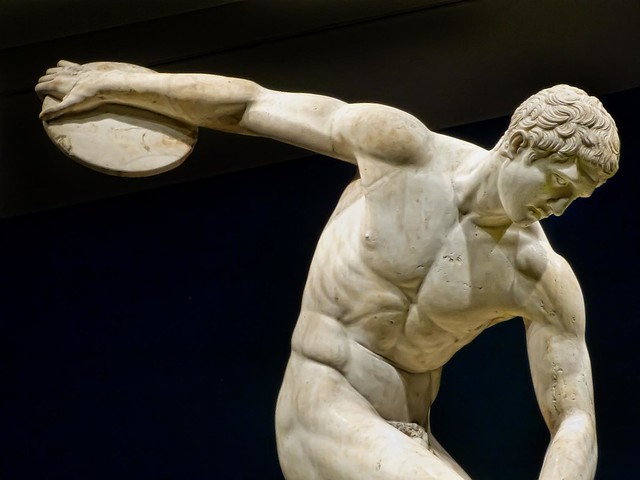
Diskobolos (discus thrower) 2nd century CE Roman copy of  450-440 BCE 
Greek bronze by Myron recovered from Emperor Hadrian's Villa in Tivoli, 
Italy.  Photographed by Mary Harrsch at the Body Beautiful exhibit at the 
Portland Art Museum, Portland, OR.
It seems that Pherenike was a young woman born into a family of Olympic victors.  Her father was a champion boxer at the Olympic Games in 464 BCE.

"Her big burly brothers continued the winning streak.  In boxing and the ferocious boxing-wrestling event called the pancratium, Pherenike's brothers swept six different Olympic Games." - Vicki León, The Joy of Sexus

León goes on to surprise me by observing that Pherenike probably watched her athletic family compete in the games when she was a young girl and later before her marriage.  Apparently, young virgins were allowed to watch the games - just not married matrons!

Then León continues saying Pherenike also married a famous athlete named Callianax and bore two sons who also trained for the Olympics.  Pherenike's older son, Eucles, won his boxing event but, because Pherenike was now married, she was not able to witness his victory.

A few years later, Pherenike's younger son Pisodorus entered his name as a contender for the boys boxing competition but before he could complete his ten months of training, Pherenike's husband died.  So, secretly Pherenike took up the mantle and resumed training her son dressed in the male garb of an official trainer.  When his time came to report for the 388 BCE Olympics, his mother went with him disguised in the full length robe of a trainer and carrying the traditional wooden staff.

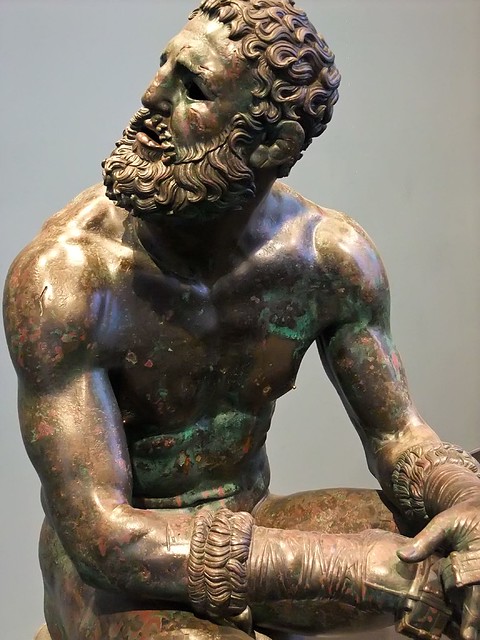
Boxer Resting 1st century BCE Roman copy of 3rd century 
Greek original by Apollonius.  Photographed at the Palazzo
Massimo in Rome, Italy by Mary Harrsch.

When her son was ultimately victorious, Pherenike, forgetting her precarious situation since a woman attending the forbidden event faced the death penalty of being thrown from the Typaeum cliffs, let out a high-pitched whoop and jumped over the fence to run and kiss her son.

"Either the high-pitched sound of her voice, or perhaps what her jump over the fence revealed, blew her disguise." - Vicki León, The Joy of Sexus

Fortunately for Pherenike, the ten Olympic judges decided not to punish her because of her illustrious family's contributions to the games, but forever after both trainers and athletes were decreed to appear in the nude.

So now I know why athletes are always depicted in the nude on all of those red and black-figure vases!

I also learned about Koan silk, a sheer see-through fabric.  I guess I hadn't kept up on all the latest discoveries and still thought silk worms were a closely guarded secret until much later in history than ancient Greece.  León reveals that some silk worms were purloined by the ancient Persians and made their way to the Greek islands of Amorgos and Kos.  Unlike the Chinese, who killed the worm to harvest the silk from their cocoons, the Greeks let the worm emerge naturally, breaking the threads as it went.  Then, using the same method they used with flax known as hackling, the women produced a gossamer silk that commanded a premium price.  The silk was so popular that Aristophanes referred to it in his play Lysistrata where women go on a sex strike to keep their men from going to war and sexually tease their husbands by prancing around "naked in their Amorgian chitons."

Apparently, in a surviving letter from Plato, the famous philosopher (and León questions "cheapskate?") orders three tunics for the daughters of a host but says "not those expensive Amorgian ones!" (I always love little tidbits that reveal what kind of person  a famous ancient was!)

The fashion eventually reached Rome and León found a quote from Pliny who called Koan silk "the vestments that cover a woman while at the same time revealing her naked charms."

These wonderful little glimpses about the truly personal lives of the ancients is what makes León's book so enjoyable.

There were only a couple of missteps that made me say "What?"  In her chapter about Alexander and Hephaestion, León explains that the Macedonians defeated the Persians at the battle of Issus. Then in the next sentence she says Persian King Darius was killed and his queen Statira captured. (p. 69 - 70) She may have been simply trying to condense the chapter but it makes it sound like Darius was killed at the battle of Issus and, of course, he wasn't.  Darius was killed some time after he fled the battle of Gaugamela and was assassinated by his own officers, who hoped to impress Alexander.  Alexander was not impressed with their treachery and ordered their execution.

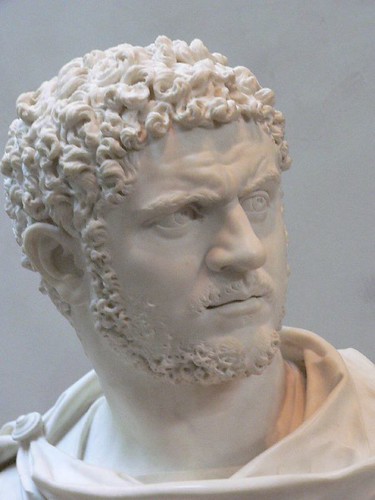
Roman emperor Caracalla by Italian sculptor
Cavaceppi 1750 CE after ancient original.
Photographed by Mary Harrsch at the
J. Paul Getty Museum in Los Angeles, CA

León made another confusing statement about the Roman emperor Caracalla.  She alluded to his death being the result of too many mistresses and a gladiator.  Although Caracalla may have dallied with too many mistresses and maybe a gladiator, too, this sounded much more like Commodus.  Caracalla was killed by a member of his own body guard when he stopped to relieve himself while marching with his army near Carrhae during a war with Parthia.  Historian Cassius Dio said the assassin, Martialis, was disgruntled for not being promoted to the rank of centurion.

But, I salute Vicki for such a revealing and fascinating look at lust, love and longing in the ancient world!

If you enjoyed this post, never miss out on future posts by following me by email!


Tuesday, February 19, 2013

Getty to Extend "Lion Attacking a Horse" Exhibit


I just got back from LA but didn't have time to go see this beautiful monumental sculpture.  Maybe I'll get another chance!

THE GETTY VILLA EXTENDS DATES FOR LION ATTACKING A HORSE  

Now through May 6, 2013

LOS ANGELES—The Getty Museum announced today that the monumental sculpture Lion Attacking a Horse, on loan from the Capitoline Museums in Rome, will be on extended view at the Getty Villa until May 6, 2013. Presented for the first time outside Rome, where it has not been on public view since 1925, the sculpture is the centerpiece of a special installation that traces its history from antiquity to the modern era and showcases recent conservation work undertaken in Rome.


“We are thrilled to have the celebrated Lion Attacking a Horse on view for an additional three months,” says Timothy Potts, director of the J. Paul Getty Museum. “This ancient masterpiece is one of the most storied sculptures to have survived from antiquity and is a dramatic addition to the Villa’s galleries as the first work of art visitors see when entering the Museum. We are grateful to our colleagues at the Capitoline Museums for agreeing to extend the loan period.”
Created in the era of Alexander the Great, Lion Attacking a Horse was a trophy of war in imperial Rome before it became a symbol of justice in the medieval city.  The sculpture’s image of savage animal combat was admired by Michelangelo and inspired generations of artists. On the Capitoline Hill, its presence heralded the Renaissance spirit, laying the foundation for the world's first public art collection. For many years, the lion-and-horse image served as the emblem of Rome before being replaced by the famous statue of a she-wolf suckling the twins Romulus and Remus.
Part of “The Dream of Rome,” a project initiated by the Mayor of Rome Giovanni Alemanno to exhibit timeless masterpieces from the city of Rome in the United States, the installation also includes related works from the Getty Museum and Getty Research Institute’s collections, as well as from private lenders.
In August 2012, the J. Paul Getty Museum and the Capitoline Superintendency of Roma Capitale signed a bilateral agreement for cultural collaboration that established a general framework for cooperation on conservation and restoration projects, exhibitions, long-term loans, conferences, publications, and other kinds of cultural exchange. Lion Attacking a Horse is the first major loan to arise from this agreement.
Other cultural partnerships between the Getty Museum and Italian institutions include the Sicilian Ministry of Culture and Sicilian Identity and the Museo Archeologico Nazionale in Florence, which will result in a number of exhibitions and cultural exchanges over the coming years. - Getty Press Release

Enhanced by Zemanta
If you enjoyed this post, never miss out on future posts by following me by email!


Friday, February 1, 2013

A Conversation with "Medicus" series author Ruth Downie


I have enjoyed Ruth Downie's "Medicus" series since I read her very first novel in the series "Medicus: A Novel of the Roman Empire" ("Medicus and the Disappearing Dancing Girls" for you UK readers).  I've followed her hero, Gaius Petreius Ruso, from Roman Britain to Gaul and back again, reviewing his latest adventure, "Semper Fidelis" just a few weeks ago.  Whenever I read a book with a Roman setting and a captivating protagonist, a number of questions about the author's interest in ancient Rome, some of her challenges in character development and research sources invariably arise.  This time, the author has generously offered to answer some of my questions and has allowed me to share her responses with you.

Ruth Downie, author of the "Medicus"
series of novels set in Roman Britain.
Image courtesy of Amazon.
Mary: What aspect of Roman civilization do you find most interesting?

 Ruth: What fascinates me is the contrast between the way Roman culture seems very familiar to us and the ways in which their thinking was so completely different. We can identify with the use of technology, the political bickering, the complex administration, the vast gap between rich and poor – and yet how could they accept slaughter as entertainment? And while there was some tinkering with the law to make the lives of slaves more bearable, the right of one person to treat another as ‘property’ was the basis of the economy and never seriously questioned.

Mary: Why did you choose the early 2nd century CE as the setting for the "Medicus" series?

Ruth: It was a trip to Hadrian’s Wall that sparked my interest in Roman Britain, so it seemed natural to write about the time when it was built. The first novel really didn’t work, but Ruso and Tilla evolved from two minor characters in the backstory. That’s why they ended up meeting some years before the wall appeared. In fact it’s worked out quite nicely, because in SEMPER FIDELIS they can slot into history and meet Hadrian on his only recorded tour of Britannia.

Mary: As a female author what aspect of your male protagonist do you find most challenging to capture?

Ruth: I’ve been racking my brains to remember the instance where I discussed a plot point with my husband, who said, “No, a man wouldn’t do that. A man would…” but I’m afraid neither of us can remember what it was!

Somebody once observed that when a man looks in the mirror he sees a person, whereas when a woman looks in a mirror she sees a woman. I don’t know how true that is now but it was certainly true for the male-dominated ancient world, and I do try to bear it in mind.

Mary: Did you use an historical Roman as a model for Ruso or a modern acquaintance? Who?

Ruth: The character of Ruso is imaginary but his meeting with Tilla was inspired by a real-life dilemma faced by two medic friends. They were stuck in traffic and realised there had been an accident on the motorway ahead of them. They had to decide whether to stay where they were and leave it to the ambulance, or abandon the car, run to the scene and try to help. The trouble was, they were only students, they knew very little emergency medicine and they had no equipment or backup (I left that part out of the novel). Fortunately in real life the ambulance got there first. I didn’t give Ruso that option.

Mary: Do you share particular character traits with Tilla? If so, which ones?

Ruth: Her cooking is possibly slightly worse than mine. Well, somebody’s has to be. Apart from that, she fulfils all my fantasies of one day becoming confident, assertive and decisive.

Mary: Now that Ruso and Tilla are married, how will you maintain the sexual tension between them?

Ruth: Whilst they are indeed man and wife, that’s not irrevocable - divorce was readily available in both their cultures. I think the cultural differences between them will continue to give rise to tensions and while Tilla is married to Ruso, he owes his first allegiance to the Emperor and the Legion. So in a sense she always has to compete for his attention, while he’s torn between his loyalty to the Army and his loyalty to his wife – and of course his duty to his patients.

Mary: In "Semper Fidelis", Ruso is temporarily demoted from an officer to a ranker. This was surprising to me since officers were typically of a higher social class and Roman society usually strictly observed social hierarchy in spite of legal infractions. Did you find an historical precedent for this type of disciplinary action during the imperial period? If so, could you describe the example you found?

Ruth: That’s an interesting point: certainly people of patrician status seem to have been regularly banished rather than suffer a more plebeian punishment. I haven’t found a specific example of demotion of legionary officers, but much of our evidence for military careers comes from tombstones, where failure is unlikely to be recorded. However commanders were able to use their discretion and one of the punishments available to them was demotion.

Secondly, although officers were generally of a higher social class than the men, doctors were an anomaly. Like many skilled trades, medicine was seen to be the province of slaves and Greeks, and its practitioners were rarely held in high esteem in civilian society. The elder Pliny had some very scathing things to say about them, and Ruso’s father was appalled when Ruso was desperate to go and learn medicine from his Uncle Theo rather than be a gentleman farmer. So although Ruso is in a position of authority because he has valuable skills, his social rank isn’t typical of officers – he would have more in common with centurions who had worked their way up through the ranks.

Another point here is that our sparse evidence on military doctors suggests that senior medics may have been appointed on short-term commissions as officers rather than having to serve the 25 years demanded of men in the ranks. There’s some dispute about this but the joy of being a novelist rather than an academic is that you can choose whichever interpretation works best for your story. So I’ve gone with the one that enables me to get Ruso and Valens very conveniently in and out of the Legion. 

Mary: You mentioned on your blog that you have participated in archaeological site excavations. What has been the most interesting site you have helped to excavate and why?

Ruth: Most of my time in the trenches has been spent on a long-term dig of a Roman villa in a scenic location in Northamptonshire – you can see the photos and read more about it at www.whitehallvilla.co.uk. Over the years, what had once been a stony field on a sheep farm was revealed as a large Romano-British villa site. We know from excavated bones that even then, the farm was breeding some very fine sheep.

My favourite day was when we finally dug below what appeared to a mass of rubble from a nearby bath-house and realised the tiles we were beginning to find were the tops of buried stacks. We had found the first heated room of a second, completely unexpected bath complex. Geophysics is a marvellous science but you never really know what you’re going to find until you start scraping away the mud with a trowel. 

Mary: What is one of the most surprising facts about the Romans or early Britons you have discovered in your research?

Ruth: Well, one of the medical textbooks regularly used in the Roman empire offers a cure for earache that involves popping in a boiled cockroach. I can’t say I’ve tried this. Nor have I yet tried to get rid of toothache by shattering the offending tooth with the sting of a stingray. If anyone does, I disclaim all responsibility.

Mary: Who is your favorite author and why?

Ruth: I fear I’m rather fickle – it tends to vary depending on who I’ve just been reading. But Martin Cruz Smith is a firm favourite. His Russian detective, Arkady Renko, is just so cool.

Mary: What Roman (besides Ruso) do you most admire and why?

Ruth: Hadrian. After a wild period in his youth he turned out be an intelligent, ambitious and hugely hardworking man. He was never liked by the Senate – the rumours of a faked succession and the murders of several opponents can’t have helped – but he was respected by his troops and made the effort to travel and see and improve the Empire he governed. Instead of embarking on crazy expeditions into territories Rome couldn’t hold, he drew back and tried to bring peace by consolidating what they already had.

 In the end he became bitter and unpopular, but that was the fate of most Emperors anyway. And I’m mightily grateful to him and his wife for saying insulting things about each other – marital tension is always a wonderful gift to a storyteller.

Enhanced by Zemanta
If you enjoyed this post, never miss out on future posts by following me by email!


Thursday, January 17, 2013

Concussion and PTSD in the Ancient World


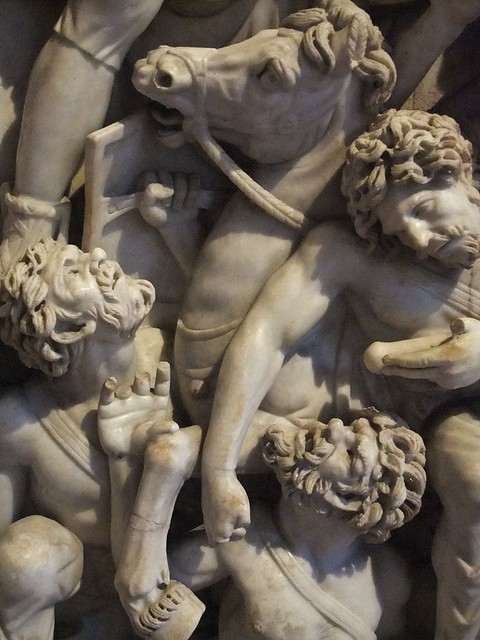
The Ludovisi Battle Sarcophagus depicting Roman conquest
of Barbarians, 2nd - 3rd century CE.  Photographed at the 
Palazzo Altemps, Museo Nazionale Romano, in Rome Italy
by Mary Harrsch.
After I suggested in my review of "Semper Fidelis"  that the antagonist in Ruth Downie's novel, a brutal Centurion named Geminus, may have been suffering from PTSD, Ruth sent me a link to a very thoughtful post by Dr. Dorothy King  entitled  "PTSD in Antiquity."  (Sadly, it is no longer online.)

In my review, I cited a post by Dr. Jonathan Eaton who had generally dismissed the probability that many ancient soldiers suffered from PTSD because modern research points to PTSD being most prevalent in soldiers experiencing explosive events (like IEDs, land mines or booby traps).  He theorizes that since gunpowder or other explosive material was generally not used in ancient warfare, such explosive events did not occur so the probability that PTSD could develop was quite low.  He also pointed to the death-filled environment of the ancient world as something that he felt would desensitize ancient peoples to the trauma of warfare.

Dr. Eaton's viewpoint may have reflected a study done in 2011 by C.W. Hoge. In it, the researchers followed 2,525 soldiers and questioned them three to four months after their return from a year-long deployment in Iraq.

"Of the majority of soldiers who suffered no combat injuries of any sort, 9.1 percent exhibited symptoms consistent with PTSD. This allows a baseline for susceptibility of roughly 10 per cent of the population.  A slightly higher number (16.2 per cent) of those who were injured in some way, but suffered no concussion, also experienced symptoms. As soon as concussive injuries were involved, however, the rates of PTSD climbed dramatically. Although only 4.9 percent of the troops suffered concussions that resulted in complete loss of consciousness, 43.9 percent of these soldiers noted on their questionnaires that they were experiencing a range of PTSD symptons.  Of the 10.3 per cent of the unit who suffered concussion resulting in confusion but retained consciousness, more than a quarter (27.3 per cent) suffered symptoms. This suggests a high correlation between head trauma and the occurrence of subsequent psychological problems." - Aislinn Melchior, Caesar in Vietnam: Did Roman Soldiers Suffer from Post-Traumatic Stress Disorder

 Melchior admits that concussion is not the only risk factor for PTSD but says it is so strongly correlated that it suggests the incidence of PTSD may have risen sharply with the arrival of gunpowder, shells, and plastic explosives.

"In Roman warfare, wounds were most often inflicted by edged weapons. Romans did of course experience head trauma, but the incidence of concussive injuries would have been limited both by the types of weapons they faced and by the use of helmets." - Aislinn Melchior, Caesar in Vietnam: Did Roman Soldiers Suffer from Post-Traumatic Stress Disorder

In his footnotes, Melchior speculates that the Romans designed their helmets with an eye to blunting the force of the blows they most often encountered.  Although Peter Connolly argued that the helmet design in the Republican period suggested a crouched fighting stance, Melchior disagrees suggesting the change in helmet design at that point may have signaled instead a shift in the role of troops from performing assaults on towns and fortifications when the empire was expanding and the blows would more often rain from above to the defense and guarding of the frontiers.

Melchior, like Eaton, also speculates that death was so common in the ancient world that it desensitized many of its residents to the prospect of unexpected death.

But in his 1999 paper entitled "The Cultural Politics of Public Spectacle in Rome and the Greek East in 167-166 BCE"  Jonathan C. Edmondson points out that when King Antiochus IV introduced Roman-style gladiatorial combats in Syria in 166 BCE, the Syrians were terrified rather than entertained.
"In time gladiatorial contests came to be accepted and even popular, but only after Antiochus had instituted a local variation whereby fights sometimes ended as soon as a gladiator was wounded."
This hardly sounds like people desensitized to death.

Dr. King also disagrees pointing to the fact that she, a diagnosed victim of PTSD, had never experienced an explosive event and she knew of a military general diagnosed with PTSD that had never been near explosive devices either.  She was particularly impressed with the research of Jonathan Shay summarized in his book " Achilles in Vietnam: Combat Trauma and the Undoing of Character . 


Shay's work has now been made into a poignant documentary entitled "Odysseus in America." 

In another of King's articles, "The Rage of Achilles and PTSD". King discusses what she feels (and I concur) are clear examples of PTSD in the ancient texts.  Her post opens with a moving passage from Homer:


Then said Achilles, "Son of Atreus, king of men Agamemnon, see to these matters at some other season, when there is breathing time and when I am calmer. Would you have men eat while the bodies of those whom Hector son of Priam slew are still lying mangled upon the plain? Let the sons of the Achaeans, say I, fight fasting and without food, till we have avenged them; afterwards at the going down of the sun let them eat their fill. As for me, Patroclus is lying dead in my tent, all hacked and hewn, with his feet to the door, and his comrades are mourning round him. Therefore I can think of nothing but slaughter and blood and the rattle in the throat of the dying."
Iliad 19.226
Then she goes on to examine descriptions of the behaviors of such ancient military men as a Greek warrior at Marathon, Leonidas at Thermopylae, Alexander the Great and Gaius Marius, all supported by quotes from the ancient sources.

So, I was gratified to find another scholar with personal experience with PTSD who also disagrees with Eaton and Melchior.   

Recently, scholars studying cuneiform medical texts left behind by ancient Mesopotamians point to passages describing mental disorders expressed by soldiers and even a king during the Assyrian Period (1300–609 BCE) when military activity was extremely frequent and brutal. The King of Elam is said to have had his mind changed.  Soldiers were described as suffering from periods where they were forgetful, their words were unintelligible, they would wander about, and suffer regular bouts of depression.

"If in the evening, he sees either a living person or a dead person or someone known to him or someone not known to him or anybody or anything and becomes afraid; he turns around but, like one who has [been hexed with?] rancid oil, his mouth is seized so that he is unable to cry out to one who sleeps next to him..." - Translation by Scurlock and Andersen, Diagnoses in Assyrian and Babylonian Medicine

"As seen in the cases of military casualties, the signs and symptoms of the victim were attributed by the ancient Mesopotamians to ghosts, as was the case with many mental and psychosomatic disorders seen during that period. It looks as if, in the case of military casualties, the responsible ghosts were usually assumed by the treating ašipu to be the ghosts of the enemies whom the patient had killed during military operations..."

"...Generally, the symptoms described fit the symptoms of post-traumatic stress disorder as we understand them now. The flashbacks of images of dead people, particularly those occurring at night (in the form of nightmares) and accompanied by fear, are an important symptom. The changes of mental state with fear, forgetfulness and depression are also symptoms that we see often in
clinical practice. - Walid Khalid Abdul-Hamid and Jamie Hacker Hughes, Nothing New under the Sun: Post-Traumatic Stress Disorders in the Ancient World (2015)

I would like to take all of their observations just a few steps further and point to even more recent findings that I feel call into question the "explosive events as the primary cause of PTSD" theory.

I think the results of the autopsy of one of the NFL players who recently committed suicide is particularly significant.  The news reported that the individual had significant brain damage from repeated concussions suffered not from explosive events but from the impacts experienced during a series of football games.  If you consider the repeated impacts ancient soldiers experienced in set piece battles where tight formations were used, such as Greek or Macedonian phalanxes or Roman maniples, the probability of the occurrence of repeated concussions similar to those experienced by modern football players is quite high.  The news program went on to interview the football player's family and they discussed how he had deteriorated mentally from an outgoing, very social individual to a sullen, withdrawn person who no longer found life fulfilling.  As the spouse of a war veteran who has been permanently disabled by severe PTSD, I found the symptoms described by the football player's family all too familiar.

I also think Eaton and Melchior dismiss too readily the psychological aspects of PTSD in the ancient world because of their observations that the ancient world was a far more brutal environment than we have now (outside of inner city ghettos).  They point out how people were surrounded by death because of disease, accidents without proper medical treatment, and entertainments that featured the orchestrated deaths of both people and animals.  I propose that observed deaths occurring in a venue where the observer and the participants are separated both by physical barriers and social hierarchy (most human victims were criminals, prisoners of war, "Others" so to speak, or slaves, those whose social status separated them from the vast number of citizens in the audience) are distinctly different when compared to violent deaths of friends, family members, and comrades, your "band of brothers," fighting right beside you in a person-to-person battle scenario.

Furthermore, ancient executions were designed to further distance the audience from the victim through the use of mythological reenactments or by placement outside the city.

"Crucifixions were usually carried out outside the city limits thus stressing the victims rejection from the civic community. Because of the absence of bloodshed out of an open and lethal wound, which evoked the glorious fate of warriors, this type of death was considered unclean, shameful, unmanly, and unworthy of a freeman. In addition the victim was usually naked. Essential, too, was the fact that the victim lost contact with the ground which was regarded as sacrilegious." - J.J. Aubert, "A Double Standard in Roman Criminal Law?" from "Speculum Juris: Roman Law as a Reflection of Social and Economic Life in Antiquity"

We also cannot forget the medical personnel either.  Following the Vietnam War, many veterans (both male and female) who served in a medical capacity were later found to be suffering from PTSD.  The medical environment of an ancient treatment facility following a major ancient battle was far worse than in a modern field hospital.  Ancient surgeons attempted to treat often thousands of wounded in a relatively short time compared to only handfuls at a time during the Vietnam conflict.  Ancient physicians were surprisingly quite skilled, especially Roman military surgeons, but they had little but herbal compounds (and honey if the Romans listened to the Egyptian physicians) to ward off infections.  Their patients' mortality rate was much higher than the relatively low mortality rate experienced in Vietnam.  So, how could they have escaped the effects of PTSD, often after years of service, not "just" 6 - 12 months - more than enough to trigger PTSD in modern warfare?

Psychotherapist Alan Greaves in his paper, "Post Traumatic Stress Disorder (PTSD) in Ancient Greece: A Methodological Review" points out that identifying the characteristic behaviors associated with PTSD in an ancient culture is particularly problematic because of socio-cultural factors such as social taboos on men crying or the abrogation of suicide.

"...we do not know how common or acceptable somatisation or the outward expression of any of the other psychological symptoms of PTSD would have been in ancient Greece, which in itself was made up of many differing local cultures or communities."

Greaves does acknowledge, though, that there is enough description in historical sources to point to a recognizable human response to traumatic stress in earlier ages.

"...the fact that PTSD has been identified, to various degrees and variously expressed, across different ethnic and cultural groups does indicate that the human species is naturally predisposed towards reaction formation following episodes of traumatic stress. As discussed above, there would appear to be some evidence that Conversion Disorder was present in Greece in the 1st millennium BC, even if finding similar evidence for PTSD is a more complicated matter because of the nature of our sources and its symptoms and definition. The sheer  prevalence of PTSD across modern populations adds further weight to the argument that it has  been a feature of human experience for a considerable  period of our history, even if the precise form of its expression has varied across contemporary and historical cultures." - Alan Greaves, "Post Traumatic Stress Disorder (PTSD) in Ancient Greece: A Methodological Review"

However, in a 1996 study of emotion, Fischer and Manstead argue: ‘there are both cross-cultural similarities and differences in emotion.’ There is, therefore, no universal human reaction that can be predicted in all circumstances of traumatic stress, but neither are our reactions entirely culturally determined. Bearing in mind the very different incidences and presenting symptoms in different cultures, can we  possibly ever know what PTSD, or any of the other post-traumatic conditions discussed above, would have looked like in ancient Greece?

Perhaps, not. I sometimes wonder, though, if modern scholars think that ancient people just didn't value their lives as much as we do, since they did not shrink from casualties as high as 50,000 in a single military engagement or investment of an enemy city.  But if you've ever looked at some of the poignant grave goods found in ancient burials or studied the reliefs and inscriptions on ancient funerary monuments, I think you will conclude that we are only separated by time, not by our shared human nature.

References:

Abdul-Hamid, W. K., & Hughes, J. H. (2014). Nothing New under the Sun: Post-Traumatic Stress Disorders in the Ancient World. Early Science and Medicine, 19(6), 549-557. doi:10.1163/15733823-00196p02

Aubert, J.-J, & Sirks, A. J. (2002). A double standard in Roman criminal law? In Specvlvm ivris: Roman law as a reflection of social and economic life in antiquity. Ann Arbor, MI: The University of Michigan Press.

Cook, J. (2012). Crucifixion as Spectacle in Roman Campania. Novum Testamentum, 54(1), 68-100. Retrieved from http://www.jstor.org.libproxy.uoregon.edu/stable/23253630

Edmonson, J. C. (1999). The cultural politics of public spectacle in Rome and the Greek East in 167-166 BCE. Studies in the History of Art, 56, 76-95.

Fischer, A. and Manstead, A. H. 1996. Emotions. In A. Kuper and J. Kuper (eds.), The Social Science  Encyclopaedia 2nd ed., 239-240. London, Routledge.


Greaves, A. M. (2008). Post Traumatic Stress Disorder (PTSD) in Ancient Greece: A Methodological Review. Warfare and Society in the Ancient Eastern Mediterranean. Retrieved from https://www.academia.edu/6897230/Post-Traumatic_Stress_Disorder_PTSD_in_Ancient_Greece_A_Methodological_Review

A. Melchior (2011). Caesar In Vietnam: Did Roman Soldiers Suffer From Post-Traumatic Stress Disorder. Greece & Rome, 58(2), 209-223. Retrieved from http://www.jstor.org.libproxy.uoregon.edu/stable/41306157

JoAnn Scurlock and Burton Andersen, Diagnoses in Assyrian and Babylonian Medicine: Ancient Sources, Translations, and Modern Medical Analyses (Urbana and Chicago: University of Illinois Press, 2005), Pp. xxiii + 879.




If you enjoyed this post, never miss out on future posts by following me by email!


Thursday, January 10, 2013

Review: Semper Fidelis by Ruth Downie


A history resource article by Mary Harrsch © 2013


Assimilating conquered warriors into the vanquishing army has been a problem for military commanders for thousands of years.  When Alexander the Great attempted to form an elite cavalry unit composed of the sons of conquered Persian nobles, his own officer corps was so enraged it led to the tragic death of Cleitus the Black, a longtime loyal officer to both Phillip II and Alexander, who was slain by Alexander himself after heated words about Alexander's efforts to incorporate Persians into positions of authority within his army.

It is this issue that forms the foundation for the plot of Ruth Downie's latest novel "Semper Fedelis".  We find our heroic medicus, Gaius Petreus Ruso, trying to find out what is happening to native Briton recruits at the hands of an apparently sadistic much-decorated centurion in second century Eboracum (modern day York).

As is usually the case, his native-born wife, Tilla, tries to help by questioning some of the local townspeople but ends up causing Ruso even more trouble with the commanding tribune who happens to be related to the family-honored centurion.  Ruso is summarily ordered to keep his nose out of things that don't concern him and Tilla receives a less subtle warning in the form of a severed pig's head found between her bedsheets.

But a recruit shows up at the hospital with a nasty infected arm after the young man had attempted to carve off a tribal tattoo to avoid any more abuse.  Then Ruso is further appalled when the man's friend turns up asking Ruso if he could remove the tattoos that embellish his arms as well.

With Tilla's urging, Ruso takes matters into his own hands when the emperor Hadrian shows up to inspect the fort, and Ruso attempts to explain the problem directly to Hadrian.  After all, Hadrian and Ruso served together in Antioch where Ruso was instrumental in saving the life of the emperor Trajan, Hadrian's adopted uncle.  Meanwhile, Tilla is called into the presence of the empress Sabina who thinks conversing with a colorful local would be amusing and Tilla attempts to bring the recruits plight to the empress' attention.
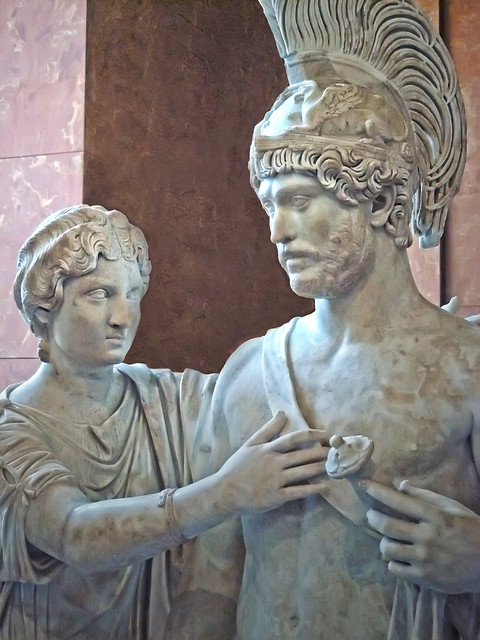
Interesting image of Mars the God of War with the face
of the Roman Emperor Hadrian and a female companion
whose face was resculpted in 170-175 CE to resemble
the Empress Lucille (according to The Louvre), wife of
the Roman emperor Lucius Verus (???) Photographed at The Louvre in Paris, France by Mary Harrsch

Then things take an even more nasty turn and the centurion in question is found murdered.  The related tribune throws Ruso into chains, more out of outrage that Ruso went to the emperor over his head than truly believing Ruso had anything to do with the murder. So Ruso and Tilla must scramble to discover the truth before Ruso is marched off to Deva for what is believed will be a summary trial and execution on the orders of the legate there.

The exciting conclusion involves Praetorian guards, conspiratorial royal secretaries, Tilla's less expert use of one of Ruso's scalpels, near mutiny of the recruits of the 22nd Legion and an ultimate solution devised by a very wise man who happens to be the most powerful ruler of the known world.

Again Downie has given us a mystery with twists and turns that keep readers guessing until almost the very end.  The characterizations of Ruso and Tilla are consistent with previous novels and, as I mentioned in a recent post to the Roman History Reading Group on Facebook, Downie offers each character's thoughts to us to flesh out their personalities.  She also provides a little backstory for tribune Accius letting us imagine his rather lonely childhood and the social importance of having an uncle publicly decorated for valor.  We can then understand, at least partly, the rational for what would normally be seen as outrageous behavior towards a respected medical officer.

The only thing I didn't understand in the plot was why Hadrian, who remained at the fort for several days during the time that tribune Accius imprisoned Ruso, did not act to prevent the mistreatment and possible loss of a valued medical officer who had proven himself in the Antioch earthquake?  Of course, our hero is ultimately saved but Hadrian's apparent indifference earlier in the story does not seem consistent with his obvious longtime respect for Ruso expressed at the end.

Of course, we don't know when Hadrian's knowledge of all of the events that occurred was realized, but as astute as Hadrian was, I can't imagine him not knowing that the tribune was blaming Ruso before Hadrian had left Eboracum for his next port of call.  If the tribune had simply locked up the native deserter, Victor, and blamed him from the beginning, it would have been more understandable that Hadrian would have been reticent to get involved.  Hadrian was a soldier's soldier and would not have intervened in a matter that should have been handled by the existing chain of command in circumstances that did not involve a professional officer held in high esteem by the emperor.  Perhaps this was Downie's way of developing events that would lead up to Russo's offer to sacrifice his own life to preserve order on the frontier and the emperor's continued successful reign.  Such an offer would then justify the size of the favor Ruso requests at the end of the story.

As for the supporting history behind the abuse of native recruits to the legions in Britain, we can look to the Vindolanda Tablets that include correspondence from the professional  auxiliaries from the Tungri tribe of the Aardennes region (Belgium/France/Luxembourg).  Although these men were not originally Romans from the Empire's heartland, they still  used a disparaging nickname for their British hosts: Brittunculi.

"In Latin, the suffix -unculus is both diminutive and pejorative: the term translates as "pathetic little Brits" (Vindolanda Tablet 164). The author was probably not referring to the provincial population as a whole, but specifically to young trainee recruits to the regiment. - Roman auxiliaries in Britain, Wikipedia

The Vindolanda Tablets, dated from 85 - 122 CE, also reveal that the military was understrength at the time of Hadrian's visit in 122 CE. The I Tungrorum listed its strength at 752 instead of the official 800 men expected to fill its rolls.  So, it would have been a time that recruits would have been sought, even from the local tribes.

Originally, Rome did not deploy auxiliary units in their home country or region but this policy relaxed to some degree as military shortages became more acute in the second century.

Centurion abuse of young recruits, outside the demanding regimen of basic training, is also documented in the ancient sources, although the most prominent record involves the Germanic Batavians.  In the "Year of the Four Emperors" (69-70 CE), the governor of Germania Inferior was ordered to raise more troops.  The Batavians  were regarded by the Romans as the very best (fortissimi, validissimi) of their auxiliary so the governor attempted to conscript more Batavi than the maximum stipulated in their treaty.  This action was compounded by the brutality and corruption of Roman recruiting-centurions including reports of sexual  assault on Batavi young men.
A Batavian helmet with remnants of blonde wig,
Courtesy of the Nijmegen museum.

Then, Julius Civilis, himself a decorated veteran of 25-years service in Britain and prince of the Batavi people, led his people in open revolt.

"... the uprising soon became a bid for independence.  Civilis exploited the fact that some legions were absent from the Rhine area due to the civil war, and the rest under-strength. In addition, the Roman commanders and their rank-and-file soldiers were divided by loyalty to rival emperors. Civilis quickly won the support of the Batavi's neighbours and kinsmen, the Cananefates, who in turn won over the Frisii. First the rebel allies captured two Roman forts in their territory, and a cohort of Tungri defected to Civilis.  Then two legions sent against Civilis were defeated when their companion Batavi ala defected to his side. The Classis Germanica (Rhine flotilla), largely manned by Batavi, was seized by Civilis. Most importantly, the eight Batavi cohorts stationed at Mainz with XIV Gemina mutinied and joined him, defeating at Bonn a Roman force that attempted to block their return to their homeland. By now, Civilis commanded at least 12 regiments (6,000 men) of Roman-trained and equipped auxiliary troops, as well as a much larger number of tribal levies. A number of German tribes from beyond the Rhine joined his cause. Several other German and Gallic units sent against him deserted, as the revolt spread to the rest of Gallia Belgica, including the Tungri, Lingones and Treviri tribes. He was able to destroy the two remaining legions in Germania Inferior, (V Alaudae and XV Primigenia). 
By this stage Rome's entire position on the Rhine and even in Gaul was imperiled. Their civil war over, the Romans mustered a huge task force of eight legions (five dispatched from Italy, two from Spain and one from Britain) to deal with Civilis. Its commander Petillius Cerialis had to fight two difficult battles, at Trier and Xanten, before he could overrun the Batavi's homeland. Tacitus' surviving narrative breaks off as he describes a meeting on an island in the Rhine delta between Civilis and Cerialis to discuss peace terms. We do not know the outcome of this meeting or Civilis' ultimate fate. But in view of his former friendship with Vespasian, who had already offered him a pardon, and the fact that the Romans still needed the Batavi levies, it is likely that the terms were lenient by Roman standards." - Roman military Auxiliaries, Wikipedia

So, the situation described in the novel could have been equally disastrous for Hadrian, who would have been keenly aware of the outcome of the Batavian revolt just 50 years before.  Furthermore, by Hadrian's time auxiliaries outnumbered legionaries by 2.5 to 1 in Britain.  Unfortunately for Ruso, Tribune Accius was far more nearsighted, thinking only of his family's social standing and not the welfare of the empire.

I also though Downie accurately portrayed the relationship between Hadrian and his wife Vibia Sabina.  Downie's townspeople mention rumors that Hadrian preferred to spend more time with his mother-in-law than Sabina.  Although that sounds strange, Hadrian's mother-in-law was actually his second cousin and only eight years older than Hadrian.  Furthermore, they were raised together in Trajan's household.

Sabina, as portrayed in the novel, was known to be independent minded and by the time of the novel, she had already had an affair with the historian Suetonius, secretary to Hadrian.  So, it would be totally in character for her to admonish Tilla by saying "Don't pray too hard" when Tilla said she would pray for the empress to be fruitful.

As a war veteran's spouse, another issue I always ponder when I read about a character being particularly brutal to other characters is whether the brutal character may be suffering from post-traumatic stress disorder.  Geminus was described as a valorous, much-decorated veteran about to retire when he finishes training this particular batch of recruits.  Although scholars like Dr. Jonathan Eaton question a diagnosis of PTSD in members of the Roman Army because of a lack of explosive or concussive events in a typical Roman battle (PTSD and the Roman Army ), I would point out that heroic epics like those of Homer formed a foundation of source material used in the formation of the Roman heroic ideal.  In Chapter 3 of "From Melos to Mylai: War and Survival", Lawrence Tritle asserts that the heroes portrayed in Homer, Tyrtaeus, Archilochus, and Aeschylus share the characteristic of being someone who takes revenge for the death of his friends and strongly believing a good man is a brave man.

Not only may Geminus have been subconsciously seeking revenge for friends lost in past campaigns but as the recruits quaked from the centurion's actions, he may have dismissed the lot of them as not worthy since they apparently displayed no bravery in his eyes.

Tritle further points out that in war, officers are taught to instill in the troops an image of the enemy as foreign and different.  "[these] emotional factors... were greater inducements to carry out brutal acts of violence than racially or culturally based perceptions of the 'Other'."

So despite his horrendous behavior, perhaps we should reserve at least a little sympathy for Geminus just as Ruso expressed for Geminus' dog, Bella.  She may have attacked Ruso because of her training, but in the end she waited calmly beside the body of her beloved master, unaware that she, too, would be struck down for her learned behavior and share his funeral pyre.

If you enjoyed this post, never miss out on future posts by following me by email!