Saturday, May 15, 2021

The Late Antique Roman Villa of Noheda

In 1897, Spanish geographer Francisco Coello reported the existence of Roman ruins, with tesserae, in the district of Noheda. But the 291 square meter  figural mosaics in the triclinium of the Late Period Roman Villa were not formally  documented until  1984 when a local peasant plowing a field belonging to José Luis Lledó Sandoval stumbled over the stones. Even then, archaeological excavations did not begin until the end of 2005.  The villa, which lies about 17 km north of Cuenca near the ruins of the ancient cities of Segóbriga , Ercávica and Valeria, was finally opened to the public in 2019. The interpretation center has been established in Villar de Domingo Garcia.

The obviously wealthy owner may have profited from the mining of lapis specularis, a variety of translucent gypsum much appreciated at the time for the manufacture of window glass.  Pliny the Elder mentions this material was mined in "100,000 places around Segóbriga" and Pliny assures us that "the most translucent of this stone is obtained near the city of Segóbriga and extracted from deep wells".

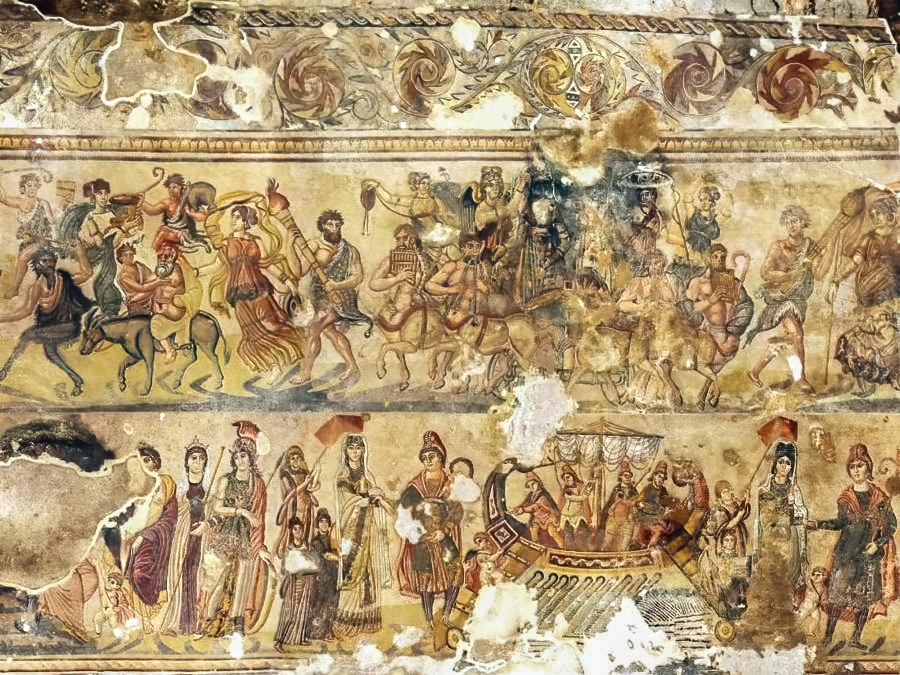
The mosaic of the  triclinium  consists of six panels with mythological and allegorical scenes: the myth of Oenomaus, Pelops and Hypodamia, two pantomimes, the judgment of Paris and the abduction of Helena, the Dionysian courtship and a marine Thiasos (procession of Dionysus). It is presently considered the largest surviving mosaic from the Roman Empire. On average 1243 tesserae were used in each 25X25 square centimeters  of the work. 

Later excavations revealed the site included a complex of private thermal baths as well. Researchers have identified more than 30 types of marble used in its construction.

Images: I have tried to select the best images I could find although the site needs to be photographed by someone like Carole Raddato or Marie-Lan Nguyen. (I'm afraid my overseas travel days are pretty much at an end).  My university has also not registered their Shibboleth license with Cambridge Core so I couldn't access the main article that originally appeared in the Journal of Roman Archaeology in 2013. As indicated, here in the US, images of ancient 2-dimensional artwork are considered "slavish copies" so therefore in the public domain.

Mosaic depicting the myth of Oenomaus and the chariot race with Pelops in the triclinium of the Roman Villa at Noheda (PD in US)

Mosaic depicting the myth of Oenomaus and the chariot race with Pelops in the triclinium of the Roman Villa at Noheda (PD in US)

Severed heads depicted in the mosaic of the Roman Villa at Noheda (Spain) (PD in US)

Boxers in the triclinium mosaic of the Roman Villa at Noheda (Spain) (PD in US)

Three panels of the triclinium mosaic in the Roman villa at Noheda (Spain) - bottom panel: the life of Paris and abduction of Helen, the middle panel: Dionysian procession (PD in US)

Detail of Dionysian courtship panel of the mosaic in the triclinium of the Roman vill at Noheda (Spain) (PD in US)

Mosaic depicting the myth of Oenomaus and the chariot race with Pelops in the triclinium of the Roman Villa at Noheda (PD in US)

Detail of a pantomime scene in the mosaic of the Roman Villa at Noheda (Spain) (PD in US)

Closeup of panel depicting the life of Paris in the mosaic of the Roman Villa at Noheda (Spain)

Mosaic depicting the myth of Oenomaus and the chariot race with Pelops in the triclinium of the Roman Villa at Noheda (PD in US)

Panel depicting the life of Paris and abduction of Helen in the mosaic of the triclinium of the Roman Villa at Noheda (PD in US)

Marine Thiasos in the triclinium of the Roman Villa in Noheda (PD in US)

Detail of a pantomime scene in the mosaic of the Roman Villa at Noheda (Spain) (PD in US)


If you enjoyed this post, never miss out on future posts by following me by email!


Friday, May 14, 2021

Apotropaic infant rattles

Baby rattles go back at least 2500 years. Ancient rattles were made of various materials, including clay, wood, bronze, dried heads of poppy flowers, and pebbles. One of the oldest infant rattles in central Europe was found in Poland  in a grave of a baby who was a member of the early Iron Age Lusatian culture (1300 BCE – 500 BCE).  That hollow clay rattle was shaped like a pillow and was filled with little balls. It was found next to a tiny urn containing the cremated remains of the baby.  

Children in ancient Greece and Rome would have been amused by mold-made rattles like those pictured here. In his Politics, Aristotle observed  that young children should be given a rattle (particularly one designed by Archytas) to keep them quiet. 

Greek mold-produced terracottas began to appear in the archaeological record around the 7th-century BCE. These figures were formed by pressing wet clay into a two‑part mold to form a small sculpture in the round that can be seen from any side. After the figure was fired in a kiln, it was removed from the mold and painted in bright colors. 

Rattles came in a variety of shapes such as spheres, boxes, and animals like owls, pigs, or dogs. Rattles in the shape of pigs probably had further significance, though, since pigs were associated with the Greek goddess Demeter, who was invoked in rituals intended to protect babies in life and death. The sound produced by rattles was thought to ward off evil. 

Most mold-made terracotta rattles have been found in children's graves and sanctuaries where they were deposited as gifts to the gods. Children were typically buried with their toys but, sometimes, even their  actual pet dogs and pigs were sacrificed.

Rattle in the form of a child sitting on a pig, east Greek, possibly Rhodian, 2nd - 1st century BCE (Roman period). A boy sits atop a rotund pig. The pig's large stomach hangs low and touches the ground. The animal's small legs seem barely able to support its weight. The boy's long hair is pulled into a central braid, a common hairstyle for both boys and girls in ancient Greece. One of the child's hands touches his chin; the other rests on the pig's back. Traces of pink and white pigment are still visible on the figurine. Inside the pig, small pieces of dried clay produce a rattling sound when shaken. This figurine is part of the collections of the J. Paul Getty Museum. Image courtesy of the museum.

A terracotta rattle depicting a dog similar to a Maltese lapdog, a favorite pet in antiquity, 4th-1st century BCE, Greece, in the collections of the Johns Hopkins Archaeological Museum. Due to its large size, it is possible that this rattle was meant to be handled by an adult who might have used it to entertain and distract a child. Image courtesy of the museum.

Another terracotta rattle with a child seated on a pig recovered from Pompeii, 1st century CE, that I photographed at the University of Pennsylvania Museum of Archaeology and Anthropology in Philadelphia.

Terracotta rattles in the shape of animals, Cypro-Archaic II period (ca. 600-480 BCE), Goulandris Museum of Cycladic Art, Athens, courtesy of Dan Diffendale (CC BY-NC-SA 2.0)

Terracotta Rattle in the Shape of a Lion, Greek made in Corinth, 600-575 BCE, that I photographed at the Getty Villa in Pacific Palisades, California.


If you enjoyed this post, never miss out on future posts by following me by email!


Wednesday, May 12, 2021

Personal worship in the ancient world

This pair of terracotta altars depicts the death of Adonis, a god of vegetation, and the rituals that were celebrated in his honor. On the altar on the right, Adonis, looking weak, sits supported in the arms of his lover Aphrodite, the goddess of love. Adonis was born of an incestuous love between the Assyrian king Theias and his daughter Myrrha; Aphrodite was smitten by the infant Adonis's great beauty and hid him in a box (cista), which she entrusted to Persephone. When Persephone opened the box, she too fell in love with the beautiful infant and decided not to give him back to Aphrodite. Zeus interceded in the quarrel between the two goddesses and ordered that Adonis should spend a third of the year with Aphrodite, a third with Persephone, and the last third wherever he liked— Adonis chose to devote that time to Aphrodite as well. The woman at bottom right, sitting on the box, is likely to be Persephone. On the left altar, three women rush to the scene, carrying musical instruments: a tympanum, or drum, and a xylophone.

Small terracotta altars such as these would have been used for private worship, perhaps to burn incense. This pair still bears traces of burning on its upper surfaces, as well as pigment used for decorating the relief figures. Stylistic features of the figures and their drapery, as well as the type of clay that was used, suggest that the altars were made in Medma, in Southern Italy. - J. Paul Getty Museum

Household shrines and a personal relationship with the gods were also important to the Romans as well.  

"The quality in which the Roman commonwealth is most distinctly superior is in my opinion the nature of their religious convictions… These matters are clothed in such pomp and introduced to such an extent into their public and private life that nothing could exceed it, a fact which will surprise many… It is a course which perhaps would not have been necessary had it been possible to form a state composed of wise men, but as every multitude is fickle, full of lawless desires, unreasoned passion, and violent anger, the multitude must be held in by invisible terrors and suchlike pageantry." - Polybius

Classicist Ben Potter, in his article "Rituals, Temples and Worship in the Ancient World" observes, "Here, the historian seems to confirm that the vast majority of common/uneducated Romans engaged in ritual practice with a high level of credulity and were not merely going through the motions when it came to showing devotion to the gods on days of ritual worship."

Read more about it: https://classicalwisdom.com/culture/traditions/rituals-temples-and-worship-in-the-ancient-world/

Small personal altars depicting the myth of Adonis produced in Calabria, southern Italy, terracotta, fourth quarter of the 4th century BCE on view at the Getty Villa, Gallery 109
If you enjoyed this post, never miss out on future posts by following me by email!


Tuesday, May 11, 2021

Professional mourners in the ancient world


Statues of Mourning Women, South Italian (Apulian, Canosan), 300-275 BCE Terracotta, now in the collections of the J. Paul Getty Museum, Villa venue, Pacific Palisades, California


This group of mourning women, often understood as female figures in prayer (orantes), was likely produced in the area of Canosa in south-eastern Italy. Although there are considerable differences in terms of clothing, poses and hairstyles, the four statues seem to depict a type of youthful female figure, probably envisioned as one of the mourners who expressed their grief during funerary ceremonies. The group was intended to be placed around a funerary couch (kline), and was probably produced for a fairly prestigious client who, in the context of Romanization in the area, aspired to underscore his economic prosperity, personal identity, and native traditions. The figures were made not with molds, as has been previously conjectured, but rather through a modeling process over a fairly thick conical structure. Working from the bottom up, clay pieces were laid over this hollow structure to define the anatomy and iconographic details of the figure. The forearms, created separately, and the head, made with a bivalve mold, were inserted in holes specially made by the craftsman. The tubular structure was then modeled from within to establish the round shapes of knees and breasts, and from the exterior, through the application of clay parts, to depict the details of the chiton and himation. A spatula and other sharp tools were used to define the hair, eyes, and various details of clothing. Colors were applied after the firing over a preparatory layer of white slip, which has been preserved in several areas. The palette shows little variety, consisting of pink, red, white, possibly dark brown, and black. - J. Paul Getty Museum

These sculptures probably represented women who were known by the Romans as praeficiae, professional mourners, who followed musicians in the funeral procession and sang a funeral song praising the deceased. Paying mourners to attend your funeral showed society the importance of your social status.

The practice of hiring professional mourners has been documented in ancient Egypt, China, and the Middle East as well as in Greece and Rome.  In ancient Egypt only childless women could become professional mourners as it was considered unseemly for men to weep in public. These women could not have any body hair and had the names of goddesses tattooed on their shoulders.

Mycenaean larnakes, burial chests, depict mourners performing ritual laments. During the Greek Archaic Period, greater simplicity in burial practices coincided with  the rise of democracy and the egalitarian military of the hoplite phalanx.  But during the 4th century BCE,  the decline of democracy and the return of aristocratic dominance was accompanied by the return of more elaborate funerary rituals.

"Ancient Romans honored their dead through extended mourning. Men would typically mourn for a period of a few days, during which they would always wear black and would not cut their hair or beards. Women would wear white and might not cut their hair as well. However, while formal mourning usually only lasted a few days for men, when a woman lost a husband or parent, it wasn’t uncommon for her to mourn for a year. Adopting traditions from the ancient Greeks, many Romans also periodically visited their deceased loved one’s tombs or burial sites to offer gifts and sacrifices. Toward the end of February, ancient Romans sometimes celebrated Feralia as well. This was a general festival for honoring the dead. Romans would traditionally celebrate by bringing food to the sepulchers of the deceased." - Joe Oliveto, State University of New York at New Paltz


Statue of Mourning Woman, South Italian (Apulian, Canosan), 300-275 BCE Terracotta, now in the collections of the J. Paul Getty Museum, Villa venue, Pacific Palisades, California


If you enjoyed this post, never miss out on future posts by following me by email!


Monday, May 10, 2021

Archaic Period Horse Sculptures

 Horses, with or without riders, were favorite subjects for Boeotian artisans. The figurines were frequently left as burial offerings in graves. Horses were a sign of wealth for the Greeks of this period, and the terracotta horses were probably left to symbolize and to reinforce the high status of the deceased. Thousands of clay figurines like this one survive from the Archaic period (600 to 480 BCE).

"Horses played a central role in the great civic festivals in the ancient world, such as the Panathenaic Games in Athens and the Olympic games at Olympos, where they took part in chariot races and single horse races. The horse’s long affiliation with gods and heroes in Greek mythology no doubt also fostered a special respect and admiration for this remarkable creature in the minds of “ordinary” Greeks. In Homer’s Iliad, horses drive the chariots of the heroes and are praised for their swiftness and beautiful coats. They are often depicted as having special relationships with their owners, like Achilles and his immortal horses, Balius and Xanthus.  In the Iliad, it is told how, when Patroclus was killed in battle, Xanthus and Balius stood motionless on the field of battle, and wept, yet when Achilles rebuked Xanthus for letting Patroklus get slain, Hera granted the horse human speech to deliver to Achilles a warning about his own fate." - Stasahatzoglou, The significance of the horse in ancient Greece.

Terracotta horse and rider, Greek, Boeotian, about 550 BCE, courtesy of the Getty Villa in Pacific Palisades, California.


Archaeic Period Horse and Rider from Cyprus, 700 BCE 


Pyxis Lid with Three Horses Greek made in Boeotia 760-750 BCE Terracotta that I photographed at the Getty Villa in Pacific Palisades, California


Terracotta horse with warrior rider Cypriot Cypro-Archaic I-II 600 BCE said to be from the temple of Apollo Hylates at Kourion that I photographed at the Metropolitan Museum of Art in New York.


Terracotta wheeled horse thought to be a toy Cypriot Cypro-Archaic 6th century BCE that I photographed at the Metropolitan Museum of Art in New York


A BOEOTIAN TERRACOTTA HORSE AND RIDER, 575-550 BCE,  courtesy of Christies


Greek Horse and Rider 6th century BCE Terracotta with slip decoration courtesy of The Barnes Foundation


If you enjoyed this post, never miss out on future posts by following me by email!