Showing posts with label Iliad. Show all posts

Tuesday, June 8, 2021

Triton and the fate of Misenus

This morning while browsing artifacts in the collections of the Getty Villa, I came across this exquisite gilded silver sculpture of a Triton forming the handle of an oinochoe.  As I described in a post a couple of years ago, the original sea god, Triton, was the son of Poseidon and Amphitrite according to Hesiod's Theogony. Triton is usually represented as a merman, with the upper body of a human and the tailed lower body of a fish. At some time during the Greek and Roman era, Tritons became a generic term for mermen in art and literature. A female version (tritoness) was eventually introduced as well.

Triton was said to dwell with his parents in  a golden palace claimed to be located at Aegae on the island of Euboea in a passage from book 5 of Homer's Iliad. It describes how  Poseidon "lashed his long-maned horses and drove to Aegae, where he had his famous palace" after having destroyed Odysseus' raft with a storm. Later in Book 13 of the Iliad, Poseidon "took three strides, and with the fourth he reached his goal—Aegae, where is his glittering golden palace, imperishable, in the depths of the sea."

Only in later times was Triton associated with possessing a conch shell, which he blew like a trumpet to calm or raise the waves. He was "trumpeter and bugler" to Oceanus and Poseidon. Its sound was so cacophonous that when loudly blown, it was said to put the giants to flight, who imagined it to be the roar of a dark wild beast.

in Virgil's epic poem the Aeneid, Misenus, a brother-in-arms of Hector and, after Hector's death, Aeneas' trumpeter, challenged the gods to a musical contest on a conch shell. He, like Marsyas, was punished for his hubris when he was drowned by Triton.  Aeneas was told by the Cumaean Sibyl at that time that Misenus's body had to be buried before he could enter the Underworld and detailed the necessary funeral rites required that were later adopted by the Romans. Cape Misenum, the headland that marks the northwestern limit of the Gulf of Naples as well as the Bay of Pozzuoli in southern Italy and supposedly named for Misenus,  was important to the Romans since it was a natural shelter for passage into the inner harbor of Portus Julius, the home port for the Roman western imperial fleet.


Image: Gilded silver oinochoe handle depicting Triton from Macedonia or Illyria, 100-1 BCE, at the Getty Villa in Gallery 111, Pacific Palisades, California. Now detached from the vessel of which it was once part, Triton’s scaly lower body serves as the functional part of the handle, and the acanthus leaves from which the torso rises would have hidden the join at the rim. Triton's torso would have projected as a decorative element above the mouth, and gilding elaborates much of its surface. The figure probably held a trident in its left hand, a frequent attribute of sea beings. Such an elaborate pouring vessel would have been part of an ornate set of serving and drinking vessels used at banquets or symposia.

If you enjoyed this post, never miss out on future posts by following me by email!


Monday, May 10, 2021

Archaic Period Horse Sculptures

 Horses, with or without riders, were favorite subjects for Boeotian artisans. The figurines were frequently left as burial offerings in graves. Horses were a sign of wealth for the Greeks of this period, and the terracotta horses were probably left to symbolize and to reinforce the high status of the deceased. Thousands of clay figurines like this one survive from the Archaic period (600 to 480 BCE).

"Horses played a central role in the great civic festivals in the ancient world, such as the Panathenaic Games in Athens and the Olympic games at Olympos, where they took part in chariot races and single horse races. The horse’s long affiliation with gods and heroes in Greek mythology no doubt also fostered a special respect and admiration for this remarkable creature in the minds of “ordinary” Greeks. In Homer’s Iliad, horses drive the chariots of the heroes and are praised for their swiftness and beautiful coats. They are often depicted as having special relationships with their owners, like Achilles and his immortal horses, Balius and Xanthus.  In the Iliad, it is told how, when Patroclus was killed in battle, Xanthus and Balius stood motionless on the field of battle, and wept, yet when Achilles rebuked Xanthus for letting Patroklus get slain, Hera granted the horse human speech to deliver to Achilles a warning about his own fate." - Stasahatzoglou, The significance of the horse in ancient Greece.

Terracotta horse and rider, Greek, Boeotian, about 550 BCE, courtesy of the Getty Villa in Pacific Palisades, California.


Archaeic Period Horse and Rider from Cyprus, 700 BCE 


Pyxis Lid with Three Horses Greek made in Boeotia 760-750 BCE Terracotta that I photographed at the Getty Villa in Pacific Palisades, California


Terracotta horse with warrior rider Cypriot Cypro-Archaic I-II 600 BCE said to be from the temple of Apollo Hylates at Kourion that I photographed at the Metropolitan Museum of Art in New York.


Terracotta wheeled horse thought to be a toy Cypriot Cypro-Archaic 6th century BCE that I photographed at the Metropolitan Museum of Art in New York


A BOEOTIAN TERRACOTTA HORSE AND RIDER, 575-550 BCE,  courtesy of Christies


Greek Horse and Rider 6th century BCE Terracotta with slip decoration courtesy of The Barnes Foundation


If you enjoyed this post, never miss out on future posts by following me by email!


Sunday, April 18, 2021

Achilles' Ambush of Troilus

All Greek and Etruscan metal rings with engraved bezels ultimately derive from Egyptian and Phoenician cartouche-shaped rings. The cartouche-shaped ring was especially popular in Etruria in the later 500s B.C., where immigrant Greek goldsmiths from Ionia introduced it.

This example features an intricate scene of two men approaching a fountain where water gushes into a vessel from a lion's head spout. Behind the fountain, a man squats as if hiding, holding a sword. These details identify the scene as a standard depiction of the ambush of Troilos (Troilus), prince of Troy, by the Greek hero Achilles during the Trojan War. On this ring, however, a strange dog-headed creature, who is not part of the Troilos myth, sits atop the fountain. The creature may actually be jackal-headed and thus meant to recall the Egyptian god Anubis harking back to the origin of such rings from Egypt.

Prophecies retold in the Iliad link the fate of Troilos, one of the sons of King Priam (or Apollo in some versions of Greek myth), with the fate of Troy itself. Ancient writers including Sophocles treated Troilos, a paragon of youthful male beauty, as the epitome of a dead child mourned by his parents. 

 Only 54 words have been identified as coming from Sophocles' play, Troilos.  Fragment 619 refers to Troilos as an andropais, a man-boy. (A fragment from the 6th century tragic poet Phyrnichus refers to Troilus as possessing the light of love glowing on his reddening cheeks) Fragment 621 indicates that Troilos was going to a spring with a companion to fetch water or to water his horses but a scholion (explanatory comment) to the Iliad states that Sophocles relates how Troilos was ambushed by Achilles while exercising his horses in the Thymbra. Fragment 623 indicates that Achilles mutilated Troilos' corpse by a gruesome method known as maschalismos. This involved preventing the ghost of a murder victim from returning to haunt their killer by cutting off the corpse's extremities and stringing them under its armpits. 

Considering Troilos, according to many versions and interpretations, was still a child, Achilles' behavior was beyond the pale. Greek heroes were not always heroic!

Gold finger ring depicting Achilles' Ambush of Troilos, Etruscan, 550-500 BCE, at the J. Paul Getty Museum, image courtesy of the museum.

Red-figured bell-krater depicting Achilles in wait for Troilos. Troilos leads up a mule to drink, with right arm over its back. He is represented as a child, with curls in front of his ears, chlamys over left shoulder, petasos hanging from neck, in left hand two spears. Mid-fifth to third centuries BCE, British Museum.

Roman relief from a statue of Germanicus, 2nd c. CE, depicting the ambush of Troilos, Archeological Museum of Perugia courtesy of Wikimedia Commons contributor Haiduc.

Achilles ambushing Troilos and Polyxena, shoulder of an Attic black-figure hydria, 560-550 BCE at the Metropolitan Museum of Art courtesy of Wikimedia Commons contributor Marie-Lan Nguyen.

Image: Achilles (left) ambushing Troilus (on horseback, right). Etruscan fresco, Tomb of the Bulls, Tarquinia, 530–520 BCE courtesy of Wikimedia Commons.
If you enjoyed this post, never miss out on future posts by following me by email!


Monday, April 5, 2021

Calchas and the prophesies of the Iliad

Despite the addition of a head of Serapis, recut and restored in the 18th century CE, the overall scene of a relief at the J. Paul Getty Museum portrays Calchas, the Argive soothsayer to whom Apollo had given the gift of prophecy. In Homer’s Iliad (II.300-30), the seer foretold that the Trojan War would last for nine years after observing a snake devour a mother sparrow and her eight chicks. The eclectic style of the relief combines the form of a late Classical Attic stele with landscape elements drawn from the Hellenistic repertoire. It was discovered in 1774 at Roma Vecchia in the Villa dei Sette Bassi, which belonged to the senatorial family of C. Bellicus Calpurnius Apolaustus. Such a panel may have decorated a library assembled by a cultured patron well versed in Greek literature. On the underside is a Latinized Greek inscription that reads XEANTHE—likely a version of Xanthe, the former name for Troy.  

It was Calchas who prophesied that in order to gain a favourable wind to deploy the Greek ships mustered in Aulis on their way to Troy, Agamemnon would need to sacrifice his daughter, Iphigeneia, to appease Artemis, whom Agamemnon had offended. Calchas also tells the Greeks that the captive Chryseis must be returned to her father Chryses in order to get Apollo to stop the plague he has sent as a punishment: this triggered the quarrel of the hero Achilles and Agamemnon, the main theme of the Iliad. As kings may do as they please, Calchas finds it necessary to lean on the support of a champion, Achilles, who opposes Agamemnon in assembly. Agamemnon refuses to accept the edict of Apollo that he should give up his prize, but bypasses it by taking Achilles’ prize. There follows "the wrath of Achilles," which is righteous anger on behalf of the divine will. With the help of the gods, Achilles struggles to restore righteousness.

Depictions of Calchas have also been found on 5th century BCE Etruscan mirrors and Calchas along with other characters of the Trojan War were popular subjects of 16th century tapestries.

Relief depicting Calchas observing a serpent attacking a nest of birds, 140-160 CE at the J. Paul Getty Museum. On this relief, a bearded man is seated in right profile on a four-legged stool (diphros) with carved legs and a cushion, and rests his feet on a footstool. With his left hand raised to his check in a contemplative gesture, he supports his left elbow on a gnarled staff held in his right hand. Beneath the chair is a griffin, the symbol of Apollo, god of prophecy. Over his left shoulder he wears a himation that covers his lower body, and sandals. Coiled around the tree in front of him is a snake, which menaces a nest of fledglings and two adult birds perched in the branches. The Pentelic marble head is ancient but does not belong to the original relief; it was recut and restored in the 18th century. The hairstyle and sober expression belong to a divinity, and a hole in the crown for the attachment of a kalathos identifies it as the head of the god Serapis.

Etruscan mirror depicting Calchas in the form of a haruspice, from Vulci, 5th century BCE, at the Vatican Museum courtesy of Wikimedia Commons contributor Waterborough.

The Prophecy of Calchas from a set of tapestries depicting The Story of Troy. late 16th century, from Macao, China, silk and gilt paper, courtesy of the Metropolitan Museum of Art.


If you enjoyed this post, never miss out on future posts by following me by email!


Tuesday, March 2, 2021

Earth Shaker

 In pre-Olympian Bronze Age Greece, Poseidon was venerated as a chief deity at Pylos and Thebes. He had also the cult title "earth shaker". In the myths of isolated Arcadia he is related with Demeter and Persephone and he was venerated as a horse, however it seems that he was originally a god of the waters. He is often regarded as the tamer or father of horses, and he could create springs with a strike of his trident.

 Homer and Hesiod suggest that Poseidon became lord of the sea following the defeat of his father Cronus, when the world was divided by lot among his three sons: Zeus was given the sky, Hades the underworld, and Poseidon the sea, with the Earth and Mount Olympus belonging to all three. In Homer's Iliad, Poseidon supports the Greeks against the Trojans during the Trojan War and in the Odyssey, during the sea-voyage from Troy back home to Ithaca, the Greek hero Odysseus provokes Poseidon's fury by blinding his son, the Cyclops Polyphemus, resulting in Poseidon punishing him with storms, the complete loss of his ship and companions, and a ten-year delay. In Plato's "Timaeus and Critias", the legendary island of Atlantis was Poseidon's domain.

Poseidon was named Neptune by the Romans and held a special place in their pantheon of deities because in Book XX of the Iliad, even though Poseidon (Neptune) favored the Greeks, he rescues Aeneas from Achilles.  In Virgil's Aeneid, Neptune is still resentful of the wandering Trojans, but is not as vindictive as Juno, and in Book I he rescues the Trojan fleet from the goddess's attempts to wreck it, although his primary motivation for doing this is his annoyance at Juno's having intruded into his domain.

Poseidon. National Archaeological Museum of Athens courtesy of Wikimedia Commons contributor Ricardo André Frantz

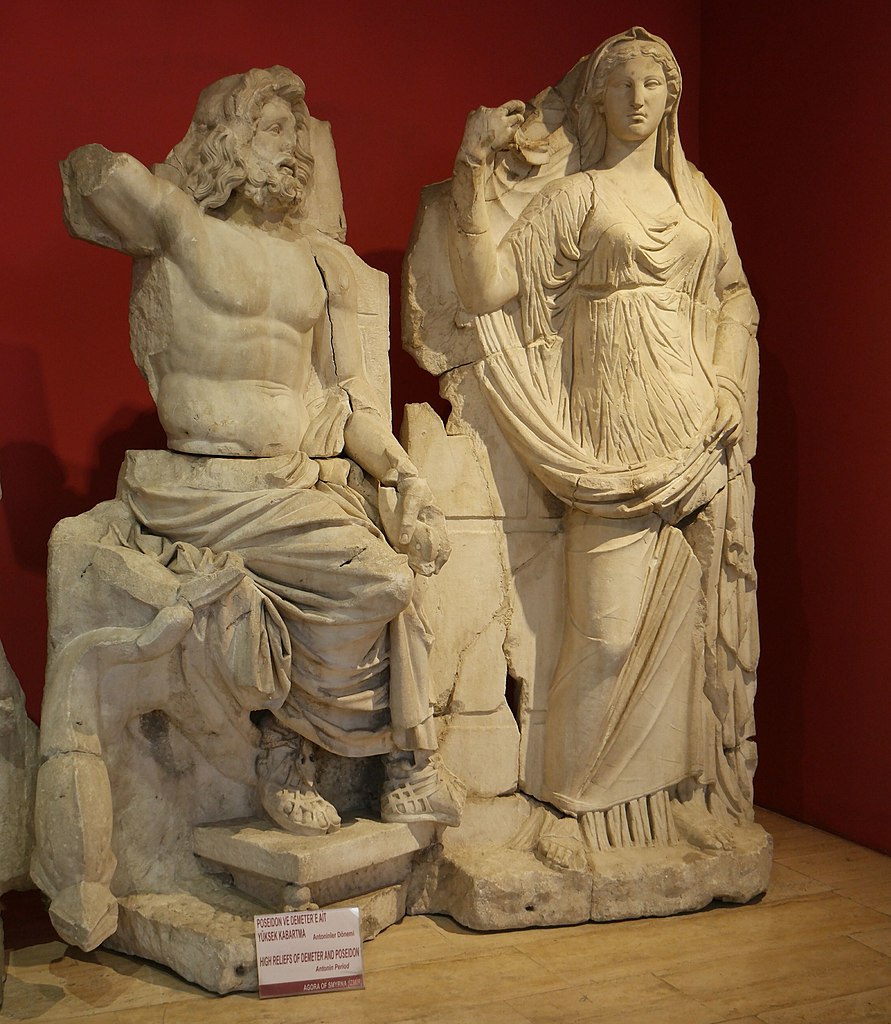
High reliefs of Poseidon and Demeter, from the Nerva–Antonine dynasty period, found in the Agora of Smyrna, now on display in the Izmir's History and Culture Museum Athens courtesy of Wikimedia Commons contributor Isabeau

Closeup of Neptune by Adam Lambert-Sigisbert 1725-1727 CE that I photographed at the Los Angeles County Museum of Art.

Bronze statuette of Poseidon, found in the Gulf of Livadostra, c. 480 BCE, courtesy of Wikimedia Commons contributor Sailko.

Roman mosaic depicting the Triumph of Neptune, 2nd century CE, at the Bardo National Museum in Tunisia courtesy of Wikimedia Commons contributor Tony Hisgett.

Mosaic depicting Neptune and Amphitrite, 1st century CE, that I photographed in the House of Neptune and Amphitrite in Herculaneum in 2007.

Reproduction of a frieze depicting an archaic style Neptune decorating the sacred area in Herculaneum that I photographed in 2007.

Sculpture of Neptune that I photographed at Huntington Gardens in Pasadena, California.

Neptune with a Hippocamp by Michel Anguier French 1652 CE Bronze that I photographed at the National Gallery of Art in Washington D.C. in 2015.

Triumph of Neptune and Amphitrite", a Roman mosaic from Cirta, now in the Louvre courtesy of Wikimedia Commons.

Neptune (with Cosimo I's head) on his chariot by Bartolomeo Ammannati II that I photographed in the Piazza della Signoria in Florence in 2005.

The Lateran Poseidon is a 2nd century CE colossal statue which derived from the lost bronze sculpture made by Lysippos (IV century BCE) for the Temple of Isthmia, on the Isthmus of Corinth, dedicated to the god Poseidon. The statue was originally in the Lateran Museum in Rome (then suppressed) and is probably the most significant evidence of the lost masterpiece of Lysippos.

Roman mosaic of Neptune from Monastir, Tunisia courtesy of Wikimedia Commons contributor Touzrimounir

Terracotta lekythos (oil flask), ca. 440 B.C.E. attributed to the Phiale Painter at the Metropolitan Museum of Art. Poseidon, the god of the sea and the brother of Zeus and Hades is said to have created fresh water springs including the great springs at Lerna in the southern Peloponnesos which gushed forth as a result of his pursuit of Amymone, the daughter of the king of Argos.

Detail of Neptune from the Roman "Mosaic of the Seasons" from Palermo in the Regional Archaeological Museum of Palermo courtesy of Wikimedia Commons contributor Giovanni Dall'Orto.


If you enjoyed this post, never miss out on future posts by following me by email!


Sunday, February 21, 2021

The psychological cost of warfare in the ancient world

Then said Achilles, "Son of Atreus, king of men Agamemnon, see to these matters at some other season, when there is breathing time and when I am calmer. Would you have men eat while the bodies of those whom Hector son of Priam slew are still lying mangled upon the plain? Let the sons of the Achaeans, say I, fight fasting and without food, till we have avenged them; afterwards at the going down of the sun let them eat their fill. As for me, Patroclus is lying dead in my tent, all hacked and hewn, with his feet to the door, and his comrades are mourning round him. Therefore I can think of nothing but slaughter and blood and the rattle in the throat of the dying." - Iliad 19.226

As some of you know, I am the spouse of a veteran who has suffered from PTSD since service in Vietnam back in 1967-68. Although the psychological trauma suffered by those who have experienced a traumatic event now has a very modern-sounding diagnosis, it is not a recent phenomenon but has been a plague upon mankind, probably since men began engaging in warfare to wrest the territory or possessions from a competing group or avenge the losses incurred in such actions.

Some scholars have proposed PTSD is a modern phenomenon brought on by the use of explosive weapons like IEDs, land mines, or booby traps and the concussions that resulted from their use.  

In her paper, Caesar in Vietnam: Did Roman Soldiers Suffer from Post-Traumatic Stress Disorder?, classicist Aislinn Melchior admits that concussion is not the only risk factor for PTSD but says it is so strongly correlated that it suggests the incidence of PTSD may have risen sharply with the arrival of gunpowder, shells, and plastic explosives.

"In Roman warfare, wounds were most often inflicted by edged weapons. Romans did of course experience head trauma, but the incidence of concussive injuries would have been limited both by the types of weapons they faced and by the use of helmets," Melchior observes. Melchior also speculates that death was so common in the ancient world that it desensitized many of its residents to the prospect of unexpected death. 

But in his 1999 paper entitled "The Cultural Politics of Public Spectacle in Rome and the Greek East in 167-166 BCE"  Jonathan C. Edmondson points out that when King Antiochus IV introduced Roman-style gladiatorial combats in Syria in 166 BCE, the Syrians were terrified rather than entertained.

"In time gladiatorial contests came to be accepted and even popular, but only after Antiochus had instituted a local variation whereby fights sometimes ended as soon as a gladiator was wounded."

This hardly sounds like people desensitized to death.

Recently, scholars studying cuneiform medical texts left behind by ancient Mesopotamians point to passages describing mental disorders expressed by soldiers and even a king during the Assyrian Period (1300–609 BCE) when military activity was extremely frequent and brutal. The King of Elam is said to have had his mind changed.  Soldiers were described as suffering from periods where they were forgetful, their words were unintelligible, they would wander about, and suffer regular bouts of depression.

I also think scholars dismiss too readily the psychological aspects of PTSD in the ancient world because of their observations that the ancient world was a far more brutal environment than we have now (outside of inner city ghettos).  They point out how people were surrounded by death because of disease, accidents without proper medical treatment, and entertainments that featured the orchestrated deaths of both people and animals.  I propose that observed deaths occurring in a venue where the observer and the participants are separated both by physical barriers and social hierarchy (most human victims were criminals, prisoners of war, "Others" so to speak, or slaves, those whose social status separated them from the vast number of citizens in the audience) are distinctly different when compared to violent deaths of friends, family members, and comrades, your "band of brothers," fighting right beside you in a person-to-person battle scenario.

Furthermore, ancient executions were designed to further distance the audience from the victim through the use of mythological reenactments or by placement outside the city.

"Crucifixions were usually carried out outside the city limits thus stressing the victims rejection from the civic community. Because of the absence of bloodshed out of an open and lethal wound, which evoked the glorious fate of warriors, this type of death was considered unclean, shameful, unmanly, and unworthy of a freeman. In addition the victim was usually naked. Essential, too, was the fact that the victim lost contact with the ground which was regarded as sacrilegious." - J.J. Aubert, "A Double Standard in Roman Criminal Law?" from "Speculum Juris: Roman Law as a Reflection of Social and Economic Life in Antiquity"

We also cannot forget the medical personnel either.  The medical environment of an ancient treatment facility following a major battle was far worse than in a modern field hospital.  Ancient surgeons attempted to treat often thousands of wounded in a relatively short time compared to only handfuls at a time during the Vietnam conflict.  Ancient physicians were surprisingly quite skilled, especially Roman military surgeons, but they had little but herbal compounds (and honey if the Romans listened to the Egyptian physicians) to ward off infections.  Their patients' mortality rate was much higher than the relatively low mortality rate experienced in Vietnam. 

I sometimes wonder, though, if modern scholars think that ancient people just didn't value their lives as much as we do, since they did not shrink from casualties as high as 50,000 in a single military engagement or investment of an enemy city.  But if you've ever looked at some of the poignant grave goods found in ancient burials or studied the reliefs and inscriptions on ancient funerary monuments, I think you will conclude that we are only separated by time, not by our shared human nature.

This post is a condensed summary of a paper I wrote, "Concussion and PTSD in the Ancient World" back in 2013.  You can read the full article at:

https://ancientimes.blogspot.com/2013/01/concussion-and-ptsd-in-ancient-world.html


Terracotta plate, ca. 510 B.C.E. Greek, Attic, at the Metropolitan Museum of Art.  The weight of the wounded or dead Amazon is beautifully conveyed by the lowered spears and shield carried by her companion.


Terracotta kylix (drinking cup), ca. 500 B.C.E., Attributed to a painter of the Thorvaldsen Group at the Metropolitan Museum of Art. Sober depiction of a warrior. While his attendant looks on, he discards his shield and helmet and leans on his spear with a pensive, downcast face. 

If you enjoyed this post, never miss out on future posts by following me by email!


Friday, October 1, 2010

Maximus vs. Achilles makes exciting face off!

This morning I received a note about a great fake movie trailer for "Star Trek vs. Star Wars" from my daily "How to Geek" subscription. The Youtube producer was so talented I couldn't help but check to see if he/she had any other remixes and found this great face off between Achilles and Maximus:

I know some ancient history enthusiasts have discussed at length whether Roman army tactics could defeat a Greek phalanx (we're split on that one - some think the maneuverability of the Roman maniple could outflank a phalanx formation but others think it would depend on the topography of the battlefield.) Of course, from the descriptions of the Greeks battlefield behavior in the Iliad, the Greeks at the time of the Trojan War didn't fight in the disciplined phalanx that was used later in Greek history.
But, history itself shows that the Romans repeatedly defeated phalanx formations:
The first encounter between a Greek phalanx and a Roman legion was the battle of Heraclea in 280, in which Pyrrhus of Epirus overcame his Italian enemies, but suffered heavy losses because the Roman army was more flexible and could replace the soldiers in the first line; they could continue to fight much longer. This flexibility was Rome's main advantage, especially when rearrangements had to be made during the battle - something that was always necessary during a fight on a hilly terrain. In June 197, at Cynoscephalae, the Roman commander Titus Quinctus Flamininus overcame the Macedonian king Philip V, and the Greek historian Polybius of Megalopolis concluded that this battle was the best example to show that legions were superior to the phalanx  (World History, 18.28-31).  - Courtesy of Livius.org
Roman Relief with gladiators. The standing Sec...Image of a Secutor (standing)  fighting a downed retiarius courtesy of  Wikipedia.As for a mano-et-mano confrontation between a seasoned Roman-trained officer and a Greek hoplite skilled in the use of a thrusting spear, I'm not so sure myself,  although it appears that the mighty Maximus is about to be victorious in this clip.  Achilles would have a much greater reach with his spear but a  full panoply of his own time period - a breastplate, greaves,  hoplon, and a tunic of stiffened linen - would weigh as much as 15 kg,  Maximus is dressed in only a ragged tunic and leather armor and armed with only a short gladius. Maximus would have speed and agility on his side like a retiarius but without the net and a longer weapon.
Russell Crowe and his character Maximus are admired as physically fine examples of an alpha male in our society but the Romans would have interpreted his lack of armament as a symbol of a demeaned status, even more than a slave.
The more skin left unarmoured and exposed, the lower a gladiator's status and the greater his perceived effeminacy. Likewise, the engulfing net may have been seen as a feminine symbol. The light arms and armour of the retiarius thus established him as the lowliest, most disgraced, and most effeminate of the gladiator types...
...There is evidence that those net-men wearing tunics, known as retiarii tunicati, formed a special sub-class, one even more demeaned than their loincloth-wearing colleagues.The Roman satirist Juvenal wrote that:
So even the lanista's establishment is better ordered than yours, for he separates the vile from the decent, and sequesters even from their fellow-retiarii the wearers of the ill-famed tunic; in the training-school, and even in gaol, such creatures herd apart….
The passage suggests that tunic-wearing retiarii were trained for a different role, "in servitude, under strict discipline and even possibly under some restraints". Certain effeminate men mentioned by Seneca the Younger in his Quaestiones naturales were trained as gladiators and may correspond to Juvenal's tunic-wearing retiarii. Suetonius reports this anecdote: "Once a band of five retiarii in tunics, matched against the same number of secutores, yielded without a struggle; but when their death was ordered, one of them caught up his trident and slew all the victors." The reaction of Emperor Caligula showed the disgust with which he viewed the gladiators' actions: "Caligula bewailed this in a public proclamation as a most cruel murder, and expressed his horror of those who had had the heart to witness it." The fate of the retiarii is not revealed. This was probably not a standard competition, as real gladiators did not surrender so easily. Rather, such tunic-wearing net-men may have served as comic relief in the gladiatorial programming. - Wikipedia
Enhanced by Zemanta
If you enjoyed this post, never miss out on future posts by following me by email!


Thursday, August 19, 2010

Turkish documentary to retrace sea voyage of Aeneas

Roman Sarcophagus Depicting Scenes from the Aeneid
2nd century CE from the Giustiniana area along the
Via Cassia Rome.  Photographed at the National Museum
in Rome, Italy by Mary Harrsch.
In an effort to promote the parallel study of the post- Trojan period in Turkey and Italy, Turkish archaeologists are planning to produce a documentary film about the sea journey of Aeneas  from Antandrus in Turkey to the Latium region of Italy.

“A ship, which we’ll name ‘Tempest,’ will set off from Altınoluk and follow the route that was taken by Aeneas’ band in 700 B.C. using sails and oars only,” said Excavation Chairman Gürcan Polat in detailing the plans for the journey from the northwestern Turkish province to Italy.

The ship to be used in re-creating Aeneas’ journey will be built in the style of the post-Trojan period, the excavation coordinator said.

“Aeneas’ experiences in every place he passed will be dramatically re-created and documented. In this way, we will have a very significant historical documentary,” said Polat, detailing plans for a documentary film to accompany the seafarers. “I hope it will also contribute to the promotion of both Antandrus and Turkey abroad.” - Turkey Daily News & Economic Review
Homer tells us that Antandrus was among the 11 cities and 12 islands conquered by Achilles during the Trojan War.


Aristotle states that Antandrus was occupied by the Cimmerians about 700 BCE and was referred to as Kimmeris for a hundred years during their occupation.


Antandrus was later colonized by the Greeks on the north side of the Adramyttian Gulf in the Troad region of Anatolia, near the modern village of Avcilar in Turkey in the 5th century BCE but scholars disagree on the founders.

"Strabo, quoting the poet Alcaeus, mentions the Leleges (Geography, 13.1.51), Herodotus believed the first settlers were Pelasgians (Histories, 7.42), and Thucydides mentions the Aeolians (History of the Peloponnesian War, 8.108)." - Livius.org

After participating in the Ionian Revolt, Antandrus later joined the Delian League.

During the Peloponnesian War, exiles from Lesbos captured the city, used it as base to recapture Mytilene, but were expelled by the Athenians, who garrisoned the place (Diodorus, World History, 12.72.2). - Livius.org

During the Corinthian War, it was used as a strategic naval base. 

The economy of Antandrus was based on the sale of timber from Ida Mountains.

In Search of a Homeland: The Story of the Aeneid   Vergil's Aeneid: Hero War Humanity   Art of the Aeneid (Bristol Classical Paperbacks.)   In Search of the Trojan War, Updated edition   Troy and its Remains: A Narrative of Researches and Discoveries Made on the Site of Ilium, and in the Trojan Plain (Cambridge Library Collection - Archaeology)   The Modern Scholar Archaeology and the Iliad: The Trojan War in Homer and History   The Trojan War: Literature and Legends from the Bronze Age to the Present
If you enjoyed this post, never miss out on future posts by following me by email!