Zeus was identified with the Roman god Jupiter and associated in the syncretic classical imagination with various other deities, such as the Etruscan Tinia and the Egyptian Amun (Ammon). He, along with Dionysus, absorbed the role of the chief Phrygian god Sabazios as well in the syncretic deity known in Rome as Sabazius.
Ammon was origiinally a Libyan deity. His oracle, situated in the Siwa oasis, 500 kilometers west of Memphis became known by the Egyptians as "Amun of Siwa, lord of good counsel." Siwa is believed to have been occupied as early as Paleolithic and Neolithic times, and some believe at one time it was the capital of an ancient kingdom that may have included Qara, Arashieh and Bahrein.
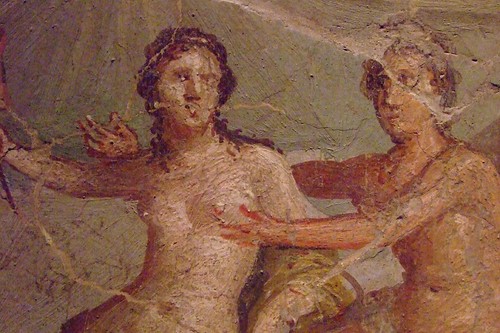
According to one myth the temple at Siwa was founded by the Greek god Dionysus. While lost in the Western Desert, Dionysus was perishing of thirst when a man appeared and guided him to the spring at Aghurmi. In gratitude, Dionysus erected the temple. In other myths, the Oracle of Siwa is reputed to have cursed Andromeda who was then tied to a rock to be devoured by a sea-serpent. Perseus is said to have stopped off to visit the Oracle prior to beheading Medusa, and Hercules is though to have visited it before he fought Bursiris.
"Siwa was too far away and too isolated to be a real part of the Egyptian kingdom, but there may have been indirect control. We are certain that during the Nineteenth Dynasty, there was a fort north of Siwa, at Umm el-Rakham on the coast. This proves that the pharaohs were interested in the far west. After the fall of the New Kingdom, Siwa was certainly independent, and it is no strange idea that the Libyan kings of the Twenty-Second and Twenty-Third Dynasties were somehow related to the rulers of Siwa."
"Siwa finally became a fully integrated part of Egypt after the domestication of the dromedary had made desert travel easier, for example to Egypt in the east, the Cyrenaica in the northwest and the Nasamones in the west. Among the oasis' exports was salt." - Livius.org
When the Libyan tribes assisted in the ascension of the pharaoh Amasis (r. 570-526 BCE), the pharoah built a shrine at site. The Lydian king Croesus, an ally of Amasis, is said to have offered sacrifices to the god Ammon. Documented by Herodotus, it is assumed that the cult had spread beyond Egypt by then (560-546 BCE). A second temple at the oasis was built by Nectanebo II ( (r. 359/358-342/341 BCE).
The first Greeks to visit the shrine were people from Cyrenaica, who knew the site through caravan trade. They called the god Zeus Ammon and the poet Pindar (522-445 BCE) was the first Greek to dedicate an ode to the god and one of the first Greeks to erect a statue to the god at Thebes and at Sparta.
“and one day Apollo, in his gold-filled house,
will admonish him by oracle,
when at length he enters the Pythian shrine,
to lead a host of men in ships
to the rich precinct of Zeus Ammon by the Nile.”
Pindar, Pythian 4
Later visitors included the Persian king Cambyses, the Athenian commander Cimon, the athlete Eubotas, the Spartan general Lysander, the Macedonian king Alexander the Great, and the Carthaginian commander Hannibal.
Cambyses was said to have wanted to destroy the Oracle but lost his army in a raging sandstorm in the Western Desert instead. Pliny tells us that this was because the sacred stone at the temple was touched by a sacrilegious hand.
In 449 BCE Cimon, the Athenian general, waiting at Cyprus, sent emissaries to the Oracle to ask if he should attack Egypt. Upon reaching the temple, his emissaries were told "Cimon is already with me!". When they returned to Cyprus they learned that Cimon had died at the same moment as they were speaking with the Oracle.
About 409 BCE, Eubotas, the famous Cyrene athlete sought advice from the Oracle and Lysander, the Spartan general, made two treks to consult with the Oracle.
In his "History of Alexander," Quintus Curtius writes:
What is worshipped as the god does not have the same form that artificers have commonly given to the deities; its appearance is very like that of a navel fastened in a mass of emeralds and other gems. When an oracle is sought, the priests carry this in a golden boat with many silver cups hanging from both sides of the boat; matrons and maidens follow, singing in the native manner a kind of rude song, by which they believe Jupiter is propitiated and led to give a trustworthy response. (4. 23-25)
Then, after sacrifice had been offered, gifts were given both to the priests and to the god, and the king’s friends also were allowed to consult Jupiter. They asked nothing more than whether the god authorized them to pay divine honours to their king. The prophets replied that this also would be acceptable to Jupiter. (4. 28-29)
Such was the oracle's reputation among the Classical Greeks that Alexander the Great, declared "the son of Amun" by the oracle at Siwa, thereafter considered himself divine.
As for Hannibal, I only found a reference that he visited the Oracle. I wish we knew what he asked and what response he received.
Under Roman administration, the Oracle began to decline in importance. Not before Cato (the Younger?), though, attempted to consult the Oracle about the freedom of Rome. One source claims the Oracle refused to answer. Another source claims it was Cato who refused to speak in his effort to challenge and disparage the Oracle. Inscriptions dating to as late as the reign of Trajan have been found there, though.
 |
| Fragment of a clay slab depicting Jupiter Ammon, 1st century CE, polychrome terracotta at the Museo Barracco in Rome, courtesy of Wikimedia Commons contributor Archeologo |
 |
| Bronze bust of god Sabazios, 2nd-century CE, in the collections of the Musei Vaticani courtesy of Wikimedia Commons contributor Jebulon. |
 |
| Tinia, highest god in Etruscan mythology, equivalent to the Roman Jupiter and the Greek Zeus. Terracotta, 300-250 B.C.E. now in the collections of the Staatliche Antikensammlungen in Munich, Germany, courtesy of Wikimedia Commons contributor Dan Mihai Pitea. |
 |
| Head of a colossal statue of ram-horned Zeus Ammon, Roman Tunisia (?), 150-180 CE, courtesy of Wikimedia Commons contributor Carole Raddato. |
 |
| Zeus Ammon. Roman copy of a Greek original from the late 5th century BCE. The Greeks of the lower Nile Delta and Cyrenaica combined features of supreme god Zeus with features of the Egyptian god Amun-Ra, now in the collections of the Staatliche Antikensammlungen in Munich, courtesy of Wikimedia Commons contributor Dan Mihai Pitea. |
 |
| Ancient Roman statue of Zeus Ammon found in Pergamon, now in the collections of the Istanbul Archaeological Museum, courtesy of Wikimedia Commons contributor Giovanni Dall'Orto |
 |
| Aequipondium (steelyard counterweight) in the shape of a Jupiter Ammon, 190-210 CE, courtesy of Wikimedia Commons contributor Sailko |
 |
| Head of Zeus Ammon, 1st-2nd centuries CE, Roman copy of a Greek original now in the collections of the Hermitage Museum in St. Petersburg, Russia. |
 |
| Diorite head of a Ptolemaic king (Ptolemy I?) as Zeus Ammon, from Egypt, now in the collections of the Istanbul Archaeological Museum |
 |
| A Marble Head of Zeus Ammon, Roman Imperial, 120-160 CE recently sold for $3,554,500. by Sotheby's. |
 |
| Coin from Cyrene, showing Zeus-Ammon now in the collections of the Kunsthistorisches Museum, Vienna (Austria) |
 |
| Entrance to the oracle courtesy of (https://www.livius.org/pictures/egypt/siwa/siwa-oracle/) |
 |
| View of the sanctuary courtesy of (https://www.livius.org/pictures/egypt/siwa/siwa-oracle-1/) Note: with sky replacement - hey, plain blue sky is boring!! |