Showing posts with label ritual. Show all posts

Tuesday, June 15, 2021

Golden Mummies of Egypt through July 11, 2021 at the North Carolina Museum of Art in Raleigh, North Carolina

This exhibition uses mummies from the collections of the Manchester Museum (England) to allow visitors to examine life for the wealthy in multicultural Roman Egypt, where diverse Egyptian, Roman, and Greek communities and cultural influences were blended. The exhibition journey traces expectations for the afterlife and introduces cultural constructions of identity, strikingly demonstrated by haunting painted panel portraits. The practices of preservation and decoration of the body, and the transformation of the deceased into a god, are explored by the mummies on display.

Eight gilded mummies  and more than 100 related objects are presented in the display, including papyri, jewelry, ceramics, and artworks depicting deities that connect the daily lives of these Greco-Roman Egyptians to the religious world of the gods in a series of lavishly illustrated thematic sections covering the period from 300 BCE to 200 CE. The youngest of the preserved individuals is a 2 or 3 year-old child wrapped in strips of linen in an intricate diagonal pattern adorned with golden studs. Elaborate wrappings and decorated cartonnage were popular during the Roman period because sarcophagi were no longer used for many inhabitants. Interactive radiographic studies and multidirectional CT scans from three of the mummies will allow visitors to see underneath the wrappings.

 “Using art and science together, we’re able to explore concepts around humanity, divinity, and ideals of eternal beauty,” explains Museum Director Valerie Hillings.

Visitors are also encouraged to explore the Greco-Roman objects in the North Carolina Museum of Art's own collection that includes a gilded mummy covering, circa 300 B.C.E, an Aphrodite-Isis sculpture from the first to second century CE, and the plaster portrait head of a coffin, circa 100 to 150 C.E. 

For those (like me) that will be unable to attend the exhibit, I hope to post images taken by my friend Allan Gluck who will be exploring the exhibit shortly.

A large cache of gilded mummies were found in The Valley of the Golden Mummies at Bahariya Oasis in the Western Desert of Egypt, dating to the Greco-Roman period. Discovered in 1996 by Zahi Hawass and his Egyptian team, approximately two hundred fifty mummies approximately two thousand years old were recovered over the period of several seasons. Excavations have continued and  the excavator estimates the site contains a total of more than ten thousand such mummies.

Many of the mummies were still in good condition when they were discovered by Hawass and his team. They were decorated in different styles. There were four general styles of the mummies at Bahariya. The first style, which was found on approximately sixty mummies, has a gilded mask covering the face and a gilded waistcoat depicting different scenes of gods and goddesses across the chest. The second style is covered with cartonnage, depicting scenes of gods such as Anubis, the god of mummification, and his four children. The third style was not decorated with gold or cartonnage, but rather was placed inside an anthropoid, a pottery coffin. The fourth style was covered in linen.

I found Dr. Hawass' book, "Valley of the Golden Mummies," absolutely riveting! 

Egyptian, from Hawara, Mummy of a woman called Isaious, 1st century C.E., human remains, linen, plaster, and gold leaf, Manchester Museum, © 2019 Manchester Museum / Michael Pollard Photographer

Egyptian, from Lahun, Mummy mask for a woman, circa 50 C.E., gilded and painted cartonnage JULIA THORNE 2020/TETISHERI MANCHESTER MUSEUM, UNIVERSITY OF MANCHESTER

Egyptian, from Hawara, Mummy mask, 332–30 B.C.E., plaster and linen, Manchester Museum. This is one of a series of mold-made masks, built up from layers of linen and plaster. Michael Pollard 2020 Manchester Museum


Egyptian, possibly from Hawara, Portrait of a woman, circa 138–160 C.E., wood, Manchester Museum, © 2019 Manchester Museum/Michael Pollard Photographer

Gilded Mummy Covering, 300 BCE, Linen with gesso, paint, and gilding, now in the collections of the North Carolina Museum of Art, image courtesy of the museum

Greco-Roman Plaster Portrait Head from a coffin, 100-150 CE, now in the collections of the North Carolina Museum of Art, image courtesy of the museum

Aphrodite-Isis, copper alloy, 1st-2nd century CE, now in the collections of the North Carolina Museum of Art, image courtesy of the museum


If you enjoyed this post, never miss out on future posts by following me by email!


Thursday, June 10, 2021

The secret of the rattling kantharos

One of just a handful of “rattling cups” that survive from the fifth and fourth centuries BCE, this elegant black-glazed wine cup from the second half of the 4th century BCE is dedicated to Kastor and Polydeukes (Castor and Pollux), the twin sons of Zeus known as the Dioscouri, who protected sailors, horseman, and chariot racers. Since each brother split his time between Mt. Olympus and Hades, they were often represented by stars, depicted here beneath the cup’s rim.  The cup's ritual purpose is further indicated by a wreath, garlands, and bucrania  bucrania (skulls of sacrificial bulls) decorating the cup’s body.

But, perhaps the most intriguing aspect of the vessel is that lifting and swirling the cup as if drinking or making a libation (liquid offering) during a ceremony produces a rattling noise.  It was assumed the sound was made by loose pellets moving inside the rim but curators at the J. Paul Getty Museum were puzzled by the fact that sometimes they could hear two balls but at other times only one.  So, they wanted to learn more about its construction and conducted a series of radiographic studies to unravel its secrets. The radiographs revealed two small balls that roll along a channel in the vessel’s rim.

Curators speculated that one way the potter might have achieved the construction of the cup is by raising the upper edge of the cup and folding it over to create a hollow space. The clay would be stretched thin by this process, which would reduce the need for ventilation holes that typically prevent pressure from trapped air. As for why it sometimes sounded like there was one ball in the rim and sometimes two, the radiograph revealed that one of the balls was resting in a small niche where it remained caught until it was knocked loose by the other pellet.

So why make an expensive cup rattle in the first place?  Getty curators said it is possible the rattling was intended to trick an unknowing handler into thinking they had broken it—quite a mistake given the cup’s obvious cost! Although the Greeks definitely had a keen sense of humor, I think due to the cup's religious dedication and symbolism, the curators' second theory is far more likely. They point out that the fourth-century BCE poet, Eubulus, mentions a glossy, black “pebble-rattling” cup used as part of a libation ceremony that took place at the end of a meal before a symposium began, in which wine was offered to Zeus Soter (Zeus the Savior). Since ritual events in antiquity were often accompanied by the sound of rattles, cymbals, and tambourines, which were thought to have magical and protective properties, the rattling sound emanating from the cup could have served the same purpose, without the necessity of hiring a cluster of religious performers who would have disrupted a cozy atmosphere conducive to sharing candid thoughts.

Read more about it here: http://blogs.getty.edu/iris/we-shook-an-ancient-ceramic-and-lived-to-tell-the-tale/ 

elegant black-glazed wine cup from the second half of the 4th century BCE is dedicated to Kastor and Polydeukes now in the collections of the J. Paul Getty Museum (Villa location) courtesy of the museum.
If you enjoyed this post, never miss out on future posts by following me by email!


Tuesday, May 11, 2021

Professional mourners in the ancient world


Statues of Mourning Women, South Italian (Apulian, Canosan), 300-275 BCE Terracotta, now in the collections of the J. Paul Getty Museum, Villa venue, Pacific Palisades, California


This group of mourning women, often understood as female figures in prayer (orantes), was likely produced in the area of Canosa in south-eastern Italy. Although there are considerable differences in terms of clothing, poses and hairstyles, the four statues seem to depict a type of youthful female figure, probably envisioned as one of the mourners who expressed their grief during funerary ceremonies. The group was intended to be placed around a funerary couch (kline), and was probably produced for a fairly prestigious client who, in the context of Romanization in the area, aspired to underscore his economic prosperity, personal identity, and native traditions. The figures were made not with molds, as has been previously conjectured, but rather through a modeling process over a fairly thick conical structure. Working from the bottom up, clay pieces were laid over this hollow structure to define the anatomy and iconographic details of the figure. The forearms, created separately, and the head, made with a bivalve mold, were inserted in holes specially made by the craftsman. The tubular structure was then modeled from within to establish the round shapes of knees and breasts, and from the exterior, through the application of clay parts, to depict the details of the chiton and himation. A spatula and other sharp tools were used to define the hair, eyes, and various details of clothing. Colors were applied after the firing over a preparatory layer of white slip, which has been preserved in several areas. The palette shows little variety, consisting of pink, red, white, possibly dark brown, and black. - J. Paul Getty Museum

These sculptures probably represented women who were known by the Romans as praeficiae, professional mourners, who followed musicians in the funeral procession and sang a funeral song praising the deceased. Paying mourners to attend your funeral showed society the importance of your social status.

The practice of hiring professional mourners has been documented in ancient Egypt, China, and the Middle East as well as in Greece and Rome.  In ancient Egypt only childless women could become professional mourners as it was considered unseemly for men to weep in public. These women could not have any body hair and had the names of goddesses tattooed on their shoulders.

Mycenaean larnakes, burial chests, depict mourners performing ritual laments. During the Greek Archaic Period, greater simplicity in burial practices coincided with  the rise of democracy and the egalitarian military of the hoplite phalanx.  But during the 4th century BCE,  the decline of democracy and the return of aristocratic dominance was accompanied by the return of more elaborate funerary rituals.

"Ancient Romans honored their dead through extended mourning. Men would typically mourn for a period of a few days, during which they would always wear black and would not cut their hair or beards. Women would wear white and might not cut their hair as well. However, while formal mourning usually only lasted a few days for men, when a woman lost a husband or parent, it wasn’t uncommon for her to mourn for a year. Adopting traditions from the ancient Greeks, many Romans also periodically visited their deceased loved one’s tombs or burial sites to offer gifts and sacrifices. Toward the end of February, ancient Romans sometimes celebrated Feralia as well. This was a general festival for honoring the dead. Romans would traditionally celebrate by bringing food to the sepulchers of the deceased." - Joe Oliveto, State University of New York at New Paltz


Statue of Mourning Woman, South Italian (Apulian, Canosan), 300-275 BCE Terracotta, now in the collections of the J. Paul Getty Museum, Villa venue, Pacific Palisades, California


If you enjoyed this post, never miss out on future posts by following me by email!


Sunday, March 21, 2021

Etruscan funerary banquet figurines

"The banquet was one of the most popular and consistent funerary motifs in ancient Etruria. The earliest banquet scenes depict people sitting, whereas later representations show banqueters reclining on couches. The deceased is either depicted at a meal or ancestor figures are shown welcoming the newly deceased to the banquet. The characterization of the deceased at a meal is a funerary theme that also finds expression in the earlier tomb groups of the Villanovan period." - Anthony S. Tuck, The Etruscan Seated Banquet: Villanovan Ritual and Etruscan Iconography

One of the earliest representations of a seated banquet was found in the Tomb of the Five Chairs at Cerveteri. A terracota figure was originally placed on each of five rock-carved thrones in a side chamber of the cruciform tomb.  Two stone tables were placed in front of the chairs  and classicist F. Prayon further describes the setting as including a large basket, libation table, and a rectangular base used for two additional cylindrical thrones.

The five figures were identified as three males and two females based on the style of the fibula worn by them. All figurines are constructed in the ritual pose, however, with the left arm hidden beneath a cloak or shroud and only the hand visible.  The right arm is extended with the palm up. Archaeologist Anthony S. Tuck states that this common gesture suggests that the scene represents more than just a simple scene of people eating and should be construed as one of welcoming and acceptance representing the induction and elevation of the newly deceased to the honorific status of the ancestors themselves.

The garments worn by the figures are quite similar to the robes of figures from a slightly earlier Tomb of the Statues at nearby Ceri. Although not well preserved these figurines hold a scepter topped with a lotus palmette which parallel enthroned figures from Asia Minor depicted on ivory plaques from Nimrud.   So scholars conclude that these works were created by Near Eastern immigrant artisans or copied by Etruscan carvers familiar with Near Eastern imports but manipulated to convey a specifically Etruscan idea.

Banquet figurine from the Tomb of the Five Chairs at Cerveteri, Etruscan, 625-600 BCE, terracotta, at the British Museum.

Banquet figurine from the Tomb of the Five Chairs at Cerveteri, Etruscan, 625-600 BCE, terracotta, at the Capitoline Museum in Rome


If you enjoyed this post, never miss out on future posts by following me by email!


Saturday, January 2, 2021

Priestly attire from Roman Period Egypt 1st century CE

Consisting of a wig with short, tight curls and a distinctive gilded sidelock, this priestly headdress made of cartonnage, said to have been purchased by Howard Carter and thought to have originated from Qau el-Kebir,  may have been found (and once worn) with a faux leopard-skin robe like the accompanying example. In all likelihood, a man serving as a sem-priest or Iunmutef-priest donned the headdress and cloak before carrying out a ritual that revivified a mummified body so that the deceased could live eternally.

Priests of Iunmutef were documented from the 5th dynasty (around 2350 BCE) clear up to the Greco-Roman period.  Iunmutef is a manifestation of Horus in his capacity as the “loving son” of Osiris. In this quality he appears in numerous temple scenes and in the royal tombs as a ritual provider of the ruler, whom he enlivens, deifies and renews through the opening of the mouth ritual and as a representative of a rightful ruler in various regeneration and transformation rites. Sources from the New Kingdom indicate the deity increased in importance during that period.

Most depictions of these priests suggest they wore actual leopard pelts but nearly all rare surviving examples are fashioned from painted linen. In the paintings in Tutankhamum's tomb, his advisor and successor "Ay" wears the ritual leopard robe while performing the "opening of the mouth" ceremony.  However, as Tutankhamun's successor, he wears the blue Khepresh crown rather than the cartonnage "helmet" of a typical high priest.

Priest with Leopard Skin Mantle, Egypt, Late Period, 26th Dynasty, reign of Apries, 589-570 BCE, that I photographed at the Walters Art Museum in Baltimore, Maryland.

Egyptian high priest with leopard robe and "helmet-style" headdress courtesy of historical-nonfiction.tumblr.com (digitally enlarged).

Tomb painting of the pharaoh Tutankhamun and his successor, Ay, performing the "opening of the mouth" ceremony, New Kingdom, 18th dynasty, Egypt (PD).

“Leopard-skin” robe of painted linen of the priest, Harnedjitef, probably 1st century CE, Roman Period Egypt, at the Metropolitan Museum of Art in New York. The "leopard spots" were once brightly colored rosettes of red, yellow, and blue.

Priestly headdress of painted cartonnage, 1st century CE, Roman Period Egypt at the Metropolitan Museum of Art in New York.


If you enjoyed this post, never miss out on future posts by following me by email!


Tuesday, June 2, 2020

Insight provided by Roman funerary inscriptions

Roman tombstone (PD)
Roman Funerary inscriptions on tombstones provide invaluable insight into the lives of ordinary Romans. Funerary inscriptions revealed that many women worked. Many of them were doctors. For example:

‘To the departed spirit of Julia Saturnina, 45 years of age, wonderful wife, excellent physician, most blameless woman. Erected by her husband Cassius Philippus out of gratitude. She lies here, and may the earth rest lightly upon her.’

Other professions attested to women’s tombstones included scribe: ‘To Hapate, short-hand writer of Greek. She lived for 25 years. Pittosus erected this monument to his most affectionate wife,’ or merchant: ‘Thymele, Marcella’s dealer in silk’ or actress: ‘Luria Privata, an actress in mime shows, lived 19 years. Bleptus made this monument.’

The epitaphs of men also illustrated a variety of jobs, from humble laborers like ‘Publius Marcius Philodamus, construction worker, freedman of Publius,’ or those with more specialized careers: ‘Here lie the bones of Quintus Tiburtinus Menolavus, freedman of Quintus, who made living slaughtering animals for sacrifices.’

Some men took great pride in their jobs, as in the case of a teacher whose epitaph stated: ‘Having left the famous city of Bithynia Nikaia as a young man, I came to the land of the Italians, and in the sacred city of Rome, I taught mathematics and geometry. This is the monument that I, Basileus, made, having paid for the work by making a living with my mind.’

https://www.thegreatcoursesdaily.com/tombstone-epitaphs-and-the-meaning-of-funerary-inscriptions-in-ancient-rome/

In the free online FutureLearn course, "Hadrian's Wall: Life On The Roman Frontier," I had the opportunity to learn how to decipher some of the abbreviations used on Roman tombstones and dedicated altars.  Such as:

Line 1: D(EO) IN(VICTO) M(ITHRAE) S(ACRUM)
Line 2: AVL(VS) CLVENTIVS
Line 3: HABITVS PRAEF(ECTVS)
Line 4: COH(ORTIS) I
Line 5: BATAVORVUM
Line 6: DOMV VLTI
Line 7: NA COLON(IA)
Line 8: SEPT(IMIA) AVR(ELIA) L(ARINO)
Line 9: V(OTUM) S(OLVIT) L(IBENS) M(ERITO)

Which is transliterated as:

Line 1: SACRED TO THE INVINCIBLE GOD MITHRAS
Line 2: AULUS CLUENTIUS
Line 3: HABITUS, PREFECT
Line 4: OF THE 1ST COHORT
Line 5: OF BATAVIANS,
Line 6: OF THE ULTINIAN VOTING TRIBE
Line 7: FROM COLONIA
Line 8: SEPTIMIA AURELIA LARINUM
Line 9: WILLINGLY AND DESERVEDLY FULFILLED HIS VOW

Professor Ian Haynes points out that often in Roman dedicatory inscriptions more information is given about the dedicant, who is showing the community that he has honored his vow, than about the deity. In this case the text focuses on Aulus Cluentius Habitus, his command and place of origin.  We were given access to a database of Roman funerary inscriptions and provided with the opportunity to translate some sample inscriptions.

https://www.futurelearn.com/courses/hadrians-wall

The six week course is in progress right now and students can join at any time.   One of FutureLearn's most popular courses, it is also offered multiple times during the year.  The course is free but I paid the extra $69 fee so I could have access to the course materials as long as they remain on FutureLearn's website.  I also received a digital certificate for completion that can be used as evidence for continuing education credits.


If you enjoyed this post, never miss out on future posts by following me by email!


Saturday, April 3, 2010

Do new discoveries disprove sacred sex in ancient temples?

It seems that scholars are never quite sure if they should embrace the reports of ancient historian Herodotus or not. Now a controversy has arisen over his statements that the "ugliest of customs", prostitution, actually took place as part of the sacred rituals inside the Temple of Ishtar.

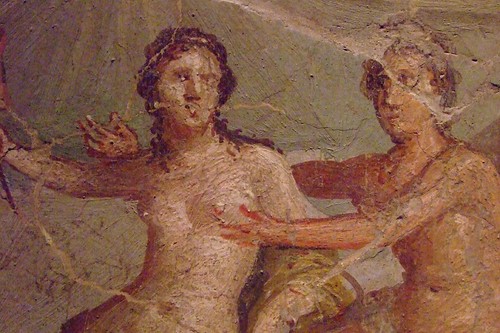
[Image: Ertoic fresco excavated from Pompeii displayed in the 'Secret Room' of the Naples Archaeological Museum.  Photo by Mary Harrsch]

If you've ever visited the "Secret Room" inside the Museo Archaeologico di Napoli in Naples, you will have no doubt that the ancients definitely enjoyed their carnal pleasure. But did they go so far as to make the deflowering of virgins part of their worship of their respective goddesses of love?

The Greek geographer Strabo thought so claiming that Persians living along the shores of the Black Sea dedicated their "virgin daughters," hardly 12 years old, to cult prostitution.

But, a small group of female gender researchers led by American scholar Julia Assante claim it's all the product of overactive male imaginations. (After all, I saw a program this week on Good Morning America about the differences in the male and female brain where a doctor was discussing how the male brain is "marinated" in testoterone!)

More moderate scholars, however, think disavowing all sacred sexual practices goes a bit too far and have expressed their opinions that there were once:

* Temples that operated brothels on the side;

* Temples in which girls held the highest offices of the priesthood, even before their first menstruation;

* Professional harlots who donated their own money to cult sites, such as a site devoted to the goddess "Aphrodite Porne."

But with all those huge buildings dedicated to Ishtar, the goddess of love, there was not a single instance of ritual depravity?

Gernot Wilhelm, an Orientalist at Julis Maximilian University in Würzburg, Germany discovered a 3,300 year-old legal document that recounts how a man delivered his own daughter to the Temple of Ishtar to serve as a Harimtu.

According to the document, the man wanted a loan from the priests and was offering his daughter as collateral.

But what exactly did the pawned daughter do for her new employers? Wilhelm speculates that the young girl worked as a prostitute, "but outside the temple."

As evidence, the professor cites the "Book of Baruch" in the Old Testament. It describes prostitutes standing "along the paths" between the dusty houses of Babylon. They too were somehow associated with a sacred organization. - "Did Prostitution Really Exist in the Temples of Antiquity? by Matthius Schulz
Assante and her colleagues dispute this interpretation, however.  She says a Harimtu was not a prostitute but just a single woman serving as a cult official.

Her reinterpretation of the word Harimtu doesn't make semantic sense, says economic historian Morris Silver. He insists that the Harimtu were clearly "professional prostitutes with cultic connections," who offered a "sexual service" on behalf of the temple. Priests acted as pimps and collected some of the profits. - "Did Prostitution Really Exist in the Temples of Antiquity? by Matthius Schulz
Other scholars point to the accounts of prostitution surrounding the Temple of Aphrodite in Corinth.  Strabo reports the temple owned a stable of over 1,000 prostitutes (I thought he was supposed to be interested in geography?)  Tanja Scheer, a professor of ancient history at the University of Oldenburg in northern Germany blames it all on an ode to Pindar.

"Pindar writes that a wealthy Olympic champion dedicated the temple to a "hundred-limbed" throng of prostitutes in 464 B.C.," Scheer points out,  "It is unlikely that the prostitutes lounged directly at the altar. Instead the wealthy athlete probably offered the temple financial assistance in the form of female slaves."

Scheer bases her theory on the fact that the Athenian statesman Solon taxed prostitutes working in government houses of pleasure in Athens around 590 B.C.. The revenues were subsequently used to build a temple for worshipers of the goddess of love.  Then somehow the construction of the temple became entangled with the source of the money used to build it in subsequent oral histories .
 
Besides, if you take Pindar literally, a "hundred-limbed" throng of prostitutes would have been only a mere 25 if you count all four limbs or 50 if you count just their arms - that seems a far cry from 1,000.

Strabo's sexual fantasies didn't end there, though, either.  He went on to claim that loose women also inhabited the Temple of Amun in Thebes (Egypt) where they served as godly consorts.

Strabo writes, "a maiden of greatest beauty and most illustrious family prostitutes herself, and cohabits with whatever men she wishes until the natural cleansing of her body takes place" (menstruation). 


 Researchers do admit that a recently translated papyrus fragment does refer to young girls in service to the god.

According to the text, girls are permitted to work in the temple until their first menstruation. After that, however, "they are cast out from their duties." - "Did Prostitution Really Exist in the Temples of Antiquity? by Matthius Schulz
So, as they say on that tabloid TV show, "What side are you on?"

 The Myth of Sacred Prostitution in Antiquity   Prostitutes and Courtesans in the Ancient World (Wisconsin Studies in Classics)   Trying Neaira: The True Story of a Courtesan's Scandalous Life in Ancient Greece   Courtesans & Fishcakes: The Consuming Passions of Classical Athens   Courtesans at Table: Gender and Greek Literary Culture in Athenaeus  
If you enjoyed this post, never miss out on future posts by following me by email!


Friday, February 26, 2010

Routine Child Sacrifice Not Practiced by Ancient Carthaginians After All

Although Hannibal was used as a "boogey man" to scare misbehaving Roman children, Carthaginians did not, contrary to popular myth, actually wantonly sacrifice their children according to a new report by researchers from the University of Pittsburg.

The scientists examined the remains of children found in Tophets, structures on the margins of Punic cemetaries where urns containing the remains of young children and animals were placed.  The contents of 348 urns were inspected for developmental markers that would reveal the children's age at death.

[Image: Medea Killing Her Sons by Delacroix, 1862.  Courtesy of Wikimedia Commons]

"Schwartz [Jeffrey H. Schwartz, a professor of anthropology and history and philosophy of science in Pitt's School of Arts and Sciences and president of the World Academy of Art and Science] and Houghton [Frank Houghton of the Veterans Research Foundation of Pittsburgh] recorded skull, hip, long bone, and tooth measurements that indicated most of the children died in their first year with a sizeable number aged only two to five months, and that at least 20 percent of the sample was prenatal."

"Schwartz and Houghton then selected teeth from 50 individuals they concluded had died before or shortly after birth and sent them to Macchiarelli and Bondioli, who examined the samples for a neonatal line. This opaque band forms in human teeth between the interruption of enamel production at birth and its resumption within two weeks of life. Identification of this line is commonly used to determine an infant's age at death. Macchiarelli and Bondioli found a neonatal line in the teeth of 24 individuals, meaning that the remaining 26 individuals died prenatally or within two weeks of birth, the researchers reported."

"The team's report also disputes the contention that Carthaginians specifically sacrificed first-born males. Schwartz and Houghton determined sex by measuring the sciatic notch&'a crevice at the rear of the pelvis that's wider in females&'of 70 hipbones. They discovered that 38 pelvises came from females and 26 from males. Two others were likely female, one likely male, and three undetermined." - More: Spero News

Carthage: A Journey Back in Time (Lost Treasures of the Ancient World)    History - Engineering An Empire: Carthage   The Punic Wars: Rome, Carthage, and the Struggle for the Mediterranean   Dying for the Gods: Human Sacrifice in Iron Age & Roman Europe   Some Inquiries Concerning Human Sacrifices Among the Romans
If you enjoyed this post, never miss out on future posts by following me by email!