Showing posts with label Apollo. Show all posts

Saturday, May 29, 2021

Apollo of Piombino, not just a Roman copy of an older Greek original but, attempt at Roman forgery of ancient Greek art

When I posted the image of a lampholder depicted as Apollo in the archaic style which is part of the new exhibit, Tota Italia, a couple of days ago, another Facebook member asked me for an image of the complete statue.  The exhibit did not provide a full length image of it so I checked the website for the National Archaeological Museum in Naples and could not find it there either. I also checked Wikimedia Commons and didn't have any luck there. I found a small side view of the full statue just in a general image search then found a full length image of the Apollo of Piombino which is another archaic-style sculpture of Apollo that is said to be very similar to the one in the exhibit that was found in Pompeii in the House of C. Julius Polybius.  Found in 1832 at Piombino (Roman Populonia), in Etruria, Apollo of Piombino depicts either the god Apollo as a kouros or youth or it may be a worshipper bringing an offering.   The bronze is inlaid with copper for the boy's lips, eyebrows, and nipples. The eyes, which are missing, unlike the statue found in Pompeii, were of another material, perhaps bone or ivory.

The Apollo of Piombino  was originally dated to the 5th century BCE by various scholars and was purchased for the Musée du Louvre in 1834.  The two sculptors responsible for the piece could not resist secreting inside the sculpture a lead tag inscribed with their names, though, which was found when the sculpture was conserved in 1842. In 1967, classicist B. S. Ridgeway, stated it to be not simply an archaizing sculpture of the 1st century BCE, of the kind designed to appeal to a Roman with refined tastes, but a consciously fabricated Roman forgery, with a false inlaid inscription of silver in archaic lettering on the left leg. He pointed out the inscription dedicated this Apollo to Athena, an anomaly as well.  When the similar sculpture of Apollo was found in 1977 in the villa of C. Julius Polybius in Pompeii, this corroborated Rideway's theory.  

Apollo of Piombino now in the collections of The Louvre, Paris.


If you enjoyed this post, never miss out on future posts by following me by email!


Tota Italia : At the Origins of a Nation

Tota Italia : At the Origins of a Nation is now open at The Scuderie del Quirinale in Rome. The presentation examines the process of Romanization beginning with exhibits from Pre-Roman Italy of the 4th century BCE then continues through the Julio-Claudian period to the ultimate unification of territories under the banner of Rome. More than thirty Italian museums have loaned objects to the exhibition to illustrate the diversity that made up the Empire and how the extraordinary differences were blended to form the cultural identity of the Italian people.

Looking through images of some of the artifacts on exhibit, I was pleased to see once more the Parian marble table support depicting two griffins attacking a doe from the 4th century BCE that I had photographed years ago at the Getty Villa. Apparently, it is thought to have originated from a tomb in Foggia, originally part of the ancient Greek colony known as Argos Hippium in southern Italy. It is truly a magnificent piece!
One of my other favorite pieces included in the exhibit is the Boxer Resting, a 1st century BCE bronze Roman copy of a 3rd century CE Greek original by Apollonius that I photographed at the Palazzo Massimo back in 2009.
The exhibit will be on display until July 25, 2021.

Table Support in the Shape of Griffins Attacking a Doe, Greek, made in South Italy and found in a tomb near Foggia, 325-300 BCE that I originally photographed at the Getty Villa just before its repatriation to Italy in 2006

Table Support in the Shape of Griffins Attacking a Doe, Greek, made in South Italy and found in a tomb near Foggia, 325-300 BCE that I originally photographed at the Getty Villa just before its repatriation to Italy in 2006

Table Support in the Shape of Griffins Attacking a Doe, Greek, made in South Italy and found in a tomb near Foggia, 325-300 BCE that I originally photographed at the Getty Villa just before its repatriation to Italy in 2006

A Boxer Resting 1st century BCE Roman copy of 3rd century BCE Greek original by Apollonius, Bronze, that I photographed at the Palazzo Massimo in 2009.

A Boxer Resting 1st century BCE Roman copy of 3rd century BCE Greek original by Apollonius, Bronze, that I photographed at the Palazzo Massimo in 2009.

A Boxer Resting 1st century BCE Roman copy of 3rd century BCE Greek original by Apollonius, Bronze, that I photographed at the Palazzo Massimo in 2009.

A Boxer Resting 1st century BCE Roman copy of 3rd century BCE Greek original by Apollonius, Bronze, that I photographed at the Palazzo Massimo in 2009.

Decoration from a shield depicting Taras, 4th century BCE from the National Archaeological Museum of Basilicata. Image courtesy of the exhibit.

Roman relief with battle scene, 3rd century BCE from the Archaeological Museum of Taranto. Image courtesy of the exhibit.

Bronze lamp holder depicting Apollo, 1st century BCE from the Archaeological Park of Pompeii. Image courtesy of the exhibit.

The Capitoline Triad 2nd century CE from the Archaeological Museum of Guidonia-Montecelio. Image courtesy of the exhibit.


If you enjoyed this post, never miss out on future posts by following me by email!


Saturday, May 22, 2021

The Aulos

An aulos or tibia (Latin) was an ancient Greek wind instrument, depicted often in art and also attested by archaeology. Though aulos is often translated as "flute" or "double flute", it was usually a double-reeded instrument like the modern oboe, but with a larger mouthpiece, and its sound—described as "penetrating, insisting and exciting"was more akin to that of the bagpipes. Although used for martial music, the aulos is more frequently depicted in other social settings. It was the standard accompaniment of the passionate elegiac poetry. It also accompanied physical activities such as wrestling matches, the broad jump, the discus throw and to mark the rowing cadence on triremes, as well as sacrifices and dramas. Plato also associates it with the ecstatic cults of Dionysus and the Korybantes.

Although aristocrats with sufficient leisure sometimes practiced aulos-playing as they did the lyre, after the later fifth century BCE the aulos became chiefly associated with professional musicians, often slaves. Nevertheless, such musicians could achieve fame. The Romano-Greek writer Lucian discusses aulos playing in his dialogue Harmonides, in which Alexander the Great's aulete Timotheus discusses fame with his pupil Harmonides. Timotheus advises him to impress the experts within his profession rather than seek popular approval in big public venues. If leading musicians admire him, popular approval will follow. However, Lucian reports that Harmonides died from excessive blowing during practicing.  

Some variants of the instrument were loud, shrill, and therefore very hard to blow. A leather strap, called a phorbeiá in Greek or capistrum in Latin, was worn horizontally around the head with a hole for the mouth by the auletai to help support the lips and avoid excessive strain on the cheeks due to continuous blowing. Sometimes a second strap was used over the top of the head to prevent the phorbeiá from slipping down. 

An aulos discarded by Athena then picked up by Marsyas the satyr was the instrument that resulted in Marsyas being flayed alive for his hubris after losing a musical contest with Apollo. A sculpture of the flayed Marsyas at the Capitoline Museum in Rome is one of the most poignant sculptures I have photographed in my travels.

Youth playing the aulos, detail of a banquet scene, tondo of an Attic red-figure cup, ca. 460 BC–450 BCE. Image courtesy of Wikimedia Commons contributor Marie-Lan Nguyen.

Coffin floorboard depicting Isis being served wine by the deceased, Egypt, Roman Period, 30 BCE-324 CE at the Royal Ontario Museum In Toronto, Canada courtesy of Wikimedia Commons contributor Daderot.

Competition between Apollo and Marsyas, panel of a sarcophagus, ca. 290–300 CE, found in 1853 on the Chiarone river banks (Tuscany, Italy), on the former Emilia-Aurelia road. Image courtesy of Wikimedia Commons contributor Marie-Lan Nguyen.

Statuette of a Young Satyr Playing the Double Aulos, silver with gilding, Roman 150-200 CE, courtesy of the J. Paul Getty Museum and photographer Bruce White. This rustic looking youth strides forward playing a double aulos or flute. The instrument is unusual in that it has one straight pipe and one with a flaring, upward-curving end. The youth is nude except for a gilded panther skin draped across his torso. The panther skin, impish facial features, and stiff, tousled hair characterize the young figure as a satyr, a semi-human follower of Dionysos, the Greek god of wine. Nevertheless, he lacks the expected animal ears of most satyr portrayals, and the place where a tail should be is covered by the panther skin. This confusion of traditional iconography, as well as his round face and bulging eyes, suggest that this statuette was made during the Antonine dynasty in the 100s CE. This time period also saw the production of many other solid-cast silver statuettes given by the wealthy as offerings to the gods either in a temple treasury or in a household shrine.

Choregos and actors including a musician playing the aulos, Roman mosaic from the House of the Tragic Poet (VI, 8, 3) in Pompeii courtesy of Wikimedia Commons contributor Marie-Lan Nguyen.

Roman mosaic depicting a comedy scene depicting a musician playing the aulos from the so-called Villa of Cicero in Pompeii 1st century CE that I photographed at the Museo Archaeologico Nazionale di Napoli in Naples, Italy.

Marsyas the satyr who was flayed alive for his hubris by Apollo for challenging him to a music contest Roman imperial period copy of 2nd century BCE Greek original that I photographed at the Capitoline Museum in Rome, Italy.

Closeup of the agony of Maryas the satyr who was flayed alive for his hubris by Apollo for challenging him to a music contest Roman imperial period copy of 2nd century BCE Greek original that I photographed at the Capitoline Museum in Rome, Italy.


If you enjoyed this post, never miss out on future posts by following me by email!


Friday, May 21, 2021

Dolphins in Greco-Roman Art

Dolphins have a rich background in Greek and Roman mythology. Not only are they frequently the companions of Venus serving as symbols of romance and reminders of the  myth that Venus was born from the sea, but in the Homeric Hymns, they play a key role when Dionysus (Roman Bacchus) was kidnapped by pirates. The god of wine turned himself into a lion to punish the kidnappers and, terrified, they jumped overboard whereupon Dionysus turned them into dolphins.  The also describe instances where the god Apollo transformed into a dolphin to guide a ship into harbor.  nother myth tells that Apollo’s son, Eikadios, was shipwrecked and carried to shore by a dolphin. This is one of many myths about dolphins rescuing drowming men, or bringing bodies back to shore for burial.

The Roman author Statius tells us in his 1st century CE work, "Achilleid" that the sea-nymph Thetis rode a chariot through the sea that was pulled by two dolphins. Philostratus’ ‘Imagines’ also describes a scene in which the one-eyed cyclops Polyphemus falls in love with the sea-nymph Galatea while she is riding four dolphins.

"Many dolphin stories can also be found in Greek and Roman folklore from small coastal towns, observes Emily Tilley, University of Leicester,  "In the first century A.D. Pliny the Elder recorded in his ‘Natural History’ the story of a young Roman boy who befriended a dolphin. Every day when the boy needed to cross the bay to get to school, he would call on his dolphin friend to carry him across the water. A second century A.D. story tells the tale of an elderly couple who rescued a young, injured dolphin and trained it to catch fish for them."

Statue of Venus (the Mazarin Venus), Roman, 2nd century CE, now on view at the Getty Villa in Gallery 106 Basilica. Image courtesy of the J. Paul Getty Museum

Early Imperial Portrait Roman 27 BCE-68 CE from the Farnese Collection in Naples that I photographed at "Pompeii: The Exhibit" at the Pacific Science Center in Seattle Washington.

Roman mosaic frieze depicting dolphins from Halicarnassus 4th century CE that I photographed at The British Museum.

Ovoid ceramic rhyton depicting a dolphin Pseira Crete Late Minoan 1B that I photographed at the University of Pennsylvania Museum of Archaeology and Anthropology

Frescoes of Marine Life including a dolphin found on a wall along the via La Portuense in the river port of San Paolo that I photographed at the Palazzo Massimo in Rome 125-150 CE

Mosaic pavement depicting a dolphin that I photographed in the Piazzale delle Corporazioni in Ostia Antica 1st century BCE-4th century CE.

Basilica of Neptune, Rome (Dolphin Frieze) Detail of Dolphins, a shell, and an upright trident from the frieze course of the entablature of the Basilica of Neptune, Rome, Hadrianic. (Hadrian r. 117-138 CE). The motif was popular for public buildings in Rome of the late first century (and the maritime theme is not necessarily associated with the function of the structure, such as a bath building). Image courtesy of Roger Ulrich (CC BY-NC-ND 2.0)

Detail of mosaic on the podium wall in the water sanctuary showing marine fauna, including a dolphin and urchins, Roman Ruins of Milreu, a luxurious rural villa transformed into a prosperous farm in the 3rd century, Portugal, courtesy of Carole Raddato.

Roman mosaic depicting the mask of Oceanus with lobster claws protruding from the head and dolphins and fish escaping from his beard, 2nd - 3rd century CE, found in 1959 at the Plaza de la Corredera, Salón de los Mosaicos (Hall of Mosaics) Alcazar of the Christian Monarchs, Cordoba, courtesy of Carole Raddato.

The Oceanus Mosaic from Bad Vilbel, it originally belonged to a Roman thermal bath facility, end of 2nd century AD, Hessisches Landesmuseum Darmstadt, Germany. The mosaic was found in 1849 during construction work of the Southern Railway Station in the remains of a Roman thermal spa. This bath complex was probably part of an estate (Villa rustica). Image courtesy of Carole Raddato.

Thalassa (spirit of the sea) with crab-claw horns, holding a ship's oar and a dolphin, late 5th century AD, found in the village of Yakto near Daphne, Hatay Archaeology Museum, Antakya, Turkey courtesy of Carole Raddato (perspective adjusted)


If you enjoyed this post, never miss out on future posts by following me by email!


Friday, January 8, 2021

Marsyas: The Price of Hubris

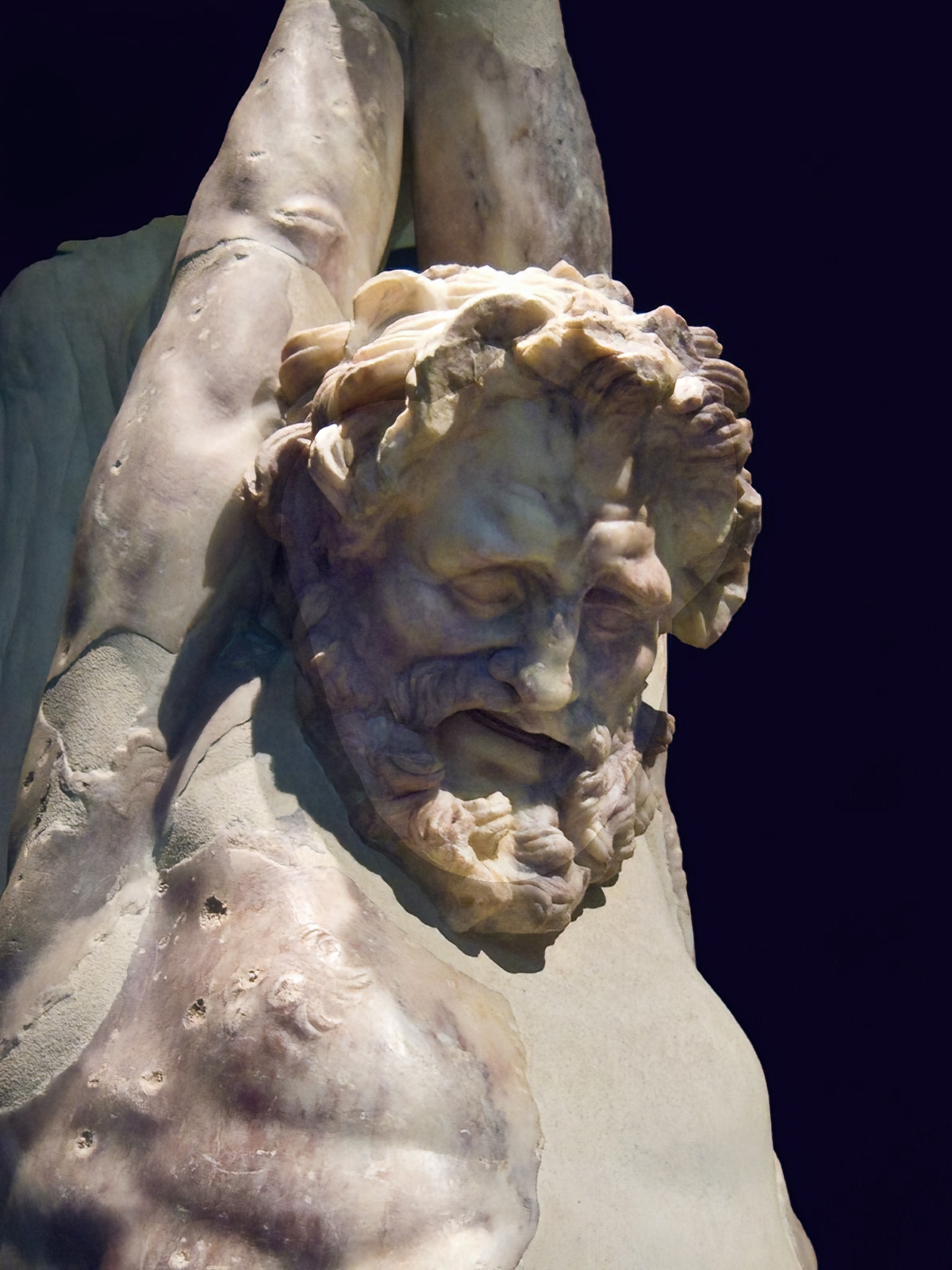
One of the most moving sculptures I have ever photographed is a depiction of the satyr Marsyas who has been flayed alive by Apollo for his hubris of challenging Apollo, the god of music (among other things), to a music contest.  The large statue of Marsyas bound and hanging by his hands with his skin already partially removed at the Capitoline Museum in Rome is a Roman Imperial Period copy of a 2nd century BCE Greek original. 

In antiquity, literary sources often emphasize the hubris of Marsyas and the justice of his punishment. Hubris has been described as a personality quality of extreme or foolish pride or dangerous overconfidence, often in combination with (or synonymous with) arrogance. Hubris, arrogance and pretension are related to the need for victory (even if it doesn't always mean winning). Hubris is usually perceived as a characteristic of an individual rather than a group, although the group the offender belongs to may suffer collateral consequences from wrongful acts. Hubris was thought to indicate a loss of contact with reality and an overestimation of one's own competence, accomplishments or capabilities. In ancient Greece, hubris referred to “outrage” - actions that violated natural order, or which shamed and humiliated the victim, sometimes for the pleasure or gratification of the abuser.

Aristotle defined hubris as shaming the victim, not because of anything that happened to the committer or might happen to the committer, but merely for that committer's own gratification: 

"Hubris is not the requital of past injuries. This is revenge. As for the pleasure in hubris, its cause is this - naive men think that by ill-treating others they make their own superiority the greater."

As hubris was considered a transgression against the gods, it was rarely left unpunished in Greek mythology.  Marsyas was ordered flayed.  Arachne, a talented young weaver, was transformed into a spider when she said that her skills exceeded those of the goddess Athena. Niobe boasted of her fourteen children, seven male and seven female (the Niobids), to Leto who only had two children, the twin gods, Apollo and Artemis. Using arrows, Artemis killed Niobe's daughters and Apollo killed Niobe's sons.  So, the consequences of hubris were severe.

These events were not limited to myth, and certain figures in history were considered to have been punished for committing hubris through their arrogance. In Aeschylus' play, "The Persians," King Xerxes is said to have suffered his defeat at Salamis because he arrogantly lashed the waters of the Hellespont with chains after his fleet was destroyed by a storm.


Full length view of of Marsyas hanging on the tree as he is going to be flayed by Apollo. Marble, Roman copy of the 1st-2nd century after a Hellenistic original. Found in Rome, Italy, part of the Borghese Collection at The Louvre, courtesy of Wikimedia Commons contributor Carole Raddato.

Head of Maryas found in the Baths of Caracalla, Roman copy of Greek original from 150-100 BCE, now in the Antikensammlung inf Berlin courtesy of Wikimedia Commons contributor Sailko.

Roman fresco of the Myth of Marsyas in continuous narration, found in Pompeii in the House of Paccia (V, 2, 10, cubicle q), now on display in the National Archaeological Museum of Naples (inv. 120626). Marsyas observes from the top of a rock the continuation of his story: below Minerva, while playing the double flute, is reflected in the circular mirror held by a nymph who has emerged from the water. A little above the nymph is Marsyas who is fleeing with the double flute that the goddess had thrown away. Still further on, we see the satyr from behind playing the double flute and approaching the procession of Muses led by Apollo, whom he will soon challenge in a musical contest. Image courtesy of Wikimedia Commons contributor Sailko.

Ceiling panel depicting Marsyas in chains by Raphael, 1509-1511, at the Apostolic Palace, the official residence of the Pope, in Vatican City courtesy of Wikimedia Commons.

Closeup of inscription on bronze thymiaterion (incense burner) with Marsyas, late 4th century BCE, Etruscan, at the Metropolitan Museum of Art in New York City

Bronze thymiaterion (incense burner) with Marsyas, late 4th century BCE, Etruscan, at the Metropolitan Museum of Art in New York City

Roman mosaic depicting Apollo's sentence of Marsyas found near Cap d'Agde, France courtesy of Wikimedia Commons contributor inharecherche.

Apollo and Marsyas mosaic at the House of Aion, Paphos Archaeological Park, Cyprus courtesy of Wikimedia Commons contributor Jules Verne Times Two.

Right corner of a sarcophagus depicting the myth of the musical contest between the satyr Marsyas and the god Apollo Roman Severan 210-230 CE that I photographed at the Metropolitan Museum of Art in New York City.

The Satyr Marsyas Roman about 200 CE Marble that I photographed at the Getty Villa in Pacific Palisades, California.

Closeup of Marsyas hanging on the tree as he is going to be flayed by Apollo. Marble, Roman copy of the 1st-2nd century after a Hellenistic original. Found in Rome, Italy, part of the Borghese Collection at The Louvre, courtesy of Wikimedia Commons contributor Marie-Lan Nguyen.

This statuette fragment, now in the Louvre, represents the flaying of the satyr Marsyas. The original statue is known to us from many other replicas (see Ma 542 in the same room) and was part of a lost bronze statue group known mainly from a Roman bas-relief found in the theatre of Hierapolis (an ancient city of Asia Minor, in present-day Turkey). The god Apollo watched the scene while a Scythian slave whetted his knife (see the modern copy in the Michelangelo gallery). The air of pathos that hangs over the preparations for the ordeal suggest the original work should be dated to the late 3rd century BC and was linked to the Pergamum school. Courtesy of Wikimedia Commons contributor, Carole Raddato.

Marble statue of Marsyas from Tarsus, Roman copy of a 3rd BCE original. Istanbul Archaeological Museums courtesy of Wikimedia Commons contributor Sandstein (digitally enhanced)

Marsyas the satyr who was flayed alive by Apollo for challenging him to a music contest Roman imperial period copy of 2nd century BCE Greek original that I photographed at the Capitoline Museum in Rome.

Marsyas the satyr who was flayed alive by Apollo for challenging him to a music contest Roman imperial period copy of 2nd century BCE Greek original that I photographed at the Capitoline Museum in Rome.

Marsyas the satyr who was flayed alive by Apollo for challenging him to a music contest Roman imperial period copy of 2nd century BCE Greek original that I photographed at the Capitoline Museum in Rome.


If you enjoyed this post, never miss out on future posts by following me by email!


Sunday, December 27, 2020

Roman influence in Buddhist art

This small bronze Buddha is probably one of the earliest iconic representations of Shakyamuni from Gandhara. He sits in a yogic posture holding his right hand in abhaya mudra (a gesture of approachability). His unusual halo has serrations that indicate radiating light. His hairstyle, the form of his robes, and the treatment of the figure reflect stylistic contacts with the classical traditions of the West. This Buddha shows closer affinities to Roman sculpture than any other surviving Gandharan bronze. - Metropolitan Museum of Art, New York City.

Buddhism developed as early as the 6th century BCE. But, before the late 1st to early 2nd century CE, the Buddha was represented by symbols and not in human form.  In this early human incarnation of the Buddha, he is shown with a mustache, considered a symbol of princely status.  This aspect, found only on very early depictions of the Buddha, was not included when representations of the Buddha in a variety of postures with varying gestures were codified in the 4th century CE. The radiant halo is thought to be unique to this sculpture.  Some scholars have suggested that it is based upon depictions of the Roman emperor Nero who liked to be portrayed as Helios, the Sun God, with a radiant crown.  Depictions of Solar Apollo in Roman art from the same period also include the radiant crown of Helios.


Seated Buddha, early 2nd century CE, ancient Gandhara (modern day Pakistan) at the Metropolitan Museum of Art in New York City.


Roman mosaic from El Djem, Tunisia depicting Solar Apollo with the radiant halo of Helios, late 2nd century CE, courtesy of Wikimedia Commons contributor Mathiarex.


If you enjoyed this post, never miss out on future posts by following me by email!


Wednesday, August 5, 2020

The symbolism of the Centauromachy

The Lapiths were a group of legendary people in Greek mythology, who were horsemen in the grasslands of Thessaly, in the valley of the Peneus and on the mountain Pelion, said to have invented the bridle's bit.  They were an Aeolian tribe, like Achilles' Myrmidons, and descendants of Lapithes, a twin to Centaurus and son of the god Apollo and the Nymph Stilbe.  

Lapithes was a valiant warrior, but Centaurus was a deformed being who later mated with mares producing the race of half-man, half-horse Centaurs.  Lapith warriors and kings, included Ixion, Pirithous, Caeneus, and Coronus, and the seers Ampycus and his son Mopsus. In the Iliad the Lapiths sent forty manned ships to join the Greek fleet in the Trojan War, commanded by Polypoetes (son of Pirithous) and Leonteus (son of Coronus, son of Caeneus).

At the wedding of the Lapith King Pirithous and the horsewoman Hippodameia, the famous Centauromachy erupted when the invited centaur, Eurytion, unused to wine, upon meeting the bride leapt up and attempted to abduct her. In the battle that ensued, Theseus came to the Lapiths' aid. They cut off Eurytion's ears and nose and banished the centaurs from Thessaly.

In later retellings, the battle between Lapiths and Centaurs eventually took on aspects of the struggle between civilized and wild behavior and was used to demonstrate the necessity of tempering wine with water to avoid the consequences of excess. The Greek sculptors of the school of Pheidias depicted the battle of the Lapiths and Centaurs as a symbolic struggle between the civilized Greeks and "barbarians" on the Parthenon and on Zeus' temple at Olympia (Pausanias, v.10.8). The Battle of the Lapiths and Centaurs was also a familiar theme for classical Greek vase-painters.


Image:  A centauromachy relief on an ancient Roman sarcophagus, c. 150 CE, at the Museo Archeologico Ostiense courtesy of Wikimedia Commons contributor, Sailko.
If you enjoyed this post, never miss out on future posts by following me by email!