Showing posts with label Celts. Show all posts

Thursday, July 20, 2017

Review: Eagle's Vengeance: Empire VI by Anthony Riches

A history resource article by Mary Harrsch © 2017

In the sixth installment of Anthony Riches' Empire Series, we find the protagonist, Centurion Marcus Tribulus Corvus (in reality Marcus Valerius Aquila), along with the first and second Tungrian cohorts back in Britannia once more.  They are quickly relieved of three chests of Dacian gold they escorted to the island by a rather sinister officer of the imperial treasury and learn that they are being sent north above the abandoned Antonine Wall to recapture the eagle of the Sixth Legion lost in a battle with revolting tribesmen back in Book 1.  The eagle has been reported in the possession of the fierce Venicone tribe and locked in their seemingly impenetrable fortress known as "The Fang."

From all appearances, the Tungrians' orders outline a suicide mission. Tribune Scaurus is to lure the main body of Venicone warriors away from the fortress then a stealthy raiding party is to find a way into the compound at night, guided by a mentally fragile legionary who has recently escaped from "The Fang" after weeks of torture. Of course, Marcus and his friends Dubnes and Arminius are selected for the raiding party along with a scout Marcus befriended back in Germania. A mysterious officer with a cadre of nefarious "specialists" that includes a thief and two Sarmatae warriors also offers the services of his group. Having recently fought the Sarmatae in Dacia, Marcus feels uneasy about the two warriors who seem to eye him like malevolent predators. But he reluctantly accepts them.

Marcus also learns from the recently captured legionary that the fortress is not only protected by a nearly impenetrable swamp but a band of cunning huntresses with their vicious, man-eating hounds as well.

The huge hounds found in 2nd century CE Scotland were similar in size
to this Irish Wolfhound depicted in a 1919 issue of National Geographic.
Image courtesy of Wikimedia Commons.


The Celts used such animals against the Greeks as far back as 279 BCE when the Tectosages and Tolistobogii Celts sacked Delphi. Survivors left accounts of the fierce Celts and the huge dogs who fought at their side. Julius Caesar recorded observing animals like these in his "Commentarii De Bello Gallico," too.

Beginning with the reign of Marcus Aurelius, the Romans themselves began training large Molossian dogs for combat, coating them in protective spiked metal collars and mail armor. These armored canines then fought in formations with the legions.

But the size and ferocity of the hounds from Scotland were particularly legendary. In 391 CE, the Roman consul Quintus Aurelius Symmachus received seven such hounds that he called "canes Scotici" as a gift to be used for fighting lions and bears.  He claimed, "all Rome viewed (them) with wonder."

Obviously, Marcus and his fellow Tungrians would need every ounce of their skill, strength, and courage to avoid particularly gruesome deaths.

Once again, Riches' fast-paced narrative and taut action sequences totally immerse the reader in the brutal world of late 2nd century Roman Britain.

A Preview:


More suggested reading:


If you enjoyed this post, never miss out on future posts by following me by email!


Wednesday, December 4, 2013

Dying Gaul on view at The National Gallery of Art in Washington D.C. Beginning Dec 12!

An ancient history resource article by  © 2013

As part of the "Year of Italian Culture in the United States" project, the Capitoline Museum has graciously loaned the moving sculpture known as "The Dying Gaul" to the National Gallery of Art in Washington D.C. where it will be on display from December 12, 2013 to March 16, 2014.  The sculpture  is a 1st - 2nd century CE Roman marble copy of a lost Hellenistic bronze that is thought to have been commissioned between 230 BCE and 220 BCE by Attalus I of Pergamon to celebrate his victory over the Galatians in Anatolia. The  identity of the sculptor of the original is unknown, but it has been suggested that Epigonus, the court sculptor of the Attalid dynasty of Pergamon, may have been its creator.

The Dying Gaul photographed at the Capitoline Museum in Rome, Italy by
 © 2005.
This breathtaking masterpiece I have had the good fortune to view at The Capitoline Museum on both of my visits there, is thought to have been discovered during excavations of the Villa Ludovisi, built upon the remains of the Gardens of Sallust, in the early 17th century.  It first appeared on an inventory of the powerful Italian family's collections in 1623 CE. In 1633, Pope Clement XII acquired it for the Capitoline collections. In the late 18th century, Napoleon acquired the sculpture under the terms of the Treaty of Tolentino.  It was subsequently exhibited in The Louvre until 1816 when it was returned to Rome.

Originally, it was thought to have depicted a defeated gladiator and was dubbed "The Dying Gladiator" or "The Dying Murmillo".  But subsequent scholarship identified it as a Celtic warrior by the 19th century.

This wonderful closeup by Professor Steven Zucker clearly shows the neck
torc (torque) worn by Celtic warriors.  Torcs are found in the Scythian, Illyrian,
Thracian, Celtic, and other cultures of the European Iron Age from around the
8th century BCE to the 3rd century CE. Often made of precious metals, torcs
were a symbol of rank and were often awarded to warriors for their bravery by
their chieftains.  They were also valued as plunder if a Celtic army was defeated.
The Roman Titus Manlius in 361 BCE challenged a Gaul to single combat, killed him,
and then took his torc. Because he always wore it, he received the nickname
Torquatus (the one who wears a torc). Pliny the Elder records that after a battle in
386 BCE the Romans recovered 183 torcs from the Celtic dead. Quintilian says
that Gauls presented the Emperor Augustus with a symbolic gold torc weighing
100 Roman pounds (nearly 33 kilos).
 Photo © 2010 by
Although heroic nudes are frequently depicted in ancient art, this particular portrayal of a nude warrior is historically accurate based on ancient descriptions of some Celtic fighting groups.

Diodorus Siculus reported that "Some use iron breast-plates in battle, while others fight naked, trusting only in the protection which nature gives." Polybius wrote an evocative account of Galatian tactics against a Roman army at the Battle of Telamon of 225 BCE:

"The Insubres and the Boii wore trousers and light cloaks, but the Gaesatae, in their love of glory and defiant spirit, had thrown off their garments and taken up their position in front of the whole army naked and wearing nothing but their arms... The appearance of these naked warriors was a terrifying spectacle, for they were all men of splendid physique and in the prime of life." - Polybius, Histories II.28
The Roman historian Livy recorded that the Celts of Asia Minor fought naked and "their wounds were plain to see on the whiteness of their bodies".

The statue has been so admired over the centuries that it was considered a "must see" for aristocrats taking the "Grand Tour" of the classical world.    The famed poet Byron even commemorated his visit to see the statue with a short but poignant poem, Childe Harold's Pilgrimage:

I see before me the gladiator lie
He leans upon his hand—his manly brow
Consents to death, but conquers agony,
And his drooped head sinks gradually low—
And through his side the last drops, ebbing slow
From the red gash, fall heavy, one by one...

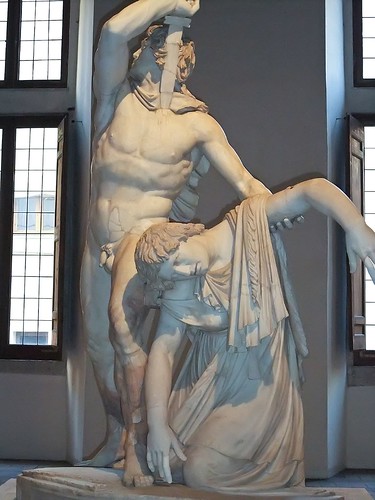
If you have the wonderful opportunity to visit Rome, don't miss the Palazzo Altemps on your list of must-see museums, either.  There, you will find another outstanding statue commemorating the valor of the Celts known as the Ludovisi Gaul.  It depicts a formidable muscled warrior in the act of plunging a sword into his chest rather than be captured by the enemy.  He grips the arm of his dying wife whom he has slain in a final act of love.


The Ludovisi Gaul photographed at the  Palazzo Altemps,
Museo Nazionale 
Romano in Rome, Italy by   ©2009.
 The Celtic warrior's heroic nudity is in contrast to his modestly-dressed wife whose attire would have been familiar on the streets of ancient Rome. This dramatic sculpture is thought to have been commissioned by Julius Caesar in the 1st century BCE after his defeat of the Gauls at the famous battle of Alesia in modern day France.  It, too, is thought to be a copy of a Hellenistic original bronze by Epigonus from a grouping at Pergamon.


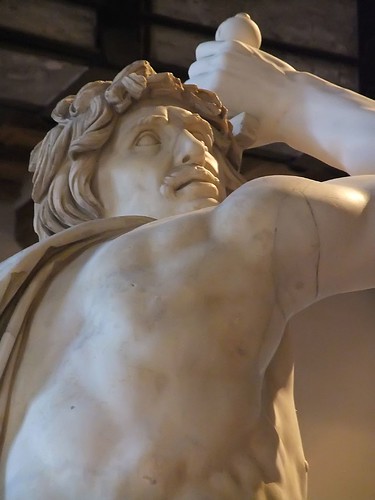
The Ludovisi Gaul is depicted with the iconic "long hair"
 and thick mustache described by the Romans in the ancient sources.

Photographed at the  Palazzo Altemps, Museo Nazionale  Romano,
Rome, Italy
by  
©2009.
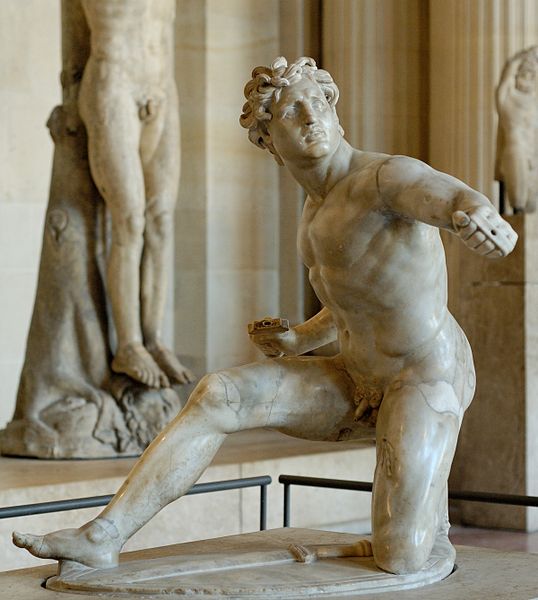
 I noticed that Wikipedia mentioned another important Celtic statue called "The Kneeling Gaul" that is in the collections of The Louvre.  Unfortunately, when I visited Paris in 2008, it was not on display.  I wish I could have seen it!


The Kneeling Gaul at The Louvre in Paris, France courtesy of
Wikipedia.
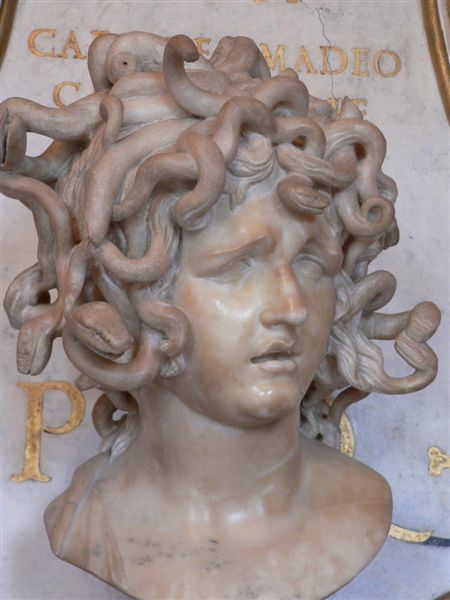
As I look at the image of The Kneeling Gaul I am struck by the facial similarities to a sculpture of Medusa by Gian Lorenzo Bernini I photographed at the Capitoline Museum back in 2005.


Medusa by Gian Lorenzo Bernini, 1630 CE.
Photographed at the Capitoline Museum in Rome, Italy by
 © 2005.
I see that Bernini produced his Medusa in 1630, about the same time the Kneeling Gaul was discovered in the former Gardens of Sallust.  I wonder if the Kneeling Gaul provided Bernini's inspiration for his Medusa figure?

If you get a chance to visit Washington D.C. in the next three months, be sure to stop by The National Gallery of Art and experience "The Dying Gaul" for yourself.  After all, this is its first appearance outside of Italy in over 200 years!  I think it will surely inspire you to seek out other magnificent works of art from the ancient world!


Enhanced by Zemanta
If you enjoyed this post, never miss out on future posts by following me by email!


Saturday, July 7, 2012

Review: The Pillars of Rome by Jack Ludlow


"One shall tame a might foe, the other strike to save Rome's fame, neither will achieve their aim.  Look aloft if you dare, though what you fear cannot fly, both will face it before you die." - Jack Ludlow, The Pillars of Rome

This prophesy by the Alban Sybil, accompanied by a crude drawing of an eagle in flight that bursts into flame of its own accord, set the stage for Jack Ludlow's first novel set in ancient Rome.

"The Pillars of Rome" is the first book in a trilogy by Jack Ludlow set in the late 2nd century BCE.  Ludlow is an experienced writer and has published a number of books set in other time periods but this is his first with a Roman theme.  Ludlow does an excellent job of developing vibrant characters and deftly recreates Republican Rome with its strict social hierarchy, scheming and corrupt senators and provincial governors, politically motivated marriages, military reliance on landowners (this is before Marius approved career soldiers without land ownership requirements) and strict military "disciplina" in the conduct of its troops who, in turn, extended little mercy to the conquered.

However, Ludlow chooses to populate his book with purely fictional characters, making it more of a challenge for me to identify the time period and discuss the differences between events described in the novel compared to actual historical events like I usually do in most of my reviews.

Ludlow did give me some clues, though, as to the historical personages used as models for his main characters thus pinpointing the period of Roman history as well.

Ludlow's two main protagonists, Aulus Cornelius Macedonicus and Lucius Falerius Nerva, are lifelong companions and the prologue opens with a scene of the two as boys creeping into a dark cavern to clandestinely meet with the Sybil to gain insight into their respective futures.  It is soon apparent that Aulus is far more pious and god-fearing than Lucius  who is willing to risk eternal damnation to learn if he will realize his dreams of fame and fortune.  Aulus' piety will eventually become revered by Roman society and serve him well in his ascension to the peak of military success.  Likewise, Lucius' ambition will be the driving force in his future where risk-taking becomes second nature in his struggle to become politically the first man in Rome.

From his cognomen, Macedonicus, we know that Aulus apparently was instrumental in the Roman conquest of Macedon.  There were a number of Macedonian Wars but as we read the novel, we learn that he defeated King Perseus, son of King Philip V of Macedon, who ascended the throne in 179 BCE giving us a historical period of the early to mid 2nd century BCE.

Perseus was defeated by the legions led by Lucius Aemilius Paullus at the Battle of Pydna in 168 BCE at the climax of the Third Macedonian War.  Thereafter, he became known as  Lucius Aemilius Paullus Macedonicus.  So, we can assume Aulus is a surrogate for Paullus and examine the life of Paullus  to gain historical insight into this personage and the events surrounding this period of history.

In Plutarch's Lives, Paullus is held up as an examplery nobleman with "traditional Roman firmness and courage in adversity" ( an introduction by Philip A. Stadter and Robin Vaterfield to Roman Lives: A Selection of Eight Lives by Plutarch).  He carefully prepared for each engagement unlike his nemesis Perseus who is characterized as miserly, cowardly and unfaithful to his mercenaries who he failed to pay.
Perseus surrenders to Paullus. Painting by Jea...
Perseus surrenders to Paullus. Painting by Jean-François Pierre Peyron from 1802. Museum of Fine Arts, Budapest. (Photo credit: Wikipedia)
Paullus was also painfully aware of the fickleness of fortune.  One of his young sons, a boy of only 14, died just five days before Paullus was set to celebrate his victory.  While preparing for his triumph, Aemilius chided the cowering Perseus for failing to bear his reversal of fortune but follows this with reproaching his sons and officers for taking too much pride in their victory:

"What occasion can there possibly be for men to take heart, when victory over others is precisely the time when we are most compelled to be afraid of fortune, and when a happy man can be plunged into the depths of depression by the realization that fate follows a cyclical course and attaches itself to different people at different times?"

This reminds me of the fatalism expressed by Scipio Aemilianus, son of Paullus, upon witnessing the destruction of Carthage in 146 BCE.  Polybius reports:

"Scipio, when he looked upon the city as it was utterly perishing and in the last throes of its complete destruction, is said to have shed tears and wept openly for his enemies. After being wrapped in thought for long, and realizing that all cities, nations, and authorities must, like men, meet their doom; that this happened to Ilium, once a prosperous city, to the empires of Assyria, Media, and Persia, the greatest of their time, and to Macedonia itself, the brilliance of which was so recent, either deliberately or the verses escaping him, he said:

A day will come when sacred Troy shall perish,
And Priam and his people shall be slain.

And when Polybius speaking with freedom to him, for he was his teacher, asked him what he meant by the words, they say that without any attempt at concealment he named his own country, for which he feared when he reflected on the fate of all things human."

The son obviously learned this sad truth from his father.


Detail of The Triumph of Aemilius Paulus
Detail of The Triumph of Aemilius Paulus (Photo credit: Wikipedia)


Aulus' [Paullus'] triumph is mentioned several times in the novel and was obviously the crowning achievement of his career.  Fortunately, a wonderful description of the  three day spectacle comes down to us from Plutarch in his biography of Paullus:

"The first day - and it was only just enough - was given over to the spectacle of all the statuettes, paintings, and statues taken during the war, which were transported on 250 wagons.  On the next day the most beautiful and valuable of the Macedonian arms and armour were carried through the streets on large numbers of carts.  The bronze and iron parts of the weapons had been polished until they shone, and all the objects had been artfully and aesthetically positioned, so as to look as much as possible as though they had fallen into random heaps of their own accord: there were helmets lying next to shields, breastplates on top of greaves, Cretan targes and Thracian wicker shields and quivers all jumbled up with horses' bridles; the piles bristled with unsheathed swords, and pikes had been planted among them.  The arms and armour were somewhat loosely arranged, so that as they were carried along they struck against one another and gave out a harsh and fearsome sound, and even though they had belonged to the losers in the war their appearance was not without its terrors.  After the wagons with the arms and armour came three thousand men carrying coined silver money in 750 boxes; each box held three talents' worth of money and was carried by four men.  Then came more men carrying silver mixing-bowls, drinking-horns, drinking bowls, and cups, each shown off to its best advantage and each remarkable for its size and for the depth of the chased work on it."

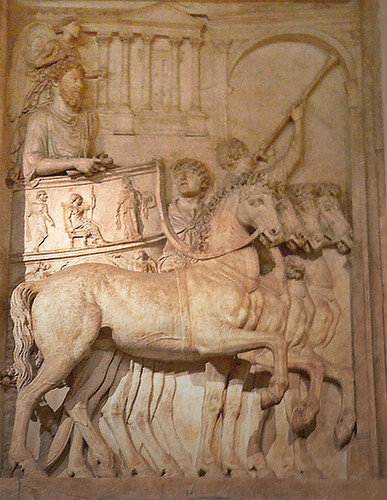
Marcus Aurelius driving a quadriga in a 
triumphal procession.  Photographed at the
Capitoline Museum by Mary Harrsch.


"Early in the morning of the third day trumpeters made their way through the streets, but the music they played was unusual for a procession or an exhibition; it was the kind with which the Romans used to rouse themselves in battle.  Behind the trumpeters 120 stall-fed oxen, with their horns gilded, and arrayed with headbands and chaplets were being led to sacrifice by young men dressed in ceremonial aprons with purple borders, and boys went with them, carrying silver and gold libation cups.  Next came the men carrying the gold coinage, which had been divided up, like the silver money, into vessels with a capacity of three talents, and there were seventy-seven such vessels altogether.  They were followed by men carrying the sacred bowl, which had been made, on Aemilius' instructions, out of ten talents of gold and studded with gems.  Next came men displaying the Antigonid, Seleucid, and Thericlean goblets, and all the golden tableware Perseus used.  They were followed by Perseus' chariot, which carried his arms and armour with his diadem lying on top of them.  Not far behind the chariot Perseus' children were led along as slaves, accompanied by a throng of weeping nurses, teachers, and tutors, who stretched out their hands in supplication to the spectators and taught the children to beg and plead.  There were two boys and one girl, too young to comprehend the magnitude of the disaster - and this made people feel so much more sad for them, considering the fact that one day this incomprehension would end, that Perseus walked by almost unnoticed by the Romans, who were just staring at the children in pity.  Many people started crying, and in all of them the spectacle aroused a mixture of pleasure and pain, until the children had passed by."

"Behind the children and their retinue came Perseus.  He wore a grey cloak and Macedonian boots, and looked as though he was utterly astounded and bewildered by the magnitude of the disaster that had happened to him.  He too was accompanied by a crowd of associates and friends; their faces were heavy with grief, but because they were constantly glancing at Perseus and weeping they gave the spectators to understand that they were mourning his fate and did not care in the slightest for their own.  Perseus had written to Aemilius, asking not to be paraded through the streets and included in the triumph, but Aemilius, apparently in mockery of Perseus' cowardice and fear of death, remarked: 'The situation is no different now from what it was before: he could grant his own request, if he wanted.' He [Aemilius] meant that he [Perseus] could always choose death instead of dishonour, but the coward could not bring himself to do that.  Instead, unmanned by hope, he became a part of his own spoils."

"After Perseus and his retinue, four hundred golden garlands were carried along, which had been brought and presented to Aemilius by representatives from the various cities in recognition of his valour.  Then came the man himself, mounted on a magnificiently decorated chariot.  He would have made a remarkable sight even without all these trappings of power; he wore a cloak dyed with purple and shot through with gold, and held in his right hand a spray of laurel.  Every single soldier likewise carried laurel.  The army marched behind their commander's chariot in their units and divisions, with the men singing partly traditional songs with an element of humour in them , and partly hymns of victory and praise for Aemilius' achievements."
In the novel, Aulus is said to have ritually strangled Perseus at the conclusion of the triumph but historically this did not occur.  Paullus actually arranged for Perseus to be moved from the "carcer" (prison) to a place that was clean "where he could life more like a human being."  But Perseus died anyway.  Plutarch says some writers say he starved himself to death while others report he angered his guards who, in retaliation, decided to not allow him to sleep, "until, eventually, worn out by this treatment he died."-  Plutarch, Aemilius Paullus, Roman Lives: A Selection of Eight Lives, edited by Philip A. Stadter and Robin Vaterfield.

As for his children that were so pitied by the Roman spectators, two of the children also died.  But Perseus' son Alexander survived and became an expert engraver and an accomplished secretary.

I sometimes wonder if ritual strangulation was as common as we are led to believe when I read about kings and rulers, like Perseus, that escaped the executioner's rope.  Maybe this ritual only occurred occasionally much like fights to the death between gladiators in the arena.

Returning to the novel, I think  Ludlow did a superb job of capturing this essence of nobility in his characterization of Aulus Cornelius.

Ludlow's novel makes a giant leap in time from the boyhood of the prologue to the mature years of his two main characters that comprise most of the novel.  When we pick up the tale in Chapter 1, Lucius has, indeed, become a powerful senator and leader of the Optimates while Aulus, the consummate warrior, has just returned from Spain where he has been battling the Celt-Iberians who have been stirred up by an outcast Gallic Druid by the name of Brennos.  The rebel activity must have been a prelude to the Celtiberian War.

"The Celtiberians, famous for their martial ability, fought a long and bitter war against Rome known as the Celtiberian war (Bellum Celtibericum, 153-133 BCE) and were involved in other conflicts with Rome throughout the 2nd century BC." -John T. Koch,  Celtic Culture: A Historical Encyclopedia

Aulus, like Paullus, had fought the Celt-Iberians in Spain earlier in his military career before his victories in Macedonia.

"Rome's most competent commanders were busy with the war against Antiochus the Great when another war broke out in the west, in Spain, where there had been serious disturbances.  Aemilius was dispatched there with the rank of praetor, but he had six extra lictors over and above the usual six praetorian lictors, with the reulst that his office was equivalent in dignity to that of a consul.  He won two pitched battles against the local tribesmen, who lost about thirty thousand men, and apparently it was plain to see that his success was due to his tactical skill, since he made victory easy for his troops by ensuring that they fought on favourable ground, on the far side of a certain river.  He also subdued 250 towns, which were happy to open their gates to him." Plutarch, Aemilius Paullus, Roman Lives: A Selection of Eight Lives, edited by Philip A. Stadter and Robin Vaterfield.

Although Plutarch never mentions Paullus' return to Spain, this is certainly a plausible plot development considering the ongoing conflicts  referred to by Koch.

Aulus finds Lucius, who has built his career around his ability to manipulate people with clever words rather than military prowess, mired in a dispute with a tribune of the plebs pushing land reform.  This can be no other than Tiberius Gracchus and Ludlow has kept the praenomen Tiberius but given his character a different gens name, Lavonius.   Tiberius Gracchus was elected tribune of the people in 133 BCE.  Historically, the problem is Paullus was already dead, having died in 160 BCE.  So Ludlow has compressed the historical timeframe at this point.  The only other reference I could find to earlier land reform efforts was a bill introduced during the consulship of Laelius in 140 BCE that was supported by Scipio Aemilianus but rejected by the senate (Paullus' younger son was adopted by the son of Scipio Africanus because Paullus, having four sons, could not afford to fund that many sons in their efforts to climb the Coursus Honorum).

Ludlow also portrays Lucius as the senator most violently opposed to the Gracchus figure which would make Lucius equivalent to Scipio Nasica Serapio.  Lucius,  like Nasica, unable to sway Tiberius Lavonius [Gracchus] from his determination to alleviate the inequality between the priviledged wealthy and thousands of Rome's destitute, hires thugs armed with clubs to seek out the tribune and club him to death - the actual fate that befell Tiberius Gracchus.

For those of you unfamiliar with Gracchus' land reform bill, here is a very good summary:

"There already existed a law at Rome - the so-called Licinian law - which limited the number of acres to be possessed by any one citizen to five hundred.  But this Licinian law had been a dead letter for many years, and there were many rich citizens in Rome who counted the number of their acres by the thousand or even ten thousand.  It was this violation of the Licinian law, and the open injustice done to the poor by this violation, which Teiberius Gracchus wanted to correct.  He therefore introduced a new agrarian law which aimed to revive the Licinian law, but at the same time greatly modified and attenuated its provision.  The change in the law which Tiberius Gracchus proposed was in one respect an act of injustice, because it put a premium on the violation of the law as it had existed, instead of punishing that biolation by imposing an adequate fine.  Under the new law a citizen might hold 500 acres of the public lands in his own name, and in addition, 250 acres for each son still under the paternal roof and authority.  Moreover, the new law provided that, whenever a citizen should be compelled to give up land which he held in excess of the share which the law allowed him, he should be reimbursed for this loss, at the appraised value, from the public treasury.  Tiberius Gracchus also favored the immediate distribution of the conviscated lands among the poor as their absolute property, and proposed that, whenever a Roman colony was founded on conquered territory, a similar distribution of the newly acquired land should be made." - Francis Johnson, Famous Assassinations of History From Philip of Macedon to Alexander of Servia

There is no mention of any violence surrounding the earlier debate over land reform in 140 BCE.  So, I feel I have teased out the historical figure represented by Lucius with a caveat.  In Ludlow's novel, Lucius and Aulus have been friends since boyhood.  However, if Lucius is really a surrogate for Scipio Nasica Serapio who orchestrated the death of Tiberius Gracchus, Ludlow must have decided to consolidate historical personages with Scipio Nasica Corculum (his father) since it is that Nasica that was more of a contemporary with Aemilius Paullus.  It is also that Nasica that served under Paullus in the Third Macedonian War, according to Plutarch in his description of the key battle of Pydna. 

Lucius is also portrayed as having no real military gifts except logistics (supply) but both Nasica Corculum and Nasica Serapio served as military commanders with Corculum leading a night action that was instrumental in the victory at Pydna. Serapio, however, is thought to be the praetor who suffered a great Roman defeat at the hands of the Pannonians in 141 BCE.  So Ludlow must have decided to soften this disparity with a middle path.

Now, let us return to Ludlow's narrative.

Aulus, suspects Lucius of having a part in the death of Tiberius Lavonius [Gracchus]and withdraws his political support, leaving Lucius angry and resentful.  Historically we know Paullus was considered a member of the aristocracy but he was recognized as being of such noble stature that he was considered "above" the day-to-day political mudslinging of the period.  We also know that his younger son did openly support the first efforts at land reform under Laelius.

Lucius is also put out about a social snub inadvertently committed by Aulus  when he failed to appear when summoned to attend the birth of Lucius' first son because Aulus was dealing with a secret birth within his own household - the subject of a subplot in the novel that will further manifest itself in successive books.

This subplot involving Paullus' second wife is, of course, totally fictitious because of the timeline if nothing else.  However, we know nothing about Paullus' second wife from the ancient sources so it isn't really historically misleading.  The ancient sources record the name of Paullus' first wife and state that Paullus actually divorced her - some say without adequate cause - even though  Aulus is portrayed as a widower in the novel.  Ludlow portrays the lady Claudia as barely 16 when she is offered to Aulus, even though he is quite mature, a common practice for the period.

(Spoiler alert) The baby is the result of Paullus' wife being captured by the Celt-Iberians and Aulus and his faithful Greek body servant Cholon take the child far away and expose it where they think no one would possibly find it.  Of course, someone does just like in the ancient Greek epics.  It's at this point that land ownership requirements for serving in the legions plays an important part in succeeding events.

One of the minor characters, a well meaning but unsuccessful former legionary who has gambled away the plot of land he received upon discharge from the army, is seduced into rejoining the legions as a surrogate for a neighbor who has been far more successful with his own plot.  The neighbor agrees to take care of the man's wife and adopted son (the child exposed by Aulus) while the hapless man is on campaign in the neighbor's stead.  In the meantime, the neighbor further fattens his pockets by avoiding taxes on his properties because he has had his surrogate enlist under the prosperous neighbor's name, making him exempt from taxation.

I never really thought about this much before since most of my study has focused on the post-Marius reform period where just about anyone could join the legions, but I'm sure these types of deceptions probably occurred during the second century BCE when military service was restricted to landowners.  The wealthy have always had carefully orchestrated loopholes to avoid mandatory military service in my lifetime so it would be logical to assume this practice has come down to us from antiquity.

But back to Aulus and Lucius!

To get Aulus out of his way politically, Lucius arranges for Aulus to head an investigation of the corrupt activities of the new governor of Illyricum since Aulus had initially pacified the area earlier in his career.

This background information about Aulus (Paullus) is also based on history.

"After being elected consul, Aemilius led an army against the Ligurians, whose territory ran alongside the Alps.  The Ligurians were a warlike and courageous people who were having their military skills honed by the Romans, whose neighbours they were...Aemilius' advance was met by a force of forty thousand, five times the number of his eight thousand men, but he engaged them in battle, forced them back, and pinned them inside their strongholds...The Ligurians trusted Aemilius and surrendered both their ships and their settlements to him.  He restored their settlements to them unharmed..." - Plutarch, Aemilius Paullus, Roman Lives: A Selection of Eight Lives, edited by Philip A. Stadter and Robin Vaterfield.

But after his conquest of Macedon, we have no evidence Paullus returned to Illyricum so this coupled with the timeline issue points to the rest of story as purely fictional.

In Illyricum, Aulus finds that the people who he had left pacified were on the verge of open revolt because the greedy governor was gouging them with taxes while at the same time delaying payment to his own legions so he could loan out money in the pay chests and reap the interest for himself.  The men of the legions have lost their discipline and are no longer in fighting trim.  So Aulus has his work cut out for him and takes command offending the corrupt governor Vegetius.  Meanwhile the rebels of Epirus rise up against the Roman administration there. Aulus marches a relief force towards the gathering rebel army near a narrow defile named Thralaxas where he faces the dire fate forecast those many years ago in the Sybil's cavern.

I'm sure Paullus would have welcomed such a heroic end but in fact, he died of natural causes.  Apparently not long after being named censor (although Plutarch points out he had time to complete all of the most important things) he fell critically ill.  His doctors advised him to rest in the country by the sea so he sailed to Velia.  But the Romans missed him.

"...in the theaters they often gave voice to what seemed to be prayers and appeals to see him.  And so, when a sacrifice was to take place which required his presence, and his health seemed up to it, he returned to Rome.  He performed the sacrifice along with his fellow priests, surrounded by a crowd of visibly happy Romans, and then the next day made another sacrifice, in private, asking the gods to keep him in good health.  When the sacrifice had been performed in the prescribed manner, he returned home and lay down, but suddenly, before he had time to notice and comprehend the change, he became delirious and deranged, and two days later he died." - Plutarch, Aemilius Paullus, Roman Lives: A Selection of Eight Lives, edited by Philip A. Stadter and Robin Vaterfield.

I found Ludlow's novel to be culturally immersive and with enough complexity to be intellectually satisfying.  His battle sequences were exhilarating and his characters empathetic.  I have already begun book two in the trilogy "The Sword of Revenge" and look forward to Aulus' son Titus exacting retribution for his father's betrayal.


Enhanced by Zemanta
If you enjoyed this post, never miss out on future posts by following me by email!


Saturday, February 5, 2011

The Gallic Wars: Genocide or Stepping Stone to Empire?

Closeup of the Ludovisi Gaul (committing suicide)
Photographed at the Palazzo Altemps in Rome,
Italy by Mary Harrsch
Historical resource article by Mary Harrsch © 2011

He slits the wombs of pregnant women; he blinds the infants.
He cuts the throats of their strong ones...
Whoever offends the god Asshur will be turned into a ruin.
- Assyrian poem glorifying a military victory of Tiglat-Pileser I, 1100 BCE

The evidence for genocide in antiquity ranges from highly rhetorical celebrations or condemnations of the annihilation of an enemy to laconic notices about the destruction of cities, and its value is often hard to assess.  Is a claim that the enemy was 'utterly destroyed' a record of genocide or a hyperbolic boast of overwhelming victory?  What does it mean when cities are said to be 'razed to the ground', when so many of these places reappear in the sources only a few years later, as if nothing had happened?  We do not always have enough evidence to answer such questions.  Yet even when we cannot tell what reality lay behind the words, the rhetoric is valuable because it reveals ancient ideologies of genocide. - The Oxford Handbook of Genocide Studies by Donald Bloxham and A Dirk Moses Oxford University Press 2010.

Any civilization that expands by military conquest engages in one time or another in activities that when analyzed by modern ethicists may be deemed genocide by our definition. But were they considered justified by populations of the past?

As political structures evolved and became more complex, pacts of non-aggression, treaties of alliance requiring close cooperation and military obligations became subjects of negotiation as early as the third millenium.

"Tension between a ruling class and the rest of the population was a constant feature of political and social life in Greek cities, and in order to strengthen or regain control over their subject allies, classical Athenians and Spartans exploited such divisions by executing or exiling hostile or rebellious political elites.  They had precursors in the Near East, such as Sennacherib's treatment of rebels in Ekron and Jerusalem, a few years before his demotion of Babylon.  In Ekron, the elite were theatrically executed, some commoners enslaved, and the rest spared."

"...the annihilation of communities was not a goal in itself, but merely an incidental consequence of a ruthless pursuit of profit." - The Oxford Handbook of Genocide Studies by Donald Bloxham and A Dirk Moses Oxford University Press 2010.
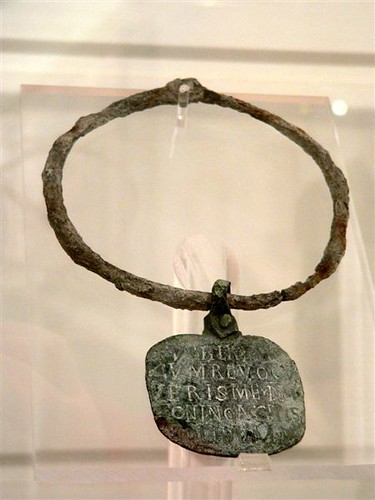
A Roman slave medallion photographed at
the Terme di Diocliziano in Rome, Italy by
Mary Harrsch

Although the initial offensive may result in indiscriminant slaughter,  'one may often see not only the corpses of human beings, but dogs cut in half and the dismembered limbs of other animals.'   When the assaulting commander gave the signal to stop, survivors of both sexes and all ages were systematically rounded up to be sold into slavery. One example is the Roman sack of 72 settlements in Epirus that produced a total of 150,000 slaves .

The Romans, always with an eye on the lucrative benefits of the slave trade, usually refrained from wholesale slaughter thereby  emulating the Athenians who, in one of their own conquests opted to kill only a thousand elite in Mytilene because Greek commanders determined it was more profitable in the long run than the massacre of the entire community.

There were exceptions, of course, but scholars point out that most of these incidents reflect a response to a perceived societal threat.

In 206 BCE, the Spanish town, Ilurgia was totally destroyed because, ancient sources tell us,  the Romans wanted to 'erase the memory' of their enemy.

As Rome expanded and developed the provincial system of administration, subjugated
communities were usually left intact, with a high degree of autonomy. Only rebellious cities suffered the exile or execution of the city's elite.

Roman soldiers were often allowed to sell captives and keep the profits for themselves as part of their remuneration so wholesale massacre was a rare occurrence unless particularly brutal tactics were used in defense.

"If the profit motive encouraged enslavement but discouraged killing, only when it was countered by even more powerful motivations did states resort to genocidal massacres....those perpetrating the massacre saw themselves as inflicting revenge or punishment for what one may call an 'aggravated' challenge to their power and status as a community and/or to the power of a god whose cause they champion." - The Oxford Handbook of Genocide Studies by Donald Bloxham and A Dirk Moses Oxford University Press 2010.
Bust of Cicero 1st century BCE photographed
at the Capitoline Museum in Rome, Italy by
Mary Harrsch

Even non-military Roman statesmen like Cicero justified the destruction of small independent towns like Pindenissus by claiming "their very independence constituted an affront which made the empire look weak."

Such drastic action, though, was imposed most often on more formidable opponents who were regarded as too persistently hostile.

But, this reaction has been documented throughout antiquity and is not unique to Roman civilization.  One example comes from ancient Greece.

"...while relations between Athens and most of its rivals alternated between hostility and alliance, the Athenians saw the neighbouring Aeginetans as implacable enemies, who had started hostitlities in the dim past and kept attacking without provocation.  In 431 BCE the Athenians drove the Aeginetans out of their island, forcing the refugees to find new homes all over Greece; a large group settled in Thyrea.  Not content with this result, in 424 BCE the Athenians sent a fleet to attack Thyrea, which they captured, looted, and burned down.  All Aeginetans captured alive were taken to Athens, where a formal decision was made to execute every last one 'on account of the hostility which they had always shown in the past." - The Oxford Handbook of Genocide Studies by Donald Bloxham and A Dirk Moses Oxford University Press 2010
Samnite warrior as depicted in the game
"Rome: Total War"

The Romans exacted a similar price on ancient Carthage in 146 BCE.

So, were the Gauls viewed as too persistently hostile immediately before Caesar became engaged in the Gallic Wars?  Yes, despite the passage of over 300 years, the Romans particularly feared the Gauls, harking back to the Gauls' sack of  Rome in 387 BCE.

In the Gallic Wars, Julius Caesar was also dealing with another common scenario, the treachery of a formerly friendly or allied city or tribal group.  Roman precedent for the treatment of a people guilty of the heinous act of treachery had been clearly demonstrated in wars of the Early Republic.  During the Second Samnite War (326-304 BCE), the Romans massacred four towns and killed all of the male residents of a fifth because the Samnites were considered guilty of treason.  Later, during the Hannibalic Wars, the Romans enslaved 14 Italian and Sicilian towns and massacred the entire population of two other towns because the victims had changed sides or were thought to be about to do so.

So, researchers Donald Bloxham and A. Dirk Moses conclude that intentional genocide was historically perpetrated throughout the ancient world but it was considered ethically legitimate if a community or group had committed a serious-enough offense.

So, was Julius Caesar, labeled by his contemporary political opponents as a war criminal, uniquely guilty of what, in the ancient world, would be viewed as indefensible genocide?

Some modern scholars like Philip Matyszak think so.  In his Chronicle of the Roman Republic, Matyszak asserts Caesar's personal commentaries on the Gallic War is personal propaganda.
A heroically nude statue of the deified
Julius Caesar from the 1st century CE.
Photographed at The Louvre by
Mary Harrsch

"It masks the war's horrendous cost in human life and suffering (one historian describes it as the greatest human and social disaster until the settlement of the Americas.) It also hides the fact that the war was fought for Caesar's enrichment and glory. Contemporary Romans were well aware of this, and there was a movement in Rome to hand Caesar to the Gauls as a war criminal." - Chronicle of the Roman Republic p. 206

Others, like Dr. Miland Brown disagree observing that the conquest of Gaul was probably inevitable.

"War was different in the ancient world. There was no Geneva Convention back then. There were no rules for war other than those decide on by the combatants and which they then had the power to enforce. The Roman Republic itself had practiced brutal war repeatedly before Caesar and had even practiced genocide on the Carthaginian culture after the Third Punic War." - Julius Caesar, War Criminal? by Dr. Miland Brown.

Let's examine some specific engagements.

In the Battle of Vosges, 35,000 Suebi were killed out of 70,000 enemy combatants. Prior to the battle, Caesar and Ariovistus conducted negotiations but Ariovistus' cavalry continued to pelt the Romans with stones and spears.  Although Caesar broke off negotiations, he still instructed his men not to retaliate so the Suebi could not claim they were trapped under "sanction of conference".

When battle was joined, the highly disciplined Romans, outnumbered almost 2 to 1, managed to slay half of the enemy warriors as they drove Ariovistus back over the Rhine.  We must remember that this battle occurred very early in the conflict and the casualty rate could easily  reflect the result of an informally trained tribal culture with a strong individual warrior ethos clashing with a professionally trained highly-disciplined force that relied on unit cohesion.
Full length view of the Ludovisi Gaul thought
to have been commissioned by Julius Caesar
after his victories in the Gallic Wars.
Photographed at the Palazzo Altemps by
Mary Harrsch.

Enemy casualties were high, but they were not excessively high in the context of an ancient battle involving hand-to-hand fighting among over 100,000 combatants.

Now let's look at an even larger battle near a major community of non-combatants.  Bibracte was one of the most important hillforts in Gaul and capital of the Aedui tribe, pledged Roman allies. But one of its prominent war leaders, Dumnorix, was treacherouly supporting the Helvetii enemy.

Caesar was warned , "...he hates Caesar and the Romans, on his own account, because by their arrival his power was weakened, and his brother, Divitiacus, restored to his former position of influence and dignity: that, if anything should happen to the Romans, he entertains the highest hope of gaining the sovereignty by means of the Helvetii, but that under the government of the Roman people he despairs not only of royalty but even of that influence which he already has."

Caesar discovered too, on inquiring into the unsuccessful cavalry engagement which had taken place a few days before, that the commencement of that flight had been made by Dumnorix and his cavalry (for Dumnorix was in command of the cavalry which the Aedui had sent for aid to Caesar); that by their flight the rest of the cavalry was dismayed. - De Bello Gallico, Julius Caesar Book 1, XVIII
Roman Silver Denarius With Head Of Captive Gau...Image via Wikipedia
Roman Silver Denarius With
Head Of Captive Gaul 48 BCE

Caesar's six legions  and Roman auxiliaries faced about 368,000 Helvetii and allied Boii and Tulingi tribes of which about 90,000 were warriors and the remaining 278,000 were non-combatants, as this was the main body of Helvetii attempting migration into Gaul.  The Romans, outnumbered almost 3 to 1 (not including non-combatants) pushed the Helvetii warriors back against their own baggage train, resulting in the involvement of many of the non-combatants.  The Helvetii and their allies suffered about 238,000 killed or captured.  But Caesar reports 130,000 men, apparently a combination of warriors and non-combatants, escaped, despite the prior treachery involved. Caesar didn't bother to report how many of the captured or killed were women or children.  After the battle Caesar ordered:

"...the Helvetii, the Tulingi, and the Latobrigi to return to their territories from which they had come, and as there was at home nothing whereby they might support their hunger, all the productions of the earth having been destroyed, he commanded the Allobroges to let them have a plentiful supply of corn; and ordered them to rebuild the towns and villages which they had burnt. This he did, chiefly on this account, because he was unwilling that the country, from which the Helvetii had departed, should be untenanted, lest the Germans, who dwell on the other side of the Rhine, should, on account of the excellence of the lands, cross over from their own territories into those of the Helvetii, and become borderers upon the province of Gaul and the Allobroges. He granted the petition of the Aedui, that they might settle the Boii, in their own (i.e. in the Aeduan) territories, as these were known to be of distinguished valour to whom they gave lands, and whom they afterwards admitted to the same state of rights and freedom as themselves." - De Bello Gallico, Julius Caesar Book 1, XVIII


I admit enemy losses were substantial but the aftermath does not sound like genocide to me.

Even at the decisive battle of Alesia where the Romans suffered more casualties than during any other battle of the Gallic conflict, one estimate is over 12,000 officers and men slain, Caesar pardoned the Aedui and Averni tribes, Roman allies who had joined the rebel alliance.

Julius Caesar, accepting the surrender of Verc...Image via Wikipedia
Vercingetorix Throws Down his Arms at the Feet of Julius Caesar [after the fall of Alesia] (1899), Lionel-Noël Royer
Of the participating Gauls, ranging in estimates from a total of 180,000 - 330,000 including the Gaul's relief force that invested the battlefield's periphery,  scholars have estimated that at least 40,000 Gauls were taken prisoner, mostly from the 80,000 warriors initially beseiged within the walls of the fortified city.  This prisoner count was estimated from a statement by Caesar in his Commentaries that each surviving man in his legions received a Gaul as a slave.  Caesar himself would have also retained the profits from the sale of a large number of slaves too, not included in the total prisoner count, as the commander's portion of the battle spoils.  Caesar also admits thousands of the 120,000 - 250,000 man relief force escaped back to their respective states.

 Some scholars point out that our best record of events for the Gallic Wars is Caesar's own Commentaries so casualty figures should be naturally suspect.  So how do these casualty figures and post-combat administrative actions compare to other ancient enagements?

One hundred and fifty years earlier, in 206 BCE the Romans squared off against the Carthaginians with Celt-Iberian allies at the battle of Ilipa during the second Punic War.  A combined force of 43,000 Romans and their Iberian allies faced 54,000-70,000 Carthaginians, Numidians and their Iberian allies, ten miles north of modern Seville, Spain.
Celt-Iberians as depicted in the game "Rome: Total War"

There, the much celebrated Scipio Africanus sucked the Carthaginians and their Celtic allies into a "reversed Cannae", a concave deployment where the experienced Roman legionaries were placed on the wings facing less trained Iberian troops, while the Roman's Iberian allies manned the center opposite Mago Barca's African contingent.  In the resulting envelopment, the Carthaginian army was almost entirely destroyed.

Sixty years later, in a Roman siege of Numantia in Hispania Ulterior in 133 BCE, the adopted grandson of Scipio, offered little mercy to its Celt-Iberian inhabitants.

Nearby fields were laid waste and what was not used burned. The stronghold of Numantia then was circumvallated with a ditch and palisade, behind which was a wall ten feet high. Towers were placed every hundred feet and mounted with catapults and ballistae. To blockade the nearby river, logs were placed in the water, moored by ropes on the shore. Knives and spear heads were embedded in the wood, which rotated in the strong current. Allied tribes were ordered to send reinforcements. Even Jugurtha, who later would revolt from Rome, himself, was sent from Numidia with twelve war elephants. The Roman forces now numbered sixty-thousand men and were arrayed around the besieged town in seven camps. The Numantines, "ready though they were to die, no opportunity was given them of fighting" (Florus, I.34.13).
Scipio Africanus the Elder photographed at the
National Museum in Naples, Italy by Massimo Finizio

There were several desperate attempts to break out but they were repulsed. Nor could there be any help from neighboring towns. Eventually, as their hunger increased, envoys were sent to Scipio, asking if they would be treated with moderation if they surrendered, pleading that they had fought for their women and children, and the freedom of their country. But Scipio would accept only deditio. Hearing this demand for absolute submission, the Numantines, "who were previously savage in temper because of their absolute freedom and quite unaccustomed to obey the orders of others, and were now wilder than ever and beside themselves by reason of their hardships," slew their own ambassadors.

After eight months, the starving population was reduced to cannibalism and, filthy and foul smelling, compelled to surrender. But, "such was the love of liberty and of valour which existed in this small barbarian town," relates Appian, that many chose to kill themselves rather than capitulate. Families poisoned themselves, weapons were burned, and the beleaguered town set ablaze. There had been only about eight-thousand fighting men when the war began; half that number survived to garrison Numantia. - The Wars in Spain

Only a pitiable few survived to walk in Scipio's triumph. The others were sold as slaves and the town razed to the ground, the territory divided among its neighbors.

In 69 BCE, just ten years before the beginning of the Gallic Wars, a Roman force of approximately 32,000 men lead by Consul Lucius Licinius Lucullus faced off against approximately 80,000 - 100,000 Armenian wariors (Appian claims 300,000 but scholars think the number wildly inflated) under the command of Tigranes the Great at the battle of Tigranocerta in the Third Mithrdatic War.

The Romans were so outnumbered that Plutarch claims Tigranes, upon seeing the much smaller Roman force remarked "If they come as ambassadors, they are too many; if they are soldiers, too few."  (Plutarch. Life of Lucullus, 27.4)  This engagement, then, was about equal in scope to the battle of Vosges, the second major battle of the Gallic War.

Unlike the Gauls, however, Tigranes forces included heavily armored cataphracts.  There was no ingrained warrior ethos for soldiers to attempt to win personal glory so no one flung themselves at the Romans as some less experienced Gauls might do.  Even so, Armenian losses were extremely high.  Lucullus exhorted his men to focus on the horses legs and thighs and the Romans drove the cataphracts back upon the ranks of the Armenian infantry.  Some scholars have estimated Armenian losses to be as high as 100,000 killed - almost annihilation.  There is no discussion of the number of prisoners, if any.  Only a note is made that Tigranes treasury was looted and each of Lucullus' soldiers received 800 drachma as their share.

Yet, I have never heard scholars or the late Roman Republican Senate apply the label of war criminal to Scipio Africanus, Scipio Aemilianus or Licinius Lucullus, commanders whose battles resulted in far greater casualty rates than Caesar's.  So why do generations of scholars continue to attempt to label Julius Caesar as a perpetrator of genocide?

I think it is the result of the Optimate propoganda machine deployed in response to the threat posed to the aristocratic power base by Caesar's political activites.  The primary focal point of Caesar's life immediately prior to and during the Gallic Wars that generates the most discussion about genocide is Caesar's recovery from almost overwhelming indebtedness due to his acquisition of  vast amounts of booty acquired in the course of the Gallic Wars.


Caesar went deeply into debt sponsoring games and other public entertainments as an aedile and bribing voters and people of influence in his climb up the Coursus Honorum.  But that was certainly not unusual.  Furthermore, Roman commanders acquiring vast wealth in the prosecution of military objectives was not unusual either.  In fact, Lucullus returned from the Third Mithradatic Wars so wealthy he astonished his contemporaries with the magnitude of his building programs, patronage of the arts and sciences and even aquaculture projects.  He transformed his hereditary estate in the Tusculan highlands into a hotel-and-library complex for scholars and philosophers. He built the horti Lucullani on the Pincian Hill in Rome, the famous gardens of Lucullus, and in general became a cultural revolutionary in the deployment of imperial wealth.

A view from the hill of Pizzofalcone, the site of the original Greek
colony of Parthenope and later occupied by a famous villa of Lucullus.
Photo courtesy of Rabun Taylor - Ancient Naples A Documentary History

Pompey, Caesar's arch military rival, amassed a fortune on campaigns in Sicily, Africa, Spain and in mopping up after Lucullus in the Third Mithradatic War.  Pompey never even bothered to incur the expense of seeking public office but merely bullied his way into consular or pro-consular positions based on his military reputation alone.
Gnaius Pompeius Magnus, Ny Carlsberg
Glyptotek (inv. 733) photographed by
Gunnar Bach Pedersen

Yet classical scholars have never tried to label these two contemporaries of Caesar as war crinimals or pepetrators of genocide despite the high casualty rates of their military engagements or lucrative acquisitions of booty in their military campaigns.  But, then again, neither of these two Roman commanders were ever targets of the Optimate propaganda machine either. 

Lucullus, though a member of the Senate, did not appear to harbor a political agenda, essentially retiring to his vast estates after Pompey helped him obtain the Senate's authorization for a triumph Lucullus so adamantly desired.

Pompey himself did, in fact, serve as consul after reluctantly agreeing to join Caesar and Crassus in the First Triumvirate,  but lost interest in politics after he married Caesar's daughter Julia.  Later Pompey was manipulated by the Optimates into assuming the premier role of head of the exiled Senate during the Civil War but had no particular political agenda of his own except the passage of a bill granting land to his veterans.

So, the primary difference between Caesar and Lucullus or Pompey was that Caesar had strong political ambitions and goals that conflicted sharply with the political agenda of the conservative, aristocratic Optimates.  It's really quite amazing that after 2,000 years, the Optimates' propaganda appears to be as virulent now as it was in the late Republic.

References:

The Oxford Handbook of Genocide Studies by Donald Bloxham, A. Dirk Moses, Oxford University Press, 2010
History by Thucydides
Histories by Herodotus
War, Peace and Empire by Oded
History 10.15-4-16.9 by Polybius
De Bello Gallico by Julius Caesar
Chronicle of the Roman Republic by Philip Matyszak
Julius Caesar, War Criminal? by Dr. Miland Brown.  World History Blog. 6/12/2006.
Goldsworthy, Adrian. Caesar: Life of a Colossus. New Haven: Yale University Press, 2007. 220-223.
Battle of Bibracte. Historical Dictionary of Switzerland
Appian's Roman History (Vol I: The Wars in Spain) (1912) translated by Horace White (Loeb Classical Library);
Lucius Annaeus Florus: Epitome of Roman History (1929) translated by Edward Seymour Forster (Loeb Classical Library)

Suggested Readings (A Kindle Preview)


More suggested reading:

If you enjoyed this post, never miss out on future posts by following me by email!