Showing posts with label Roman Army. Show all posts

Monday, August 2, 2021

Roman military belts: Symbols of social status and Auctoritas

While browsing the collections of the Museum of Fine Arts Boston, I saw this fragmentary figurine of a Roman soldier from the 3rd century CE found in Naukratis, Egypt by legendary archaeologist Flinders Petrie.  Looking at it I noticed the knotted sash just above the waist and realized this is not just any soldier but a senior officer.

The plated military balteus was not worn with a muscled cuirass.  Instead senior officers wore a fabric belt or sash with fringed ends, a traditional distinction of command worn since the Hellenistic period.

The balteus, also known as the cingulum militare from the 3rd century CE onwards, worn by all legionaries, was often elaborate, too, though.  

"The narrator of Apuleius’ satirical novel ‘The Golden Ass’ describes a man as being recognisably “miles elegione” (a soldier and legionary) and he also tells us how he recognized this: Through his “habitus atque habitude” (dress and manner)," points out archaeologist Stefanie Hoss.  "This and other writings in a similar vein make it quite obvious that soldiers were easily recognizable, even when they were not wearing full armour."

"In Rome, a man’s dress and his social cultural and political identity in Roman society were directly connected. The toga was both the prerogative and the iconic symbol of the Roman male citizen.  In a similar way, other sartorial choices spoke clearly of the status and station in life of the wearer. What then, was the distinguishing dress of the Roman soldier? We know that in Apuleius’ time unarmoured soldiers usually wore a belted tunica, nailed sandals and a long, heavy cloak, fixed on the right shoulder with a fibula. Neither the tunica nor the cloak seem to have differed much from average well-off civilian clothing. The truly distinguishing factor of the military dress were the sandals (caligae) and the military belt."

"It [the military belt] became invested with meaning to such an extent that taking away the military belt of a soldier in public for hours or days was a humiliation used as a dsciplinary measure by their superiors. Taking away the military belt permanently after a capitulation or during a dishonourable discharge from the army seems also to have been practised. The significance of the belt as a symbol of ‘being a soldier’ continued well into the late empire as is demonstrated by the symbolic act of Christian soldier-saints openly refusing to remain in the army by throwing off their military belt in public." 

"The military belt of the Roman soldier can therefore be defined as a symbolic object, both an article of clothing and a piece of military equipment, setting the soldier apart from civilian men and marking him as a "miles."

Hoss tells us the belt was decorated with "elaborate buckles, metal plates, strap-ends and other attachments, which made it heavy, eye-catching and "jingly". 

"Together with the crunch of hob-nailed sandals, the jingling of the metal belt pieces must have given soldiers a distinctive ‘sound’, announcing their presence," she observes.

I found it interesting that experimental archaeology indicates the heaviness of the military belt produced a swaggering, wide-legged manner of standing and walking. It also seemed to hinder running!

Mosaics and wall paintings also depict the military belt as red indicating they were often dyed.

"Most of the metal parts of the belt were made from copper alloys," Hoss observes. "Some were made from silver, gold or ivory, which were more expensive than copper alloys, while the pieces in bone and iron can be seen as cheaper versions. Especially in the 1st century CE, belt pieces were regularly tinned or silvered ,later it is more of an exception. "

"On the whole, the metal belt pieces were made with two different techniques, casting (lost mould or two-part mould) or embossing, or a combination of both. Ivory or bone would be simply cut. The surface of the metal plates could then be further decorated by engraving and cutting or by using niello or enamel decorations."

"The military belt of the ‘typical’ infantryman during the pre-Flavian 1st century consisted of two rather narrow belts worn crossing at mid-body, ‘cowboy-fashion’...Except for centurions and standard-bearers, the soldier wore one sidearm on each belt: his short sword on the right hip and a dagger on the left."

Hoss reports that experimental archaeology has indicated that the "apron" of leather straps (baltea) with decorated studs (bullae), supposedly designed to protect the groin of the soldier, proved to be more of a risk to the groin during violent movement like running. So researchers propose that it was merely a mark of status that maximized the characteristic jingling. 

I've always considered the Romans to be quite practical, especially when it comes to their military prowess. But Hoss points out that the "apron" disappears by the Antonine Period so perhaps the archaeologists are correct in this assumption.

Hoss goes into great detail about the evolution of belt decoration over the centuries and how iconography changed based on the cultural influences the Romans encountered in their empirical expansion. Although belt decoration changed across the centuries and provided the best opportunity for a soldier to express his individualism, Hoss says the archaeological record provides evidence that there was a surprising degree of homogeneity in belt decoration across the Roman empire as a whole from Hadrian's Wall in the west to Dura Europos in the east.

"According to a theory developed by Pierre Bourdieu, “[taste] functions as a sort of social orientation, a ‘sense of one’s place’, guiding the occupants of a given […] social space towards the social positions adjusted to their properties, and towards the practices or goods which befit the occupants of that position”, Hoss observes. "In Bourdieu’s theory, symbolic capital (e.g. prestige, honour) is a crucial source of power, enabling the holder to exercise symbolic violence over non-holders. To attain this symbolic power, one must be able to conform to certain social expectations (the ‘right’ manner of speaking, walking, eating, dressing, etc.). While Bourdieu explored how parents would teach their children to conform to these expectations, it seems convincing that similar mechanisms take place in other social groups than the family. Tight-knit hierarchical groups like army units also constitute a group in which a certain set of rules is passed from a group of older and/or higher ranking men to a group of younger men. This set of rules naturally includes the ‘technical’ knowledge of the job: knowledge of arms, warfare, camp building and other necessities of army life, but it also includes ‘the right way’ of walking, talking, eating, dressing, etc. In a outwardly traditional society as the Roman, the older and/or higher ranking soldiers would ‘set the tone’ in their unit, establishing which fashions were acceptable and which were not, the verdict then being ‘executed’ by peer pressure. The surprising ‘uniformity’ of Roman military belts was thus not forced on the soldiers from above, but rather a product of their own desire for conformity.

Hoss' full article is available here:  

https://www.academia.edu/212354/The_Roman_Military_Belt

Terracotta figurine of a Roman soldier, 3rd century CE, from Naukratis, Egypt, now in the collections of the Museum of Fine Arts Boston, courtesy of the museum.

A bronze statue of Gaius Julius Caesar beside the Via Foro Imperiali in front of the Forum Julia that I photographed in Rome, Italy. Notice the command sash knotted just above his waist.

Armored statue of the Roman emperor Hadrian, 2nd century CE, with the fringed command sash, at the Antalya Archeological Museum , courtesy of Wikimedia Commons contributor Wolfgang Sauber.

Roman relief depicting two baltei criss-crossed in the "cowboy" fashion, pre-Flavian 1st century CE. Image courtesy of Stephanie Hoss.

Modern reconstruction of lorica squamata with military belt at the 2013 Cricău Festival courtesy of Wikimedia Commons contributor Saturnian.

Modern reconstruction of lorica segmentata with military belt by LEGIO XXX ULPIA TRAIANA VICTRIX ONLUS courtesy of Wikimedia Commons contributor Marten253.

Historical reenactor wearing Lorica Hamata armor with military belt courtesy of Wikimedia Commons contributor Greatbeagle.

Detail of a display depicting a Roman centurion wearing a plated military belt at the exhibition "Romans on the Limes" courtesy of Wikimedia Commons contributor RömerWelt

Hardware from an ancient Roman military belt from Lower Bavaria, courtesy of Wikimedia Commons contributor Wolfgang Sauber.

Sketches of recovered decorations from Roman military belts across the centuries courtesy of Stephanie Hoss.

Bronze plates from a Roman balteus at the National Museum of Denmark, image courtesy of the museum and Wikimedia Commons.

Closeup of a bronze plate from a Roman balteus at the National Museum of Denmark, image courtesy of the museum and Wikimedia Commons.


If you enjoyed this post, never miss out on future posts by following me by email!


Sunday, July 21, 2019

Review: Army of the Roman Emperors: Archaeology and History by Thomas Fischer


History resource article by Mary Harrsch © 2019

Casemate Academic Publishing recently sent me a reference text to examine entitled "Army of the Roman Emperors: Archaeology and History" by Thomas Fischer.  This comprehensive  work is divided into six parts.

Part I, written by Dietrich Boschung,  examines "Iconographic sources for the Roman military" from the Republican period through Late Antiquity.  I found its in-depth descriptions of some famous Roman imagery very revealing.  Furthermore, some of the astonishing pieces I had not seen before either.  One such piece was the Gemma Augusta, a low-relief cameo cut from Arabian onyx attributed to Dioscurides or one of his disciples created in the second or third decade of the 1st century CE. It is currently housed in the Kunsthistorisches Museum in Vienna, Austria.  The text explains the significance of each major figure on the piece, something you rarely get with a museum identification card, and speculates on the purpose for which the piece was created.

1st century CE Roman cameo depicting Tiberius and Augustus with various deities and prisoners
courtesy of Wikimedia Commons contributor Carole Raddato
 It peaked my interest so much that I researched the cameo further and discovered there are also alternative explanations for some of the figures, particularly those in the lower register where captives are shown awaiting the erection of a tropaion.  It was interesting to read how various art historians use slight clues from hairstyles and attire in combination with a knowledge of political and military history of the period to determine who is actually represented and for what purpose.

Part II explores the changes that occurred over time in the armament and equipment of the Roman army, a result of the development of more advanced weapons and fluctuations in the procurement of raw materials.  It also discusses archaeological finds made in different contexts such as battlefield and siege finds, objects recovered from camps, forts and other military sites, those found in civilian settlements, and artifacts recovered from water deposits, hoards, and grave sites.

Part III examines all of the costumes, weapons, and equipment from original archaeological finds. This was my favorite section since I am a visually-oriented person and it was full of photographs, drawings, and reconstructions of objects actually recovered from the field.  I was particularly impressed with the condition of some of the artifacts, especially ornate pugio scabbards and cavalry helmets, many of them, I noticed, in private collections.  I was also surprised by the variety of different helmet designs and the degree of ornamentation on some accessories like a privately-owned collection of cheek pieces. I really appreciated the drawings showing the placement of some items of a legionary's kit and those used with horses, too.

Part IV explored the details of Roman army constructions and architecture from marching camps to vexillation fortresses and how defensive structures changed through the centuries.  There is even a discussion of the various military structures in Rome itself from the Castra Praetoria to the accommodation for the vigiles.

Part V wraps up the army portion with a chronological look at military conflicts and the armament and equipment used in each historical period beginning with the Republic.

Then Part VI discusses the development of the Roman navy from the arming and equipping of the marines to locations of naval installations including those along major rivers and tributaries.  A wealth of illustrations, informed by not only iconographic sources but the recovery of actual vessels, depict various ships and smaller craft as well as harbor installations.

I think this book would be an invaluable reference work for not only Roman history enthusiasts and re-enactors but aspiring novelists as well.  Its extensive bibliography serves as a stepping stone to more research sources and it offers a thorough index as well.
If you enjoyed this post, never miss out on future posts by following me by email!


Thursday, July 20, 2017

Review: Eagle's Vengeance: Empire VI by Anthony Riches

A history resource article by Mary Harrsch © 2017

In the sixth installment of Anthony Riches' Empire Series, we find the protagonist, Centurion Marcus Tribulus Corvus (in reality Marcus Valerius Aquila), along with the first and second Tungrian cohorts back in Britannia once more.  They are quickly relieved of three chests of Dacian gold they escorted to the island by a rather sinister officer of the imperial treasury and learn that they are being sent north above the abandoned Antonine Wall to recapture the eagle of the Sixth Legion lost in a battle with revolting tribesmen back in Book 1.  The eagle has been reported in the possession of the fierce Venicone tribe and locked in their seemingly impenetrable fortress known as "The Fang."

From all appearances, the Tungrians' orders outline a suicide mission. Tribune Scaurus is to lure the main body of Venicone warriors away from the fortress then a stealthy raiding party is to find a way into the compound at night, guided by a mentally fragile legionary who has recently escaped from "The Fang" after weeks of torture. Of course, Marcus and his friends Dubnes and Arminius are selected for the raiding party along with a scout Marcus befriended back in Germania. A mysterious officer with a cadre of nefarious "specialists" that includes a thief and two Sarmatae warriors also offers the services of his group. Having recently fought the Sarmatae in Dacia, Marcus feels uneasy about the two warriors who seem to eye him like malevolent predators. But he reluctantly accepts them.

Marcus also learns from the recently captured legionary that the fortress is not only protected by a nearly impenetrable swamp but a band of cunning huntresses with their vicious, man-eating hounds as well.

The huge hounds found in 2nd century CE Scotland were similar in size
to this Irish Wolfhound depicted in a 1919 issue of National Geographic.
Image courtesy of Wikimedia Commons.


The Celts used such animals against the Greeks as far back as 279 BCE when the Tectosages and Tolistobogii Celts sacked Delphi. Survivors left accounts of the fierce Celts and the huge dogs who fought at their side. Julius Caesar recorded observing animals like these in his "Commentarii De Bello Gallico," too.

Beginning with the reign of Marcus Aurelius, the Romans themselves began training large Molossian dogs for combat, coating them in protective spiked metal collars and mail armor. These armored canines then fought in formations with the legions.

But the size and ferocity of the hounds from Scotland were particularly legendary. In 391 CE, the Roman consul Quintus Aurelius Symmachus received seven such hounds that he called "canes Scotici" as a gift to be used for fighting lions and bears.  He claimed, "all Rome viewed (them) with wonder."

Obviously, Marcus and his fellow Tungrians would need every ounce of their skill, strength, and courage to avoid particularly gruesome deaths.

Once again, Riches' fast-paced narrative and taut action sequences totally immerse the reader in the brutal world of late 2nd century Roman Britain.

A Preview:


More suggested reading:


If you enjoyed this post, never miss out on future posts by following me by email!


Thursday, January 10, 2013

Review: Semper Fidelis by Ruth Downie


A history resource article by Mary Harrsch © 2013


Assimilating conquered warriors into the vanquishing army has been a problem for military commanders for thousands of years.  When Alexander the Great attempted to form an elite cavalry unit composed of the sons of conquered Persian nobles, his own officer corps was so enraged it led to the tragic death of Cleitus the Black, a longtime loyal officer to both Phillip II and Alexander, who was slain by Alexander himself after heated words about Alexander's efforts to incorporate Persians into positions of authority within his army.

It is this issue that forms the foundation for the plot of Ruth Downie's latest novel "Semper Fedelis".  We find our heroic medicus, Gaius Petreus Ruso, trying to find out what is happening to native Briton recruits at the hands of an apparently sadistic much-decorated centurion in second century Eboracum (modern day York).

As is usually the case, his native-born wife, Tilla, tries to help by questioning some of the local townspeople but ends up causing Ruso even more trouble with the commanding tribune who happens to be related to the family-honored centurion.  Ruso is summarily ordered to keep his nose out of things that don't concern him and Tilla receives a less subtle warning in the form of a severed pig's head found between her bedsheets.

But a recruit shows up at the hospital with a nasty infected arm after the young man had attempted to carve off a tribal tattoo to avoid any more abuse.  Then Ruso is further appalled when the man's friend turns up asking Ruso if he could remove the tattoos that embellish his arms as well.

With Tilla's urging, Ruso takes matters into his own hands when the emperor Hadrian shows up to inspect the fort, and Ruso attempts to explain the problem directly to Hadrian.  After all, Hadrian and Ruso served together in Antioch where Ruso was instrumental in saving the life of the emperor Trajan, Hadrian's adopted uncle.  Meanwhile, Tilla is called into the presence of the empress Sabina who thinks conversing with a colorful local would be amusing and Tilla attempts to bring the recruits plight to the empress' attention.
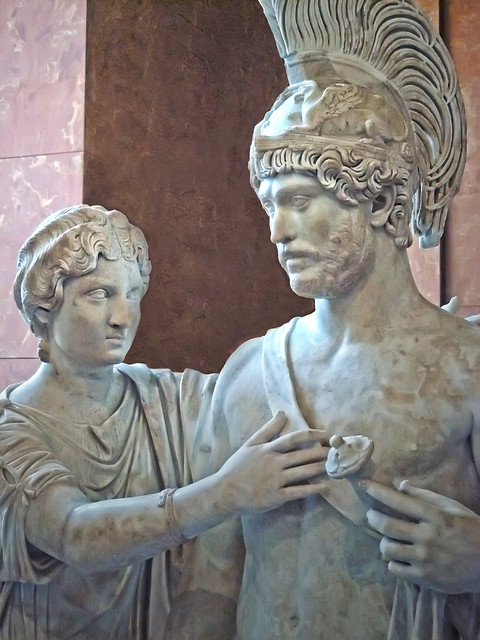
Interesting image of Mars the God of War with the face
of the Roman Emperor Hadrian and a female companion
whose face was resculpted in 170-175 CE to resemble
the Empress Lucille (according to The Louvre), wife of
the Roman emperor Lucius Verus (???) Photographed at The Louvre in Paris, France by Mary Harrsch

Then things take an even more nasty turn and the centurion in question is found murdered.  The related tribune throws Ruso into chains, more out of outrage that Ruso went to the emperor over his head than truly believing Ruso had anything to do with the murder. So Ruso and Tilla must scramble to discover the truth before Ruso is marched off to Deva for what is believed will be a summary trial and execution on the orders of the legate there.

The exciting conclusion involves Praetorian guards, conspiratorial royal secretaries, Tilla's less expert use of one of Ruso's scalpels, near mutiny of the recruits of the 22nd Legion and an ultimate solution devised by a very wise man who happens to be the most powerful ruler of the known world.

Again Downie has given us a mystery with twists and turns that keep readers guessing until almost the very end.  The characterizations of Ruso and Tilla are consistent with previous novels and, as I mentioned in a recent post to the Roman History Reading Group on Facebook, Downie offers each character's thoughts to us to flesh out their personalities.  She also provides a little backstory for tribune Accius letting us imagine his rather lonely childhood and the social importance of having an uncle publicly decorated for valor.  We can then understand, at least partly, the rational for what would normally be seen as outrageous behavior towards a respected medical officer.

The only thing I didn't understand in the plot was why Hadrian, who remained at the fort for several days during the time that tribune Accius imprisoned Ruso, did not act to prevent the mistreatment and possible loss of a valued medical officer who had proven himself in the Antioch earthquake?  Of course, our hero is ultimately saved but Hadrian's apparent indifference earlier in the story does not seem consistent with his obvious longtime respect for Ruso expressed at the end.

Of course, we don't know when Hadrian's knowledge of all of the events that occurred was realized, but as astute as Hadrian was, I can't imagine him not knowing that the tribune was blaming Ruso before Hadrian had left Eboracum for his next port of call.  If the tribune had simply locked up the native deserter, Victor, and blamed him from the beginning, it would have been more understandable that Hadrian would have been reticent to get involved.  Hadrian was a soldier's soldier and would not have intervened in a matter that should have been handled by the existing chain of command in circumstances that did not involve a professional officer held in high esteem by the emperor.  Perhaps this was Downie's way of developing events that would lead up to Russo's offer to sacrifice his own life to preserve order on the frontier and the emperor's continued successful reign.  Such an offer would then justify the size of the favor Ruso requests at the end of the story.

As for the supporting history behind the abuse of native recruits to the legions in Britain, we can look to the Vindolanda Tablets that include correspondence from the professional  auxiliaries from the Tungri tribe of the Aardennes region (Belgium/France/Luxembourg).  Although these men were not originally Romans from the Empire's heartland, they still  used a disparaging nickname for their British hosts: Brittunculi.

"In Latin, the suffix -unculus is both diminutive and pejorative: the term translates as "pathetic little Brits" (Vindolanda Tablet 164). The author was probably not referring to the provincial population as a whole, but specifically to young trainee recruits to the regiment. - Roman auxiliaries in Britain, Wikipedia

The Vindolanda Tablets, dated from 85 - 122 CE, also reveal that the military was understrength at the time of Hadrian's visit in 122 CE. The I Tungrorum listed its strength at 752 instead of the official 800 men expected to fill its rolls.  So, it would have been a time that recruits would have been sought, even from the local tribes.

Originally, Rome did not deploy auxiliary units in their home country or region but this policy relaxed to some degree as military shortages became more acute in the second century.

Centurion abuse of young recruits, outside the demanding regimen of basic training, is also documented in the ancient sources, although the most prominent record involves the Germanic Batavians.  In the "Year of the Four Emperors" (69-70 CE), the governor of Germania Inferior was ordered to raise more troops.  The Batavians  were regarded by the Romans as the very best (fortissimi, validissimi) of their auxiliary so the governor attempted to conscript more Batavi than the maximum stipulated in their treaty.  This action was compounded by the brutality and corruption of Roman recruiting-centurions including reports of sexual  assault on Batavi young men.
A Batavian helmet with remnants of blonde wig,
Courtesy of the Nijmegen museum.

Then, Julius Civilis, himself a decorated veteran of 25-years service in Britain and prince of the Batavi people, led his people in open revolt.

"... the uprising soon became a bid for independence.  Civilis exploited the fact that some legions were absent from the Rhine area due to the civil war, and the rest under-strength. In addition, the Roman commanders and their rank-and-file soldiers were divided by loyalty to rival emperors. Civilis quickly won the support of the Batavi's neighbours and kinsmen, the Cananefates, who in turn won over the Frisii. First the rebel allies captured two Roman forts in their territory, and a cohort of Tungri defected to Civilis.  Then two legions sent against Civilis were defeated when their companion Batavi ala defected to his side. The Classis Germanica (Rhine flotilla), largely manned by Batavi, was seized by Civilis. Most importantly, the eight Batavi cohorts stationed at Mainz with XIV Gemina mutinied and joined him, defeating at Bonn a Roman force that attempted to block their return to their homeland. By now, Civilis commanded at least 12 regiments (6,000 men) of Roman-trained and equipped auxiliary troops, as well as a much larger number of tribal levies. A number of German tribes from beyond the Rhine joined his cause. Several other German and Gallic units sent against him deserted, as the revolt spread to the rest of Gallia Belgica, including the Tungri, Lingones and Treviri tribes. He was able to destroy the two remaining legions in Germania Inferior, (V Alaudae and XV Primigenia). 
By this stage Rome's entire position on the Rhine and even in Gaul was imperiled. Their civil war over, the Romans mustered a huge task force of eight legions (five dispatched from Italy, two from Spain and one from Britain) to deal with Civilis. Its commander Petillius Cerialis had to fight two difficult battles, at Trier and Xanten, before he could overrun the Batavi's homeland. Tacitus' surviving narrative breaks off as he describes a meeting on an island in the Rhine delta between Civilis and Cerialis to discuss peace terms. We do not know the outcome of this meeting or Civilis' ultimate fate. But in view of his former friendship with Vespasian, who had already offered him a pardon, and the fact that the Romans still needed the Batavi levies, it is likely that the terms were lenient by Roman standards." - Roman military Auxiliaries, Wikipedia

So, the situation described in the novel could have been equally disastrous for Hadrian, who would have been keenly aware of the outcome of the Batavian revolt just 50 years before.  Furthermore, by Hadrian's time auxiliaries outnumbered legionaries by 2.5 to 1 in Britain.  Unfortunately for Ruso, Tribune Accius was far more nearsighted, thinking only of his family's social standing and not the welfare of the empire.

I also though Downie accurately portrayed the relationship between Hadrian and his wife Vibia Sabina.  Downie's townspeople mention rumors that Hadrian preferred to spend more time with his mother-in-law than Sabina.  Although that sounds strange, Hadrian's mother-in-law was actually his second cousin and only eight years older than Hadrian.  Furthermore, they were raised together in Trajan's household.

Sabina, as portrayed in the novel, was known to be independent minded and by the time of the novel, she had already had an affair with the historian Suetonius, secretary to Hadrian.  So, it would be totally in character for her to admonish Tilla by saying "Don't pray too hard" when Tilla said she would pray for the empress to be fruitful.

As a war veteran's spouse, another issue I always ponder when I read about a character being particularly brutal to other characters is whether the brutal character may be suffering from post-traumatic stress disorder.  Geminus was described as a valorous, much-decorated veteran about to retire when he finishes training this particular batch of recruits.  Although scholars like Dr. Jonathan Eaton question a diagnosis of PTSD in members of the Roman Army because of a lack of explosive or concussive events in a typical Roman battle (PTSD and the Roman Army ), I would point out that heroic epics like those of Homer formed a foundation of source material used in the formation of the Roman heroic ideal.  In Chapter 3 of "From Melos to Mylai: War and Survival", Lawrence Tritle asserts that the heroes portrayed in Homer, Tyrtaeus, Archilochus, and Aeschylus share the characteristic of being someone who takes revenge for the death of his friends and strongly believing a good man is a brave man.

Not only may Geminus have been subconsciously seeking revenge for friends lost in past campaigns but as the recruits quaked from the centurion's actions, he may have dismissed the lot of them as not worthy since they apparently displayed no bravery in his eyes.

Tritle further points out that in war, officers are taught to instill in the troops an image of the enemy as foreign and different.  "[these] emotional factors... were greater inducements to carry out brutal acts of violence than racially or culturally based perceptions of the 'Other'."

So despite his horrendous behavior, perhaps we should reserve at least a little sympathy for Geminus just as Ruso expressed for Geminus' dog, Bella.  She may have attacked Ruso because of her training, but in the end she waited calmly beside the body of her beloved master, unaware that she, too, would be struck down for her learned behavior and share his funeral pyre.

If you enjoyed this post, never miss out on future posts by following me by email!


Wednesday, July 2, 2008

First Punic War Rostrum Found Off The Coast of Sicily


"Italian researchers say a rostrum, used by ancient Romans to ram enemy ships, was found off the coast of Sicily.

The rare bronze appendage may have been used in the final naval battle of the First Punic War, ANSA reported Tuesday. The rostrum was recovered about 230 feet below the surface by divers aided by remotely operated vehicles.

Sicily's maritime affairs department department head, Sebastiano Tusa, said the Egadi rostrum confirms his theory that a battle took place northeast of the island of Levanzo between fleets from Rome and Carthage during the Battle of the Egadi in 241 B.C., the Italian news agency said."

It was the ancient custom for Roman senators and victorious generals to give speeches from the captured prows, or bows of enemy ships. The ships would then be drawn up on the beach and destroyed except for the prow.

"When you won a naval victory, you cut off the enemy rostra, brought them home, and mounted them on new ships of your own. The bronze prow was the most costly part of the ship, so bringing home the other guy's rostra meant that you could expand your fleet. After really great victories, you could do some serious bragging by mounting some of the rostra for public display rather than reusing them -- "We beat them so bad we have rostra to spare!" So Duilius mounted six "spare" captured rostra on the face of the forum tribunal after his fleet demolished the Latin fleet at Antium in 338 BC. In 260 BC, C. Duilius Nepos added several more after beating the Carthaginians at Mylae. Julius Caesar's plan to expand what by then was called "the Rostrum" was carried out by Augustus, but Augustus's rostra were decorative fakes -- real bronze showing wealth, but not from enemy ships. (The brick Rostrum seen today is a modern restoration.)

Augustus mounted real rostra from the naval battle of Actium on the front platform of the temple that he built to honor his assassinated uncle, "The Divine Julius (Caesar)", and that was particularly significant for two reasons. First, the Actium rostra were Roman, not foreign: they came from Marc Anthony's fleet. Second, Augustus was proclaiming the dominance and divinity of what was to become the Julio-Claudian dynasty both by putting a temple to his uncle Julius in the forum and by placing trophies on its front. He thus established a new Julio-Claudian Rostrum, and during that dynasty you had to be brave or silly to use the old one. The Flavian Emperors took over after Nero ended the Julio-Claudian line in disgrace, and use of the original Rostrum at the other end of the forum resumed." - Tom Wukitsch, Arlington Learning in Retirement Institute

Our English word rostrum, for the wooden stand used by a public speaker, comes from the Latin word for ship's prow.


For coin collectors in the crowd, the presence of a ship's prow on a coin reverse was used to signify victory, the importance of the grain supply (which was carried from Egypt in ships) or an emperor's care in ensuring an adequate grain supply."

If you enjoyed this post, never miss out on future posts by following me by email!


Saturday, June 16, 2007

Gallic-Romano mythology - Tarvos Trigaranus

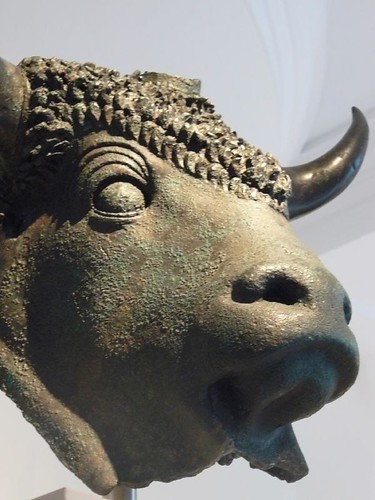
I uploaded some more images from the Met today and among them are several images of a bronze three-horned bull (unfortunately the center horn is missing) that was recovered from Octodurus, a city founded by the Emperor Claudius, in Switzerland.

It's a wonderful sculpture and I'm so glad the piece was not melted down as it appears to be part of a statue that had been rendered apart in preparation for scrapping. It made me curious about the worship of a three-horned bull so I researched it further and learned that the three-horned bull, sometimes called Tarvos Trigaranus, was worshiped by the Celts in Gaul and Britain.

According to an article by Susan Read, Martin Henig, and Leslie Cram that appeared in the journal Brittania, art depicting three-horned bulls was common in northeastern Gaul. They said it seems to have been derived from statues of two-horned bulls from Campania that were constructed with a crescent between their horns. They mention four such statues found in Britain - one in Maiden Castle at Dorset, one from the Jewry Wall Site in Leicester, one from Southbroom near Devizes in Wiltshire, and the last a pipeclay figurine, "certainly an import from Gaul", found at Colcester.

I also read an interesting description of a divination to determine a new Celtic king using a bull.

"Bulls were used in divination in both Ireland and Scotland. At Tara a new king might be chosen in the tarbfheis, `bull-feast' or `bull-sleep', in which a bull was killed and a man ate his fill of its flesh, drank its broth, and then lay down to sleep. After an incantation had been chanted over him by four druids, the dreamer would know the new king in his dream. In Scotland a person might answer an important question about the future (no king was to be selected) by wrapping himself in the warm, smoking hide of a newly slain bull in a remote place, such as near a waterfall. Upon going into a trance the person would have the answer. This method was known as taghairm." - Celtic Mythology, Oxford University Press.

Apparently the three-horned bull even found its way to the standards of the Roman Legions:

"...standards of ala Longiniana (CIL XI11 8094) and cohors I Gallica (ILS 9127) appear to have been adorned with animals popular in Gallic religious
iconography - respectively, a three-horned bull (Green 1976, 13) and a small boar.6 Such animals almost certainly appeared on signa of the type referred to by Tacitus (Germ. 7; Hist. 4.22), borne by the pagi and tribal groupings of the Gauls (Royrnans 1990,19). They appear open to different symbolic interpretations: depending on the cultural perspective of the viewer, they could have been seen primarily as traditional Gallic tribal totems or as Roman military regimental standards." - The Roman Army As A Community .
If you enjoyed this post, never miss out on future posts by following me by email!


Saturday, October 1, 2005

Welcome To The New Roman Times!

After struggling with the constantly changing tools to convert RSS feeds to HTML using scripts that seem to hiccup every time someone makes a change to user security or the underlying javascript, I've decided to take a new approach to publishing Roman Times.

I've embedded the columns into inline frames with scroll bars to use to see more articles about each topic group. Each column title is linked to the actual blog that I use to update the articles in that group if you wish to see a full page version. You can also scroll to the right to see the links to each group's archives. I have also consolidated all of the information onto a single (long) page. I think you will find scrolling down less confusing than clicking links to move from one page to the next.

Hopefully this blogger shell will prove to be a more efficient way to bring you the latest news in the study and enjoyment of the ancient world.
If you enjoyed this post, never miss out on future posts by following me by email!