Showing posts with label book review. Show all posts

Monday, August 6, 2018

Review: The Middle Ages in 50 Objects by Gertsman and Rosenwein

A history resource article by Mary Harrsch © 2018

Normally, I review books focused on the ancient world but I received an email from Cambridge University Press asking if I would be interested in receiving a review copy of their new release "The Middle Ages in 50 objects." Even though the Middle Ages is not the period of my personal research, I still enjoy examining art and artifacts from the Middle Ages when I photograph the permanent collections of of the museums I visit, so I agreed to give it my attention.

As promised, the book was lavishly illustrated with full page color photos of the artifacts selected for inclusion.  I was surprised that all of the objects came from a single museum, the Cleveland Museum of Art, though.  Most world-class museums have galleries of medieval art so I was not expecting a single museum not devoted to that historical period, to have the breadth needed to encompass an entire age.

But Professor Elina Gertsman of Case Western Reserve University and her co-author, Professor Barbara Rosenwein of Loyola University Chicago, have certainly selected objects that are representative of their four focus areas, The Holy and the Faithful, The Sinful and the Spectral, Daily Life and Its Fictions, and Death and Its Aftermath.

Most objects are Christian-themed, but several artifacts from Islamic regions are also included.  I was particularly surprised to find a sculpture dated as early as 280-290 CE to be the first object discussed, though. I usually consider the Middle Ages a period from the fifth to fifteenth centuries CE, after the fall of the Western Roman Empire and lasting into the early Renaissance.  But, as a scholar of the ancient period, I was, of course, anxious to read what these distinguished art historians had to say about the piece.

Jonah Cast Up Roman 280-290 CE. Courtesy of the Cleveland Museum of Art.

The piece, entitled Jonah Cast Up, was a bit baffling to me. Most of us are quite familiar with the tale of Jonah being swallowed by a a huge fish (New International version, King James version) or dag gadol - great fish (Hebrew). But here, the "fish" has the head and forepaws of a wolf, typically symbolic of the Roman Empire. Furthermore, the male figure has the hair style and beard often seen in Roman art depicting Jupiter.

The authors, too, recognized the resemblance of the Jonah figure to Zeus (Jupiter in the Roman pantheon).

"A strong muscular man with an abundant beard and wild curly hair, Jonah dives out from the jaws of the beast, arms up, the movement of his torso echoing the direction of the sea creature's pricked up ears and scrunched snout. The broad-shouldered Jonah, with his copious curls and robust arms, is reminiscent of images of Zeus, the Greek god of Thunder and the ruler of Olympus."

But they say nothing about the symbolism of the wolf other than to observe that the great fish of the Jonah story has sometimes been interpreted as a sea monster (in later Greek translations of the scriptures).

I thought, perhaps, the archaeological context could provide additional insight.

The authors point to collateral finds as possible evidence of a patron with Christian leanings.
"This sculpture seems to have formed part of an ensemble.  It was supposedly found buried in a very large jar alongside six paired portrait busts, an image of Christ the Good Shepherd, and three other representations of Jonah in prayer, under the shade plant, and being swallowed by the sea monster. The patrons therefore appear to have had Christian leanings."

The dating appears to be tentative and the authors speculate whether it was produced a little later than the date given, perhaps during Diocletian's persecution of Christian believers in 302 CE.

Portrait head of Diocletian photographed at the
Art Institute of Chicago by Mary Harrsch © 2016
"Soldiers were ordered to sacrifice to the Roman gods or face discharge; Christian churches were destroyed; books of scripture were confiscated and burned; and Christians were stripped of their rank if they did not conform, making them liable to torture or execution. Whether carved before the Great Persecution or at some point during it, the marble image of the rebellious Jonah - not only saved from drowning but also finding himself cast safely ashore - must have been exceptionally reassuring."

I would offer a slightly different interpretation as another possibility. I think the sculpture could have been produced a little later still, during the reign of Constantius II.  Although seemingly an image representing the Jonah story, I think it could have been carved to represent the expulsion of paganism from the Roman Empire itself.  That would account for the human figure's resemblance to Zeus (Jupiter) and for the wolf's head on the sea monster's body - still probably reassuring to a Christian-leaning patron who may have suffered during the Great Persecution.

I definitely agree with the author's summary conclusion, however.

"Jonah Cast Up stands as a perfect witness to the cultural and religious complexity of the late third [and early fourth] century."

I also found a gilt-silver arm reliquary of the Apostles, circa 1190 CE, from lower Saxony interesting too. Although I view the veneration of bits of human corpses to be a macabre practice, I have admired beautiful reliquaries, strictly from an artistic perspective, at a number of museums I have visited.  As an ancient scholar, though, the thing I found really intriguing was the authors' observation that often reliquaries do not house the body part they represent, although this one did.  It seems deception has plagued religions for thousands of years as I have read that ancient Egyptian votive mummies depicting various animals rarely contain the animal they represent either.

I found the background information on a 14th century French ivory mirror case depicting a couple playing chess quite eye-opening. In fact, the authors' description of some of the symbolism represented by this particular mirror and chess as a metaphor for courtship made me blush!

"Such mirrors were popular in French and German wealthy households, surviving in large numbers. The subjects carved on their cases were almost always secular, some featuring the God of Love, others the Castle of Love Under attack still other scenes of courtship and narratives from romances.  The game of chess, very popular in medieval literature, was particularly favored for mirrors, which were given as gifts and often formed part of a trousseau."

I'll definitely have to keep my eye out for more of these little marvels in my museum travels!

I found the authors' background information and symbolic interpretation of the selected artifacts in "The Middle Ages in 50 Objects" quite fascinating and highly recommend this text.


If you enjoyed this post, never miss out on future posts by following me by email!


Sunday, July 29, 2018

Review: Onslaught by Anthony Riches

A historical resource article by Mary Harrsch © 2018


As I began listening to Anthony Riches' "Retribution" today, I realized I had not reviewed its prequel "Onslaught", the second in "The Centurions" series about the Batavian Revolt during the year of the Four Emperors, 69 CE. So, let's remedy that now.

Toward the end of The Centurions Book 1, "Betrayal", a sizable portion of the Batavian cohorts has been sent south from Germania Inferior to fight the forces of Marcus Salvius Otho, a young Roman aristocrat who has instigated the assassination of the short-lived emperor Servius Sulpicius Galba and now claims the purple for himself. The legions guarding the Rhine frontier, who initially marched south to fight Galba, are unwilling to accept Otho either, since they declared their own commander Aulus Vitellius emperor before hearing of Otho's coup. Now they plan to enforce their will regardless of which man the weak Roman senate ordains.

The forces clash violently at Cremona with Vitellius' forces victorious due in no small part to the ferocity of the Batavians.  As a reward, Vitellius orders the Batavians to return to their homeland.

But then word comes Titus Vespasianus, a general who has personally fought beside the Batavians in Britannia and even owes his life to them, has declared his intention to wrest control of the empire from Vitellius' tenuous grasp.  So, Vitellius changes his mind about sending the Batavians home to their prince.

This poses quite a dilemma for the Batavians as they have no real personal allegiance to Vitellius and they also know the Rhine legions he commands are determined to eliminate their prince Gaius Julius Civilis for his apparent collusion with Gaius Julius Vindex in an ill-fated revolt to support Galba a year earlier. Then, word leaks out that Vitellius plans to break up the Batavian cohorts and distribute them across his legions to blunt any threat they may present in the future.

Meanwhile, Civilis meets with envoys from Vespasianus including Pliny the Elder, and agrees to begin a rebellion to distract Vitellius and prevent him from ordering the remaining Rhine legions south to meet Vespasian's forces. Historically, this may have occurred, but is not specifically stated in any ancient sources.

Civilis knows it is a dangerous game he plays as Rome has always ruthlessly punished any tribal group who attempt to throw off the Roman yoke.  How far can he really trust Vespasian or even his own countrymen knowing he, himself, does not go unchallenged for leadership?  Much hinges on arrangements he has made with a long-time tribal opponent, Claudius Labeo. The plan is kept secret from even Civilis' closest kinsmen. Civilis wonders whether he can restrain his warriors from claiming Roman battle trophies and accept the defeat and plunder of Roman auxiliaries and fellow Germans instead.  Furthermore, for the plan to succeed, Civilis needs the rest of the Batavian cohorts now poised between returning to Batavia and continuing south with the forces of Vitellius.

His choice apparently made, Civilis sends a secret messenger to the Batavians in the south asking them to ignore Vitellius and continue their march north to join their countrymen and the game of thrones begins in earnest.

The grisly battle scenes, as is always the case with Riches' tales, keep you riveted to the action and guessing as to what Prince Civilis has up his sleeve. The characters are vibrantly drawn and  you can't help but feel empathy for them as they desperately battle their former comrades for the continued freedom of their tribe and even life itself.

I found myself still more partial to the Batavians than the defenders of the "Old Camp" and didn't really find a new Roman centurion called Aquilius particularly appealing either due to his brutal nature. But I know such characters really crank up the tension and realism of the narrative.

I am anxious to continue the Centurions' trilogy with "Retribution" and highly recommend this masterful series.


If you enjoyed this post, never miss out on future posts by following me by email!


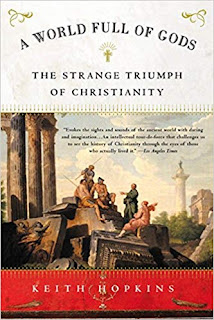
Review: A World Full of Gods: The Strange Triumph of Christianity by Keith Hopkins


A historical resource article by Mary Harrsch

When I was researching the Roman Empire's financial crisis of the late 3rd century and subsequent embrace of Christianity as part of the solution, I found a wealth of information in the late Keith Hopkins book "A World Full of Gods: The Strange Triumph of Christianity."  Before his death in 2004, I had often admired Hopkins insight shared in a number of television documentaries on the Roman Empire. 

Although Hopkins is mostly remembered as a professor of ancient history at Cambridge, he also served a lectureship at the London School of Economics. Since my research was going to cross over from history to economics, I was excited to find his book, originally published in 1999.

But the book, like the man, was quite unconventional. Instead of a purely historic treatise on the rise of Christianity, it began with a fictional tale of time travel to first, ancient Pompeii, and then to ancient Egypt, to give the reader a taste of other competing religions during the formative years of Christianity's development.  Although I was really more interested in facts than fantasy, I enjoy time travel tales so was not dissuaded from continuing to read on.

Then, I came upon a very long third chapter and it was literally stuffed with the background information and sociological interpretation I was truly looking for.  I marked each usable passage with purple sticky tabs and soon that portion of the text was fluttering with purple markers.
Hopkins, a sociologist, drew parallels between the ancient Christian "revolution" and the political upheaval resulting in the establishment of communist China.

"...in Rome as in China, the veneer of virtuous prescription disguised a multitude of sins; the church grew steadily richer, and more corrupt; Christian rigorists pursued mad ends with obsessional fervor; bishops borrowed the oppressive powers of the state to bully, exclude, and even execute doctrinal rivals. "

Hopkins goes on to point out Christians viewed themselves as the fervent elect, chosen by God, and linked together by their difference from and radical rejection of others. 

"...once in alliance with the state, Christian leaders exploited their newfound powers in order to impose single versions of correct belief, through votes by universal councils of bishops.  Almost inevitably, once its influence and power was buttressed by the state, the church also became in part a business, distributing charity, patronage, privilege, and immortality."

How I interpreted this information and dozens of other passages in relation to the financial crisis of the Roman empire and the "conversion" of the Roman Emperor Constantine can be read in my paper, "Did Financial Exigency Drive The Roman Empire to Embrace Christianity?"

Hopkins spends the rest of his text examining Christian literature, comparing different versions of the gospels, and evaluating Christianity's turbulent coexistence with Judaism and paganism.

If you are looking for an account of purely historical events, this book, with the exception of Chapter Three, may disappoint.  But, if you are open to exploring religious roots as a journey, you may find Hopkins unorthodox approach thought-provoking.

If you enjoyed this post, never miss out on future posts by following me by email!


Thursday, July 19, 2018

Review: The Throne of Caesar by Steven Saylor

A historical resource article by Mary Harrsch © 2018


Gordianus "The Finder," with his 66th birthday approaching, now spends much of his day relaxing in his peristyle garden reading and sipping a cup of the best vintage he can afford.  But some of his old clients can't seem to let him slip away into anonymity.  First Tiro, Cicero's secretary, comes knocking with a request for Gordianus to call upon his master.  Then Meto, Gordianus' oldest adopted son and trusted officer in the service of Gaius Julius Caesar, pays his father a visit. Caesar, now ruling dictator of Rome, also wishes to consult with the old "Finder".

So, we are once more immersed in the politics of a crumbling Roman Republic as Gordianus must brush the cobwebs from his tired brain and consider a list of possible suspects who may be contemplating the assassination of the most powerful man in the Mediterranean world. To help him do this, he decides to retreat to one of his favorite hangouts, the Salacious Tavern, and banter with his old friend Helvius Cinna, the most renowned poet in Rome.

When I began reading this book, I had heard that this was to be the capstone of Steven Saylor's Roma Sub Rosa series. The pace of the novel is leisurely with Gordianus reminiscing about old cases and now dimly remembered characters who once played a role in his life as he meets with famous historical personalities like Cicero, Caesar, Cleopatra, Calpurnia, Cassius, and Brutus . I must admit this was a bit jarring, at first, for me having just read eleven of Anthony Riches' action-packed novels of the Roman Army.  But, I realized that the author was using this opportunity to remind us of why this period of history and this civilization was so memorable, carefully evoking the atmosphere and lifestyles of its inhabitants.

Saylor also spends a significant portion of the book revisiting Greco-Roman mythology and its role in Roman poetry.  Some readers may consider this a bit of an indulgence by the author. But as it turns out, myth is central to the final plot twist.

Mystery has always been the centerpiece of Saylor's novels and this one would be no different. We are given the chance to experience Caesar's fate through the eyes of Gordianus but it is not his death that will take center stage in the novel's climax.

It did appear to me that, sadly, Gordianus' powers of observation have lost some of their acuity and was a painful reminder of the decline I have experienced as advancing age has made its effects felt.  This is made a little more pronounced by the author's third person asides pointing out suspicious behaviors of the conspirators that seemingly went unnoticed. I am just two years older than the fictional hero and found myself cringing each time he referred to himself as an old man.

Fulvia depicted as Phrygia Eumeneia on a coin minted in 41-40 BCE


But, I appreciated the opportunity to explore the characters and motivations of such historical figures as Antony and Fulvia as the story within a story unfolded.  We find Antony is not just the bull-necked riotous playboy often depicted in Octavian's propaganda but a skilled orator and seemingly conscientious, though pragmatic, Roman politician.  In Fulvia, we find a woman not only driven by ambition but a forceful feminist who has learned how to balance Roman-prescribed pudicitia with power obtained from a carefully managed relationship with her marital partner.

So, be forewarned that this is not just a retelling of Caesar's final days, but an evaluation of relationships, missed opportunities, the power of literature, and the weight of responsibility even the "elderly" have to family, to friends and to society.


If you enjoyed this post, never miss out on future posts by following me by email!


Tuesday, March 20, 2018

Review: Vindolanda by Adrian Goldsworthy

A historical resource article by Mary Harrsch © 2018


Having recently delved into Adrian Goldsworthy's "Pax Romana" which I found eminently readable and stuffed with fascinating facts and insight into the Roman world, I was excited to see that Goldsworthy had tried his hand at historical fiction when "Vindolanda" showed up in my list of audiobooks available on Audible. Without hesitation I used one of my subscription credits to purchase it and began listening to it as soon as I finished my last of eleven novels by Anthony Riches.

I realized this novel appeared to be his first effort at using his formidable knowledge about the Roman world in a fictional tale but I was not daunted by that since one of my favorite series, "Warrior of Rome", was written by a the Director of Studies in Ancient History at Oxford University, Harry Sidebottom.

Goldsworthy's protagonist, Flavius Ferox, is a prince of the Silures tribe who, as a hostage taken after the Roman conquest of Britain, was educated in Rome and inducted into the legions.

The Silures were a powerful tribal confederation that occupied what is now southeast Wales. Their first resistance to Roman conquest began in 48 CE with the help of Caratacus, a prince of the  Catuvellauni, who had fled from further east after his own tribe was defeated. The Romans, led by  Publius Ostorius Scapula, spent several years campaigning against the Silures, and found the Silures so adept at guerrilla warfare that Ostorius announced they posed such a danger that they should be either exterminated or transplanted.

After Ostorius died the Silures, still undefeated, went on to defeat the Second Legion. But, they were eventually subdued by Sextus Julius Frontinus in a series of campaigns ending about 78 CE. Of the Silures, the Roman historian Tacitus wrote: non atrocitate, non clementia mutabatur– the tribe "was changed neither by cruelty nor by clemency".

When the novel begins, Ferox is a  Centurio Regionarius, an officer responsible for local law enforcement, who has been sent to an isolated outpost within a days ride of the more formidable Roman fort at Vindolanda. We learn from his own recalled memories or from comments made by a Brigantes scout named Vindex, that Ferox has a past littered with moments of extreme bravery clouded by an irascible nature that has resulted in conflict between Ferox and his commanders, ultimately leading to his apparent banishment to this backwater post.

Ferox also appears to have a sporadic drinking problem that crops up whenever he is not kept suitably occupied. We learn his wife mysteriously disappeared some years ago and he blames himself. Whether she was kidnapped by disaffected druids or simply left for personal reasons is not made clear. This plot point was apparently introduced to justify his rather unprofessional initial behavior.
Vindex has known Ferox for some time and knows how to handle him during his despondent periods. The best medicine is loosing Ferox on the scent of a murder and fortunately, Vindex rides in with two bodies.

At this point I had to adjust my expectations for this story. I was expecting a story about a Centurion and a band of reluctant cohorts that he had to whip into shape to confront a threat from local rebels. But, I was only partly correct. As it turns out, Ferox is first and foremost, a highly skilled tracker and more of a detective type, than cohort commander. Ferox appears to have little influence on his own troops but soon leaves them anyway so I guess it doesn't matter. The only relationship he has developed is with Vindex and it is more like that between two lone wolves than the close brotherhood of centurions I had grown so accustomed to after reading eleven novels by Anthony Riches.

This lack of depth in character dynamics left me feeling detached from any of the people I met, including Ferox. So I began to struggle to become engaged in the plot.

Ferox and Vindex find evidence of a rebel war band and track the rebels to the road leading to Vindolanda. They find the rebels attacking a Roman carriage escorted by a Batavian cohort from Vindolanda. But, the Batavians are outnumbered and are being overwhelmed by scantily dressed warriors emblazoned by tatoos shaped like a horse.

At this point, I really had to struggle to remain open-minded as I had just read "Betrayal" and "Onslaught" in Anthony Riches' "Centurions" series about the Batavian Revolt in which I learned the Batavians were considered the "best of the best" Roman auxilliaries. But this was about thirty years after that time and perhaps the Batavians had lost some of their edge after being put in their place when the Romans exacted "Retribution" (the third novel in the series due out in April).

Anyway, Ferox and Vindex turn the tables and Ferox ends up saving the life of Sulpicia Lepidina, wife of the prefect of Vindolanda, Flavius Cerialis (and a real woman in history as attested to by letters that have been recovered by archaeologists there).

Ferox and Sulpicia are apparently attracted to one another and their relationship will become a subplot throughout the rest of the novel.

Ferox and Vindex return the lady and her maid to Vindolanda and confer with Cerialis about the looming rebel threat. Then Ferox and Vindex ride out to the signal tower to see why the warning signal was delayed. There they find the detachment slaughtered with the exception of one soldier who is missing. At this point Ferox begins to suspect there must be a high-ranking traitor among the Romans who is working with the enemy.

The rest of the novel follows Ferox as he tries to determine who has betrayed Rome and survive the forces of "The Stallion."

With Goldsworthy's extensive classical education, the descriptions of Roman life and military deployments is, of course, authoritative. However, sometimes the extensive descriptions actually get in the way of the story and slow the pace considerably.  I also felt the supporting characters lacked sufficient development to make the story as compelling as it could have been. I didn't know enough about the officer who turned out to be the villain to be appalled by his behavior and Goldsworthy didn't supply enough information about why his family opposed the newly minted emperor Trajan to really justify his betrayal. I also didn't think there were enough "breadcrumbs" left throughout the story so a reader could at least have an idea who the traitor might be. At the end, when all was revealed, I felt no catharsis, since I didn't have hardly a clue about who it might be anyway.

However, I do think Goldsworthy's battle scenes were visceral and authentic, reflecting his extensive study of the Roman military in action. For a first novel, it was a good effort and I do plan to give the sequel, "The Encircling Sea," a listen if it makes it to Audible.

A Kindle preview:


More suggested reading:


If you enjoyed this post, never miss out on future posts by following me by email!


Sunday, March 18, 2018

Review: Atlas of Empires by Peter Davidson

A historical resource article by Mary Harrsch © 2018


In the opening pages of this reference work, Peter Davidson tells us about his friend who defined an empire as "murder, incest, and the wearing of expensive jewelry!"

"There is the image here both of glorious conquest and of power held over far-flung lands, and indeed this captures something of what we have come to mean by the term 'empire,'" Davidson observes, "But how, then, does empire come about, what forms can it take, and does it have a defining characteristic?"

These are the questions he attempts to answer as he compiles information about most, if not all, empires that have arisen and collapsed throughout world history.

He begins by dividing up his work into nine main chapters, beginning with early civilizations formed when the social construct of empire was a new concept.  The first chapter, entitled "War and Peace", examines the contention between Sumer and Akkad, the rise of Egypt, how the attributes of a military society like Assyria could not achieve stability without advances in administration like those developed by the rulers of Babylonia, and how religion was used to forge unity between disparate peoples by the kings of Persia.

Chapter two focuses on empires of the classical world including Greece and Rome, as well as Alexander's conquests, the Parthians and Sasanians of Iran, the Mauryas and Guptas of India, and the Qin and Han of ancient China.

"The story of Rome is one of adaptation," Davidson points out. "The early growth of Roman power sprange from a zealous and rapacious republicanism that eventually threatened to destroy the republic itself. Unlike Athens, however, Rome restructured to resolve the tension between republic and empire. Subsequently, Rome began to resemble the Persia of Cyrus and Darius in the measures it took to cope with its increasing size and multiculturalism."

In chapter three Davidson leaves the ancient world behind and concentrates on what he terms "Empires of Faith", the Byzantine Empire, the Holy Roman Empire, and the Abbasid Caliphate.
"All the classical empires found ways to supplement control by force with a measure of consent delivered by shared beliefs," Davidson explains. "As the classical world crumbled and people looked for something to hold on to, however, religious ideas promising salvation exerted a stronger pull than political ideas such as citizenship."

Empires of the horse take up Chapter Four as Davidson examines the conquests and achievements of the Mongols, the later empires of the Chinese beginning with the Sui and ending with the Qing, Muslim India with the splendor of the Mughals, and the Ottoman Empire.

"The horse made light work of invading Eurasia's agricultural civilizations but building empires was another matter," Davidson points out. "The steppe riders faced the usual tribal problems of creating a larger community. They also faced the dilemma of what to do with the societies they conquered. If they destroyed they gained little. If they bent themselves to an alien way of life they stood to lose their identity."

Chapter Five looks at what Davidson terms "Empires of Isolation." Three empires are examined here including Mali, the Aztecs, and the Incas. Davidson observes that the empires arising in Eurasia  were ultimately linked by trade and religion but such was not the case in sub-Saharan Africa and in Central and South America. And yet, spectacular empires arose even without the use of iron and steel, draft animals or even the wheel, in some cases.

Chapter Six looks at the first global empires, Spain, Portugal, the Dutch, and both Britain and France in the Americas.

"Managing such far-flung empires was a new challenge," says Davidson. "It was partly a question of money. To squeeze profit from the silver mines of Peru or the nutmeg trees of the Est Indies, ships had to be built, voyages that could take two years had to be financed, and things had to keep going at home."

Chapter Seven examines the conquests of Napoleon, the development of Tsarist Russia and the rule of the Austrian Habsburgs.

"As much in opposition to French occupation as in sympathy with French ideals, national independence movements sprouted across the continent," Davidson observes. "The age of the nation-state had arrived, with first Greece, and later Italy, Germany, and others finding their modern form."
The imperialism of Britain and Japan are examined in Chapter Eight.

"By the 1870s, nationalism had become as much a force to serve imperial ambitions as to incite independence movements. A second industrial revolution now gave Continental powers the chance to compete with Brtain, and , as the 19th century drew to a close, a single global empire gave way to a feeding frenzy for colonial possessions ending in the First World War," Davidson states.

In the last chapter, entitled "Empires and Utopias" Davidson looks at the U.S., the Soviet Uniion, and the European Union.  In it, Davidson says each of these entities were ultimately searching for a better world but with the world defined differently to different people with widely disparate histories.

Like any good atlas, this one is full of maps I found extremely helpful in understanding the migration routes of various groups that conquered or influenced specific civilizations. There are other illustrations of cultural art and architecture. Davidson also includes an index and suggested readings.

Davidson does a good job of defining and describing key cultural characteristics of each empire and the inherent challenges their leaders faced.  He also astutely defines the strengths and weaknesses of each and how these either helped it to achieve greatness or resulted in its ultimate decline and destruction. You will not find descriptions of specific battles or a comprehensive discussion of each emperor's reign. Davidson limits even the most complex empire to about four to five pages including illustrations. But, I think this reference work does an excellent job of providing an overview of peoples and forces that have shaped our world.


If you enjoyed this post, never miss out on future posts by following me by email!


Sunday, February 18, 2018

Review: Betrayal Book 1 of the Centurions trilogy by Anthony Riches

A history resource article by Mary Harrsch © 2017


After reading nine books in Riches' "Empire" series, I had to do an about face when I began to read Betrayal, Book 1 of his "Centurions" trilogy. Not only was I transported back almost 100 years earlier but it's the Year of the Four Emperors and suddenly both sides poised for mortal combat are all members of the Roman army.  Quite honestly, I didn't know who to root for. On the one hand, I came to admire Kivilaz, known as Julius Civilis to the Romans, prince of the Batavi and a courageous warrior who demonstrates his bravery and intrinsic leadership in the opening pages of the introduction at the battle of the Medway River. But on the other hand I soon found Centurion Marius, first spear of the Fifth Legion, a man who has come up through the ranks and maintains a fierce sense of loyalty to the empire and to the men who serve with him, equally inspiring.

When we first meet Civilis, he has been unjustly imprisoned for, what the Roman's suspect, support of Gaius Julius Vindex and his Gallic revolt against the emperor Nero.

Vindex attempted to clear the way to the throne for the then governor of Hispania Tarraconensis, Servius Sulpicius Galba. According to the historian Cassius Dio, Vindex "was powerful in body and of shrewd intelligence, was skilled in warfare and full of daring for any great enterprise; and he had a passionate love of freedom and a vast ambition." However, in the novel Civilis has a much different opinion of Vindex that appears to be warranted when Vindex is defeated by the legions of Germania Superior lead by Lucius Verginius Rufus and commits suicide.

Nero has, in the meantime, committed suicide and Galba has taken the throne. Even though Galba's accession was the goal of the Vindex revolt, Galba is of the old school of Roman justice that dictates Roman rebels must be severely dealt with, regardless of who they were attempting to elevate. So Civilis' fate hangs by a thread.

Galba dismisses his Batavian bodyguard, who have served as loyal bodyguards of emperors  since the days of Augustus, and replaces them with local Praetorians. He spares Civilis, though, unwilling to put to death what he views as a loyal supporter. But Galba sends Civilis and the Batavi back to their homeland in disgrace, even though Civilis and the eight Batavi cohorts had played an important role in the Roman invasion of Britain in 43 CE and the subsequent subjugation of that country from 43 - 66 CE.

Batavian cavalry mask
To make matters worse between Rome and the Batavi, the new commander of Germania Inferior, Aulus Vitellius, is convinced by the centurions of the "old camp" who originally charged Civilis with treason, to rearrest him upon his return.

The Rhine legions have not forgotten Nero's betrayal and the part Galba played in it. So, at the beginning of the new year they refuse to take the sacramentum, the oath of loyalty, to Galba. Instead they proclaim Vitellius as the new emperor and all available troops, including the Batavi are swept up to march south to meet the "usurper's" legions.

As the novel progressed, I came to admire Alcaeus, the Batavi's wolf-priest of Hercules, for not only his martial prowess but his deeply seated sense of honor and dedication to his Batavi brothers. I became fond of a new Batavi recruit named Eglehart, too. Although newly inducted into the Batavi auxiliary, he had spent years in training with his father and uncle, veterans who served the legions loyally for over 25 years. So, it's no surprise when he is eventually dubbed Achilles for his courage and skill on the battlefield.

Once again I found Riches' characters vibrant and their friendship with each other compelling. I found myself going about my daily chores chanting "Batavi swim the seas..," the Batavi's battle cry.

Of course Riches' gritty, heart-pounding combat sequences always keep me on the edge of my seat. The novel ends with the climactic battle of Cremona (also known as the First Battle of Bedriacum) where the Batavi face off against a corps of marines and a unit of gladiators fighting for Otho. I found the battle sequence particularly interesting because the battle was also the climax of Doug Jackson's novel, "Sword of Rome", only his hero Gaius Valerius Verrens is fighting with the gladiators and marines. So, I have now had the chance to view this battle from both sides!

Betrayal is another outstanding example of Anthony Riches' craftsmanship and meticulous research and I highly recommend it! I'm really looking forward to Onslaught, Book2, where the Batavian Revolt gets underway in earnest!

If you enjoyed this post, never miss out on future posts by following me by email!


Sunday, October 8, 2017

Review: Altar of Blood Empire IX by Anthony Riches

A historical resource article by Mary Harrsch © 2017

In the ninth and final installment (at least for now) of Anthony Riches' Empire series dubbed "Altar of Blood", we find the young centurion Marcus Valerius Aquila accompanying Tribune Rutilius Scaurus and about three dozen hand-picked men from the Tungrian cohorts back to Germania where they have been charged with kidnapping the seer of the fiercesome Bructeri tribe. The sinister imperial chamberlain, Marcus Aurelius Cleander, has not revealed the reason for this clandestine action across the Renus (Rhine) into such dangerous territory but Scaurus and his men are not given any choice in the matter.

The Bructeri are one of the six tribes who attacked Publius Quintilius Varus and massacred the seventeenth, eighteenth and nineteenth legions at the battle of the Teutoburg Forest at the beginning of the first century. Six years after the famous disaster, Lucius Stertinius, a general serving under Germanicus, swept through the Bructeri territory between the Amisia and Luppia rivers, destroying everything in their path and recovering the eagle of Legio XIX.

The Bructeri next appear in history during the Batavi revolt of 69-70 CE. Their tribal seer during that period was named Veleda. It is said she foretold the Batavi success in that uprising and was considered the tribe's spiritual leader.

Germanic Warrior courtesy of military artist Johnny Shumate
Of course, that was all more than a century before our novel's time period but it made the existence of a revered tribal seer quite believable and certainly explained the bad blood between the Romans and the Bructeri.

To make an almost impossible situation worse, Germania Inferior is now governed by Tribune Scaurus' arch nemesis, Clodius Albinus. Albinus is actually a historical figure who served the emperor Commodus in both Gallia Belgica and, later, Britain.  But when a false rumor claimed Commodus was dead (before he actually was), Albinus denounced Commodus before his soldiers in Britain, calling Commodus a tyrant, and maintained that it would be useful to the Roman Empire to restore to the Senate its ancient dignity and power. Although this declaration pleased the Senate it understandably riled Commodus who sent Junius Severus to relieve Albinus of his command. But, the relief order was not received until Commodus and even his successor, Pertinax, were murdered in 193 CE, a year that was to become known as the Year of the Five Emperors.

In our story, though, Albinus is still just a duplicitous schemer who is trying to thwart Tribune Scaurus in his mission or at least claim the captive seer and credit for the mission's success. Tribune Scaurus is going to have to use every bit of cunning he possesses to escape a determined Bructeri war band and prevent his men from being sacrificed on an "Altar of Blood" - that of either the Bructeri's bloodthirsty war god Wodanaz or an unscrupulous Roman's ambition.

One of my favorite characters was captured by the Bructeri in this novel and I spent a good deal of time worrying about his ultimate fate. I certainly didn't want to visualize him spread-eagled on a bloody altar with a wild-eyed shaman hovering over him with a wickedly-sharpened knife! As you can tell, over the course of nine novels I have closely identified with such finely crafted characters and felt a member of their select group.  I will definitely miss them although I suspect Riches is not yet done with them all as the seer claims Rutilius Scaurus will play a key role in the Year of the Five Emperors!

Here's a short preview:


More suggested reading:


If you enjoyed this post, never miss out on future posts by following me by email!


Tuesday, September 12, 2017

Review: Thunder of the Gods - Empire VIII by Anthony Riches

Historical resource article by Mary Harrsch © 2017


When we left Marcus Valerius Aquila and the Tungrian auxiliaries in Book 7, they had returned to Rome to expose the corruption of Praetorian Prefect Sextus Tigidius Perennis. While there, Marcus also ferreted out the names of the Prefect's assassins responsible for the deaths of his family members and taken brutal revenge on all of them except the despicable emperor Commodus, himself.

Although glad to be rid of the "Emperor's Knives", the emperor's chamberlain Cleander considers Marcus to be a valuable but dangerous asset who might attempt to take ultimate revenge on the emperor as well. So, as Book 8 opens, Cleander has decreed that heretofore Tribune Rutilius Scaurus is promoted to Legatus and Marcus  is appointed his equestrian-level tribune. Together with any Tungrians who wished to accompany them, they have been ordered to Syria. There, Legatus Scaurus is ordered to take command of Legio III Gallica, root out the corruption that has flourished under the current governor, and relieve a Parthian siege of the important Roman stronghold of Nisibis (modern Nusaybin, Turkey).

One of my favorite historical novels, "Fire in the East", by Harry Sidebottom, takes place in Roman Syria so I was already familiar with many of the obstacles Marcus and his Legatus would face there including the lethal armored cataphracts and the deadly archers with their perfected "Parthian shot".

The action is driven by the historical events of an uprising of Parthian client kings against both Rome and their own ruler, Vologases IV. Although I could not find a particular reference to a siege of the contested stronghold of Nisibis during this time period, it could have very well occurred during attempts by Osroes II, King of Media, to overthrow his father, the King of Kings, Vologases IV, and prevent the succession of his brother Vologases V. Osroes II, as well as his ally, Narsai of Adiabene were both historical figures that appear in this installment.  The author does an outstanding job of bringing this struggle to life since the ancient sources are rather sketchy on the details of events that transpired during this period.

File:Coin of Vologases IV of Parthia.jpg
Silver coin of Vologases IV

The first major battle that occurs while the troops make their way to Nisibis, is nothing less than thrilling as Legatus Scaurus uses every tactic he has read about to thwart destruction of his forces - specially laminated shields, improved body armor, portable bolt throwers, lengthened thrusting spears and, of course, deadly caltrops. Scaurus has left nothing to chance, drilling his men for weeks before they finally set out on the march. As it turns out, the Tungrians must use every ounce of that training to drive back the Parthians and keep them at bay until they can finally reach the relative safety of the stolid Roman outpost.

But, how will Scaurus and Marcus lift the siege and return this part of the Roman frontier to a respectful stalemate? It will take another valiant defense against almost impossible odds as well as the blessings of Fortuna on a clandestine attempt by Marcus to negotiate a settlement with the King of Kings himself!

Highly recommended!

Check out the preview:


If you enjoyed this post, never miss out on future posts by following me by email!


Sunday, July 30, 2017

Review: A Cabinet of Ancient Medical Curiosities: Strange Tales and Surprising Facts from the Healing Arts of Greece and Rome by J.C. McKeown

A history resource article by Mary Harrsch © 2017

Galen, one of the ancient world's most revered physicians, once said, "The only difference between doctors in Rome and highwaymen is that the doctors do their work in the city, not in the mountains."

What a cynical viewpoint from one of the best of his profession! Obviously, attitudes toward health care were as controversial in the ancient world as they are now, judging from all of the anguish expressed lately by members of the U.S. Congress. It is with these controversies in mind that J.C. McKeown, Professor of Classics at the University of Wisconsin-Madison collected quotes from the ancient sources to produce A Cabinet of Ancient Medical Curiosities: Strange Tales and Surprising Facts from the Healing Arts of Greece and Rome.

McKeown groups his quotes by category, including medicine, religion and magic, the doctor in society, attitudes towards doctors (that included the quote above), anatomy, sex matters, women and children, preventative medicine, treatment and diagnosis, and cures (many dubious if not outrageous.)
Much of the "wisdom" of the ancients he includes in his text leaves you scratching your head or, in some cases, outright appalled. Individuals whose teachings have been the foundation of medical ethics for centuries have expressed sentiments towards the healing arts that I certainly did not expect.

For example, Hippocrates himself once said "I shall begin with a definition of what I consider medicine to be, it consists of freeing patients from their disease, dulling the intensity of diseases, and not taking on hopeless cases, since medicine can do nothing for them."

He goes on to explain, "Some people criticize the medical art because of doctors who refuse to take on hopeless cases. They claim that those they do take on would recover by themselves, while they do not touch those who do need help. If medicine really is an art, they assert, it should cure all alike...But, whenever someone suffers from a disease that is too strong for the resources available to medicine, there should be no expectation that such an affliction can be overcome through medicine."

Hippocrates, the so-called "father of medicine" sounds like an ancient insurance company executive!

Two icons of health in the ancient world, Asclepius god
of medicine and healing and his daughter Hygeia
personification of health depicted as household gods. Roman
100-150 CE Bronze.Photographed at The Getty Villa,
Pacific Palisades, CA 
by Mary Harrsch © 2006
Other quotes, though, elicited a smile.  Pliny the Elder in his Naturalis Historia opines, "It is better to have sexual intercourse infrequently, though it revitalizes sluggish athletes, restores a husky voice, and cures back pain, dull vision, mental problems, and depression."

Some even cloaked a hint of truth within their admonitions. In his On Medicine, Aulus Cornelius Celsus warns, "People with weak constitutions  —most city dwellers and practically everyone who is keen on literature belong in this category — need to monitor their health more carefully than other people, so that by taking precautions they may compensate for the deficiencies in their physical well-being or in their environment or in their activities."

Apparently, Celsus believed anyone who read much must obviously be the Roman version of a couch potato!

One reviewer pointed out that McKeown's little book is best consumed in small bites and I would tend to agree. It is not written as a page turner and McKeown has not made any effort to interpret the remarks or even provide some degree of context to them. But, it certainly raised my awareness of such issues as eugenics in the classical world (see my resulting blog post, Ancient Eugenics: Much More Than Just Selective Infanticide), the ancient practice of talk therapy (I thought it was a modern construct), and that the ancients, though famous for their culinary binges, even dealt with anorexia.  In other words, it made me think! 

A preview:


More suggested reading:


If you enjoyed this post, never miss out on future posts by following me by email!