Showing posts with label Achaemenid. Show all posts

Saturday, July 3, 2021

The Napatan Period and Rome's clash with Kush

Napata was founded by Thutmose III in the 15th century BCE after his conquest of Kush. Napata’s location as the southernmost point in the empire led it to become an important religious center and settlement. In 750 BCE, during the political instability of the Third Intermediate Period, the Kushite ruler, Kashta, attacked Upper Egypt. His policy was pursued by his successors Piye, and Shabaka (721–707 BCE), who eventually brought the whole Nile Valley under Kushite control and ruled Egypt as the Twenty-fifth Dynasty. Religion, the arts, and architecture were restored to their Old, Middle, and New Kingdom forms under such pharaohs as Taharqa who built or restored temples and monuments throughout the Nile, including at Memphis, Karnak, Kawa, Jebel Barkal, and elsewhere.

However the dynasty was relatively brief. Taharqa and his successor cousin, Tantamani were constantly in conflict with the Neo-Assyrian Empire. Neo-Assyrian emperor Esarhaddon conquered Lower Egypt about 670 BCE then enlisted the conquered to assist him against the Kushite rulers of Upper Egypt. Necho, who became the ruler of Sais in 672 BCE and subsequently Esarhaddon's vassal, was given new territories possibly including the city of Memphis, 

Taharqa convinced some rulers of Lower Egypt, including Necho, to break with the Assyrians. However, Assurbanipal, who had succeeded Esarhaddon in the meantime, overpowered the coalition and deported the Egyptian conspirators to his capital at Nineveh, killing part of the population of the cities they governed. But, Necho was pardoned and reinstated at Sais with even more new territories.  Some scholars think Ashurbanipal hoped to rely on the loyalty of an Egyptian ally in the event of another offensive led by the 25th Dynasty pharaohs, and perhaps to inspire and strengthen a rivalry between the Kushites and the Saites. 

However, Necho I as slain in 664 BCE near Memphis while defending his realms from a new Kushite offensive led by Taharqa's successor Tantamani while Necho's son, Psamtik, fled to Nineveh under Ashurbanipal's aegis. This Nubian invasion into the Egyptian Delta was subsequently (664-663 BCE) repelled by the Assyrians who proceeded to advance south into Upper Egypt and performed the infamous sack of Thebes. Tantamani eventually abandoned his attempt to conquer Lower Egypt and retreated to Napata. However, his authority over Upper Egypt was acknowledged until the 8th regnal year of his reign at Thebes (or 656 BCE), when Psamtik I dispatched a naval fleet to Upper Egypt and succeeded in placing all of Egypt under his control.

The Napatan dynasty continued to rule the Kushite state, though, which flourished in Napata and Meroƫ until at least the second century CE. Napatan architecture, paintings, writing script, and other artistic and cultural forms were Kushite in style, but Egyptian burial customs continued, the building of pyramids resumed, and Kushites worshipped several Egyptian deities including Amun and Mut.

Napata began to lose its economic influence after an Achaemenid Persian raid in 591 BCE. The importance of iron propelled Meroe into prominence and it replaced Napata as the capital of Kush. 

In 23 BCE, the Governor of Roman Egypt, Gaius Petronius, invaded Kush with 10,000 men after an initial attack by the queen of MeroĆ«, Kandake, razing Napata to the ground, according to the  Res Gestae Divi Augusti.  In retaliation, the Nubians crossed the lower border of Egypt and looted many statues (among other things) from the Egyptian towns near the first cataract of the Nile at Aswan. 

The destruction of Napata was not a crippling blow to the Kushites, though, and did not frighten Kandake enough to prevent her from again engaging in combat with the Roman military. Indeed, it seems that Petronius's attack might have had a revitalizing influence on the kingdom. In 22 BCE, a large Kushite force moved northward with intention of attacking Qasr Ibrim. Alerted to the advance, Petronius again marched south and managed to reach Qasr Ibrim and bolster its defenses before the invading Kushites arrived. Although the ancient sources give no description of the ensuing battle, we know that at some point the Kushites sent ambassadors to negotiate a peace settlement with Petronius and possibly accept a status like "Client State" of Rome. 

Napata was restored by King Natakamani, who renovated the temple of Amun and constructed a palace. But eventually the site was abandoned and its buildings plundered and destroyed. This may have been the result of a change in religious practices.  The first archaeologist to excavate the site, George Reisner, discovered two caches of statues, thought to have once adorned the Temple of Amun, comingled with ash indicating they had been purposefully destroyed.

Amethyst lion's head pendant, Napatan, Egypt, Dynasty 25, now in the collections of the Cleveland Art Museum, image courtesy of the museum. This pendant consists of two parts: a superbly carved lion’s head in amethyst that has been set into a D-shaped gold base consisting of a platform surrounded by eight seated baboons. The lion’s head is an heirloom from the New Kingdom, most likely a gaming piece that had been adapted in the Napatan period to serve as an pendant amulet.

Sandstone Omphalos depicting Nubian shrine, Meroitic Period, 100-200 CE, from Gebel Barkal Temple B 500, now in the collections of the Museum of Fine Arts Boston, image courtesy of the museum. Once thought to be a shrine imitating the form of a traditional African shelter, this hollow dome-like object of sandstone can now be identified as a model of Gebel Barkal, the "Pure Mountain" of Napata, which was the chief sanctuary and coronation center of Kush and the site of the oracle of Amun, said to select each new king following the death of his predecessor. The form of the object imitates the unique Napatan hieroglyphic symbol for Gebel Barkal, which appears several times in the stele of Nastasen (cat. 265). As a hieroglyph, the mountain is shown as a dome with a uraeus or cobra diadem rising from one side.
From the Egyptian New Kingdom onwards, Gebel Barkal was believed to be the residence of the southern (and primeval) form of the Theban god Amun, who was known as "Amun of Napata, dweller in the Pure Mountain." Because of the 75-meter high pinnacle on the southern corner of Gebel Barkal, which in silhouette looks like a rearing uraeus, the mountain was not only identified as the dwelling place of Amun, but was also identified by the Kushites as the true source of kingship in the Nile Valley, from which derived the legitimacy of the Twenty-fifth Dynasty.

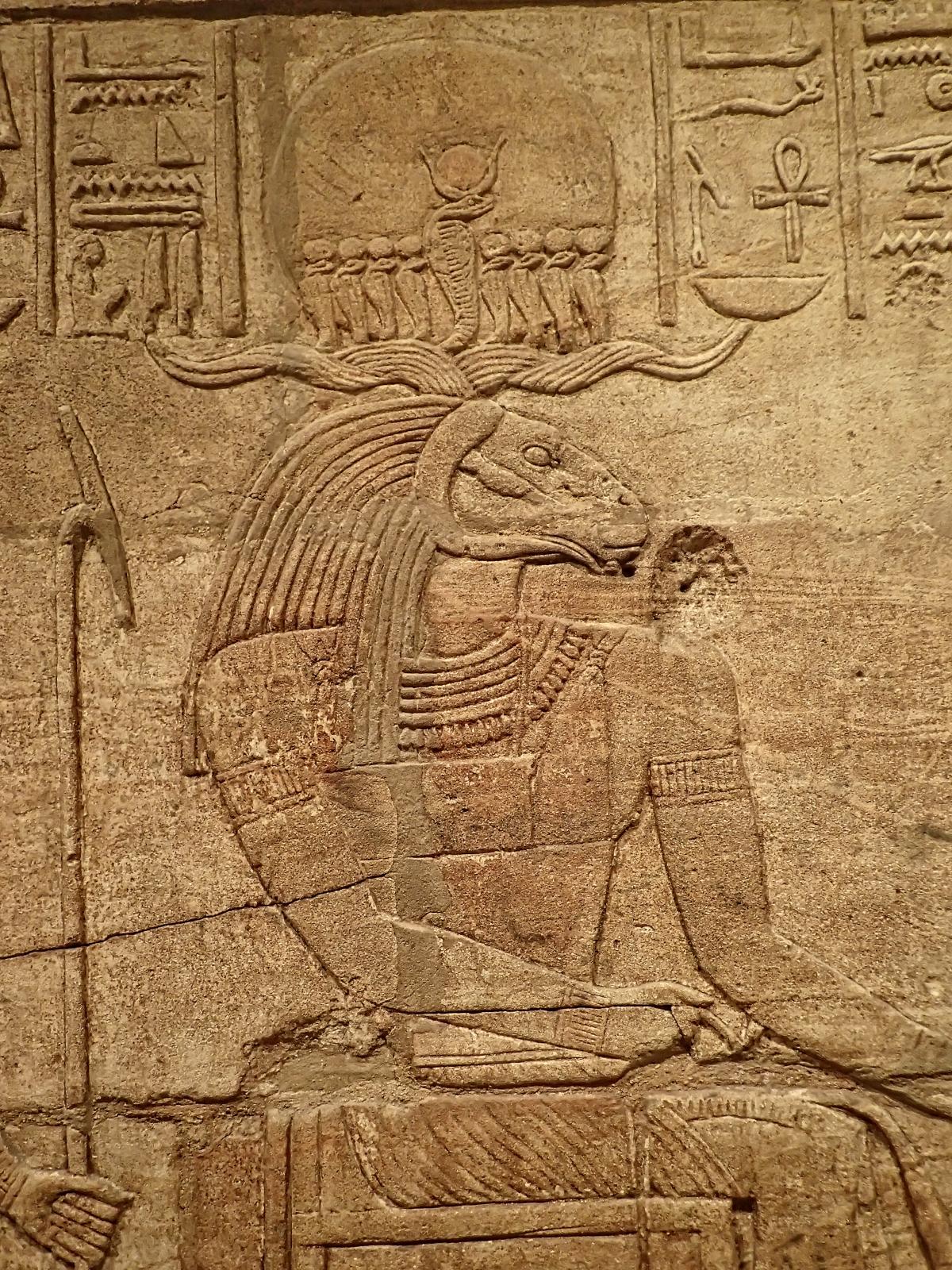
Shrine of the 25th dynasty pharaoh and Kushite King Taharqa Egypt 7th century BCE that I photographed at the Ashmolean Museum in Oxford.

Shrine of the 25th dynasty pharaoh and Kushite King Taharqa Egypt 7th century BCE that I photographed at the Ashmolean Museum in Oxford.


Closeup of Shrine of the 25th dynasty pharaoh and Kushite King Taharqa Egypt 7th century BCE that I photographed at the Ashmolean Museum in Oxford.

Closeup of Shrine of the 25th dynasty pharaoh and Kushite King Taharqa Egypt 7th century BCE that I photographed at the Ashmolean Museum in Oxford.

Closeup of Shrine of the 25th dynasty pharaoh and Kushite King Taharqa Egypt 7th century BCE that I photographed at the Ashmolean Museum in Oxford.

Closeup of Shrine of the 25th dynasty pharaoh and Kushite King Taharqa Egypt 7th century BCE that I photographed at the Ashmolean Museum in Oxford.

Closeup of Shrine of the 25th dynasty pharaoh and Kushite King Taharqa Egypt 7th century BCE that I photographed at the Ashmolean Museum in Oxford.

Closeup of Shrine of the 25th dynasty pharaoh and Kushite King Taharqa Egypt 7th century BCE that I photographed at the Ashmolean Museum in Oxford.

Shrine of the 25th dynasty pharaoh and Kushite King Taharqa Egypt 7th century BCE that I photographed at the Ashmolean Museum in Oxford.

Closeup of Shrine of the 25th dynasty pharaoh and Kushite King Taharqa Egypt 7th century BCE that I photographed at the Ashmolean Museum in Oxford.

Closeup of Shrine of the 25th dynasty pharaoh and Kushite King Taharqa Egypt 7th century BCE that I photographed at the Ashmolean Museum in Oxford.

Closeup of Shrine of the 25th dynasty pharaoh and Kushite King Taharqa Egypt 7th century BCE that I photographed at the Ashmolean Museum in Oxford.

Closeup of Shrine of the 25th dynasty pharaoh and Kushite King Taharqa Egypt 7th century BCE that I photographed at the Ashmolean Museum in Oxford.

Closeup of Shrine of the 25th dynasty pharaoh and Kushite King Taharqa Egypt 7th century BCE that I photographed at the Ashmolean Museum in Oxford.

Closeup of Shrine of the 25th dynasty pharaoh and Kushite King Taharqa Egypt 7th century BCE that I photographed at the Ashmolean Museum in Oxford.

Statuette of a Kushite ruler, probably Taharqa, Dynasty 25, 690-664 BCE, Bronze, now in the collections of the Museum of Fine Arts Boston, image courtesy of the museum

Amulet of Pataikos, Napatan Period, reign of Shebitka or Taharqa, 712-664 BCE, Meroe now in the collections of the Museum of Fine Arts Boston, image courtesy of the museum. This faience figure of Pataikos has a faded glaze. He has a scarab on head, hawks on his shoulders and crocodiles under his feet. Winged Sekhmet is at the back, and there is an incised eye on the base.

Statuette of King Taharqa, Napatan Period, Gebel Barkal, 690-664 BCE, Bronze, now in the collections of the Museum of Fine Arts Boston, image courtesy of the museum

Cowroid of blue-green glazed steatite; back carries an incised border of line decoration. Base inscribed with throne name of Third Intermediate Period ruler Taharqa (Khuinefertemre), now in the collections of the Museum of Fine Arts Boston, image courtesy of the museum.


If you enjoyed this post, never miss out on future posts by following me by email!


Friday, February 12, 2021

Cypriot gold spiral earrings: Local fashion or the result of Achaemenid influence?

 According to the Metropolitan Museum of Art, spirals with ornate animal-head terminals are frequently found in Cypriot tombs of the Classical period. Terracotta and limestone votive statues illustrate that from the Archaic through the Classical period it was customary for Cypriot men and women to wear such ornaments in large holes pierced through their earlobes.

When I saw these earrings, I wondered if this Cypriot practice of making large holes in their earlobes to accommodate these ornaments was a local fashion or adopted as a result of Persian rule beginning in 545 BCE, especially since most examples I have seen  are dated between the late 6th century to the 5th century BCE. I managed to find images of Achaemenid bracelets similarly made of gold tubing but each example of similar earrings I found in my research were all labeled Cypriot. Since the Cypriots were ruled by the Assyrians and even the Egyptians for a short time, I researched the jewelry of those cultures as well but found nothing similar. 


Cypriot Earrings or spiral with lion-griffin terminals, Gold and Silver, 400-350 BCE and Lion headed spirals from mid-5th century BCE, at the Metropolitan Museum of Art


Cypriot Gold and copper alloy spiral with lion-head terminal, 2nd half of the 5th century B.C.E. at the Metropolitan Museum of Art. The lion-head is made in two halves (left and right) from sheet gold.


Cypriot Earrings or spiral with lion-griffin terminals, Gold and Silver, 400-350 BCE, at the Metropolitan Museum of Art.


Cypriot Earrings or spiral with lion-griffin terminals, Gold and Silver, 400-350 BCE, at the Metropolitan Museum of Art.

Pair of gold spiral earrings with terminals in the form of a crested griffins head. Cypriot, 475-400 B.C.E. British Museum

Gilt bronze spiral with griffin terminal. Period: Classical. Date: ca. 400–350 B.C.E. Culture: Cypriot. Medium: Gold, bronze. British Museum

Cypriot Gold allow spiral earings with Griffin terminals 5th century BCE at the British Museum courtesy of Wikimedia Commons contributor Paul Hudson. (digitally enhanced and recomposed)

Cypriot Gold alloy spiral earring with horned mythological creature terminal and floret, 5th century BCE, at the Antikensammlung Museum in Berlin courtesy of Wikimedia Commons contributor Marsupium

Achaemenid Gold Bracelet with Inlaid Termini in the Form of Duck's Heads, Gold with lapis lazuli, agate, and carnelian inlay, mid-6th-4th century B.C.E. at the Miho Museum in Kyoto, Japan. The ducks are reduced to protomes with their heads turned back in a typical Achaemenid fashion. The bracelet is constructed of hollow gold tubing, and the duck protomes were formerly elaborately inlayed with colored stones. One duck bill is made of agate, the other of carnelian. The ducks were both made separately and were in all likelihood originally joined together at their breasts. In order to put on the bracelet, the birds could be separated from the circlet by removing the rivets.

The bracelet type is preserved in much simpler versions of bronze or golden wire, and details like the turned heads resting on the animals' backs seem truly Achaemenid, but a certain naturalistic tendency along with the concept of a removable part may point to a later period and attribute this piece to the circle of Achaemenizing art fashioned in the Hellenistic period. It must be stressed, however, that at the moment, this is nothing but a hypothesis. - Miho Museum, Kyoto, Japan

Achaemenid Gold Bracelet with Inlaid Termini in the Form of Seated Ducks, Gold with lapis lazuli, turquoise, onyx, and rock crystal inlay, mid-6th-4th century B.C.E. at the Miho Museum in Kyoto, Japan. The jeweler of this bracelet chose ducks as terminal figures and combined them with a rather heavy looking circlet that can be opened. The ducks were fashioned separately, and all the feathers and the eyes were originally characterized by inlays. The ducks' bills are not preserved. The birds are fixed to a single massive tubular circlet, which originally had colored inlays at the junction between the ducks. The use of colored inlays for the details of the feathering is a feature of Egyptianizing tendencies in Achaemenid craftsmanship. Though the "Great Kings" are known to have employed Egyptian craftsmen, the use of this technique does not necessarily imply that the jeweler was an Egyptian, because the technique was widely used on objects of truly Achaemenid style. 
If you enjoyed this post, never miss out on future posts by following me by email!


Wednesday, January 27, 2021

Phoenician mortuary practices of the Achaemenid Period

The Phoenicians as a politically, religiously, and perhaps even ethnically distinct entity on the Levantine coast emerged at the end of the Late Bronze Age about 1200 BCE, as one of the successor cultures to the Canaanites.  From their homeland on the coast of the Levant, the Phoenicians spread throughout the Mediterranean and its islands including Cyprus, Sicily and Malta. Some scholars have observed that Iron Age Phoenicia was not a nation, but rather a collection of cities built around natural harbors along the coast. While they shared a common culture, these small states remained independent, competing with each other in the international marketplace. 

"Depending on how evidence is weighed [based on Ugaritic texts and classical sources], Phoenician religion might be presented on the one hand as inclusive and diverse – a “conservatively” polytheistic society easily able to incorporate or syncretize new deities, customs and traditions or on the other hand as highly place-specific – a model in which Phoenicians were devoted to city-gods only, with little shared pantheon above the local or regional scale," Helen Dixon, University of Michigan, observes.

This variety in religious practices initially resulted in the use of both cremation and inhumation in mortuary practices and funerary art often expressed influences by non-Phoenician ruling administrations like New Kingdom Egyptians, Assyrians, and Achaemenid Persians.  By the Achaemenid period, however, adult cremation abruptly disappears from sites in the Phoenician cultural sphere.  This corresponds with the increasing importance of Zoroastrianism in the 5th century BCE. In Zoroastrianism, water (aban) and fire (atar) are agents of ritual purity, and the associated purification ceremonies are considered the basis of ritual life. A corpse is considered a host for decay. Consequently, scripture enjoins the safe disposal of the dead in a manner such that a corpse does not pollute the good creation.

For inhumation burials, the use of sarcophagi during the Achaemenid period along with epigraphic evidence points to a consistent and insistent emphasis on the integrity of the burial. Deities, including Astarate, are invoked to assist with the procurement of blessings and to enforce curses and righteousness is defined by political accomplishments or the building of religious shrines.  Although Egyptian iconography persisted, it was supplemented by Persian iconography. A paucity of grave goods was referenced in inscriptions as a deterrent to grave robbing and what few ceramic vessels have been found in Phoenician burials have been ceremonially broken. Wealthier burials, though, apparently included the use of expensive resins such as myrrh to anoint, perfume or preserve the body and the deceased were dressed in special garments with head ornaments, particularly royal women whose head ornament was described as a gold bridle. However, there apparently were no extensive preparations for a “next life,” no large quantities of food or drink on which to survive or any biographical depictions or texts to accompany the dead. With the exception of the occasional appearance of amulets or other possibly apotropaic items, there was no preparation for an encounter with an underworld deity or space or expectation of  a future meeting one's deceased ancestors.

Read more about it in Dixon's dissertation, "Phoenician Mortuary Practice in the Iron Age I – III (ca. 1200 – ca. 300 BCE) Levantine “Homeland”:

https://deepblue.lib.umich.edu/handle/2027.42/99972

Sarcophagus made from Greek marble. burial grounds of Antarados, northern Lebanon. 480-450 BCE courtesy of Wikimedia Commons contributor McLeod

Anthropoid sarcophagi, from Sidon, 5th century BCE, National Museum of Beirut, Lebanon courtesy of Carole Raddato.


Phoenician sarcophagus of the fifth century BCE, from the Carthaginian colonization of Sicily. Discovered in Palermo. Regional Archaeological Museum of Palermo, courtesy of Wikimedia Commons contributor Giovanni Dall'Orto.


Sarcophagus of Eshmunazar II, king of Sidon, Phoenicia, ca first quarter of the 5th century BC.E. at The Louvre courtesy of Wikimedia Commons contributor Fred Romero.

Marble anthropoid sarcophagus, last quarter of the 5th century B.C.E., Graeco-Phoenician found on Cyprus at the Metropolitan Museum of Art.


Phoenician sarcophagus of the fifth century BCE, from the Carthaginian colonization of Sicily. Discovered in Palermo. Regional Archaeological Museum of Palermo, courtesy of Wikimedia Commons contributor Giovanni Dall'Orto.


Marble anthropoid sarcophagus, last quarter of the 5th century B.C.E., Graeco-Phoenician found on Cyprus at the Metropolitan Museum of Art.

Phoenician marble sarcophagus found in CƔdiz. Spain, 5th century BCE, courtesy of Wikimedia Commons contributor Professor Ɓngel M. Felicƭsimo, University of MƩrida.

Phoenician marble sarcophagus found in CƔdiz. Spain, 5th century BCE, courtesy of Wikimedia Commons contributor Professor Ɓngel M. Felicƭsimo, University of MƩrida.


If you enjoyed this post, never miss out on future posts by following me by email!


Sunday, January 24, 2021

Persian cavalry before the cataphractarii

The Persians did not use cavalry to a great extent until Cyrus the Great  gave the Persian nobility both horses and the wealth to maintain them from the proceeds of his western conquests. He encouraged them to ride and it became a source of disgrace for a Persian noble to be seen walking.  Cyrus then recruited his cavalry from the nobles, creating a regiment of 15,000 men drawn from the Huvaka or “kinsmen.” These kinsmen adopted brightly-colored trousers and shorter tunics that were more suitable for riding from the Medes.  Cyrus adopted cavalry tactics from the Khorassan horsemen of northeastern Iran, parts of modern Afghanistan and the southern parts of Central Asia. He initially armed his cavalry with the standard weapons of the Persian infantrymen: bows, battle-axes, and oval shields. Later, they were re-equipped with short stabbing swords and throwing javelins instead. Long lances and spears made of wood or entirely of metal were used too.

In the mid-5th century Persian cavalrymen adopted the use of wicker and leather shields.  They were designed after those carried by the Saka, a group of nomadic Iranian peoples who historically inhabited the northern and eastern Eurasian Steppe and the Tarim Basin.

According to Herodotus, at the time of the Persian invasion of Greece, Persian cavalry, assembled from a variety of contingents within the empire, were protected only by various kinds of soft headgear and wore no substantial body armor. This is reflected both in the 3rd century BCE Cypriot statuette as well as the famous Alexander mosaic from the House of the Faun in Pompeii.  Cavalry officers may have worn more protective armor, however, as indicated at the battle of Plataea where Masistius, a Persian cavalry commander, is reported to have worn gold scale armor under his scarlet surcoat. 

"When his horse was hit by an arrow, he defended himself vigorously on foot and could not be brought down by body blows. At last, the Athenians who surrounded him guessed the secret and struck at his face." - The Persian Achaemenid Army, weaponsandwarfare.com

Detail from the Alexander Mosaic from the House of the Faun in Pompeii depicting Achaemenid Persian cavalry at the Battle of Issus, 1st century BCE-1st century CE at the National Archaeological Museum in Naples courtesy of Wikimedia Commons contributor Lucas.


Terracotta statuette of a horseman, 3rd century B.C.E. Cyprus, at the Metropolitan Museum of Art in New York.


If you enjoyed this post, never miss out on future posts by following me by email!


Thursday, July 16, 2020

The Oxus Treasure and the challenges of provenance

The Oxus Treasure is a collection of about 180 surviving pieces of metalwork in gold and silver from the Achaemenid Persian period which were found by the Oxus river about 1877-1880.  The metalwork is believed to date from the sixth to fourth centuries BCE and is thought to belong to a temple where votive offerings were deposited over a long period. Sculptural objects include two model chariots in gold, one incomplete, plus figures of a horse and a rider that may belong to this or other model groups, as may two other horses cut out from sheet gold. The wheels of the complete chariot would originally have turned freely, and it had received at least one repair in antiquity. It is pulled by four horses (rather small, and with only nine legs surviving between them) and carries two figures, a driver and a seated passenger, both wearing torcs. The chariot has handrails at the open rear to assist getting in and out, while the solid front carries the face of the protective Egyptian dwarf-god Bes.  Another exceptional piece is thought to be a gold cap ornament (aigrette) that reflects Scythian influence in the folded legs of the recumbent lion-griffin with wings, straight horns, long pointed ears, and a curled tail. There are cavities for inlay on the flank and shoulder. At the back of the plaque are two long prongs for attachment. The two griffin-headed bracelets or armlets recovered from the site are considered by some the most spectacular pieces, despite lacking their stone inlays. There are a number of other bracelets, some perhaps torcs for the neck, several with simpler animal head terminals variously depicting goats, ibex, sheep, bulls, ducks, lions, and fantastic creatures. Many have inlays, or empty cells for them. It used to be thought that this technique was acquired from Ancient Egyptian jewelry (as in some of Tutankhamun's grave goods), but Assyrian examples are now known.

The circumstances of the discovery and trading of the pieces, and their variety of styles and quality of workmanship, cast some doubt on their authenticity from the very beginning.  Indian dealers initially made copies of items and tried to pass them off to Franks, who though not deceived, bought some "at a small percentage over the gold value" and then received the genuine objects, which were easily distinguished.  Since then later  Achaemenid finds of jewelry including armlets and torcs in a tomb at Susa by a French expedition from 1902 , excavated under proper archaeological conditions, closely resemble objects found in the Oxus Treasure and are considered contemporary evidence of their ancient source.

Gold four horse chariot model, Achaemenid Period 5th-4th centuries BCE, Oxus Treasure at the British Museum
courtesy of Wikimedia Commons contributor Cristian Bortes

Lion-griffin hat ornament (aigrette), gold, Achaemenid Period, 5th-4th centuries BCE, Oxus Treasure at the British Museum
courtesy of the museum

Griffin-embellished gold armlets, Achaemenid Period, 5th-4th centuries BCE courtesy of Wikimedia Commons contributor Marie-Lan Nguyen.


If you enjoyed this post, never miss out on future posts by following me by email!


Thursday, April 9, 2020

The Lion Strangler: Symbol of Power in Ancient Persia

Achaemenid Lion Strangler at the Cleveland Museum of Art in Cleveland, Ohio.
A hero strangling a lion was an enduring motif in the ancient Middle East. Possibly referring to the myth of Gilgamesh or Herakles, it was considered a symbol of Persian royal power. As a royal symbol it was already fully developed in the art of the Protoliterate period beginning approximately in 3500 BCE. In its earliest manifestations, the lion strangler was thought to depict the hero protecting the sacred flocks of the goddess of fertility. This concept was gradually replaced by the idea it reflected the eternal conflict between man and beast where man represented the defender of order and civilized life against the the chaotic forces of nature. Likewise, Gilgamesh in the early Sumerian epic, slew several monsters including Huwawa and the Bull of Heaven in such symbolic contests. Eventually, though, the iconography of the lion strangler simply became a symbol of power favored by kings who viewed themselves as powerful and brave enough to strangle a lion with their bare hands. The motif of the lion strangler continued in popularity long after the Muslim conquest and found its way to Islamic Spain where it adorned silk textiles. From there it was passed to the rest of Europe and was adopted by Romanesque sculptors for the decoration of capitals.


Image: Median Lion Strangler carved in Lapis Lazuli, Persian, Achaemenid Period, 1st half of the 5th century BCE.
If you enjoyed this post, never miss out on future posts by following me by email!