Napata was founded by Thutmose III in the 15th century BCE after his conquest of Kush. Napata’s location as the southernmost point in the empire led it to become an important religious center and settlement. In 750 BCE, during the political instability of the Third Intermediate Period, the Kushite ruler, Kashta, attacked Upper Egypt. His policy was pursued by his successors Piye, and Shabaka (721–707 BCE), who eventually brought the whole Nile Valley under Kushite control and ruled Egypt as the Twenty-fifth Dynasty. Religion, the arts, and architecture were restored to their Old, Middle, and New Kingdom forms under such pharaohs as Taharqa who built or restored temples and monuments throughout the Nile, including at Memphis, Karnak, Kawa, Jebel Barkal, and elsewhere.
However the dynasty was relatively brief. Taharqa and his successor cousin, Tantamani were constantly in conflict with the Neo-Assyrian Empire. Neo-Assyrian emperor Esarhaddon conquered Lower Egypt about 670 BCE then enlisted the conquered to assist him against the Kushite rulers of Upper Egypt. Necho, who became the ruler of Sais in 672 BCE and subsequently Esarhaddon's vassal, was given new territories possibly including the city of Memphis,
Taharqa convinced some rulers of Lower Egypt, including Necho, to break with the Assyrians. However, Assurbanipal, who had succeeded Esarhaddon in the meantime, overpowered the coalition and deported the Egyptian conspirators to his capital at Nineveh, killing part of the population of the cities they governed. But, Necho was pardoned and reinstated at Sais with even more new territories. Some scholars think Ashurbanipal hoped to rely on the loyalty of an Egyptian ally in the event of another offensive led by the 25th Dynasty pharaohs, and perhaps to inspire and strengthen a rivalry between the Kushites and the Saites.
However, Necho I as slain in 664 BCE near Memphis while defending his realms from a new Kushite offensive led by Taharqa's successor Tantamani while Necho's son, Psamtik, fled to Nineveh under Ashurbanipal's aegis. This Nubian invasion into the Egyptian Delta was subsequently (664-663 BCE) repelled by the Assyrians who proceeded to advance south into Upper Egypt and performed the infamous sack of Thebes. Tantamani eventually abandoned his attempt to conquer Lower Egypt and retreated to Napata. However, his authority over Upper Egypt was acknowledged until the 8th regnal year of his reign at Thebes (or 656 BCE), when Psamtik I dispatched a naval fleet to Upper Egypt and succeeded in placing all of Egypt under his control.
The Napatan dynasty continued to rule the Kushite state, though, which flourished in Napata and Meroë until at least the second century CE. Napatan architecture, paintings, writing script, and other artistic and cultural forms were Kushite in style, but Egyptian burial customs continued, the building of pyramids resumed, and Kushites worshipped several Egyptian deities including Amun and Mut.
Napata began to lose its economic influence after an Achaemenid Persian raid in 591 BCE. The importance of iron propelled Meroe into prominence and it replaced Napata as the capital of Kush.
In 23 BCE, the Governor of Roman Egypt, Gaius Petronius, invaded Kush with 10,000 men after an initial attack by the queen of Meroë, Kandake, razing Napata to the ground, according to the Res Gestae Divi Augusti. In retaliation, the Nubians crossed the lower border of Egypt and looted many statues (among other things) from the Egyptian towns near the first cataract of the Nile at Aswan.
The destruction of Napata was not a crippling blow to the Kushites, though, and did not frighten Kandake enough to prevent her from again engaging in combat with the Roman military. Indeed, it seems that Petronius's attack might have had a revitalizing influence on the kingdom. In 22 BCE, a large Kushite force moved northward with intention of attacking Qasr Ibrim. Alerted to the advance, Petronius again marched south and managed to reach Qasr Ibrim and bolster its defenses before the invading Kushites arrived. Although the ancient sources give no description of the ensuing battle, we know that at some point the Kushites sent ambassadors to negotiate a peace settlement with Petronius and possibly accept a status like "Client State" of Rome.
Napata was restored by King Natakamani, who renovated the temple of Amun and constructed a palace. But eventually the site was abandoned and its buildings plundered and destroyed. This may have been the result of a change in religious practices. The first archaeologist to excavate the site, George Reisner, discovered two caches of statues, thought to have once adorned the Temple of Amun, comingled with ash indicating they had been purposefully destroyed.
 |
| Amethyst lion's head pendant, Napatan, Egypt, Dynasty 25, now in the collections of the Cleveland Art Museum, image courtesy of the museum. This pendant consists of two parts: a superbly carved lion’s head in amethyst that has been set into a D-shaped gold base consisting of a platform surrounded by eight seated baboons. The lion’s head is an heirloom from the New Kingdom, most likely a gaming piece that had been adapted in the Napatan period to serve as an pendant amulet. |
 |
Sandstone Omphalos depicting Nubian shrine, Meroitic Period, 100-200 CE, from Gebel Barkal Temple B 500, now in the collections of the Museum of Fine Arts Boston, image courtesy of the museum. Once thought to be a shrine imitating the form of a traditional African shelter, this hollow dome-like object of sandstone can now be identified as a model of Gebel Barkal, the "Pure Mountain" of Napata, which was the chief sanctuary and coronation center of Kush and the site of the oracle of Amun, said to select each new king following the death of his predecessor. The form of the object imitates the unique Napatan hieroglyphic symbol for Gebel Barkal, which appears several times in the stele of Nastasen (cat. 265). As a hieroglyph, the mountain is shown as a dome with a uraeus or cobra diadem rising from one side.
From the Egyptian New Kingdom onwards, Gebel Barkal was believed to be the residence of the southern (and primeval) form of the Theban god Amun, who was known as "Amun of Napata, dweller in the Pure Mountain." Because of the 75-meter high pinnacle on the southern corner of Gebel Barkal, which in silhouette looks like a rearing uraeus, the mountain was not only identified as the dwelling place of Amun, but was also identified by the Kushites as the true source of kingship in the Nile Valley, from which derived the legitimacy of the Twenty-fifth Dynasty.
|
 |
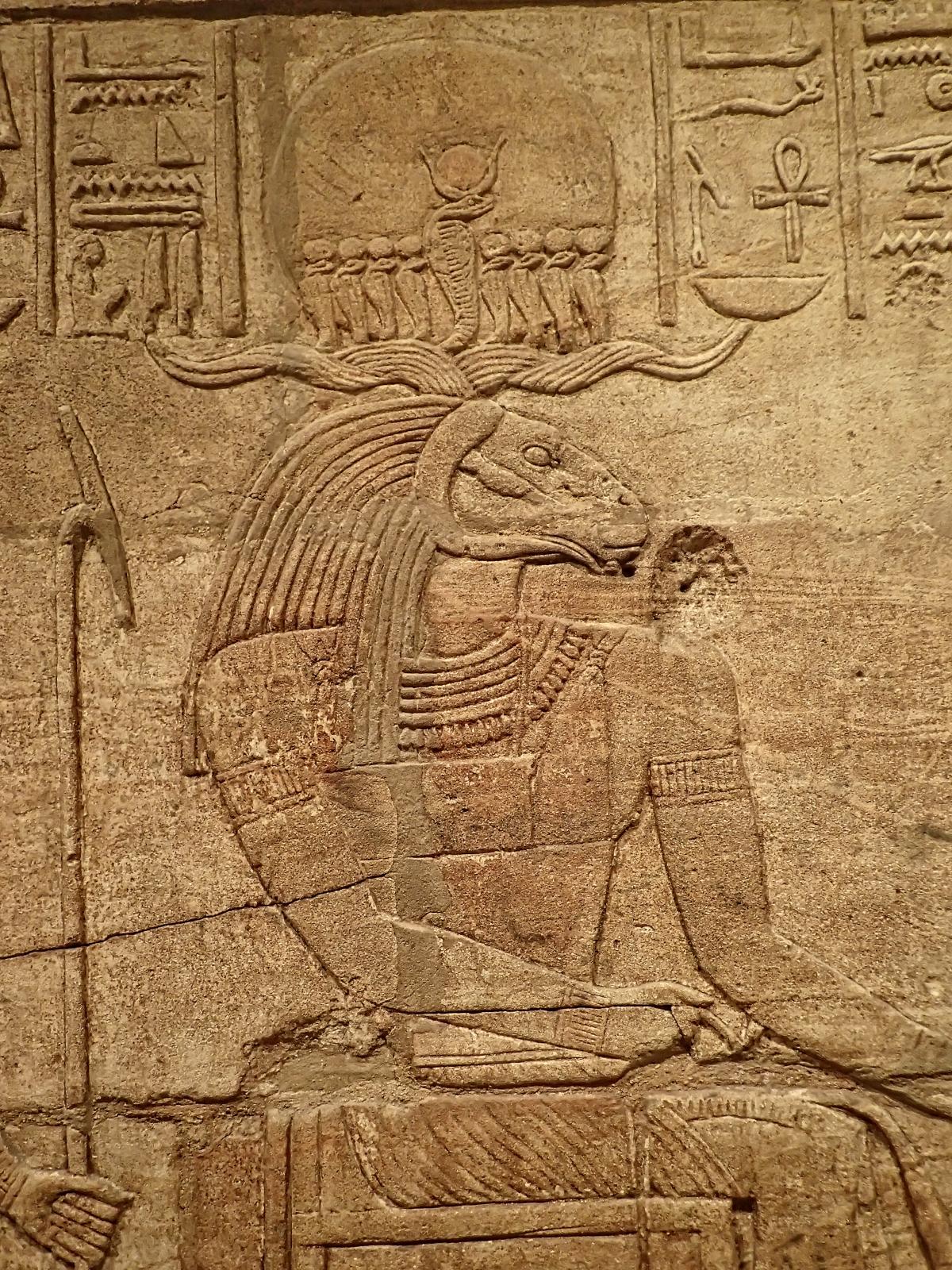
| Shrine of the 25th dynasty pharaoh and Kushite King Taharqa Egypt 7th century BCE that I photographed at the Ashmolean Museum in Oxford. |
 |
Shrine of the 25th dynasty pharaoh and Kushite King Taharqa Egypt 7th century BCE that I photographed at the Ashmolean Museum in Oxford.
|
 |
| Closeup of Shrine of the 25th dynasty pharaoh and Kushite King Taharqa Egypt 7th century BCE that I photographed at the Ashmolean Museum in Oxford. |
 |
| Closeup of Shrine of the 25th dynasty pharaoh and Kushite King Taharqa Egypt 7th century BCE that I photographed at the Ashmolean Museum in Oxford. |
 |
| Closeup of Shrine of the 25th dynasty pharaoh and Kushite King Taharqa Egypt 7th century BCE that I photographed at the Ashmolean Museum in Oxford. |
 |
| Closeup of Shrine of the 25th dynasty pharaoh and Kushite King Taharqa Egypt 7th century BCE that I photographed at the Ashmolean Museum in Oxford. |
 |
| Closeup of Shrine of the 25th dynasty pharaoh and Kushite King Taharqa Egypt 7th century BCE that I photographed at the Ashmolean Museum in Oxford. |
 |
| Closeup of Shrine of the 25th dynasty pharaoh and Kushite King Taharqa Egypt 7th century BCE that I photographed at the Ashmolean Museum in Oxford. |
 |
| Shrine of the 25th dynasty pharaoh and Kushite King Taharqa Egypt 7th century BCE that I photographed at the Ashmolean Museum in Oxford. |
 |
| Closeup of Shrine of the 25th dynasty pharaoh and Kushite King Taharqa Egypt 7th century BCE that I photographed at the Ashmolean Museum in Oxford. |
 |
| Closeup of Shrine of the 25th dynasty pharaoh and Kushite King Taharqa Egypt 7th century BCE that I photographed at the Ashmolean Museum in Oxford. |
 |
| Closeup of Shrine of the 25th dynasty pharaoh and Kushite King Taharqa Egypt 7th century BCE that I photographed at the Ashmolean Museum in Oxford. |
 |
| Closeup of Shrine of the 25th dynasty pharaoh and Kushite King Taharqa Egypt 7th century BCE that I photographed at the Ashmolean Museum in Oxford. |
 |
| Closeup of Shrine of the 25th dynasty pharaoh and Kushite King Taharqa Egypt 7th century BCE that I photographed at the Ashmolean Museum in Oxford. |
 |
| Closeup of Shrine of the 25th dynasty pharaoh and Kushite King Taharqa Egypt 7th century BCE that I photographed at the Ashmolean Museum in Oxford. |
 |
| Statuette of a Kushite ruler, probably Taharqa, Dynasty 25, 690-664 BCE, Bronze, now in the collections of the Museum of Fine Arts Boston, image courtesy of the museum |
 |
| Amulet of Pataikos, Napatan Period, reign of Shebitka or Taharqa, 712-664 BCE, Meroe now in the collections of the Museum of Fine Arts Boston, image courtesy of the museum. This faience figure of Pataikos has a faded glaze. He has a scarab on head, hawks on his shoulders and crocodiles under his feet. Winged Sekhmet is at the back, and there is an incised eye on the base. |
 |
| Statuette of King Taharqa, Napatan Period, Gebel Barkal, 690-664 BCE, Bronze, now in the collections of the Museum of Fine Arts Boston, image courtesy of the museum |
 |
| Cowroid of blue-green glazed steatite; back carries an incised border of line decoration. Base inscribed with throne name of Third Intermediate Period ruler Taharqa (Khuinefertemre), now in the collections of the Museum of Fine Arts Boston, image courtesy of the museum. |
If you enjoyed this post, never miss out on future posts by following me by email!