Showing posts with label Gaul. Show all posts

Monday, December 7, 2020

Barbotine ware of Britannia and European Roman provinces

 The term barbotine refers to a ceramic technique in which decorative elements are either piped onto an object similar to decorating a cake, or molded then applied to a pottery vessel.  

With Type A barbotine, the potter uses a quill, horn, or other kind of nozzle to apply a soft slip mixture to a ceramic piece. Today the technique is known as slip-trailing. The slip would normally be in a contrasting color to the rest of the vessel, and forms a pattern, or inscription, that is slightly raised above the main surface. Barbotine designs have been found on pottery from ancient Egypt, the Middle Minoan period on Crete, and embellishing Roman vessels, where the color may be the same as the rest of the vessel rather than contrasting.

With type B barbotine, the sllip or barbotine is cast in molds to form three-dimensional decorative sections which, when dried out, are added to the main vessel. Typically, these might be flowers, fruit, or animals. Type B barbotine was particularly popular in Britannia and the Roman provinces of Europe because of the consistency of the local clay. These vessels were probably filled with foods or liquids and given either as gifts to an elaborate burial or as offerings to a god's shrine.


Romano-British beaker, decorated in the barbotine technique with a chariot-racing scene. Made either in Colchester or in the Nene Valley region of Cambridgeshire. 2nd century CE. at the British Museum, London courtesy of Wikimedia Commons contributor AgTigress.

The form and the single handle suggest that this jug was used for pouring wine. It is decorated in the "barbotine" technique, where a liquid clay or slip is applied in relief through a tube, much like icing is applied to a cake. Here, two stork-like birds are facing a large plant in the middle, framed by a garland of ivy leaves around the neck of the jug. Such idyllic scenes with animals and plants are typical of ceramic and metal vessels made during the time of Emperor Augustus. 1st century BCE - 1st century CE courtesy of the Walters Art Museum.

Closeup of a Barbotine-applied decoration of a bird on a Roman jug from the Augustan Period, 1st century BCE-1st century CE courtesy of the Walters Art Museum.

Ancient Roman beaker with hunting scene, from the castellum of the 1st Canathenian cohort in Straubing courtesy of Wikimedia Commons contributor Wolfgang Sauber.

Ancient Roman beaker with hunting scene, from the castellum of the 1st Canathenian cohort in Straubing courtesy of Wikimedia Commons contributor Wolfgang Sauber.

Terracotta cup with barbotine decoration, 2nd–early 3rd century C.E., Roman, at the Metropolitan Museum of Art. This cup is representative of the sort of pottery that was produced in Roman Britain, influenced by wares made in eastern Gaul and the Rhineland. The shape of the vessel and the style of the hunting scene are typical of the northwestern provinces, but barbotine decoration itself—the application of a thick clay slip to the vessel surface—is found on many different types of pottery across the Roman Empire.

Terra Sigillata bowl with barbotine decoration in the Museum Rheinzabern courtesy of Wikimedia Commons contributor Haselburg-müller.

"Caster Ware" Vase with Hunt Scene, Roman, mid-2nd century, courtesy of the Cleveland Museum of Art. 

Bellied pot with barbotine decoration made of novaesium, rough-walled ware, 1st century CE, Clemens-Sels-Museum, Neuss courtesy of Wikimedia Commons contributor Hartmann Linge 

Green glazed_beaker, glazed earthenware with barbotine decoration, 1st century CE, made of novaesium, Clemens-Sels-Museum, Neuss courtesy of Wikimedia Commons contributor Hartmann Linge
If you enjoyed this post, never miss out on future posts by following me by email!


Sunday, June 28, 2020

The Vermand Treasure

The Vermand Treasure was discovered in the last quarter of the nineteenth century by Benoni Lelaurain.  It was recovered from a cemetery near the modern village of Vermand, which is located beside the Celtic oppidum of Viromandui.  In the 3rd century CE, Vermand served as a castra hiberna within the network of provincial Roman border defenses. It was also a thriving glass production center and home to a large number of refugees following the destruction of Augusta Viromanduorum in the late 3rd century by barabarian invaders.

The treasure was found in one of the few military burials in the cemetery.  However, grave robbers had previously plundered the burial, cracked the stone sarcophagus and scattered the contents. Perhaps they had been interrupted in their violation of the grave as six objects including this gilt silver spear shaft mount were left behind.  Others, documented in the excavation report, remained as well but it is thought the excavator's workmen pilfered the hilt of a sword and the majority of objects, held at the the Musée Lécuyer in St.  Quentin "disappeared" by the end of World War I.  These objects included an iron battle-ax head, ten small javelin heads, a lance head of iron inlaid with silver and copper, two small belt buckles with ferrets, an oval silver plaque, fragments of a sword blade and one or two more small bronze objects.

The grave was likely that of an auxiliary soldier.  The six-pointed interlaced star seen on the mount was not at that time a Jewish symbol.  It appears as a decorative motif in both Roman and Germanic art.

The objects were originally thought to be Merovingian artifacts dating from the 4th - 7th centuries but were reevaluated by The Metropolitan Museum of Art's curator of medieval art and reclassified as late Roman dating to the second half of the 4th century CE.


Image: Gilt silver (niello) mount for a spear shaft from the Vermand Treasure 400 CE courtesy of the Metropolitan Museum of Art.
If you enjoyed this post, never miss out on future posts by following me by email!


Saturday, July 11, 2015

Roman remains of ancient Gaul: Nimes (Nemausus)

An ancient history resource article by  © 2015
The Tour Magne is the remains of
one of the Roman tours built
during the reign of Augustus.
Image courtesy of Wikipedia.

In May, 2013, I had the opportunity to travel to southern France to explore and photograph Roman remains there. I originally wrote this article six months later and saved it to draft.  I only now noticed that I hadn't finished it.  So I thought I better wrap it up and get it posted. Thankfully, it wasn't a time-dependent piece.  As time permits I hope to write other articles about some of the sites I visited in Roman Gaul.

The first Roman site I visited in southern France was the city of Nimes known as Nemausus in Roman times, after a local sacred spring located there.

Nimes became part of the Roman Empire sometime before 28 BCE.  It was colonized by veterans of the Roman legions who had served Julius Caesar in his Nile campaigns. By the reign of Augustus in the 1st century CE Nimes had reached a population of 60,000.

Augustus ordered the construction of
a ring of ramparts six kilometres (3.7 miles) long, reinforced by fourteen towers.  Although two gates remain today, the Porta Augusta and the Porte de France, as well as the remains of one tower dubbed the Tour Magne, we, unfortunately, did not have time to inspect them. 


Our first stop was the Maison Carrée, a Roman temple originally constructed in 16 BCE. Originally the temple was designed after the temples of Apollo and Mars Ultor in the Forum of Augustus in Rome.  The structure was rebuilt by the famous Roman admiral, Marcus Agrippa (victor of Actium), in approximately 2 - 4 CE.  The temple was dedicated to his two ill-fated sons, Gaius and Lucius, who had been adopted by his best friend Augustus so they would rule Rome one day.  However, both died tragically young (poisoned by Augustus' vile wife Livia if we believe Robert Graves' interpretation of events in "I, Claudius!") 


The Maison Carree, an example of Vitruvian architecture built
in 16 BCE now houses an information center and theater
in Nimes, France.
Photo by . © 2013
The structure is an example of architecture popularized by the famous Roman architect, Vitruvius.  It is almost twice as long as it is wide with its entry fronted by six Corinthian columns topped with ornately carved acanthus leaves.


A pidgeon nestles into the protective acanthus
leaves sculpted on the capital of a Corinithian
column of the Maison Carrée
in Nimes, France.
Photo by  © 2013
The deep portico or proanos consumes 1/3 of the building's length and features a ceiling accented by a relief of ornamental rosettes.  The ceiling was restored in the early 19th century.  The big bronze doors were replaced in 1824.

Like the Pantheon in Rome, the temple survived the widespread destruction of pagan centers of worship after Rome adopted Christianity because it was converted to a church.  In the years that followed it was subsequently converted to a meeting hall for the city's consuls, a canon's house and even a stable for government-owned horses during the French Revolution.  It now houses an information center and theater.

Inside we bought a three day pass for all of the surrounding historical sites for only 11 Euros. It included admission to a short 3-D movie about the history of Nimes that was very well done even though Cecelia, a medieval reenactor, made fun of the less than authentic fencing in one of the segments.

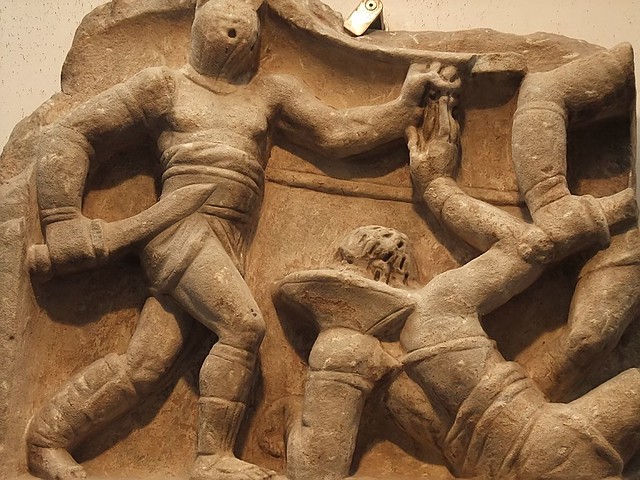
I thought the segment on gladiatorial fights was quite authentic with a properly attired Roman referee and a retiarius (net man with trident) and a Secutor battling it out with little blood spilled. Each time one of the gladiators was in danger of a mortal wound the referee would step in and separate the combatants. 

Finally one of the men went down and the referee looked to the crowd for a verdict and declared the victor without any further harm coming to his opponent. In historical times that type of encounter was far more common than the blood bath seen on the Starz' Spartacus: Blood and Sand series. The only thing that was not quite authentic was that the men were relatively svelt. In Roman times gladiators ate an almost vegetarian diet of barley gruel to put on a protective layer of fat and often appeared rather barrel-chested.


This Roman relief  found along the Via Appia near the tomb of Cecilia Metella
illustrates the well fed contours of arena combatants in the 1st century BCE
.
Photogaphed at the Baths of Diocletian venue of the National Museum, Rome, Italy by  © 2009
After the movie ended we climbed down the rather steep stairs and walked several blocks to the Roman amphitheater. The amphitheater was constructed in approximately 70 CE.  It measures 133 meters long and 101 meters wide and in ancient times could seat 24,000 people.  The stone for its construction was quarried at Roquemaillère and Baruthel located near Nîmes.

s er
A Roman amphitheater now serves
as a venue for bullfights
in Nimes, France.
Photo by  © 2013
Although several tiers of the structure are now missing, what remains is in very good condition. It is significantly smaller than the Colloseum in Rome, though. 


Once fortified by the Visigoths, the Nimes amphitheater was a target of destruction
by Charles Martel in 737 CE so only the lower tiers of the structure remain.
Photographed in Nimes, France by  © 2013
With the upper tiers of the structure missing I could not see any remnants of the supports for the sun shades that were usually extended to shade the spectators on a hot day. I also did not see any numbers carved in to the stone above the various entry doors that matched tokens given to attendees to tell them which door to use so ingress and egress could be accomplished in a relatively short time.  The official website for the site pointed out the fore-body parts of two bulls with their legs folded on either side on one of the arches.  I wish I would have noticed that. 

It also said there was a relief of a she-wolf giving milk to two children, Romulus and Remus, the mythical founders of Rome, on one of the pilasters opposite the Palais du Justice. Unlike the Roman version, the Nîmes she-wolf is looking towards the children. If you visit the amphitheater, don't overlook them like I did.

The archaeology museum in Nimes,one of the largest in France, is presently housed in the 17th century Jesuits College at 13 Boulevard Amiral Courbet, 30000. Iron age and Gallo-Roman artifacts comprise most of the collection with a host of everyday objects, including sigillated ceramics, bronze tableware, lamps, toilet and dress accessories. There is also an exhibit of Greek ceramics that have been recovered from the area.

In 2018, the collection will be moved to the new Museum of Romanity that is being built facing the Roman amphitheater.
An artist's rendering of the new Museum of Romanity slated for completion in 2018.  Image courtesy of  Nimes Tourism.


If you enjoyed this post, never miss out on future posts by following me by email!


Wednesday, December 4, 2013

Dying Gaul on view at The National Gallery of Art in Washington D.C. Beginning Dec 12!

An ancient history resource article by  © 2013

As part of the "Year of Italian Culture in the United States" project, the Capitoline Museum has graciously loaned the moving sculpture known as "The Dying Gaul" to the National Gallery of Art in Washington D.C. where it will be on display from December 12, 2013 to March 16, 2014.  The sculpture  is a 1st - 2nd century CE Roman marble copy of a lost Hellenistic bronze that is thought to have been commissioned between 230 BCE and 220 BCE by Attalus I of Pergamon to celebrate his victory over the Galatians in Anatolia. The  identity of the sculptor of the original is unknown, but it has been suggested that Epigonus, the court sculptor of the Attalid dynasty of Pergamon, may have been its creator.

The Dying Gaul photographed at the Capitoline Museum in Rome, Italy by
 © 2005.
This breathtaking masterpiece I have had the good fortune to view at The Capitoline Museum on both of my visits there, is thought to have been discovered during excavations of the Villa Ludovisi, built upon the remains of the Gardens of Sallust, in the early 17th century.  It first appeared on an inventory of the powerful Italian family's collections in 1623 CE. In 1633, Pope Clement XII acquired it for the Capitoline collections. In the late 18th century, Napoleon acquired the sculpture under the terms of the Treaty of Tolentino.  It was subsequently exhibited in The Louvre until 1816 when it was returned to Rome.

Originally, it was thought to have depicted a defeated gladiator and was dubbed "The Dying Gladiator" or "The Dying Murmillo".  But subsequent scholarship identified it as a Celtic warrior by the 19th century.

This wonderful closeup by Professor Steven Zucker clearly shows the neck
torc (torque) worn by Celtic warriors.  Torcs are found in the Scythian, Illyrian,
Thracian, Celtic, and other cultures of the European Iron Age from around the
8th century BCE to the 3rd century CE. Often made of precious metals, torcs
were a symbol of rank and were often awarded to warriors for their bravery by
their chieftains.  They were also valued as plunder if a Celtic army was defeated.
The Roman Titus Manlius in 361 BCE challenged a Gaul to single combat, killed him,
and then took his torc. Because he always wore it, he received the nickname
Torquatus (the one who wears a torc). Pliny the Elder records that after a battle in
386 BCE the Romans recovered 183 torcs from the Celtic dead. Quintilian says
that Gauls presented the Emperor Augustus with a symbolic gold torc weighing
100 Roman pounds (nearly 33 kilos).
 Photo © 2010 by
Although heroic nudes are frequently depicted in ancient art, this particular portrayal of a nude warrior is historically accurate based on ancient descriptions of some Celtic fighting groups.

Diodorus Siculus reported that "Some use iron breast-plates in battle, while others fight naked, trusting only in the protection which nature gives." Polybius wrote an evocative account of Galatian tactics against a Roman army at the Battle of Telamon of 225 BCE:

"The Insubres and the Boii wore trousers and light cloaks, but the Gaesatae, in their love of glory and defiant spirit, had thrown off their garments and taken up their position in front of the whole army naked and wearing nothing but their arms... The appearance of these naked warriors was a terrifying spectacle, for they were all men of splendid physique and in the prime of life." - Polybius, Histories II.28
The Roman historian Livy recorded that the Celts of Asia Minor fought naked and "their wounds were plain to see on the whiteness of their bodies".

The statue has been so admired over the centuries that it was considered a "must see" for aristocrats taking the "Grand Tour" of the classical world.    The famed poet Byron even commemorated his visit to see the statue with a short but poignant poem, Childe Harold's Pilgrimage:

I see before me the gladiator lie
He leans upon his hand—his manly brow
Consents to death, but conquers agony,
And his drooped head sinks gradually low—
And through his side the last drops, ebbing slow
From the red gash, fall heavy, one by one...

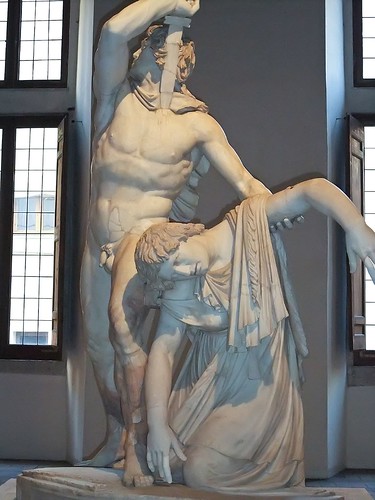
If you have the wonderful opportunity to visit Rome, don't miss the Palazzo Altemps on your list of must-see museums, either.  There, you will find another outstanding statue commemorating the valor of the Celts known as the Ludovisi Gaul.  It depicts a formidable muscled warrior in the act of plunging a sword into his chest rather than be captured by the enemy.  He grips the arm of his dying wife whom he has slain in a final act of love.


The Ludovisi Gaul photographed at the  Palazzo Altemps,
Museo Nazionale 
Romano in Rome, Italy by   ©2009.
 The Celtic warrior's heroic nudity is in contrast to his modestly-dressed wife whose attire would have been familiar on the streets of ancient Rome. This dramatic sculpture is thought to have been commissioned by Julius Caesar in the 1st century BCE after his defeat of the Gauls at the famous battle of Alesia in modern day France.  It, too, is thought to be a copy of a Hellenistic original bronze by Epigonus from a grouping at Pergamon.


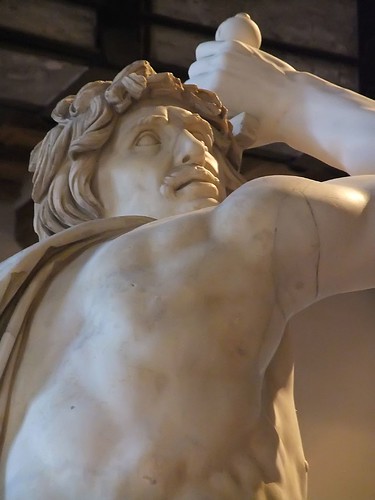
The Ludovisi Gaul is depicted with the iconic "long hair"
 and thick mustache described by the Romans in the ancient sources.

Photographed at the  Palazzo Altemps, Museo Nazionale  Romano,
Rome, Italy
by  
©2009.
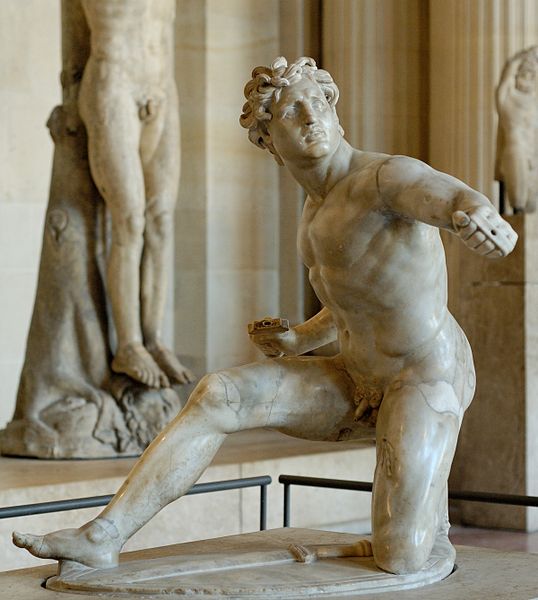
 I noticed that Wikipedia mentioned another important Celtic statue called "The Kneeling Gaul" that is in the collections of The Louvre.  Unfortunately, when I visited Paris in 2008, it was not on display.  I wish I could have seen it!


The Kneeling Gaul at The Louvre in Paris, France courtesy of
Wikipedia.
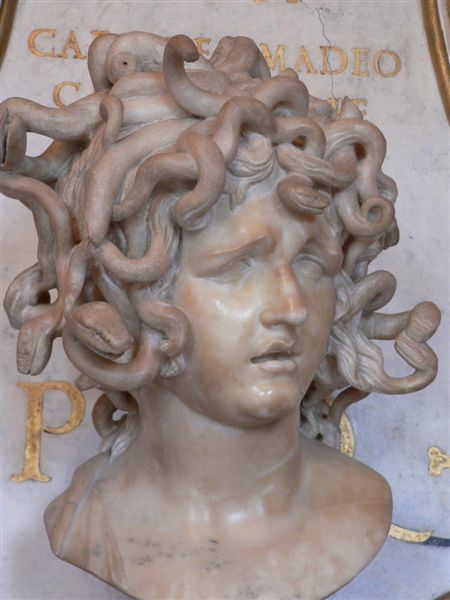
As I look at the image of The Kneeling Gaul I am struck by the facial similarities to a sculpture of Medusa by Gian Lorenzo Bernini I photographed at the Capitoline Museum back in 2005.


Medusa by Gian Lorenzo Bernini, 1630 CE.
Photographed at the Capitoline Museum in Rome, Italy by
 © 2005.
I see that Bernini produced his Medusa in 1630, about the same time the Kneeling Gaul was discovered in the former Gardens of Sallust.  I wonder if the Kneeling Gaul provided Bernini's inspiration for his Medusa figure?

If you get a chance to visit Washington D.C. in the next three months, be sure to stop by The National Gallery of Art and experience "The Dying Gaul" for yourself.  After all, this is its first appearance outside of Italy in over 200 years!  I think it will surely inspire you to seek out other magnificent works of art from the ancient world!


Enhanced by Zemanta
If you enjoyed this post, never miss out on future posts by following me by email!


Wednesday, July 2, 2008

Roman Paris

A new internet friend just sent me this link to a marvelous site about ancient Roman Paris. It not only includes beautiful 3D graphics of reconstructions of some of the original Roman structures but an interesting virtual tour of places that can be visited today that have vestiges of Paris' Roman past. I found the description of the multi-use amphitheater particularly fascinating:

"What today is known as Les arènes de Lutèce [the Lutetian arena] is in fact a Gallo-Roman mixed-used amphitheatre, i.e. an amphitheatre with a stage. It consisted of an oval arena, two large lateral entryways and a cavea that did not completely encircle the arena. The missing section was taken up by a stage for mimes, pantomimes and singing performances. The arena was where gladiatorial combats (munera) took place and where wild beasts were hunted (venationes). The structure had an exterior gallery and a highly ornamented facade. Its impressive size-100 X 130.4 meters-make Lutetia's amphitheatre/stage one of the largest constructions of its kind in Gaul."
If you enjoyed this post, never miss out on future posts by following me by email!