Showing posts with label Capitoline Museum. Show all posts

Tuesday, March 23, 2021

Mars and the Roman celebration of war


Statue of the Roman emperor Hadrian as Mars, God of War, 117–125 CE, that I photographed at the Capitoline Museums, Rome, Italy

In ancient Roman religion and myth, Mars was the god of war and also an agricultural guardian, a combination characteristic of early Rome. He was the son of Jupiter and Juno, and he was the most prominent of the military gods in the religion of the Roman army. 

Under the influence of Greek culture, Mars was identified with the Greek god Ares, whose myths were reinterpreted in Roman literature and art under the name of Mars. But the character and dignity of Mars differed in fundamental ways from that of his Greek counterpart, who is often treated with contempt and revulsion in Greek literature. Mars' altar in the Campus Martius, the area of Rome that took its name from him, was supposed to have been dedicated by Numa, the peace-loving semi-legendary second king of Rome. Although the center of Mars's worship was originally located outside the sacred boundary of Rome (pomerium), Augustus made the god a renewed focus of Roman religion by establishing the Temple of Mars Ultor in his new forum.

Although Ares was viewed primarily as a destructive and destabilizing force, Mars represented military power as a way to secure peace, and was a father (pater) of the Roman people. In the mythic genealogy and founding myths of Rome, Mars was the father of Romulus and Remus by his rape of Rhea Silvia. His love affair with Venus symbolically reconciled the two different traditions of Rome's founding; Venus was the divine mother of the hero Aeneas, celebrated as the Trojan refugee who "founded" Rome several generations before Romulus laid out the city walls.

Most of Mars' festivals were held in March, the month named for him (Latin Martius), which began the season for military campaigning and October, that ended the season for campaigning and farming.  

The Tubilustrium was the ceremony held using tubae, sacred trumpets,  to make the army fit for war. The ceremony was held on March 23, the last day of the Quinquatria festival held in tribute to the Roman God Mars and Nerine, a Sabine goddess. The Salii, the "leaping priests" (from the verb saliƍ "leap, jump") of Mars supposed to have been introduced by King Numa Pompilius, danced through the streets. They were twelve patrician youths, dressed as archaic warriors: an embroidered tunic, a breastplate, a short red cloak (paludamentum), a sword, and a spiked headdress called an apex. They were charged with the twelve bronze shields called ancilia, which, like the Mycenaean shield, resembled a figure eight. One of the shields was said to have fallen from heaven in the reign of King Numa and eleven copies were made to protect the identity of the sacred shield on the advice of the nymph Egeria, consort of Numa, who prophesied that wherever that shield was preserved, the people would be the dominant people of the earth.

If you enjoyed this post, never miss out on future posts by following me by email!


Friday, June 12, 2020

Mars: The Roman God of War

Mars was one of the more important gods of the Roman pantheon. Numerous temples, shrines, and altars were dedicated to him in Rome and throughout the Empire. As the god of war, he had many of the same attributes as the Greek god Ares, but he was also closely associated with the imperial cult, since the emperor's power and popularity depended heavily on the army and its military successes. Mars was therefore often depicted on monuments celebrating imperial victories, notably on triumphal arches, a distinctively Roman type of public building. This fragment presumably comes from one such monument, perhaps even from the now lost Portico of Septimius Severus in Rome. Mars is represented in the canonical guise of an older, bearded man wearing a Corinthian helmet tipped back on his head. - The Metropolitan Museum of Art


Image: Mars fragment possibly from the Portico of Septimius Severus courtesy of the Metropolitan Museum of Art
Colossal statue of Mars found in the forum of Nerva photographed at the Capitoline Museum

Colossal statue of Mars found in the forum of Nerva photographed at the Capitoline Museum

If you enjoyed this post, never miss out on future posts by following me by email!


Sunday, June 7, 2020

The Metamorphosis of Polyphemus


The Cyclops Polyphemus from the Antonine period 2nd - 3rd century CE photographed at the Capitoline Museum in Rome, Italy.
Depictions of the Cyclops Polyphemus have differed radically, depending on the literary genres in which he has appeared, and have given him an individual existence independent of the Homeric herdsman encountered by Odysseus. In the epic he was a man-eating monster dwelling in an unspecified land.

Some centuries later, a dithyramb by Philoxenus of Cythera, followed by several episodes by the Greek pastoral poets, created of him a comedic and generally unsuccessful lover of the water nymph Galatea. In the course of these he woos his love to the accompaniment of either a cithara or the pan-pipes. Such episodes take place on the island of Sicily, and it was here that the Latin poet Ovid also set the tragic love story of Polyphemus and Galatea recounted in the Metamorphoses.

Still later tradition made him the eventually successful husband of Galatea. According to some accounts, the Celts (Galati in Latin) were descended from their son Galatos, while Appian credited them with three children, Celtus, Illyrius and Galas, from whom descended the Celts, the Illyrians and the Gauls.  That their conjunction was fruitful is also implied in a later Greek epic from the turn of the 5th century CE. In the course of his Dionysiaca, Nonnus gives an account of the wedding of Poseidon and Beroe, at which the Nereid "Galatea twangled a marriage dance and restlessly twirled in capering step, and she sang the marriage verses, for she had learnt well how to sing, being taught by Polyphemos with a shepherd’s syrinx."

If you enjoyed this post, never miss out on future posts by following me by email!


Wednesday, May 20, 2020

A Despot's Course

Those who attempt a despot's course must encounter the disasters which befall despotic power and be afflicted by the very things which they inflict upon others.  Isocrates.  On The Peace.  Speech 8.  Section 91.

Note: Surprisingly, Aristotle promoted the concept of oriental despotism. Aristotle asserted that oriental despotism was not based on force, but on consent. Hence, fear could not be said to be its motivating force, but rather the servile nature of those enslaved, which would feed upon the power of the despot master. Sounds totally appalling to me!


Image:  Battle of Alexander versus Darius by Pietro da Cortona, between 1644 and 1650, at the Capitoline Museums in Rome, Italy courtesy of the Google Art Project and Wikimedia Commons.
If you enjoyed this post, never miss out on future posts by following me by email!


Wednesday, December 4, 2013

Dying Gaul on view at The National Gallery of Art in Washington D.C. Beginning Dec 12!

An ancient history resource article by  © 2013

As part of the "Year of Italian Culture in the United States" project, the Capitoline Museum has graciously loaned the moving sculpture known as "The Dying Gaul" to the National Gallery of Art in Washington D.C. where it will be on display from December 12, 2013 to March 16, 2014.  The sculpture  is a 1st - 2nd century CE Roman marble copy of a lost Hellenistic bronze that is thought to have been commissioned between 230 BCE and 220 BCE by Attalus I of Pergamon to celebrate his victory over the Galatians in Anatolia. The  identity of the sculptor of the original is unknown, but it has been suggested that Epigonus, the court sculptor of the Attalid dynasty of Pergamon, may have been its creator.

The Dying Gaul photographed at the Capitoline Museum in Rome, Italy by
 © 2005.
This breathtaking masterpiece I have had the good fortune to view at The Capitoline Museum on both of my visits there, is thought to have been discovered during excavations of the Villa Ludovisi, built upon the remains of the Gardens of Sallust, in the early 17th century.  It first appeared on an inventory of the powerful Italian family's collections in 1623 CE. In 1633, Pope Clement XII acquired it for the Capitoline collections. In the late 18th century, Napoleon acquired the sculpture under the terms of the Treaty of Tolentino.  It was subsequently exhibited in The Louvre until 1816 when it was returned to Rome.

Originally, it was thought to have depicted a defeated gladiator and was dubbed "The Dying Gladiator" or "The Dying Murmillo".  But subsequent scholarship identified it as a Celtic warrior by the 19th century.

This wonderful closeup by Professor Steven Zucker clearly shows the neck
torc (torque) worn by Celtic warriors.  Torcs are found in the Scythian, Illyrian,
Thracian, Celtic, and other cultures of the European Iron Age from around the
8th century BCE to the 3rd century CE. Often made of precious metals, torcs
were a symbol of rank and were often awarded to warriors for their bravery by
their chieftains.  They were also valued as plunder if a Celtic army was defeated.
The Roman Titus Manlius in 361 BCE challenged a Gaul to single combat, killed him,
and then took his torc. Because he always wore it, he received the nickname
Torquatus (the one who wears a torc). Pliny the Elder records that after a battle in
386 BCE the Romans recovered 183 torcs from the Celtic dead. Quintilian says
that Gauls presented the Emperor Augustus with a symbolic gold torc weighing
100 Roman pounds (nearly 33 kilos).
 Photo © 2010 by
Although heroic nudes are frequently depicted in ancient art, this particular portrayal of a nude warrior is historically accurate based on ancient descriptions of some Celtic fighting groups.

Diodorus Siculus reported that "Some use iron breast-plates in battle, while others fight naked, trusting only in the protection which nature gives." Polybius wrote an evocative account of Galatian tactics against a Roman army at the Battle of Telamon of 225 BCE:

"The Insubres and the Boii wore trousers and light cloaks, but the Gaesatae, in their love of glory and defiant spirit, had thrown off their garments and taken up their position in front of the whole army naked and wearing nothing but their arms... The appearance of these naked warriors was a terrifying spectacle, for they were all men of splendid physique and in the prime of life." - Polybius, Histories II.28
The Roman historian Livy recorded that the Celts of Asia Minor fought naked and "their wounds were plain to see on the whiteness of their bodies".

The statue has been so admired over the centuries that it was considered a "must see" for aristocrats taking the "Grand Tour" of the classical world.    The famed poet Byron even commemorated his visit to see the statue with a short but poignant poem, Childe Harold's Pilgrimage:

I see before me the gladiator lie
He leans upon his hand—his manly brow
Consents to death, but conquers agony,
And his drooped head sinks gradually low—
And through his side the last drops, ebbing slow
From the red gash, fall heavy, one by one...

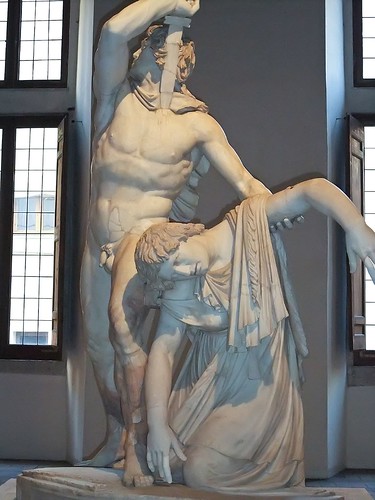
If you have the wonderful opportunity to visit Rome, don't miss the Palazzo Altemps on your list of must-see museums, either.  There, you will find another outstanding statue commemorating the valor of the Celts known as the Ludovisi Gaul.  It depicts a formidable muscled warrior in the act of plunging a sword into his chest rather than be captured by the enemy.  He grips the arm of his dying wife whom he has slain in a final act of love.


The Ludovisi Gaul photographed at the  Palazzo Altemps,
Museo Nazionale 
Romano in Rome, Italy by   ©2009.
 The Celtic warrior's heroic nudity is in contrast to his modestly-dressed wife whose attire would have been familiar on the streets of ancient Rome. This dramatic sculpture is thought to have been commissioned by Julius Caesar in the 1st century BCE after his defeat of the Gauls at the famous battle of Alesia in modern day France.  It, too, is thought to be a copy of a Hellenistic original bronze by Epigonus from a grouping at Pergamon.


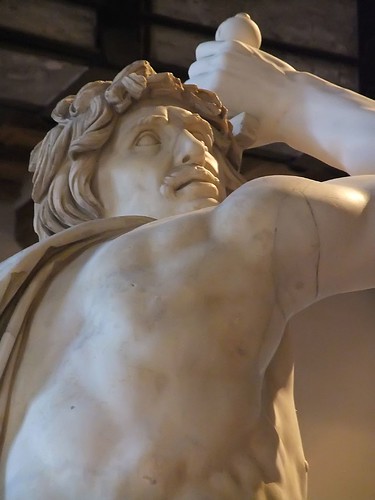
The Ludovisi Gaul is depicted with the iconic "long hair"
 and thick mustache described by the Romans in the ancient sources.

Photographed at the  Palazzo Altemps, Museo Nazionale  Romano,
Rome, Italy
by  
©2009.
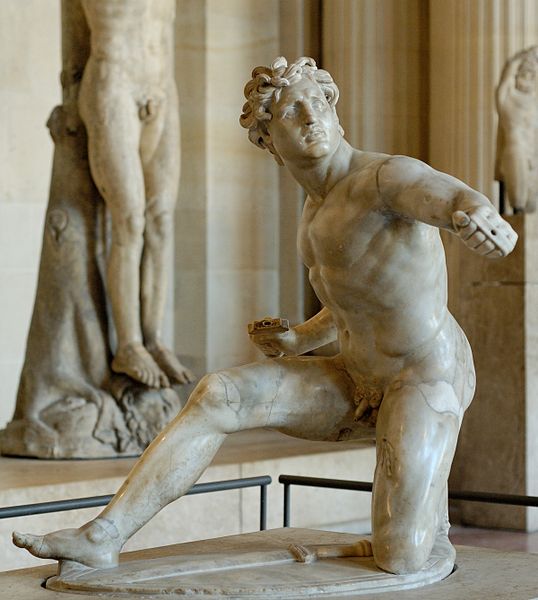
 I noticed that Wikipedia mentioned another important Celtic statue called "The Kneeling Gaul" that is in the collections of The Louvre.  Unfortunately, when I visited Paris in 2008, it was not on display.  I wish I could have seen it!


The Kneeling Gaul at The Louvre in Paris, France courtesy of
Wikipedia.
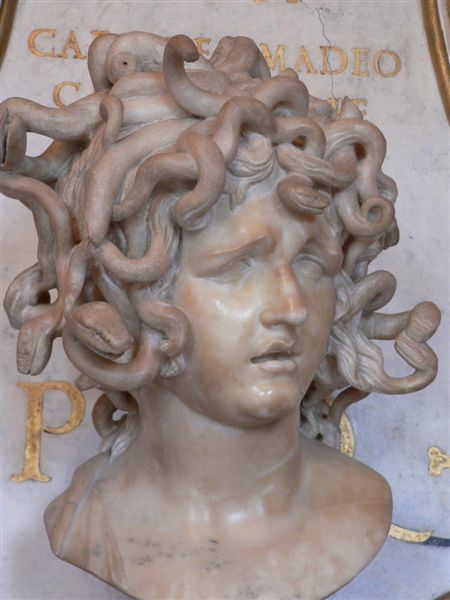
As I look at the image of The Kneeling Gaul I am struck by the facial similarities to a sculpture of Medusa by Gian Lorenzo Bernini I photographed at the Capitoline Museum back in 2005.


Medusa by Gian Lorenzo Bernini, 1630 CE.
Photographed at the Capitoline Museum in Rome, Italy by
 © 2005.
I see that Bernini produced his Medusa in 1630, about the same time the Kneeling Gaul was discovered in the former Gardens of Sallust.  I wonder if the Kneeling Gaul provided Bernini's inspiration for his Medusa figure?

If you get a chance to visit Washington D.C. in the next three months, be sure to stop by The National Gallery of Art and experience "The Dying Gaul" for yourself.  After all, this is its first appearance outside of Italy in over 200 years!  I think it will surely inspire you to seek out other magnificent works of art from the ancient world!


Enhanced by Zemanta
If you enjoyed this post, never miss out on future posts by following me by email!


Monday, March 12, 2012

Identifying Ancient Art - A game of smoke and mirrors?

History resource article by Mary Harrsch © 2012

Today, I watched a fascinating lecture "Mistaken Identities: How to identify a Roman emperor" by Mary Beard recently delivered at Stanford University.  As a "fan" of Julius Caesar, I thought her critique of a number of heads identified as Caesar over the years was very enlightening.

I also found her overall discussion of the rather tenuous nature of sculpture identification particularly interesting because lately, I have been re-editing a number of images I shot of Roman sculpture at the Capitoline and National Museums in Rome back in 2005.  I had just started my crusade to photograph historical art and make my images freely available to teachers, researchers and students and had not yet developed my current practice of photographing the identification placards in a sequence with the sculpture to enable me to properly identify the artwork once I returned home to my office.  So, on that first trip to Rome, I ended up with dozens of photographs that all I could say for sure were portraits of Roman men or women until I had a chance to research them further to label them properly.

With the internet and our current technology, I naively believed that proper identification would be a relatively straightforward process.  I have since learned that not only is it not straightforward, even what is thought to be accurate identification at the time changes as different scholars apply different interpretations or museums reliant on governmental support become subject to various political agendas seeking some kind of historical confirmation through a culture's art legacy.

It gets even more confusing when identification displayed at a museum differs from the museum's own collections catalog. I recently received a request from a publisher in Denmark for an image I took back in 2007 of a fresco at the Museo Archeologico Nazionale in Naples that, at the time, was labeled "Cleopatra greets the god of the Underworld'.  But, when I looked the image up in the collections book that I purchased at the museum, I noticed that it said it was Io being welcomed upon her arrival to Egypt by the goddess Isis to her sanctuary of Canopos.  The fresco was unearthed in 1764 in the Temple of Isis in Pompeii in a room dubbed the Ekklesiasterion.


The satyr-looking creature bearing up Io looks like it could be Hades but the catalog says it is a river god.  Io is identified by the vestiges of horns she still retains from her time as a heifer.  Isis appears to be dressed in the Greek fashion and holds a cobra coiled around her arm.  The catalog tells us that the painting originated from the court of the Ptolemies in Alexandria "in order to legitimize their dynasty by rooting it in ancient Heraclean and Argive origins which embraced the dual ethnic components of the new kingdom, the Egyptian and the Macedonian".  The fresco is thus dated to the the early Ptolemaic dynasty after a 3rd century BCE prototype .  This all sounds quite carefully researched and definitive.  However, there is no mention of technical dating examinations so I must assume this is educated conjecture.  The only thing that nags at me is the prominent display of the cobra and the knowledge that the fresco was apparently once thought to represent Cleopatra VII in the role of Isis.

In the historical record, Cleopatra VII represented herself as the living embodiment of Isis and the cobra was known to be not only a sacred creature but a pharaonic symbol.  When I check the "king's list" of the Ptolemaic Dynasty, I find a few females mentioned as co-rulers, usually regents for under-age male inheritors, beginning with Cleopatra II Philometora Soteira in 131 BCE, but you really don't find a woman ruling with the trappings of pharaoh until you reach Cleopatra VII in 51 BCE.  So the possibility that Cleopatra VII as Isis is the welcoming figure in the fresco cannot be totally dismissed.  I also can't help but think the widespread publicity surrounding Cleopatra and her death by the bite of a cobra in the 1st century BCE could easily have influenced a Roman artist charged with decorating the walls of a temple to Isis in Pompeii during that period.

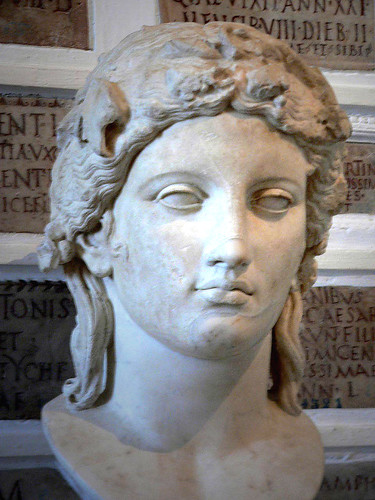
Another confusing identification I encountered recently was a picture of a sculpture said to be Apollo of the Anzio type at the Capitoline Museum:


Call me crazy but it looks like remnants of grapes and grape leaves in the hair which would make me think it was Dionysos.  Many sculptures of Apollo also have an iconic knot in the hair on top of the head so I am baffled by the identification associated with this piece.

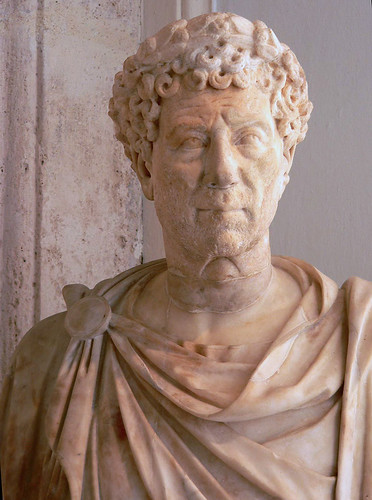
Reviewing my images from the Hall of Emperors in the Capitoline Museum, I came across the following bust:


After reviewing hundreds of images of Roman emperors (or said to be Roman emperors), I cannot find a single one that looks like him.  He appears to be wearing a laurel crown and in 2005 was positioned close to the busts of  Vespasian, Domitian and Titus (based on the photo time stamp).  This would make me think he may have been one of the emperors in the Year of the Four Emperors after the assassination of Nero but I checked images of Otho, Galba and Vitellius and he doesn't resemble any images identified as them.  Although I thought the museum positioned busts in relationship to the sequence of their reigns, this may not be the case either.  So, I would appreciate any information anyone could offer that would help identify this Roman.  


Enhanced by Zemanta
If you enjoyed this post, never miss out on future posts by following me by email!