An ancient history resource article by Mary Harrsch © 2013
As part of the "Year of Italian Culture in the United States" project, the Capitoline Museum has graciously loaned the moving sculpture known as "The Dying Gaul" to the National Gallery of Art in Washington D.C. where it will be on display from December 12, 2013 to March 16, 2014. The sculpture is a 1st - 2nd century CE Roman marble copy of a lost Hellenistic bronze that is thought to have been commissioned between 230 BCE and 220 BCE by Attalus I of Pergamon to celebrate his victory over the Galatians in Anatolia. The identity of the sculptor of the original is unknown, but it has been suggested that Epigonus, the court sculptor of the Attalid dynasty of Pergamon, may have been its creator.
This breathtaking masterpiece I have had the good fortune to view at The Capitoline Museum on both of my visits there, is thought to have been discovered during excavations of the Villa Ludovisi, built upon the remains of the Gardens of Sallust, in the early 17th century. It first appeared on an inventory of the powerful Italian family's collections in 1623 CE. In 1633, Pope Clement XII acquired it for the Capitoline collections. In the late 18th century, Napoleon acquired the sculpture under the terms of the Treaty of Tolentino. It was subsequently exhibited in The Louvre until 1816 when it was returned to Rome.
Originally, it was thought to have depicted a defeated gladiator and was dubbed "The Dying Gladiator" or "The Dying Murmillo". But subsequent scholarship identified it as a Celtic warrior by the 19th century.
Although heroic nudes are frequently depicted in ancient art, this particular portrayal of a nude warrior is historically accurate based on ancient descriptions of some Celtic fighting groups.
Diodorus Siculus reported that "Some use iron breast-plates in battle, while others fight naked, trusting only in the protection which nature gives." Polybius wrote an evocative account of Galatian tactics against a Roman army at the Battle of Telamon of 225 BCE:
The statue has been so admired over the centuries that it was considered a "must see" for aristocrats taking the "Grand Tour" of the classical world. The famed poet Byron even commemorated his visit to see the statue with a short but poignant poem, Childe Harold's Pilgrimage:
If you have the wonderful opportunity to visit Rome, don't miss the Palazzo Altemps on your list of must-see museums, either. There, you will find another outstanding statue commemorating the valor of the Celts known as the Ludovisi Gaul. It depicts a formidable muscled warrior in the act of plunging a sword into his chest rather than be captured by the enemy. He grips the arm of his dying wife whom he has slain in a final act of love.
The Celtic warrior's heroic nudity is in contrast to his modestly-dressed wife whose attire would have been familiar on the streets of ancient Rome. This dramatic sculpture is thought to have been commissioned by Julius Caesar in the 1st century BCE after his defeat of the Gauls at the famous battle of Alesia in modern day France. It, too, is thought to be a copy of a Hellenistic original bronze by Epigonus from a grouping at Pergamon.As part of the "Year of Italian Culture in the United States" project, the Capitoline Museum has graciously loaned the moving sculpture known as "The Dying Gaul" to the National Gallery of Art in Washington D.C. where it will be on display from December 12, 2013 to March 16, 2014. The sculpture is a 1st - 2nd century CE Roman marble copy of a lost Hellenistic bronze that is thought to have been commissioned between 230 BCE and 220 BCE by Attalus I of Pergamon to celebrate his victory over the Galatians in Anatolia. The identity of the sculptor of the original is unknown, but it has been suggested that Epigonus, the court sculptor of the Attalid dynasty of Pergamon, may have been its creator.
 |
| The Dying Gaul photographed at the Capitoline Museum in Rome, Italy by Mary Harrsch © 2005. |
Originally, it was thought to have depicted a defeated gladiator and was dubbed "The Dying Gladiator" or "The Dying Murmillo". But subsequent scholarship identified it as a Celtic warrior by the 19th century.
 |
| This wonderful closeup by Professor Steven Zucker clearly shows the neck torc (torque) worn by Celtic warriors. Torcs are found in the Scythian, Illyrian, Thracian, Celtic, and other cultures of the European Iron Age from around the 8th century BCE to the 3rd century CE. Often made of precious metals, torcs were a symbol of rank and were often awarded to warriors for their bravery by their chieftains. They were also valued as plunder if a Celtic army was defeated. The Roman Titus Manlius in 361 BCE challenged a Gaul to single combat, killed him, and then took his torc. Because he always wore it, he received the nickname Torquatus (the one who wears a torc). Pliny the Elder records that after a battle in 386 BCE the Romans recovered 183 torcs from the Celtic dead. Quintilian says that Gauls presented the Emperor Augustus with a symbolic gold torc weighing 100 Roman pounds (nearly 33 kilos). Photo © 2010 by Professor Steven Zucker. |
Diodorus Siculus reported that "Some use iron breast-plates in battle, while others fight naked, trusting only in the protection which nature gives." Polybius wrote an evocative account of Galatian tactics against a Roman army at the Battle of Telamon of 225 BCE:
"The Insubres and the Boii wore trousers and light cloaks, but the Gaesatae, in their love of glory and defiant spirit, had thrown off their garments and taken up their position in front of the whole army naked and wearing nothing but their arms... The appearance of these naked warriors was a terrifying spectacle, for they were all men of splendid physique and in the prime of life." - Polybius, Histories II.28The Roman historian Livy recorded that the Celts of Asia Minor fought naked and "their wounds were plain to see on the whiteness of their bodies".
The statue has been so admired over the centuries that it was considered a "must see" for aristocrats taking the "Grand Tour" of the classical world. The famed poet Byron even commemorated his visit to see the statue with a short but poignant poem, Childe Harold's Pilgrimage:
I see before me the gladiator lie
He leans upon his hand—his manly brow
Consents to death, but conquers agony,
And his drooped head sinks gradually low—
And through his side the last drops, ebbing slow
From the red gash, fall heavy, one by one...Consents to death, but conquers agony,
And his drooped head sinks gradually low—
And through his side the last drops, ebbing slow
If you have the wonderful opportunity to visit Rome, don't miss the Palazzo Altemps on your list of must-see museums, either. There, you will find another outstanding statue commemorating the valor of the Celts known as the Ludovisi Gaul. It depicts a formidable muscled warrior in the act of plunging a sword into his chest rather than be captured by the enemy. He grips the arm of his dying wife whom he has slain in a final act of love.
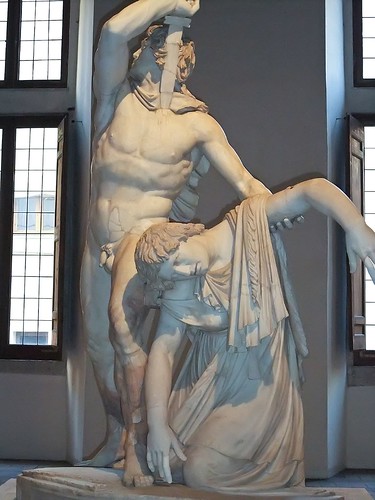 |
| The Ludovisi Gaul photographed at the Palazzo Altemps, Museo Nazionale Romano in Rome, Italy by Mary Harrsch ©2009. |
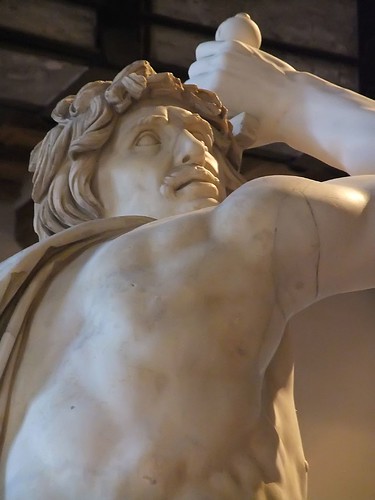 |
| The Ludovisi Gaul is depicted with the iconic "long hair" and thick mustache described by the Romans in the ancient sources. Photographed at the Palazzo Altemps, Museo Nazionale Romano, Rome, Italy by Mary Harrsch ©2009. |
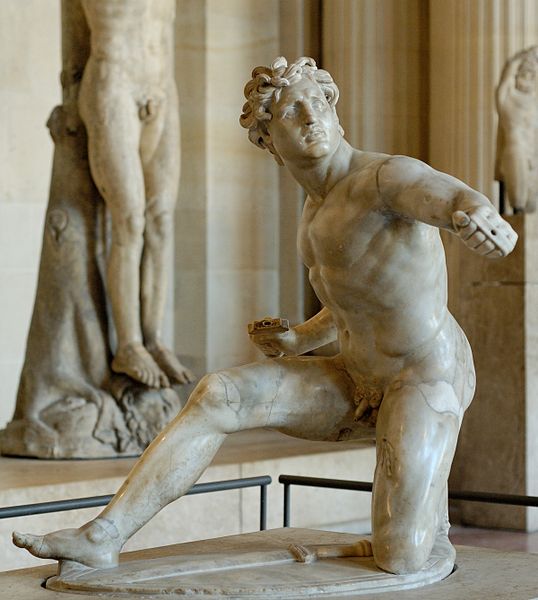 |
| The Kneeling Gaul at The Louvre in Paris, France courtesy of Wikipedia. |
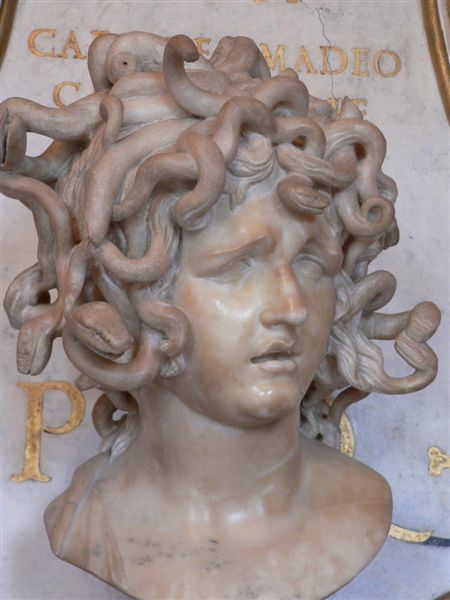 |
| Medusa by Gian Lorenzo Bernini, 1630 CE. Photographed at the Capitoline Museum in Rome, Italy by Mary Harrsch © 2005. |
If you get a chance to visit Washington D.C. in the next three months, be sure to stop by The National Gallery of Art and experience "The Dying Gaul" for yourself. After all, this is its first appearance outside of Italy in over 200 years! I think it will surely inspire you to seek out other magnificent works of art from the ancient world!
 
|
 
|
 
|
 
|




 In the first century BC, the picturesque Bay of Naples became a
 Museum of Art, with the cooperation of the