Showing posts with label Jews. Show all posts

Thursday, December 18, 2008

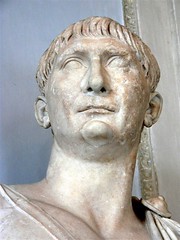
Trajan and the Jewish Revolt on Cyprus


An interesting reference to Roman clashes with the Jews on Cyprus during Trajan's reign:

[Photo: My image of a bust of Trajan at the Capitoline Museum in Rome. All of my images are freely available for noncommercial use with attribution on Flickr]

"Under Roman rule Cyprus remained in peace or "pax romana" as it was known for over three hundred years until 115 AD. At this time the Jews inspired by a belief that the coming of their Messiah was imminent started a revolt against Rome on the Island. They were led by a man called Atermion a Jew who had taken a Greek name as was the custom at the time. There were hardly any Roman troops stationed in Cyprus at this time which explains why the revolt grew so quickly. The Roman emporer Trajan dispatched one of his generals to the Island and the rebellion was quelled. Historians say that 24,000 Jews were massacred on the Island by this roman army but there is a likelyhood that the actual numbers were significantly less. Following the revolt a decree was issued that Rome would forbid any Jew to ever set foot in Cyprus ever again even if shipwrecked." - Destinations

Livius.org gives us much more details:


The revolt started in Cyrene, where one Lukuas -sometimes called Andreas- ordered the Jews to destroy the pagan temples of Apollo, Artemis, Hecate, Demeter, Isis and Pluto, and to assail the worshippers. The latter fled to Alexandria, where they captured and killed many Jews. (With a population of some 150,000 Jews, Alexandria was Judaism's largest city.) In 116, the Jews organized themselves and had their revenge. The temples of gods like Nemesis, Hecate and Apollo were destroyed; the same fate befell the tomb of Pompey, the Roman general who had captured Jerusalem almost two centuries before.

Meanwhile, the Cyrenaican Jews plundered the Egyptian countryside, reaching Thebes, six hundred kilometers upstream. The future historian Appian of Alexandria records that he made a providential escape from a party of Jews pursuing him in the Nile marshes (more...). There was nothing the Roman governor Marcus Rutilius Lupus could do, although he sent a legion (III Cyrenaica or XXII Deiotariana) to protect the inhabitants of Memphis.

Trajan sent out two expeditionary forces. One, consisting of VII Claudia, restored order on Cyprus; the other was to attack Lukuas' rebels and was commanded by Quintus Marcius Turbo. The Roman general sailed to Alexandria, defeated the Jews in several pitched battles and killed thousands of enemies, not only those in Egypt but also those of Cyrene. It is unclear what became of Lukuas, except for the fact that according to our Greek source Eusebius he had styled himself 'king' (= Messiah?). After this war, much of northern Africa had to be repopulated. The emperor Trajan and his successor Hadrian confiscated Jewish property to pay for the reconstruction of the destroyed temples.

Trajan was afraid that this revolt would spread to the Jews in the rebellious eastern provinces. Perhaps, there was some cause for his anxiousness. After the end of the revolt in Mesopotamia, someone had written the Book of Elchasai, in which the end of the world was predicted within three years. Of course, Trajan did not read this book, but he may have sensed that the Jews remained restless.

Therefore, he ordered the commander of his Mauritanian auxiliaries, Lusius Quietus, to clean the suspects out of these regions. Quietus organized a force and killed many Cypriote, Mesopotamian and Syrian Jews - in effect wiping them out; as a reward, he was appointed governor of Judaea. (He is one of the few blacks known to have made a career in Roman service.) He was responsible for a forced policy of hellenization; in response, the rabbis ordered the Jewish fathers not to teach their sons Greek (Mishna Sota 9.14).

Meanwhile, Trajan had reached his military aims and returned home. On his way back, he fell ill, and not much later, he died (8 August 117). His successor Hadrian gave up the newly conquered countries and dismissed Lusius Quietus, who was killed in the Summer of 118."

We are supplied with the following sources:

The revolt against Trajan is the subject of a book by Marina Pucci, La rivolta Ebraica al tempo di Traiano (1981 Pisa). Another discussion of this rebellions can be found in Gedaliah Alon's The Jews in their land in the Talmudic age (1980 Harvard).

If you enjoyed this post, never miss out on future posts by following me by email!


Wednesday, July 25, 2007

Julian the Apostate's support of the Jews

A history resource article by  © 2007

Julian the Apostate presiding at a conference of sectarians by Edward Armitage, 1875.  Image courtesy of
Wikimedia Commons.
I found this article about Julian's support for the reconstruction of the Jewish Temple in Jerusalem quite interesting. I have read Michael Curtis Ford's "Gods and Legions", a novel about the life and reign of the emperor Julian and gained an admiration for this "soldier, inspired military commander and rhetorician" despite the centuries of vilification heaped upon him by subsequent Christian rulers.

"The Roman Emperor Julian, who ruled 361-363 CE, called on the Jews to return to the Land of Israel and rebuild their Temple in Jerusalem. Whatever his motives, he showed our ancestors unusual respect and understanding. 
Julian was hardly an ordinary emperor, though history has failed to pay sufficient attention to his policies. In Julian, the Romans had a just ruler and brave soldier. He was a modest man who labored to relieve the distress of his subjects while endeavoring to connect authority with merit and happiness with virtue. 

A bronze coin portrait of the Emperor Julianus II (the Apostate)

As a young soldier Julian subdued, against the odds, the German threat in Gaul with a small force. He ruled ancient Gaul with wisdom and authority, hardly ever seeking a personal gain. He slept on the ground with his legionnaires, earning their respect. Julian was an excellent organizer, an honest judge, a writer and a philosopher. 
Brought up as a Christian, Julian rejected the religion and turned back to the paganism of Greek and Roman days. He argued that Christianity would weaken and ultimately destroy the Roman Empire. As a result, he attempted to restore Hellenism, which earned him everlasting Christian disdain. 
Known to Christians as Julian the Apostate, the emperor restored pagan temples and the cult of the old Roman gods. These were to be served by a reform-minded pagan clergy with high moral character, who would compete with the Christian clergy in meeting the religious needs of the people. 
Julian remains famous for having declared absolute freedom for all religious beliefs - making him perhaps the first leader to extend toleration of religion to all Romans. 
ON THE July 19, 362 C.E., Julian left Constantinople and arrived in Antioch to prepare for the invasion of Persia. However busy he must have been, he met with "the chiefs of the Jews." 
The details of this fascinating meeting, preserved only in Christian sources, are cited in Michael Avi Yona's The Jews under Roman and Byzantine Rule - A Political History from the Bar Kochba War to the Arab Conquest. 
Julian, who wanted to form a common cause with the Jews against Christianity, asked: "Why do you not sacrifice to God, as required by the laws of Moses?" 
The Jews replied: "We are not allowed by our laws to sacrifice outside our Holy City. How can we do it now? Restore to us the City, rebuild the Temple and the altar, and we shall offer sacrifices, as in days of old." 
He promised: "I shall endeavor with the utmost zeal to set up the Temple of the Most High God." 
THE RESTORATION of the Jewish Temple in Jerusalem would, in Julian's opinion, defeat the Christian argument of replacement theology - that the Church was the true Israel, and that the Temple's destruction and the subsequent exile was the just punishment suffered by the Jewish people for the Crucifixion. The Temple's restoration, Julian figured, would persuade Christian converts that God still favored the Jewish people. 
As an army commander, embarking on a war against a formidable Persian enemy, Julian could also expect that the Jews of Mesopotamia would assist his legions. But there can also be no doubt that Julian's attitude of fairness and his respect for the stubborn stand of the Jewish remnant played a role in his desire to achieve a Jewish restoration. 
In his "Four Letters" addressed to the Jewish people, Julian recognized their dire situation and appealed to them to join him in his campaign. That's a vast difference from the Persian ruler Cyrus, who had only allowed the Jews to rebuild the Temple; Julian virtually ordered them to do so, and perhaps, upset by their initial hesitation, appointed Alypius, a pagan native of Antioch and his best friend, to supervise the work. 
In a letter to the Jewish Patriarch Hillel II, residing in Tiberias, Julian abrogated the entire gamut of anti-Jewish legislation and recognized Jewish authority in Israel, including the right to levy taxes. 
ACCORDING TO the Christian sources, there was considerable initial enthusiasm among the Jews of Diaspora. Many purses were opened. But other leading Jews were confused and apprehensive. The community had only recently suffered yet another painful defeat in the failed uprising against Gallus (351 C.E.), which erupted in protest against discriminatory anti-Jewish legislation. The Patriarchate had lost Lydda, the few remaining settlements in Judea and several vital Galilean villages. 
A 354 CE sketch of Constantius Gallus.  Image courtesy of Wikimedia Commons.

The people quoted a verse from Daniel (11:34): "Now when they shall stumble, they shall be helped with a little help; but many shall join themselves unto them with blandishments." 
The Jews were doubtless divided between those who believed that Julian was a savior and those who remembered Rabbi Simon Ben Eliezer's warning against the youthful enthusiasm of the second generation after the Bar Kochba disaster: "If children tell you: 'Go, build the Temple - do not listen to them.'" 
Above all, could Jewish hopes depend on the fortunes of one man? 
In the end, no attempt was made to set up a temporary altar and offer sacrifices on the former Temple grounds, as the Maccabeans had done. While the Jews could not oppose the will of the Roman emperor, they could drag their feet. Apparently the majority did. They remembered Rome as Amalek, not as a benefactor. 
THE WORK ordered on the Temple's foundation advanced slowly. It took time to provide silver spades and pickaxes, since no iron was allowed to be used. And then, according to the Roman writer Ammianus, "balls of fire" supposedly erupted from the foundations and rendered the place inaccessible. 
The Christian majority of Jerusalem described this fire in glowing terms, as a splendid miracle, a further proof of the rightness of Christianity. The Jews suspected Christian arson. Meanwhile Alypius, Julian's pagan friend, seemed hardly in a hurry to carry out the emperor's order."
A Kindle preview of "Gods and Legions" by Michael Curtis Ford:


More suggested reading:


If you enjoyed this post, never miss out on future posts by following me by email!