Showing posts with label Cyprus. Show all posts

Sunday, January 24, 2021

Persian cavalry before the cataphractarii

The Persians did not use cavalry to a great extent until Cyrus the Great  gave the Persian nobility both horses and the wealth to maintain them from the proceeds of his western conquests. He encouraged them to ride and it became a source of disgrace for a Persian noble to be seen walking.  Cyrus then recruited his cavalry from the nobles, creating a regiment of 15,000 men drawn from the Huvaka or “kinsmen.” These kinsmen adopted brightly-colored trousers and shorter tunics that were more suitable for riding from the Medes.  Cyrus adopted cavalry tactics from the Khorassan horsemen of northeastern Iran, parts of modern Afghanistan and the southern parts of Central Asia. He initially armed his cavalry with the standard weapons of the Persian infantrymen: bows, battle-axes, and oval shields. Later, they were re-equipped with short stabbing swords and throwing javelins instead. Long lances and spears made of wood or entirely of metal were used too.

In the mid-5th century Persian cavalrymen adopted the use of wicker and leather shields.  They were designed after those carried by the Saka, a group of nomadic Iranian peoples who historically inhabited the northern and eastern Eurasian Steppe and the Tarim Basin.

According to Herodotus, at the time of the Persian invasion of Greece, Persian cavalry, assembled from a variety of contingents within the empire, were protected only by various kinds of soft headgear and wore no substantial body armor. This is reflected both in the 3rd century BCE Cypriot statuette as well as the famous Alexander mosaic from the House of the Faun in Pompeii.  Cavalry officers may have worn more protective armor, however, as indicated at the battle of Plataea where Masistius, a Persian cavalry commander, is reported to have worn gold scale armor under his scarlet surcoat. 

"When his horse was hit by an arrow, he defended himself vigorously on foot and could not be brought down by body blows. At last, the Athenians who surrounded him guessed the secret and struck at his face." - The Persian Achaemenid Army, weaponsandwarfare.com

Detail from the Alexander Mosaic from the House of the Faun in Pompeii depicting Achaemenid Persian cavalry at the Battle of Issus, 1st century BCE-1st century CE at the National Archaeological Museum in Naples courtesy of Wikimedia Commons contributor Lucas.


Terracotta statuette of a horseman, 3rd century B.C.E. Cyprus, at the Metropolitan Museum of Art in New York.


If you enjoyed this post, never miss out on future posts by following me by email!


Saturday, December 12, 2020

"Emerging" Aphrodite

This morning while searching for additional information about rare Roman funerary cippi recovered on Cyprus, I stumbled across this little figurine of "emerging" Aphrodite in the collections of the Museum of Cycladic Art. The reason it caught my attention is the pose is strikingly similar to the fresco of Venus in the triclinium of the House of the Prince of Naples that I studied earlier this year.  At the time, I was  wondering why the fresco was identified as Venus (Aphrodite) when the other main fresco in the room was identified as Bacchus (Dionysus), since Ariadne was the consort of Dionysus, not Venus.  Dr. Wallace-Hadrill had patiently explained to me that the goddess in the triclinium was identified as Venus because she is depicted wringing the sea water from her hair as described in Greek mythology (Hesiod's "Theogony" to be exact) but up until now I had never seen other ancient artwork with Venus in that particular pose.

According to the museum, the emerging Aphrodite was a common theme up to about the 1st century BCE, corresponding with the period leading up to Pompeii's destruction. The museum points out that, although Aphrodite was represented in Greek art as early as the 5th century BCE, the "emerging" Aphrodite was a creation of the Hellenistic period rather than the Classical period.

 "Some scholars believe that the type derives its origin from a famous painting of the emerging Aphrodite by the painter Apellis in the Asclepieion of Kos (second half of the 4th century BCE), which, like the pragmatic statue of Cnidia Aphrodite, is mentioned in innumerable ancient sources and seems to have contributed to the formation of a new model of female beauty in Hellenistic times. It is, after all, clear that the erotic dimension of Aphrodite emerges only during the Hellenistic period, when the naked depictions of the goddess increase and the word "Aphrodite" becomes synonymous with the erotic encounter. This fact is probably connected with an improvement of the social position of the woman and her release from the conservatism of the strictly male-dominated cities of the Classical era but also of classical art, which based its aesthetics on the worship of the male body." - Museum of Cycladic Art, Athens, Greece.

So the depiction of "emerging" Venus in the House of the Prince of Naples was not a questionable mismatch of consorts that I initially perceived as the less educated choice of art made by a merchant class resident seeking to project a more elite status, but simply a reflection of Pompeii's earlier Greek influence.  Sigh...so much to learn about ancient art and so little time!! 


Fresco of Emerging Venus (Aphrodite) in the summer triclinium of the House of the Prince of Naples in Pompeii.


Terracotta  Figurine of "Emerging" Aphrodite, Hellenistic 200 BCE - 1 BCE courtesy of the Museum of Cycladic Art, Athens, Greece.
If you enjoyed this post, never miss out on future posts by following me by email!


Friday, November 27, 2020

Africans in Greek and Roman Art

 The Bronze Age Minoans of Crete were probably the first Greeks to come into contact with Ethiopians, a Greek name meaning those with "burnt" faces.  The tomb of Rekhmire, governor of Thebes and vizier during the reigns of the pharaohs Thutmosis III and Amenhotep II, circa 1400 BCE, includes one of the earliest depictions of both African and Aegean peoples, thought to be Nubians and Minoans.  However, the collapse at the end of the Late Bronze Age severed Greek connections with Egypt and even the Near East.

Trade between the Greeks and the northern periphery of Africa finally resumed in the 8th and 7th centuries BCE including the establishment of trading centers along the Nile and at Cyrene on the northern coast of Africa. Then depictions of Africans began to appear in Aegean art.

All black Africans were known as Ethiopians to the ancient Greeks, as the fifth-century BCE historian Herodotus tells us, with their black skin color being the primary identifying physical characteristic. The black glaze central to Athenian vase painting was ideally suited for representing black skin and archaeologists have also recovered black African comic masks used in the plays of Aeschylus, Sophocles, and Euripides.

By the 4th century BCE, Ethiopians were regularly featured in Greek vase painting, especially on the highly decorative red-figure vases produced by the Greek colonies in Magna Graecia, although depictions of Ethiopians in scenes of everyday life were still rare.  However, after the conquests of Alexander the Great and the establishment of the Ptolemaic dynasty in Egypt, knowledge of Nubia became more widespread as Greeks and Africans lived together in metropolitan centers like Alexandria.

As a result, African imagery in Greek art expanded  and Ethiopians were frequently depicted as athletes and entertainers. African artisans became subjects of artwork, too,  as well as some African slaves captured during wartime or through piracy.  Images of "Ethiopians" began to appear on gold jewelry and fine bronze statuettes like the one included here from the Metropolitan Museum of Art.

Read more about it and view additional artifacts at:

https://www.metmuseum.org/toah/hd/afrg/hd_afrg.htm


Bronze lamp in the shape of a Nubian head Pompeii Roman 1st century CE that I photographed at "Pompeii: The Exhibition" at the Oregon Museum of Science and Industry in Portland, Oregon.


Roman portrait of a man with African attributes carved with a turned head and redirected gaze in the style of Caracalla 230-240 CE photographed at the Walters Art Museum in Baltimore, Maryland.


Bronze lamp in the shape of a Nubian head found near the Porta Nola in Pompeii Roman 1st century CE that I photographed at "Pompeii: The Exhibit" at the Pacific Science Center in Seattle, Washington.


Head of a Man with tight, curly hair, Egypt, Ptolemaic Period, 100 BCE Marble that I photographed at the Brooklyn Museum in Brooklyn, New York.


Terracotta vase in the form of a sleeping African boy Cypriot 3rd-2nd century BCE from Cyprus that I photographed at the Metropolitan Museum of Art in New York.


Terracotta vase combining the distinctive neck of the Shape VII oinochoe with a naturalistic head of a young black-African boy Etruscan 4th century BCE  that I photographed at the Metropolitan Museum of Art in New York.


Terracotta vase with janiform heads (left) and terracotta mug in the form a black African boy's head Etruscan late 4th century BCE that I photographed at the Metropolitan Museum of Art in New York.


Head of a Young Roman Boy probably from North Africa 150-200 CE Marble that I photographed at the Getty Villa in Pacific Palisades, California.


Bronze statuette of an African (known as Ethiopian) youth, 3rd–2nd century BCE courtesy of the Metropolitan Museum of Art.  The distinctive garment is characteristic of artisans, especially those working in the heat of a foundry, forge, or brazier.
If you enjoyed this post, never miss out on future posts by following me by email!


Sunday, May 3, 2020

Cyprus and Rome: A kingdom falls to a Roman Tribune of the Plebs

The island of Cyprus has been inhabited by humans since at least 10,000 BCE.  During the late Bronze Age the island experienced two waves of Greek settlement, around 1400 BCE, and,  following the Bronze Age collapse of Mycenaean Greece, from 1100 to 1050 BCE. 

Literary evidence also suggests an early Phoenician presence at Kition which was under Tyrian rule at the beginning of the 10th century BCE. It is thought Phoenician merchants colonized the area and expanded the political influence of Kition.

Then, Cyprus was conquered by Assyria, first during the reign of Tiglath-Pileser III (744-7242 BCE), then by Sargon II (722-705 BCE). Assyrian hegemony ended with the fall of the Neo Assyrian Empire in 609 BCE. 

The city-kingdoms of Cyprus gained their independence for a short time before domination by Egypt in the sixth century BCE, followed by Persia in 545 BCE.  In 499 BCE, the Cypriots, led by Onesilus, king of Salamis, joined the Greeks in the unsuccessful Ionian Revolt. These gold ear ornaments with lion-griffin terminals reflect Persian motifs and were produced just before the island was conquered by Alexander the Great in 333 BCE. 

After Alexander's death and the subsequent wars of the Diadochi (Alexander's successor generals), Cyprus was fully Hellenized under the rule of Ptolemaic Egypt. In 58 BCE, Cyprus was annexed as a Roman province.  According to Strabo, Ptolemy, the King of Cyprus and younger brother of  Ptolemy XII Auletes, king of Egypt, offended  Publius Clodius Pulcher, by failing to ransom him when he had fallen into the hands of Cilician pirates.  In retaliation, when Clodius became tribune  in 58 BCE, he enacted a law to deprive Ptolemy of his kingdom, and reduce Cyprus to a Roman province. Cato the Younger, who was entrusted with carrying out this decree, advised Ptolemy to submit, offering him his personal safety, with the office of high-priest at Paphos and a generous pension. Ptolemy refused, and, wholly unprepared to resist Roman power and deciding to die a king, put an end to his own life.


Image: Cypriot gold ear ornaments with Lion-Griffin terminals, beginning of the 4th century BCE, at the Metropolitan Museum of Art

If you enjoyed this post, never miss out on future posts by following me by email!


Thursday, December 18, 2008

Trajan and the Jewish Revolt on Cyprus


An interesting reference to Roman clashes with the Jews on Cyprus during Trajan's reign:

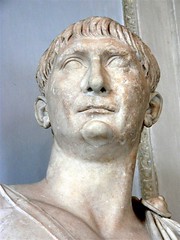
[Photo: My image of a bust of Trajan at the Capitoline Museum in Rome. All of my images are freely available for noncommercial use with attribution on Flickr]

"Under Roman rule Cyprus remained in peace or "pax romana" as it was known for over three hundred years until 115 AD. At this time the Jews inspired by a belief that the coming of their Messiah was imminent started a revolt against Rome on the Island. They were led by a man called Atermion a Jew who had taken a Greek name as was the custom at the time. There were hardly any Roman troops stationed in Cyprus at this time which explains why the revolt grew so quickly. The Roman emporer Trajan dispatched one of his generals to the Island and the rebellion was quelled. Historians say that 24,000 Jews were massacred on the Island by this roman army but there is a likelyhood that the actual numbers were significantly less. Following the revolt a decree was issued that Rome would forbid any Jew to ever set foot in Cyprus ever again even if shipwrecked." - Destinations

Livius.org gives us much more details:


The revolt started in Cyrene, where one Lukuas -sometimes called Andreas- ordered the Jews to destroy the pagan temples of Apollo, Artemis, Hecate, Demeter, Isis and Pluto, and to assail the worshippers. The latter fled to Alexandria, where they captured and killed many Jews. (With a population of some 150,000 Jews, Alexandria was Judaism's largest city.) In 116, the Jews organized themselves and had their revenge. The temples of gods like Nemesis, Hecate and Apollo were destroyed; the same fate befell the tomb of Pompey, the Roman general who had captured Jerusalem almost two centuries before.

Meanwhile, the Cyrenaican Jews plundered the Egyptian countryside, reaching Thebes, six hundred kilometers upstream. The future historian Appian of Alexandria records that he made a providential escape from a party of Jews pursuing him in the Nile marshes (more...). There was nothing the Roman governor Marcus Rutilius Lupus could do, although he sent a legion (III Cyrenaica or XXII Deiotariana) to protect the inhabitants of Memphis.

Trajan sent out two expeditionary forces. One, consisting of VII Claudia, restored order on Cyprus; the other was to attack Lukuas' rebels and was commanded by Quintus Marcius Turbo. The Roman general sailed to Alexandria, defeated the Jews in several pitched battles and killed thousands of enemies, not only those in Egypt but also those of Cyrene. It is unclear what became of Lukuas, except for the fact that according to our Greek source Eusebius he had styled himself 'king' (= Messiah?). After this war, much of northern Africa had to be repopulated. The emperor Trajan and his successor Hadrian confiscated Jewish property to pay for the reconstruction of the destroyed temples.

Trajan was afraid that this revolt would spread to the Jews in the rebellious eastern provinces. Perhaps, there was some cause for his anxiousness. After the end of the revolt in Mesopotamia, someone had written the Book of Elchasai, in which the end of the world was predicted within three years. Of course, Trajan did not read this book, but he may have sensed that the Jews remained restless.

Therefore, he ordered the commander of his Mauritanian auxiliaries, Lusius Quietus, to clean the suspects out of these regions. Quietus organized a force and killed many Cypriote, Mesopotamian and Syrian Jews - in effect wiping them out; as a reward, he was appointed governor of Judaea. (He is one of the few blacks known to have made a career in Roman service.) He was responsible for a forced policy of hellenization; in response, the rabbis ordered the Jewish fathers not to teach their sons Greek (Mishna Sota 9.14).

Meanwhile, Trajan had reached his military aims and returned home. On his way back, he fell ill, and not much later, he died (8 August 117). His successor Hadrian gave up the newly conquered countries and dismissed Lusius Quietus, who was killed in the Summer of 118."

We are supplied with the following sources:

The revolt against Trajan is the subject of a book by Marina Pucci, La rivolta Ebraica al tempo di Traiano (1981 Pisa). Another discussion of this rebellions can be found in Gedaliah Alon's The Jews in their land in the Talmudic age (1980 Harvard).

If you enjoyed this post, never miss out on future posts by following me by email!