Showing posts with label Roman emperor. Show all posts

Saturday, May 23, 2020

The consequences of lying

If liars are convicted of lying, they will suffer nothing worse than their actual lot, while if they succeed in deceiving you they will be rid of their present troubles. Yet surely such men as these, whether accusers or witnesses, should win no credit, when they have a great profit to make for themselves by their statements concerning others. Lysias. For Callias. Speech 5. Section 4.


Image: Geta (co-emperor with Caracalla) dying in his mother's arms by Jacques-Augustin-Catherine Pajou (1766-1828) courtesy of Wikimedia Commons contributor José Luiz Bernardes Ribeiro.
If you enjoyed this post, never miss out on future posts by following me by email!


Monday, March 12, 2012

Identifying Ancient Art - A game of smoke and mirrors?

History resource article by Mary Harrsch © 2012

Today, I watched a fascinating lecture "Mistaken Identities: How to identify a Roman emperor" by Mary Beard recently delivered at Stanford University.  As a "fan" of Julius Caesar, I thought her critique of a number of heads identified as Caesar over the years was very enlightening.

I also found her overall discussion of the rather tenuous nature of sculpture identification particularly interesting because lately, I have been re-editing a number of images I shot of Roman sculpture at the Capitoline and National Museums in Rome back in 2005.  I had just started my crusade to photograph historical art and make my images freely available to teachers, researchers and students and had not yet developed my current practice of photographing the identification placards in a sequence with the sculpture to enable me to properly identify the artwork once I returned home to my office.  So, on that first trip to Rome, I ended up with dozens of photographs that all I could say for sure were portraits of Roman men or women until I had a chance to research them further to label them properly.

With the internet and our current technology, I naively believed that proper identification would be a relatively straightforward process.  I have since learned that not only is it not straightforward, even what is thought to be accurate identification at the time changes as different scholars apply different interpretations or museums reliant on governmental support become subject to various political agendas seeking some kind of historical confirmation through a culture's art legacy.

It gets even more confusing when identification displayed at a museum differs from the museum's own collections catalog. I recently received a request from a publisher in Denmark for an image I took back in 2007 of a fresco at the Museo Archeologico Nazionale in Naples that, at the time, was labeled "Cleopatra greets the god of the Underworld'.  But, when I looked the image up in the collections book that I purchased at the museum, I noticed that it said it was Io being welcomed upon her arrival to Egypt by the goddess Isis to her sanctuary of Canopos.  The fresco was unearthed in 1764 in the Temple of Isis in Pompeii in a room dubbed the Ekklesiasterion.


The satyr-looking creature bearing up Io looks like it could be Hades but the catalog says it is a river god.  Io is identified by the vestiges of horns she still retains from her time as a heifer.  Isis appears to be dressed in the Greek fashion and holds a cobra coiled around her arm.  The catalog tells us that the painting originated from the court of the Ptolemies in Alexandria "in order to legitimize their dynasty by rooting it in ancient Heraclean and Argive origins which embraced the dual ethnic components of the new kingdom, the Egyptian and the Macedonian".  The fresco is thus dated to the the early Ptolemaic dynasty after a 3rd century BCE prototype .  This all sounds quite carefully researched and definitive.  However, there is no mention of technical dating examinations so I must assume this is educated conjecture.  The only thing that nags at me is the prominent display of the cobra and the knowledge that the fresco was apparently once thought to represent Cleopatra VII in the role of Isis.

In the historical record, Cleopatra VII represented herself as the living embodiment of Isis and the cobra was known to be not only a sacred creature but a pharaonic symbol.  When I check the "king's list" of the Ptolemaic Dynasty, I find a few females mentioned as co-rulers, usually regents for under-age male inheritors, beginning with Cleopatra II Philometora Soteira in 131 BCE, but you really don't find a woman ruling with the trappings of pharaoh until you reach Cleopatra VII in 51 BCE.  So the possibility that Cleopatra VII as Isis is the welcoming figure in the fresco cannot be totally dismissed.  I also can't help but think the widespread publicity surrounding Cleopatra and her death by the bite of a cobra in the 1st century BCE could easily have influenced a Roman artist charged with decorating the walls of a temple to Isis in Pompeii during that period.

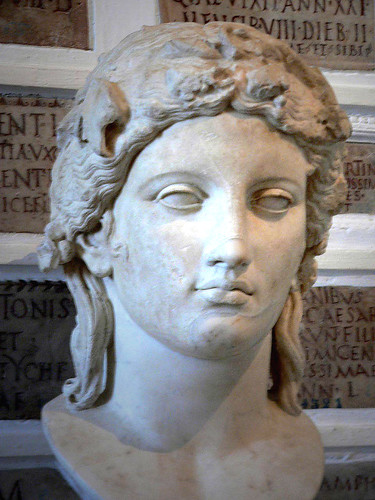
Another confusing identification I encountered recently was a picture of a sculpture said to be Apollo of the Anzio type at the Capitoline Museum:


Call me crazy but it looks like remnants of grapes and grape leaves in the hair which would make me think it was Dionysos.  Many sculptures of Apollo also have an iconic knot in the hair on top of the head so I am baffled by the identification associated with this piece.

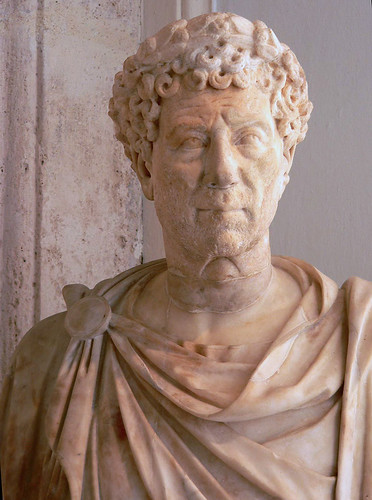
Reviewing my images from the Hall of Emperors in the Capitoline Museum, I came across the following bust:


After reviewing hundreds of images of Roman emperors (or said to be Roman emperors), I cannot find a single one that looks like him.  He appears to be wearing a laurel crown and in 2005 was positioned close to the busts of  Vespasian, Domitian and Titus (based on the photo time stamp).  This would make me think he may have been one of the emperors in the Year of the Four Emperors after the assassination of Nero but I checked images of Otho, Galba and Vitellius and he doesn't resemble any images identified as them.  Although I thought the museum positioned busts in relationship to the sequence of their reigns, this may not be the case either.  So, I would appreciate any information anyone could offer that would help identify this Roman.  


Enhanced by Zemanta
If you enjoyed this post, never miss out on future posts by following me by email!


Sunday, April 13, 2008

Equestrian Statue Fragment Found Near Colosseum


"A fragment of an ancient Roman equestrian statue that once adorned the Colosseum has been found during excavations near the world famous Italian landmark.

According to the Italian daily, Il Messaggero, the fragment was discovered among the remains of an ancient pavement that once surrounded the amphitheatre.

"A marble fragment measuring one metre by a metre and a half, is from an equestrian statue, probably a statue that embellished the arches of the Colosseum," said archaeologist Silvana Rizzo, advisor to the minister of culture and tourism, Francesco Rutelli.

"The left flank of a rider with the detail of a leg, bridle and harness of a horse, as well as a part of a dagger scabbard are perfectly visible from the fragment," said Rizzo, who has spent his life doing Roman excavations.

"They are details that suggest the statue of an emperor and left us with the hope that we could find the entire statue."

Update: "Two days later the head of a male statue was discovered, both of which had been only 50cm below the surface. According to archaeologists the piece of the equestrian statue suggests one of an emperor due to its size and most likely adorned the arch over the imperial entrance. The head is too small to be that of the rider of the horse in the equestrian statue."
If you enjoyed this post, never miss out on future posts by following me by email!


Thursday, March 20, 2008

Artifacts ripped from Trajan's Villa recovered from wealthy engineer


Roman mosaics are among my favorite art forms so this article made me shudder.

"Police seized some 1,000 ancient artifacts from a wealthy Italian man's country house outside Rome that were stolen from one of Emperor Trajan's villas, prosecutors said Wednesday.

Authorities contend the artifacts, which were being used to decorate the man's weekend residence, were ripped off the walls of what is believed to be Trajan's hunting retreat in Arcinazzo Romano, a town in the countryside outside Rome.

Some were stolen from boxes of fragments that archaeologists had excavated from the villa but had left at the site of the ongoing dig, prosecutors told a news conference.

Pieces of ancient Roman mosaics were inserted into the man's basement floor and his fireplace and bathroom were decorated with other pieces, authorities said.

Many of the artifacts were damaged by glue that he apparently used to stick them to transparent display supports, said Marina Sapelli Ragni, Lazio's superintendent for archaeology. Restorers would try to repair the damage, she said.

Among the loot are pieces of marble that once covered the sprawling villa in the upper Aniene River valley in Lazio. The villa has only been partially excavated."

If you enjoyed this post, never miss out on future posts by following me by email!


Sunday, March 9, 2008

Villa of Augustus on Palatine Hill Now Open To The Public

Exquisitely preserved frescoed rooms in the ruined house of Augustus, the first Emperor of Rome, were opened to the public today for the first time since they were unearthed nearly half a century ago.

Archaeologists say that the future emperor lived in the house on the Palatine Hill above the Forum in about 30BC, before he gained supreme power and built his imperial palace complex higher up the hill. The paintings have been restored at a cost of nearly €2 million (£1.5 million).

The wall and ceiling paintings in the house - discovered in the 1960s by the Italian archeologist, Gianfilippo Carrettoni - are in vivid red, blue and ochre. They include a small study, believed to have been Augustus's private retreat...

Some decorations on the walls and vaulted ceilings were found intact, while others have been pieced together from fragments. In one room, dubbed the Room of the Pines, the walls are painted to represent yellow columns.

In another, known as the Room of the Masks, a wall is painted like a stage, with narrow side doors standing ajar, comic masks peering through small windows and painted garden vistas beyond.

Visitors will enter the rooms in small groups to avoid damage to the delicate frescoes, restored after 20 years of excavation and conservation at the site by a team led by Irene Jacopi, the archaeologist in charge of the Palatine Hill.

Angelo Bottini, superintendent of archeology for Rome, said that a new combined ticket would provide access to the Roman Forum, the Colosseum, and the Palatine Hill, including the house of Augustus.

If you enjoyed this post, never miss out on future posts by following me by email!


Monday, December 31, 2007

Nero Treasure Trove in Lombardy?

Although this item is a little dated, I encountered a reference to it and did not remember reading the original article.

"Traces of a legendary treasure trove left by the infamous Roman Emperor Nero have been found at this northern Italian city.Half a million artefacts have emerged in a three-year dig at a patrician villa that appeared during the construction of a multi-storey car park.Among these, a handful of precious fragments are believed to have come from the fabulous array of riches the emperor assembled from all over the empire before his death in 68 AD.According to Roman historians, Nero's treasure was lost when his successor Vespasian wiped out all traces of the unpopular emperor in Rome - covering his fabled Golden House in rubbish and building the Colosseum in its grounds.But there has been repeated speculation that parts of the magnificent trove were smuggled out of Rome during a civil war in the Year of the Four Emperors (Galba, Otho, Vitellius and Vespasian) in 69 AD.According to Lombardy's archaeological superintendent, Lynn Passi Pitcher, "Otho probably snatched precious objects from the Domus Aurea - objects which then came into the possession of Vitellius after his victory over Otho and the sack of Cremona"."They somehow ended up here in the house of this affluent Cremona patrician," she said." - Italy.News.Net

I wonder where the artifacts are now?
If you enjoyed this post, never miss out on future posts by following me by email!


Monday, December 17, 2007

Palace of the Emperor Augustus to Reopen


I'm so excited to see this note. My friend Richard White had previously toured the Palatine Hill and told me there wasn't much to see there. This will probably change his mind!

"Emperor Augustus' frescoed palace atop Rome's Palatine Hill, one of the city's famous seven hills, will partially reopen to the public March 2 after decades of restoration work, officials said Monday.

Since the palace was closed in the 1980s, experts have spent at least $17.6 million to restore the porticoed garden of Rome's first emperor and piece together precious frescoes that time had reduced to fragments. The palace was built in the first century B.C.

Groups of up to 10 people will be guided through the decorative marvels in Augustus' studio and in the hall where the emperor received guests, as well as rooms in the nearby palace built for his wife, Livia.

"We can finally enter into these places that have been preserved for some 2,000 years," said Rome Mayor Walter Veltroni.

Restoration of other parts of the residence will continue, officials said."

If you enjoyed this post, never miss out on future posts by following me by email!


Friday, August 17, 2007

Lebanese play "Zenobia" draws cultural and historical parallels

A history resource article by  © 2007

Queen Zenobia's Last Look Upon Palmyra, by Herbert Gustave Schmalz
Image courtesy of Wikimedia Commons
This play sounds fascinating! I am presently reading The Chronicle of Zenobia by Judith Weingarten so the characters portrayed in this performance are known to me. Zenobia's leadership in a culture where women were seldom seen and not officially heard is nothing short of miraculous. Her adaptability is even more amazing as, unlike her distant relation Cleopatra, Zenobia endured being the captured prize in a Roman triumph and even later married a Roman senator. I wish I could see this play. I wonder if anyone has thought about filming it?

"History is a mirror of the future," says Oussama Rahbani. "If you don't have a history, you don't have a future." It was with this notion of embracing the past in order to greet the future that Lebanese composer Mansour Rahbani, in collaboration with his sons Marwan, Oussama, and Ghady Rahbani, created the epic musical "Zenobia," which opened a five-night run on Wednesday evening for the Byblos International Festival, in the old port city north of Beirut.

Though in many ways a tragedy, ending in defeat and suicide, the play is at heart a celebration - of culture, music and freedom, and, perhaps more forcefully, of the strength, determination and ferocity of the female spirit.

What makes "Zenobia" enveloping and believable is the plot's adherence to the play's historical foundation. Zenobia was the third-century queen of Palmyra, an oasis in the desert of central Syria fueled by caravans snaking along the Silk Road. Sandwiched between the two great powers of the day, the Persians to the east and the Romans to the west, the city was caught between two empires jockeying for position. Palmyra became a Roman province in the first century.

A head said to represent Odenathus in the Palmyra
Museum.  Image courtesy of Wikimedia Commons.
When her husband Odenathus was murdered along with his heir, Zenobia, ruling in the stead of her young son Vaballathus, rebelled against Rome. She was eventually defeated and hauled off to answer for her defiance but not before liberating greater Syria, Palestine and parts of Egypt.

With this historic episode as a reference, the Rahbanis succeed in fabricating a performance of savory meaning and depth. This is not to say that they do it alone - close to 100 actors and actresses took the stage on Wednesday night, with a supporting army of technicians, designers, choreographers and assistants - but the creative energy behind the production is exemplary of the quality of theater Lebanese audiences have come to expect from a Rahbani production.

The play opens with a dream sequence in which Zenobia, played by Carole Samaha, receives a prophecy from Cleopatra that she will be ruler of the East. In reality Cleopatra was Zenobia's idol - she even claimed to have descended from her as Zenobia's mother hailed from Egypt. But in the play, Cleopatra takes on the additional role of Zenobia's subconscious, mentor and, at times, tormentor.

Odenathus, the king of Palmyra, returns with the army from a victorious battle against the Persians. While Zenobia asserts that the victory belongs to Palmyra and not Rome, her counselor Longinus - modeled after the queen's real-life advisor, the philosopher and rhetorician Cassius Dionysius Longinus - tries to convince her to break away from Rome. Zenobia is reluctant to cut the alliance, even though she remains intensely tethered to the East.

This state of affairs does not last long, however. Odenathus travels to Emesa (modern day Homs in Syria) against the advice of Zabdai (played by Ghassan Saliba), the leader of Palmyra's army. There the king is betrayed by his nephew Ismail Maeonus, who, after killing Odenathus and his son, declares himself "the king of kings."

Zenobia, who now fears that her city will be trampled underfoot by the Persians and Romans alike, takes charge and vows to extend her territory into Asia Minor and up to the gates of Rome itself."

More about Zenobia:

A Kindle preview:


More suggested reading:

If you enjoyed this post, never miss out on future posts by following me by email!


Wednesday, July 25, 2007

Julian the Apostate's support of the Jews

A history resource article by  © 2007

Julian the Apostate presiding at a conference of sectarians by Edward Armitage, 1875.  Image courtesy of
Wikimedia Commons.
I found this article about Julian's support for the reconstruction of the Jewish Temple in Jerusalem quite interesting. I have read Michael Curtis Ford's "Gods and Legions", a novel about the life and reign of the emperor Julian and gained an admiration for this "soldier, inspired military commander and rhetorician" despite the centuries of vilification heaped upon him by subsequent Christian rulers.

"The Roman Emperor Julian, who ruled 361-363 CE, called on the Jews to return to the Land of Israel and rebuild their Temple in Jerusalem. Whatever his motives, he showed our ancestors unusual respect and understanding. 
Julian was hardly an ordinary emperor, though history has failed to pay sufficient attention to his policies. In Julian, the Romans had a just ruler and brave soldier. He was a modest man who labored to relieve the distress of his subjects while endeavoring to connect authority with merit and happiness with virtue. 

A bronze coin portrait of the Emperor Julianus II (the Apostate)

As a young soldier Julian subdued, against the odds, the German threat in Gaul with a small force. He ruled ancient Gaul with wisdom and authority, hardly ever seeking a personal gain. He slept on the ground with his legionnaires, earning their respect. Julian was an excellent organizer, an honest judge, a writer and a philosopher. 
Brought up as a Christian, Julian rejected the religion and turned back to the paganism of Greek and Roman days. He argued that Christianity would weaken and ultimately destroy the Roman Empire. As a result, he attempted to restore Hellenism, which earned him everlasting Christian disdain. 
Known to Christians as Julian the Apostate, the emperor restored pagan temples and the cult of the old Roman gods. These were to be served by a reform-minded pagan clergy with high moral character, who would compete with the Christian clergy in meeting the religious needs of the people. 
Julian remains famous for having declared absolute freedom for all religious beliefs - making him perhaps the first leader to extend toleration of religion to all Romans. 
ON THE July 19, 362 C.E., Julian left Constantinople and arrived in Antioch to prepare for the invasion of Persia. However busy he must have been, he met with "the chiefs of the Jews." 
The details of this fascinating meeting, preserved only in Christian sources, are cited in Michael Avi Yona's The Jews under Roman and Byzantine Rule - A Political History from the Bar Kochba War to the Arab Conquest. 
Julian, who wanted to form a common cause with the Jews against Christianity, asked: "Why do you not sacrifice to God, as required by the laws of Moses?" 
The Jews replied: "We are not allowed by our laws to sacrifice outside our Holy City. How can we do it now? Restore to us the City, rebuild the Temple and the altar, and we shall offer sacrifices, as in days of old." 
He promised: "I shall endeavor with the utmost zeal to set up the Temple of the Most High God." 
THE RESTORATION of the Jewish Temple in Jerusalem would, in Julian's opinion, defeat the Christian argument of replacement theology - that the Church was the true Israel, and that the Temple's destruction and the subsequent exile was the just punishment suffered by the Jewish people for the Crucifixion. The Temple's restoration, Julian figured, would persuade Christian converts that God still favored the Jewish people. 
As an army commander, embarking on a war against a formidable Persian enemy, Julian could also expect that the Jews of Mesopotamia would assist his legions. But there can also be no doubt that Julian's attitude of fairness and his respect for the stubborn stand of the Jewish remnant played a role in his desire to achieve a Jewish restoration. 
In his "Four Letters" addressed to the Jewish people, Julian recognized their dire situation and appealed to them to join him in his campaign. That's a vast difference from the Persian ruler Cyrus, who had only allowed the Jews to rebuild the Temple; Julian virtually ordered them to do so, and perhaps, upset by their initial hesitation, appointed Alypius, a pagan native of Antioch and his best friend, to supervise the work. 
In a letter to the Jewish Patriarch Hillel II, residing in Tiberias, Julian abrogated the entire gamut of anti-Jewish legislation and recognized Jewish authority in Israel, including the right to levy taxes. 
ACCORDING TO the Christian sources, there was considerable initial enthusiasm among the Jews of Diaspora. Many purses were opened. But other leading Jews were confused and apprehensive. The community had only recently suffered yet another painful defeat in the failed uprising against Gallus (351 C.E.), which erupted in protest against discriminatory anti-Jewish legislation. The Patriarchate had lost Lydda, the few remaining settlements in Judea and several vital Galilean villages. 
A 354 CE sketch of Constantius Gallus.  Image courtesy of Wikimedia Commons.

The people quoted a verse from Daniel (11:34): "Now when they shall stumble, they shall be helped with a little help; but many shall join themselves unto them with blandishments." 
The Jews were doubtless divided between those who believed that Julian was a savior and those who remembered Rabbi Simon Ben Eliezer's warning against the youthful enthusiasm of the second generation after the Bar Kochba disaster: "If children tell you: 'Go, build the Temple - do not listen to them.'" 
Above all, could Jewish hopes depend on the fortunes of one man? 
In the end, no attempt was made to set up a temporary altar and offer sacrifices on the former Temple grounds, as the Maccabeans had done. While the Jews could not oppose the will of the Roman emperor, they could drag their feet. Apparently the majority did. They remembered Rome as Amalek, not as a benefactor. 
THE WORK ordered on the Temple's foundation advanced slowly. It took time to provide silver spades and pickaxes, since no iron was allowed to be used. And then, according to the Roman writer Ammianus, "balls of fire" supposedly erupted from the foundations and rendered the place inaccessible. 
The Christian majority of Jerusalem described this fire in glowing terms, as a splendid miracle, a further proof of the rightness of Christianity. The Jews suspected Christian arson. Meanwhile Alypius, Julian's pagan friend, seemed hardly in a hurry to carry out the emperor's order."
A Kindle preview of "Gods and Legions" by Michael Curtis Ford:


More suggested reading:


If you enjoyed this post, never miss out on future posts by following me by email!