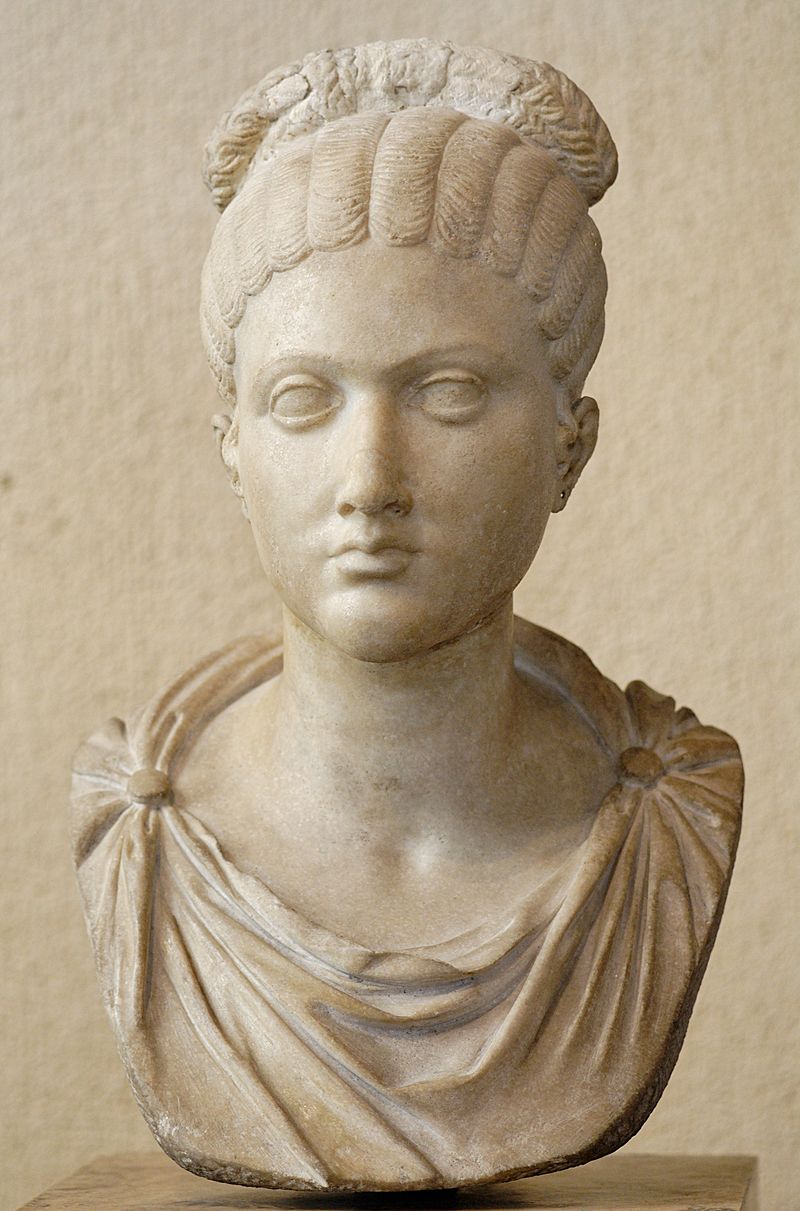
Showing posts with label Julia Domna. Show all posts

Saturday, April 10, 2021

Julia Domna and the Severan Prophecy

Julia Domna was born in Emesa (present-day Homs) in Roman Syria, the youngest daughter of the high priest of Baal, Julius Bassianus. The family had enormous wealth and was promoted to Roman senatorial aristocracy. Before her marriage, Domna also inherited the estate of her paternal great-uncle, Julius Agrippa, a former leading centurion. 

In 187 CE, she married Severus, who at the time was governor of the Roman province of Gallia Lugdunensis. The Augustan History relates that, after losing his first wife around 186 CE, Septimius Severus heard a prophesy of a woman in Syria who would marry a king. So Severus sought out Domna from one of Syria's most prominent families as his wife.

As empress, Domna was famous for her political, social, and philosophical influence. She received titles such as "Mother of the Invincible Camps" because, unlike most imperial wives, Domna remarkably accompanied her husband on his military campaigns and stayed in camp with the army. After the elder of her sons, Caracalla, started ruling with his father, she was briefly co-empress with Caracalla's wife, Fulvia Plautilla, until the latter fell into disgrace. Following the death of Severus in 211, Domna became the first empress dowager to receive the title combination "Pia Felix Augusta", which may have implied greater powers being vested in her than what was usual for a Roman empress mother. 

Domna is said to have committed suicide in 217 CE upon hearing of her son Caracalla's assassination in the course of his campaign against Parthia, on which she had accompanied him as far as Antioch (present-day Antakya, Turkey).


Image: A Severan Period mold-made lamp, 2nd century CE, terracotta, at the J. Paul Getty Museum (Villa).  This unusual moldmade lamp depicts  a woman dressed in a long-sleeved garment standing next to a truncated column, playing a harp, which leans on her shoulder. Her hairdo is similar to a style worn by Empress Julia Domna, wife of Septimius Severus . The Filling-hole is on top of the instrument and the wick-hole pierces its base. 


If you enjoyed this post, never miss out on future posts by following me by email!


Monday, December 28, 2020

Melon hairstyles and mummy masks of the Roman Period

 Plaster Romano-Egyptian mummy masks of the 1st - 2nd century CE appear to be individualized, much like the famous mummy portraits of the Faiyum region. But, in fact, most were made in a mold.  Distinguishing details were added while the plaster was still moist with a spatula or knife. Ears were added separately and, sometimes, eyes were inlaid then the mask painted or gilded.

"This woman's waved hairstyle is based on Roman court fashion, but three hanging corkscrew curls behind the ears and a short fringe of curls over the forehead and in front of the ears seem to reflect a local style. Toward the back of her head, above her ears, are traces of a smooth area that once represented a pillow. In general earlier Roman-period masks such as this one show the deceased as if reclining on a bier with the head on a pillow, while later masks have the head raised as if the deceased is rising from the bier. The underneath edge of this example is flat where it is meant to be attached to a body covering of wood or other materials." - Metropolitan Museum of Art.

The "melon" hairstyle used to cap the top of the head of this woman appeared in Greece before the 3rd century BCE.  In Egypt, it was worn by the Ptolemaic queens Arsinoe II and Berenice II.  More "masculinized" portraits of Cleopatra VII, such as the one that appeared on a 1st century BCE silver denarius,  feature a melon hairstyle. Roman women are thought to have copied the hairstyle, especially after Cleopatra's visit in 46 and 44 BCE. But, it fell out of favor when Octavian declared war on Cleopatra. Although the hairstyle was eventually replaced by the lavish Flavian hairstyles for a time, it reappeared during the Antonine period, most notably on portraits of Julia Domna, wife of Septimius Severus. It continues to be shown on female portraits through the 3rd century CE. 


Mummy mask of a woman with corkscrew locks and bang, 50–150 CE, Roman Period Egypt at the Metropolitan Museum of Art in New York. 


Roman female portrait of the 1st century BCE at The Louvre, courtesy of Wikimedia Commons contributor Marie-Lan Nguyen.


If you enjoyed this post, never miss out on future posts by following me by email!