A
history resource article by
Mary Harrsch ©
2015
A recently published article, "Has the diagnosis of a stroke been overlooked in the symptoms of Julius Caesar", by Francesco M. Galassi and
Hutan Ashrafian of
Imperial College London, has generated quite a bit of interest both in the media and among historians. As Julius Caesar has always been one of my research interests, I contacted Dr. Ashrafian and requested a copy of the full article, after reading a synopsis in the mainstream media.
In the article, I learned that the medical community has, in the past, relied on only two episodes of Caesar falling, one at
Cordoba and another at
Thapsus, along with ancient sources referring to Caesar as having the "falling sickness", as the basis for acceptance of the diagnosis of epilepsy. Drs. Galassi and Ashrafian point out that an analysis of the symptoms indicates that cerebrovascular insults and stroke should be considered, especially in view of other behavioral symptoms reported by the ancient sources.
"Caesar also suffered from other symptoms including depression and personality changes (exampled by emotional lability when listening to a moving oration by Cicero), which may also be consistent with cerebrovascular disease." - Francesco M. Galassi, Hutan Ashrafian,
Has the diagnosis of a stroke been overlooked in the symptoms of Julius Caesar?, Neurological Sciences, March 2015
The researchers go on to point out that Caesar's father and great grandfather had both died suddenly without apparent cause.
"This has been explained by some in terms of
SUDEP (sudden unexpected death in epilepsy); however, these events can be more readily associated with the cardiovascular complications of stroke episode or a lethal myocardial infarction. Even if Caesar participated in an active lifestyle and may have benefited from an environmental background of a Mediterranean diet, there is the added possibility of genetic predisposition towards cardiovascular disease." Francesco M. Galassi, Hutan Ashrafian,
Has the diagnosis of a stroke been overlooked in the symptoms of Julius Caesar?, Neurological Sciences, March 2015
I think the researchers make very important points but I thought it would be even more illuminating to examine a more extensive case history. Since we don't have a lot of information about Caesar's symptoms in the ancient sources, I decided to examine the much more detailed information we have, thanks to
Nicolaus of Damascus and
Suetonius, about the health of
Augustus, since he, too, was said to have the "falling sickness" and was a blood relative of Caesar.
 |
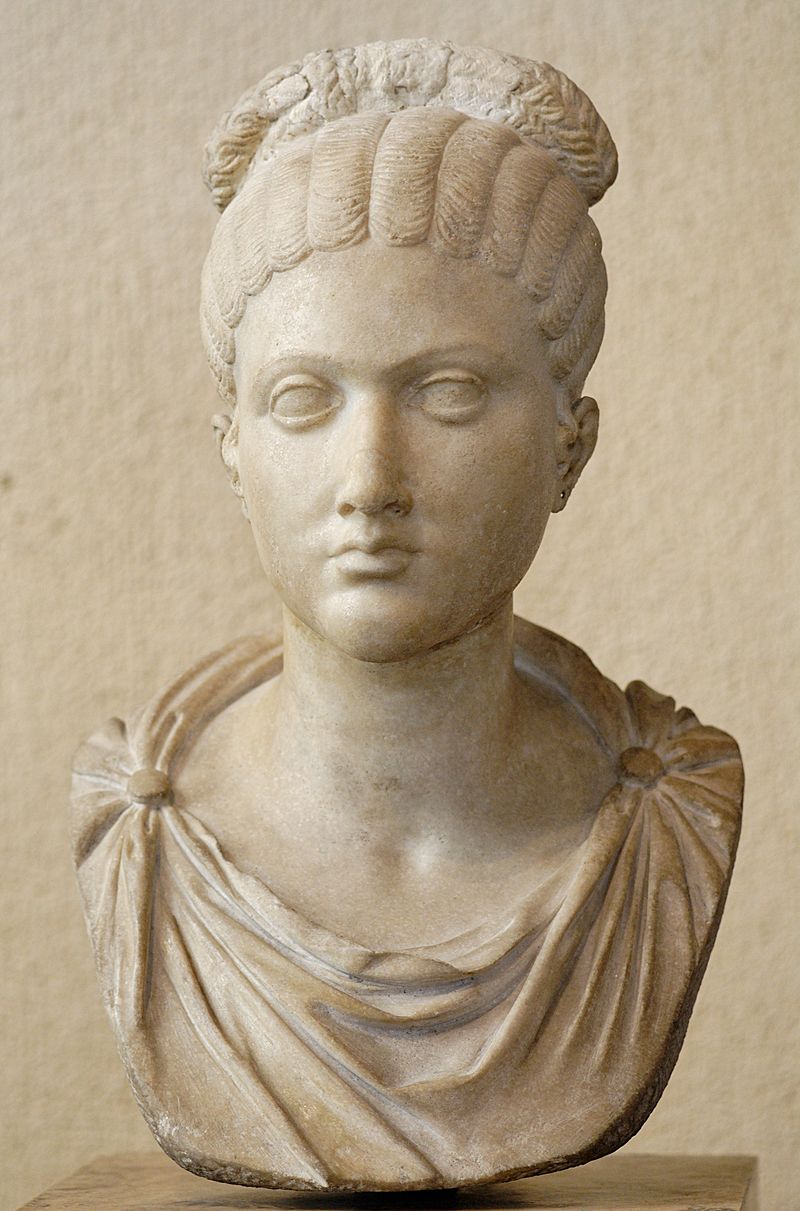
Augustus as Pontifex Maximus (High Priest).
Photographed at the Palazzo Massimo venue
of the National Museum of Rome, Rome, Italy
by Mary Harrsch © 2009 |
Caesar had only two siblings, sisters, both named Julia. Sadly, little is known about either Julia so we have no definitive health information about them.
Julia the Younger married
Marcus Atius Balbus and had either three or two daughters (depending on which source you read). Her second daughter named Atia married
Gaius Octavius and bore him a son, Octavian (later called the emperor Augustus) and a daughter named
Octavia the Younger.
We know from the ancient sources that Octavian, like Caesar, was thought to have the "falling sickness". We also know that his sister, Octavia, was said to have "fainting episodes".
Although most women, including Octavia, were practically ignored by ancient historians,
Aelius Donatus, in his
Life of Virgil, recalls at least one of Octavia's "fainting episodes.
"...
Virgil recited three whole books [of his
Aeneid] for Augustus: the second, fourth, and sixth--this last out of his well-known affection for Octavia, who (being present at the recitation) is said to have fainted at the lines about her son, "… You shall be Marcellus" [Aen. 6.884]. Revived only with difficulty, she sent Virgil ten-thousand sesterces for each of the verses."
Marcellus was Octavia's son who had recently died suddenly at a very young age. Although Octavia may have had a simple fainting episode due to her intense grief, the fact that she was "revived only with difficulty" points to a more serious underlying health issue.
So, we appear to have two siblings that both suffer periods of unconsciousness.
Augustus had only a single daughter, Julia. Julia was first married to her first cousin, Marcellus (Octavia's son by her first husband,
Gaius Claudius Marcellus Minor). Marcellus died two years later and the union produced no children - probably very fortunate since the couple had parents on both sides with possible seizure issues).
Then Julia was married to
Marcus Vipsanius Agrippa and bore five children. One of them,
Vipsania Agrippina would become the mother of the
Emperor Gaius (Caligula) when she married
Germanicus, Octavia's grandson. (those afflicted family lines cross again!)
 |
Marcus Vipsanius Agrippa. Photographed at
The Musée du Louvre in Paris, France by
Mary Harrsch © 2008 |
Octavia, Augustus' apparently afflicted sister, had two children with her second husband,
Marc Antony -
Antonia the Elder who became grandmother to the Emperor Nero, and Antonia the Younger who was mother to the
Emperor Claudius, grandmother to the Emperor Gaius (Caligula) and the great-grandmother to the
Emperor Nero. The ancient sources refer to all of these Julio-Claudian emperors as having the "falling sickness".
Research has shown that heart defects like
atrial septal defect, a hole between the two upper chambers of the heart, can be inherited by successive generations within a family group. It has also been shown that such defects can be transmitted through
multifactorial inheritance (just like epilepsy), not just simply through the
Mendelian Law of Dominance, the expression of a dominant or combination of recessive genes.
"When the defect is determined by a single gene difference, the risk to the unborn can be predicted from the Mendelian laws and does not change with successive children, but in a multifactorial system, the risk to the unborn increases with the number of relatives affected." - James J. Nora, M.D., Dan G. McNamara, M.D., and F. Clarke Fraser, M.D., Ph.D.,
Hereditary Factors in Atrial Septal Defect, Circulation Vol. XXXV, March 1967.
The study referenced above focused on atrial septal defects because it is the most common congenital heart defect encountered in adults. Untreated atrial septal defect in adults is characterized by shortness of breath with minimal exercise (because of lower than normal oxygen levels in the lungs), congestive heart failure, and/or cerebrovascular accident (stroke).
Stroke results in an individual with ASD when a blood clot forms in a vein, dislodges and enters the arterial system rather than traveling to the lungs as it would in an individual with a normal dividing wall (
interatrial septum) between the two upper chambers of the heart. This can cause any phenomenon that is attributed to acute loss of blood to a portion of the body, including cerebrovascular accident (stroke), infarction of the spleen or intestines, or even a distal extremity (i.e., finger or toe). This is known as a paradoxical embolus because the clot material paradoxically enters the arterial system instead of going to the lungs.
So, with a heart defect and associated cerebrovascular accidents in mind, let's see what Octavian's health history reveals.
Like Caesar, Octavian lost his father from unexplained sudden death at a relatively young age. His father, like Caesar's father, also appeared to be physically robust just prior to sudden death.
"Macedonia fell to his [Gaius Octavius'] lot at the end of his praetorship; on his way to the province, executing a special commission from the senate, he wiped out a band of runaway slaves, refugees from the armies of Spartacus and Catiline, who held possession of the country about Thurii. In governing his province he showed equal justice and courage; for besides routing the Bessi and the other Thracians in a great battle, his treatment of our allies was such, that Marcus Cicero, in letters which are still in existence, urges and admonishes his brother Quintus, who at the time was serving as proconsular governor of Asia with no great credit to himself, to imitate his neighbour Octavius in winning the favour of our allies."
While returning from Macedonia, before he could declare himself a candidate for the consulship, he died suddenly..." - Suetonius, The Lives of the Caesars,
The Life of Augustus, 3:1
We already know that Octavian's grandmother's father (Julius Caesar's father) suffered sudden unexplained death as did her great great grandfather. We have no health history for his mother or his grandmother but we do know from modern research that heart defects are expressed more often in females than males so there is a strong possibility that his mother and/or his grandmother inherited some form of defect from their fathers.
The degree of debilitation in Octavian's case, if caused by an inherited cardiac-related condition, was compounded by his own father's probable predisposition to a heart disorder as well as an inherited condition from Caesar's father through Caesar's sister to Octavian's mother, Atia.
Then, when we examine the symptoms recorded by Augustus' biographers, particularly Nicolaus of Damascus and Suetonius, we find numerous suggestions of a cardiac-related condition resulting in pathology from apparent cerebrovascular accidents.
At the age of 14, Octavian donned the
toga virilis and was immediately elected to the college of priests because of the death of Lucius Domitius. But contemporary biographer Nicolaus of Damascus reports that Octavian's mother, Atia, watched over him closely and took care of him as if he was still a child.
 |
Preparations for a Roman ritual sacrifice depicted on Trajan's Column in Rome.
Photographed by Mary Harrsch. © 2009. |
"He entered the Forum, aged about fourteen, to put off the toga praetextata and assume the toga virilis, this being a token of his becoming registered as a man. Then while all the citizens looked upon him, because of his comeliness and very evidently noble descent, he sacrificed to the gods and was registered in the sacred college in place of Lucius Domitius, who had died. The people indeed had very eagerly elected him to this position. Accordingly, he performed the sacrifice, adorned with the toga virilis and at the same time the honors of a very high priestly office."
"Nevertheless, though he was registered as of age according to law, his mother would not let him leave the house other than as he did before, when he was a child, and she made him keep to the same mode of life and sleep in the same apartment as before. For he was of age only by law, and in other respects was taken care of as a child." - Nicolas of Damascus,
Life of Augustus, 4.
This could be an example of a smothering parent but we see that Octavian also seemed to avoid climbing steep stairs:
"He went to the temples on the regular days, but after dark on account of his youthful charm, seeing that he attracted many women by his comeliness and high lineage; though often tempted by them he seems never to have been enticed. Not only did the watchful care of his mother, who guarded him and forbade his wandering, protect him, but he too was prudent now that he was advancing in age. During the Latin festival when the consuls had to ascend the Alban Mount to perform the customary sacrifices, the priests meanwhile succeeding to the jurisdiction of the consuls, Octavius sat on the Tribunal in the center of the forum." - Nicolaus of Damascus,
Life of Augustus, 4.
When Caesar returned from Egypt and Syria and was planning his African campaign in Libya, Octavian wanted to go with him.
 |
| Triumphs of Caesar by Andrea Mantegna, Italian, circa 1485-1494 |
"Caesar had by this time completed the wars in Europe, had conquered
Pompey in Macedonia, had taken Egypt, had returned from Syria and the Euxine Sea, and was intending to advance into Libya in order to put down what was left of war over there; and Octavius wanted to take the field with him in order that he might gain experience in the practice of war. But when he found that his mother Atia was opposed he said nothing by way of argument but remained at home. It was plain that Caesar, out of solicitude for them, did not wish him to take the field yet, lest he might bring on illness to a weak body through changing his mode of life and thus permanently injure his health. For this cause, he took no part in the expedition. " - Nicolaus of Damascus,
Life of Augustus, 6.
When Caesar returned from Africa, he asked Octavian to accompany him to many social functions including temple sacrifices, theater performances and banquets as if Octavian was his own son. But again, Octavian was stricken with serious illness:
"Caesar wished Octavius to have the experience of directing the exhibition of theatrical productions (for there were two theaters, the one Roman, over which he himself had charge, and the other Greek). This he turned over to the care of Octavius. The latter, wishing to exhibit interest and benevolence in the matter, even on the hottest and longest days, never left his post before the end of the play; with the result that he fell ill, for he was young and unaccustomed to toil. Being very ill, everyone felt considerable apprehension regarding him, lest a constitution such as his might suffer some mishap, and Caesar most of all. Accordingly, every day he either called himself and encouraged him or else sent friends to do so, and he kept physicians in continuous attendance. On one occasion word was brought to him while he was dining that Octavius was in a state of collapse and dangerously ill. He sprang up and ran barefooted to the place where the patient was, and in great anxiety and with great emotion questioned the physicians, and he sat down by the bedside himself. When Octavius' full recovery was brought about, he showed much joy." - Nicolaus of Damascus,
Life of Augustus, 9.
When Caesar planned to go to Spain to engage the sons of his former rival Pompey, he tells Octavian, who is still weak, to join him when he is well enough.
"While Octavius was convalescent, still weak physically though entirely out of danger, Caesar had to take the field on an expedition in which he had previously the intention of taking the boy. This however he could not now do on account of his attack of sickness. Accordingly, he left him behind in the care of a number of persons who were to take particular charge of his mode of life; and giving orders that if Octavius should grow strong enough, he was to follow him, he went off to the war. The eldest son of Pompeius Magnus [
Gnaeus Pompeius] had got together a great force in a short time, contrary to the expectations of everyone, with the intention of avenging his father's death, and, if possible, of retrieving his father's defeat. Octavius, left behind in Rome, in the first place gave his attention to gaining as much physical strength as possible, and soon he was sufficiently robust." - Nicolaus of Damascus,
Life of Augustus, 10.
However, when Octavian returns to Rome, his health still seems to be problematic and he seems to avoid physical exertion.
"Octavius lived soberly and in moderation; his friends know of something else about him that was remarkable. For an entire year at the very age at which youths, particularly those with wealth, are most wanton, he abstained from sexual gratification out of regard for both his voice and his strength." - Nicolaus of Damascus,
Life of Augustus, 15.
 |
| Assassination of Julius Caesar by William Holmes Sullivan (1836-1908). |
When Caesar is assassinated, Octavian takes up the challenge to avenge his adopted father and assume his rightful place as heir to both Caesar's fortunes and ambitions. But his health is still fragile.
At the battle of
Mutina when Octavian's forces beseiged
Decimus Brutus, one of the conspirators in the assassination of Caesar, Marc Antony claims " he took to flight and was not seen again until the next day, when he returned without his cloak and his horse." Although this incident could have been a loss of nerve, his following actions do not support a lack of courage.
"but in that which followed all agree that he played the part not only a leader, but of a soldier as well, and that, in the thick of the fight, when the eagle-bearer of his legion was sorely wounded, he shouldered the eagle and carried it for some time. " - Suetonius, The Lives of the Caesars,
The Life of Augustus, 10:1
Although Suetonius also claims Augustus did not lack the gift of speaking offhand without preparation, he points out that after the battle of Mutina the young Octavian never again addressed the people or soldiers without reading from a written manuscript.
"Even his conversations with individuals and the more important of those with his own wife
Livia, he always wrote out and read from a notebook, for fear of saying too much or too little if he spoke offhand." Suetonius, The Lives of the Caesars,
The Life of Augustus, 84:1
Illness struck him down again at the
battle of Philippi:
"Then, forming a league with Antony and
Lepidus, he finished the war of Philippi also in two battles, although weakened by illness, being driven from his camp in the first battle and barely making his escape by fleeing to Antony's division." - Suetonius, The Lives of the Caesars,
The Life of Augustus, 13:1
Plutarch gives a more thorough description, indicating Octavian was so ill he had to be carried on a
litter:
"And Octavius, as he himself tells us in his Commentaries, in consequence of a vision which visited one of his friends, Marcus Artorius, and ordered that Octavius should rise up from his bed and depart from the camp, barely succeeded in having himself carried forth, and was thought to have been slain. For his litter, when empty, was pierced by the javelins and spears of his enemies." Plutarch, Parallel Lives,
Brutus, 41:7
During the subsequent Sicilian War with Pompey's son,
Sextus, Suetonius records that Octavian appears to have suffered a
catatonic episode:
"...he defeated Pompey between Mylae and Naulochus, though just before the battle he was suddenly held fast by so deep a sleep that his friends had to awaken him to give the signal. And it was this, I think, that gave Antony opportunity for the taunt: 'He could not even look with steady eyes at the fleet when it was ready for battle, but lay in a stupor on his back, looking up at the sky, and did not rise or appear before the soldiers until the enemy's ships had been put to flight by Marcus Agrippa.' - Suetonius, The Lives of the Caesars,
The Life of Augustus, 16:1
Although this episode is first described as Octavian being in an unusually deep sleep, the symptoms in Antony's taunt are more illuminating, clearly describing the unresponsive Octavian on his back with his eyes open. Catatonia has been observed in individuals suffering from focal neurologic lesions, including strokes. There was no mention of any convulsive activity. Furthermore, mini-strokes can resolve without intervention. If Octavian's condition was caused by a sudden vascular ischemic event that was not accompanied by edema or hemorrhage, it could resolve itself within minutes and he could become once more, apparently fully functional.
But, these repeated occurrences of neurological events would not be without behavioral consequences. As time passes and Octavian assumes the ultimate position of power over the Roman Empire, Octavian, now called Augustus, appears fickle in his administration of justice - sometimes extremely lenient while at other times totally without compassion and stubbornly inflexible. He also became subject to sudden outbursts of immoderate speech and outright brutality.
"While he was triumvir, Augustus incurred general detestation by many of his acts. For example, when he was addressing the soldiers and a throng of civilians had been admitted to the assembly, noticing that Pinarius, a Roman knight, was taking notes, he ordered that he be stabbed on the spot, thinking him an eavesdropper and a spy. Because Tedius Afer, consul elect, railed at some act of his in spiteful terms, he uttered such terrible threats that Afer committed suicide. Again, when Quintus Gallius, a praetor, held some folded tablets under his robe as he was paying his respects, Augustus, suspecting that he had a sword concealed there, did not dare to make a search on the spot for fear it should turn out to be something else; but a little later he had Gallius hustled from the tribunal by some centurions and soldiers, tortured him as if he were a slave, and though he made no confession, ordered his execution, first tearing out the man's eyes with his own hand." - Suetonius, The Lives of the Caesars,
The Life of Augustus, 27:3
Loss of impulse control and the ability to interpret other people's behaviors have been documented in modern studies of individuals who have suffered frontal lobe brain injury.
Octavian, who initially opposed the proscriptions of his opponents (the seizing of their property that was often accompanied by their deaths) favored by his fellow triumvirs, Antony and Lepidus, enforced proscriptions with greater severity than either of his colleagues.
"For while they could oftentimes be moved by personal influence and entreaties, he alone was most insistent that no one should be spared, even adding to the list his guardian Gaius Toranius, who had also been the colleague of his father Octavius in the aedileship." - Suetonius, The Lives of the Caesars,
The Life of Augustus, 27:1
Inflexibility in decision making has also been observed in studies of individuals who have suffered lesions in their frontal lobes.
Later, Augustus also appears to have demonstrated a heightened xenophobic response. He fiercely opposed the grant of citizenship to any foreign resident or former slave:
 |
Roman slave medallion. Photographed at
the National Museum of Rome in the
remains of the Terme di Diocleziano
(Baths of Diocletian), Rome, Italy by
Mary Harrsch. © 2005 |
"Considering it also of great importance to keep the people pure and unsullied by any taint of foreign or servile blood, he was most wary of conferring Roman citizenship and set a limit to manumission. When Tiberius requested citizenship for a Grecian dependent of his, Augustus wrote in reply that he would not grant it unless the man appeared in person and convinced him that he had reasonable grounds for the request; and when Livia asked it for a Gaul from a tributary province, he refused, offering instead freedom from tribute, and declaring that he would more willingly suffer a loss to his privy purse than the prostitution of the honour of Roman citizenship. Not content with making it difficult for slaves to acquire freedom, and still more so for them to attain full rights, by making careful provision as to the number, condition, and status of those who were manumitted, he added the proviso that no one who had ever been put in irons or tortured should acquire citizenship by any grade of freedom." - - Suetonius, The Lives of the Caesars,
The Life of Augustus, 40:3
When Rome suffered a grain shortage, Augustus ejected foreigners and slaves.
Once indeed in a time of great scarcity when it was difficult to find a remedy, he expelled from the city the slaves that were for sale, as well as the schools of gladiators, all foreigners with the exception of physicians and teachers, and a part of the household slaves; - Suetonius, The Lives of the Caesars,
The Life of Augustus, 42:3
Augustus also allowed superstition to rule much of his life. Augustus would delay journeys, decisions or public addresses if it began to rain or he accidentally put the left shoe on first in the morning upon rising instead of the right, considering it a bad omen.
Increased paranoia has also been recorded in studies of brain injury.
Where as a young man, Octavian was sexually circumspect, as the years passed he became sexually wanton, so much so even Antony, no stranger to a promiscuous lifestyle, questioned the dramatic change in Octavian's behavior.
 |
Portrait head thought to be Marc Antony from Egypt.
Photographed at the Brooklyn Museum in
Brooklyn, New York by Mary Harrsch © 2014 |
"That he was given to adultery not even his friends deny, although it is true that they excuse it as committed not from passion but from policy, the more readily to get track of his adversaries' designs through the women of their households. Mark Antony charged him, besides his hasty marriage with Livia, with taking the wife of an ex-consul from her husband's dining-room before his very eyes into a bed-chamber, and bringing her back to the table with her hair in disorder and her ears glowing; that Scribonia was divorced because she expressed her resentment too freely at the excessive influence of a rival; that his friends acted as his panders, and stripped and inspected matrons and well-grown girls, as if Toranius the slave-dealer were putting them up for sale. Antony also writes to Augustus himself in the following familiar terms, when he had not yet wholly broken with him privately or publicly: 'What has made such a change in you? Because I lie with the queen? She is my wife. Am I just beginning this, or was it nine years ago? What then of you — do you lie only with Drusilla? Good luck to you if when you read this letter you have not been with Tertulla or Terentilla or Rufilla or Salvia Titisenia, or all of them. Does it matter where or with whom you take your pleasure?'" - Suetonius, The Lives of the Caesars,
The Life of Augustus, 69:1
"Hypersexuality is a rare but well recognised sequela of brain injury . It has been defined as the subjective experience of loss of control over sexuality; and consists of increased need or intense pressure for sexual gratification." - PO Eghwrudjakpor, AA Essien,
Hypersexual Behavior Following Craniocerebral Trauma An Experience with Five Cases
In addition to behavioral aberrations, Augustus also developed physical impairments specific to one side of his body or the other.
"He was not very strong in his left hip, thigh, and leg, and even limped slightly at times; but he strengthened them by treatment with sand and reeds. He sometimes found the forefinger of his right hand so weak, when it was numb and shrunken with the cold, that he could hardly use it for writing even with the aid of a finger-stall of horn." - Suetonius, The Lives of the Caesars,
The Life of Augustus, 80:1
Problems with weakness on his left side definitely point to a cerebrovascular event. Even the disability of his right forefinger could be attributed to a paradoxical embolus.
Augustus continued to be ravaged by illness throughout his life even though, amazingly, he micromanaged Rome's burgeoning empire and presided over a period of great prosperity that has become known as the Pax Romana.
"It chanced that at the time of the games which he had vowed to give in the circus, he was taken ill and headed the sacred procession lying in a litter;" - Suetonius, The Lives of the Caesars,
The Life of Augustus, 43:5
"He was sometimes absent for several hours, and now and then for whole days, making his excuses and appointing presiding officers to take his place. " - Suetonius, The Lives of the Caesars,
The Life of Augustus, 45:1
"In the course of his life he suffered from several severe and dangerous illnesses, especially after the subjugation of
Cantabria [about age 44], when he was in such a desperate plight from abscesses of the liver, that he was forced to submit to an unprecedented and hazardous course of treatment. Since hot fomentations gave him no relief, he was led by the advice of his physician Antonius Musa to try cold ones." Suetonius, The Lives of the Caesars,
The Life of Augustus, 81:1
Could the "abscesses of the liver" actually be an infarction of the spleen or intestines from a paradoxical embolism?
The severity of the illness Augustus suffered after the Cantabrian war is hinted at indirectly when Suetonius points out that Augustus wrote thirteen books of his autobiography describing the events of his life up to the Cantabrian war but no farther. Did he simply get tired of writing or couldn't he remember key experiences or the order in which the experiences occurred after that event?
"...studies suggest that patients with lateral PFC [prefrontal cortex] damage, especially to the DLPFC [dorsolateral prefrontal cortex], are unable to organize learned information to facilitate their recall. It has been proposed that most of these deficits result from a failure of the PFC to inhibit unwanted information or to select among competing memories. As a result, recently activated memories can interfere with the ability to retrieve more distant memories (Shimamura et al., 1995 and Warrington and Weiskrantz, 1974)." - Sara M. Szczepanski, Robert T. Knight,
Insights into Human Behavior from Lesions to the Prefrontal Cortex
"He experienced also some disorders which recurred every year at definite times; for he was commonly ailing just before his birthday [23 September]; and at the beginning of spring he was troubled with an enlargement of the diaphragm, and when the wind was in the south, with catarrh [excess mucus] Hence his constitution was so weakened that he could not readily endure either cold or heat." Suetonius, The Lives of the Caesars,
The Life of Augustus, 81:2
Of course everyone's life is littered with illness to some degree. But, I think Augustus clearly represents an individual with a recurring pattern of overall physical weakness indicative of a vascular deficit combined with symptoms of cerebrovascular accident.
In Summary:
We began our evaluation of Augustus' health with the consideration of a pedigree including multiple ancestors on his mother's side and his father who suffered sudden unexplained death. We find a childhood plagued with prolonged illness that made him so physically weak that his activities had to be curtailed. We have evidence he avoided stairs and sexual activity in early adulthood when his hormones would have been at their peak.
We read reports of unexplained disappearances and what appears to be a serious loss of short term memory, continued severe weakness that required him to be carried on a litter and even an episode of catatonia.
Then we learn about changes in his behavior that included loss of impulse control, loss of the ability to interpret other people's behavior accurately, changes in sexual behavior, heightened paranoia as expressed in increased xenophobia and superstition and inconsistent decision making.
We also know from the historical record that other descendants of Augustus' mother appeared to have suffered serious physical and/or neurological issues, including the emperors Gaius (Caligula), Nero and Claudius as well as Claudius' son, Britannicus.
In a 1958 study, A. Esser describes the routes a condition subject to multifactorial inheritance could take in the Julio-Claudians. It was quoted in an article published in October 2004 by Epilepsy & Behavior. Although he was discussing epilepsy, the same routes could be followed by congenital heart defects like atrial septal defect.
"Esser had provided interesting blood connections between the three members of the Julio-Claudian family with seizures: (1) Julius Caesar, (2) Caligula, and (3) Britannicus. Julius' sister Julia is the ancestor of both Caligula and Britannicus. There were three major blood streams to Caligula. The first is through Julius' sister, Julia, to Atia, Octavianus (Augustus), to (another) Julia, Agrippina Major, and finally to Caligula. The second is also through Octavianus but then to Drusus I and Germanicus to Caligula. The third is also through sister Julia and Atia, but then to Octavia minor, to Antonia Minor, to Germanicus, and finally to Caligula. The latter Antonia Minor also provides one of the paths to Britannicus through Claudius, his father. The second path to Britannicus is also through Octavia Minor, through Antonia Major to Domita Lepida, to Messalina, and finally to Britannicus. These complex paths would argue for a recessive mode of inheritance. In the latter paths both Octavianus and his sister Octavia Minor are grandchildren of Julius Caesar's sister. Octavianus had a problem with “deep sleep” and his sister, Octavia Minor, with “fainting attacks,” but nothing more is known about these symptoms to qualify them as definite epileptic phenomena. The “fainting attacks” of Octavia minor, however, are suspicious for possible seizure phenomena." - John R. Hughes,
Dictator Perpetuus: Julius Caesar - Did he have seizures? If so, what was the etiology?, Epilepsy & Behavior, Vol 5, Issue 5, October 2004.
Although seizures may have occured, especially in view of increased brain damage with each stroke episode, I believe the ancient sources provide enough symptoms consistent with cardiac dysfunction and related cerebral accidents to support Drs. Galassi and Ashrafian in their proposal that cardiac dysfunction and stroke eventually produced the physical and psychological changes expressed in Julius Caesar (and Augustus).
References:
Galassi, F., & Ashrafian, H. (2015). Has the diagnosis of a stroke been overlooked in the symptoms of Julius Caesar? Neurological Sciences.
Cawthorne, T. (1958). Julius Cæsar and the Falling Sickness. Proceedings of the Royal Society of Medicine, 51(1), 27-30.
Hughes, J. (2004). Dictator Perpetuus: Julius Caesar?Did He Have Seizures? If So, What Was The Etiology? Epilepsy & Behavior, 5(5), 756-764.
Nora, J., Mcnamara, D., & Fraser, F. (1967). Hereditary Factors in Atrial Septal Defect. Circulation, XXXV, 448-456. Retrieved April 20, 2015.
American Journal of Neuroradiology (
Focal Neurologic Deficit)
Szczepanski, S., & Knight, R. (2014). Insights into Human Behavior from Lesions to the Prefrontal Cortex. Neuron, 83(5), 1002–1018.
Fowler, M., & McCabe, P. C. (2011). Traumatic brain injury and personality change. Bethesda: Retrieved from http://search.proquest.com/docview/867665184?accountid=14698
Eghwrudjakpor, P., & Essien, A. (2008). Hypersexual Behavior Following Craniocerebral Trauma An Experience with Five Cases. The Libyan Journal of Medicine, 3(4), 192–194. doi:10.4176/080908
Catalan J, Singh A. Hypersexuality revisited. Journal of Foresnsic Psychiatry and Psychology. 1995;6(2):255–258.
Suetonius, G. (n.d.). The Life of Augustus. The Lives of the Caesars.
Suetonius, G. (n.d.). The Life of Nero. The Lives of the Caesars.
Nicolas of Damascus. (n.d.). The Life of Augustus.
Donatus, A. (n.d.). Life of Virgil.
Plutarch, L. (n.d.). Brutus. Parallel Lives.