Showing posts with label mask. Show all posts

Monday, December 28, 2020

Melon hairstyles and mummy masks of the Roman Period

 Plaster Romano-Egyptian mummy masks of the 1st - 2nd century CE appear to be individualized, much like the famous mummy portraits of the Faiyum region. But, in fact, most were made in a mold.  Distinguishing details were added while the plaster was still moist with a spatula or knife. Ears were added separately and, sometimes, eyes were inlaid then the mask painted or gilded.

"This woman's waved hairstyle is based on Roman court fashion, but three hanging corkscrew curls behind the ears and a short fringe of curls over the forehead and in front of the ears seem to reflect a local style. Toward the back of her head, above her ears, are traces of a smooth area that once represented a pillow. In general earlier Roman-period masks such as this one show the deceased as if reclining on a bier with the head on a pillow, while later masks have the head raised as if the deceased is rising from the bier. The underneath edge of this example is flat where it is meant to be attached to a body covering of wood or other materials." - Metropolitan Museum of Art.

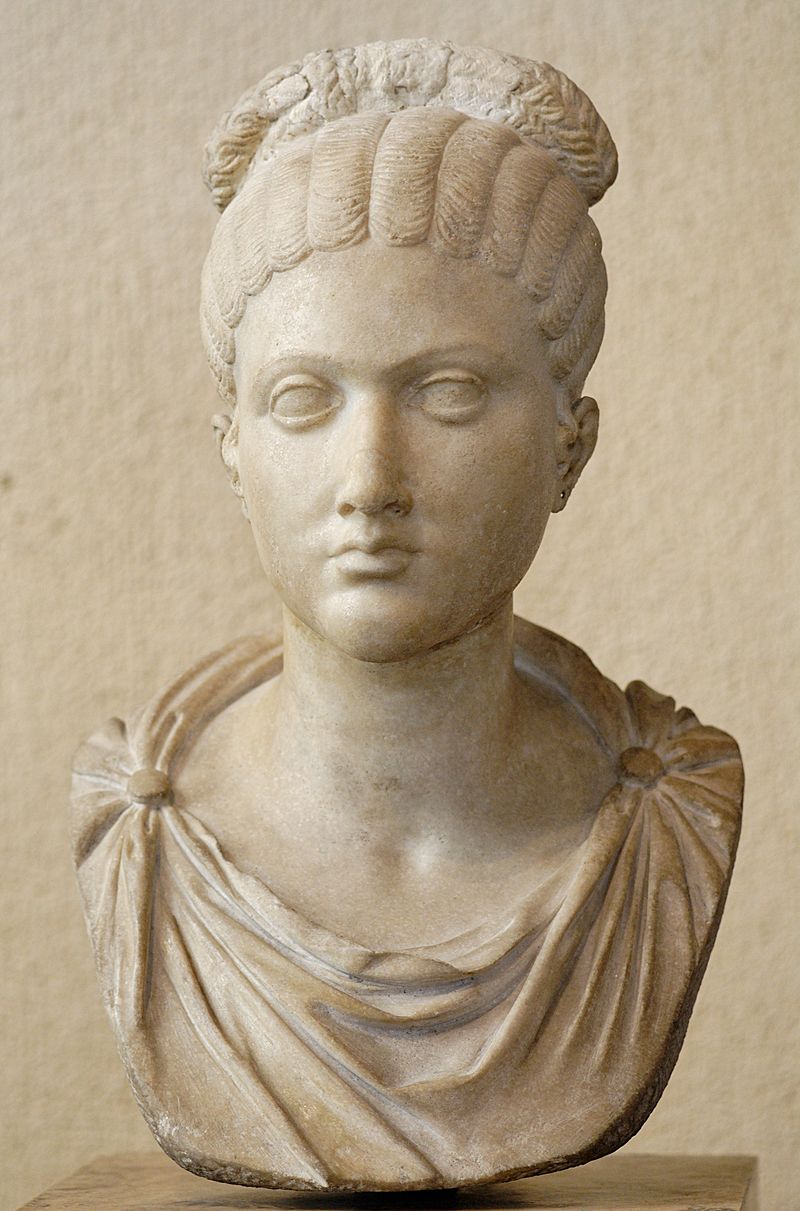
The "melon" hairstyle used to cap the top of the head of this woman appeared in Greece before the 3rd century BCE.  In Egypt, it was worn by the Ptolemaic queens Arsinoe II and Berenice II.  More "masculinized" portraits of Cleopatra VII, such as the one that appeared on a 1st century BCE silver denarius,  feature a melon hairstyle. Roman women are thought to have copied the hairstyle, especially after Cleopatra's visit in 46 and 44 BCE. But, it fell out of favor when Octavian declared war on Cleopatra. Although the hairstyle was eventually replaced by the lavish Flavian hairstyles for a time, it reappeared during the Antonine period, most notably on portraits of Julia Domna, wife of Septimius Severus. It continues to be shown on female portraits through the 3rd century CE. 


Mummy mask of a woman with corkscrew locks and bang, 50–150 CE, Roman Period Egypt at the Metropolitan Museum of Art in New York. 


Roman female portrait of the 1st century BCE at The Louvre, courtesy of Wikimedia Commons contributor Marie-Lan Nguyen.


If you enjoyed this post, never miss out on future posts by following me by email!


Saturday, November 21, 2020

Roman cavalry masks

 According to Arrian of Nicomedia, a Roman provincial governor and a close friend of Hadrian, face mask helmets were used in cavalry parades and sporting mock battles called “hippika gymnasia“.  Both men and horses wore elaborate suites of equipment on these occasions, often in the guise of Greeks and Amazons. Parades or tournaments played an important part in maintaining unit morale and fighting effectiveness. They took place on a parade ground situated outside a fort and involved the cavalry practising manoeuvring and the handling of weapons such as javelins and spears (Fields, Nic; Hook, Adam. Roman auxiliary cavalryman: AD 14-193).

Calvary helmets were made from a variety of metals and alloys, often from gold-coloured alloys or iron covered with tin. They were decorated with embossed reliefs and engravings depicting the war god Mars and other divine and semi-divine figures associated with the military.

To see a fascinating selection of these masks and read more about them check out:

https://followinghadrian.com/2013/08/28/the-face-of-mock-battles-images-of-roman-cavalry-helmets-from-germania-inferior/


Image: Face mask of a cavalry helmet, second century, from Durnomagus (Dormagen), Rheinisches Landesmuseum, Bonn (Germany) courtesy of Carole Raddato.


If you enjoyed this post, never miss out on future posts by following me by email!


Wednesday, October 13, 2010

Steely Gaze Part of Cavalry Attire Since 6th century BCE

An Exceptional Roman Bronze Cavalry Parade Helmet1st century CE Bronze Roman Cavalry Mask.  Image by Ancient Art via FlickrAn auction in Britain has made a millionaire of the metal detectorist who discovered a fantastic Roman parade helmet and mask in a field near the little English hamlet of Crosby Garrett.  Whenever I see such a beautiful piece of art surface in a rather unlikely place I always wonder how it came to be discarded by the original owner.  The article in the UK's Daily Mail said the detectorist, who had searched the field for seven years, had only found bits of scrap metal and a few coins before discovering the 1st century CE cavalry helmet
The artifact looks so complete I was surprised to read that it was initially found in 67 fragments.  Some of the fragments showed traces of a white metal coating, indicating that the face mask would originally have been tinned to give the appearance of silver.  But, the silver on this helmet may have been removed in preparation for ritual burial much like the Xanten helmet unearthed in the late 1980s in an old arm of the Rhine River.   The Crosby Garrett mask had also been folded before burial, and placed with the visor face down, further suggesting that it may have been a votive offering.  
Surprisingly, researchers studying the Xanten helmet reconstructed it with folded iron like the original and found the mask could withstand the force of an arrow fired from a Roman ballistae.

A close examination showed that the helmets were forged from sheet iron, folded and wrought from several layers of iron, and covered with silver foil for decoration purposes. Remains of braided ribbons combined with circular bands around the head were found outside the skull piece. The textile applications proved to be made of horsehair. The fineness and the length indicate that selected hairs from the tail of the horse were used. The headbands were sometimes additionally padded with a woolen fabric to generate a certain relief. An ancient glue mix was used to fix the silver foil and the textile applications. It consisted of pitch, bitumen and fatty components. - Sylvia Mitschke, University of Sheffield, Questions of identities concerning Roman cavalry helmets
Heavily armored cavalry wearing masks actually dates back as far as the 6th century BCE.

One of the earliest known examples of heavy cavalry was discovered in Khwarezm, a region in central Asia near the Aral Sea. Excavations have revealed paintings of warriors clad in armor mounted on an armored horse, carrying a lance and bow. It is estimated that these horsemen were used in that region as early as the sixth century BC. It is also around this time that cavalry gradually began replacing chariots in the near east. Cultures such as the Assyrians, Achaemenids Persians, and later the Macedonians all successfully fielded heavy cavalry in their armies. The Acahemenids, in particular, were known to field heavily armored horsemen along with horse armor.- Cataphracts and Clibanarii of the Ancient World, All Empires Online History Community
 Graffito of a Parthian Cataphract at Dura
Europos.  Courtesy of  All Empires.
 The Seleucids, ruled by descendants of one of Alexander the Great's generals, first used heavily armored cataphracts against the Romans in the battle of Magnesia in 188 BCE.  Although the Seleucid army was defeated in the battle, including the cataphracts, Polybius tells us that the Romans began arming their cavalry in the "Greek style" during the late Republican period.  Both Plutarch and Crassus reported that the shear momentum of the rider and horse was capable of driving the spear through two men. I wonder if Crassus had any premonition of the fate of his troops at Carrhae when he recorded that observation?
Although Christie's did an excellent job of restoring the Crosby Garrett mask's aesthetic appearance I was disturbed to read that experts from the British Museum were not asked to examine the find before restoration took place so archaeological information may have been lost.  Apparently, even though this mask brought a staggering sum of money from anxious bidders, it was not legally considered "treasure" by the British government because it contained neither gold nor silver. 
Although no significant remains of Roman occupation was known in the general area where the mask was found, preliminary investigations that have been conducted since the discovery indicate a Roman occupation layer may be revealed with further excavation.


The article mentioned that there have been only two other complete helmets with masks found in Britain.  Fortunately, others have been found elsewhere to give us information about the variety of designs that were developed during the height of the Roman Empire.


 RomanLegions.info has a webpage with images of several distinctly different cavalry masks that have been found across Europe dating from the Augustan period through the 5th century. 


Cavalry Helmet Mask Roman 75-125 CE BronzeBronze Roman cavalry mask 75-125 CE.  Image by mharrsch via Flickr
I have seen other examples at the Metropolitan Museum of Art and the one pictured at right produced from 75 - 125 CE at the Getty Villa.


Arrian of Nicomedia described the wearing of full face masks by cavalry troops on parade in the 2nd century CE:


The horsemen enter fully armed and those of distinguished station or superior in horsemanship wear gilded helmets of iron or bronze, to draw to themselves the gaze of the spectators. Unlike the helmets made for active service, these do not cover the heads and cheeks only but are made to fit round the faces of the riders with apertures for the eyes, so as to give protection to the eyes without interfering with vision. From the helmets hang yellow plumes — a matter of decor as much as of utility. As the horses move forward, the slightest breeze adds to the beauty of these plumes.—Arrian of Nicomedia

The Roman Cavalry Late Roman Cavalryman AD 236-565 (Warrior)   The Cavalry of the Roman Republic 
Enhanced by Zemanta
If you enjoyed this post, never miss out on future posts by following me by email!


Tuesday, July 21, 2009

Fabula Atellana Masks from Pompeii Rediscovered

This mask of Atellan character, Buccus [left], seems to have a more human expression, despite the prescribed comic grimace, than the more stilted and formal masks I have seen elsewhere like the theater at Ostia Antica. Of course it could have been distorted from volcanic heat following the eruption of Vesuvius.

The Discovery article describing a collection of masks recently "rediscovered" from Pompeii pointed out that some of the masks had closed mouths indicating they were used as models for the mask craftsman. However, the masks could have been worn by dancers in a pantomine, who wore masks with closed mouths because they did not speak but performed using only expressive gestures.

"...the most popular genres were unquestionably mime and pantomime, which sought to please the audience. Here even nudatio mimarum (a sort of striptease) was sometimes staged or, more surprising yet, the reenaction of real executions and torture. Mime was based on action and performed without masks. It was the only type of performance in which women played the female roles."

The number of days devoted annually to [theatrical] games gradually increased over time. At the end of the third century BC there were probably twelve at the most and, yet, at the beginning of the Empire, there were already 56 consecrated to theatre performances, reaching 100 by the mid-fourth century AD - The Roman Theater: Staging the Performance
A set of 15 mysterious life-size masks, reminiscent of ancient Roman drama, have been rediscovered in Pompeii after being forgotten for more than two centuries, according to Italian archaeologists who have shown them for the first time at an exhibition in Naples, Italy.

Made of plaster, the rather heavy masks were unearthed in 1749 in Pompeii during the excavations promoted by King Charles of Bourbon. They were deposited, along with many other artifacts, in the Royal Palace of Portici, a town on the Bay of Naples.

"Two masks show letters in the space usually reserved to the mouth. While the meaning of one is incomprehensible, on the other we can clearly read the word 'Buco,'" Borriello said. The word refers to Buccus, a stock character from the earliest form of Italian farce, known as fabula Atellana.

Deriving its name from the town of Atella in the southern Campania region, the fabula Atellana was a form of entertainment widely popular from the second century B.C. to the fourth century A.D. Basically a form of improvised farce, it used masked actors, stock characters and conventional plots. - More: Discovery News

Atellan farces also relied on the physical comedy of slapstick and burlesque.

By the early Imperial period, Atellan farces were no longer improvisational, but scripted performances.

Livy describes the Atellan Farces and the names for the actors (histriones) in section 7.2. of his History of Rome, where he says the Romans first performed them to try to fight a pestilence (in 363 B.C., according to Richard C. Beacham in The Roman Theatre and Its Audience). - About.com


If you enjoyed this post, never miss out on future posts by following me by email!