A history resource article by Mary Harrsch © 2014

 It's been a busy summer but I finally finished the first book in bestselling author Ben Kane's series about the Hannibalic Wars entitled "Hannibal: Enemy of Rome". As in his popular "The Forgotten Legion", Kane has used young men on the cusp of manhood as his primary characters.
We first meet Hanno, a young Carthaginian who hopes to become a soldier like his father, Malchus, once was. Now, Malchus serves on the council in Carthage and, although Malchus drags Hanno to the council meetings so he may learn statecraft, Hanno finds the meetings a bore and prefers to skip out and go fishing with his best friend, Suniaton, the son of a high priest.
We also briefly meet Hanno's two older brothers, Sapho and Bostar who presently serve as officers in the Carthaginian army. We discover that Sapho, the eldest, is jealous of Bostar because Bostar has been promoted above him because of Bostar's superior tactical acumen. Sapho's jealousy also extends to a lesser degree to Hanno, who, as the youngest, has captured his father's heart after the death of Hanno's mother.
Kane provides a vivid description of the capital of Carthage, still majestic even after suffering defeat at the hands of the Romans in the First Punic War. But all is not well as Carthage and Rome have once more butted heads in Iberia where Carthage has conquered most of the peninsula and the town of Saguntum, fearful of the growing Carthaginian presence in the region, has appealed to Rome for help.
Malchus supports the Barca family and clearly expects Hannibal, the senior Barca commander, to exact "payback" from the Romans for their past offenses to Carthage.
Meanwhile, Hanno and Suniaton hear of a large run of tunny (tuna), and can't resist trying their luck so they can earn a little spending money. They set off in a small boat that they soon fill with fish. Suniaton has pilfered a bottle of wine from his father's wine cellar and they decide to celebrate their good luck. Soon they fall asleep in the warm sun so do not see an approaching storm. When the violence of the storm finally awakens them they find they have been swept far out to sea and cannot see the outline of Carthage in any direction. As they were only on an afternoon outing they have no supplies and soon are famished from thirst and hunger. Finally they see a ship on the horizon and think they are saved. But the ship is manned by pirates who see the two boys as nothing more than slaves that can be sold for a profit.
To make matters worse, a patrol ship makes the pirate captain decide to avoid Sicily and steer to Italy instead. When the ship arrives in Italy the two boys are marched off towards Capua where it is hoped they will be sold to a gladiator school.
But Hanno is purchased by a Roman equestrian family that runs a farm near Capua instead. Then we meet Quintus and Aurelia, the son and daughter of Fabricius, once a Roman cavalry officer and now a landowner who raises grain and livestock.
Now we find out what Roman life is like for this semi-retired military veteran and his family. I really like the way Kane gives us thorough backgrounds on all of these characters so we have a solid understanding of the similarities and differences that separate the two cultures.
Hanno and Quintus who are almost the same age become friends and as the plot unfolds, each saves the other's life, making their bond even stronger.
In the meantime, since Rome does not send assistance, Saguntum subsequently falls to Hannibal's forces. So talk of war with Carthage soon dominates the conversations at the villa. Quintus begins cavalry training and Quintus' father, Fabricius is soon ordered to join Roman forces in southern Gaul marching towards Iberia where the Romans plan to confront Hannibal.
With Fabricius gone, the villa overseer, who lost his wife and children to Carthaginians on Sicily and harbors hatred for Hanno, attempts to drag Hanno away to Capua where he plans to sell the youth to the lanista at the gladiator school for an arranged fight to the death with Hanno's friend Suniaton. But I don't want to give away much more of the plot so you'll have to read it for yourselves to find out what happens.
Eventually, Hanno and Quintus both end up serving in their respective armies after Hannibal successfully crosses the Alps and the two armies end up camped across the Trebia River from each other.
Having studied the Second Punic War to some extent, I was wondering how Quintus and his father were going to escape the slaughter that I knew was about to befall them. Kane does such a good job of characterization that at this point in the book I cared about both the Carthaginian family and the Roman family equally.
The climactic battle sequence was nothing short of breathtaking. What I liked the most was Kane's description of the scenes and terror each character saw around them and felt as the epic struggle unfolded - Hanno and his father fighting with the Libyan spearmen near the center of the Carthaginian line while Quintus and his father struggled with the Roman cavalry on the flanks.
I appreciate the fact that Kane does not attempt to "take sides" on the historical controversy over whether Scipio tried to warn Sempronius Longus against the ill-fated attack or not. Polybius claims he did but many scholars look askance at this report since Polybius and the Scipios were closely allied. These scholars also point to the reported number of Roman troops involved in the engagement as problematic. Livy records there were 18,000 Romans and 20,000 Italic allies involved. Polybius claims there were 16,000 Romans and 20,000 Italic allies.It's been a busy summer but I finally finished the first book in bestselling author Ben Kane's series about the Hannibalic Wars entitled "Hannibal: Enemy of Rome". As in his popular "The Forgotten Legion", Kane has used young men on the cusp of manhood as his primary characters.We first meet Hanno, a young Carthaginian who hopes to become a soldier like his father, Malchus, once was. Now, Malchus serves on the council in Carthage and, although Malchus drags Hanno to the council meetings so he may learn statecraft, Hanno finds the meetings a bore and prefers to skip out and go fishing with his best friend, Suniaton, the son of a high priest.
We also briefly meet Hanno's two older brothers, Sapho and Bostar who presently serve as officers in the Carthaginian army. We discover that Sapho, the eldest, is jealous of Bostar because Bostar has been promoted above him because of Bostar's superior tactical acumen. Sapho's jealousy also extends to a lesser degree to Hanno, who, as the youngest, has captured his father's heart after the death of Hanno's mother.
 |
| A painting of the intricate harbor and ancient city of Carthage. Image courtesy of the Carthage Archaeological Museum, Tunis, Tunisia. |
Malchus supports the Barca family and clearly expects Hannibal, the senior Barca commander, to exact "payback" from the Romans for their past offenses to Carthage.
Meanwhile, Hanno and Suniaton hear of a large run of tunny (tuna), and can't resist trying their luck so they can earn a little spending money. They set off in a small boat that they soon fill with fish. Suniaton has pilfered a bottle of wine from his father's wine cellar and they decide to celebrate their good luck. Soon they fall asleep in the warm sun so do not see an approaching storm. When the violence of the storm finally awakens them they find they have been swept far out to sea and cannot see the outline of Carthage in any direction. As they were only on an afternoon outing they have no supplies and soon are famished from thirst and hunger. Finally they see a ship on the horizon and think they are saved. But the ship is manned by pirates who see the two boys as nothing more than slaves that can be sold for a profit.
To make matters worse, a patrol ship makes the pirate captain decide to avoid Sicily and steer to Italy instead. When the ship arrives in Italy the two boys are marched off towards Capua where it is hoped they will be sold to a gladiator school.
But Hanno is purchased by a Roman equestrian family that runs a farm near Capua instead. Then we meet Quintus and Aurelia, the son and daughter of Fabricius, once a Roman cavalry officer and now a landowner who raises grain and livestock.
%2BAF%2BTOPAZ%2BVIBRANCE%2BCROPPED.jpg) |
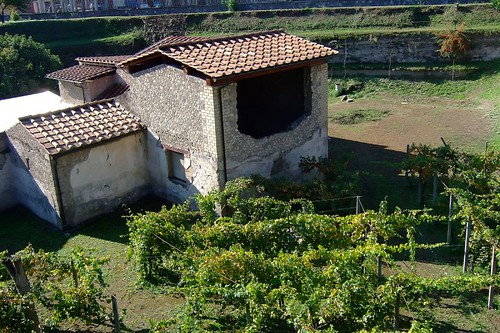
| A Roman villa rustica excavated near the ancient town of Boscoreale north of Naples, Italy. Photo by Mary Harrsch © 2007. |
Hanno and Quintus who are almost the same age become friends and as the plot unfolds, each saves the other's life, making their bond even stronger.
In the meantime, since Rome does not send assistance, Saguntum subsequently falls to Hannibal's forces. So talk of war with Carthage soon dominates the conversations at the villa. Quintus begins cavalry training and Quintus' father, Fabricius is soon ordered to join Roman forces in southern Gaul marching towards Iberia where the Romans plan to confront Hannibal.
With Fabricius gone, the villa overseer, who lost his wife and children to Carthaginians on Sicily and harbors hatred for Hanno, attempts to drag Hanno away to Capua where he plans to sell the youth to the lanista at the gladiator school for an arranged fight to the death with Hanno's friend Suniaton. But I don't want to give away much more of the plot so you'll have to read it for yourselves to find out what happens.
 |
| Remains of the amphitheater at Capua. Image courtesy of Flickr user Robert Ulrich. |
Having studied the Second Punic War to some extent, I was wondering how Quintus and his father were going to escape the slaughter that I knew was about to befall them. Kane does such a good job of characterization that at this point in the book I cared about both the Carthaginian family and the Roman family equally.
The climactic battle sequence was nothing short of breathtaking. What I liked the most was Kane's description of the scenes and terror each character saw around them and felt as the epic struggle unfolded - Hanno and his father fighting with the Libyan spearmen near the center of the Carthaginian line while Quintus and his father struggled with the Roman cavalry on the flanks.
 |
The Gauls, who had been previously allied with the Romans, joined Hannibal at the Battle of the Trebia River and were placed at the Carthaginian center. Although fierce, the Gauls could not hold back the disciplined Roman legionaries who fought through the center then retreated back to Placentia (Modern day Piacenza). Image courtesy of Total War: Rome II by Creative Assembly.
|
"The numbers stated to have fought the battle are problematic: a combined Roman army should have had 5 legions of 20,000 men and all 30,000 allies authorized by the Senate and yet if the armies were not combined Sempronius should have had only two legions of 8,000 men. One answer is that Scipio gave up two legions and kept one and 20,000 auxiliaries in his own camp as a reserve. Livy seems to think that Scipio's wound gave the entire authority to Sempronius, but immediately after the battle Scipio commanded an army marching from his camp to Placentia. If Scipio could command after the battle then he was not so incapacitated as to be removed from command before it. Both authors agreed that the two consuls had sharp differences of opinion and that Sempronius acted on his own."
"It is possible that the authors doubled the number of Roman legions fighting the battle and that Sempronius had only 8,000 or 9,000 Roman infantry. The authors both relate, however, that a mass of 10,000 men broke out of the Carthaginian encirclement and fell back on Placentia. Tiberius apparently did have more than two legions. Scipio argues in the story that Sempronius' men needed the winter to train, suggesting that on the way to north Italy Sempronius may have raised two more legions of recruits, throwing them into battle under difficult physical circumstances against expert advice without training. There is no mention of any such events, however."
"Yet another hypothesis for reconciling the numbers cited by Livy for combined strength of the two consular armies and the actual number of participants in the battle of the Trebia would be that Sempronius detached part of his allied contingents for garrison duty on Sicily and for naval service with Marcus Aemilius and Sextus Pomponius. Some allowance should also be made for non-combat losses. The strength of this hypothesis lies in the maximum use of ancient evidence." - The Battle of the Trebia, WikipediaSince this crucial bit of evidence relies on theory rather than certainty, Kane's decision to sidestep the issue was certainly reasonable. He does, however, relay to us the impatience expressed by the troops themselves over Scipio's apparent hesitance to act while recuperating from his wounds.
 |
A beautiful 17th century ivory rendering of Scipio fighting Hannibal by Ignaz Elhafen currently on display at the royal
castle in Warsaw, Poland. This is probably a depiction of the Battle of Zama where Scipio Africanus defeated Hannibal. Publius Cornelius Scipio (the elder) lost to Hannibal at the battle of the Ticinus River but that was primarily a cavalry engagement and war elephants were not involved. This work has also been called Alexander's defeat of Porus. Image courtesy of S.F. Burgerer via Wikimedia Commons. Digitally enhanced by Mary Harrsch.
|
I am definitely looking forward to the next book in this exciting trilogy. The only criticism I would have is that the title makes it sound like the book is about Hannibal himself. Although the key events in the latter part of the book are the result of Hannibal's orders, Hannibal himself appears only infrequently in the narrative. It perhaps would have been somewhat more accurate to name the series "The Hannibalic Wars" with the subtitle "Enemy of Rome" (Book One). But I can certainly understand the choice of title from a marketing perspective since some people may not actually make the connection between "Hannibalic Wars" and Hannibal.
|
|
 
|
 
|
 
|