Showing posts with label Persian. Show all posts

Saturday, July 10, 2021

Nomads of the Golden Mountains of Altai

Yesterday when I was researching the post about horses in the ancient world, I was intrigued by the detail image of a Persian horseman on the so-called Pazyryk carpet that Lloyd Llewellyn-Jones included in his blog post. The Pazyryk carpet is considered the oldest surviving example of a pile carpet in the world and is thought to have been made around 400 BCE in Armenia or Persia.

It was discovered in a Scythian kurgan burial in the Pazyryk Valley of the Ukok plateau in the Altai Mountains, Siberia, south of the modern city of Novosibirsk, Russia. The tomb mounds discovered there are now part of the  Golden Mountains of Altai UNESCO World Heritage Site. 

The horseman of the Pazyryk culture apparently  accumulated great wealth through horse trading with merchants in Persia, India and China as evidenced by the variety of grave goods including Chinese silk, the pile carpet,  horses decked out in elaborate trappings, and wooden furniture and a full-sized burial chariot found there.   Some horses were provided with leather or felt masks made to resemble animals, with stag antlers or rams’ horns often incorporated in them. Bearded mascarons (masks) of well-defined Greco-Roman origin were also found.  Scholars think these may have been inspired by the Hellenistic kingdoms of the Cimmerian Bosporus. 

These finds were preserved when water seeped into the tombs in antiquity and froze, encasing the burial goods in ice until their excavation by archaeologists M. P. Gryaznov in 1929 and Sergei Ivanovich Rudenko in 1947–1949.

In his book, "The frozen tombs of Siberia: the Payryk Burials of Iron-Age Horseman," Rudenko comments on the close similarities between the equestrian and animal motifs of the Pazyryk carpet and the sculptures of Achaemenid Persepolis.

"Arranged chain-like men and beasts in certain spaces, obviously remind us of Achaemenid and Assyrian styles. Decorating horse tail and foretop is also a Persian tradition. Stablemen pace on the horse's left while their right hand is on its neck both in Persepolis statues and Pazyryk."

He also points out that the deer design is a yellow deer known as a Persian Fallow Deer or Mesopotamian Fallow Deer.

Five bodies were found in the Pazyryk burials during this period including a powerfully built man in his fifties thought to be a chieftain. The man was elaborately decorated with an interlocking series of striking designs representing a variety of fantastic beasts. The best preserved tattoos were images of a donkey, a mountain ram, two highly stylized deer with long antlers and an imaginary carnivore on the right arm. Two monsters resembling griffins decorate the chest, and on the left arm are three partially obliterated images which seem to represent two deer and a mountain goat. On the front of the right leg a fish extends from the foot to the knee. A monster crawls over the right foot, and on the inside of the shin is a series of four running rams which touch each other to form a single design. 

A carefully embalmed young female, dubbed the Siberian Ice Maiden, was discovered by archaeologist Natalia Polosmak in 1993 at Ukok, near the Chinese border. She had been buried over 2,400 years ago in a casket fashioned from the hollowed-out trunk of a Siberian larch tree. On the outside of the casket were stylized images of deer and snow leopards carved in leather.  Six horses wearing elaborate harnesses had been sacrificed and lay to the north of the chamber. Her hair was shaved off but she was wearing a wig and tall hat and was  clad in a long crimson and white striped woolen skirt and white felt stockings. Her yellow blouse was originally thought to be made of wild "tussah" silk but closer examination of the fibers indicate the material is not Chinese but was a wild silk which came from somewhere else, perhaps India. Like the chieftain, she had been tatooed with animal motifs including creatures with horns that transformed into flowers. Although Herodotus described the widespread use of cannabis by Scythian nomads, the seeds found in the tomb of the Ice Princess were only coriander, probably used to disguise the smell of the body.

In January 2007 a timber tomb of a blond chieftain warrior was unearthed close to the Mongolian border. Like the other individuals, the man was tattooed and he wore a well-preserved sable coat. What looks like scissors were found among his grave goods. Additional tombs were found as recently as the summer of 2012.

Detail of horseman on the Pazyryk carpet, 400 BCE, courtesy of Lloyd Llewellyn-Jones

The Pazyryk carpet 400 BCE, courtesy of the Hermitage Museum and Wikimedia Commons.

Detail of deer on Payryk carpet, 400 BCE, courtesy of the Hermitage Museum and Wikimedia Commons.

Funerary chariot found in a Pazyryk burial courtesy of Charles Recknagel and the Hermitage Museum.

Closeup of a felt saddle pad from a Pazyryk burial mound courtesy of Charles Recknagel and the Hermitage Museum

A saddle found in the Pazyryk tombs, showing the same kinds of tassels that can be seen on the saddles depicted in the Pazyryk carpet courtesy of Charles Recknagel and the Hermitage Museum.

Wooden table found in a Pazyryk burial mound courtesy of Charles Recknagel and the Hermitage Museum

A gilded wooden figurine of a deer from the Pazyryk burials, 5th century BCE courtesy of the Hermitage Museum in St. Petersburg, Russia and Wikimedia Commons.

Fifth century BCE bridle with wooden Hellenistic motifs, Pazyryk Culture, courtesy of the Hermitage Museum in St. Petersburg, Russia

Wood and leather finial of a griffin with a stag in its beak, Pazyryk Culture, 5th century BCE, courtesy of the Hermitage Museum in St. Petersburg, Russia

Mask with Antlers for a Horse Head, Pazyryk Culture, 5th century BCE, courtesy of the Hermitage Museum in St. Petersburg, Russia

This plaque in the shape of a griffin standing on the defeated ibex served as decoration of the headdress of a noble warrior. The entire composition is raised in relief from a sheet of gold. The griffin's head is hollow. Its figure seems enormous as compared with that of the ibex. The ibex is depicted with its hind quarters twisted upwards, which is typical of Altaic art. The griffin's body was richly decorated in a cloisonne technique, but the insets have not survived. This composition is similar to that of the leather object found in the Pazyryk Barrow No. 2 in Altai. The ibex's posture and the decorative devices are identical to the depictions on the saddle covers from the Pazyryk Barrow No. 1. Thus this splendid aigrette can be attributed to the 5th to 4th century BCE. Besides, we see that the whole composition, particularly the griffin, was produced under the influence of the Achaemenid art, courtesy of the Hermitage Museum in St. Petersburg, Russia.

Leather, fur, and gold foil headdress, Early Iron Age, Pazyryk Culture, courtesy of the Hermitage Museum in St. Petersburg, Russia


If you enjoyed this post, never miss out on future posts by following me by email!


Saturday, February 13, 2021

Bust of a Priest with Silver Inlaid Eyes, Roman or Sasanian?

While I was researching the Cypriot ear spirals yesterday, I noticed this bronze bust of a priest with silver inlaid eyes dated from the 3rd - 4th century CE at the Miho Museum.  The museum identified it as late Roman but the museum's image had been shared on Flickr and I noticed that someone with the username eternal persia commented on the piece and insisted it was Sasanian.  He/she pointed to the monogram on the hat, clothes, hair design and leaves that decorate the bust and insisted these are Sasanian elements.

Intrigued, I researched the item a little further.  At first, most Sasanian portrait sculptures I reviewed were all bearded.  Then I saw an image of a relief depicting Kartir, a high priest and vizier serving during the reigns of Shapur I, Hormizd I, Bahram I, and Bahram II. Not only is Kartir clean shaven, he sports the corkscrew curls and crested hat worn by the priest of the bust at the Miho Museum.

Some scholars think Kartir may have been a eunuch, due to being depicted without a beard in the Sasanian reliefs. He first appears in historical records in Shapur I's inscription at the Ka'ba-ye Zartosht, which was most likely created between 260–262 CE. Kartir is the only religious bureaucrat mentioned in the inscription. Shapur I, termed a "lukewarm Zoroastrian", was known for his tolerance towards other religions. Although admiring the teachings of his own religion and encouraging the Zoroastrian clergy, Shapur I allowed the Jews, Christians, Buddhists, and Hindus to freely practice their religion. He was also friendly towards the founder of Manichaeism, Mani, whom he allowed to preach freely and even to be an escort in his military expeditions.

Shapur I's religious practices seems to have been somewhat unusual, though, with animal sacrifice being made for the soul of the kings and queens of the Sasanian family. Kartir, who "abhorred animal sacrifice" was unable to stop Shapur I from performing them. Shapur I died in 270 CE, and was succeeded by Hormizd I, who gave Kartir clothes that were worn by the upper class including the cap and belt (kulāf ud kamarband) and appointed him as the chief priest (mowbed).

Hormizd I died the following year and Bahram I, who was never considered a candidate for succession of the throne by his father, ascended the throne with the aid of Kartir, whose authority and influence had greatly increased. Bahram I then made a settlement with his brother Narseh who he asked to give up his entitlement to the throne in return for the governorship of the important frontier province of Armenia, which was constantly the subject of war between the Roman and Sasanian Empires.  Although Narseh held the title of Vazurg Šāh Arminān ("Great King of Armenia"), scholars think he probably still viewed Bahram I as a usurper.

Although previous Sasanian shahs had pursued a policy of religious tolerance towards the non-Zoroastrian minorities in the empire, with Bahram I's accession to the throne, and the rise of the authority of the Zoroastrian priesthood under the leadership of Kartir, this changed. When Mani, still the leader of the Manichaeists, arrived in the city of Gundishapur, Kartir and his cadre of Zoroastrian priest protested, viewing Mani as a threatening heterogeneous philosopher who presented an obscure perception of Zoroastrianism tainted by Jewish, Buddhist, and Christian ideas. Kartir pressured Bahram I to have Mani imprisoned and sentenced to death in 274 CE. Mani's death was followed by the persecution of his followers by Kartir and the Zoroastrian clergy, who used the persecution of religious minorities as a method to increase and spread their vast influence.  With the backing of Bahram I, Kartir laid foundations for Zoroastrianism's adoption as the state religion.

When Bahram I died, his son viewed Kartir as a mentor and granted him the rank of grandee (wuzurgan), and appointed him as the supreme judge (dadwar) of the whole empire.  Thereafter, Zorastrian priests were given the office of judge. Kartir's intolerance continued and his inscription at  Ka'ba-ye Zartosht boasts that he "struck down" non-Zoroastrian minorities, although modern scholars point out that Jewish and Christian sources makes no mention of persecutions during this period.

When Bahram III succeeded his father, Bahram II, something changed, however, in Kartir's relationship with the royal family.  Kartir inexplicably threw in his lot with Narseh and, along with a group of Sasanian nobles, supported Narseh's overthrow of Bahram III. But Narseh's reign  marked the return to the policy of religious tolerance which had been practiced by his father, Shapur I, all those years ago, and Kartir finally fades from history. 
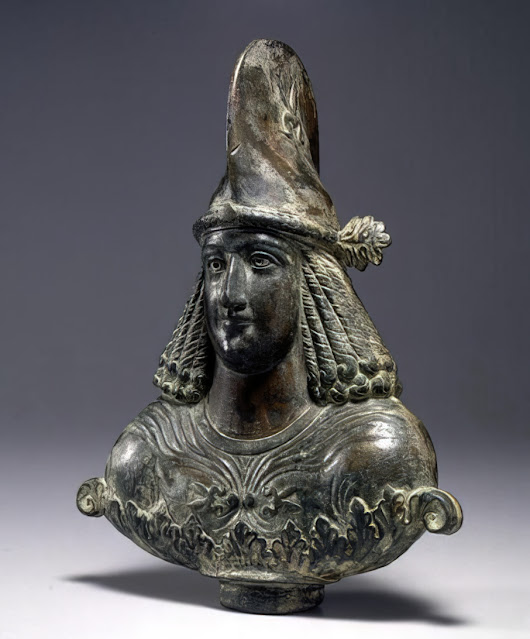
Bust of a Priest with Silver Inlaid Eyes, Bronze and sliver, 3rd-4th century C.E., courtesy of the Miho Museum in Kyoto, Japan.


Relief of Kartir, the Zoroastrian high priest at Naqsh-e Rajab courtesy of Wikimedia Commons contributor درفش کاویانی.


If you enjoyed this post, never miss out on future posts by following me by email!


Sunday, January 31, 2021

Eggs and Oonoi: Symbols of birth and rebirth in the ancient world

In many myths, ranging from Egypt to the Far East, the initial process of creation and birth begins when a cosmic egg. sometimes fertilized by a serpent but more often laid in the primeval sea by a giant bird. From these sacred eggs, the sun (the golden yolk)  is hatched leading to the division of earth and sky and the multiplicity of life, natural and supernatural. Eggs are well attested as funerary offerings—real eggs, artistic counterparts in marble and terracotta or diminutive vases of egg shape. 

Between approximately 65,000 and 55,000 years ago, African hunter-gatherers scratched on eggshells at Diepkloof Rock Shelter in South Africa.  Eggs were found in the Royal Cemetery at Ur dating to 3800 BCE. In archaeological sites of predynastic Egypt (Naqada II period - 3600-3200 BCE) ostrich eggs were found in graves, partially cut and used as containers or placed in graves whole. Many of the eggs were decorated with incised or painted designs which took the form of geometric decoration or drawings of birds and animals. Since then, evidence has been recovered illustrating not only the Egyptians, but also the Phoenicians applied artistic designs to ostrich eggs from the first millennium onwards.  Their examples, with  painted geometric designs used as cups and bowls, have been found in Carthage, Sardinia, Sicily, the Iberian Peninsula and Ibiza. Even the Greeks, Persians, Etruscans, and Romans decorated their eggs, either real or emulated in terracotta pottery, often with mythological scenes like those on black-figured ceramics. 

In Greek mythology, Helen of Troy is said to have come from an egg that had fallen from the moon or born from an egg laid by Leda, queen of Sparta, after she had coupled with Zeus, who had disguised himself as a swan.  Such scenes have been found on egg-shaped vessels called "oonoi" in a funerary context.

In the ancient world, ostrich eggs were used as containers for food and liquids such as water or milk, as drinking cups, and as bowls. The ancient Libyans offered ostrich eggs to the Egyptian pharaohs as items of tribute. Babylonian and Assyrian texts record the ostrich egg's medicinal as well as its magical values. Ostrich eggs were also used for religious purposes as symbols of fertility and prosperity. In Egyptian Coptic churches, egg iconography represented resurrection. 

In 2020,  Isotope analysis of decorated ostrich eggs in the British Museum showed that eggs from the same archaeological site had originated in different places. The studies suggested that, rather than the eggs having been laid by captive birds, almost all had most likely been collected in the wild, a potentially hazardous undertaking.

Read more about them here:

https://ticiaverveer.wordpress.com/2016/03/21/the-worlds-oldest-decorated-eggs/

Attributed to the Washing Painter, this oon (terracotta egg), depicts an abduction scene that has been interpreted as depicting Paris and Helen, 40-410 BCE, courtesy of the Metropolitan Museum of Art in New York. The shape is particularly pertinent to the subject because Helen was hatched from an egg.

An example of a Minoan ostrich egg rhyton, ca. 1600 B.C., decorated with two octopuses in red paint.

Punic ostrich egg used as a vessel, open at the top. The decoration, painted in red, is arranged in the form of a frieze composed of palmettes separated by vertical bands with interlaced lines on a white background. Necropolis of Puig des Molins. Height: 14.50 cm; maximum diameter: 12.50 cm. Inv. No. 1923/60/305. National Archaeological Museum of Spain courtesy of Wikimedia Commons contributor Dorieo

Pottery imitation ostrich eggs painted with black-figure decorations, Greek, 5th century BCE, Kerameikos Archaeological Museum (Athens), courtesy of Wikimedia Commons contributor Giovanni Dall'Orto.

Pottery imitation ostrich eggs painted with black-figure decorations, Greek, 5th century BCE, Kerameikos Archaeological Museum (Athens), courtesy of Wikimedia Commons contributor Giovanni Dall'Orto.

Pottery imitation ostrich eggs painted with black-figure decorations, Greek, 5th century BCE, Kerameikos Archaeological Museum (Athens), courtesy of Wikimedia Commons contributor Giovanni Dall'Orto.

Ostrich egg decorated with geometric motifs, from the Tomb of the Golden Breastplate at Monterozzi loc. Arcatelle, 650 BCE

An ostrich egg decorated with painted red lines. Punic artwork from the Iron Age II, Villaricos necropolis, Andalusia, Spain, courtesy of Wikimedia Commons contributor Luis Garcia (Zaqarbal).

Pottery imitation ostrich eggs painted with black-figure decorations, Greek, 5th century BCE, Kerameikos Archaeological Museum (Athens), courtesy of Wikimedia Commons contributor Giovanni Dall'Orto.


Ostrich eggs were used as grave goods by the Punic- Phoenicians and Etruscans, symbolizing resurrection and eternal life, as well as providing “food” for the deceased. This Punic-Phoenician ostrich egg was found in the Isis Tomb at the Polledrara Cemetery of Vulci in Italy. It once had a mouthpiece and support to form a vessel. Four sphinxes are painted on the surface.

4,000-year-old Egyptian Ostrich egg decorated with spirals at the Archaeological Museum in Brussels, Belgium courtesy of ticiaverveer.wordpress.com.

Ostrich egg with animal drawing found at Naqada, Egypt, at the Asmolean Museum in Oxford courtesy of ticiaverveer.wordpress.com

Attributed to the Washing Painter, this oon (terracotta egg), depicts an abduction scene that has been interpreted as depicting Paris and Helen, 40-410 BCE, courtesy of the Metropolitan Museum of Art in New York. The shape is particularly pertinent to the subject because Helen was hatched from an egg.

Attributed to the Washing Painter, this oon (terracotta egg), depicts an abduction scene that has been interpreted as depicting Paris and Helen, 40-410 BCE, courtesy of the Metropolitan Museum of Art in New York. The shape is particularly pertinent to the subject because Helen was hatched from an egg.

Punic ostrich egg found in the phoenician necropolis of Puig des Molins. Museum of Puig des Molins in Ibiza (Spain) courtesy of Wikimedia Commons contributor Nanosanchez.

An ostrich egg rhyton from Mycenae in Greece. The appliqué dolphins are made of faience. The underpiece attached to the base is made of gold foil over a wooden core. 1600 B.C. E. courtesy of Wikimedia Commons contributor Schuppi


If you enjoyed this post, never miss out on future posts by following me by email!


Sunday, December 13, 2020

Cypriot funerary colonettes from the Roman period

Only a handful of these funerary colonettes, referred to as cippi, decorated with portrait busts, have been recovered from Roman Cyprus.  The Museum of Cycladic Art points out that this type of grave marker was used commonly from the Late Hellenistic to the Late Roman period in several parts of Cyprus, such as Limmasol (Amathous), Larnaca (Kition), Famagusta (Ammochostos) and Kyrenia but the majority are simply inscribed with the deceased name, sometimes the name of the father or spouse, and expressions of condolence such as "no one is immortal." 

The Metropolitan Museum of Art compares their appearance during this period to the development of personalized Egyptian painted portraits around the same time. I couldn't help but see the resemblence of these grave markers to chess pieces, though.There may be absolutely no connection at all but I found it interesting that the game of chess is thought to have originated around the same time (or possibly earlier) in the Gupta Empire of ancient India.  From there it spread to Persia and became part of the courtly education of Persian nobility.  Cyprus was ruled briefly by the Persians until its conquest by Alexander the Great and, eventually, the Romans in 58 BCE.  Although chess is thought to have been developed before 600 CE, its earliest origins are uncertain.

I've read a number of historical fiction novels set in ancient Rome where political maneuvers are referred to as part of "The Great Game." I can easily imagine followers of an ancient philosopher with the same viewpoint fashioning their funerary monuments to personify their lives as pieces in life's Great Game! 


Cypriot Cippus (Grave Column)  Middle-Late Roman, 100-300 CE from Tremithousa, Larnaca (Cyprus) at the Museum of Cycladic Art.


Cypriot limestone funerary cippus (tomb marker) depicting a woman named Kratea.   In an attempt to capture her individuality, she is represented with rather bony and irregular features, and her hair is parted down the middle, a convention that seems to imply that she was elderly. Her jewelry is meant as an indicator of her wealth and status.  Roman, , 2nd–3rd century CE at the Metropolitan Museum of Art. 


Cypriot limestone funerary cippus (tomb marker) depicting  a youth is identified by the Greek inscription that reads: “Good Artemidoros, farewell”, Roman, 2nd–3rd century CE at the Metropolitan Museum of Art. 


If you enjoyed this post, never miss out on future posts by following me by email!


Sunday, October 4, 2020

The evolution of Scythian art

Early Scythian art was characterized by its use of animal motifs and appeared in eastern Europe in the 8th century BCE. Some scholars suggest the art style developed under Near Eastern influence during the military campaigns of the 7th century BCE, but the more common theory is that it developed on the eastern part of the Eurasian Steppe under Chinese influence. Others have sought to reconcile the two theories, suggesting that the animal style of the west and eastern parts of the steppe developed independently of each other, under Near Eastern and Chinese influences respectively. Regardless, the animal style art of the Scythians was distinctive and differed considerably from the cultures around it.

Scythian animal style works are typically divided into birds, ungulates and beasts of prey. This probably reflects the tripartite division of the Scythian cosmos, with birds belonging to the upper level, ungulates to the middle level and beasts of prey in the lower level. Images of mythological creatures such a griffins are not uncommon in Scythian animal style, but these are probably the result of Near Eastern influences. By the late 6th century BCE, as Scythian activity in the Near East was reduced, depictions of mythological creatures largely disappears from Scythian art.

With the increased influence of the Greeks and Persians in the 5th century BCE, the depictions of animals became more realistic and are depicted fighting each other rather than as individual subjects. Warriors on kurgan stelae, earlier depicted with almond-shaped eyes and mustaches, are shown in the 5th century BCE with rounder eyes and full beards.

By the 4th century BCE, scholars think much of the Scythian artwork found in royal burials is being made by Greek craftsmen.  Depictions of human beings is much more prevalent, mythological creatures are reintroduced, and themes are thought to be illustrations of Scythian legends, some with religious significance. 

Ongoing Hellenization in the 3rd century BCE, however, results in the disappearance of original Scythian art forms all together. The Scythians eventually settled in the Crimea and along the Lower Dnieper River and engaged in stockbreeding and agriculture. Their capital at Scythian Neapolis served as an important trading center until the 2nd century CE even though its royal palace was destroyed by Diophantus,  a general of the Pontic king Mithridates VI, at the end of the 2nd century BCE, and was not rebuilt. It is thought the Scythians were eventually assimilated by the Sarmatians.

Gold dress ornament depicting two Scythian archers standing back to back as they shoot their compound bows from the tomb of a Scythian king, and his consort 400-350 BCE made at Pantikapaion on the north coast of the Black Sea that I photographed at the British Museum in 2016.

A gold plaque depicting a Scythian rider with a spear in his right hand, 2nd century BCE, courtesy of Wikimedia Commons.

Scythian comb from Solokha, early 4th century BCE courtesy of Wikimedia Commons and the Hermitage Museum in St. Petersburg.

Closeup of the reverse side of a Scythian comb from Solokha, early 4th century BCE courtesy of Wikimedia Commons and the Hermitage Museum in St. Petersburg.

Gold pectoral, or neckpiece, from a royal kurgan in Tolstaya Mogila, Pokrov, Ukraine, dated to the second half of the 4th century BCE, of Greek workmanship. The central lower tier shows three horses, each being torn apart by two griffins. Scythian art was especially focused on animal figures. Courtesy of Wikimedia Commons contributor Д.Колосов.


If you enjoyed this post, never miss out on future posts by following me by email!


Sunday, September 20, 2020

Chariots in ancient warfare

 The origin of the chariot is not definitively documented but it is thought to have been a technology developed in the Eurasian steppe by cultures such as the Sintashta, a Middle Bronze Age civilization dating to the period 2200-1800 BCE.  The earliest remains of chariots have been found in Sintashta burials.

Russian archaeological analysis indicates the preceding Abashevo culture was already marked by endemic intertribal warfare. Intensified by ecological stress and competition for resources in the Sintashta period, this drove the construction of fortifications on an unprecedented scale and innovations in military technique such as the invention of the war chariot.   Many Sintashta graves are furnished with weapons, although the composite bow associated later with chariotry does not appear.

The Sintashta economy included the production of copper from ore in nearby mines  and arsenical bronze, that uses arsenic rather than tin, which was smelted on an industrial scale.  The metal was exported to the cities of Bactria-Margiana in Central Asia, for the first time connecting the steppe region to the ancient urban civilizations of the Near East.  It was through these trade routes that domesticated horses and chariots were introduced to the Near East and ultimately the rest of the Mediterranean basin.

The oldest testimony of chariot warfare in the ancient Near East is the Old Hittite Anitta text (18th century BCE), which mentions 40 teams of horses at the siege of Salatiwara.  The Hittites became renowned charioteers. They developed a new chariot design that had lighter wheels, with four spokes rather than eight, and that held three rather than two warriors. It could hold three warriors because the wheel was placed in the middle of the chariot and not at the back as in Egyptian chariots. Typically one Hittite warrior steered the chariot while the second man was usually the main archer; the third warrior would either wield a spear or sword when charging at enemies or hold up a large shield to protect himself and the others from enemy arrows.  The Battle of Kadesh in 1274 BCE is likely to have been the largest chariot battle ever fought, involving over 5,000 chariots.

The Persians may have been the first to yoke four horses to their chariots. They also used scythed chariots. Cyrus the Younger employed these chariots in large numbers at the Battle of Cunaxa. Herodotus mentions that the ancient Libyan and the ancient Indian (Sattagydia, Gandhara and Hindush) satrapies supplied cavalry and chariots to Xerxes the Great's army. However, by this time, cavalry was far more effective and agile than the chariot, and the defeat of Darius III at the Battle of Gaugamela (331 BCE), where the army of Alexander simply opened their lines and let the chariots pass and attacked them from behind, effectively marked the end of the era of dependence on chariot warfare in Mediterranean battlefield tactics.

The Romans encountered the use of chariots in warfare by the Britons but never used chariots for warfare themselves.  Julius Caesar reported that, unlike earlier Near Eastern tactics where warriors or archers fought from chariots, the Britons would drive their chariots "in between the troops of horse, leap from their chariots and engage on foot. The charioteers in the meantime withdraw some little distance from the battle, and so place themselves with the chariots that, if their masters are overpowered by the number of the enemy, they may have a ready retreat to their own troops."  

The last mention of chariot use in battle in Brittania was reported to be at the Battle of Mons Graupius in modern Scotland in 84 CE (Agricola 1.35-36).  "The plain between resounded with the noise and with the rapid movements of chariots and cavalry." But the chariots did not win even their initial engagement with the Roman auxiliaries.

Fragmentary terracotta model of a four horse chariot from Cyprus, 700-500 BCE, Cypro-Archaic I-II Period, at the Royal Ontario Museum in Toronto, Canada courtesy of the museum.

Nike mounted on a quadriga that I photographed in the King Victor Emmanuel II Monument in Rome, Italy.

Bronze Etruscan chariot inlaid with ivory, 2nd quarter of 6th century BCE found near Monteleone di Spoleto with scenes of the battles of Achilles that I photographed at the Metropolitan Museum of Art in New York.

A reconstructed four-wheeled Gallic "chariot" at the Musée archéologique de Strasbourg courtesy of Wikimedia contributor Chatsam

A four-horse Qin Dynasty chariot of the tomb of Chinese emperor Qin Shi Huang, 210 BCE, that I photographed at the Terracotta Warriors exhibit at The Field Museum in Chicago, Illinois.

A Lucanian tomb fresco from Paestum depicting a biga, two-horse chariot, courtesy of Carole Raddato.

A Roman mosaic depicting a quadriga, four-horse racing chariot courtesy of the Rheinisches Landesmuseum in Trier, Germany.

A reconstructed four-wheeled Gallic "chariot" at the Musée archéologique de Strasbourg courtesy of Wikimedia contributor Chatsam


If you enjoyed this post, never miss out on future posts by following me by email!


Monday, August 24, 2020

Syncretistic religions of the Roman Imperial Period

Many religions of the ancient world were syncretistic, meaning that as they grew and came into contact with other religions, they adopted new beliefs and modified their practices to reflect their changing environment. Both Greek and Roman religious beliefs were deeply influenced by the so-called mystery religions of the East, including the Egyptian cult of Isis, which revealed beliefs and practices to the initiated that remained unexplained, or mysterious, to the uninitiated. Most popular Roman cults had associations with these mystery religions and included the prospect of an afterlife. Zeus Labraundos was a local version of Zeus from Mylasa in Caria (southwestern Asia Minor), of whom very few representations exist except on Roman coins. The front of his apron-like garment is decorated with images of divinities and astral symbols. On his head, he wears a tall headdress with lotus elements reflecting Egyptian influences and the eagle of Zeus at the front. - Walters Art Museum

Remains of the sanctuary of Zeus Labraundos still exist today.  The site in Mylasa was rediscovered in the 19th century.  Frenchman A. Laumonier carried out initial surveys in 1932 but the first archaeological excavations did not begin until 1948, under the direction of the Swedish archaeologist A.W. Persson.  Dedications inscribed on the architraves of the monuments reveal the structure was built by Mausolus (of the Mausoleum of Halicarnassus fame) and his brother Idrieus.  Although the building was organized like a typical Greek sanctuary, it also contained banquet halls in the Persian fashion.  These banquet halls, by their size, location and use were central to the political and religious functioning of Labraunda. The satraps held council and received ambassadors from foreign cities there.  An Achaemenid sphinx and the head of a second were found nearby and thought to have symbolized the authority and protection of the Persian Empire.  

The ancient geographer Strabo described the sanctuary as "connected to the city by a causeway of nearly 60 stadia, which is called the sacred way and which is used for pumps or processions. The High Priest is invariably chosen from among the most illustrious citizens of Mylasa and always appointed for life." 

Image: Zeus Labraundos, bronze, 1st century CE Roman Imperial Period that I photographed at the Walters Art Museum in Baltimore, Maryland.  


If you enjoyed this post, never miss out on future posts by following me by email!