Showing posts with label artist. Show all posts

Friday, April 16, 2021

Daedalic Style of the 7th century BCE

In the early 600s BCE, new artistic ideas flowed into Greece as a result of increased contacts with the Near East. Because of Crete’s central location along maritime trade routes between these regions, artists on the island played a leading role in synthesizing native and Near Eastern elements.

An artist from Crete that became known as Daidalos (Daedalus) , produced a series of female figurines that combined both Greek and Near Eastern features including triangular faces and stylized wig-like hair forming two upward-facing triangles on either side of the face.  The top of the head is flattened to maintain triangularity, giving a “brainless look”, according to some scholars, and producing a low forehead with a straight hairline. The eyes are usually large and set rather high.The woman is portrayed in a frontal orientation and the female's clothing was often depicted as formless drapery or as a simple style, sometimes decorated with geometric patterns, tied with a wide belt at the waist.  A few male figures were also produced, nude except for a belt.  In addition to figurines, these sculptures appeared on clay plaques and in relief decorations on vases. The style had a marked influence on artistic productions in the Peloponnese, Dorian Crete, and Rhodes.

An artist named Daidalos is actually mentioned in Homer's Iliad (18.590.92), as the builder of a dancing floor on Crete.  Later authors state he was the grandson of the early Athenian king, Erechtheus.

Daidalos was also credited with the invention of agalmata, votive statues of the gods which had open eyes and moveable limbs.  These statues were so lifelike that Plato remarked upon their amazing and disconcerting mobility.

A figure of a woman with her arms folded across her belly forms the body of this aryballos, a container for holding scented oil. The modeled human head forms the vessel's spout and neck. A hole at the back of the head would have been used for suspension. The artist used black paint to further elaborate the figure, and traces of the original pigment remain on the eyes and hair, and in three bands on the body, Greek (Cretan), 675-650 BCE, terracotta, at the J. Paul Getty Museum.

Yet another Middle Daedalic piece is this Protocorinthian aryballos (oil flask) from Thebes. The head was made with a mold. The decoration was by a known artist, the Boston Painter, and can be dated with some confidence to around 650 BCE. Datable vases such as this one are important, for they give us a means of dating other Daedalic pieces. Courtesy of art historian Emily Claire Kibbe

Representing the Late Daedalic (c. 630-600 BCE) is this torso of a seated woman from Eleutherna on Crete. The medium is limestone. The oval face points to a late date, c. 600. The coiffure is crimped tresses (Perlenlocken). Courtesy of art historian Emily Claire Kibbe

Representing the Early Daedalic (675-c. 655 BCE) is this ivory sphinx from the sanctuary of Hera Limenia in Perachora. In this phase the faces tend to be long triangles, with the chin rounded off. Courtesy of art historian Emily Claire Kibbe

Also representing the Middle Daedalic is this torso from a female figurine, mold-made out of terracotta, from Crete, one of a series produced there from c. 680-625 BCE. The detailed coiffure (Etagenperücke) and anatomy indicate a date toward the end of the series, c. 650-625 BCE. Courtesy of art historian Emily Claire Kibbe

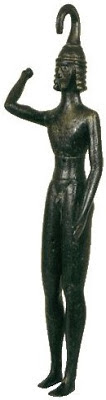
A rare male example of the new style, a bronze statuette from Olympia dating to c. 700-675 BCE a warrior, naked but for his belt and crested helmet, stands with his right arm raised to hold a spear (missing). His hair is an early rendition of the Etagenperücke. Courtesy of art historian Emily Claire Kibbe

For more about Daedalic art: https://gjclarthistory.blogspot.com/2017/02/welcome-is-place-to-find-much-of.html


If you enjoyed this post, never miss out on future posts by following me by email!


Tuesday, February 2, 2021

The quiet nobility of the Villa Giulia Painter

The Villa Giulia Painter decorated vases in Athens during the period from about 470 to 440 B.C. He worked primarily in the red-figure technique, but he also produced some white-ground pieces. Most of his work appears to have been on large vessels, especially kraters of various forms. The Villa Giulia Painter usually favored quiet scenes, but he also included many depictions of Dionysiac religion and unusual myths. As with most ancient artists, the real name of the Villa Giulia Painter is unknown, and he is identified only by the stylistic traits of his work. Scholars named him after a krater in the Villa Giulia Museum in Rome. - Getty Museum

According to classicist John Beazley, The Villa Giulia Painter's work was representative of the "academic wing of early classic vase-painting”, whose best works are distinguished by “a quiet nobility.”  Some of his work also includes a kalos or "love name" applied near a depicted character. Vase painters commonly added these terms of endearment to acknowledge some athlete or youth popular at the time. The names were not necessarily related to the scenes depicted.

Often when I am photographing ancient art I have found both black and red-figure scenes on ancient Greek ceramics can sometimes be a bit chaotic.  So these pieces by the Villa Giulia Painter with their "quiet nobility" really appealed to me. 

Interesting article about Greek vase painting:

https://smarthistory.org/greek-vase-painting-an-introduction2/

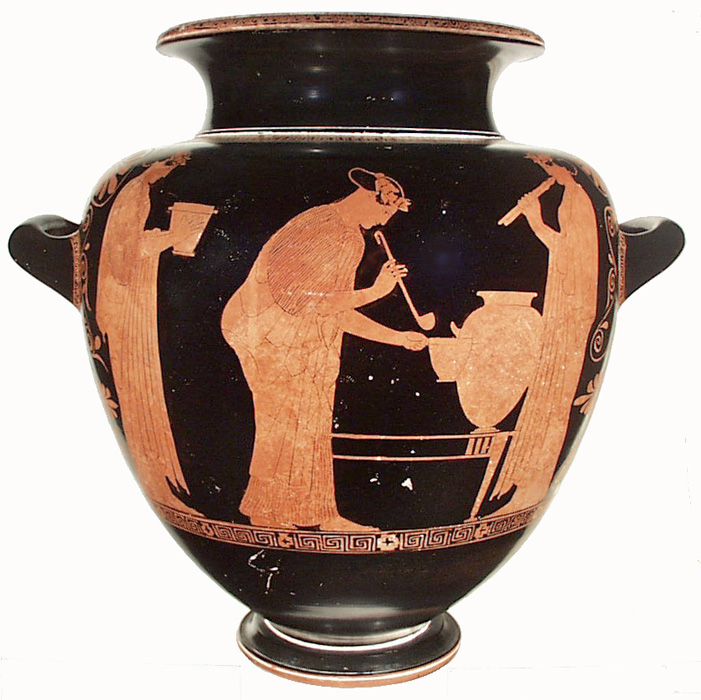
Attic red-figure stamnos by the Villa Giulia Painter, mid-5th century, at the Ashmolean Museum.  Side A. largely motionless women, heavily draped and garlanded with wine vine leaves, hold a skyphos (left) and play double pipes (right) around another who leans towards a low table supporting a large stamnos from which she has ladled wine into a skyphos. B. A woman wearing a decorated fillet around her head and holding a skyphos and thyrsus is framed by two companions, one (left) also holding a skyphos  and the other (right) with her head thrown back as if singing; all are moving as if in dance.

Attic red-figure stamnos by the Villa Giulia Painter, mid-5th century, at the Ashmolean Museum.  Side A. largely motionless women, heavily draped and garlanded with wine vine leaves, hold a skyphos (left) and play double pipes (right) around another who leans towards a low table supporting a large stamnos from which she has ladled wine into a skyphos. B. A woman wearing a decorated fillet around her head and holding a skyphos and thyrsus is framed by two companions, one (left) also holding a skyphos  and the other (right) with her head thrown back as if singing; all are moving as if in dance.

Red-figure kylix (drinking cup) attributed to the Villa Giulia Painter with a shortened form of the kalos, or "love name," eolais above the seated youth, 5th century BCE, Athens, courtesy of the Minneapolis Institute of Art.  A seated youth holding a staff, his athletic equipment--bathing sponge; an aryballos, a round, short-necked jar containing rubbing oil, and a curved metal strigil, used for scraping oil and moisture off the skin after exercising--hangs on the wall of the gymnasium.

Alabastron (oil bottle) attributed to the Villa Giulia Painter, 470-440 BCE, Athens, courtesy of the RISD (Rhode Island School of Design) Museum in Providence, Rhode Island. 

Alabastron (oil bottle) attributed to the Villa Giulia Painter, 470-440 BCE, Athens, courtesy of the RISD (Rhode Island School of Design) Museum in Providence, Rhode Island. 

White-ground Lykethos (oil flask), 460 BCE, Villa Giulia Painter, Classical Greek, Athens, A woman in a long sleeved chiton, with himation around her legs, earrings, bracelets, hair looped up, with rows of curls over forehead, seated on a diphros to right, holding up with both hands a hoop, which she grasps with thumb and finger of the left hand above and of right below. On right hangs from the upper border a saccos, on left, from an oblong object, an alabastron with cords, behind her, a large basket, courtesy of the British Museum

Red-figured pelike depicting Hera and Hebe (Side A) and Zeus and Nike at an altar (Side B), attributed to the Villa Giulia Painter, 460-450 BCE, found near the Dipylon Gate, Athens, courtesy of the British Museum

Red-figured pelike depicting Hera and Hebe (Side A) and Zeus and Nike at an altar (Side B), attributed to the Villa Giulia Painter, 460-450 BCE, found near the Dipylon Gate, Athens, courtesy of the British Museum

Terracotta lekythos (oil flask) attributed to the Villa Giulia Painter, 460 BCE, courtesy of the Metropolitan Museum of Art. From the end of the sixth century B.C., the lekythos served as a funerary vase to contain offerings of oil for the dead. During the second quarter of the fifth century, white-ground lekythoi, on which the decoration was painted over a white slip, became the typical funerary vase. While the subject here is the libation at the departure of a warrior, the shape suggests that the warrior did not return alive and that this vase was placed on his grave.

Attic Red-Figure Calyx Krater; Villa Giulia Painter Athens, Greece; 460–450 B.C.E., Terracotta,  J. Paul Getty Museum.  Side A, Orpheus attacked by Thracian Women. The woman on the left thrusts a spear towards Orpheus's throat. He staggers backwards, having dropped his lyre. A second woman attacks from the right, swinging an axe. Side B, three standing youths carrying spears and wearing distinctive Thracian helmets and cloaks. The two on the left face one another, the third walks away to the right, looking back. Lotus and palmette band on the rim; stopped meander with saltire squares below the groundline. Palmette complex above the handles.

Terracotta kylix (drinking cup) attributed to the Villa Giulia Painter, 470 BCE, courtesy of the Metropolitan Museum of Art, New York.  a goddess—identifiable by her scepter—stands by an altar to pour an offering from a phiale (libation bowl). Details such as the phiale and the figure's bracelets and necklace are rendered in added clay, which originally would have been gilded. It is likely that the vase was specially commissioned for dedication in a sanctuary.


If you enjoyed this post, never miss out on future posts by following me by email!


Monday, April 13, 2020

Pierre Olivier Joseph Coomans: Gifted Belgian artist of the Neo-Pompeian genre

As often happens, when I was looking for images to illustrate my Ancient Wisdom post yesterday and came across that endearing painting of a little boy frightening his little brother with a Roman tragic mask by Belgian painter Pierre Olivier Joseph Coomans, I noticed that despite his prolific body of work, Coomans did not have a biography on English Wikipedia so I spent all day yesterday and this morning researching and writing a biography for him including a gallery of his work. I discovered he had a very eventful life. His work was already exhibition quality by the time he was 16 years old. After studying at the Academy of Fine Arts in Antwerp, he was commissioned by Queen Marie-Louise to accompany Marshal Thomas-Robert Bugeaud to Algeria where he spent several years as a military painter. Then he was dispatched to the Crimean War serving on the staff of General Aimable Pélissier. He eventually contracted cholera on the battlefield and went to Greece, Turkey, and Italy to recuperate. He wound up moving to Naples in 1860 and became enthralled by the excavations taking place in Pompeii and from that point on concentrated his talents on depictions of ancient Roman life.
I found and added another eight more images to his works on Wikimedia Commons. I just wish I could have found more of his earlier historical paintings.
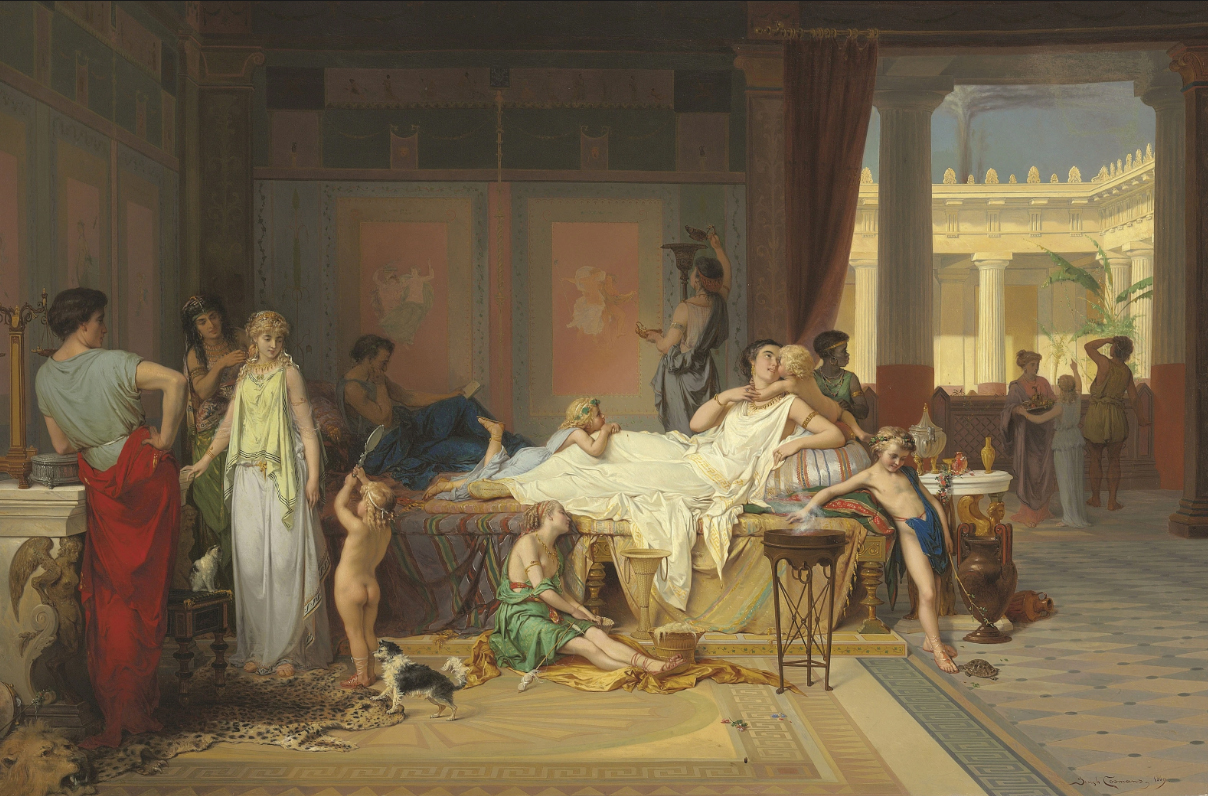
So here's today's "hot off the press" biography with a gallery of Pierre Olivier Joseph Coomans' paintings (I even had to translate one of the main sources from French first!) The painting below is "Last Hours of Pompeii in the House of the Poet" painted in 1869. It brought over 60,000 Euros in a recent auction.


If you enjoyed this post, never miss out on future posts by following me by email!


Monday, November 24, 2008

Luna Roman-era painting lost for over a century to be auctioned by Christies

This article about a beautiful painting by Philippine artist, Juan Luna y Novicio (1857-1899), caught my eye, not only because it has an ancient Roman subject, but because it reminds me so much of one of my favorite Victorian artists, Sir Lawrence Alma-Tadema. It is expected to bring close to $10 million dollars when it goes up for bid on November 30.


Christies lot notes:

Las damas Romanas
(Roman maidens) by the Filipino painter Juan Luna y Novicio (1857-1899) was an unlocated work for over a century ever since it was painted. Documentation was scant: Las Damas Romanas was but a title in the 1957 biography of Luna by Carlos E. Da Silva; it was but a faded black and white photograph from the file of the pre-war art dealer and historian Alfonso T. Ongpin, reproduced by Santiago Pilar in the standard work on the artist (1980). Las Damas Romanas, an early work, enlarges our knowledge and appreciation of Luna who is unfortunately remembered for his largest work Spoliarium (1884) that may well be his most important painting historically, but is not necessarily the best aesthetically.

To appreciate the dark and gory Spoliarium that now dominates the Hall of the Masters in the National Gallery in Manila, one has to remember that aside from being an artist, Juan Luna is also considered a hero and patriot of the Philippines. Spoliarium won the first gold medal in the Madrid Exposition of Fine Arts in 1884, a triumph that made Luna and his contemporary, Felix Resurrection Hidalgo, who won a silver medal, the first "international artists" of the Philippines. Luna painted a scene from ancient Roman history, the corpse of a gladiator being discarded in a room under the Coliseum. So powerful was this image it was used by Filipino propagandists as an allegory of the abuses of Spain in the colonial Philippines. It takes a bit of imagination and a heavy dose of textbook history for young Filipinos to see oppression and the Philippines in a painting best understood alongside the recent films like "Gladiator". One can read many meanings into a painting, sometimes, even meanings unintended by the artist. For example, in 1983, Spoliarium was seen to be quite prophetic. Benigno S. Aquino was assassinated on the tarmac of the Manila International Airport and one in a series of photographs showing soldiers dragging the corpse into a military van has been said to mirror the main element in Luna's 1884 canvas.

Las Damas Romanas is likewise drawn from ancient Roman history, but is more cheerful. Two ladies lie on the wide steps of a dwelling, one of them holding the reins of two frisky pet dogs, restraining them from scaring away frolicking doves. In the background behind them appears to be a shelf with assorted artifacts, to their left is a small shrine with a triangular pediment with incense smoke rising from a burner in front of it. Should Las Damas Romanas be seen at face value? Is it but a typical domestic scene in ancient Rome or does it have deeper, hidden meanings?

There are three main pictorial elements here: women, dogs, and doves. Dogs were part of Roman life and were basically used: for hunting, as guardians of home or property, and in this case as women's companions. These slim and elegant dogs were pets, although they had to be kept on a leash. An inscription said to have been found in the ruins of Pompeii reads "cave canis." This is a warning still used today---"Beware of Dog". Doves were often given erotic connotations; in the Philippines, to refer to a woman as kalapatingmababaanglipad (low-flying dove) means she is of ill-repute. So is this an allegory of restrained lust or merely a way for Luna to execute many details copied from trips to Naples, Pompeii, Venice and Florence? It has even been suggested that the dark-haired woman on the right is Luna's wife, Paz Pardo de Tavera, who he shot and killed in Paris in 1892 at the height of a jealous rage. That would have fitted the theme of love and lust but unfortunately, Luna was not married when he painted Las Damas Romanas in Rome in 1882. He had not even met his future wife at the time. That multiple meanings, different interpretations can be found in one painting always adds to its interest.

Las Damas Romanas was painted while Luna was a student of the Spanish Academy in Rome. It is a work completed between his prize-winning works "Death of Cleopatra" that won a silver medal in the Madrid Exposition of 1881 and the Spoliarium that garnered the first gold medal in the Madrid Exposition of 1884. It is not well known that Luna spent six years in Rome from 1878-1884. He enrolled in the school of painting in the Real Academia de Bellas Artes de San Fernando (Royal Academy of Fine Arts of San Fernando) in Madrid in 1877 and there took courses in color and composition and began a study of ancient art. One of his professors, Alejo Vera, went to Rome in 1878 to fulfill some commissions and he took Luna along as an apprentice.

Two years after arriving in what Luna described as "the capital of the Caesars", his teacher returned to Madrid and Luna stayed another four years to complete his studies. Many students of the Academia de San Fernando in Madrid were allowed to gain credit for their stay in Rome. The course of study usually took three years: the first year was spent copying Greek and Roman sculpture to learn anatomy, they studied and copied classical architecture to learn ideal proportion, and finally they copied old master paintings; the second year they did work on the human figure; and by the third year they utilized all the skills learned by practice, travel, and observation into one large historical painting drawn from either religious, classical, or historical texts. Hence the 1881 "Death of Cleopatra" acquired by the Spanish government could be seen as his graduation work. Recognizing his talent, Luna was then awarded a four-year grant by the Ayuntamiento de Manila to continue his studies in Rome. The grant was also a commission to do one painting for the Ayuntamiento but the grateful Luna gave them three, one of these, Pacto de Sangre (Blood Compact) is still extant and hangs in the seat of government, Malacanang Palace in Manila.

Las Damas Romanas is one of a number of drawings, watercolors, and oils by Luna that have surfaced in the past quarter of a century. As an important example of his early work, Las Damas Romanas helps us understand his training as an academic painter and enriches our knowledge of his life and work. - by Ambeth R Ocampo, Chariman, National Historical Institute, The Philippines
I always thought doves were a symbol of purity and were used as such in ancient augury rituals. Apparently, the article author points this out as well:

"Against the dark interpretation of the doves, some observers have noted that the doves in Roman mythology really symbolize the divine. The fact that the two ladies seek to restrain the dogs from attacking the birds appear to highlight the sacredness of the divine. This makes it really a picture of the abundant richness of life, with humankind shown in harmony with Nature." - By Lito Zulueta, Philippine Daily Inquirer
If you enjoyed this post, never miss out on future posts by following me by email!