Showing posts with label Crete. Show all posts

Friday, April 16, 2021

Daedalic Style of the 7th century BCE

In the early 600s BCE, new artistic ideas flowed into Greece as a result of increased contacts with the Near East. Because of Crete’s central location along maritime trade routes between these regions, artists on the island played a leading role in synthesizing native and Near Eastern elements.

An artist from Crete that became known as Daidalos (Daedalus) , produced a series of female figurines that combined both Greek and Near Eastern features including triangular faces and stylized wig-like hair forming two upward-facing triangles on either side of the face.  The top of the head is flattened to maintain triangularity, giving a “brainless look”, according to some scholars, and producing a low forehead with a straight hairline. The eyes are usually large and set rather high.The woman is portrayed in a frontal orientation and the female's clothing was often depicted as formless drapery or as a simple style, sometimes decorated with geometric patterns, tied with a wide belt at the waist.  A few male figures were also produced, nude except for a belt.  In addition to figurines, these sculptures appeared on clay plaques and in relief decorations on vases. The style had a marked influence on artistic productions in the Peloponnese, Dorian Crete, and Rhodes.

An artist named Daidalos is actually mentioned in Homer's Iliad (18.590.92), as the builder of a dancing floor on Crete.  Later authors state he was the grandson of the early Athenian king, Erechtheus.

Daidalos was also credited with the invention of agalmata, votive statues of the gods which had open eyes and moveable limbs.  These statues were so lifelike that Plato remarked upon their amazing and disconcerting mobility.

A figure of a woman with her arms folded across her belly forms the body of this aryballos, a container for holding scented oil. The modeled human head forms the vessel's spout and neck. A hole at the back of the head would have been used for suspension. The artist used black paint to further elaborate the figure, and traces of the original pigment remain on the eyes and hair, and in three bands on the body, Greek (Cretan), 675-650 BCE, terracotta, at the J. Paul Getty Museum.

Yet another Middle Daedalic piece is this Protocorinthian aryballos (oil flask) from Thebes. The head was made with a mold. The decoration was by a known artist, the Boston Painter, and can be dated with some confidence to around 650 BCE. Datable vases such as this one are important, for they give us a means of dating other Daedalic pieces. Courtesy of art historian Emily Claire Kibbe

Representing the Late Daedalic (c. 630-600 BCE) is this torso of a seated woman from Eleutherna on Crete. The medium is limestone. The oval face points to a late date, c. 600. The coiffure is crimped tresses (Perlenlocken). Courtesy of art historian Emily Claire Kibbe

Representing the Early Daedalic (675-c. 655 BCE) is this ivory sphinx from the sanctuary of Hera Limenia in Perachora. In this phase the faces tend to be long triangles, with the chin rounded off. Courtesy of art historian Emily Claire Kibbe

Also representing the Middle Daedalic is this torso from a female figurine, mold-made out of terracotta, from Crete, one of a series produced there from c. 680-625 BCE. The detailed coiffure (Etagenperücke) and anatomy indicate a date toward the end of the series, c. 650-625 BCE. Courtesy of art historian Emily Claire Kibbe

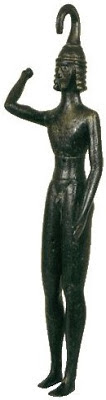
A rare male example of the new style, a bronze statuette from Olympia dating to c. 700-675 BCE a warrior, naked but for his belt and crested helmet, stands with his right arm raised to hold a spear (missing). His hair is an early rendition of the Etagenperücke. Courtesy of art historian Emily Claire Kibbe

For more about Daedalic art: https://gjclarthistory.blogspot.com/2017/02/welcome-is-place-to-find-much-of.html


If you enjoyed this post, never miss out on future posts by following me by email!


Monday, March 15, 2021

Hercules and the Cretan Bull

According to Jeremy McInerney, the iconography of the bull permeates Minoan culture. The cult of the bull was also prominent in southwestern Anatolia. Bernard Clive Dietrich notes that the most important animal in the Neolithic shrines at Çatalhöyük was the bull. The bull was a chthonic animal associated with fertility and vegetation. It figured in cave cults connected with rites for the dead.  

According to Greek myth, to confirm his right to rule, King Minos of Crete prayed to Poseidon to send him a snow-white bull as a sign. Poseidon sent Minos the bull, with the understanding that bull would be sacrificed to the god. Deciding that Poseidon's bull was too fine of a specimen to kill, Minos sent the bull to his herds and substituted another, inferior bull for sacrifice. Enraged, Poseidon had Aphrodite cause Pasiphaë, wife of Minos, to fall in love with the bull. She subsequently gave birth to the half-man, half-bull, Minotaur. Poseidon passed on his rage to the bull, causing him lay waste to the land.

As his seventh labor, Heracles was sent to capture the bull by Eurystheus.  Heracles sailed to Crete and King Minos gave Heracles permission to take the bull away as he had been wreaking havoc on Crete by uprooting crops and leveling orchard walls. Heracles captured the bull, and then shipped him to Eurystheus in Tiryns. The bull later broke loose and wandered into Marathon, becoming known as the "Marathonian Bull" who was later captured and sacrificed by Theseus.

McInerney observes that the story of Pasiphaë and the Cretan Bull was not written until after Crete had come under Greek control, however, and despite the fact that the palace at Knossos displays a number of murals depicting young men and women vaulting over a bull, scholars are divided as to whether or not this reflects an actual practice.  There is also no recorded evidence that has been recovered there of any Minoan legend of the famous Cretan Bull or the Minotaur either.


Hercules and the Cretan Bull at Schwerin Castle, Germany courtesy of Wikimedia Commons contributor Jens Burkhardt-Plückhahn


Heracles fighting the Cretan bull, while a siren perches on a branch. Laconian black-figure kylix in the manner of the Arkesilas Painter, ca. 550 BCE at the Metropolitan Museum of Art, New York, courtesy of Wikimedia Commons contributor ClaireH. (glare removed)


Ivory figure of Hercules capturing the Cretan bull, probably used to decorate a piece of furniture or a box, Roman 1st century CE, ivory, courtesy of the British Museum


Detail of the Mosaic with the Labors of Hercules (Seventh Labour: Cretan Bull), 3rd century AD, found in Llíria (Valencia), National Archaeological Museum of Spain, Madrid courtesy of Wikimedia Commons contributor Carole Raddatto


Heracles and the Cretan Bull - a metope from the Temple of Zeus at Olympia, in the Archaeological Museum of Olympia, Greece courtesy of Wikimedia Commons contributor Nicholas Hartmann


Detail of a Roman sarcophagus from Perge, Turkey depicting the capture of the Cretan Bull, 2nd century CE (?) courtesy of Wikimedia Commons contributor Mourad Ben Abdallah


Heracles binds the Cretan bull. Attic black-figure amphora in the manner of the Antimenes Painter, ca. 510 BCE From Vulci, Italy at the Staatliche Antikensammlungen in Munich, Germany courtesy of Wikimedia Commons contributor Bibi Saint-Pol.


Architectural terracotta plaque (so-called Campana plaque) representing Hercules capturing the Cretan bull, 1st half of the 1st century CE, discovered in 1828 in Quadraro (Roma Vecchia), Gregorian Etruscan Museum, Vatican City, courtesy of Wikimedia Commons contributor Jean-Pol Grandmont


If you enjoyed this post, never miss out on future posts by following me by email!


Tuesday, March 9, 2021

Crete's Minoan, Mycenaen, and Roman treasures

I noticed this morning that Carole Raddato retweeted a link to her excellent article, "Exploring Western Crete's Archaeological Treasures" that she originally wrote back in May 2019. I must have missed the original post so read it for the first time today and found it fascinating and beautifully illustrated.  So I am featuring an abstract of it as today's "Antiquity Alive" presentation:

"The Minoan civilization emerged on the island of Crete in the Early Bronze Age at the end of the third and beginning of the second millennium BCE. It flourished from c. 2000 BCE until c. 1500 BCE with the establishment of centres, called "palaces" by modern archaeologists, that concentrated political and economic powers, as well as artistic activities. Of particular significance was the religious role played by the palaces in the cult of the Mother Goddess."

"The British archaeologist Sir Arthur Evans discovered the first of these palaces in Knossos in 1900 CE and named the people who built them after the legendary King Minos. It was King Monos who, according to tradition, ordered the construction of a labyrinth in Knossos to hold the Minotaur, the mythical half-man, half-bull creature. The Minoan culture spread throughout the entire eastern Mediterranean world and its stunning art and architecture deeply influenced the Mycenaean Civilization (1600 - 1100 BCE)  that would succeed it. After the downfall of the Mycenaeans, Crete was ruled by various ancient Greek city-states until the Romans conquered the island in 69 BCE and made Gortyn their capital."

"According to tradition, Gortyn is where Zeus, in the guise of a bull, brought the princess Europa from her home in Phoenicia." (Following this affair three children were born, Minos, Rhadamanthys and Sarpedon, who became the kings of the three Minoan Palaces in Crete.)

 "Homer mentions Gortyn in the Iliad as “having walls” and in the Odyssey as the place where Menelaus and his fleet of ships, returning home from the Trojan War, were blown off course to the Cretan coastline." 

"Under Roman rule, Crete re-emerged as a major cultural centre and became the joint province of Crete and Cyrenaica and a centre of early Christianity. When the Roman Empire split into two, Crete was made part of the Eastern empire. It continued to prosper during the Byzantine era until it faced repeated Arab raids and, ultimately, full conquest in the 820s CE." - Carole Raddato

In 1884, the Gortyn Law Code was discovered on the site of a structure built by the Roman emperor Trajan, the Odeon, which for the second time, reused stones from an inscription-bearing wall that also had been incorporated into the foundation of an earlier Hellenistic structure.  It is both the oldest and most complete known example of a code of ancient Greek law.  Although portions of the inscriptions have been placed in museums such as the Louvre in Paris, a modern structure at the site of the mostly ruined Odeon now houses many of the stones bearing the famous law code.

 https://www.ancient.eu/article/1391/exploring-western-cretes-archaeological-treasures/

Statue group of Persephone (as Isis) and Pluto (as Serapis) with the three-headed dog Cerberus. From the Sanctuary of the Egyptian Gods at Gortyn on the island of Crete. Mid-2nd century CE. Heraklion Archaeological Museum.
Pluto-Serapis has the modus on his head, a utensil used for the measurement of grain. Persephone-Isis with covered head bears her symbols at the forehead (the crescent moon, the solar disk and the snake (uraeus). She is depicted holding in her right hand the sistrum, an Egyptian musical instrument. The inclusion of Cerberus, guard of the underworld, in the group defines the two deities, despite their Egyptian symbols, as Pluto and Persephone, gods of the underworld.


If you enjoyed this post, never miss out on future posts by following me by email!


Friday, October 16, 2020

The Minoan snake goddess and other "mistresses of animals"

 The iconic figurine of a woman holding a snake in either hand with a cat sitting on top of her head discovered by Arthur Evans in the "Pillar Shrine" within the Minoan palace of Knossus, Crete is probably one of the most instantly recognized artifacts from the Minoan world.  The original faience sculpture is displayed today at the Herakleion Archaeological Museum on Crete.  But a less well known delicate figurine composed of ivory and gold, dating from 1750 to 1580 BCE, can be seen in the Walters Art Museum in Baltimore, Maryland.

In the ancient world, snakes were symbolically associated with the renewal of life because the reptile was known for sheddding its skin periodically.  This belief was shared not only by the Minoans and Pelasgians, indigenous inhabitants of the Aegean Sea region and their cultures, but by the ancient Mesopotamians and Semites as well. Within the Greek Dionysiac cult, the serpent signified wisdom and was a symbol of fertility.  Other scholars relate  the snake goddess with the Phoenician Astarte (virgin daughter) because her temples were decorated with serpentine motifs. 

Sir Arthur Evans thought the goddess may be linked to the Egyptian snake goddess Wadjet, especially since the figurine he discovered was constructed of faience, a well-known technology using a fired quartz paste that he thought the Minoans probably acquired from the Egyptians. The figurines have also been interpreted as depicting  a mistress of animals-type goddess, a widespread motif in ancient art from the Mediterranean world and the ancient Near East, showing a central human, or human-like, female figure who grasps two animals, one to each side.  Art historians frequently refer to such images using the Greek term Potnia Theron regardless of culture of origin.  The term was first used by Homer as a descriptor of Artemis because of her association with animals and was since used to describe other female divinities associated with animals. The word Potnia, meaning mistress or lady, was a Mycenaean Greek word inherited by Classical Greeks, with the same meaning.  

The snake goddess was also thought to be a precursor to Athena Parthenos, who was associated with snakes.  According to the Bibliotheca, Athena visited the smith-god Hephaestus to request some weapons, but Hephaestus was so overcome by desire that he tried to seduce her in his workshop. Determined to maintain her virginity, Athena fled, pursued by Hephaestus. He caught Athena and tried to rape her, but she fought him off. During the struggle, his semen fell on her thigh, and Athena, in disgust, wiped it away with a scrap of wool and flung it to the earth. As she fled, Erichthonius was born from the semen that fell to the earth. Athena could not abandon the infant but did not wish anyone to find out what happened so placed the infant in a box and gave the box to the three daughters (Herse, Aglaurus and Pandrosus) of Cecrops, the king of Athens, and warned them never to look inside. Pandrosus obeyed, but Herse and Aglaurus were overcome with curiosity and opened the box, which contained the infant and future-king, Erichthonius ("troubles born from the earth,"). The sisters were terrified by what they saw in the box: either a snake coiled around an infant, or an infant that was half-human and half-serpent. They went insane and threw themselves off the Acropolis. 

When he grew up, Erichthonius became king of Athens and Athena protected him. The snake was his symbol, and he was represented in the statue of Athena in the Parthenon as the snake hidden behind her shield. The most sacred building on the Acropolis of Athens, the Erechtheum, is dedicated to Erichthonius. 

The iconic figurine of a woman holding a snake in either hand with a cat sitting on top of her head discovered by Arthur Evans in the "Pillar Shrine" within the Minoan palace of Knossus, Crete in the Herakleion Archaeological Museum courtesy of Wikimeda Commons contributor Soverylittlehoneybee

Minoan snake goddess of ivory and gold dating from 1750 to 1580 that I photographed at the Walters Art Museum in Baltimore, Maryland.

Gold pin with a Mistress of the Animals (potnia theron). Gold with granulation, Greek, ca. 630 BCE at The Louvre, courtesy of Wikimedia Commons contributor Marie-Lan Nguyen.

Bronze sheet with embossed representation of the Mistress of animals, probably a decorative cover of an object from a Samian workshop, about 600 BCE recovered from the Sanctuary of Olympia at the National Archaeological Museum of Athens courtesy of Wikimedia Commons contributor Zde.

Winged goddess with a Gorgon's head wearing a split skirt and holding a bird in each hand, a type of the Potnia Theron. Probably made on Rhodes. From Kameiros, Rhodes at the British Museum courtesy of Wikimedia Commons contributor Ealdgyth.

Ivory representation of the goddess Artemis Orthia found in her sanctuary, now in the National Archaeological Museum in Athens courtesy of Wikimedia Commons contributor Marsyas (white balance adjusted).

Mistress of animals (Potnia theron) and nature on a Pithos with relief, from the years 625-600 BCE. National Archaeological Museum of Athens, courtesy of Wikimedia Commons contributor Zde.

Snake-witch (Ormhäxan) stone from Gotland, Sweden. Now in Fornsalen Museum courtesy of Wikimedia Commons contributor Jürgen Howaldt.


If you enjoyed this post, never miss out on future posts by following me by email!


Monday, May 18, 2020

Seventh century BCE Armor Fit For The Gods!

These helmets and mitra (belly guards) are among the finest pieces of a large cache of armor found near Afrati in south central Crete. The inscriptions suggest that the armor was captured as booty and offered as a dedication. In repoussé on both sides of one helmet is a pair of winged youths grasping a pair of intertwined snakes. Below them are two panthers with a common head. The helmet is inscribed "Neopolis." In repoussé on both sides of the other helmet is a horse. Incised on each cheekpiece is a lion. Images of strength and calm, these creatures were intended to provide symbolic protection in battle. The helmets are made in symmetrical pieces and tapered at the base to protect the warrior's neck. The inscription states that Synenitos, the son of Euklotas, took this object. The mitrai were suspended from belts to protect the lower abdomen. One, with a depiction of the foreparts of horses, is inscribed "Synenitos, the son of Euklotas, [took] this." The second mitra decorated with two sphinxes in a heraldic representation reflects the influence of Near Eastern prototypes.
All images courtesy of the Metropolitan Museum of Art except the frontal view of the helmet which is my own.

7th century BCE helmet recovered from a cache of armor found near Afrati, Crete at the Metropolitan Museum of Art in New York

7th century BCE helmet recovered from a cache of armor found near Afrati, Crete at the Metropolitan Museum of Art in New York

7th century BCE helmet recovered from a cache of armor found near Afrati, Crete photographed at the Metropolitan Museum of Art in New York

7th century BCE mitra recovered from a cache of armor found near Afrati, Crete at the Metropolitan Museum of Art in New York

7th century BCE mitra recovered from a cache of armor found near Afrati, Crete at the Metropolitan Museum of Art in New York
If you enjoyed this post, never miss out on future posts by following me by email!


Wednesday, May 2, 2012

Review: The Legion by Simon Scarrow


"The Legion" is the second book by Simon Scarrow I have read although it is the tenth in Scarrow's "Under the Eagle" series.  I admit I have not read its immediate predecessor "Gladiator" but I had no problem picking up the story line with the background information provided.

The other Scarrow book I read was Centurion and in it, Cato and Macro were both Centurions.  From reading other reviews, I gather that in previous novels, Macro has been the experienced teacher and Cato the young up-and-coming protégé.  In this book the relationship has changed significantly and Cato now holds the superior rank of prefect.

The two heroes are in pursuit of a nasty former gladiator named Ajax who led a slave revolt on Crete following an earthquake and tsunami.

Historically, there have been only three major Roman slave revolts documented by ancient historians - two on the island of Sicily and the famous revolt led on the Italian mainland by a Thracian slave turned gladiator named Spartacus.  Scarrow may have used these revolts to  inform his fictional narrative of a similar revolt on Crete.  Appian mentions a conflict on Crete at about the same time as the Spartacan revolt (a century before the reign of Claudius which is the time frame Scarrow uses for his "Under the Eagle" series) but I could not find anything definitive pointing to a slave uprising on Crete at the time or in a later period.

Scarrow may have pulled his villain from the first Sicilian revolt, though, that occurred on the island of Sicily from 136 - 132 BCE.  It was led by a Syrian slave named Eunus, whose reputation included an aptitude for magic and foretelling the future.  Diodorus Siculus tells us:

"...he not only gave oracles by means of dreams, but even made a pretence of having waking visions of the gods and of hearing the future from their own lips.

Of his many improvisations some by chance turned out true, and since those which failed to do so were left unchallenged, while those that were fulfilled attracted attention, his reputation advanced apace. Finally, through some device, while in a state of divine possession, he would produce fire and flame from his mouth, and thus rave oracularly about things to come.

For he would place fire, and fuel to maintain it, in a nut -- or something similar -- that was pierced on both sides; then, placing it in his mouth and blowing on it, he kindled now sparks, and now a flame. Prior to the revolt he used to say that the Syrian goddess appeared to him, saying that he should be king, and he repeated this, not only to others, but even to his own master." - Diodorus Siculus, Library, Books 34/35. 2. 1-48  

Apparently, Eunus, also called Antiochus, was not taken seriously at first and was used as entertainment at dinner parties.  But his ruthlessness was soon revealed when he was asked to lead 400 slaves against the city of Enna where his men "found their way into the houses shedding much blood, sparing not even suckling babes."

As Eunus' victories over the Romans grew more numerous, thousands of slaves flocked to his banner, much like Spartacus.  Eunus was eventually crowned king by the rebels and among those appointed to his royal council was an Achaean (Greek) who was known for his intelligence and military acumen.  Perhaps it was this Achaen that provided the model for Scarrow's rebel leader, Ajax.

Roman War Galleys were frequent subjects of Pompeii frescoes 1st century CE.
Photographed at the Museo Archaeologico in Naples, Italy by Mary Harrsch.


However, in Scarrow's novel, Ajax and his men, instead of meeting their end on the island as Eunus and Achaeus' men did, have hijacked a Roman ship and are sailing around the Mediterranean wreaking havoc, slaughtering most of the people they encounter and leaving only lone survivors here and there that have been so badly tortured they usually expire shortly after telling their rescuers that they were slaughtered by a Roman named Macro.  Of course this infuriates Macro and raises the stakes as it becomes apparent Ajax is heading for Egypt.

Arriving in Alexandria, Cato and Macro are hauled off to prison and must convince the governor of Ajax's ruse before the governor crucifies Macro.  Fortunately for Macro, one tortured survivor, an Egyptian priest, convinces the governor that Macro was not the man who butchered his fellow priests.  So the governor releases Cato and Macro and they set off in pursuit of Ajax once again with the recovered priest as guide.
But Ajax continues to elude them, slipping through one trap after the next, until the governor interrupts their chase and orders the pair to the Egyptian frontier to help fend off an invading Nubian army.  When Macro and Cato arrive, the governor's commander is acting strangely and our two heroes discover Ajax has joined the Nubians.  Now they must find a way to defeat the Nubians to end Ajax's reign of terror.

Scarrow has crafted a well-paced plot but like "Centurion", I found the characterizations of Cato and Macro quite thin.  I thought carefully about what was missing in the narrative that made the protagonists seem so flat and I realized Scarrow never gives us any insight into their thoughts.  He relates their actions but it's like viewing their activities through binoculars without any insight to what they are thinking.

I thought back on Harry Sidebottom's novels and his protagonist, the Anglo-Saxon born Roman officer, Ballista.  We hear Ballista praying to his "All Father, Death Bringer".  We experience the horror of one of his nightmarish visions of the Emperor Maximinus Thrax who always promises to see Ballista again at Aqualeia where Ballista originally broke his oath and assassinated the brutish emperor.  Dr. Sidebottom describes each character's body language, the complex emotions reflected on their faces and the way members of Ballista's familia banter with each other, filled with recollections of past battles, mistakes and triumphs as well as an understanding of each others fears.

The only indication of the depth of friendship between Cato and Macro in "The Legion" occurs when Macro touches the shoulder of his friend with concern when Cato has been wounded after a skirmish with Ajax.   I was actually appalled by a scene where an individual who has fought beside Cato and Macro is suspected of being an "embedded" spy and Cato and Macro coldly decide to crucify him in the morning without even listening to his side of the story.  Talk about cold and unfeeling!

I also did not feel immersed in the culture or geography of Egypt, the novel's setting, either.  Cato and Macro could have been in any desert.  I felt no sense of being there like I have when reading Sidebottom's books or those by Conn Iggulden (I just finished "Conqueror", a retelling of the ascension of Kublai Khan to the throne of the Mongol Empire).  I know both Sidebottom and Iggulden have traveled extensively to the locations described in their books and the realism they impart when describing the settings is palpable. Sidebottom also has a doctorate in ancient history from Oxford that is reflected in the depth of information he provides about each of Ballista's surroundings and opponents as he battles his way across the Near East of the third century.   What little information Scarrow gives about the Nubians, Cato and Macro's final opponents is sparse at best.

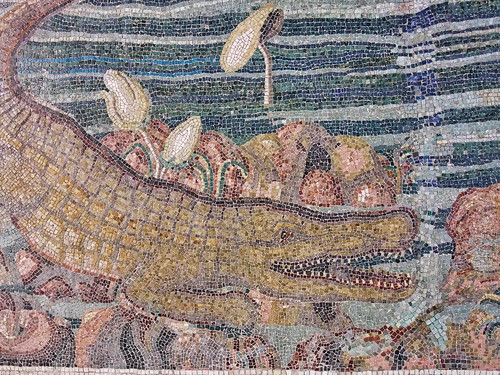
Mosaic Pavement Depicting a Nile Scene from the Maccarani vineyard 
area of the Aventine Hill Roman 2nd century CE. Photographed at the 
Palazzo Massimo by Mary Harrsch. 
Also, at one point in Scarrow's story Cato and Macro chase Ajax into the treacherous marshes of the Egyptian delta and during the pursuit, they hear something swishing past them in the water.  Macro explains it is probably a crocodile but demonstrates no real depth of fear that should have been generated by a close encounter with a ferocious creature depicted in Roman Nilotic mosaics and well known for ripping less fortunate creatures apart in Roman arenas.  It is passages like this that blunt the tension in the narrative.  If Scarrow had one of his protagonists relate a memory of seeing such a beast wreaking devastation during a numachia or something, it would have elevated the tension during the hunt and brought significantly more impact to the novel's conclusion.

I checked out Scarrow's website and he shares it with his brother Alex.  I see Alex has a time travel series with the latest installment being "TimeRiders: The Gates of Rome".  I love time travel stories so I'll have to check it out.  It will be interesting to see if the two brothers differ in their writing styles.


Enhanced by Zemanta
If you enjoyed this post, never miss out on future posts by following me by email!