"The Legion" is the second book by
Simon Scarrow I have read although it is the tenth in Scarrow's "Under the Eagle" series. I admit I have not read its immediate predecessor "Gladiator" but I had no problem picking up the story line with the background information provided.
The other Scarrow book I read was Centurion and in it, Cato and Macro were both Centurions. From reading other reviews, I gather that in previous novels, Macro has been the experienced teacher and Cato the young up-and-coming protégé. In this book the relationship has changed significantly and Cato now holds the superior rank of prefect.
The two heroes are in pursuit of a nasty former gladiator named Ajax who led a slave revolt on Crete following an earthquake and tsunami.
Historically, there have been only three major
Roman slave revolts documented by ancient historians - two on the island of Sicily and the famous revolt led on the Italian mainland by a Thracian slave turned gladiator named Spartacus. Scarrow may have used these revolts to inform his fictional narrative of a similar revolt on Crete. Appian mentions a conflict on Crete at about the same time as the Spartacan revolt (a century before the reign of Claudius which is the time frame Scarrow uses for his "Under the Eagle" series) but I could not find anything definitive pointing to a slave uprising on Crete at the time or in a later period.
Scarrow may have pulled his villain from the first Sicilian revolt, though, that occurred on the island of Sicily from 136 - 132 BCE. It was led by a Syrian slave named
Eunus, whose reputation included an aptitude for magic and foretelling the future.
Diodorus Siculus tells us:
"...he not only gave oracles by means of dreams, but even made a pretence of having waking visions of the gods and of hearing the future from their own lips.
Of his many improvisations some by chance turned out true, and since those which failed to do so were left unchallenged, while those that were fulfilled attracted attention, his reputation advanced apace. Finally, through some device, while in a state of divine possession, he would produce fire and flame from his mouth, and thus rave oracularly about things to come.
For he would place fire, and fuel to maintain it, in a nut -- or something similar -- that was pierced on both sides; then, placing it in his mouth and blowing on it, he kindled now sparks, and now a flame. Prior to the revolt he used to say that the Syrian goddess appeared to him, saying that he should be king, and he repeated this, not only to others, but even to his own master." -
Diodorus Siculus, Library, Books 34/35. 2. 1-48
Apparently, Eunus, also called Antiochus, was not taken seriously at first and was used as entertainment at dinner parties. But his ruthlessness was soon revealed when he was asked to lead 400 slaves against the city of Enna where his men "found their way into the houses shedding much blood, sparing not even suckling babes."
As Eunus' victories over the Romans grew more numerous, thousands of slaves flocked to his banner, much like Spartacus. Eunus was eventually crowned king by the rebels and among those appointed to his royal council was an Achaean (Greek) who was known for his intelligence and military acumen. Perhaps it was this Achaen that provided the model for Scarrow's rebel leader, Ajax.
 |
Roman War Galleys were frequent subjects of Pompeii frescoes 1st century CE.
Photographed at the Museo Archaeologico in Naples, Italy by Mary Harrsch. |
However, in Scarrow's novel, Ajax and his men, instead of meeting their end on the island as Eunus and Achaeus' men did, have hijacked a Roman ship and are sailing around the Mediterranean wreaking havoc, slaughtering most of the people they encounter and leaving only lone survivors here and there that have been so badly tortured they usually expire shortly after telling their rescuers that they were slaughtered by a Roman named Macro. Of course this infuriates Macro and raises the stakes as it becomes apparent Ajax is heading for Egypt.
Arriving in Alexandria, Cato and Macro are hauled off to prison and must convince the governor of Ajax's ruse before the governor crucifies Macro. Fortunately for Macro, one tortured survivor, an Egyptian priest, convinces the governor that Macro was not the man who butchered his fellow priests. So the governor releases Cato and Macro and they set off in pursuit of Ajax once again with the recovered priest as guide.
But Ajax continues to elude them, slipping through one trap after the next, until the governor interrupts their chase and orders the pair to the Egyptian frontier to help fend off an invading Nubian army. When Macro and Cato arrive, the governor's commander is acting strangely and our two heroes discover Ajax has joined the Nubians. Now they must find a way to defeat the Nubians to end Ajax's reign of terror.
Scarrow has crafted a well-paced plot but like "Centurion", I found the characterizations of Cato and Macro quite thin. I thought carefully about what was missing in the narrative that made the protagonists seem so flat and I realized Scarrow never gives us any insight into their thoughts. He relates their actions but it's like viewing their activities through binoculars without any insight to what they are thinking.
I thought back on
Harry Sidebottom's novels and his protagonist, the Anglo-Saxon born Roman officer, Ballista. We hear Ballista praying to his "All Father, Death Bringer". We experience the horror of one of his nightmarish visions of the Emperor
Maximinus Thrax who always promises to see Ballista again at Aqualeia where Ballista originally broke his oath and assassinated the brutish emperor. Dr. Sidebottom describes each character's body language, the complex emotions reflected on their faces and the way members of Ballista's familia banter with each other, filled with recollections of past battles, mistakes and triumphs as well as an understanding of each others fears.
The only indication of the depth of friendship between Cato and Macro in "The Legion" occurs when Macro touches the shoulder of his friend with concern when Cato has been wounded after a skirmish with Ajax. I was actually appalled by a scene where an individual who has fought beside Cato and Macro is suspected of being an "embedded" spy and Cato and Macro coldly decide to crucify him in the morning without even listening to his side of the story. Talk about cold and unfeeling!
I also did not feel immersed in the culture or geography of Egypt, the novel's setting, either. Cato and Macro could have been in any desert. I felt no sense of being there like I have when reading Sidebottom's books or those by
Conn Iggulden (I just finished "Conqueror", a retelling of the ascension of Kublai Khan to the throne of the Mongol Empire). I know both Sidebottom and Iggulden have traveled extensively to the locations described in their books and the realism they impart when describing the settings is palpable. Sidebottom also has a doctorate in ancient history from Oxford that is reflected in the depth of information he provides about each of Ballista's surroundings and opponents as he battles his way across the Near East of the third century. What little information Scarrow gives about the Nubians, Cato and Macro's final opponents is sparse at best.
 |
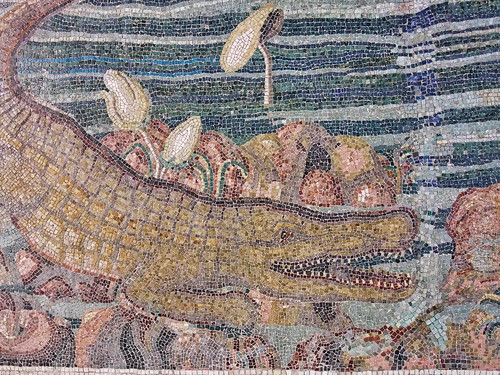
Mosaic Pavement Depicting a Nile Scene from the Maccarani vineyard
area of the Aventine Hill Roman 2nd century CE. Photographed at the
Palazzo Massimo by Mary Harrsch.
|
Also, at one point in Scarrow's story Cato and Macro chase Ajax into the treacherous marshes of the Egyptian delta and during the pursuit, they hear something swishing past them in the water. Macro explains it is probably a crocodile but demonstrates no real depth of fear that should have been generated by a close encounter with a ferocious creature depicted in Roman Nilotic mosaics and well known for ripping less fortunate creatures apart in Roman arenas. It is passages like this that blunt the tension in the narrative. If Scarrow had one of his protagonists relate a memory of seeing such a beast wreaking devastation during a numachia or something, it would have elevated the tension during the hunt and brought significantly more impact to the novel's conclusion.
I checked out Scarrow's website and he shares it with his brother Alex. I see Alex has a time travel series with the latest installment being "TimeRiders: The Gates of Rome". I love time travel stories so I'll have to check it out. It will be interesting to see if the two brothers differ in their writing styles.