Showing posts with label empress. Show all posts

Saturday, April 10, 2021

Julia Domna and the Severan Prophecy

Julia Domna was born in Emesa (present-day Homs) in Roman Syria, the youngest daughter of the high priest of Baal, Julius Bassianus. The family had enormous wealth and was promoted to Roman senatorial aristocracy. Before her marriage, Domna also inherited the estate of her paternal great-uncle, Julius Agrippa, a former leading centurion. 

In 187 CE, she married Severus, who at the time was governor of the Roman province of Gallia Lugdunensis. The Augustan History relates that, after losing his first wife around 186 CE, Septimius Severus heard a prophesy of a woman in Syria who would marry a king. So Severus sought out Domna from one of Syria's most prominent families as his wife.

As empress, Domna was famous for her political, social, and philosophical influence. She received titles such as "Mother of the Invincible Camps" because, unlike most imperial wives, Domna remarkably accompanied her husband on his military campaigns and stayed in camp with the army. After the elder of her sons, Caracalla, started ruling with his father, she was briefly co-empress with Caracalla's wife, Fulvia Plautilla, until the latter fell into disgrace. Following the death of Severus in 211, Domna became the first empress dowager to receive the title combination "Pia Felix Augusta", which may have implied greater powers being vested in her than what was usual for a Roman empress mother. 

Domna is said to have committed suicide in 217 CE upon hearing of her son Caracalla's assassination in the course of his campaign against Parthia, on which she had accompanied him as far as Antioch (present-day Antakya, Turkey).


Image: A Severan Period mold-made lamp, 2nd century CE, terracotta, at the J. Paul Getty Museum (Villa).  This unusual moldmade lamp depicts  a woman dressed in a long-sleeved garment standing next to a truncated column, playing a harp, which leans on her shoulder. Her hairdo is similar to a style worn by Empress Julia Domna, wife of Septimius Severus . The Filling-hole is on top of the instrument and the wick-hole pierces its base. 


If you enjoyed this post, never miss out on future posts by following me by email!


Thursday, April 1, 2021

The challenge of ancient portrait identification

 This portrait of a well-fed 3rd century CE Roman empress caught my attention because the woman appears to be rather plump, obviously not suffering deprivation during the most tumultuous period of the crisis of the Third Century.  The Getty does not speculate on which empress this woman is so I compared it to known sculptures and coin portraits of powerful women surrounding Alexander Severus.  The longer looped hair behind the ears appears in portraits of both the emperor's mother, Julia Avita Mamaea and his first young wife, Orbiana Sallustius but neither are portrayed as plump or with the bun on the top of the head.  I could find no images of his second wife, Sulpicia Memmia, however, and his third wife's name is unknown.

When Alexander was assassinated in 235 CE, he was succeeded by Maximinus Thrax.  The coin portrait of his wife, Caecilia Paulina, depict a rather hawkish woman with none of the distinctive characteristics of this portrait either.

After Maximinus Thrax was killed in Aquileia, the aged Gordian, in his late 60s, was pressured to take the throne  along with his son but their reigns lasted only 21 days with the younger Gordian killed in the battle of Carthage fighting against Maximinus' loyalists and his father hanging himself after his son's defeat. Although Gordian I struck a coin with his portrait, there appears to be no portraits of his or his son's wives.

Gordians' successors, Pupienus and Balbinus, lasted only a few months and, again, there appears to be no images of their wives.  That brings us to Goridan III, son of Antonia Gordiana, the daughter of Emperor Gordian I and the younger sister of Emperor Gordian II.  Although there is no images of his wife, Furia Sabinia Tranquillina, I was struck by a similarity in the soft shape of Gordian III's chin and that of the woman in the portrait. So I couldn't help but wonder if the female portrait may be his mother, Antonia Gordiana, or his wife, sculpted at the same time as Gordian IIII's portrait, which is now in The Louvre.

Portrait Head of an Empress, Roman, second quarter of the 3rd century CE at the J. Paul Getty Museum, courtesy of the museum.

Bust of Gordianus III. Marble, Roman artwork, between 242 and 244 CE. From Gabii now in The Louvre, courtesy of Wikimedia Commons contributor Marie-Lan Nguyen
If you enjoyed this post, never miss out on future posts by following me by email!


Thursday, October 25, 2007

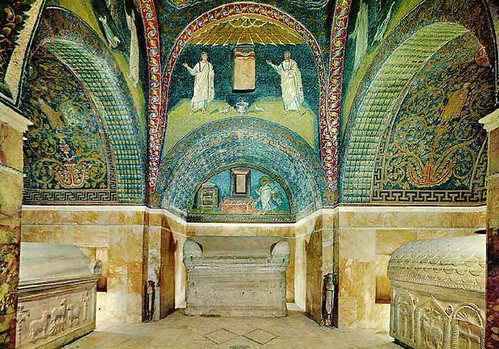
Mosaics in Ravenna Still Dazzle


I was searching for a picture of the Amazon Warrior sculpture that was recently found in Herculaneum and stumbled across this blog about Mosaic Art and these wonderful pictures of the tomb of Galla Placidia, the powerful half-sister of Honorius and wife of Emperor Constantius III. I had heard that the mosaics in Ravenna are particularly spectacular and if these are any indication, they certainly are!

"Galla Placidia was the daughter of Roman Emperor Theodosius I (379-395) and his second wife, Galla, the daughter of Valentinian I. She was the half-sister of the young Roman emperors Honorius (393-423) and Arcadius (383-408), the aunt of Theodosius II, the wife of Athaulf, King of the Goths, and then of Flavius Constantius (421) (who was promoted to co-emperor with Honorius shortly before his death), and the mother of Valentinian III.

When, under the leadership of Alaric, the Goths sacked Rome in August 410, they took Galla Placidia with them to Gaul. After the death of Alaric, Athaulf became the king. Galla Placidia married him in Narbo in January 414 -- against the wishes of her half-brother Honorius, and had a son named Theodosius who died soon thereafter. Following the death of Athaulf in 414, the Goths returned Galla Placidia to the Romans who wanted her to marry Flavius Constantius, who had succeeded Stilicho to power. Reluctantly, Galla Placidia did so and produced two children, Justa Grata Honoria and Valentinian. When, on February 8, 421, Constantius was made co-emperor (Constantius III) in the west by Honorius, Galla Placidia was named Augusta. Constantius died on September 2, 421. Galla Placidia and her childless half-brother Honorius became very close for a while, but then they quarreled. Galla Placidia fled with her children to Constantinople in 423 to escape a charge of aiding her brother's enemies. Although earlier Theodosius hadn't recognized the imperial elevation of Constantius and therefore, the status of his aunt as Augusta, he welcomed her, and soon recognized both her status and the legitimacy of her son as heir. Honorius died soon after, on August 27 of the same year. A usurper John assumed the throne in Ravenna. Theodosius set out to win the throne back for his family. When the imperial party reached Thessalonica the young Valentinian was made Caesar. Placidia was regent for her young son for the next 12 years. She had legislation passed in her son's name (according to Oost), stating that the emperor was subject to the laws of the land, as opposed to the situation in the east where the emperor was above the law. Galla Placidia was also involved in the power play between Felix, Boniface, and Aetius, who has been called the last of the Romans. Earlier, Placidia is thought to have been involved in the conspiracy against the Vandal Stilicho and the subsequent execution of Serena, Stilicho's wife and Galla Placidia's cousin." - About Ancient History

Image by designucdavic
If you enjoyed this post, never miss out on future posts by following me by email!